Monday, March 18th 2019

NVIDIA to Enable DXR Ray Tracing on GTX (10- and 16-series) GPUs in April Drivers Update
NVIDIA had their customary GTC keynote ending mere minutes ago, and it was one of the longer keynotes clocking in at nearly three hours in length. There were some fascinating demos and features shown off, especially in the realm of robotics and machine learning, as well as new hardware as it pertains to AI and cars with the all-new Jetson Nano. It would be fair to say, however, that the vast majority of the keynote was targeting developers and researchers, as usually is the case at GTC. However, something came up in between which caught us by surprise, and no doubt is a pleasant update to most of us here on TechPowerUp.
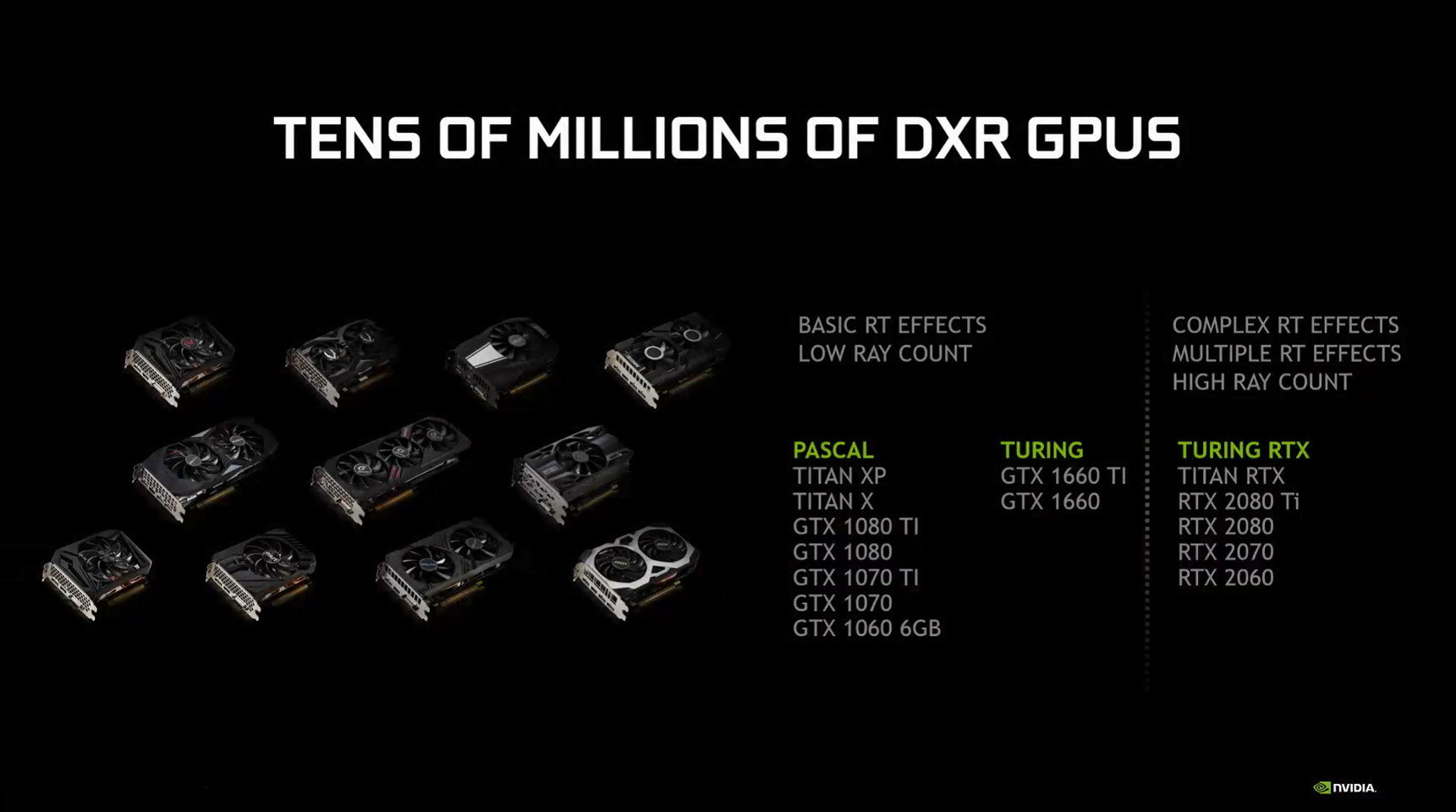
Following AMD's claims on software-based real-time ray tracing in games, and Crytek's Neon Noir real-time ray tracing demo for both AMD and NVIDIA GPUs, it makes sense in hindsight that NVIDIA would allow rudimentary DXR ray tracing support to older hardware that do not support RT cores. In particular, an upcoming drivers update next month will allow DXR support for 10-series Pascal-microarchitecture graphics cards (GTX 1060 6 GB and higher), as well as the newly announced GTX 16-series Turing-microarchitecture GPUs (GTX 1660, GTX 1660 Ti). The announcement comes with a caveat letting people know to not expect RTX support (think lower number of ray traces, and possibly no secondary/tertiary effects), and this DXR mode will only be supported in Unity and Unreal game engines for now. More to come, with details past the break.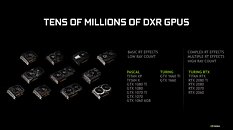
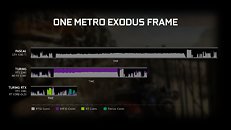
 NVIDIA claims that DXR mode will not run the same on Pascal GPUs relative to the new Turing GTX cards, primarily given how the Pascal microarchitecture can only run ray tracing calculations in FP32 mode, which is slower than what the Turing GTX cards can do via a combination of FP32 and INT32 calculations. Both will still be slower and less capable of hardware with RT cores, which is to be expected. An example of this performance deficit is seen below for a single frame from Metro Exodus, showing the three different feature sets in action.
 Dragon Hound, an MMO title shown off before by NVIDIA at CES, will be among the first game titles, if not the very first, to enable DXR support for the aforementioned GTX cards. This will be followed by other game titles that already have NVIDIA RTX support, including Battlefield V and Shadow of the Tomb Raider, as well as synthetic benchmarks including Port Royal. General incorporation into Unity and Unreal engines will help a lot coming forward, and NVIDIA then mentioned that they are working with more partners across the board to get DXR support going. Time will tell how well these implementations go, and the performance deficit coming with them, and we will be sure to examine DXR in the usual level of detail TechPowerUp is trusted for. But for now, we can all agree that this is a welcome move in greatly increasing the number of compatible devices capable for some form of real-time ray tracing, which in turn will enable game developers to focus on implementation as well now that there is a larger market.


Following AMD's claims on software-based real-time ray tracing in games, and Crytek's Neon Noir real-time ray tracing demo for both AMD and NVIDIA GPUs, it makes sense in hindsight that NVIDIA would allow rudimentary DXR ray tracing support to older hardware that do not support RT cores. In particular, an upcoming drivers update next month will allow DXR support for 10-series Pascal-microarchitecture graphics cards (GTX 1060 6 GB and higher), as well as the newly announced GTX 16-series Turing-microarchitecture GPUs (GTX 1660, GTX 1660 Ti). The announcement comes with a caveat letting people know to not expect RTX support (think lower number of ray traces, and possibly no secondary/tertiary effects), and this DXR mode will only be supported in Unity and Unreal game engines for now. More to come, with details past the break.


113 Comments on NVIDIA to Enable DXR Ray Tracing on GTX (10- and 16-series) GPUs in April Drivers Update
Edit: github.com/GPUOpen-LibrariesAndSDKs/RadeonRays_SDK/blob/master/RadeonRays/src/intersector/intersector_lds.cpp
Yup, RadeonRays SDK has FP16 checks.
www.techpowerup.com/forums/threads/nvidia-to-enable-dxr-ray-tracing-on-gtx-10-and-16-series-gpus-in-april-drivers-update.253759/page-4#post-4018035
Also- how FP16 impact on performance on Polaris? it offers 1:1 Ratio- but can FP16 help in better utilizing memory Bandwidth vs INT32/FP32?
Peformance of RTX2080 FE, 11GB, option for water cooling (not full cover waterblock) but at least for that money is included cooler comparable with AIO kits worth over 100$.
And option to install full custom waterblock for ASUS Strix when price drop to around 70 euro.
We can say different things for AMD, but they help to everyone with their research and trying to offer for lower price.
Intel and NVIDIA alone would massacred us with their politic and prices without AMD.
First impression after GeForce users switch to high end Radeon graphic card will be... I feel like picture quality is little better, like sharper cleaner more photographic image.
And in future if NVIDIA continue to ask 1000$ for high end GPU and AMD offer 10% weaker for 750$, I'm ready to consider combination Intel-Radeon.
On Turings whitepaperthey say even on current games they could get some performance benefit only from that. And is the one of the main reasons why Turing gets more performance out of TFlops compared to Pascal(The second being new shared cache).
Later this gets a little more... confusing.So in the first sentence they say that those are separate cores. But the numbers (64FP+64INT) add to the same number like on Pascal (128FP). And the last sentence talks again specifically of "thread scheduling"...
I don't think there would be a physical difference between an INT32 and a FP32 core. It's only the schedulers that make that difference.This is in line with the hyper-threading gains on CPU's.
GP102-450-A1 has 3840 cores and 30 Streaming Multiprocessors. 3840/30=128
GP104-410-A1 has 2560 / 20 = 128
TU102-400-A1 has 4608 cores and 72 Streaming Multiprocessors. 4608/72=64
TU104-400-A1 has 2944 / 46 = 64
To me looks like definitelly they broke those SM in two and they can issue either INT32 or FP32 commands to them, on independent paths. Which is consistent with approx 50% gains.