Thursday, November 7th 2019

AMD Announces Ryzen 9 3950X, Details 3rd Gen Ryzen Threadripper, unlocked Athlon 3000G
AMD today announced four new desktop processors across three very diverse markets. To begin with, the company crowned its socket AM4 mainstream desktop platform with the mighty new Ryzen 9 3950X processor. Next up, it released its new baseline entry-level APU, the Athlon 3000G. Lastly, it detailed the 3rd generation Ryzen Threadripper HEDT processor family with two initial models, the Ryzen Threadripper 3960X and the flagship Ryzen Threadripper 3970X. The company also formally released its AGESA Combo PI 1.0.0.4B microcode, and with it, introduced a killer new feature for all "Zen 2" based Ryzen processors, called ECO Mode.
The Ryzen 9 3950X is a 16-core/32-thread processor in the AM4 package, compatible with all socket AM4 motherboards, provided they have the latest BIOS update with AGESA Combo PI 1.0.0.4B microcode. The processor comes with clock-speeds of 3.50 GHz base, with 4.70 GHz maximum boost frequency, and the same 105 W TDP as the 12-core Ryzen 9 3900X. With 512 KB of dedicated L2 cache per core, and 64 MB of shared L3 cache, the chip has a mammoth 72 MB of "total cache."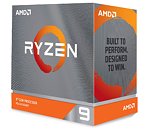
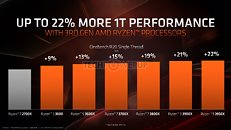
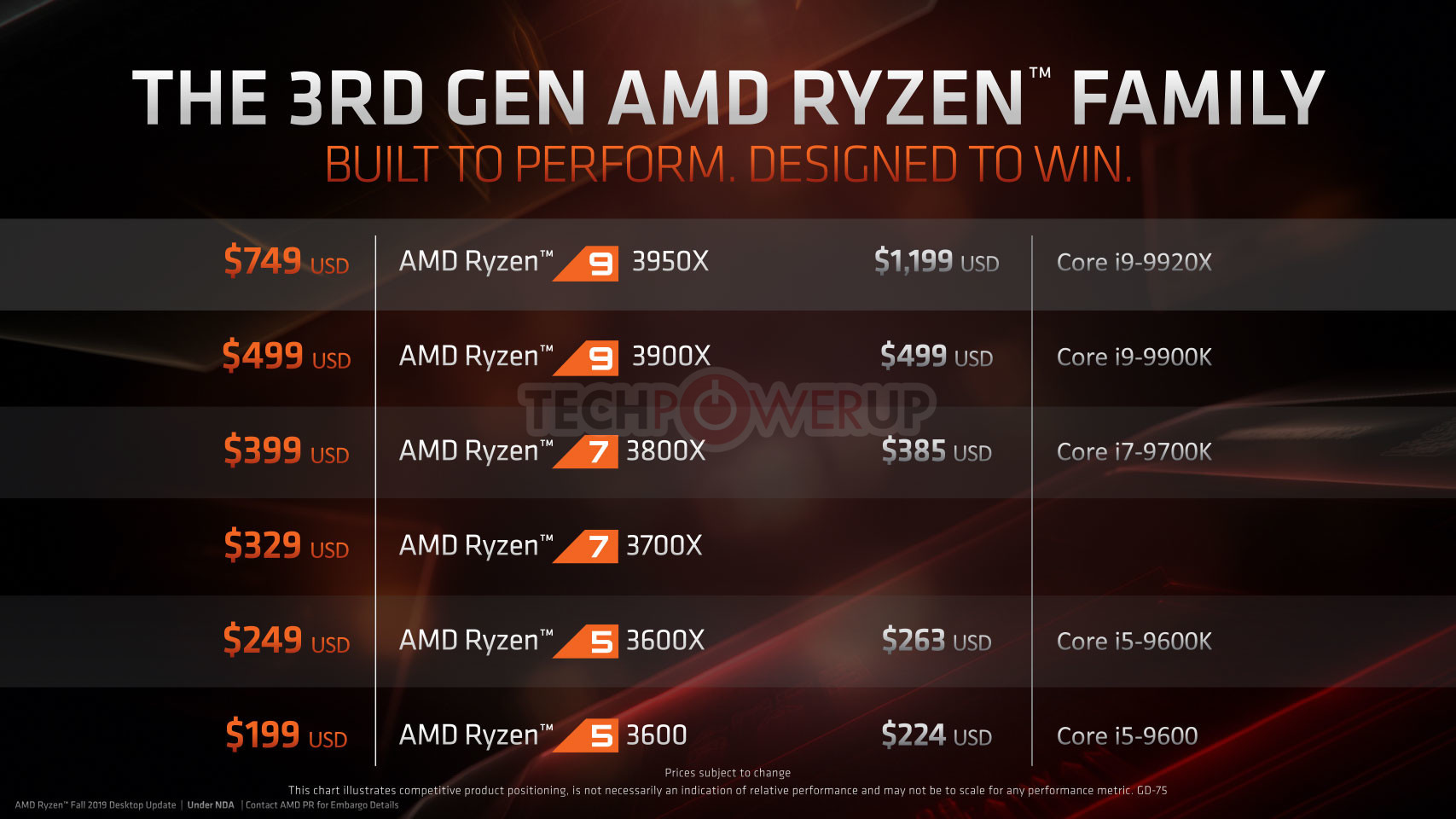
 According to performance numbers put out by AMD, the Ryzen 9 3950X offers up to 22 percent higher single-threaded performance than the Ryzen 7 2700X as tested in Cinebench R20, and a whopping 79 percent higher multi-threaded performance than the Core i9-9900K. The company also claims gaming performance parity with the i9-9900K. The company also claims huge performance-per-Watt gains over the i9-9900K. Available for purchase from November 25, 2019, the Ryzen 9 3950X is priced at USD $749 (MSRP). The retail PIB box package lacks a cooling solution, and AMD recommends at least a 240 mm x 140 mm AIO liquid CPU cooler to go with this chip.


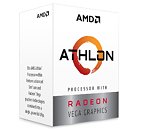
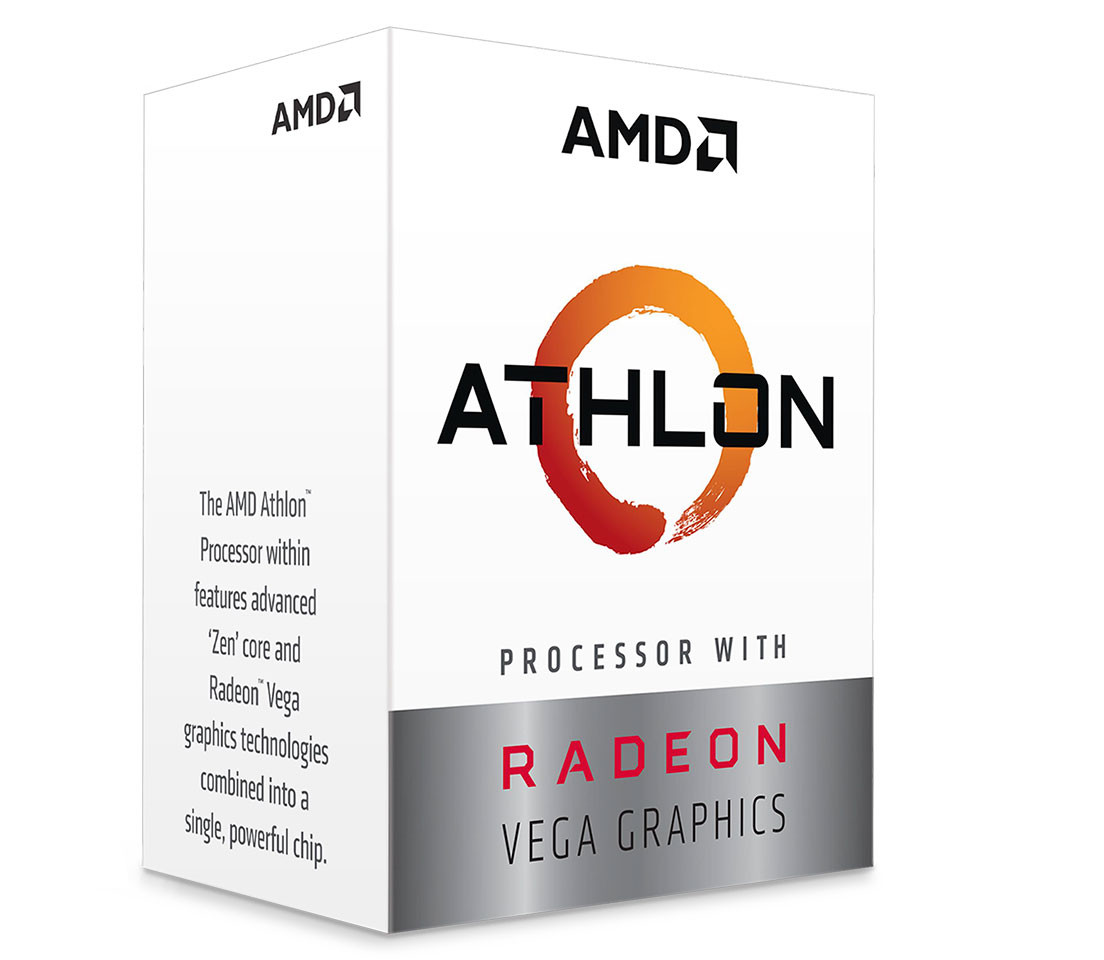
 AMD also sealed the bottom end of its socket AM4 processor lineup with the new Athlon 3000G, which adds a few segment-first features. The 3000G is based on the 12 nm "Picasso" silicon that combines CPU cores based on the "Zen+" microarchitecture with an iGPU based on the "Vega" graphics architecture. The 3000G is configured with a 2-core/4-thread CPU and the Radeon Vega 3 onboard graphics that has 3 "Vega" NGCUs. The CPU is clocked at 3.50 GHz, which is a 300 MHz gain over the Athlon 200GE. This time around, AMD has also provided an unlocked base-clock multiplier for the CPU, letting you overclock it. The Radeon Vega 3 iGPU is configured with 192 stream processors, and 1100 MHz engine clock, a 100 MHz gain over that of the 200GE. Available for purchase from November 19, 2019, the Athlon 3000G is priced at just USD $49, and could make for an entertaining little toy for enthusiasts, as well as a formidable chip for home-theater, NAS, or other low-power desktop builds.


 Moving on to the most exciting part of the day's announcements, AMD unveiled its 3rd generation Ryzen Threadripper high-end desktop (HEDT) processor series, debuting with two models, the Threadripper 3960X and the Threadripper 3970X. The two are based on the new sTRX4 CPU socket, and are being launched alongside the new AMD TRX40 chipset. The socket itself looks physically similar to the older TR4 socket, and offers cooler compatibility, meaning that any CPU cooler or water-block that's compatible with TR4 will be compatible with sTRX4 as well. Your only consideration should be the cooler's thermal load capacity, as both the processors being announced today have a TDP rating of 280 W. The 3rd gen Ryzen processors themselves have no backwards-compatibility with older AMD X399 chipset motherboards, nor would older Threadrippers work on TRX40 chipset motherboards.


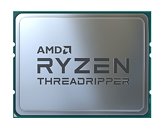
 As for the processors themselves, the Ryzen Threadripper 3960X is a 24-core/48-thread beast priced at USD $1,399 (same exact price as the previous generation 24-core Threadripper 2970WX). The 3960X offers frequencies of 3.80 GHz base with up 4.50 GHz maximum boost, and a gargantuan 140 MB total cache (L2+L3). The Threadripper 3970X, on the other hand, is a 32-core/64-thread monstrosity priced at USD $1,999. Despite its extreme core-count, it doesn't skimp on clock-speeds, offering 3.70 GHz nominal clocks, and 4.50 GHz maximum boost frequency. Both chips will be available to purchase on November 25, 2019.
Interestingly, AMD has launched no HEDT chips priced under $1000 this time around, which is where Intel retreated its 10th generation Core X lineup to. AMD says that its 2nd generation Ryzen Threadripper chips are still competitive with Intel's HEDT chips, and suggested that consumers to pick up those chips instead. We interpret this as AMD preparing a round of price-cuts to 2nd gen Threadrippers already in the market, and possibly getting its motherboard partners to do the same with their X399 motherboards.
The 3rd generation Ryzen Threadripper is a derivative of the company's "Rome" multi-chip module, featuring five chips - four 7 nm "Zen 2" 8-core CPU chiplets (or CCDs), and one 14 nm I/O Controller die (or ICOD). The four CCDs talk to the ICOD over the Infinity Fabric interconnect, which has doubled in bandwidth over the previous generation. The ICOD on the sTRX4 Threadrippers are configured with a monolithic quad-channel DDR4 memory interface that supports up to 2 TB of memory, including ECC support. The PCI-Express root-complex of the 3rd generation Ryzen Threadripper is massive, and fascinating. It puts out a total of 64 PCI-Express gen 4.0 lanes, wired out as follows:
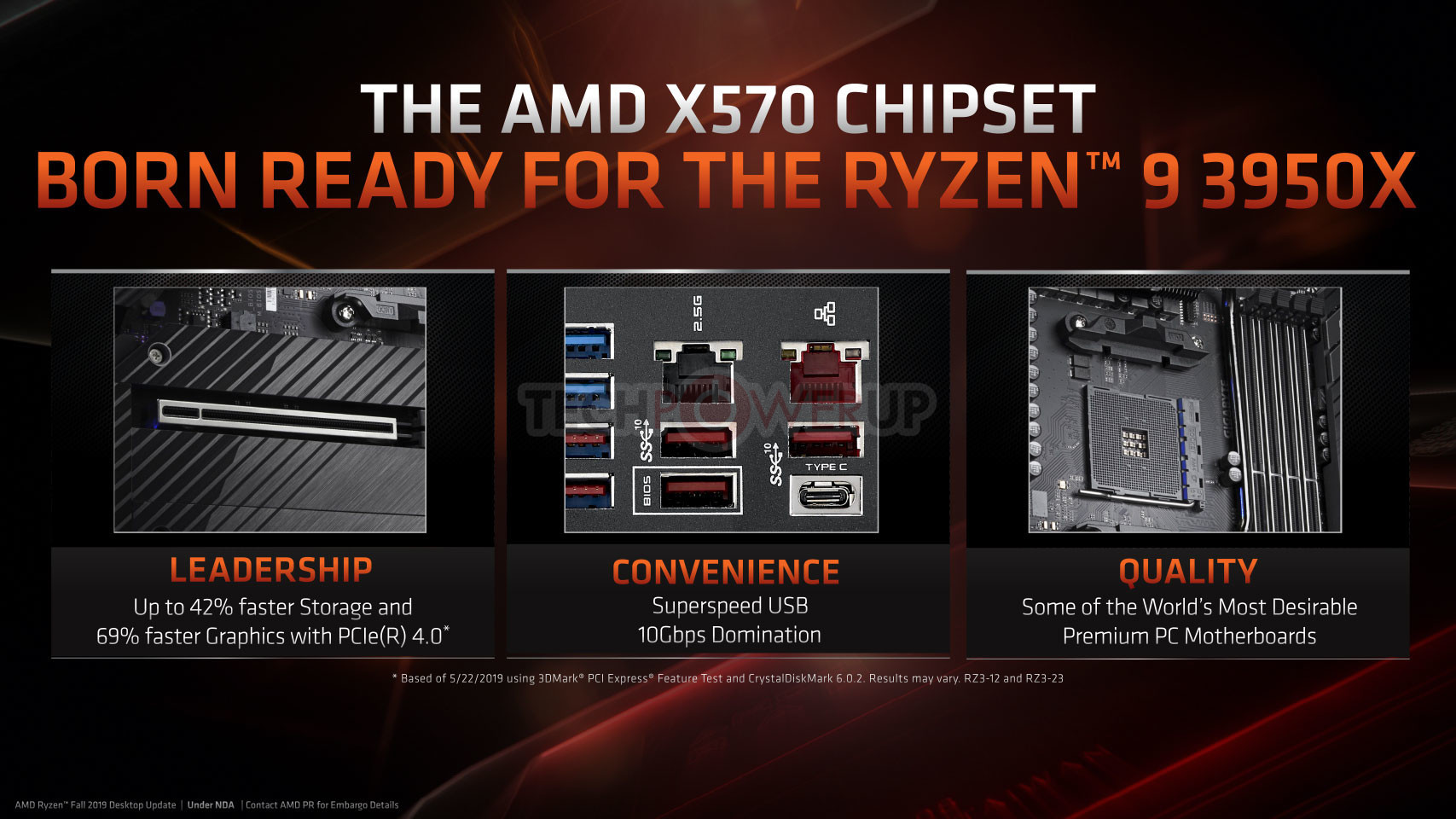
The AMD TRX40 chipset is physically similar to the X570 and is designed in-house by AMD for GlobalFoundries 12 nm FinFET node. Its PCI-Express gen 4.0 switch is configured differently to accommodate the wider x8 chipset-bus. The TRX40's PCIe budget is laid out as follows. Lastly, AMD announced a fascinating new platform feature called ECO Mode. Applicable to all socket AM4 processors that have "Zen 2" CPU cores (Ryzen 5 3500 and above), ECO Mode is essentially a cTDP (configurable TDP) implementation for the desktop platform. You flick a toggle in Ryzen Master, and the processor's TDP is capped at 65 Watts on-the-fly. So when not gaming or doing serious work, you can turn on ECO Mode and ensure your processor never draws more than 65 Watts. For the mighty Ryzen 9 3950X, ECO Mode offers 77 percent performance, but 44 percent lower power-draw, and 7°C lower temperatures.
The entire slide-deck follows.




The Ryzen 9 3950X is a 16-core/32-thread processor in the AM4 package, compatible with all socket AM4 motherboards, provided they have the latest BIOS update with AGESA Combo PI 1.0.0.4B microcode. The processor comes with clock-speeds of 3.50 GHz base, with 4.70 GHz maximum boost frequency, and the same 105 W TDP as the 12-core Ryzen 9 3900X. With 512 KB of dedicated L2 cache per core, and 64 MB of shared L3 cache, the chip has a mammoth 72 MB of "total cache."




Interestingly, AMD has launched no HEDT chips priced under $1000 this time around, which is where Intel retreated its 10th generation Core X lineup to. AMD says that its 2nd generation Ryzen Threadripper chips are still competitive with Intel's HEDT chips, and suggested that consumers to pick up those chips instead. We interpret this as AMD preparing a round of price-cuts to 2nd gen Threadrippers already in the market, and possibly getting its motherboard partners to do the same with their X399 motherboards.
The 3rd generation Ryzen Threadripper is a derivative of the company's "Rome" multi-chip module, featuring five chips - four 7 nm "Zen 2" 8-core CPU chiplets (or CCDs), and one 14 nm I/O Controller die (or ICOD). The four CCDs talk to the ICOD over the Infinity Fabric interconnect, which has doubled in bandwidth over the previous generation. The ICOD on the sTRX4 Threadrippers are configured with a monolithic quad-channel DDR4 memory interface that supports up to 2 TB of memory, including ECC support.

- 48 lanes toward PCI-Express x16 slots (x16/x16/x16), which can be further segmented two x8 slots, each
- 8 lanes toward chipset-bus. That's right, AMD is using an extra-wide PCI-Express 4.0 x8 pipe between the CPU and the TRX40 chipset
- 8 general purpose lanes, either configured as two M.2 NVMe slots with x4 wiring, each, or as x4 motherboard slots, or even additional SATA ports
The AMD TRX40 chipset is physically similar to the X570 and is designed in-house by AMD for GlobalFoundries 12 nm FinFET node. Its PCI-Express gen 4.0 switch is configured differently to accommodate the wider x8 chipset-bus. The TRX40's PCIe budget is laid out as follows.
- 8 lanes toward chipset-bus (this can't be changed)
- 8 general purpose lanes (for external onboard devices such as GbE or WLAN controllers, additional USB controllers, etc., or even wired out as slots)
- Bloc of 4 lanes configurable as four SATA 6 Gbps ports, general purpose lanes for slots, or an M.2/U.2 NVMe connection with x4 wiring
- A second such bloc of 4 lanes

The entire slide-deck follows.







114 Comments on AMD Announces Ryzen 9 3950X, Details 3rd Gen Ryzen Threadripper, unlocked Athlon 3000G
Intel will be price / perf for a while then there will be a 'transition' generation like the original conroe vs K10 where we will get an e6600 for cheap, then they will go back to premium pricing.It will just be a faster and slightly hotter 3900x methinks... Not sure it will be worth the $$ for the large majority of use cases.
Excellent 2nd gen Threadripper was for enthusiasts and scientists. Sorry AMD, but 3rd gen Threadripper is for scientists (workstations) only. Sad to say, but old/new 10980XE will be better choice for enthusiasts than new 3rd gen Threadripper (server CPU). And because difference between 3950 a 3960 is so BIG, 10980XE will be new HEDT entry point CPU soon.
Bye, bye Threadripper.
Why do people insist on using a 32 core CPU for gaming? It's a goddamn workstation CPU, it's intended for that kind of work load only.
But apparently AMD isnt allowed to sell high margin CPUs. If they are not barrgins, AMD is no better then hitler to the peanut gallery. You guys realize the $500 12 core 3900x isnt going away, right? You can still get lots of cores on the cheap, stop whining you dont have the money for a $2K CPU. If you want AMD to compete they need the money to fight intel's massive R+D budget.
I assume no AVX-512. Also now officially confirmed no X399 support for Gen3 TR so no upgrade path for the TR system we have in lab. Real bummer.
I will wait around and see some scientific computing benchmark first.
I would never chose a quad-core cpu today for gaming unless I whas so dam poor I cut not afford anything better.
My first AMD CPU was an AM5x86-P100, a Socket 7 CPU which was a drop-in upgrade for a 486. Overclocked to 133MHz via dip switch. Very cool chip. Both figuratively, and literally, as these were in the days before heatsinks became necessary to cool desktop CPUs.
I've also owned the following AMD CPUs, during what I consider to be their heyday:
Athlon XP 1700+, and 2800+
Athlon 64 3000+
Opteron 175
I've also owned AMD-powered laptops, and an Athlon II X3 460.
I bought and overclocked my first AMD CPU likely before you were even born.
As for Radeon GPUs, I owned the very first model, and many thereafter, including numerous Crossfire systems (early adopter there as well, anyone remember Master and slave cards?)
I buy the best hardware for my budget and use-case.
Consider that the Fury X stock as a rock, running Fur Mark hits 47'C loaded and it's running a single 120mm rad...
That card was crunching 250W...
Not that I mind, hopefully it drives the 3900X prices down.
How about we go back to single core and no ht/smt:p
Well you can also add some features sets that Intel has and AMD doesnot.
Plus some optimized softwares.
Don't get me wrong, 40-50% faster than Intel's flagship HEDT part (excluding the insane W-3175x) is nothing to sneeze at. It's just not worth the cost for me at $2500-$3000 for a platform upgrade to get another 40-50% performance.
For those that have yet to buy into an HEDT platform though, if the budget is there it's a no-brainer. Though personally I'll be waiting to see what a theoretical 3990WX looks like before I decide to upgrade.