Wednesday, August 13th 2025

ASUS Intros ROG Crosshair X870E Hero BTF Motherboard
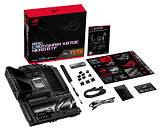
ASUS introduced the ROG Crosshair X870E Hero BTF motherboard. This Socket AM5 motherboard is a variant of the original ROG Crosshair X870E Hero that ASUS debuted with its AMD X870-series chipset motherboard lineup launched alongside Ryzen 9000 series processors; and comes with ASUS's BTF standard of backside connectivity. The board has all its onboard headers, ports, and connectors pointing backside (reverse side of the PCB), to nearly eliminate visible cable clutter. A key aspect of this board is its preparation of BTF power delivery for graphics cards. The board has a 600 W-capable 12V-2x6 power input on the reverse side, which is wired to the BTF power delivery slot meant for compatible ASUS TUF Gaming, ROG Strix, and ROG Astral series BTF graphics cards.
Besides these, the ASUS ROG Crosshair X870E Hero BTF is laid out similar to the original board, and comes with an otherwise identical feature-set, which includes a power CPU VRM, a PCI-Express 5.0 x16 slot, as many as five M.2 NVMe slots, two wired Ethernet interfaces (2.5 GbE and 5 GbE), and Wi-Fi 7 + Bluetooth 5.4, driven by a premium MediaTek MT7927 (320 MHz) WLAN controller. USB connectivity includes two 40 Gbps USB4, eight 10 Gbps USB 3.2 ports (6x type-A and 2x type-C), two 20 Gbps USB 3.2 Gen 2x2 (type-C header), and two additional 5 Gbps USB 3.2 Gen 1 headers. The onboard audio solution combines a Realtek ALC4082 CODEC with ESS ES9219 quad DAC and Savitech AMPs. The company didn't reveal pricing, but we expect this board to cost 5-10% more than the regular ROG Crosshair X870E Hero.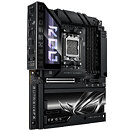
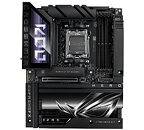
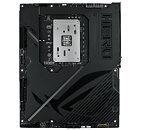
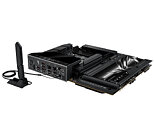
Besides these, the ASUS ROG Crosshair X870E Hero BTF is laid out similar to the original board, and comes with an otherwise identical feature-set, which includes a power CPU VRM, a PCI-Express 5.0 x16 slot, as many as five M.2 NVMe slots, two wired Ethernet interfaces (2.5 GbE and 5 GbE), and Wi-Fi 7 + Bluetooth 5.4, driven by a premium MediaTek MT7927 (320 MHz) WLAN controller. USB connectivity includes two 40 Gbps USB4, eight 10 Gbps USB 3.2 ports (6x type-A and 2x type-C), two 20 Gbps USB 3.2 Gen 2x2 (type-C header), and two additional 5 Gbps USB 3.2 Gen 1 headers. The onboard audio solution combines a Realtek ALC4082 CODEC with ESS ES9219 quad DAC and Savitech AMPs. The company didn't reveal pricing, but we expect this board to cost 5-10% more than the regular ROG Crosshair X870E Hero.


19 Comments on ASUS Intros ROG Crosshair X870E Hero BTF Motherboard
Never wipe Back To Front.
Note: I hint at the "supreme FX" label on the cheap plastic cover on the usual Audio area of ASUS mainboards.
I mean compared to how it used to be on mobos from a year ago. I think the original ROG CROSSHAIR X870E HERO also had four USB-C ports on the back panel.
They do require specific cases, and each of these mobo manufacturers has been releasing cases to support those formats. But 3rd party (Corsair, Fractal, etc) have also started designing their new cases to be compatible with these formats. One example is the Fractal Design North XL RC, where RC stands for reverse connector. Corsair also mentions their 2500 and 6500 series in their blog post on the topic. Lian Li also got into that action with the Lancool 217 and some others. Those are just a few examples, you can view a list on the german price comparison site Geizhals, which has a filter for it.
So yeah, you need a compatible case and probably will need to buy a new one, but it's not so hard to find anymore.
That's a specially negative point when I require stuff that's not common anymore, such as external drive bay for an optical disc drive, or a "large-ish" amount of 3.5 internal drive bays for hard drives.
At this orice point, there cannot be an excuse for not offering second PCIe x8 slot.
Always seemed like a silly change to me, but there's not really any disadvantage and it can make things easier to connect, but they must create a standard that everyone can work to support! Otherwise you're just limiting compatibility for no reason.
The wait continues.