Sunday, November 9th 2025

Samsung Teases Modular SSD and M.2 2242 SSD with DRAM
Although we're almost two months away from CES, companies are already starting to tease products that they will have on display at the show. Samsung has unveiled a pair of new SSDs, of which one might find an appeal with owners of portable gaming devices. The other, is not going to be something most consumers will ever have any direct contact with, but the Detachable AutoSSD is an interesting product from Samsung that might spill over in other markets in the future. It's intended for the automotive market and uses the E1.A form factor, but what makes it truly unique is the fact that the SSD controller and the NAND are separated from each other, something Samsung claims improves heat dissipation, but also that it can extend the product life and make upgrades and/or replacements easier.
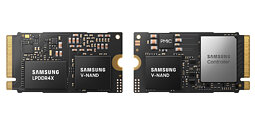
A more useful addition to its lineup of SSDs is the PM9E1 M.2 22x42, which is an OEM drive in the M.2 2242 form factor. This is as far as we're aware, the first announcement of an M.2 2242 PCIe 5.0 drive, but it's also one of what has to be less than a handful of drives in this form factor that has DRAM onboard. Samsung claims read speeds of up to 14.8 GB/s and write speeds of up to 13.4 GB/s, courtesy of its Presto SSD controller and its V8 TLC V-NAND. The PM9E1 will come in sizes up to 4 TB, which means it's a double sided drive with components on both sides of the PCB, which could make it a tad tricky when it comes to the cooling. However, for those with a handheld gaming device like the Steam Deck, could prove to be one of the best performance options out there, while at the same time offering plenty of storage space for your game library.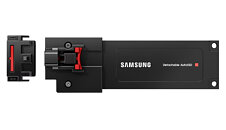
Source:
Samsung Semiconductors
A more useful addition to its lineup of SSDs is the PM9E1 M.2 22x42, which is an OEM drive in the M.2 2242 form factor. This is as far as we're aware, the first announcement of an M.2 2242 PCIe 5.0 drive, but it's also one of what has to be less than a handful of drives in this form factor that has DRAM onboard. Samsung claims read speeds of up to 14.8 GB/s and write speeds of up to 13.4 GB/s, courtesy of its Presto SSD controller and its V8 TLC V-NAND. The PM9E1 will come in sizes up to 4 TB, which means it's a double sided drive with components on both sides of the PCB, which could make it a tad tricky when it comes to the cooling. However, for those with a handheld gaming device like the Steam Deck, could prove to be one of the best performance options out there, while at the same time offering plenty of storage space for your game library.


21 Comments on Samsung Teases Modular SSD and M.2 2242 SSD with DRAM
Do gaming machines even need 14.8GB/s reads yet? I still haven't found a game that doesn't take more than 10 or so seconds to load a save file from a decent SSD and I'm pretty sure most of that time is the CPU chugging at getting everything setup.
SSD capacity on the consumer side has stagnated for way too long. You have Kioxia with a 245TB 2.5' drive on the enterprise side that can still do an overkill read of 12GB/s, while we're stuck with 8TB that still costs way too much. Where’s my 16TB, 32TB, or 64TB NVMe at decent prices? Consumers are being mugged.
I bought a Samsung 8TB QVO drive a few years ago, and it's still the largest consumer capacity which is bloody insane.
It's also at roughly the same $0.65 per gigabyte pricing (compared to say a Samsung 990 EVO)(EDIT: pricing info I found was speculative)The problem with flash memory is reliability issues at smaller process nodes, hence why they've resorted to 3D stacking. So until we ever overcome this or find another way to store data, we're pretty much stuck here.
Just having ANY kind of SSD that at least has onboard DRAM and you'll be fine. And I don't expect this to change any time soon. I have 2TB SATA SSD and 4TB NVMe SSD (both top end in its class). For testing not long ago I moved everything to SATA SSD. I couldn't really tell a difference. If you have NVMe PCIe 3.0 drive you're more than fine today and you probably have a faster drive than 75% of computer users.
Nier replicant is an interesting one, from a JRPG dev, JRPG devs have a habit of carrying on coding the game after release, and then "not" back porting the improvements to the earliest versions.
Nier Replicant was released on PS4 first and also plays on PS5 the PS4 build, it has no AF, bilinear instead, and wait for it longer loading times. This version feels like a straight PS4 compat port on PS5.
On both Xbox Series and PC which came later they got AF, and much better loading times. Optimised for the platforms.
I dont think its directstorage level of optimisation, but clearly something was done on the loading process, as e.g. the home village is 2 seconds on PC/Xbox and 9 seconds on PS5.
I think even if we think about media editing, directstorage games (as rare as they are at the moment), its hard to consider gen 5 as an exciting development, I feel what most people care about at this point is cost and capacity. Gen 4 is easily good enough,
We can definitely get double digit capacity in 2.5inch SSD's that issue is a combination of high margin expectation and protecting the enterprise market. I expect it should be possible to do 8TB 2280 as well.
A lot of game engines also mitigate loading hitches by loading the bare minimum first, then load in the higher quality assets later on spare cycles.
In reality, if you remove the SLC cache trick, the true write performance of TLC flash can’t even exceed 500 MB/s.
And big sequential speeds have very little actual use but are good form marketing and come with relatively small effort on state of the art drives.
Isn't random performance largely down to cost and efficiency though? Flash does have its limitations but more channels and more Flash chips plus more RAM for caching has effectively been the answer to this but the cost-performance benefit for sales isn't there. I do wish XPoint/Optane would still get R&D but that does seem to be gone and alternatives all have an uphill battle against mass-produced Flash that is cheap thanks to economies of scale.
Since their first appearance amount of layers has increased steadily increasing capacity per chip.
Basically we're now around 300 layer level and manufacturers are racing toward 400 layers:
www.allpcb.com/allelectrohub/3d-nand-hits-400-layers-with-hybrid-bondingTLC drives have long ago exceeded 500 MB/s write speeds.
Full drive fill test in TPU's reviews tests precisely that by saturating drive so that it doesn't have spare time to empty SLC cache, but has to go writing natively in TLC.
www.techpowerup.com/review/team-group-mp34-nvme-ssd/6.html
www.techpowerup.com/review/western-digital-wd-black-2018-nvme-500-gb/6.html
It's QLC drives which struggle to exceed HDDs in native write speed.
That is the performance writing to 1 stack of nand... 50k iops of 4kb.
That maths out to.... 200MB/s
Drives have many channels and you have to write to multiple to get good performance because the underlying nand has not scaled.
- Real TLC writing is roughly 2k IOPS (1 divided by NAND program time of ~500 µs, which you can find for some NAND types in the TPU SSD DB)
- writing with fsync is up to 8k IOPS, no parallelisation is possible here (unless the controller is cheating), it can't be to TLC, therefore it's to SLC - see the latest SSD review (Phison E28)
- Random Q1 writing is above 100k IOPS, also from the latest review; this may involve SLC writing, a lot of parallelisation, reordering of writes for best performance and who knows what else.
One of my recent comments is actually closely related to this:
I did write to them about this as do any application really need that fast.
Even the Samsung 990 Pro for most users you won't tap on it's 7900MB/S
unless you are doing editing and heavy transfer.
I did enquire will there be anymore Gen 3 SSD especially for older PCs out there.
Not many will know Gen 3 drives Samsung 970 EVO Plus have been discontinued and
soon Samsung 980 (Non-pro).
These drives even though the read/write is at 3500mb/s so actually more than
sufficient for most users.
And yes Gen 4 is backward compatible but kind of waste in my opinion.
M.2 SATA are non-existent except PCs that have such limitation.
So Samsung not everyone need really fast SSD unless AI or Editing purpose.
Some just want fast and reliable SSD for data and games.
This is common on i/o, there is different ways of making requests.