Tuesday, February 17th 2026

Blind Testing Shows Gamers Prefer NVIDIA DLSS 4.5 Over Native Resolution Rendering and AMD FSR 4
ComputerBase conducted a massive online blind test, allowing thousands of gamers to vote on their preferred game video output. The options included NVIDIA's latest Deep Learning Super Sampling 4.5, AMD's FSR Upscaling AI with FSR 4 on Radeon RX 9000 series GPUs, and native resolution rendering without AI upscaling. Interestingly, DLSS 4.5 received the highest percentage of votes, winning in every scenario. ComputerBase tested various games like Anno 117, ARC Raiders, Cyberpunk 2077, Horizon Forbidden West, Satisfactory, and The Last of Us Part II. Only in Cyberpunk 2077 did gamers almost equally prefer native resolution rendering, but DLSS 4.5 still came out on top with a slight edge.
Initially, the ComputerBase team conducted the comparison using videos labeled only with options like 1/2/3/4, without revealing which rendering method was used, to ensure a fully blind test. After two weeks of testing and thousands of votes, the results showed a significant preference for NVIDIA's latest DLSS 4.5 technology. This conclusion highlights that NVIDIA's newest technology is now so refined that its video output offers superior visual appeal. DLSS 4.5 uses a second-generation Transformer model trained on a much larger dataset of video games, with five times the computational investment of the first DLSS 4 Transformer upscaler. It utilizes the FP8 data format, allowing for more processing with minimal precision loss. The new algorithm is more context-aware, and NVIDIA confirmed that the input for upscaling is used more intelligently, resulting in much more detailed and precise video output.
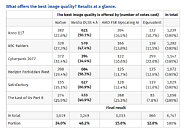 Out of all the games tested, AMD's latest ML-based video technologies, now part of the AMD "Redstone" package, fully support Cyberpunk 2077 and ARC Raiders with AMD's current best rendering techniques. Interestingly, in neither scenario have gamers overwhelmingly preferred the "Redstone" package, as in both cases, gamers felt better off with native resolution rendering. Although AMD's upscaling may not be the most visually appealing, it does provide a good enough FPS boost for gamers. However, NVIDIA's DLSS 4.5 continues to dominate, and the second-generation Transformer model powering it is the real differentiating factor for the vast majority.
Source:
ComputerBase
Initially, the ComputerBase team conducted the comparison using videos labeled only with options like 1/2/3/4, without revealing which rendering method was used, to ensure a fully blind test. After two weeks of testing and thousands of votes, the results showed a significant preference for NVIDIA's latest DLSS 4.5 technology. This conclusion highlights that NVIDIA's newest technology is now so refined that its video output offers superior visual appeal. DLSS 4.5 uses a second-generation Transformer model trained on a much larger dataset of video games, with five times the computational investment of the first DLSS 4 Transformer upscaler. It utilizes the FP8 data format, allowing for more processing with minimal precision loss. The new algorithm is more context-aware, and NVIDIA confirmed that the input for upscaling is used more intelligently, resulting in much more detailed and precise video output.


173 Comments on Blind Testing Shows Gamers Prefer NVIDIA DLSS 4.5 Over Native Resolution Rendering and AMD FSR 4
The original page for the test: www.computerbase.de/artikel/grafikkarten/nativ-vs-dlss-4-5-vs-fsr-upscaling-ai-leser-blindtest.95965/
DLSS > native is something I've heard before (maybe it was Digital Foundry who covered it first for Control) but never really cared about.
I personally stick to native resolution. I don't have the option to use DLSS or even FSR4 for that matter (let's not make this an Nv vs AMD thread).
In addition, people tend to prefer over-sharpened images as well. Of which DLSS 4.5 / 4.0 is in most cases.
DLSS is better but this study is basically worthless outside of being troll-bait.
For me personally I recently cashed out a little & went 4090 --> 5080 --> 9070XT, with a 32" 4k 144Hz monitor. So I'm using upscaling in most things now, & yeah, for me FSR4 at the higher quality settings is generally "fine" for me too.
There is no blind study because each upscaling algorithm will put out a different result, and it would a real blind test if people were asked to actually play games without knowing what upscaling model is being used. I personally wouldn't trust a video alone to make a decision on what is better, as a video clip can be used to highlight artifacts or graphical errors. DLSS is technically better, but I'd have a difficult time telling while playing a game, not stopping a video to stare at every pixel.
Currently I prefer/use DLSS 4.5 in most of the games that I play with preset L + tweaked sharpness option in each game as long as it has an option for it and to me this is much better/pleasant to look at than native.
"Blind Testing Shows Gamers Prefer NVIDIA DLSS 4.5 Over Native Resolution Rendering......................without AI upscaling"
Predictable outcome even from a completely blind test so that no brand bias can be applied, only bias for which image looked better. Hopefully comparisons and publicity like this keeps Intel and AMD pushing to catch Nvidia, and keeps Nvidia pushing to stay ahead.
In the end, we all win.
Plus, how many people do you really think can identify upscalers based on specific quirks or artifacts produced? And is that really going to cause them to preferentially pick that upscaler when they recognize a drawback of it? You're really stretching it trying to discredit this survey.