Tuesday, February 17th 2026

Blind Testing Shows Gamers Prefer NVIDIA DLSS 4.5 Over Native Resolution Rendering and AMD FSR 4
ComputerBase conducted a massive online blind test, allowing thousands of gamers to vote on their preferred game video output. The options included NVIDIA's latest Deep Learning Super Sampling 4.5, AMD's FSR Upscaling AI with FSR 4 on Radeon RX 9000 series GPUs, and native resolution rendering without AI upscaling. Interestingly, DLSS 4.5 received the highest percentage of votes, winning in every scenario. ComputerBase tested various games like Anno 117, ARC Raiders, Cyberpunk 2077, Horizon Forbidden West, Satisfactory, and The Last of Us Part II. Only in Cyberpunk 2077 did gamers almost equally prefer native resolution rendering, but DLSS 4.5 still came out on top with a slight edge.
Initially, the ComputerBase team conducted the comparison using videos labeled only with options like 1/2/3/4, without revealing which rendering method was used, to ensure a fully blind test. After two weeks of testing and thousands of votes, the results showed a significant preference for NVIDIA's latest DLSS 4.5 technology. This conclusion highlights that NVIDIA's newest technology is now so refined that its video output offers superior visual appeal. DLSS 4.5 uses a second-generation Transformer model trained on a much larger dataset of video games, with five times the computational investment of the first DLSS 4 Transformer upscaler. It utilizes the FP8 data format, allowing for more processing with minimal precision loss. The new algorithm is more context-aware, and NVIDIA confirmed that the input for upscaling is used more intelligently, resulting in much more detailed and precise video output.
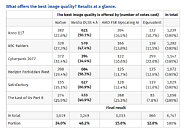 Out of all the games tested, AMD's latest ML-based video technologies, now part of the AMD "Redstone" package, fully support Cyberpunk 2077 and ARC Raiders with AMD's current best rendering techniques. Interestingly, in neither scenario have gamers overwhelmingly preferred the "Redstone" package, as in both cases, gamers felt better off with native resolution rendering. Although AMD's upscaling may not be the most visually appealing, it does provide a good enough FPS boost for gamers. However, NVIDIA's DLSS 4.5 continues to dominate, and the second-generation Transformer model powering it is the real differentiating factor for the vast majority.
Source:
ComputerBase
Initially, the ComputerBase team conducted the comparison using videos labeled only with options like 1/2/3/4, without revealing which rendering method was used, to ensure a fully blind test. After two weeks of testing and thousands of votes, the results showed a significant preference for NVIDIA's latest DLSS 4.5 technology. This conclusion highlights that NVIDIA's newest technology is now so refined that its video output offers superior visual appeal. DLSS 4.5 uses a second-generation Transformer model trained on a much larger dataset of video games, with five times the computational investment of the first DLSS 4 Transformer upscaler. It utilizes the FP8 data format, allowing for more processing with minimal precision loss. The new algorithm is more context-aware, and NVIDIA confirmed that the input for upscaling is used more intelligently, resulting in much more detailed and precise video output.


173 Comments on Blind Testing Shows Gamers Prefer NVIDIA DLSS 4.5 Over Native Resolution Rendering and AMD FSR 4
HUB writes articles for techspot, they don't own techspot - they are primarily a youtube channel.
Your arguments don't make sense anyways, when people say they prefer SMAA or FXAA over TAA, what they want is to remove the TAA blur in motion, which require video capture to compare, not screenshot in the first place.
I recorded a bunch of video already :roll:
I am not the least bit surprised that you still haven't understood what i said in the first place regarding smaa + supersampling.
SMAA4x = SMAA + MSAA 4x, not Supersampling
LMAO
In the example of skyrim, you set 4x msaa in the ingame settings, and set 4x sparse grid super sampling in nvidia inspector - then you apply fxaa / smaa on top of that.
But i suppose you never tried it, as it's not a gooner game...
I guess you live in your own over-sharpened world:roll:
Btw Skyrim is the most gooner game, i guess you just didn't know :roll:.
I am sure you can come up with a video with it allegedly showing that. But fact of the matter is that you didn't even know what sparse grid super sampling was a second ago, and you no doubt don't know that it only works with the original version of skyrim either.
Any game can be made into a gooner game, but unlike stellar blade, skyrim isn't a gooner game per default. But im not the least bit surprised if you made your skyrim into the sleaziest gooner game ever...
Anyways I guess we have too different taste to discussion anything else, I'm not interested in making ugly characters looks over-sharpened while killing my FPS :roll:.
Enjoy your ugly character screenshots, I'm sure you keep them close to your heart :roll:
You both seem to be lost in your bickering without making any meritful points.
How about you both just agree that DLSS 4.5 is a vast improvement over anything else available and quit this back and forth? Hmm?
Dlss dll 310.3 with preset k looks alot more natural and pleasing imo. And runs better on top of that.
Maybe the Quality settings allowed more fps so the smoother gameplay looked better?
All gameplay footage was 4k60fps, so smoothness was definitely not a factor.