Tuesday, February 17th 2026

Blind Testing Shows Gamers Prefer NVIDIA DLSS 4.5 Over Native Resolution Rendering and AMD FSR 4
ComputerBase conducted a massive online blind test, allowing thousands of gamers to vote on their preferred game video output. The options included NVIDIA's latest Deep Learning Super Sampling 4.5, AMD's FSR Upscaling AI with FSR 4 on Radeon RX 9000 series GPUs, and native resolution rendering without AI upscaling. Interestingly, DLSS 4.5 received the highest percentage of votes, winning in every scenario. ComputerBase tested various games like Anno 117, ARC Raiders, Cyberpunk 2077, Horizon Forbidden West, Satisfactory, and The Last of Us Part II. Only in Cyberpunk 2077 did gamers almost equally prefer native resolution rendering, but DLSS 4.5 still came out on top with a slight edge.
Initially, the ComputerBase team conducted the comparison using videos labeled only with options like 1/2/3/4, without revealing which rendering method was used, to ensure a fully blind test. After two weeks of testing and thousands of votes, the results showed a significant preference for NVIDIA's latest DLSS 4.5 technology. This conclusion highlights that NVIDIA's newest technology is now so refined that its video output offers superior visual appeal. DLSS 4.5 uses a second-generation Transformer model trained on a much larger dataset of video games, with five times the computational investment of the first DLSS 4 Transformer upscaler. It utilizes the FP8 data format, allowing for more processing with minimal precision loss. The new algorithm is more context-aware, and NVIDIA confirmed that the input for upscaling is used more intelligently, resulting in much more detailed and precise video output.
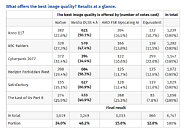 Out of all the games tested, AMD's latest ML-based video technologies, now part of the AMD "Redstone" package, fully support Cyberpunk 2077 and ARC Raiders with AMD's current best rendering techniques. Interestingly, in neither scenario have gamers overwhelmingly preferred the "Redstone" package, as in both cases, gamers felt better off with native resolution rendering. Although AMD's upscaling may not be the most visually appealing, it does provide a good enough FPS boost for gamers. However, NVIDIA's DLSS 4.5 continues to dominate, and the second-generation Transformer model powering it is the real differentiating factor for the vast majority.
Source:
ComputerBase
Initially, the ComputerBase team conducted the comparison using videos labeled only with options like 1/2/3/4, without revealing which rendering method was used, to ensure a fully blind test. After two weeks of testing and thousands of votes, the results showed a significant preference for NVIDIA's latest DLSS 4.5 technology. This conclusion highlights that NVIDIA's newest technology is now so refined that its video output offers superior visual appeal. DLSS 4.5 uses a second-generation Transformer model trained on a much larger dataset of video games, with five times the computational investment of the first DLSS 4 Transformer upscaler. It utilizes the FP8 data format, allowing for more processing with minimal precision loss. The new algorithm is more context-aware, and NVIDIA confirmed that the input for upscaling is used more intelligently, resulting in much more detailed and precise video output.


173 Comments on Blind Testing Shows Gamers Prefer NVIDIA DLSS 4.5 Over Native Resolution Rendering and AMD FSR 4
It's been demonstrated that higher FPS can produce better visuals (30 vs 60), at least with DLSS, because of the increased/more tightly stacked temporal accumulation. So testing for image quality alone I would expect them all to be done at identically capped FPS.
Obviously there are some real benefits to Upscaling, DLSS won this blind test and in Quality mode at 4k surely is capable of also pumping out higher FPS, a win win.
Over draw is still major issue in unreal engine 5 with lumen & nanite.
Even your second point is wrong modern GPUs just simplify MSAA2x with almost no performance hit. The hit comes in has MSAAx8 which is completely unnecessary.
The only part that is correct is that it doesn't work WELL for Transparent or semitransparent objects & textures.
It works fine with polygons or else it wouldn't able to do EDGES properly
Seriously were are you getting this stuff?
So RTX owners can just safely choose the DLSS Performance mode at 4K and it's guaranteed to looks as good or better than Native in the majority of games. Though the issue with RT Reflections need to be addressed ASAP with the new RR model.
DLSS is the finewinest of finewine, RTX2000/3000 owners are getting ~50% better FPS at higher image quality than Native with DLSS 4.5 :roll:
I've been forcing Preset L and a 42% scale, so halfway between Ultra performance modes 33% and Performances 50%, and the results are stunning. It's very much a 4kTAA-alike presentation, and even then I'd say it's sharper, more detailed and more stable on the fine detail overall, at least in the games I have tried. Rendering only 17% of Native 4k's pixels... it's just insane.
Having the ultra light laptop with HX370, I wish AMD has Ultra Performance mode too, so I don't have to lower the screen resolution + FSR.Performance to get some playable FPS in ARC Raiders :cry:
By the time AMD gets close to catching up to the old version of DLSS Nvidia releases the new hotness, and it's available through ALL RTX cards and all games with a simple .DLL swap.
FSR4 was finally a competitor if not taking any wins, but surprise! Eat a fat one if you paid a grand on an XTX or use a $2000 Strix Halo APU because you don't matter. To which Nvidia answers with an even better DLSS4.5
It's dumb shit like this that makes people just hold their nose and pay the small premium for Nvidia, as much as we all despise them.
I use 80-90% sharpening in driver panel and games become crystal clear like it's magic. No gaylss needed.
But I also play virtually nothing new, b/c it's all trash.
That makes absolutely no sense... being able to tell the difference is the entire purpose of the study. The participants don't know which is which before making their judgment, hence they are "blind." You're free to disagree with the results ofc, but this argument is nonsense.
R.I.P. Native
<50% of people thought DLSS looked better.
If DLSS was as good as it's supposed to be, I'd expect higher numbers than that.
For transparency, I've used Nvidia exclusively since 2013/2014.
I think there should be a better allegory (alliteration?) out there :shadedshu:
A polished TAA turd, is still a turd.
There is no escaping the "TSR".
researchmethod.net/volunteer-sampling/
Limitations of Volunteer Sampling
- Selection Bias: Volunteers may not represent the broader population, affecting generalizability.
- Over-representation: Attracts individuals with strong opinions or specific traits, skewing results.
- Lack of Randomization: Reduces the ability to eliminate bias inherent in the sample.
- Ethical Concerns: Participants may self-select based on perceived benefits, such as compensation, brand-confirmation bias, etc.
- Low Reliability for Statistical Inference: Findings may not accurately reflect the population due to non-random sampling.
The scope of insights and possible conclusions from this study are fairly limited, but still interesting:- we don't know whether the sample represented the ratio of GPU brand that owners user in real life. This data was not collected. If it did, it would imply that many Nvidia GPU users did not find the upscaler on Nvidia cards better in those games. The preference for DLSS reproducing the real life GPU ratio would need to be above 80%. It's only ~50%.
- results are split, roughly half of participants opted for DLSS and other half for non-DLSS videos. A toss of a coin.
- again, never forget the above mentioned limitations of volunteer samplingNot only independent, but primarily in a randomized study, a gold standard in any empirical testing, which would be more challenging and expensive to organize in this case.