Tuesday, February 17th 2026

Blind Testing Shows Gamers Prefer NVIDIA DLSS 4.5 Over Native Resolution Rendering and AMD FSR 4
ComputerBase conducted a massive online blind test, allowing thousands of gamers to vote on their preferred game video output. The options included NVIDIA's latest Deep Learning Super Sampling 4.5, AMD's FSR Upscaling AI with FSR 4 on Radeon RX 9000 series GPUs, and native resolution rendering without AI upscaling. Interestingly, DLSS 4.5 received the highest percentage of votes, winning in every scenario. ComputerBase tested various games like Anno 117, ARC Raiders, Cyberpunk 2077, Horizon Forbidden West, Satisfactory, and The Last of Us Part II. Only in Cyberpunk 2077 did gamers almost equally prefer native resolution rendering, but DLSS 4.5 still came out on top with a slight edge.
Initially, the ComputerBase team conducted the comparison using videos labeled only with options like 1/2/3/4, without revealing which rendering method was used, to ensure a fully blind test. After two weeks of testing and thousands of votes, the results showed a significant preference for NVIDIA's latest DLSS 4.5 technology. This conclusion highlights that NVIDIA's newest technology is now so refined that its video output offers superior visual appeal. DLSS 4.5 uses a second-generation Transformer model trained on a much larger dataset of video games, with five times the computational investment of the first DLSS 4 Transformer upscaler. It utilizes the FP8 data format, allowing for more processing with minimal precision loss. The new algorithm is more context-aware, and NVIDIA confirmed that the input for upscaling is used more intelligently, resulting in much more detailed and precise video output.
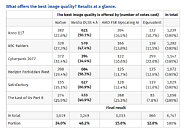 Out of all the games tested, AMD's latest ML-based video technologies, now part of the AMD "Redstone" package, fully support Cyberpunk 2077 and ARC Raiders with AMD's current best rendering techniques. Interestingly, in neither scenario have gamers overwhelmingly preferred the "Redstone" package, as in both cases, gamers felt better off with native resolution rendering. Although AMD's upscaling may not be the most visually appealing, it does provide a good enough FPS boost for gamers. However, NVIDIA's DLSS 4.5 continues to dominate, and the second-generation Transformer model powering it is the real differentiating factor for the vast majority.
Source:
ComputerBase
Initially, the ComputerBase team conducted the comparison using videos labeled only with options like 1/2/3/4, without revealing which rendering method was used, to ensure a fully blind test. After two weeks of testing and thousands of votes, the results showed a significant preference for NVIDIA's latest DLSS 4.5 technology. This conclusion highlights that NVIDIA's newest technology is now so refined that its video output offers superior visual appeal. DLSS 4.5 uses a second-generation Transformer model trained on a much larger dataset of video games, with five times the computational investment of the first DLSS 4 Transformer upscaler. It utilizes the FP8 data format, allowing for more processing with minimal precision loss. The new algorithm is more context-aware, and NVIDIA confirmed that the input for upscaling is used more intelligently, resulting in much more detailed and precise video output.


173 Comments on Blind Testing Shows Gamers Prefer NVIDIA DLSS 4.5 Over Native Resolution Rendering and AMD FSR 4
In the end, it's just a matter of taste and looking at the who-have-more-precentage tell nothing about your personal taste.
The majority might love x buy you (and might it be only you) prefer y and it's 100% OK.
Btw, I only drink water.
Then again, dsr x4 can be combined with dlss for a nearly as good result as true 4x supersampling, but without the massive performance hit.
Edit, I don't think the comparison is even done with user playing, it's from videos... please.
Basically the only shortfall of TAA are the blurriness and ghosting, which DLSS 4.5 ultimately fix (or fixing, as they can still improve further)
And then you show an image of smaa on its own, like it's going to prove anything.
it seems marketing for me , matter of interpretation ..
saying nvidia dlss is the "winner" .. NOPE .. this is not my interpretation of the results .. if you add people
prefering native + fsr4 + think both are the same .. most of people don't see nvidia as the winner
;)
and isn't it possible this feeling to be depending on the games too ? some games rendering better with a techno than with a an other ? or is there something that makes this even ?
lets make a feeling/price ratio
Watch at 10:30, it's all shimmering and flickering with FXAA and SMAA, the Anti Aliasing aspect of SMAA was useless as hell, might as well use no AA option with SuperSampling
imagine they will do a blind FPS test with 3 presets:
1) 80fps locked
2) 100fps locked
3) 120 fps locked
are we really sure that 120 will win? or 80? mind that 120 is +50% blastling faster than 80
that wouldn't mean that 80 is better
just saying
And like you said, let throw FPS out the windows and compare SMAA 4x to DSR 4x DLAA
Well, you can actually run older games at acceptable performance with smaa + 4x supersampling. Dsr 4x + dlaa would absolutely kill performance on any gpu. But, you can get quite close to the same level of percieved image quality with dsr 4x + dlss ultra performance / performance, and very acceptable performance (percieved, as when you study the images closely, there are obvious differences between 4x dsr + dlaa and 4x dsr + ultra performance).
Just as an fyi, im not saying smaa + 4x supersampling is better than 4x dsr + dlss, but rather that you shouldn't discount the former. It was how we got super high image quality in the past, prior to dsr and dlss.
If you take screenshots, compare them in 4K video because 8K screenshot will look better than 4K screenshot no matter what.
I can't buy the game since it's region lock :/
I am not sure what your point even is, to be honest. Yes, SMAA can look good paired with supersampling. Anything can. That’s the natural result of rendering at a higher resolution. The comparison is inherently flawed since that comes, expectedly, at a massive performance cost. Like, if we take the conditions of the very test described in the thread - would the AA performance of rendering a 4K presentation at 8K and applying a post-processing AA pass be superb? Sure. Would you unironically in practice actually do that instead of just using DLSS and getting SIGNIFICANTLY higher framerates? No, no you would not. Is it a useful technique for older games? Yes. But those aren’t the ones suffering from shit TAA implementations anyway, which is what you would fix with DLSS. And modern games that DO already struggle to run just at native, adding SSAA on top is madness, no card existing today would be able to cope.
But for your last "point" : dsr x4 + dlss ultra performance is faster than native, so wrong.
"And modern games that DO already struggle to run just at native, adding SSAA on top is madness".
As i said, you can infact run dsr x4 at higher fps than native, which is in effect ssaa.
That you were strictly talking about smaa + ssaa just shows that you infact didn't read my posts. As i said, fxaa/smaa + ssaa was how we got pristine image quality in the past, similar image to dsr 4x + dlss today.
And what was my point ? That it wasn't useless, like the original dude claimed - it's simply an older and heavier way of getting perfect image quality.
Funnily, I think we are actually in agreement, for the most part. I don’t really know why you opted to jump down my throat on this one.
As for why i replied as i did, perhaps you should look at how you wrote in the first place, dude.
I am also not sure what is this in response to, considering what I said. I don’t remember claiming that DSR + DLSS wouldn’t look good.I was perfectly civil, I thought. A tad snarky, perhaps, but that’s just how I normally post. And talk, for that matter.