Tuesday, February 17th 2026

Blind Testing Shows Gamers Prefer NVIDIA DLSS 4.5 Over Native Resolution Rendering and AMD FSR 4
ComputerBase conducted a massive online blind test, allowing thousands of gamers to vote on their preferred game video output. The options included NVIDIA's latest Deep Learning Super Sampling 4.5, AMD's FSR Upscaling AI with FSR 4 on Radeon RX 9000 series GPUs, and native resolution rendering without AI upscaling. Interestingly, DLSS 4.5 received the highest percentage of votes, winning in every scenario. ComputerBase tested various games like Anno 117, ARC Raiders, Cyberpunk 2077, Horizon Forbidden West, Satisfactory, and The Last of Us Part II. Only in Cyberpunk 2077 did gamers almost equally prefer native resolution rendering, but DLSS 4.5 still came out on top with a slight edge.
Initially, the ComputerBase team conducted the comparison using videos labeled only with options like 1/2/3/4, without revealing which rendering method was used, to ensure a fully blind test. After two weeks of testing and thousands of votes, the results showed a significant preference for NVIDIA's latest DLSS 4.5 technology. This conclusion highlights that NVIDIA's newest technology is now so refined that its video output offers superior visual appeal. DLSS 4.5 uses a second-generation Transformer model trained on a much larger dataset of video games, with five times the computational investment of the first DLSS 4 Transformer upscaler. It utilizes the FP8 data format, allowing for more processing with minimal precision loss. The new algorithm is more context-aware, and NVIDIA confirmed that the input for upscaling is used more intelligently, resulting in much more detailed and precise video output.
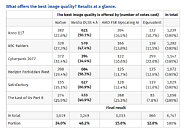 Out of all the games tested, AMD's latest ML-based video technologies, now part of the AMD "Redstone" package, fully support Cyberpunk 2077 and ARC Raiders with AMD's current best rendering techniques. Interestingly, in neither scenario have gamers overwhelmingly preferred the "Redstone" package, as in both cases, gamers felt better off with native resolution rendering. Although AMD's upscaling may not be the most visually appealing, it does provide a good enough FPS boost for gamers. However, NVIDIA's DLSS 4.5 continues to dominate, and the second-generation Transformer model powering it is the real differentiating factor for the vast majority.
Source:
ComputerBase
Initially, the ComputerBase team conducted the comparison using videos labeled only with options like 1/2/3/4, without revealing which rendering method was used, to ensure a fully blind test. After two weeks of testing and thousands of votes, the results showed a significant preference for NVIDIA's latest DLSS 4.5 technology. This conclusion highlights that NVIDIA's newest technology is now so refined that its video output offers superior visual appeal. DLSS 4.5 uses a second-generation Transformer model trained on a much larger dataset of video games, with five times the computational investment of the first DLSS 4 Transformer upscaler. It utilizes the FP8 data format, allowing for more processing with minimal precision loss. The new algorithm is more context-aware, and NVIDIA confirmed that the input for upscaling is used more intelligently, resulting in much more detailed and precise video output.


173 Comments on Blind Testing Shows Gamers Prefer NVIDIA DLSS 4.5 Over Native Resolution Rendering and AMD FSR 4
All we can conclude with certainty is that DLSS is the best option, but it doesn't say anything about whether FSR is preferred to Native. If DLSS wasn't an option, maybe a great deal of the DLSS voters would choose FSR over native, who knows. That just wasn't part of this survey.
Self defeating test or smart advertising? :roll:
Next time they should try native + a thin layer of vaseline applied to the monitor vs dlss and a clean monitor. It will be as fair as that.
Next time they should find a game with a good msaa implementation and test native with 4x msaa vs dlss.
The best way to explain this is that game engines do not put out perfect video streams. This provides DLSS 4.5 an opportunity to improve and clean-up the native video streams.
This test also may have turned out differently if it was using lower resolution than 4k.
There are a couple UE5 games i find unusable with DLSS 4.5 though see the Digital Foundry video on the technology to see what I'm talking about.
The T in TAA should stand for Trash.
I suspect that FSR 4 vs TAA would lean FSR 4 as well. I recently got to see it on a 4k display and in the quality mode it looks quite good where DLSS pulls ahead to my eyes is when more aggressive upscaling is used or one is using a 1440p monitor.
That being said DLSS 4.5 still has a ton of issues I don't like with how it handles AO and RT in some games. Some of it can be mitigated by disabling the denoiser but honestly it should just work.
So a ton of room for improvement from all technologies.
I don't personally use upscaling but TAA is trash, as others have mentioned. Given the choice, I always replace it with FSR/XESS. They look better and are usually faster.
Preset K on 310.3 dll looks much more natural, in addition to running a fair bit faster.
However, it doesn't surprise me that alot of people like preset M, as alot of people like those terrible reshades with way too much sharpening and contrast aswell (tim from hardware unboxed constantly glazing the sharpness of preset M comes to mind, despite preset M clearly being oversharpened with a forced postprocessing filter...)
4k dlss quality
8k dlss ultra performance
Same render res, but the 8k image looks drastically better :D
- It causes performance issues with deferred rendering.
- The other rendering method, forward rendering, has a minimum workload of 2x2 pixels. With games having a lot of detail these days in terms of poly-count, you run into issues with massive overdraw. That is, if a polygon only covers one pixel out of the four, it still gets rendered four times and the GPU drops three of the samples. Or perhaps, it goes through the entire pipeline only to reach a big fat nothing three times.
- It doesn't work on transparent or semi-transparent objects/textures
- It doesn't work within a polygon. That is, if there's a high frequency component (like an undersampled texture), you don't get any anti-aliasing benefits
So you'd get the same image without TAA, with smoother edges on completely opaque polygons, at worse performance.People love framegen and I feel all types have way more negatives than upscaling lol.
VS TAA I'll take anything DLSS 3/4/4.5 lol in every game I can think of probably FSR4 too at least at 4k in the quality mode.
I greatly disliked framegen initially - loathed it infact. But been using it in witcher 3 remaster - really does provide a more pleasant experience imo :D
I'm saying that in order to call a study / experiment blind, the subjects cannot be able to determine the difference between the two in any capacity. Even the possibility of them differentiating the two means it's not. It opens the study up for potential bias, which in and of itself disqualifies it from using the "blind" label. How many people might have actually done this is not relevant. Your logic here is akin to saying a benchmark is fine when the operator failed to isolate for OS, software, and BIOS settings. It MIGHT be fine but any decent operator would throw out the results because they might not be. Even if your results match other reviews, your data would still be in question. That's classic confirmation and outcome bias. If you don't have confidence in the methodology, you shouldn't have confidence in the data regardless of how much it conforms to what you expected or other existing results.
I said nothing about "thousands of people" or them participating in a series of events that would amount to collusion, that's a ridiculous chain of events and a hyperbolically high bar to set. This isn't a tinfoil hat, it's understanding basic scientific methodology (or lack there of in this instance).HWUB evaluated across serval titles and concluded that DLSS 4.5 tends to oversharpen:
I agree personally, it looks too sharp in many examples and way too sharp in NIOH 3. I've had to lower the sharpening way down out of the box.It depends on the pool they pulled from but how many is really not relevant. So long as there's a chance that isn't very very near 0, it cannot be considered a blind study. The whole point of the blind study is the higher level of certainty. The label means nothing if you are basically just hoping that you don't pick people who can tell the difference. Just call it a regular study at that point.
Most bias is not going to be coming from active thought processes but subconscious processes. I'm not saying these were factors in the study but it is possible people favored the upscaler they are familiar with. It's well studied that people tend to do this. In addition, the brain tends to filter out noise it frequently encounters. That too could be a factor.
The key word here is could, there are potential sources of bias, not actual proven sources. Potential alone is enough to make this just a regular study and not a blind one, as it's impossible to work backwords to determine if there was bias.
If they said they were doing a survey of asking users which output looked the best without saying anything else, then that's about as blind of an experiment as they could make it. You could argue the same information could be inferred (why else would they ask people to rate each output), but nobody would know that for sure.