Friday, February 20th 2026

Intel "Nova Lake-S" Coming in 2027, CES Launch Alongside AMD "Olympic Ridge" Likely
It was revealed in a recent leak that the next-gen AMD Zen 6 Ryzen CPUs would be delayed until 2027, and it has now emerged, that the upcoming Intel "Nova Lake-S" Core Ultra Series 4 CPUs may be joining AMD for an early 2027 launch, when previous reports placed the launch in late 2026. The news comes by way of ubiquitous leakers, HXL on X and Golden Pig Upgrade on Weibo, who say that a CES 2027 launch seems likely for both new CPU generations.
Previously, we got a taste of what to expect from Nova Lake-S in a series of leaks and rumors, which pointed to increased NPU performance as well as core counts that range from 12 on the low-end (4 P-cores, 4 E-cores, 4 LP-cores) to 52 on the high-end (16 P-cores, 32 E-cores, 4 LP-cores). Obviously, these are early leaks, and the official launch is still a way out, so dates may still change, but it seems as though the current silicon and DRAM shortages may result in the lengthening of product launch cycles across the PC industry in general—an outcome that was previously predicted.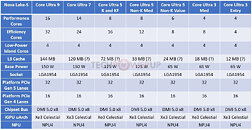

Sources:
Weibo, HXL on X
Previously, we got a taste of what to expect from Nova Lake-S in a series of leaks and rumors, which pointed to increased NPU performance as well as core counts that range from 12 on the low-end (4 P-cores, 4 E-cores, 4 LP-cores) to 52 on the high-end (16 P-cores, 32 E-cores, 4 LP-cores). Obviously, these are early leaks, and the official launch is still a way out, so dates may still change, but it seems as though the current silicon and DRAM shortages may result in the lengthening of product launch cycles across the PC industry in general—an outcome that was previously predicted.


118 Comments on Intel "Nova Lake-S" Coming in 2027, CES Launch Alongside AMD "Olympic Ridge" Likely
- PCIe 4.0 adoption first onto all motherboards in desktop, workstation and server space
- PCIe 5.0 adoption into server boards
- integrate USB10 into chipset and CPU
- offer NVMe drive IO on the CPU, including Gen5 NVMe drive on the CPU
- offer 4 displays on iGPU via desktop APU
- offer NPU via desktop APU
- support DP40 and HDMI 2.1 FRL on iGPU
- important adoption of UALink open ecosystem in server space
Obviously, Intel has a longer list, buy hey, consumers benefit from both.Yep. That was a mistake. They did not get their packaging plant working on time, to stitch V-cache dies with the rest sooner. I hope they don't make the same mistake again. Up to 3 months difference in vanilla and X3D SKUs is tolerable, but not any longer.
That H1 2026 estimate is based on current Steam Survey. My guess is that it would be a bit lower. ~40%, but more is possible if Arrow Lake refresh does not impress buyers.
Once upon a time, these companies were living on the cutting edge, took chances and were innovative.
Then the upper management got old and comfortable, their businesses had outlasted the competition, so there was no longer any need to do more than they had to, as the money was still coming in and they had their share of the market.
The only "innovation" that was going on, was when there was a new motherboard chipset or some generational shift in technology, more often than not, pushed by Intel and also encouraged by Intel through their MDF program.
What you're listing are just evolutional steps of already existing standards (except USB10?), which didn't scare these companies, as AMD never pushed for a different graphics card interface or some non standard type connector or a new type of memory. On top of that, Intel followed shortly behind on many of these things, making it a safe bet for the board makers and they could beta test some things on the AMD platform and if anything went wrong, they could always blame it on AMD.
If you look at actual motherboard specs, things like HDMI 2.1 was blocked by the board makers and often still are, especially on lower-end boards that get to make do with HDMI 1.4. AMD has always and still is struggling to get the board makers to implement new features, even more so if it's not something that isn't on Intel's road map.
AMD doesn't have much of an MDF program, AMD doesn't really have the engineering resources Intel has had in the past, although I don't know what it's like today, but Intel have had local FAE's that come over and train the motherboard makers, reference boards and really detailed documentation, whereas AMD hasn't invested in these type of things. There's a reason why the Initial AM4 motherboards weren't so good, as AMD had apparently sent over a few trays of chipsets, some rough instructions and asked the board makers to make some boards. These are things that aren't general knowledge for obvious reasons, but that I've been told by people in the industry, due to both having worked as a tech journalist for a long time, but also having lived in Taiwan for a good chunk of my life.
Should things be like this? No, but these companies have old, slow leadership that wants to make safe products that they know there where the ROI is. Taking chances isn't something they do easily any more and this is most likely also a reason why we won't see CAMM2 boards, unless someone like Kingston does it together with Intel.
Just look at how dumb the motherboard market is that the four "big" motherboard makers (Asus, ASRock, Gigabyte and MSI) can't sit down and agree on some common standards. As such, we now have four different back side connector layouts, we have four different ways of attaching Wi-Fi antennas and there could be common connector standards for a lot of other things, but not. They really need a kick in the arse for this.
The sales numbers prove that. While it would be nice to get 12c on a single CCD with Zen 6 i also dont feel like it's strictly necessary for most people.
Much less the 52c Intel plans and that's going to cost and arm and a leg. (just looks at Panther Lake prices).
Not that i think Zen 6 will be cheap either because even if it's economically cheaper to make due to much smaller chiplets than Intel, AMD will likely still price it high because margins...Something a tiny minority of people care about even in the DIY space.
Most people consume content. They dont create the content.
At least not the kind of content that would meaningfully benefit from high core counts.I fail to see how pushing 2-3x the power can be considered winning. A pyrrhic win at best.8c/16t etc topped the charts last year too. Way before DDR5 prices went to hell. It's not a recent development.They chose to go with 8 P-Cores because of power limitations. 13th and 14gn were already power hogs even with 8p.
I shiver to think what the results would have been with 16p. And even so with 8p they still pushed these too far.
Tho to be fair the degradation issue was not because of core counts or even core power consumption.Which are these?
I've seen the old standard screw in the cables variant (annoying) and the new quick connect variant everyone seems to be moving to. What are the other two?
MSI at least retained the option of using screw in antennas, which Asus and Gigabyte didn't bother with.
As for the market contracting, those claims are grossly exaggerated. While the selection and pricing of memory and SSDs are bad, they are absolutely more obtainable (if you adjust your expectations) than during the 2020-2021 problems, and there are bundles as well as great deals for CPUs and motherboards. I expect the sales to be just fine, even though the selection of some parts will be challenging.
To @dgianstefani. Dear, stop spewing this Intel marketing vomit and show us how you run real-time applications (ohh, may be games?) on your favorite ecores cores with the same performance as pcores.
If you disagree, you're welcome to supply some evidence to the contrary.
chipsandcheese.com/p/skymont-intels-e-cores-reach-for-the-sky
blog.hjc.im/spec-cpu-2017
chipsandcheese.com/p/skymont-in-gaming-workloads
Friend, it's all about L2cache and memory latencies loss. For ecore, it's a 2x penalty compared to pcore. No amount of IPC will help them.
Clock speed of E-cores are much less than normal cores, and that's it.
Performance is IPC * clock.
Skymont E Core IPC is essentially the same as Raptor Cove P core, but of course they run at 4.x GHz instead of 5.x GHz, and as has been pointed out there's some latency and cache differences, but it's not false to say the IPC is essentially the same. A massive achievement considering the die area of the cores being compared.
Going to bed now, but I'm satisfied with the sources I've provided to defend that statement.
Yes, you can say that the IPC is similar, but first clock speed is not the same.
Secondly, and more importantly, is if the next e-core supports 512-bit FPU instructions with 512-bit FPUs, then the advantages of "small" size will diminish.
Or if it executes with 256-bit FPUs, then it still lags behind P-cores and/or Zen 5/6.
And those same general users will buy a 52 or 48 core Nova lake CPU and 2/3 of those cores will be idle majority of the time.That life cycle will be alittle longer if Zen 7 gets released for AM5 and based on memory pricing and when DDR6 is going to come out I think its highly likely.
Do you think you will be happy if your pay cut is cut by 20%. Or you will not be happy with you pay rises by 20%?
Wasn't that Intel?Nvm, after some extra googling I found about the 8000G series, I had totally forgotten about those.They clearly mentioned IPC, not absolute performance, and they are indeed right on that claim.Se above, they never claimed that those E-cores were overall faster than the P-cores, but just compared the IPC.
"Gracemont’s shared L2 controller and offcore interface is probably also a complex piece of logic that draws a good chunk of power by itself. Labeled in orange above, this block is responsible for handling L2 requests coming from all cores in the cluster, and arbitrating between them. That means each Gracemont core has a less direct path to the ring bus."
www.techpowerup.com/review/intel-core-i9-12900k-e-cores-only-performance/2.html
Can we ask @W1zzard to do a completely identical test for skymont?
I presume 1080p, but the C&H article does not specify.
Also they tested with Arc B580. A relatively weak CPU to use for a CPU limited test.
If it's a CPU test then it's not optimal as the results look more GPU limited than CPU limited.
Plus they used the built in benchmark that is not CPU limited so that's another mistake.
They also dont state if they used APO (CP2077 being one of the APO supported games) or what specific Windows version they were using as this can greaty affect AMD's performance.
This is from 285K launch. Default configuration (all P and E enabled). Tested with 4090 in a custom CPU limited area:
I very much doubt that e cores would be so close to p cores in this scenario and nor would the 285K be this close to 9900X.
In the Techspot article their difference is not 3fps, but rather 26fps.Top #10 are between $84 and $675.
#1 is $473.
Only 3 out of 10 are below $200.
I very much doubt it's about price.
www.amazon.com/Best-Sellers-Computer-CPU-Processors/zgbs/pc/229189
We can know that, in general, compared to 8p, 8p16e can improve gaming performance by 5%. For games with good MT optimization such as 2077, e-core performance scales well. Using e-core alone performs poorly in purely ST games like Starcraft 2, but in most games the performance difference from p-core is not significant. 8p is affected by the thread count and performs worse than 16e in more modern games.