Friday, February 20th 2026

Intel "Nova Lake-S" Coming in 2027, CES Launch Alongside AMD "Olympic Ridge" Likely

It was revealed in a recent leak that the next-gen AMD Zen 6 Ryzen CPUs would be delayed until 2027, and it has now emerged, that the upcoming Intel "Nova Lake-S" Core Ultra Series 4 CPUs may be joining AMD for an early 2027 launch, when previous reports placed the launch in late 2026. The news comes by way of ubiquitous leakers, HXL on X and Golden Pig Upgrade on Weibo, who say that a CES 2027 launch seems likely for both new CPU generations.

Previously, we got a taste of what to expect from Nova Lake-S in a series of leaks and rumors, which pointed to increased NPU performance as well as core counts that range from 12 on the low-end (4 P-cores, 4 E-cores, 4 LP-cores) to 52 on the high-end (16 P-cores, 32 E-cores, 4 LP-cores). Obviously, these are early leaks, and the official launch is still a way out, so dates may still change, but it seems as though the current silicon and DRAM shortages may result in the lengthening of product launch cycles across the PC industry in general—an outcome that was previously predicted.
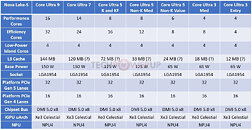

Sources: Weibo, HXL on X
Add your own comment

118 Comments on Intel "Nova Lake-S" Coming in 2027, CES Launch Alongside AMD "Olympic Ridge" Likely

#1
Hyderz
Oh man if this is true wizard and other reviewers gonna have double the work, this gonna be good
Posted on Reply
#2
Tomorrow
This was always pretty much a given. Remember how Panther Lake was also "promised" for end of 2025 and launched in 2026?
Same with Nova Lake. Unless you want to lose money then never bet on Intel's release dates.
Posted on Reply
#3
N/A
So only 72 MB LLC per tile. Double the last gen.
Posted on Reply
#4
john_
Intel will be marketing cores, while AMD will be marketing threads. We have a reverse of the market we had 8 years ago when AMD had the core and thread count advantage.
Posted on Reply
#5
ZoneDymo
john_Intel will be marketing cores, while AMD will be marketing threads. We have a reverse of the market we had 8 years ago when AMD had the core and thread count advantage.
Not to that guy but in that case its not a reverse.
Anywho, who cares about cores or threads, its performance that matters, if a company would come along and launch a single core cpu that beats it all then people should get that one.
Doesnt matter how its achieved, what matters is that its achieved.
Posted on Reply
#6
john_
ZoneDymoNot to that guy but in that case its not a reverse.
Anywho, who cares about cores or threads, its performance that matters, if a company would come along and launch a single core cpu that beats it all then people should get that one.
Doesnt matter how its achieved, what matters is that its achieved.
90% of consumers, if not more, do not spent time reading tech stuff online. Their approach on choosing PC hardware is usually very simple.
The CPU with the more cores is faster.
The graphics card with the more VRAM is faster.
And that's it.

It's how I will choose for example a refrigerator.
"This is bigger, it's non-frost and at a better price, while carrying a known brand's name. I should choose that".
Someone reading tech staff about refrigerators will probably have a reason, or two, or even ten, to explain to me why I should avoid that model.
Posted on Reply
#7
dgianstefani
TPU Proofreader
N/ASo only 72 MB LLC per tile. Double the last gen.
That's before BLLC too afaik.
john_Intel will be marketing cores, while AMD will be marketing threads. We have a reverse of the market we had 8 years ago when AMD had the core and thread count advantage.
52 is still more than 48, and those 52 are real cores, while the 48 is actually only 24.

Will be interesting to see 8+8/32/4 vs 12+12.

I'm wondering how much difference the memory controller being on the compute tile is going to make, vs Arrow Lake which has it on a separate tile. Really crippled latency and didn't let the powerful cores stretch their legs in gaming. It's honestly impressive the updates and microcode has essentially brought ARL up to the level of RPL in gaming at this point, considering the +30% memory latency.
Posted on Reply
#8
Tek-Check
john_90% of consumers, if not more, do not spent time reading tech stuff online. Their approach on choosing PC hardware is usually very simple.
The CPU with the more cores is faster.
The graphics card with the more VRAM is faster.
Customer behaviors seem more complex than that, some more influenced by marketing propaganda, some less:
- many buyers found out that more cores are not faster if there is more cache for gaming (X3D CPUs)
- many buyers were happily brainwashed that more VRAM is less relevant if other features compensate for it (DLSS by Nvidia)
dgianstefani52 is still more than 48, and those 52 are real cores, while the 48 is actually only 24.
It has been irrelevant so far that Intel offers more cores. This did not trick millions of buyers in recent years. Quite the opposite. The unprecedented change in CPU market share (Q4 Mercury Research data, published everywhere) has not been based on the number of cores, but on CPU performance features, such as 3D V-cache, platform longevity and ease of upgrade, value, etc. This is also explored in the latest video by Hardware Unboxed.

For the upcoming LGA1954 to be a successful platform, Intel will have to play AMD's playbook and offer way more value, including far better platform longevity and ease of upgrade rather than changing sockets every 2-3 years. It's absolutely fundamental that they change their past approach to frequently dumped sockets.
Posted on Reply
#9
TumbleGeorge
dgianstefaniI'm wondering how much difference the memory controller being on the compute tile
Doesn't matter, dimm slot are in same distance like before.
Posted on Reply
#10
john_
dgianstefani52 is still more than 48, and those 52 are real cores, while the 48 is actually only 24.
This is a reply from a moderator in a site specialized in computer hardware for decades. No mention about Performance cores, or Efficiency cores. Even those low power efficient cores are counted as typical cores. They are cores. They are all cores. Right? No it is. They are all just cores. REAL cores. Indirectly, they are all promoted as performance cores. Frequency, architecture, they are irrelevant. They are simply "cores". Performance cores. Oh, yes, we don't call them directly "performance cores", but we are hoping the average consumer to think that they are all performance cores. Treat them in their mind as performance cores. Most of them will probably never realize they are not all the same and even if they do, well, would they be able to understand what that means, or even care? Even a 6 core modern CPU can do almost any task today without a problem.

There are articles about Bartlett Lake-S in TPU and other sites and there are people who would love having P cores only CPUs from Intel, with more than 8 P cores. I guess they don't know that "cores are cores", no matter the type of cores, so it is better an Intel hybrid with just 8 or even 6 P cores and a bunch of E cores, than a P only intel CPU with 12 P cores. They just don't understand it.

If a moderator in a tech site can use that argument, that they are "real cores", ignoring the fact that they are not all the same, the same argument will be used from sales people and companies. Intel will easily win market share just by advertising cores. That was the idea behind the hybrid design anyway. And it worked.
By the way, that 52 CPU model, is said of having peak power consumption at 700W. But it's 52 cores, right? 52 :cool: Now if you need a $700 motherboard and a $300 1.2KW-1.5KW PSU to just be able to use it without worries, at it's advertised frequencies, it's unimportant.
Posted on Reply
#11
Airisom
Core ultra 7 and 9 look enticing, but thermals are going to be through the roof with all of those cores. Depending on how well those p cores perform, they might trade blows with the x3d chips in gaming, and multi thread will definitely be in their ballpark. Power, efficiency & thermals will likely go to AMD, but will fall behind in multi thread.

When it comes to core count, Intel basically put an hedt processor on a mainstream chipset, so maybe this will push AMD to throw one of their server CCDs on their next socket change. Zen 6C is rumored to be a 32 core CCD, so they could put one of those on and then a regular 12 core CCD, making room for an x3d version for the 12 core CCD. But we're looking at a socket change for something like that.

AMD has some cards to play still, but Intel seems like they're playing their hand with Nova lake. Whenever AMD gets around to changing their socket, I think a hybrid setup with regular CCDs and C CCDs will be necessary to compete with Intel on core volume.
Posted on Reply
#12
dgianstefani
TPU Proofreader
john_This is a reply from a moderator in a site specialized in computer hardware for decades. No mention about Performance cores, or Efficiency cores. Even those low power efficient cores are counted as typical cores. They are cores. They are all cores. Right? No it is. They are all just cores. REAL cores. Indirectly, they are all promoted as performance cores. Frequency, architecture, they are irrelevant. They are simply "cores". Performance cores. Oh, yes, we don't call them directly "performance cores", but we are hoping the average consumer to think that they are all performance cores. Treat them in their mind as performance cores. Most of them will probably never realize they are not all the same and even if they do, well, would they be able to understand what that means, or even care? Even a 6 core modern CPU can do almost any task today without a problem.

There are articles about Bartlett Lake-S in TPU and other sites and there are people who would love having P cores only CPUs from Intel, with more than 8 P cores. I guess they don't know that "cores are cores", no matter the type of cores, so it is better an Intel hybrid with just 8 or even 6 P cores and a bunch of E cores, than a P only intel CPU with 12 P cores. They just don't understand it.

If a moderator in a tech site can use that argument, that they are "real cores", ignoring the fact that they are not all the same, the same argument will be used from sales people and companies. Intel will easily win market share just by advertising cores. That was the idea behind the hybrid design anyway. And it worked.
By the way, that 52 CPU model, is said of having peak power consumption at 700W. But it's 52 cores, right? 52 :cool: Now if you need a $700 motherboard and a $300 1.2KW-1.5KW PSU to just be able to use it without worries, at it's advertised frequencies, it's unimportant.
Arrow Lake E cores are equivalent IPC to Raptor Lake P cores, which are stronger than Zen 4, and the 285K compares favourably to the 9950X with significantly fewer threads, so yes, they're real cores. The layout and distinction is to maximise efficiency, as you likely know. In fact the efficient cores are so damn good that Intel will be switching to a unified core based off them, not the P cores, in future.

Red herring arguments based around big numbers like "700 W" are unfortunate, especially when you don't mention the rather pertinent fact that was in a power limits removed manual tune setup, not stock. You going to mention Threadrippers hitting 1 KW+ under the same conditions? No?
john_No mention about Performance cores, or Efficiency cores.
dgianstefaniWill be interesting to see 8+8/32/4 vs 12+12.
I've bolded it for your convenience.
Posted on Reply
#13
john_
Tek-CheckCustomer behaviors seem more complex than that, some more influenced by marketing propaganda, some less:
- many buyers found out that more cores are not faster if there is more cache for gaming (X3D CPUs)
- many buyers were happily brainwashed that more VRAM is less relevant if other features compensate for it (DLSS by Nvidia)
The first example is applicable in the DIY market. I doubt people buying gaming systems from big corporations to even know what X3D chips are.
The second example whould have been correct if the Nvidia brand wasn't as strong as it is today. People look at the Nvidia logo first, then look at their wallet to decide how much of Nvidia VRAM they can buy. AMD played the VRAM card and they still do, Intel also gone the VRAM root, but they couldn't beat Nvidia's brand power. Now if we limit ourselves in the Nvidia market share ignoring AMD and intel offerings, the RTX 5060 Ti with 16GBs of VRAM selling close or even higher in some cases against the RTX 5070 12GBs, shows that people still buy based on VRAM capacity.
Tek-CheckThis did not trick millions of buyers in recent years.
It did. Intel started winning back market share after the introduction of the 12th gen series. AMD started defending it's market share when X3D CPUs where introduced, but it had Intel to shoot it's feat with the problematic, degrading, 14th and 13th gen CPUs to start losing market share again. Probably because large OEMs lowered their orders from Intel fearing higher RMA numbers and bad publicity for their own brands.
dgianstefaniArrow Lake E cores are equivalent IPC to Raptor Lake P cores, which are stronger than Zen 4, and the 285K compares favourably to the 9950X with significantly fewer threads, so yes, they're real cores. The layout and distinction is to maximise efficiency, as you likely know. In fact the efficient cores are so damn good that Intel will be switching to a unified core based off them, not the P cores, in future.

Red herring arguments based around big numbers like "700 W" are unfortunate, especially when you don't mention the rather pertinent fact that was in a power limits removed manual tune setup, not stock. You going to mention Threadrippers hitting 1 KW+ under the same conditions? No?


I've bolded it for your convenience.
No you just greyed the important part. But thanks for insisting of counting all cores as equal. Because that's what marketing does and what marketing will continue doing. I mean, we are talking about Nova Lake and you compare with the cores in Raptor Lake. Is Nova Lake a 2027 model or a 2022 model? Are we going to keep finding excuses why 2022 performance should be treated as equal to 2027 performance? And that's IPC alone, probably ignoring top frequency and how about architecture and feature support?

As I said before, when this is a reply from a moderator in a tech site, does the average consumer has any chance at all to not be fooled by a sales person or the marketing material from an OEM? I believe not.
Posted on Reply
#14
dgianstefani
TPU Proofreader
john_No you just greyed the important part. But thanks for insisting of counting all cores as equal.
Are more virtual cores from SMT or HT, but fewer actual cores, as good as more dedicated cores, regardless of the type, for security or performance, in 2026 when we have CPUs with 24+ cores? Are you insisting threads are equal to cores? If anything, threads are a marketing point.
john_Because that's what marketing does and what marketing will continue doing. I mean, we are talking about Nova Lake and you compare with the cores in Raptor Lake.
We have numbers for Raptor, Arrow, Zen etc, we don't have numbers for Nova. Despite that you're using leaked overclocks as snide remarks about efficiency, and complaining about a hybrid architecture every other ISA than x86 has leapt on, for good reason. But you're perfectly happy to state the point of E cores is to "trick" consumers, regardless.

Apple M series chips, lauded as being best in class. Are they P core only designs? No? Wonder why?
john_Is Nova Lake a 2027 model or a 2022 model? Are we going to keep finding excuses why 2022 performance should be treated as equal to 2027 performance? And that's IPC alone, probably ignoring top frequency and how about architecture and feature support?
How about objective benchmarks, where Zen 5 and Arrow Lake trade blows? There's more than one way to achieve an objective. We can't remark on 2027 performance because the tests haven't been done.
john_As I said before, when this is a reply from a moderator in a tech site, does the average consumer has any chance at all to not be fulled by a sales person or the marketing material from an OEM? I believe not.
I'm not a moderator, you should make a point rather than dancing around unstated implications based on who is saying something.

Are the Zen 4/5 +Zen C core laptops, desktop and server chips designed to "trick" consumers too?

Tell me, when HT/SMT threads add ~20-30% MT to a core while introducing extra heat and security risks, do you think a second core clocked at ~70% as the main P core would do better than that virtual one?

The answer is yes.
john_the same argument will be used from sales people and companies. Intel will easily win market share just by advertising cores. That was the idea behind the hybrid design anyway. And it worked.
Did AMD Bulldozer having double the cores as Intel "work" for marketshare?

Your assertion Hybrid architectures are for marketing core counts instead of a conscious architectural choice with legitimate engineering and performance/efficiency reasons behind it, is weak.
Posted on Reply
#15
TheLostSwede
News Editor
TumbleGeorgeDoesn't matter, dimm slot are in same distance like before.
Unless there's a move to CAMM2 on the desktop.
Posted on Reply
#16
dgianstefani
TPU Proofreader
TumbleGeorgeDoesn't matter, dimm slot are in same distance like before.
Also it does matter, the IMC being on a different die added a lot of latency in Arrow Lake. This was somewhat fixed with 200S boost that increases interconnect speed among other things. But the IMC being on the same die as the cores keeps latency lower than otherwise, regardless of distance to the actual modules. It's a similar situation to core to core latency being really bad in inter CCD situations for dual CCD Zen cores, that round trip is bad.
Posted on Reply
#17
john_
dgianstefaniAre more virtual cores from SMT or HT, but fewer actual cores, as good as more dedicated cores, regardless of the type, for security or performance, in 2026 when we have CPUs with 24+ cores? Are you insisting threads are equal to cores? If anything, threads are a marketing point.
I am talking about the marketing of cores being cores, no matter if they are performance cores that have full feature set and cache and clock up to over 5.x GHz, or if they are low powered cores meant to lack features, have less cache and clock lower than 4GHz. You happily keep supporting that marketing, of "cores are cores", because, yeah, if we compare them to 2022 cores and ignore that those cores had probably better feature set, more cache and where clocking higher, well, they are equal.
dgianstefaniWe have numbers for Raptor, Arrow, Zen etc, we don't have numbers for Nova. Despite that you're using leaked overclocks as snide remarks about efficiency, and complaining about a hybrid architecture every other ISA than x86 has leapt on, for good reason. But you're perfectly happy to state the point of E cores is to "trick" consumers, regardless.

Apple M series chips, lauded as being best in class. Are they P core only designs? No? Wonder why?
Ah yeah, modern SoCs in smartphones come with configurations like, ONE high performance core, just ONE, three somewhat performance cores and four efficiency cores. It's enough for most smartphones, it's probably enough for most applications even on desktop, but are we going to use the fact that today's CPUs are more than enough for the most average tasks people need, to use that to try to hide under the carpet the fact that people are sold "8 core SOCs" and they don't realize, that those cores aren't equal? Are we a tech site, or are we evaluating marketing material and having a debate about how easy it is to trick consumers?

Apple M series are used mostly in mobile systems or mini PCs, with passive cooling to sell "high performance, no noise" systems to consumers. The Ultra series, like the M3 Ultra chip that is used in Mac pro, integrates 32 cores, 24 Performance cores and only 8 Efficiency cores. NOT the opposite. You are defending the marketing behind "a few P cores and a gazillion of E cores" the opposite of what Apple is doing.
dgianstefaniHow about objective benchmarks, where Zen 5 and Arrow Lake trade blows? There's more than one way to achieve an objective. We can't remark on 2027 performance because the tests haven't been done.
Benchmarks? Ok, let's see some benchmarks.
Benchmarks of Performance-core only Bartlett Lake CPU emerge, 10-core offers 26% faster multithreaded performance than 14-core i5-14400 — 12-core version launch could be imminent | Tom's Hardware
"10-core offers 26% faster multithreaded performance than 14-core i5-14400"
dgianstefaniI'm not a moderator, you should make a point rather than dancing around unstated implications based on who is saying something.

Are the Zen 4/5 +Zen C core laptops, desktop and server chips designed to "trick" consumers too?

Tell me, when HT/SMT threads add ~20-30% MT to a core while introducing extra heat and security risks, do you think a second core clocked at ~70% as the main P core would do better than that virtual one?

The answer is yes.
Sorry, "stuff member".
You think if you are having a debate with someone who is a simple member, people would ignore the fact that you are part of the team of TPU? Should I think that you don't believe that your position as a TPU member add to the credibility of what you post?

Zen C cores are NOT equal to Zen cores and we all understand it. Even the fact that Zen C cores, on the contrary of what Intel is doing, do have the same architecture and feature set as typical Zen cores, it is a fact that they lack cache and they clock lower. So, who is more sincere towards the average consumer? AMD that is selling full feature set and same architecture Zen C cores, or Intel that sells cores that are having IPC like 2022 cores based on what YOU say, while, compared to those 2022 cores, probably lack features, lack cache and clock lower?

The fact that you insist on calling even those island cores in Nova Lake chips as just "cores", while using Zen C cores as an example, does say something here.

As for extra heat, that's an Intel problem, going even higher than 100C when it shouldn't introducing throttling and instability, when in Zen cores that are smaller and more efficient than Intel P cores, the temperature is reaching 95C because that's how they are designed. Even AVX is done the correct way in AMD CPUs, not pushing them in overheating territory.

Security? Intel in the last many years had many more security problems than AMD. The problems in Intel CPUs where so severe compared to the problems in AMD CPUs, that at one time a non existing security company in Israel has being used in an efford to paint a bad image of AMD CPUs.

You see, you are using Intel problems, to keep defending Intel's solution to that problems, which was to limit the P cores in it's CPU designs and disable AVX512 commands in it's mainstream CPUs. AMD doesn't have such problems. You can't project Intel's problems on AMD CPUs thinking that this is an argument.


Nothing more to add here.
Your reaction

which translates to "I don't have arguments", closes our conversation.
Posted on Reply
#18
dgianstefani
TPU Proofreader
john_I am talking about the marketing of cores being cores, no matter if they are performance cores that have full feature set and cache and clock up to over 5.x GHz, or if they are low powered cores meant to lack features, have less cache and clock lower than 4GHz. You happily keep supporting that marketing, of "cores are cores", because, yeah, if we compare them to 2022 cores and ignore that those cores had probably better feature set, more cache and where clocking higher, well, they are equal.

Ah yeah, modern SoCs in smartphones come with configurations like, ONE high performance core, just ONE, three somewhat performance cores and four efficiency cores. It's enough for most smartphones, it's probably enough for most applications even on desktop, but are we going to use the fact that today's CPUs are more than enough for the most average tasks people need, to use that to try to hide under the carpet the fact that people are sold "8 core SOCs" and they don't realize, that those cores aren't equal? Are we a tech site, or are we evaluating marketing material and having a debate about how easy it is to trick consumers?

Apple M series are used mostly in mobile systems or mini PCs, with passive cooling to sell "high performance, no noise" systems to consumers. The Ultra series, like the M3 Ultra chip that is used in Mac pro, integrates 32 cores, 24 Performance cores and only 8 Efficiency cores. NOT the opposite. You are defending the marketing behind "a few P cores and a gazillion of E cores" the opposite of what Apple is doing.


Benchmarks? Ok, let's see some benchmarks.
Benchmarks of Performance-core only Bartlett Lake CPU emerge, 10-core offers 26% faster multithreaded performance than 14-core i5-14400 — 12-core version launch could be imminent | Tom's Hardware
"10-core offers 26% faster multithreaded performance than 14-core i5-14400"

Sorry, "stuff member".
You think if you are having a debate with someone who is a simple member, people would ignore the fact that you are part of the team of TPU? Should I think that you don't believe that your position as a TPU member add to the credibility of what you post?

Zen C cores are NOT equal to Zen cores and we all understand it. Even the fact that Zen C cores, on the contrary of what Intel is doing, do have the same architecture and feature set as typical Zen cores, it is a fact that they lack cache and they clock lower. So, who is more sincere towards the average consumer? AMD that is selling full feature set and same architecture Zen C cores, or Intel that sells cores that are having IPC like 2022 cores based on what YOU say, while, compared to those 2022 cores, probably lack features, lack cache and clock lower?

The fact that you insist on calling even those island cores in Nova Lake chips as just "cores", while using Zen C cores as an example, does say something here.

As for extra heat, that's an Intel problem, going even higher than 100C when it shouldn't introducing throttling and instability, when in Zen cores that are smaller and more efficient than Intel P cores, the temperature is reaching 95C because that's how they are designed. Even AVX is done the correct way in AMD CPUs, not pushing them in overheating territory.

Security? Intel in the last many years had many more security problems than AMD. The problems in Intel CPUs where so severe compared to the problems in AMD CPUs, that at one time a non existing security company in Israel has being used in an efford to paint a bad image of AMD CPUs.

You see, you are using Intel problems, to keep defending Intel's solution to that problems, which was to limit the P cores in it's CPU designs and disable AVX512 commands in it's mainstream CPUs. AMD doesn't have such problems. You can't project Intel's problems on AMD CPUs thinking that this is an argument.


Nothing more to add here.
You can keep looking for conspiracies where they don't exist, hope it works out for you. I could refute each of these "points" but they're cherry picked to suit an agenda, example being the Ultra M series, I.e the exception in the lineup. But it's a waste of time since, like I said, you have a predetermined fact (Intel bad) you'll measure every situation against. Luckily realities have been stated for other people reading even if it's wasted on some.
Posted on Reply
#19
john_
dgianstefaniYou can keep looking for conspiracies where they don't exist, hope it works out for you.
You can keep supporting hybrid CPU marketing as much as you like. It's fine with me.

PS Damn, accusing me of using "cherry picked points" when in fact I am replying to your own "points" - you mentioned Apple, but now you regret it I guess - it's really funny.
Posted on Reply
#20
Tomorrow
john_Intel will be marketing cores, while AMD will be marketing threads. We have a reverse of the market we had 8 years ago when AMD had the core and thread count advantage.
Isn't that what they've been doing since 12th gen? Hasn't helped them much so far...
john_90% of consumers, if not more, do not spent time reading tech stuff online. Their approach on choosing PC hardware is usually very simple.
The CPU with the more cores is faster.
And that's it.
Yet looking at the Amazon best sellers list these "more cores" models do not top sales charts.
It is as if people realize they dont need more than 8c/16t.
Posted on Reply
#21
RinSenpai
TomorrowIsn't that what they've been doing since 12th gen? Hasn't helped them much so far...
As long as it does the job, most people don't care about that at all unless they have specific needs.
TomorrowYet looking at the Amazon best sellers list these "more cores" models do not top sales charts.
It is as if people realize they dont need more than 8c/16t.
If you buy spare parts like that, you're already at the very least in the minority that does DIY PCs. Doesn't matter where you buy your spare parts after that. Getting 50% of sales from a market that is like 5% at best is nothing compared to the entire PC market. At least the brand gets loyalty/fidelity, but we're already too deep for the average consumer to care about that, and neither do they care about this feeling as well.
Posted on Reply
#22
Tek-Check
john_It did. Intel started winning back market share after the introduction of the 12th gen series. AMD started defending it's market share when X3D CPUs where introduced, but it had Intel to shoot it's feat with the problematic, degrading, 14th and 13th gen CPUs to start losing market share again. Probably because large OEMs lowered their orders from Intel fearing higher RMA numbers and bad publicity for their own brands.
Here is a graph for analysis. Strangely, it was Rocket Lake that recovered market share a bit. Alder Lake did not make a bigger impact until Q3 2022. This is linked to memory prices going down. That Q3 2022 looks bizarre too, like an anomaly. It took the whole year for new AM5 platform to start gaining momentum on Zen4. Once this process started, the rest is history of accelerated gain in market and revenue share.
dgianstefaniTell me, when HT/SMT threads add ~20-30% MT to a core while introducing extra heat and security risks, do you think a second core clocked at ~70% as the main P core would do better than that virtual one? The answer is yes.
Intel CEO said that SMT/HT will be coming back, after all. Is he not concerned with extra heat and security risks anymore?
TheLostSwedeUnless there's a move to CAMM2 on the desktop.
Very unlikely in current state of PC industry. Almost entire R&D effort has shifted towards data centers for the foreseeable, which means no time and money for significant innovations in desktop space. We will get a drop-in upgrade from AMD, perhaps a new chipset, and new platform from Intel at the next CES, more cores, a few extra IO on chipsets and that's about it.
Posted on Reply
#23
TheLostSwede
News Editor
Tek-CheckVery unlikely in current state of PC industry. Almost entire R&D effort has shifted towards data centers for the foreseeable, which means no time and money for significant innovations in desktop space. We will get a drop-in upgrade from AMD, perhaps a new chipset, and new platform from Intel at the next CES, more cores, a few extra IO on chipsets and that's about it.
CAMM2 is finished, so there's no more R&D to be done, just manufacturing.
There might be some performance improvements to be had from a tuned memory controller for it, but as we've already seen demo boards based on current hardware platforms, there isn't much too it.
The question is if there will be any DRAM module maker that will be willing to be first and/or if Intel will push it, as AMD is still terrible at pushing new standards and the Taiwanese board makers pretty much don't care about what AMD wants when it comes to new tech.
Posted on Reply
#24
john_
TomorrowIsn't that what they've been doing since 12th gen? Hasn't helped them much so far...
It did. It helped them go against AMD with the same or more numbers of cores. Where AMD was having an advantage, with 12th gen Intel managed to somewhat turn the tables. AMD's 6 core CPUs where put against 10(6+4) core Intel CPUs, losing in productivity, where 16 cores AMD CPUs where now competing with 16 cores(8+8) Intel CPUs. In single thread performance Intel was on parity or winning, because in single threat tests you only need one P core, while in multicore tests Intel was winning or coming close to AMD's 16 core models. And because Zen3 was configured for efficiency, when Intel was pushing 250W-300W power consumption, it was winning.
TomorrowYet looking at the Amazon best sellers list these "more cores" models do not top sales charts.
It is as if people realize they dont need more than 8c/16t.
Because consumers are looking at DDR4 platforms the last few months, because of DDR5 RAM prices, that's why 8 core AM4 CPUs are top options. 12 or 16 core AM4 CPU models are probably considered expensive and unnecessary for those looking at AM4 options.

The first one who realized that 8 P cores are probably enough, was Intel. That's why they chose to go with a maximum of 8 P cores. The problem with Intel's approach is elsewhere. In an effort to prove to me that I was looking at hybrid designs in a wrong way, another member mentioned Apple and it's M series. But here is the difference between Apple and Intel. Intel is promoting designs with a minimum number of P cores and usually multiples of Efficient cores. Apple is doing the opposite. It offers more P cores in higher performing models of it's CPUs, while keeping the E cores number at a minimum. That hybrid design respects the consumer.
Tek-CheckHere is a graph for analysis. Strangely, it was Rocket Lake that recovered market share a bit. Alder Lake did not make a bigger impact until Q3 2022. This is linked to memory prices going down. That Q3 2022 looks bizarre too, like an anomaly. It took the whole year for new AM5 platform to start gaining momentum on Zen4. Once this process started, the rest is history of accelerated gain in market and revenue share.
Interesting. I asked Google's AI (Mercury Research numbers) and it does give an explanation for the strange part. When asking about that Q3 2022, it replied with "Significant inventory shifts." AM5 needed time because AMD delayed the 7000 X3D chips for about 6 months.
Period AMD Share Intel Share Milestone / Context
H1 2020 ~18.6% ~81.4% Early COVID-19 desktop demand surge.
H2 2020 ~19.3% ~80.7% Launch of Ryzen 5000 (Zen 3).
H1 2021 ~17.1% ~82.9% Intel recovers share due to better supply chain.
H2 2021 ~16.2% ~83.8% Release of Intel 12th Gen (Alder Lake)
H1 2022 ~18.8% ~81.2% Alder Lake stabilizes Intel's gaming lead.
H2 2022 ~18.6% ~81.4% Launch of Ryzen 7000 (AM5 Platform).
H1 2023 ~19.2% ~80.8% Market inventory correction period.
H2 2023 ~19.8% ~80.2% AMD gains in high-end enthusiast segment.
H1 2024 ~23.0% ~77.0% Strong demand for Ryzen "X3D" gaming chips.
H2 2024 ~28.7% ~71.3% AMD exceeds 25% for the first time in years.
H1 2025 ~32.2% ~67.8% Launch of Ryzen 9000 series.
H2 2025 ~36.4% ~63.6% AMD reaches historic unit share high (Q4 2025).
H1 2026 ~43.0% ~57.0% Current Estimate (Q1 2026).
Posted on Reply
#25
XeonsNOpterons
Well, considering Intel's CEO confirmed Nova Lake in 2026 just a few weeks ago, I am bit skeptical. I think both Zen 6 and Nova Lake will drop at the end of 2026, these seem to be more or less fluff rumors. Also, even more doubtful as they keep calling them 10000-series when the pattern should make then 11000-series. Either way, Zen 6 and Nova Lake likely will launch in short succession to each other. It will be very exciting, and there is a good chance Intel takes a decent lead in all aspects with Nova Lake. Considering it will also have full AVX-512 support for both P and E cores, and the E-cores will likely have IPC similar to Zen 5... probably a blood bath for AMD in compute/productivity. At least, if software properly utilize Nova Lake.
Posted on Reply
Add your own comment
Nov 13th, 2026 07:17 PST change timezone

New Forum Posts

Popular Reviews

TPU on YouTube

Controversial News Posts