Friday, February 20th 2026

Intel "Nova Lake-S" Coming in 2027, CES Launch Alongside AMD "Olympic Ridge" Likely

It was revealed in a recent leak that the next-gen AMD Zen 6 Ryzen CPUs would be delayed until 2027, and it has now emerged, that the upcoming Intel "Nova Lake-S" Core Ultra Series 4 CPUs may be joining AMD for an early 2027 launch, when previous reports placed the launch in late 2026. The news comes by way of ubiquitous leakers, HXL on X and Golden Pig Upgrade on Weibo, who say that a CES 2027 launch seems likely for both new CPU generations.

Previously, we got a taste of what to expect from Nova Lake-S in a series of leaks and rumors, which pointed to increased NPU performance as well as core counts that range from 12 on the low-end (4 P-cores, 4 E-cores, 4 LP-cores) to 52 on the high-end (16 P-cores, 32 E-cores, 4 LP-cores). Obviously, these are early leaks, and the official launch is still a way out, so dates may still change, but it seems as though the current silicon and DRAM shortages may result in the lengthening of product launch cycles across the PC industry in general—an outcome that was previously predicted.
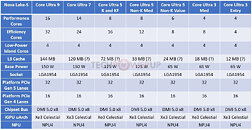

Sources: Weibo, HXL on X
Add your own comment

118 Comments on Intel "Nova Lake-S" Coming in 2027, CES Launch Alongside AMD "Olympic Ridge" Likely

#51
tsurugi
john_I am talking about the marketing of cores being cores, no matter if they are performance cores that have full feature set and cache and clock up to over 5.x GHz, or if they are low powered cores meant to lack features, have less cache and clock lower than 4GHz. You happily keep supporting that marketing, of "cores are cores", because, yeah, if we compare them to 2022 cores and ignore that those cores had probably better feature set, more cache and where clocking higher, well, they are equal.

Ah yeah, modern SoCs in smartphones come with configurations like, ONE high performance core, just ONE, three somewhat performance cores and four efficiency cores. It's enough for most smartphones, it's probably enough for most applications even on desktop, but are we going to use the fact that today's CPUs are more than enough for the most average tasks people need, to use that to try to hide under the carpet the fact that people are sold "8 core SOCs" and they don't realize, that those cores aren't equal? Are we a tech site, or are we evaluating marketing material and having a debate about how easy it is to trick consumers?

Apple M series are used mostly in mobile systems or mini PCs, with passive cooling to sell "high performance, no noise" systems to consumers. The Ultra series, like the M3 Ultra chip that is used in Mac pro, integrates 32 cores, 24 Performance cores and only 8 Efficiency cores. NOT the opposite. You are defending the marketing behind "a few P cores and a gazillion of E cores" the opposite of what Apple is doing.


Benchmarks? Ok, let's see some benchmarks.
Benchmarks of Performance-core only Bartlett Lake CPU emerge, 10-core offers 26% faster multithreaded performance than 14-core i5-14400 — 12-core version launch could be imminent | Tom's Hardware
"10-core offers 26% faster multithreaded performance than 14-core i5-14400"

Sorry, "stuff member".
You think if you are having a debate with someone who is a simple member, people would ignore the fact that you are part of the team of TPU? Should I think that you don't believe that your position as a TPU member add to the credibility of what you post?

Zen C cores are NOT equal to Zen cores and we all understand it. Even the fact that Zen C cores, on the contrary of what Intel is doing, do have the same architecture and feature set as typical Zen cores, it is a fact that they lack cache and they clock lower. So, who is more sincere towards the average consumer? AMD that is selling full feature set and same architecture Zen C cores, or Intel that sells cores that are having IPC like 2022 cores based on what YOU say, while, compared to those 2022 cores, probably lack features, lack cache and clock lower?

The fact that you insist on calling even those island cores in Nova Lake chips as just "cores", while using Zen C cores as an example, does say something here.

As for extra heat, that's an Intel problem, going even higher than 100C when it shouldn't introducing throttling and instability, when in Zen cores that are smaller and more efficient than Intel P cores, the temperature is reaching 95C because that's how they are designed. Even AVX is done the correct way in AMD CPUs, not pushing them in overheating territory.

Security? Intel in the last many years had many more security problems than AMD. The problems in Intel CPUs where so severe compared to the problems in AMD CPUs, that at one time a non existing security company in Israel has being used in an efford to paint a bad image of AMD CPUs.

You see, you are using Intel problems, to keep defending Intel's solution to that problems, which was to limit the P cores in it's CPU designs and disable AVX512 commands in it's mainstream CPUs. AMD doesn't have such problems. You can't project Intel's problems on AMD CPUs thinking that this is an argument.


Nothing more to add here.
Your reaction

which translates to "I don't have arguments", closes our conversation.
Hx370 zen5c and zen5 pcore are not on the same ring, which affects performance, and it fails to achieve the power-saving effect of intel lp-e, both of which are unfavorable to consumers. The only thing missing from intel e core is avx512, which will be added in novalake as avx10. It is expected that Arcticwolf IPC will exceed zen6 with a 20% lower clock, and e core is also a qualified high-performance core.
Posted on Reply
#52
N/A
12-P core on the same crystal is where it is at. Nova lake fails for this reason. If Intel wants to have 40 benchies just put them on a separate die for enthusiasts.
Posted on Reply
#53
qcmadness
tsurugiHx370 zen5c and zen5 pcore are not on the same ring, which affects performance, and it fails to achieve the power-saving effect of intel lp-e, both of which are unfavorable to consumers. The only thing missing from intel e core is avx512, which will be added in novalake as avx10. It is expected that Arcticwolf IPC will exceed zen6 with a 20% lower clock, and e core is also a qualified high-performance core.
AVX-512 support will add a lot of die space for FPU, even more if it is of full 512-bit data paths.
Posted on Reply
#54
john_
tsurugiHx370 zen5c and zen5 pcore are not on the same ring, which affects performance, and it fails to achieve the power-saving effect of intel lp-e, both of which are unfavorable to consumers. The only thing missing from intel e core is avx512, which will be added in novalake as avx10. It is expected that Arcticwolf IPC will exceed zen6 with a 20% lower clock, and e core is also a qualified high-performance core.
You (all) still don't get it do you? Or you just don't want to acknowledge it. It doesn't matter what the IPC of the E cores will be, as long as they are clearly inferior to the P cores. When Nvidia had done the 3.5+0.5 fiasco with the GTX 970, many where saying "It's good enough for me, so I don't bother". My argument was "You never tested that GTX 970 3.5+05, against a GTX 970 with all 4GB being fast VRAM to KNOW if it bothers you or not. And I am pretty sure when games started asking for 4GB of VRAM many seen that card under performing, but still they didn't had a GTX 970 with 4GB to test against.
When Intel's hybrid design came out people where cheering because those E cores where increasing the score in Cinebench. So I was repeating the same argument, because the same argument applies. You don't know how much you are missing, that's why you are happy. The increased number of cores, the sensation of having more cores affects you psychologically and seeing a benchmark like Cinebench scoring higher than a P cores only CPU model with LESS cores makes you believe that the design is good, it's great, it's the preferred option. But there is a difference with the GTX 970 example. Intel made the mistake of showing us what people where missing. Of course now they try to hide it by not releasing these CPUs to the retail market.
Benchmarks of Performance-core only Bartlett Lake CPU emerge, 10-core offers 26% faster multithreaded performance than 14-core i5-14400 — 12-core version launch could be imminent | Tom's Hardware
"10-core offers 26% faster multithreaded performance than 14-core i5-14400"

You are happy to point at Zen5C disadvantages, while you are rushing to defend Intel's approach. You more so pretend that you don't know what E cores are, by saying that they are only missing AVX512. Nothing about IPC against the P cores, nothing about cache, nothing about max frequency, nothing about other stuff that might differenciate those types of cores. On the contrary, I haven't done that, because It's NOT about AMD vs Intel. It's what they are selling me, against what I could be buying. And if I was an Intel customer, I could be buying a 10 P cores CPU, probably at a lower price than that 6+8 hybrid CPU, which might be having hiccups with applications that could use up to 8 or 10 P cores. By accepting a 6+4 cores CPU in place of a real 10 P cores CPU I am losing 20% performance while also I am accepting of relying on a "Thread Director", while I also accept (usually) the majority of my cores to have a lesser set of features while boosting also at a much lower frequency. Why? So I can see more graphs in my task manager.

All those excuses you are throwing as arguments, in favor of having a bunch of E cores next to a few P cores, will come and bite you in the future. Especially in case Intel wins against AMD. Intel will be selling you as a DESKTOP CPU a 2+4+4 core configuration, like what it is doing now in laptops with CPUs like the Intel Core Ultra 7 265U and you will be cheering "Yes but I am faster than Zen".
Unfortunately I don't have strong enough arguments against that kind of mentality. The only thing I can do is just wait a few years to read comments like "Oh come on Intel, why do I have to pay over $400 to get at least 6 P cores?" getting a reply "Those E cores are fast enough, you shouldn't complain".
Posted on Reply
#55
dgianstefani
TPU Proofreader
john_You (all) still don't get it do you? Or you just don't want to acknowledge it. It doesn't matter what the IPC of the E cores will be, as long as they are clearly inferior to the P cores. When Nvidia had done the 3.5+0.5 fiasco with the GTX 970, many where saying "It's good enough for me, so I don't bother". My argument was "You never tested that GTX 970 3.5+05, against a GTX 970 with all 4GB being fast VRAM to KNOW if it bothers you or not. And I am pretty sure when games started asking for 4GB of VRAM many seen that card under performing, but still they didn't had a GTX 970 with 4GB to test against.
When Intel's hybrid design came out people where cheering because those E cores where increasing the score in Cinebench. So I was repeating the same argument, because the same argument applies. You don't know how much you are missing, that's why you are happy. The increased number of cores, the sensation of having more cores affects you psychologically and seeing a benchmark like Cinebench scoring higher than a P cores only CPU model with LESS cores makes you believe that the design is good, it's great, it's the preferred option. But there is a difference with the GTX 970 example. Intel made the mistake of showing us what people where missing. Of course now they try to hide it by not releasing these CPUs to the retail market.
Benchmarks of Performance-core only Bartlett Lake CPU emerge, 10-core offers 26% faster multithreaded performance than 14-core i5-14400 — 12-core version launch could be imminent | Tom's Hardware
"10-core offers 26% faster multithreaded performance than 14-core i5-14400"

You are happy to point at Zen5C disadvantages, while you are rushing to defend Intel's approach. You more so pretend that you don't know what E cores are, by saying that they are only missing AVX512. Nothing about IPC against the P cores, nothing about cache, nothing about max frequency, nothing about other stuff that might differenciate those types of cores. On the contrary, I haven't done that, because It's NOT about AMD vs Intel. It's what they are selling me, against what I could be buying. And if I was an Intel customer, I could be buying a 10 P cores CPU, probably at a lower price than that 6+8 hybrid CPU, which might be having hiccups with applications that could use up to 8 or 10 P cores. By accepting a 6+4 cores CPU in place of a real 10 P cores CPU I am losing 20% performance while also I am accepting of relying on a "Thread Director", while I also accept (usually) the majority of my cores to have a lesser set of features while boosting also at a much lower frequency. Why? So I can see more graphs in my task manager.

All those excuses you are throwing as arguments, in favor of having a bunch of E cores next to a few P cores, will come and bite you in the future. Especially in case Intel wins against AMD. Intel will be selling you as a DESKTOP CPU a 2+4+4 core configuration, like what it is doing now in laptops with CPUs like the Intel Core Ultra 7 265U and you will be cheering "Yes but I am faster than Zen".
Unfortunately I don't have strong enough arguments against that kind of mentality. The only thing I can do is just wait a few years to read comments like "Oh come on Intel, why do I have to pay over $400 to get at least 6 P cores?" getting a reply "Those E cores are fast enough, you shouldn't complain".
What a disingenuous comparison.

1. Comparing Raptor Lake architecture to Alder Lake architecture CPUs.
2. Comparing larger die 7 series chips to smaller die 5 series chips.
3. Comparing high TDP chips vs low TDP chips.
4. Comparing expensive chips vs cheap chips.

Now, lets do a more fair comparison.

10 P cores takes essentially the same die area as 8 P cores + 8 E cores, so lets compare against a similar power target, same architecture (Raptor Lake), same tier (7), same die size chip, the 13700K.
To drive home the point, lets even include the smaller 13600K, a cut down die, with 6+8, and the 65 W locked low power version of it, too.


If you want to state "E cores are slower than P cores", that's true. Your argument is based around arbitrary limitations though, people aren't forced to choose between parts with the same number of cores pre and post Hybrid architectures. The 11600K had 6 P cores. The 12600K had 6 P cores and 4 E cores. The 13600K had 6 P cores and 8 E cores. They're a bonus. You don't get more performance or efficiency by swapping four E cores for one P core. Again, you can fit four E cores in the space of one P core, and 6+8 Intel chips sell for the same price as 6+0 AMD chips. Last time I checked the Intel and AMD P cores are competitive, so you can consider the E cores as "free".
Posted on Reply
#56
Contra
tsurugiWe can know that, in general, compared to 8p, 8p16e can improve gaming performance by 5%. .
Thanks for your miss. Our discussion here is about running real-time applications only on ecores with CPU cores (which are unnecessary because supposedly IPC ecores are the same and even have the same performance)
tsurugiIntel uses 2P per ring stop in Novalake, following the e-core method, viewing the sharing of a ring stop among multiple cores as a more advanced practice.
There's no point in speculating on non-existent products. Otherwise, we might think its performance will be worse than Lion Cove's, which was worse than Golden Cove's.
Posted on Reply
#57
john_
dgianstefaniWhat a disingenuous comparison.
Says the person that yesterday run away because of having no arguments. Remember that you used Apple as an example and then accusing me of using Apple as an example? No? I bet you don't.
Posted on Reply
#58
dgianstefani
TPU Proofreader
john_Says the person that yesterday run away because of having no arguments.
I went to bed as I stated it was past midnight and debating with randos online isn't top of my priorities list. My points were backed up with sources and there was nothing more to say.
john_Remember that you used Apple as an example and then accusing me of using Apple as an example? No? I bet you don't.
You mean the part where you picked the extremely low volume, multi thousand dollar single SKU exception to the rule as some kind of gotcha against a general comparison? Oversimplifying, cherry picking examples to find edge cases that support your position (cheap vs expensive, mobile vs desktop, new vs old) and putting words into other people's mouths doesn't win you any points when anyone can just scroll up and see what was actually written in full. Text based debates are good like that.

To be clear, in your vitriol against the hated Intel, you framed Apple as a pro consumer company.
Posted on Reply
#59
tsurugi
qcmadnessAVX-512 support will add a lot of die space for FPU, even more if it is of full 512-bit data paths.
Yes, 96mm2 die size compared to n3b arl 117mm2 checked.
Posted on Reply
#60
Contra
dgianstefaniIf you want to state "E cores are slower than P cores", that's true. Your argument is based around arbitrary limitations though, people aren't forced to choose between parts with the same number of cores pre and post Hybrid architectures. The 11600K had 6 P cores. The 12600K had 6 P cores and 4 E cores. The 13600K had 6 P cores and 8 E cores. They're a bonus. You don't get more performance or efficiency by swapping four E cores for one P core. Again, you can fit four E cores in the space of one P core, and 6+8 Intel chips sell for the same price as 6+0 AMD chips. Last time I checked the Intel and AMD P cores are competitive, so you can consider the E cores as "free".
Free, right? It's clearly not free for those who advertise it! Especially when they say "these 52 ecores are the same as 52 pcores" because they have the same IPC! Continue your marketing vomit elsewhere.
Posted on Reply
#61
dgianstefani
TPU Proofreader
Contra"these 52 ecores are the same as 52 pcores" because they have the same IPC!
I'm sure this was stated and this is an honest representation, so it should be easy for you to find a quote where I said this.

Again, perks of text based debate. People can verify statements.
Posted on Reply
#62
Contra
dgianstefani52 is still more than 48, and those 52 are real cores, while the 48 is actually only 24.
This is marketing vomit)
Posted on Reply
#63
dgianstefani
TPU Proofreader
ContraThis is marketing vomit)
You're entitled to your opinion on fact based statements.
Posted on Reply
#64
tsurugi
john_You (all) still don't get it do you? Or you just don't want to acknowledge it. It doesn't matter what the IPC of the E cores will be, as long as they are clearly inferior to the P cores. When Nvidia had done the 3.5+0.5 fiasco with the GTX 970, many where saying "It's good enough for me, so I don't bother". My argument was "You never tested that GTX 970 3.5+05, against a GTX 970 with all 4GB being fast VRAM to KNOW if it bothers you or not. And I am pretty sure when games started asking for 4GB of VRAM many seen that card under performing, but still they didn't had a GTX 970 with 4GB to test against.
When Intel's hybrid design came out people where cheering because those E cores where increasing the score in Cinebench. So I was repeating the same argument, because the same argument applies. You don't know how much you are missing, that's why you are happy. The increased number of cores, the sensation of having more cores affects you psychologically and seeing a benchmark like Cinebench scoring higher than a P cores only CPU model with LESS cores makes you believe that the design is good, it's great, it's the preferred option. But there is a difference with the GTX 970 example. Intel made the mistake of showing us what people where missing. Of course now they try to hide it by not releasing these CPUs to the retail market.
Benchmarks of Performance-core only Bartlett Lake CPU emerge, 10-core offers 26% faster multithreaded performance than 14-core i5-14400 — 12-core version launch could be imminent | Tom's Hardware
"10-core offers 26% faster multithreaded performance than 14-core i5-14400"

You are happy to point at Zen5C disadvantages, while you are rushing to defend Intel's approach. You more so pretend that you don't know what E cores are, by saying that they are only missing AVX512. Nothing about IPC against the P cores, nothing about cache, nothing about max frequency, nothing about other stuff that might differenciate those types of cores. On the contrary, I haven't done that, because It's NOT about AMD vs Intel. It's what they are selling me, against what I could be buying. And if I was an Intel customer, I could be buying a 10 P cores CPU, probably at a lower price than that 6+8 hybrid CPU, which might be having hiccups with applications that could use up to 8 or 10 P cores. By accepting a 6+4 cores CPU in place of a real 10 P cores CPU I am losing 20% performance while also I am accepting of relying on a "Thread Director", while I also accept (usually) the majority of my cores to have a lesser set of features while boosting also at a much lower frequency. Why? So I can see more graphs in my task manager.

All those excuses you are throwing as arguments, in favor of having a bunch of E cores next to a few P cores, will come and bite you in the future. Especially in case Intel wins against AMD. Intel will be selling you as a DESKTOP CPU a 2+4+4 core configuration, like what it is doing now in laptops with CPUs like the Intel Core Ultra 7 265U and you will be cheering "Yes but I am faster than Zen".
Unfortunately I don't have strong enough arguments against that kind of mentality. The only thing I can do is just wait a few years to read comments like "Oh come on Intel, why do I have to pay over $400 to get at least 6 P cores?" getting a reply "Those E cores are fast enough, you shouldn't complain".
Everyone knows that the intel e-core architecture is the future unified core architecture, and Arcticwolf ipc is very likely to exceed zen6. Your argument is completely invalid.
12 p-core has high area costs. On Raptorlake, 4 e-cores are equivalent to the area of 1 p-core. Napkin math shows that 6+8 requires the area of 8 p-cores, while 10-core is a cut-down version of 12-core. For the same cost, you could get 8+16 instead of 12/10, which increases the performance you get at the same cost.
That is how it works.
Under a given cost, hybrid is the optimal solution. Intel will not give you more silicon area, but because intel considers that after exceeding 8 p-cores, the performance gained by adding p-cores is lower than adding e-cores, they chose to add e-cores under the same area constraint. Since intel used 2 CPU architectures, utilizing the high performance of p-cores and high area efficiency of e-cores, there is nothing incomprehensible here.
you have a bias against e-cores, ignoring the fact that it is a very advanced CPU architecture. The latest e-core Arcticwolf ipc can fully compare with zen6 and coyotecove, and you also ignore the fact that intel has sold so many hybrid CPUs, Windows and Thread Director work very well, and performance has increased rather than decreased.
Posted on Reply
#65
john_
dgianstefaniI went to bed as I stated it was past midnight and debating with randos online isn't top of my priorities list. My points were backed up with sources and there was nothing more to say.
You think I want to lose time with people like you that are posting based on an agenda? JMO of course. My problem is that I can't block a stuff member.
You mean the part where you picked the extremely low volume, multi thousand dollar single SKU exception to the rule as some kind of gotcha against a general comparison? Oversimplifying, cherry picking examples to find edge cases that support your position (cheap vs expensive, mobile vs desktop, new vs old) and putting words into other people's mouths doesn't win you any points when anyone can just scroll up and see what was actually written in full. Text based debates are good like that.
See why I don't want to lose time with you?
Intel is using an approach that is more logical for mobile, low powered devices. It builds it's hybrid CPUs like they are meant to go into a smartphone. A few P cores, more E cores, in the majority of cases. When you used Apple, you probably had in mind that Apple does the same, but Apple doesn't do the same. Their hybrid CPUs come with more P cores than E cores. Not only the top model, but MOST models.

See how the efficiency cores are only 4 and the number of P cores is increasing?
How about the M3 series.

WOW! They are even decreasing the number of E cores to fit more P cores. Imagine that!

Maybe in the past they where doing it differently?

Well, they did increased P cores in the Ultra model, but they are still half the P cores.
How about their first series?

Even then.

Intel had to do something against AMD's multicore CPUs. Because of having an older node and because AMD's Zen cores are smaller than Intel's P cores, they couldn't fit up to 16 cores like AMD in their CPUs. So they had the idea of Hybrid CPUs and because they already had little cores for over a decade, they combined those cores. And it was a very good idea. But unfortunately Intel didn't follow Apple's example. Instead they decided to beat AMD in numbers and use E cores as a marketing tool. To be able to sell CPUs with more cores than AMD. So instead of using TSMC's 3nm to fit more P cores and now 18A to fit even more P cores, they are just adding a gazillion of E cores. Maybe at Apple they are stupid, maybe you should send them a mail and explain it to them. Or maybe they respect more their customers. Maybe they understand that it is better to have 10-20 P cores than having 30-40 E cores that aren't going to be used in cases outside of Cinebench. Maybe?

Anyway, in a few years you will be explaining to me why a 2+4+4 configuration is more than enough for DESKTOPS. Something like "Those 2 P cores beat a Zen 7, those +4 beat a Zen 6 and those +4 beat a Zen 5" argument.
and putting words into other people's mouths doesn't win you any points
Yeah, right.
dgianstefaniApple M series chips, lauded as being best in class. Are they P core only designs? No? Wonder why?
dgianstefaniI could refute each of these "points" but they're cherry picked to suit an agenda, example being the Ultra M series, I.e the exception in the lineup.
I putted words in your mouth, right?
Posted on Reply
#66
dgianstefani
TPU Proofreader
john_So instead of using TSMC's 3nm to fit more P cores and now 18A to fit even more P cores, they are just adding a gazillion of E cores.
P Core counts are literally doubling in Nova Lake...
john_Anyway, in a few years you will be explaining to me why a 2+4+4 configuration is more than enough for DESKTOPS. Something like "Those 2 P cores beat a Zen 7, those +4 beat a Zen 6 and those +4 beat a Zen 5" argument.
Still putting words into my mouth I see.
Posted on Reply
#67
N/A
Haha, no, you can fit only 2.66 Ecore into one Pcore. 6 Pcore ~~ 16 Ecore. But the performance is 33% better for synthetics. Which is completely useless. I don't play synthetics. Intel just broke the processor into pieces and made a mess.
Posted on Reply
#68
dgianstefani
TPU Proofreader
N/AHaha, no, you can fit only 2.66 Ecore into one Pcore. 6 Pcore ~~ 16 Ecore. But the performance is 33% better for synthetics. Which is completely useless. I don't play synthetics. Intel just broke the processor into pieces and made a mess.
2.66?

Raptor Lake die shot.


This is an Arrow Lake die shot.

Posted on Reply
#69
john_
dgianstefaniP Core counts are literally doubling in Nova Lake...

Still putting words into my mouth I see.
Any comment about your Apple example? Or are you going to selectively ignore almost everything, like 80%, of what I post and doesn't suits your narrative?
Posted on Reply
#70
dgianstefani
TPU Proofreader
john_Any comment about your Apple example? Or are you going to selectively ignore almost everything, like 80%, of what I post and doesn't suits your narrative?
4+4, 4+6, 5+6, 6+6 and 8+4 being the most commonly sold (base and pro) so different from 6+4, 6+8 (i5/ultra 5) most commonly sold chips?
Posted on Reply
#71
john_
dgianstefani4+4, 4+6, 5+6, 6+6 and 8+4 being the most commonly sold (base and pro) so different from 6+4, 6+8 (i5/ultra 5) most commonly sold chips?
Come on, see the lineups above. Does Apple use E cores as a way to increase number of cores, or as a way to use them the way they are meant to be used, for efficiency when the system is idle?

Why am I even asking? Obviously you don't want to post something that will make you look wrong. You don't have the nerve.
Posted on Reply
#72
N/A
dgianstefani2.66?

Raptor Lake die shot.
Lion Cove (with L2) = 4.53 mm²
Skymont (with L2) = 1.73 mm²
Even less so when you consider the clock and power management die area.
Posted on Reply
#73
dgianstefani
TPU Proofreader
N/AEven less so when you consider the clock and power management die area.
The L2 is shared between four cores though.
Posted on Reply
#74
tsurugi
N/AEven less so when you consider the clock and power management die area.
nope. e core 4.6ghz is good, and is close to zen5 5.3ghz. 15% difference
What is power management die area, and is it permissible to make up non-existent content when discussing technology?
Posted on Reply
#75
N/A
dgianstefaniThe L2 is shared between four cores though.
Well, they probably shouldn't do that when L3 plays that role. all 20 Ecores must share all 20MB and increase it to 50MB. Now it's just leaving room for improvement. Like they did with rocket lake and leaving alder lake early adopters in the dust.
tsurugiWhat is power management die area, and is it permissible to make up non-existent content when discussing technology?
This is something I noticed on the pixelated image.
Posted on Reply
Add your own comment
Nov 13th, 2026 08:07 PST change timezone

New Forum Posts

Popular Reviews

TPU on YouTube

Controversial News Posts