Friday, February 20th 2026

Intel "Nova Lake-S" Coming in 2027, CES Launch Alongside AMD "Olympic Ridge" Likely

It was revealed in a recent leak that the next-gen AMD Zen 6 Ryzen CPUs would be delayed until 2027, and it has now emerged, that the upcoming Intel "Nova Lake-S" Core Ultra Series 4 CPUs may be joining AMD for an early 2027 launch, when previous reports placed the launch in late 2026. The news comes by way of ubiquitous leakers, HXL on X and Golden Pig Upgrade on Weibo, who say that a CES 2027 launch seems likely for both new CPU generations.

Previously, we got a taste of what to expect from Nova Lake-S in a series of leaks and rumors, which pointed to increased NPU performance as well as core counts that range from 12 on the low-end (4 P-cores, 4 E-cores, 4 LP-cores) to 52 on the high-end (16 P-cores, 32 E-cores, 4 LP-cores). Obviously, these are early leaks, and the official launch is still a way out, so dates may still change, but it seems as though the current silicon and DRAM shortages may result in the lengthening of product launch cycles across the PC industry in general—an outcome that was previously predicted.
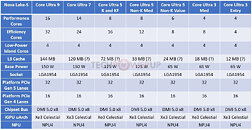

Sources: Weibo, HXL on X
Add your own comment

118 Comments on Intel "Nova Lake-S" Coming in 2027, CES Launch Alongside AMD "Olympic Ridge" Likely

#76
qcmadness
dgianstefaniThe L2 is shared between four cores though.
Unless you can remove that part in actla products, you should include it in calculations.
Posted on Reply
#77
dgianstefani
TPU Proofreader
N/AWell, they probably shouldn't do that when L3 plays that role. all 20 Ecores must share all 20MB and increase it to 50MB. Now it's just leaving room for improvement. Like they did with rocket lake and leaving alder lake early adopters in the dust.

This is something I noticed on the pixelated image.
Sure, I'm just pointing out that die size calculations should use 1/4 the size of the L2, if you're using direct single Lion Cove + L2 compared to single Skymont + L2, since four Skymont + L2 doesn't suddenly have 16 MB worth of L2 on the die. I guess a fair way of doing the calculation would be comparing four Lion Cove + L2 vs four Skymont + L2, or just not including cache in core die area comparisons. E.g. much of the die size reductions from Zen to Zen C cores is from halving the cache.
qcmadnessUnless you can remove that part in actla products, you should include it in calculations.
You should, yes, but in a manner that is mathematically accurate. Using shared cache as part of a single core die size number is not the same methodology as using dedicated cache, as in the Lion Cove number. Those E cores don't come in singular units, they come as blocks of four.
Posted on Reply
#78
qcmadness
dgianstefaniSure, I'm just pointing out that die size calculations should use 1/4 the size of the L2, if you're using direct single Lion Cove + L2 compared to single Skymont + L2, since four Skymont + L2 doesn't suddenly have 16 MB worth of L2 on the die. I guess a fair way of doing the calculation would be comparing four Lion Cove + L2 vs four Skymont + L2, or just not including cache in core die area comparisons. E.g. much of the die size reductions from Zen to Zen C cores is from halving the cache.


You should, yes, but in a manner that is mathematically accurate. Using shared cache as part of a single core die size number is not the same methodology as using dedicated cache, as in the Lion Cove number. Those E cores don't come in singular units, they come as blocks of four.
I know his numbers are good since I calculated myself. But I have lost the data so I will start over again.

www.techpowerup.com/img/6OiYtPkXwaf5pbEp.jpg

Total die size: 114.5 mm^2 (847*437)
P-Core with L2 cache: 5.30 mm^2 (115*149)
E-Core cluster with L2 cache: 7.05 mm^2(154*148)
1 e-core: 1.76 mm^2

www.techpowerup.com/img/gMqnfAZUnWWvmECy.jpg
As for Zen 5 vs Zen 5c, there are more than cache size reductions.
Strix Point: 225.6 mm^2 (1850*1187)
Zen 5: 3.7mm^2 (155*229)
Zen 5c: 3.2 mm^2 (155*199)
At same L2 cache size, by tuning the target frequency, the size of a core could shrink by 15%.
And please notice Strix Point has only half FPU present, so the difference will be bigger for full FPU variations (Zen 5 CCD & Zen 5c CCD).
Posted on Reply
#79
dgianstefani
TPU Proofreader
qcmadnessI know his numbers are good since I calculated myself. But I have lost the data so I will start over again.

www.techpowerup.com/img/6OiYtPkXwaf5pbEp.jpg

Total die size: 114.5 mm^2 (847*437)
P-Core with L2 cache: 5.30 mm^2 (115*149)
E-Core cluster with L2 cache: 7.05 mm^2(154*148)
1 e-core: 1.76 mm^2
Interesting, so the ratio changed with Arrow Lake from Raptor Lake, where it was closer to four. Makes sense since the E cores saw a ~50% performance jump from Meteor Lake Crestmont, though of course there's changes from laptop-desktop variants. E.g. Arrow Lake Skymont is arranged differently from Lunar Lake Skymont.

5.3 is 301.13636363636% of 1.76
qcmadnesswww.techpowerup.com/img/gMqnfAZUnWWvmECy.jpg
As for Zen 5 vs Zen 5c, there are more than cache size reductions.
Strix Point: 225.6 mm^2 (1850*1187)
Zen 5: 3.7mm^2 (155*229)
Zen 5c: 3.2 mm^2 (155*199)
At same L2 cache size, by tuning the target frequency, the size of a core could shrink by 15%.
Yeah IIRC they also removed through silicon vias and made manufacturing changes with C cores.
Posted on Reply
#80
qcmadness
dgianstefaniInteresting, so the ratio changed with Arrow Lake from Raptor Lake, where it was closer to four. Makes sense since the E cores saw a ~50% performance jump.

5.3 is 301.13636363636% of 1.76

Yeah IIRC they also removed through silicon vias and made manufacturing changes with C cores.
Three is close to four?
I am not convinced at all.

And the P-core is even larger than Zen 5 with an inferior node (N3B vs N4P).
dgianstefaniInteresting, so the ratio changed with Arrow Lake from Raptor Lake, where it was closer to four. Makes sense since the E cores saw a ~50% performance jump from Meteor Lake Crestmont, though of course there's changes from laptop-desktop variants. E.g. Arrow Lake Skymont is arranged differently from Lunar Lake Skymont.

5.3 is 301.13636363636% of 1.76

Yeah IIRC they also removed through silicon vias and made manufacturing changes with C cores.
You are wrong.
I am comparing the Zen5 vs Zen 5c cores in Zen 5 APUs where vias are not present.
Posted on Reply
#81
dgianstefani
TPU Proofreader
qcmadnessThree is close to four?
I am not convinced at all
I'm referring to Raptor Lake with the "close to four" as the discussion was about the 10P/0E vs normal Raptor Lake hybrid chips. Arrow Lake has bigger relative E cores.
qcmadnessYou are wrong.
I am comparing the Zen5 vs Zen 5c cores in Zen 5 APUs where vias are not present.
Relax, I'm talking about normal CCD Zen 5/Zen 5c, since it's a simpler direct comparison, not the monolithic APUs.
Posted on Reply
#82
qcmadness
dgianstefaniI'm referring to Raptor Lake with the "close to four" as the discussion was about the 10P/0E vs normal Raptor Lake hybrid chips. Arrow Lake has bigger relative E cores.


Relax, I'm talking about normal CCD Zen 5/Zen 5c, since it's a simpler direct comparison, not the monolithic APUs.
You could not compare them directly because they are made with different nodes (N4P vs N3B).
I don't know why you compare them directly.

What we could compare directly is that a 4-core e-core cluster has similar die size with 2.3 Zen 5c cores.
Posted on Reply
#83
dgianstefani
TPU Proofreader
1x Golden Cove w/ 1.25MB L2$ is 7.04mm² .

1x Gracemont w/o L2$ = 1.70mm².

1x Golden Cove (roughly) w/o L2$ = 5.55mm²

4x Gracemont w/ 2MB L2$ = 8.78mm² (+25% vs. 1x Golden Cove)

Note that Raptor Lake Raptor Cove P cores have 2 MB L2 than the 1.25 MB Alder Lake Golden Cove P core, otherwise being the same, so they're bigger from Alder-Raptor Lake, pushing it closer to a 1:4 ratio, whereas both use Gracemont E cores.
qcmadnessI don't know why you compare them directly.
As mentioned, the topic came up because a member compared the 10P/0E Raptor Cove CPU vs a 6P/4E Golden Cove/Gracemont unit. First of all that's flawed because they're different generations, Raptor Cove has 2 MB vs the 1.25 MB of L2 Golden Cove has. The comparison was between Raptor Cove and Gracemont, emphasising that for those two extra P cores, you can fit ~8 extra E cores. So it would be 8+8 or 10+0, roughly.
qcmadnessWhat we could compare directly is that a 4-core e-core cluster has similar die size with 2.3 Zen 5c cores.
Yeah that's an interesting one.
Posted on Reply
#84
qcmadness
dgianstefani1x Golden Cove w/ 1.25MB L2$ is 7.04mm² .

1x Gracemont w/o L2$ = 1.70mm².

1x Golden Cove (roughly) w/o L2$ = 5.55mm²

4x Gracemont w/ 2MB L2$ = 8.78mm² (+25% vs. 1x Golden Cove)

Note that Raptor Lake Raptor Cove E cores have 2 MB L2, so they're bigger from Alder-Raptor Lake, whereas both use Crestmont E cores.


As mentioned, the topic came up because a member compared the 10P/0E Raptor Cove CPU vs a 6P/4E Raptor Cove/Gracemont unit. The comparison was between Raptor Cove and Gracemont, emphasising that for those two extra P cores, you can fit ~8 extra E cores. So it would be 8+8 or 10+0, roughly.

Yeah that's an interesting one.
No one would compare items without L2 caches as they are integral in performance and the ratio is fixed already.
Posted on Reply
#85
dgianstefani
TPU Proofreader
qcmadnessNo one would compare items without L2 caches as they are integral in performance and the ratio is fixed already.
Yeah but you can't directly compare one E core with L2 to a P core with L2 because on the E core it's a shared hardware unit with three other E cores, but it's dedicated per core for the P. You have to take a block of four with it's shared L2, then divide by four.
Posted on Reply
#86
qcmadness
dgianstefaniYeah but you can't directly compare one E core with L2 to a P core with L2 because on the E core it's a shared hardware unit, but it's dedicated per core for the P. You have to take a block of four with it's shared L2, then divide by four.
Already in all of my calculations.
Posted on Reply
#87
dgianstefani
TPU Proofreader
qcmadnessAlready in all of my calculations.
As in mine...
So?

I included both with/without caches.

That's because it's relevant, Golden Cove - Raptor Cove is the same architecture, just with different levels of cache, that affects per core die size by a fair bit. Similar with Zen 5 and Zen 5c.
Posted on Reply
#88
john_
tsuruginope. e core 4.6ghz is good, and is close to zen5 5.3ghz. 15% difference
Source?
Posted on Reply
#89
tsurugi
john_Source?
zen5 5.3ghz
tpu 9700x review overclocking page.
e-core 4.6ghz
tpu 285k review overclocking page.
Posted on Reply
#90
john_
tsurugizen5 5.3ghz
tpu 9700x review overclocking page.
e-core 4.6ghz
tpu 285k review overclocking page.
Show us.
Is there a comparison between one E core and one Zen 5 core that shows what you are claiming? Please, show us.
Posted on Reply
#91
XeonsNOpterons
dgianstefaniIPC is indeed instruction per clock.
Performance is IPC * clock.
Skymont E Core IPC is essentially the same as Raptor Cove P core, but of course they run at 4.x GHz instead of 5.x GHz, and as has been pointed out there's some latency and cache differences, but it's not false to say the IPC is essentially the same. A massive achievement considering the die area of the cores being compared.

Going to bed now, but I'm satisfied with the sources I've provided to defend that statement.
Based upon my PassMark floating point performance data, Skymont E-cores are around 1730 FP/GHz/core while Raptor Cove P-cores are around 2022 FP/GHz/core. In extended instructions, it is nowhere close though, around 324 EXI/GHz/core for Skymont E-cores and around 810 EXI/GHz/core for Raptor Core P-cores. This is likely due to the fact Skymont does not have AVX-512 and instead rather weak AVX2 implementation. The story is similar in Cinebench as the floating point PassMark scores. Overall, the E-cores are pretty good.

Intel is really going to bring the pain I think with Nova Lake as not only will there be huge core count bump and an E-core IPC gain of around 30%, but also the E-cores are getting AVX-512. And the fact the E-cores are remaining roughly the same size while increasing in IPC closer and closer to P-cores, means the unified Titan Lake cores will be smaller than current P-cores while being much faster and more efficient.
Posted on Reply
#92
RejZoR
I love my passive cooled ultrabook with Pentium N6000 running 4 E-Cores (Tremont). I wish there was passive cooled one with N350 chip running 8x E-Core (Alder Lake N). This would be an absolute beast and at just 7W.

I don't understand why scheduler doesn't run games entirely on P-Cores and all windows stuff separately on E-Cores. This way all the background crap wouldn't interfere with the games and fight for the CPU clock cycles. Game would just get absolute full time from P-Cores and the rest of crap would hog the E-Cores.
Posted on Reply
#93
tsurugi
john_Show us.
Is there a comparison between one E core and one Zen 5 core that shows what you are claiming? Please, show us.
You've got the wrong person, I'm talking about the clock, I already told you. Darkmont e core ipc is already the same as zen5, novalake only needs to reach 5ghz+ clock on arcticwolf n2, and there isn't much difference from the 5ghz+ zen6.
RejZoRI love my passive cooled ultrabook with Pentium N6000 running 4 E-Cores (Tremont). I wish there was passive cooled one with N350 chip running 8x E-Core (Alder Lake N). This would be an absolute beast and at just 7W.

I don't understand why scheduler doesn't run games entirely on P-Cores and all windows stuff separately on E-Cores. This way all the background crap wouldn't interfere with the games and fight for the CPU clock cycles. Game would just get absolute full time from P-Cores and the rest of crap would hog the E-Cores.
Game programs call fewer than 8 threads as the primary load. 6c12t has 95% performance, 8c16t has 100% performance, turning off smt can improve performance by 2%, but it is not exactly like that, 8p16e can make game performance reach 105%.
Posted on Reply
#94
Tomorrow
tsurugiYou've got the wrong person, I'm talking about the clock, I already told you. Darkmont e core ipc is already the same as zen5, novalake only needs to reach 5ghz+ clock on arcticwolf n2, and there isn't much difference from the 5ghz+ zen6.
Please stick to what's on the market. We dont know the final clocks speeds of either NVL or Zen 6 as both are still roughly 12 months away from being independently tested. The best we can do now is base our opinions on existing products and their clock speeds.
Posted on Reply
#95
MufasaV
john_You (all) still don't get it do you? Or you just don't want to acknowledge it. It doesn't matter what the IPC of the E cores will be, as long as they are clearly inferior to the P cores. When Nvidia had done the 3.5+0.5 fiasco with the GTX 970, many where saying "It's good enough for me, so I don't bother". My argument was "You never tested that GTX 970 3.5+05, against a GTX 970 with all 4GB being fast VRAM to KNOW if it bothers you or not. And I am pretty sure when games started asking for 4GB of VRAM many seen that card under performing, but still they didn't had a GTX 970 with 4GB to test against.
When Intel's hybrid design came out people where cheering because those E cores where increasing the score in Cinebench. So I was repeating the same argument, because the same argument applies. You don't know how much you are missing, that's why you are happy. The increased number of cores, the sensation of having more cores affects you psychologically and seeing a benchmark like Cinebench scoring higher than a P cores only CPU model with LESS cores makes you believe that the design is good, it's great, it's the preferred option. But there is a difference with the GTX 970 example. Intel made the mistake of showing us what people where missing. Of course now they try to hide it by not releasing these CPUs to the retail market.
Benchmarks of Performance-core only Bartlett Lake CPU emerge, 10-core offers 26% faster multithreaded performance than 14-core i5-14400 — 12-core version launch could be imminent | Tom's Hardware
"10-core offers 26% faster multithreaded performance than 14-core i5-14400"

You are happy to point at Zen5C disadvantages, while you are rushing to defend Intel's approach. You more so pretend that you don't know what E cores are, by saying that they are only missing AVX512. Nothing about IPC against the P cores, nothing about cache, nothing about max frequency, nothing about other stuff that might differenciate those types of cores. On the contrary, I haven't done that, because It's NOT about AMD vs Intel. It's what they are selling me, against what I could be buying. And if I was an Intel customer, I could be buying a 10 P cores CPU, probably at a lower price than that 6+8 hybrid CPU, which might be having hiccups with applications that could use up to 8 or 10 P cores. By accepting a 6+4 cores CPU in place of a real 10 P cores CPU I am losing 20% performance while also I am accepting of relying on a "Thread Director", while I also accept (usually) the majority of my cores to have a lesser set of features while boosting also at a much lower frequency. Why? So I can see more graphs in my task manager.

All those excuses you are throwing as arguments, in favor of having a bunch of E cores next to a few P cores, will come and bite you in the future. Especially in case Intel wins against AMD. Intel will be selling you as a DESKTOP CPU a 2+4+4 core configuration, like what it is doing now in laptops with CPUs like the Intel Core Ultra 7 265U and you will be cheering "Yes but I am faster than Zen".
Unfortunately I don't have strong enough arguments against that kind of mentality. The only thing I can do is just wait a few years to read comments like "Oh come on Intel, why do I have to pay over $400 to get at least 6 P cores?" getting a reply "Those E cores are fast enough, you shouldn't complain".
We do very much get it. It matters a lot the IPC of E cores. Especially when they get to the point that their performance is the same as a P core at multicore clocks. Remember that multicore workloads, always drop max clocks significantly. Even for single core, the E core helps massively in energy efficiency since the E core now is the default core for 90% of workloads (not just background tasks) since it is fast enough.

Comparing a 6+4 with a 10P core CPU makes no sense since one is drastically larger than the other. a 6+4 CPU is smaller than an 8 core CPU and MUCH faster in multicore workloads. Why? Because the E core IPC has almost caught up to the P core, and the P core runs at lower clocks in multicore unless power balloons past 300W. The only scenario 6+4 is bad, is pure performance in unlimited power scenarios. Or lacking AVX512, but even that is disappearing next gen.

Like I always say, let's not get too caught up in MARKETING and should instead of arguing on the basis of what should E core, P core, C core, whatever be in a perfect world, just look at the benchmarks of single thread and multithread vs the die sizes and max clocks achievable for each design of the cores and argue from there.
Posted on Reply
#96
john_
tsurugiYou've got the wrong person, I'm talking about the clock, I already told you. Darkmont e core ipc is already the same as zen5, novalake only needs to reach 5ghz+ clock on arcticwolf n2, and there isn't much difference from the 5ghz+ zen6.
"Trust me bro" source. OK.
MufasaVWe do very much get it. It matters a lot the IPC of E cores. Especially when they get to the point that their performance is the same as a P core at multicore clocks. Remember that multicore workloads, always drop max clocks significantly. Even for single core, the E core helps massively in energy efficiency since the E core now is the default core for 90% of workloads (not just background tasks) since it is fast enough.

Comparing a 6+4 with a 10P core CPU makes no sense since one is drastically larger than the other. a 6+4 CPU is smaller than an 8 core CPU and MUCH faster in multicore workloads. Why? Because the E core IPC has almost caught up to the P core, and the P core runs at lower clocks in multicore unless power balloons past 300W. The only scenario 6+4 is bad, is pure performance in unlimited power scenarios. Or lacking AVX512, but even that is disappearing next gen.

Like I always say, let's not get too caught up in MARKETING and should instead of arguing on the basis of what should E core, P core, C core, whatever be in a perfect world, just look at the benchmarks of single thread and multithread vs the die sizes and max clocks achievable for each design of the cores and argue from there.
When you start paying $400 for a desktop CPU with 2 P cores + 4 E cores + 4 Island cores, to run applications or games that ask for at least 8 fast cores for optimal performance, don't forget to post the same arguments.

I really love people who in my opinion, more or less say in their arguments "I will be paying for Nova Lake, but most of the cores will be Raptor Lake performance, but Raptor Lake was fast enough, so I am fine. Of course at the same time I would never ever pay for a Raptor Lake CPU at it's MSRP, because Raptor Lake is an old product". This is how I translate this kind of arguments when people try to convince me that cores performing like older products, in new products, are just fine. And they are fine for every day usage. I mean, I have an old Xeon E5 2680 V4 (14c/28t) here that I took from Ali in the form of those nice Xeon+X99+DDR combos for a friend and it is more than overkill for the majority of stuff he is going to do. And that's where the Hybrid designs bet. That you only need a couple of fast cores to win single threaded benchmarks. For the majority of stuff people are doing, even if you add a dozen of old Haswell cores the system will be more than fast and smooth enough. I just don't think we should applause when we get a new product that the majority of it's cores run like last year's product.
Posted on Reply
#97
N/A
tsurugi... novalake only needs to reach 5ghz+ clock on arcticwolf n2, and there isn't much difference from the 5ghz+ zen6
Very curious indeed. CPUz bench for 285K 950 1T 5.7 GHz / 19500 24T 4.9 P-core 4.6 Ghz E-core

What does this mean for Ecores.. 800*8 P-core 4.9, 800*16, it turns out that Ecore offers better IPC than Pcore. But again, that's 8 ALus, 4 backends, and 4 frontends. P Core only has 6 Alus frontends, so there's some truth to that.

Depending on what Game, Nioh 3 uses like 16T otherwise I get 30 FPS.
Posted on Reply
#100
Tomorrow
CPU-Z has always been a very poor benchmark that heavily favors Intel CPU's for some reason.
And like was posted above the e-core era is just a phase necessitated by other factors.
The sooner Intel returns to unified cores the better.

No one wants to deal with three different types of cores on the desktop.
Posted on Reply
Add your own comment
Nov 13th, 2026 08:07 PST change timezone

New Forum Posts

Popular Reviews

TPU on YouTube

Controversial News Posts