Friday, July 3rd 2026

Intel Readies Two 22-Core "Nova Lake-S" SKUs with 108 MB bLLC Cache for Gaming
According to well-known Intel leaker Jaykihn, Intel is preparing two "Nova Lake-S" CPU models with a 22-core configuration, enhanced by the big Last Level Cache (bLLC). These processors are part of the Core Ultra 5 400S family, and Intel is developing two mid-range configurations, each with 22 cores. Both models will feature 6 "Coyote Cove" P-Cores, 12 "Arctic Wolf" E-Cores, and 4 LPE-Cores. This design includes a single compute die aimed at mid-range gaming rigs. Alongside the 22 cores, Intel plans to add an extra 108 MB of bLLC cache to boost gaming performance, similar to AMD's approach with its Ryzen X3D gaming CPUs, which currently lead in gaming performance. Intel aims to match raw CPU compute power with newer CPU cores and use bLLC to improve latency-sensitive tasks like gaming. The only difference between the two new models is that one is an unlocked 125 W TDP version, part of the "K" overclockable family, while the other is a 65 W base TDP model.
Recently, it has been observed that Intel's upcoming Z9x0 platform for "Nova Lake-S" will support up to 52 cores in a single LGA-1954 socket. Some early rumors suggest a PL2 power draw of 474 W, which is a significant increase over previous designs. This is understandable, considering that the design brings workstation-like core counts into the consumer sector for the first time. Regarding the socket, Intel's LGA-1954 has been pictured with a 2-lever independent loading mechanism (ILM), similar to what Intel's HEDT sector uses. This is typically reserved for larger CPU packages, and with the pin count now nearing 2,000 socket pins, it is a necessary choice for Intel. Importantly, the first "Nova Lake-S" CPU SKUs are scheduled for release in just a few months, likely leading to more rumors as we approach the final launch.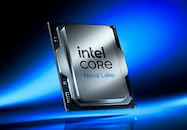
Source:
Jaykihn on X
Recently, it has been observed that Intel's upcoming Z9x0 platform for "Nova Lake-S" will support up to 52 cores in a single LGA-1954 socket. Some early rumors suggest a PL2 power draw of 474 W, which is a significant increase over previous designs. This is understandable, considering that the design brings workstation-like core counts into the consumer sector for the first time. Regarding the socket, Intel's LGA-1954 has been pictured with a 2-lever independent loading mechanism (ILM), similar to what Intel's HEDT sector uses. This is typically reserved for larger CPU packages, and with the pin count now nearing 2,000 socket pins, it is a necessary choice for Intel. Importantly, the first "Nova Lake-S" CPU SKUs are scheduled for release in just a few months, likely leading to more rumors as we approach the final launch.

279 Comments on Intel Readies Two 22-Core "Nova Lake-S" SKUs with 108 MB bLLC Cache for Gaming
Is nova lake still no HT?
MLID said that HT will return on Hammer Lake.
Socket longevity is a fallacy to me.. I rather just sell and buy a newer board every 3~ or so years. Especially since both AMD and Intel have had their share of CPU related problems. Seems too risky to extend a board past standard warranty in 2026.
AMD has been slaying it for years now, either they have something sweet cooking for Zen 6 and Zen 7 or they might just be rehashing things a bit more and Intel will take their crown. We'll see I guess. I still don't like Intel's short lived sockets. I like how AMD really uses it up fully before switching to new one where Intel is just swapping them like underwear.
And we will see a 16 core single CCD X3D part in Zen 7.
With all of the changes coming in Zen 6 things maybe different for Dual CCD's chips from the current generation will be looking forward to both of these next year.
The way i understand it, intel replaced a compute tile with a cache tile. Do we have any idea what the latency between the compute and cache tile will be?
Remember that the magic from AMDs 3d-Cache comes mostly from no latency increase from the normal L3 cache compared to the stacked on L3 cache.
Since someone mentioned the i7 5775c, with add 128mb eD-RAM, i think the new cache structure from intel is more compareable to that, since it is an extra tile. I would like to see benchmarks between chips with and without the cache tile and same amount of cores (deactivate the compute tile on the 56 core cpu).
The current memory and ssd chip shortile still won't help sales for both AMD and Intel when the new stuff gets released.
KEK
'Guess AMD had really been competitive these last several years; they're swapping places (relative to the Consumer):
AMD's AM5 is channeling Intel's 14nm++++++ energy with Prom21, and Intel is actually innovating and giving consumers more expansion.
What a time to be alive!
I know 14700kf > 270K PLUS isn't a huge upgrade. But I also game at 4k60, so on the gaming side, at this point in time, pretty much any modern half decent cpu will do. But I also do encoding and on that front, well, the 14700kf is also pretty impressive. So performance wise I'm already satisfied. Its just like with ram and ssds though. SSDs, I sure got my fill when they were cheap, ram.... not so much. Will I be asking myself the same question if its cpus up next?
So yeah, I guess its mostly fear based in these uncertain times.
A new homegrown architecture that competes well might not have that same price advantage. Again, hope I'm wrong.... but I think intel still thinks of themselves as premium. Maybe I'm wrong on that. But they did release the 14900ks soooo I don't know what lessons have been learned and what haven't.
Then the core counts are odd. I love gobs of e cores but my workload actually USES gobs of cores with code compiles and comp/decomp workloads. I'm not the average user though. The vast majority of people don't use the ecores as it is. 6cores is fine if that's the low end but it better be priced at $200-$250.
I'll be trying to get a 16+32+4 complete SKU but it'll take a good while after it launches. I'll wait a bit to see if Intel does a KS or something, and in that meantime hopefully I can grab a Z990 Apex
From the looks of it, they might be on track to release something this fall. And if they don't artificially gimp the 6/8 p-core models, then these would be the most relevant for most builders. I'm doubtful that they would be able to produce enough quantities of the 16 p-core model to try to push every "demanding user" towards that.
Anyways, getting the models which are ready out there as early as possible is only an advantage to us. The sooner these get in the hands of users, the sooner BIOS and firmware bugs will be ironed out.
Replacing the second compute tile with a cache tile seems the most cost efficient way to me. You can still use the same assembly line, you just feed it another, same sized tile.
For example, if 8P+16E had the same computing power relevant for gaming as 16P, I would like to see the comparison between 16P and 8P+16E.
I would not be surprised if 8P+16E performed a little bit worse than 16P, because the E cores were emplyed as a way to improve MT performance and not gaming.
I am convinced that Intel 6P+8E is better than 8 core normal AMD CPU as an universal PC CPU and there is nothing inherently wrong in using the hybrid P+E approach. However, proving that the E cores are beneficial for gaming by comparing 8P vs 8P+16E is simply wrong and misleading.
well, well, well..