Friday, July 3rd 2026

Intel Readies Two 22-Core "Nova Lake-S" SKUs with 108 MB bLLC Cache for Gaming
According to well-known Intel leaker Jaykihn, Intel is preparing two "Nova Lake-S" CPU models with a 22-core configuration, enhanced by the big Last Level Cache (bLLC). These processors are part of the Core Ultra 5 400S family, and Intel is developing two mid-range configurations, each with 22 cores. Both models will feature 6 "Coyote Cove" P-Cores, 12 "Arctic Wolf" E-Cores, and 4 LPE-Cores. This design includes a single compute die aimed at mid-range gaming rigs. Alongside the 22 cores, Intel plans to add an extra 108 MB of bLLC cache to boost gaming performance, similar to AMD's approach with its Ryzen X3D gaming CPUs, which currently lead in gaming performance. Intel aims to match raw CPU compute power with newer CPU cores and use bLLC to improve latency-sensitive tasks like gaming. The only difference between the two new models is that one is an unlocked 125 W TDP version, part of the "K" overclockable family, while the other is a 65 W base TDP model.
Recently, it has been observed that Intel's upcoming Z9x0 platform for "Nova Lake-S" will support up to 52 cores in a single LGA-1954 socket. Some early rumors suggest a PL2 power draw of 474 W, which is a significant increase over previous designs. This is understandable, considering that the design brings workstation-like core counts into the consumer sector for the first time. Regarding the socket, Intel's LGA-1954 has been pictured with a 2-lever independent loading mechanism (ILM), similar to what Intel's HEDT sector uses. This is typically reserved for larger CPU packages, and with the pin count now nearing 2,000 socket pins, it is a necessary choice for Intel. Importantly, the first "Nova Lake-S" CPU SKUs are scheduled for release in just a few months, likely leading to more rumors as we approach the final launch.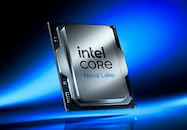
Source:
Jaykihn on X
Recently, it has been observed that Intel's upcoming Z9x0 platform for "Nova Lake-S" will support up to 52 cores in a single LGA-1954 socket. Some early rumors suggest a PL2 power draw of 474 W, which is a significant increase over previous designs. This is understandable, considering that the design brings workstation-like core counts into the consumer sector for the first time. Regarding the socket, Intel's LGA-1954 has been pictured with a 2-lever independent loading mechanism (ILM), similar to what Intel's HEDT sector uses. This is typically reserved for larger CPU packages, and with the pin count now nearing 2,000 socket pins, it is a necessary choice for Intel. Importantly, the first "Nova Lake-S" CPU SKUs are scheduled for release in just a few months, likely leading to more rumors as we approach the final launch.

279 Comments on Intel Readies Two 22-Core "Nova Lake-S" SKUs with 108 MB bLLC Cache for Gaming
You didn't buy it cause it's more efficient but because it's cheaper. If they were the same price everyone would buy the 9800x3d and set the clocks to the 7800x 3ds clocks, assuming they cared about efficiency. You end up with a faster, more efficient and cooler cpu.
When normalised to the same frequency, P core is only 40% more powerful than E core in Raptor lake and 20% in Arrow lake.
I made this comparison:
www.techpowerup.com/forums/attachments/arrow-raptor-1-core-perf-png.369503/
E cores in Arrow lake are pretty powerful.
Just how much are people sitting watching youtube or using office? So if people can afford a high performance PC then complaining about idle power draw is a bit pointless.
I suppose it might be important for some working from home, but I'd rather have a separate work PC for that. The 270k plus has no upgrade path, you're going to be spending a lot more if you want the next gen CPU, especially if it offers a significant jump in gaming and productivity performance.A disadvantage of $15-20 a year is massively overblown compared to choosing an Intel CPU where the platform doesn't allow for upgrades.It goes both ways, I remember when Ryzen launched many Intel users dismissed having more than 4 cores on desktop, or having AVX, or having socket longevity until the rumor of Nova Lake supporting more than just a single refresh appeared in the news. Intel users don't care about load efficiency since "e-cores" help in certain scenarios. The interesting thing to me is those e-cores aren't so efficient anymore, while Intel keeps clocking e-cores higher and adding more features in order to get them to be useful.I care more about the motherboard supporting upgrades since it's more money saved than replacing a motherboard, a few $ here or there on electricity is worth not having to drop $300 on a new motherboard.
- Maybe because programming slop going on right now is insane
- AVX is useless for the average consumer, but nice to have for professional work
- Socket longevity is whatever, argument above applies.
- E-cores are efficient IPC-wise but they lack the cache configuration for sustaining very high performance over very long periods of time like gaming.
$300 for an Intel motherboard? You're the kind of guy who's throwing money at anything anywhere at this point, and I can't take you seriously there.Old components can be sold, Because z890 and 270k plus are more stable in value than 9800x3d, the difference in money can be smaller.
The 270k plus might be more valuable than the 9800x3d years later, considering its performance is 2 times that of 9800x3d and it has a very good igpu, just like we see now with many old intel cpus, whose prices are higher than old amd cpus from the same period.Two PCs are great, but it costs a lot of money especially on amd systems, based on the 9950x/9800x3d configuration. you can choose 270k plus and 9800x3d, which seems to be the best choice to play on both platforms at the same time.
The infinite money strategy worked again, so you have money, then you can buy whatever you want to buy, but you are still unwilling to replace the motherboard.This is good, which means you get a discount again and better performance. And you can always change to the most fun new motherboard, while your old motherboard stays with you for a lifetime.I don't think it's necessary to change the cpu frequently, my money can be used for other things of more value. while the gaming/x3d CPU is more about vanity and doesn't seem to change much. CPU, as long as there is good enough st/mt, it works fine in gaming, I can't feel a 5ms difference, I don't think the performance of x3d in tests is good enough to be necessary, as it is very similar to intel cpu in most AAA games. but st/mt actually plays a real role and saves my time.
and there is no need to spend more money to get a less poor 8 core x3d.
For example, intel seems to intend to release an 8p+4lpe bllc product based on the 18a-p node. its MT performance is bad, but the "gaming performance" is good. however, this obviously won't make it sell at the price of current amd x3d products because it is completely manufactured by intel itself and the cost is very low. intel might want to sell as many as possible. But for real high-end MT cpus, intel won't lower the price by even a penny. by then, the so-called high-end impression of x3d gaming CPUs will fall apart.Sounds like you spent a lot of money on changing the CPU. Lga1954 supporting the next-gen cpus will make novalake cpu prices drop significantly, the lga1954 situation is very similar to amd, cpus always face heavy price drops.
I don't have any special feelings for my motherboard, so I will replace it along with the cpu when needed.
I think platform longevity is a fallacy. Always something better.. even X870 vs X670 EE design in regards to memory optimization.
Having resale value is nice, however trying to find buyers for components isn't always easy, especially ones who won't try to scam you saying a part doesn't work.
Newer Intel CPU's ones sell at a lower price so won't have a higher resale value, on the other hand AMD X3D CPU's have a very high resale value because of their performance.I was referring to having a work provided PC, though no one is making you buy a 9950X or 9800X3D, a 9700X or 7800X3D are much better value.
The infinite money strategy seems to be replacing a motherboard with every upgrade.What is fun about having to replace a motherboard? I don't understand the process of constantly wanting a new motherboard.
What features are necessary that an LGA1851 mobo can't provide?It isn't necessary to change the CPU frequently, though ironically I see people with Core 200 plus CPU's getting excited for Nova Lake, that seems rather frequent to be replacing the CPU to me.
But X3D isn't just about having lower latency, it provides higher average FPS than non-X3D CPU's do. I don't do work on my gaming PC and I'm not a youtuber so I don't care about a few mins extra of encoding time. The funny thing is Intel users dismissed the usefulness of X3D cache, until Intel announced their own CPU's with a large L3 cache, which probably won't be a price/performance value but I'm sure the same people who complained about X3D being too expensive will be buying bLCC CPU's.AM5 launched in late 2022, so anyone who doesn't want to change their motherboard constantly can hang onto the same board to drop in Zen 6, being able to keep the same board for at least 4-5 years.
I don't care about the board, what I do care about is unnecessarily changing the board because Intel refuses to stick to a socket.The GPU is always consuming more so I don't see the concern over idle CPU power, and getting a 14700KF down to less than 15W sounds like you're undervolting it, not really a comparison IMO.
I've never had a CPU go to 70C while browsing, though idle temps usually don't bother me either since any modern CPU will boost often as possible unless clocks are manually limited, and it's gotten worse since Microslop forced CPU's to boost in W11.It's the same argument every time, you don't need to upgrade every 2 years when AMD supports a socket much longer than 2 years. Enthusiasts rarely keep a CPU longer than 2 years regardless, I see people say that all the time but they rush to pay launch prices for the latest CPU's, just see how many people with relatively recent systems are excited for Nova Lake.
Even when giving the system to a family member I could still give them a CPU upgrade later without having to build another new PC.- I'm glad I can use Linux for most things nowadays, much of the programming slop is on Windows, and in games it's on overpriced AAA slop.
- My point was Intel took away AVX for a long time, then brought it back and suddenly AVX is a useful feature again, it's a double standard of things only being useful when Intel provides them.
- To each their own, I value not having to buy a new motherboard every 2 years.
- E-cores not having the same cache and performance as P-cores is why I don't like a mixed core architecture. I'd rather the NPU get dropped for more P cores.Decent Z series boards are usually around $300, with Nova Lake I'm expecting it to be more of an entry level given how the high end Nova Lake SKU is going to have a 474W PL2.
EVERYBODY thus should be excited about Nova lake and also about Zen 6.
* I must admit I still do not fully understand the astonishing willingnes of consumers to buy weak 8 core CPUs from AMD for extreme prices.
also pointless overprice same as AMD 6 core X3D vs "top-selling" (in fanboys zone) 8-corers R7.it all depends whether you want "OC" of K-SKUs, benchmark playing or generic PC. No need to overpay for VRM with GREAT "spare of power".:rolleyes:in theories only. No retailer wants to have losses if they have some stock. Same as with phones selling "previous" model when new arrives (except for BS that they just "magically disappear"), they make some "discount" for few tens of $/EUR, which is totally pointless when new model costs same "few tens" of $/EUR more, lol
Ex: I can't find previous gen i5 for price of new i3, same for old i7 vs new i5 etc etc. Can't find 7800X3D for the half price of 9800X3D, what you call "HEAVY DROPS" LMFAO
And you need to convince people to choose zen5 before the new zen6 12 core, which is very difficult.It is precisely because it is cheap that you cannot lose too much. The cpu specs are right there, the 270k plus MT performance is better than zen6 12 core, and some people can use it very well.Few people change their cpu every generation, you cannot represent the majority.You need to replace your cpu frequently, you cannot represent the majority. You spend much more money on the cpu and motherboard than most people, you need to understand that.Because 8 core is too weak, the situation for zen6 will be much better, but 12 core is still slightly worse than 6+12.
Motherboards are cheap compared to the cpu and can be sold together with the cpu, which is not a key feature that should be prioritized for purchase at all.
Because the performance of the cpu itself is the most important. I can understand that 9800x3d has very good gaming performance and people value this a lot, so it can sustain its premium.
But compared to the oced 270k plus, gaming performance is not significantly better, and a 5-10% gaming performance difference is not enough to justify the MT disadvantage and price.In 2022 am5 was expensive, and cpu performance was worse than intel. Overall, the price you paid for one amd motherboard and two cpus exceeded two intel cpus and two motherboards.
And you need to ensure that your motherboard vrm is sufficient to supply zen6 and that there is no loss of features compared to new motherboards, which was very difficult to determine in 2022.
You care about motherboards, no need to hide that. An am5 used motherboard you hold has little value, that is what you keep, while what is truly expensive is the cpu, you change frequently, buying high and selling low, paying a lot.