Friday, July 3rd 2026

Intel Readies Two 22-Core "Nova Lake-S" SKUs with 108 MB bLLC Cache for Gaming
According to well-known Intel leaker Jaykihn, Intel is preparing two "Nova Lake-S" CPU models with a 22-core configuration, enhanced by the big Last Level Cache (bLLC). These processors are part of the Core Ultra 5 400S family, and Intel is developing two mid-range configurations, each with 22 cores. Both models will feature 6 "Coyote Cove" P-Cores, 12 "Arctic Wolf" E-Cores, and 4 LPE-Cores. This design includes a single compute die aimed at mid-range gaming rigs. Alongside the 22 cores, Intel plans to add an extra 108 MB of bLLC cache to boost gaming performance, similar to AMD's approach with its Ryzen X3D gaming CPUs, which currently lead in gaming performance. Intel aims to match raw CPU compute power with newer CPU cores and use bLLC to improve latency-sensitive tasks like gaming. The only difference between the two new models is that one is an unlocked 125 W TDP version, part of the "K" overclockable family, while the other is a 65 W base TDP model.
Recently, it has been observed that Intel's upcoming Z9x0 platform for "Nova Lake-S" will support up to 52 cores in a single LGA-1954 socket. Some early rumors suggest a PL2 power draw of 474 W, which is a significant increase over previous designs. This is understandable, considering that the design brings workstation-like core counts into the consumer sector for the first time. Regarding the socket, Intel's LGA-1954 has been pictured with a 2-lever independent loading mechanism (ILM), similar to what Intel's HEDT sector uses. This is typically reserved for larger CPU packages, and with the pin count now nearing 2,000 socket pins, it is a necessary choice for Intel. Importantly, the first "Nova Lake-S" CPU SKUs are scheduled for release in just a few months, likely leading to more rumors as we approach the final launch.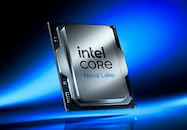
Source:
Jaykihn on X
Recently, it has been observed that Intel's upcoming Z9x0 platform for "Nova Lake-S" will support up to 52 cores in a single LGA-1954 socket. Some early rumors suggest a PL2 power draw of 474 W, which is a significant increase over previous designs. This is understandable, considering that the design brings workstation-like core counts into the consumer sector for the first time. Regarding the socket, Intel's LGA-1954 has been pictured with a 2-lever independent loading mechanism (ILM), similar to what Intel's HEDT sector uses. This is typically reserved for larger CPU packages, and with the pin count now nearing 2,000 socket pins, it is a necessary choice for Intel. Importantly, the first "Nova Lake-S" CPU SKUs are scheduled for release in just a few months, likely leading to more rumors as we approach the final launch.

279 Comments on Intel Readies Two 22-Core "Nova Lake-S" SKUs with 108 MB bLLC Cache for Gaming
Besides, I paid for a Titanium 1200 W power supply and a Titanium 1200 W power supply I shall use :rockout: :roll:
I personally care more about power use when actually using the system, and it's nice to not need to tinker in the UEFI to get load power use under control.
Do 13900T's run way faster? Yeah, especially if it's allowed the 106 W PL2 burst, and of course these chips are quite adequate for low-power designs, but I can't quite ignore that it clearly relies on the extended wattage range to get the bulk of its performance back
EG1. Talking about stock voltage curve, no UV and stuff.
I got an anti-meltdown cable for the second 5090 🙏
I am curious how Zen6 will be constructed.
It will be interesting to see how these nova lake chips compare to arrow lake and zen 5
Complaining about idle power draw is irrelevant, power draw at load is what matters, and as mentioned it's the heat and cooling requirements that become a concern with power hungry CPU's.
I'd rather not need to turn up the AC to keep the room cool, or need an E-ATX case for a high performance CPU.
Can't we just.... not talk about amd in this thread for once and stay on topic? Healthy competition is good for everyone.
In telation to this SKU, I can only say that diversity of SKUs on offer will be significant and many are looking forward to see how extended L3 cache would perform.
It might be a treacherous journey both for Intel and AMD if new generations of CPUs land in this sick PC market. Sales would be much lower due to absurd memory prices.
I'm looking forward to how Nova Lake and Zen 6 perform, but not to what launch prices are going to be, although AMD and Intel are going to need to be more aggressive on pricing due to the cost of RAM and SSD's, the desire to buy new platforms from enthusiasts has dropped quite a bit. Competition is nice, but Intel still has 80% marketshare, it's not like they're a failing company.