Friday, July 3rd 2026

Intel Readies Two 22-Core "Nova Lake-S" SKUs with 108 MB bLLC Cache for Gaming
According to well-known Intel leaker Jaykihn, Intel is preparing two "Nova Lake-S" CPU models with a 22-core configuration, enhanced by the big Last Level Cache (bLLC). These processors are part of the Core Ultra 5 400S family, and Intel is developing two mid-range configurations, each with 22 cores. Both models will feature 6 "Coyote Cove" P-Cores, 12 "Arctic Wolf" E-Cores, and 4 LPE-Cores. This design includes a single compute die aimed at mid-range gaming rigs. Alongside the 22 cores, Intel plans to add an extra 108 MB of bLLC cache to boost gaming performance, similar to AMD's approach with its Ryzen X3D gaming CPUs, which currently lead in gaming performance. Intel aims to match raw CPU compute power with newer CPU cores and use bLLC to improve latency-sensitive tasks like gaming. The only difference between the two new models is that one is an unlocked 125 W TDP version, part of the "K" overclockable family, while the other is a 65 W base TDP model.
Recently, it has been observed that Intel's upcoming Z9x0 platform for "Nova Lake-S" will support up to 52 cores in a single LGA-1954 socket. Some early rumors suggest a PL2 power draw of 474 W, which is a significant increase over previous designs. This is understandable, considering that the design brings workstation-like core counts into the consumer sector for the first time. Regarding the socket, Intel's LGA-1954 has been pictured with a 2-lever independent loading mechanism (ILM), similar to what Intel's HEDT sector uses. This is typically reserved for larger CPU packages, and with the pin count now nearing 2,000 socket pins, it is a necessary choice for Intel. Importantly, the first "Nova Lake-S" CPU SKUs are scheduled for release in just a few months, likely leading to more rumors as we approach the final launch.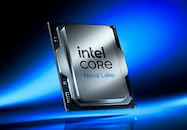
Source:
Jaykihn on X
Recently, it has been observed that Intel's upcoming Z9x0 platform for "Nova Lake-S" will support up to 52 cores in a single LGA-1954 socket. Some early rumors suggest a PL2 power draw of 474 W, which is a significant increase over previous designs. This is understandable, considering that the design brings workstation-like core counts into the consumer sector for the first time. Regarding the socket, Intel's LGA-1954 has been pictured with a 2-lever independent loading mechanism (ILM), similar to what Intel's HEDT sector uses. This is typically reserved for larger CPU packages, and with the pin count now nearing 2,000 socket pins, it is a necessary choice for Intel. Importantly, the first "Nova Lake-S" CPU SKUs are scheduled for release in just a few months, likely leading to more rumors as we approach the final launch.

279 Comments on Intel Readies Two 22-Core "Nova Lake-S" SKUs with 108 MB bLLC Cache for Gaming
I ran my 14900K with a 240mm AIO, ZERO issues, ran my 285K with a 240M AIO ZERO issues.
I wanted to use an AIO on my 225 system so I took the 240MM AIO from my 285K and put a 360mm AIO and again without issues
Also, let's not sink to making things personal, please.
C'mon, dude, there's no need to be an arse.
It's also worth noting that some AMD CPUs are equally guilty, despite the lower power consumption.
I wish we got reviews of non-K Intel chips, too. Those are the ones to truly compete with the 7700, 7800X3D and 9700X which are my favourite chips here.
-------------
We really ought to shift the whole intel vs amd thing to x86 vs arm. Because imo, thats where the threats truly lies. And if diy pcs become arm, mobos will come packaged with cpus and possibly ram too. So I guess what I'm trying to say is, not everything has to be seen from the lens of amd vs intel. Infact, they are even coordinating now. We should really get out of that mindset.
I mean arm does have benefits. And maybe I'm in the wrong for wanting to stick with x86 instead of embracing new technology, not being able to see the future and all. But I want the ability to build pcs ( not just stick in an ssd and gpu) to continue, and I don't want all the compatibility problems with old software.
If either AMD or INTEL fell ( well they'd more likely be bought off - but for what purpose is unknown) I don't think the other would be willing to fill the gap in the consumer market when silicon can make more profit in other places. So.... in comes arm.
Do you get what I'm saying? Both companies survival in x86 is literally key to custom built pcs as we know them.... continuing period.
I look through that lens.
Unnecessary 20W of idle power running 8 hours a day year long is 60 kWh wasted. If you were running AC for a third of a year and required 6W of cooling power to cool this 20W, you wasted 66 kWh. You could have run a powerful 2kW appliance for 33 hours with this wasted energy, this is not negligible at all.
These premature discussions about unreleased products can get very frustrating at times, but at least show that people are excited about the upcoming products.
Also 7800x3d, one cpu, not amd as a whole. I see a lot of amd at the bottom there. And under what configuration are thesse cpus? Who knows? I've seen 7800x3d idle using more power than whats on the chart there.
But I don't care. You like the 7800x3d... then use it. I just think its possible that if we keep fighting over amd and intel.... arm is gonna sneak up and ruin it all.
EDIT: Lets unite the tribes. I mean amd and intel are already doing it themselves. They see the threat. So should we.
And I know you used intel for a long time.
Now is that a huge difference? No, not really. But the difference in gaming power draw isn't that much different either. Actually in gaming the difference is much smaller as a percentage of your total power one PC will be drawing 465w (270k + a 300w gpu + rest components) and the other one 420w (9700x + 300w gpu + rest). That's a 10% difference. On the other hand in idle lower power workloads the difference is ~60w vs ~90+w. That's 33% more.
The things aren't even out yet and people are already making up their minds on them. And with that chart... I've seen 7800x3ds use more power than that doing absolutely nothing.
But whatever, even if I give you the benefit of the doubt here.... Its not worth arguing over.
There's pros and cons and a lot of a variables and different words mean different things to people which makes these conversations.... non-productive.
DIYs very existence is at risk right now. We need both companies to do well if we want diy to survive. It just seems so... pointless to argue over a few watts, especially in a thread like this.
If somebody comes along and asks, well that might be a more appropriate place for your opinions on the x3d imo.
I'm gonna withhold judgement on intel until they actually release. Tbh, I'm mostly worried about price. Do they have the scale to compete with tsmc when using their own fabs? I guess we'll find out.
For the os, p core, e core, and smt threads are just execution tools for tasks. And unless you disable smt and only use physical cores, it is impossible to get identical processing power. Increasing concurrency with different processing powers (e core or smt) is usually faster rather than slower, because modern software designed for concurrency can handle concurrency very well.This looks like a driver issue. If you can clearly pinpoint that the problem originates from the nvidia driver, threads are within processes, and the cpu's physical threads and logical threads are just execution tools for OS threads—the two are not the same concept. It seems difficult to map this to a p/e hybrid core issue.I don't know much about this, but generally speaking, only some professional high-performance computing tasks require cpu threads to have this capability, aiming for low latency and predictability, such as financial low-latency trading. They will buy DC products and then turn off SMT for tasks. This kind of tasks rarely occurs in personal computing. This is why intel uses a hybrid design in personal cpus, and the relevant foundation should be very reliable after several years of development, such as windows scheduling, the intel hardware thread scheduler, and the performance of e cores themselves, which should have no obvious impact on individuals, but the MT performance will be significantly improved.Unified Core will also be divided into p core and e core to meet the design goals of balancing cost, performance, and power. Whether the cpu cores are designed based on the same cpu microarchitecture is not important because when they are logically differentiated into p core and e core, they already have different performance, and their cache configurations and clock targets are also different. Therefore, you cannot get the same processing power just because the cpu microarchitecture is the same. Instead, using different cpu microarchitectures actually maximizes the advantages of hybrid design, because high-performance cores often have a higher area cost and cannot bring more parallelism. If the p and e cores of Unified Core have completely different IPC and can thus be regarded as different cpu architectures, even though they are based on the same Cooper Shark lineage, I would not be surprised.
BTW I am very unhappy that my GPU idles at 30W just because I have two monitors hooked to it. With one 60 Hz 4K display it idles at 17W and with a gaming monitor added it sucks 30W. One may argue, that it is not idling, but running two monitors and displaying 2D content, but it still does not feel OK.
We are in CPU limbo and this Intel part is old news on release. It ain't gonna be notable faster, certainly not more energy efficient, as a gaming chip, and definitely not both at the same time.
next!Its pretty obvious that a gaming rig is going to be under load more than it is idling.
I turn it on, play game, turn it off, honestly. And if its idling for longer than 10-15 mins it'll hibernate.
Idle load is completely irrelevant, but I guess its the last hill Intel fans can stand on without being knocked off constantly ;)
I sense a lot of people are looking forward and another lot of people fearing the arrival of Nova Lake CPUs, they should come already. This waiting is pure torture!!!
Just took a screenshot from my hwinfo after 17 hours, includes gaming, streaming games to other devices, browsing and some work on excels speadsheets etc.
Average power draw with all of that = 10.3 watts. A ryzen chip would be 3x times to sit there idly..