Sunday, September 6th 2026

DLSS 5 Testing Ends in a Melted RTX 5090 Connector, Power Shoots Past 600 W
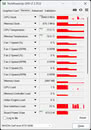
DLSS 5 seems to be contributing to increased power draw, and we have our first victim here. Videocardz reports a new melted-connector case on an MSI GeForce RTX 5090 Gaming Trio OC, which surfaced during DLSS 5 Neural Rendering testing in NBA 2K27, currently the only officially supported game. A reader nicknamed erek documented the incident, noting DLSS 5 pushed the card's power draw from around 450 W to over 600 W, which is above MSI's 575 W rating. A GPU-Z screenshot showed a peak board power reading of 613.5 W, which erek says held steady rather than spiking briefly.
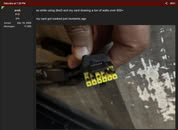
Erek reported the card stopped working shortly after, and a burning smell led him to find that the connector's plastic had melted and fused to the socket. We already reported last week that DLSS 5 can push the RTX 5090's power draw unusually high, so this seems to be the first reported case where that added power draw has burned the notorious RTX 5090 power connectors. However, it should be remembered that GPU-Z tracks total board power rather than just the auxiliary connectors, since the PCIe slot also supplies power, so the reading doesn't necessarily mean the connector carried the full load.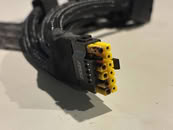
 Melted RTX 5090 connectors have shown up under plenty of other workloads too, so DLSS 5 may have contributed without being the sole cause. Given how flimsy the 12V-2x6 connector has already proven, it's not unreasonable to wonder whether a feature that keeps cards pinned at high sustained power could make these failures more common, though one case isn't enough to confirm that. NVIDIA hasn't commented on this incident or the increased power draw of DLSS 5 in general.
Source:
Videocardz
Erek reported the card stopped working shortly after, and a burning smell led him to find that the connector's plastic had melted and fused to the socket. We already reported last week that DLSS 5 can push the RTX 5090's power draw unusually high, so this seems to be the first reported case where that added power draw has burned the notorious RTX 5090 power connectors. However, it should be remembered that GPU-Z tracks total board power rather than just the auxiliary connectors, since the PCIe slot also supplies power, so the reading doesn't necessarily mean the connector carried the full load.


342 Comments on DLSS 5 Testing Ends in a Melted RTX 5090 Connector, Power Shoots Past 600 W
overclocking/comments/1o907hu/pcie_8pin_burnt_at_two_12v_rails_narrowly_burning
Not as many cases anymore since most GPUs on the market the past 5 years have been using the 12vh cables but if you back to when 8pins were popular youll find way too many cases. And with low power GPUs mind you!
What a silly question this is, of course I looked.That was not my argument. Perhaps I worded it wrong. My argument is that a cable should be able to withstand several plug-unplug cycles without burning up, be it 8-pin, 12-pin, 685378-pin or whatever.I'm not looking for cable melts - and that's the thing. I never heard of a single case before the 12-pin was invented, and now these cases hit me in the face left and right. It's on YouTube, it's here, it's everywhere. I'm not even on Reddit, by the way.
Any connector wear or cables damage caused by improper use of the cables in on consumers. Period.
I would really like to see the comparison of failure rates between factory built computers with all cables properly mounted and strain relieved and between home built computers with abused damaged cables.
So you think Seasonic gave a 12-year warranty on my PSU for one system?No, it's not. If anything, it would be basis for valid legal defense in case of a lawsuit. You know, the same way microwave manufacturers tell you not to put live animals in one.Were you there every time a cable melted? You must be quite the traveler! :eek:
So any time a youtuber says something bad about AMD, I can use the "because it generates clicks" argument to prove that it's a lie, right? Are we really devolving to cavemen levels?Sure. Why no media coverage? Don't tell me that it was a mistake to leave my tinfoil hat at home.
You can just google minifit JR specifications and youll see the specs for all molex connectors.At this point I think you are on purpose trying to change what im saying. This is bad faith.
I never said it's a lie. Im saying the reason it's making the news is because it generates clicks. I'm sure there are plenty of devices that have broken yet AMD unboxed never made a video out of it. Because it wouldn't generate revenue.
Luckily these components alone are available to purchase for the end consumers - they can build their own PC - it is a very fortunate anomaly. Usually only the finished products are available to purchase to consumers.
Any of these components can be removed from sale to end consumers at any time. Consumers have no right to purchase these components and companies have no obligation to provide any warranty to end consumers for individual components.
I believe that there is a realistic possibility, that for example GPUs with power draw above some threshold will be removed from consumer market entirelly, if consumers perstist proving, that they are unable to follow good practice in building PC and they destroy the components and then ask manufacturers to cover the damage.
If this connector requires additional circuit (mostly for safety sake), this was supposed to be defined in PCI-SIG specification for this connector. Cause: bad specification.
But that's still not the root cause. What's the real root cause? Saving on production costs while keeping the final product price same or higher to maximize profits (= basically greed).
There's a reason why this connector had different power delivery wiring in RTX 3090 (Ti) GPUs. There's also reason why this approach was omitted with RTX 4000 and 5000 series. Costs, again.You can't really see. 12V2x6 pin connector must be aligned on microscopic level.
Connectors do not overheat, when they are not damaged - loose, worn by number of insertions out of their specification or damaged by straining the plug.
Connectors work, when they are OK, and burn out, when they are damaged.
I will not defend the idea of running 600 or more Watts through a delicate connector. If somebody wants to do that, he should be sure that the connectors are OK.
Also, the manufacturers did not help by providing the adaptors which have so many wires leading in the plug, that it is very difficult to not strain the plug.
Also, how I said many times already, I believe that the material used to make the contacts in some cases was not good - too soft metal became deformed too easilly.
Copper alloys are used for contacts both in connectors and PCB contacts. There's difference in plating.
For power delivery purposes, copper alloy is plated with tin, for signal trasnmit purposes, it is plated with gold.
Not really other choice in terms of materials to use in mass production. Silver is way too pricy.
And no, it's not just any connector is OK when it's not damaged.
Connector might be in 100% state, but if current going through it is way above what was designed for, it's a problem.
There are multiple records of users that used 12V2x6 connector 1-2 times and it still melted.
What, user error again?
And if the problem is in most cases caused by consumers abusing the cable (i.e. by too many insertions) and straining the plugs, is that really a problem of the connector or is the problem elsewhere?What are you talking about? The material of the pin counterparts, which exert the force on the pin, IS CRITICAL. The whole problem is caused by the contact tubes not exerting high enough contact force on the pins.What do you mean? By "used" you mean plug inserted and then the cable properly fixed while providing strain relief to the plug? Or what?
And what reports exactly are you talking about? Are they trustworthy? Are you really sure what REALLY happened to the cables? And did not you forget, that the cables can be manufactured faulty, as anything else?
In my opinion, the connector was used by Nvidia a a scapegoat to divert the blame away from their cost-cutting PCB design which traded consumer safety for their profits. The revised ATX 12V-2X6 connectors are still melting with "foolproof" sense pins that have several mm of 12V pin mating before the sense circuit even makes contact.
These things provably melt when they are absolutely buried home, 100% seated correctly. The Wireview 1 and Wireview 2 hardware proves that the cause of the failures is 25+ Amps of current down a properly-seated pin rated for 9.5 Amps. That's a fault in the power circuitry, or rather lack of current-balancing circuitry. You can't blame the connector for melting when the device's shit power delivery design is causing waaaaay more current to flow through the connector than it was ever designed for.
Should reviewers use different psus and cables for every cpu and gpu they test?
No!
So this is the solution that really works:
Buy GPUs in bulk.
After some intense DLSS5-Testing, your 5090 will be burned up (this is expected), replace it with a new one, proceed testing...
This way you will always have a working test setup.
This is the "preferred by NVIDIA" and "approved by NVIDIA" solution!
A good quality cable in theory should work fine for at least few dozens insertions.
Elysium, Blade Runner 2049, Children of Men, Oblivion, The Book of Eli, Mad Max, Mortal Engines etc.
Just have a bit more patience.Initially it was 9.2 A. Some time after these Amphenol randos decided that their plug can somehow do a bit more, hence the 9.5 A per pin with all pins energized. Oh and 50 mating cycles compared to 30 for some others.
They can choke on it, it cannot.
tpucdn.com/review/moaiplay-ora-pro-g1-1000-w/images/psucon.jpg
It's all explained by thermal density, the 16AWG wires can take the load but the connector cannot.
The plastic walls are thinner than 8 pin, the pins are thinner and less conductive (easier to disturb), and the footprint is comparable but we are talking 600 W through that footprint compared to 336 W for 8 pin EPS.
So no it can't do 600 W, and it can't even do 336 W like the EPS, because again of the plastic walls and pins.
The safety margins for the EPS are HUGE compared to this turd.
The load balancing is a separate matter, it simply allows the connector to run at 85-90% or whatever without deviating, thus if everything about the connector is fine it can keep running without issue. But that doesn't make the thin safety margins less thin.
With no current monitoring on the wire pairs a circuit that gets significantly warmer than its neighbours for any reason is likely to trigger the feedback cycle; a 25C delta is about a 10% increase in resistance, which is significant enough to upset the current balance. The cables getting warm isn't a problem, it's the cables getting unevenly warm when there's no system in place to balance the change in resistance and current draw that the temperature change causes.You'll get no argument from me on that. I've spent almost 4 years criticising 12VHPWR for reducing the safety margin and I'm not particularly comfortable with it going much over 300W.
I was simply quoting you to highlight the ridiculous confidence some manufacturers have in the connector, the 0.3 A increase is mostly academic but it's surprising that it is an actual increase given the situation.The opinion changes based on how good the "contact" is. Get it? :rolleyes::laugh:It's their greed as well if they implemented it the way nVidia did since the 40 series.