Sunday, September 6th 2026

DLSS 5 Testing Ends in a Melted RTX 5090 Connector, Power Shoots Past 600 W
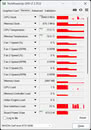
DLSS 5 seems to be contributing to increased power draw, and we have our first victim here. Videocardz reports a new melted-connector case on an MSI GeForce RTX 5090 Gaming Trio OC, which surfaced during DLSS 5 Neural Rendering testing in NBA 2K27, currently the only officially supported game. A reader nicknamed erek documented the incident, noting DLSS 5 pushed the card's power draw from around 450 W to over 600 W, which is above MSI's 575 W rating. A GPU-Z screenshot showed a peak board power reading of 613.5 W, which erek says held steady rather than spiking briefly.
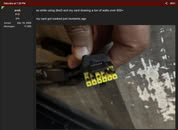
Erek reported the card stopped working shortly after, and a burning smell led him to find that the connector's plastic had melted and fused to the socket. We already reported last week that DLSS 5 can push the RTX 5090's power draw unusually high, so this seems to be the first reported case where that added power draw has burned the notorious RTX 5090 power connectors. However, it should be remembered that GPU-Z tracks total board power rather than just the auxiliary connectors, since the PCIe slot also supplies power, so the reading doesn't necessarily mean the connector carried the full load.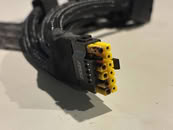
 Melted RTX 5090 connectors have shown up under plenty of other workloads too, so DLSS 5 may have contributed without being the sole cause. Given how flimsy the 12V-2x6 connector has already proven, it's not unreasonable to wonder whether a feature that keeps cards pinned at high sustained power could make these failures more common, though one case isn't enough to confirm that. NVIDIA hasn't commented on this incident or the increased power draw of DLSS 5 in general.
Source:
Videocardz
Erek reported the card stopped working shortly after, and a burning smell led him to find that the connector's plastic had melted and fused to the socket. We already reported last week that DLSS 5 can push the RTX 5090's power draw unusually high, so this seems to be the first reported case where that added power draw has burned the notorious RTX 5090 power connectors. However, it should be remembered that GPU-Z tracks total board power rather than just the auxiliary connectors, since the PCIe slot also supplies power, so the reading doesn't necessarily mean the connector carried the full load.


342 Comments on DLSS 5 Testing Ends in a Melted RTX 5090 Connector, Power Shoots Past 600 W
OK, maybe if applied perfectly, it will actually reduce stress on cables, but still - micro-movement of pins is unavoidable, epoxy or no epoxy, it is simple property of metal when temperature goes up and down. So this will probably help, but it will not solve 12V2 problems.
And don't worry, plenty of cases confirming that 12HPWR is junk are incoming...
"PNY Denied Warranty To An RTX 5090 Owner Because Dead GPU Wasn’t Used With Company-Approved 12VHPWR Power Cable Or Adapter"
"RTX 5090 12V-2×6 connector reaches 91.7°C with DLSS 5, 16-pin input peaks at 647W "
I even think that the cable in case of very expensive or very power hungry cards should be attached to the card permanently, not through a connector.
Another option is to make the connector very tight (high contact forces) and one insertion only. The card could grip the cable after insertion in such a way the cable could not be removed without destrying the cable (and not the GPU) .
This connector does not need any special balancing circuitry any more than most of all other electrical connectors. Electrical connectors work well when they are OK and fail when they get worn and loose. This is how connectors work and fail. Almost everybody understands that.
Why do you think this connector is not "proper"? When it reliably works in tens or even hundreds of millions of GPUs and the failures concentrate mainly in the tiny niche - the combinantion of PC home builders, who do not use and install the cables as they should, and an extremely power hungry GPUs, sometimes even pushed outside their specified power draw, that arguably do not belong in a normal consumer PC at all?
so far so good
WireView Pro II GPU
Alignment: Normal | Variant: Black
Product number: S-TG-WV-P2-H19N