Sunday, July 28th 2019

Intel Starts Shipping 10 nm Ice Lake CPUs to OEMs
During its second quarter earnings call, Intel announced that it has started shipping of 10th generation "Core" CPUs to OEMs. Making use of 10 nm lithography, the 10th generation of "Core" CPUs, codenamed Ice Lake, were qualified by OEMs earlier in 2019 in order to be integrated into future products. Ice Lake is on track for holiday season 2019, meaning that we can expect products on-shelves by the end of this year. That is exciting news as the 10th generation of Core CPUs is bringing some exciting micro-architectural improvements along with the long awaited and delayed Intel's 10nm manufacturing process node.
The new CPUs are supposed to get around 18% IPC improvement on average when looking at direct comparison to previous generation of Intel CPUs, while being clocked at same frequency. This time, even regular mobile/desktop parts will get AVX512 support, alongside VNNI and Cryptography ISA extensions that are supposed to bring additional security and performance for the ever increasing number of tasks, especially new ones like Neural Network processing. Core configurations will be ranging from dual core i3 to quad core i7, where we will see total of 11 models available.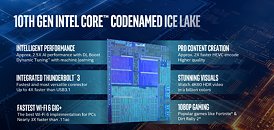
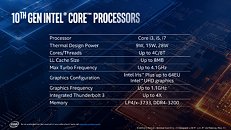
Additionally, the integrated graphics will get some upgrades as well. Intel's Gen11 GPU architecture, as it is called, will be incorporated inside Ice Lake boosting performance and efficiency of the GPU. Intel claims that the new GPU will break 1 TeraFLOP of FP32 compute performance with its 64 Execution Units. Furthermore, new iGPU will feature native support for DisplayPort 1.4, HDMI 2.0b and HDCP 2.2.
The platform for 10th generation Core CPUs is getting improvements as well. There will be an integrated Thunderbolt 3 controller built into chipset, WiFi 6, DDR4 with up to 3733 MHz support and more.
Source:
AnandTech
The new CPUs are supposed to get around 18% IPC improvement on average when looking at direct comparison to previous generation of Intel CPUs, while being clocked at same frequency. This time, even regular mobile/desktop parts will get AVX512 support, alongside VNNI and Cryptography ISA extensions that are supposed to bring additional security and performance for the ever increasing number of tasks, especially new ones like Neural Network processing. Core configurations will be ranging from dual core i3 to quad core i7, where we will see total of 11 models available.
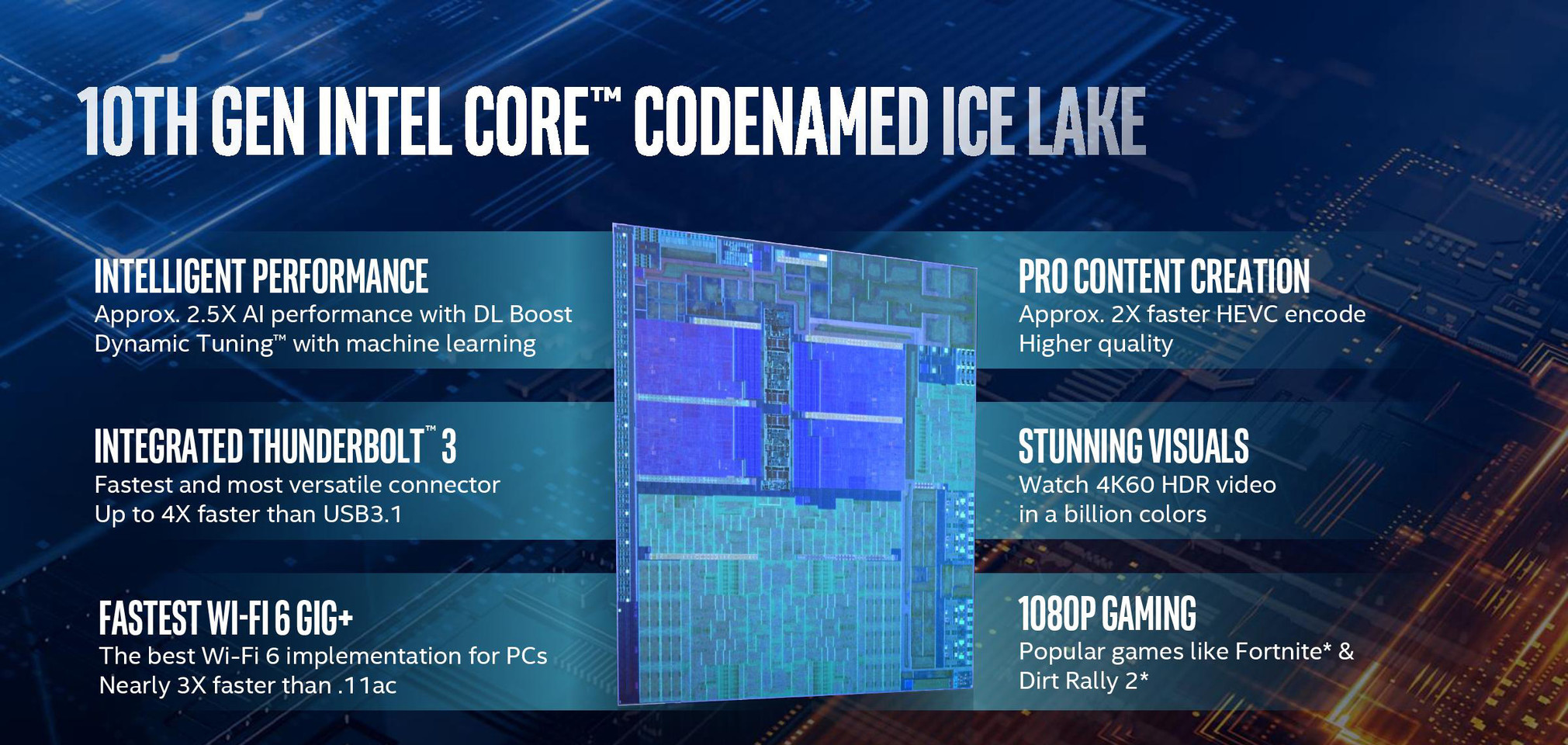
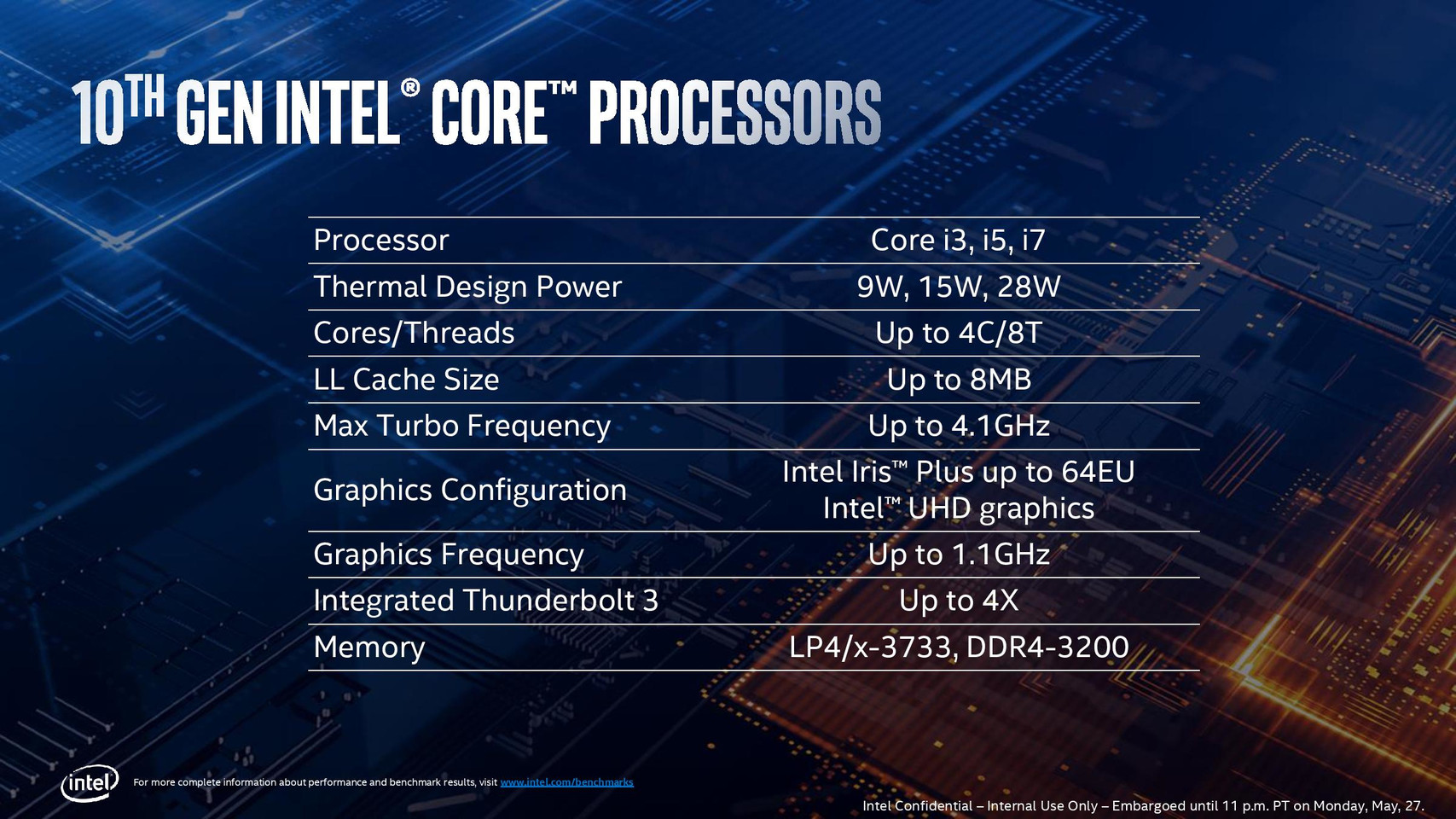
The platform for 10th generation Core CPUs is getting improvements as well. There will be an integrated Thunderbolt 3 controller built into chipset, WiFi 6, DDR4 with up to 3733 MHz support and more.

78 Comments on Intel Starts Shipping 10 nm Ice Lake CPUs to OEMs
There's still a business case for Intel. Not much, but not .01% as you imply either.
If you need something for work get a proper laptop with proper cooling - no desktop CPUs required.
You can't measure IPC unless you run the same code on all CPUs.
If you were comparing a AVX-512 workload vs. a non-AVX-512 workload, IPC would actually go down, while performance goes up. And to my knowledge, there are "no" benchmarks or client applications using AVX-512 yet. This would be a benchmark of implementation, not of IPC.
Ice Lake(Sunny Cove) offers numerous improvements over Skylake, including over double INT DIV/MUL, double load/store, more memory address calculation performance, more cache etc. It will be the fastest architecture we've seen by far, but I'll wait for independent reviews before claiming exactly 18% IPC gains.
- The voltage/frequency curve is pretty horrible, and the only way they can release these currently are to crank down the voltage, which makes them competitive only as laptop chips
- The new uArch in Ice Lake does not scale well at higher frequencies, either becoming unstable or not giving a linear increase in performance.
In either or both of these situations, it is smart to put out the first batch in ultraportables to try to play to the current benefits and use R&D money to start paying off the massive capital expenses for the new node. However, both circumstances would require considerable time to refine the product for eventual desktop use.
I'm reminded of Broadwell, Intel's first 14 nm architecture. It had a bump in IPC over Haswell (though only about 5%), it was on a new node, and it did not scale very well compared to the previous or next architectures. So people complained and we did eventually get a desktop chip, the 5675c/5775c. It's only stable up to 4.2-4.3 GHz, no matter how much voltage you throw at it. Hopefully Intel will be able to do something similar and get a 10 nm node and architecture update to match and exceed their existing chips. I'm very happy with my 5775c, but it is an odd chip that didn't sell well, wasn't produced much, and whose main benefit in the desktop sphere was an iGPU that could actually replace entry-level graphics cards, and lower power usage than normal desktop chips. We should maybe be grateful that Intel didn't bow to demands and put out 10 nm desktop chips while they are still very much not ready.
This is the very definition of compromise. Unless you treat your PC as a video game console like a super nintendo that draws 350w power at the wall.
9700k is obviously better than 3600 for e-sports as it assures higher framerate. Look up on youtube for "3600 battlefield V multiplayer conquest Low settings", you will see it topping out at 150fps. Then do the same for the 9700k, you will see it on 200fps most of the time. 50fps difference right there.
Now try the same on Quake Champions, Pubg, Apex, Blackout, Escape from Tarkov or Ring of Elysium. Another 30-50fps differences when GPU is not the bottleneck. So yeah, objectively speaking 9700k is a superior CPU for e-sports games, compared to 3600. Just like 3600 objectively offers better value. But I am not talking about value here, not everyone goes by value, a lot of people goes by performance for their needs. And this is why 9700k sold out in my country after Zen 2 release and is also why you see 9700k number 3 on the best selling CPUs right now on Amazon. Something it NEVER achieved before, not even when it released.
geizhals.eu/?cmp=2064574&cmp=1870100
You are comparing 3600 - a 206€ CPU against 9700K - a 379€ CPU. It is 45% more expensive than 3600.
Considering it's price i say it does very well in esports titles. 8% slower overall on 1080p according to TPU's review.
I do not see this 50fps BFV difference in reviews.
This just reaffirms my belief that Intel is relegated to the high end by AMD. For people who are willing to pay twice as much to get those extra 5-10% frames in some games.
Atleast 9700K has the benefit on being unaffected by the HT related security issues.
Actually a person who i respect a great deal got himselt a 9700K over Ryzen last year and he makes a rather compelling case if anyone is intrested: www.tweakguides.com/Hardcon19_3.html
The other thing is, Intel has been dominant for a decade. The applications will run faster despite the IPC because the apps are made for it.
BTW this is changing and you can see it with the so called "cherry picked" games that are running better on AMD CPU and these cpus have been here for a month or so.
In this context, frames and latencies are of great importance and therefore the visual detail is sacrificed. It has always been this way and still is in competitive gaming.
Of course, for most consumers is a different talk. Most are limited by the graphics card and abuse the settings, so having one CPU or another will almost always do the same, with rare exceptions.
If I say "high end" gaming or "top-notch" gaming would these be competitive to your competitive gaming or casual gaming or both? Or is it just to prove a point that is not there? Maybe there's more adjectives that can describe "gaming"?
Can't you see the difference in that and what the typical gamer does?
The reason why Intel is shipping smaller mobile chips on 10nm now, and server chips soon is production volume. Intel can't mass produce like Ice Lake-S and Ice Lake-H models until they have enough production capacity to satisfy the demands of the OEMs. In this case, Intel's dominant market position makes it more difficult to jump to a new node. These concerns are very similar to the issues of Broadwell on 14nm, where Intel ended up refreshing Haswell on 22nm instead, while moving forward for server and mobile. That doesn't mean they couldn't in theory have launched a Broadwell for mainstream desktop.This is a silly argument.
The results will at worst be a little screwed, but not enough to paint the wrong picture. And what about all those who build/buy powerful PCs and don't run Steam or game at all?
While the Steam hardware survey isn't perfect, it's by far the most representative selection of PC gamers out there. My biggest complaint about it is the lack of statistics over time.
If Intel can't ramp up the volume for large 10nm chips then it make sense that big companies like Google/Amazon etc will start to loose the patience.
EliteBooks are not proper laptops? Latitudes are not proper laptops? ThinkPads are not proper laptops?
Dude...
The market is already awash with CPUs that run in 15W power envelope or lower, and at that point the screen brightness, battery size and platform power-saving mojo is more important than the processor efficiency.
By the time Intel has a viable new desktop/server process node running, we'll be on 14nm++++++++++++++++++++++++++++++++++++++++++Exactly!
In the real world, people don't buy 2080Ti cards. Look at the steam hardware survey. The majority of the results are Nvidia X60 or X50 cards from various generations, with a decent number of X70 cards too.
That means that in the situations where Intel currently has a gaming IPC advantage, the majority of gamers will not see the benefit because they'll be GPU-limited.
In CPU-limited games like Civ, Ashes, etc, Ryzen already spanks intel; More cache, more cores, more bandwidth at ANY given price range.