Wednesday, March 18th 2020

Sony Reveals PS5 Hardware: RDNA2 Raytracing, 16 GB GDDR6, 6 GB/s SSD, 2304 GPU Cores
Sony in a YouTube stream keynote by PlayStation 5 lead system architect Mark Cerny, detailed the upcoming entertainment system's hardware. There are three key areas where the company has invested heavily in driving forward the platform by "balancing revolutionary and evolutionary" technologies. A key design focus with PlayStation 5 is storage. Cerny elaborated on how past generations of the PlayStation guided game developers' art direction as the low bandwidths and latencies of optical discs and HDDs posed crippling latencies arising out of mechanical seeks, resulting in infinitesimally lower data transfer rates than what the media is capable of in best case scenario (seeking a block of data from its outermost sectors). SSD was the #1 most requested hardware feature by game developers during the development of PS5, and Sony responded with something special.
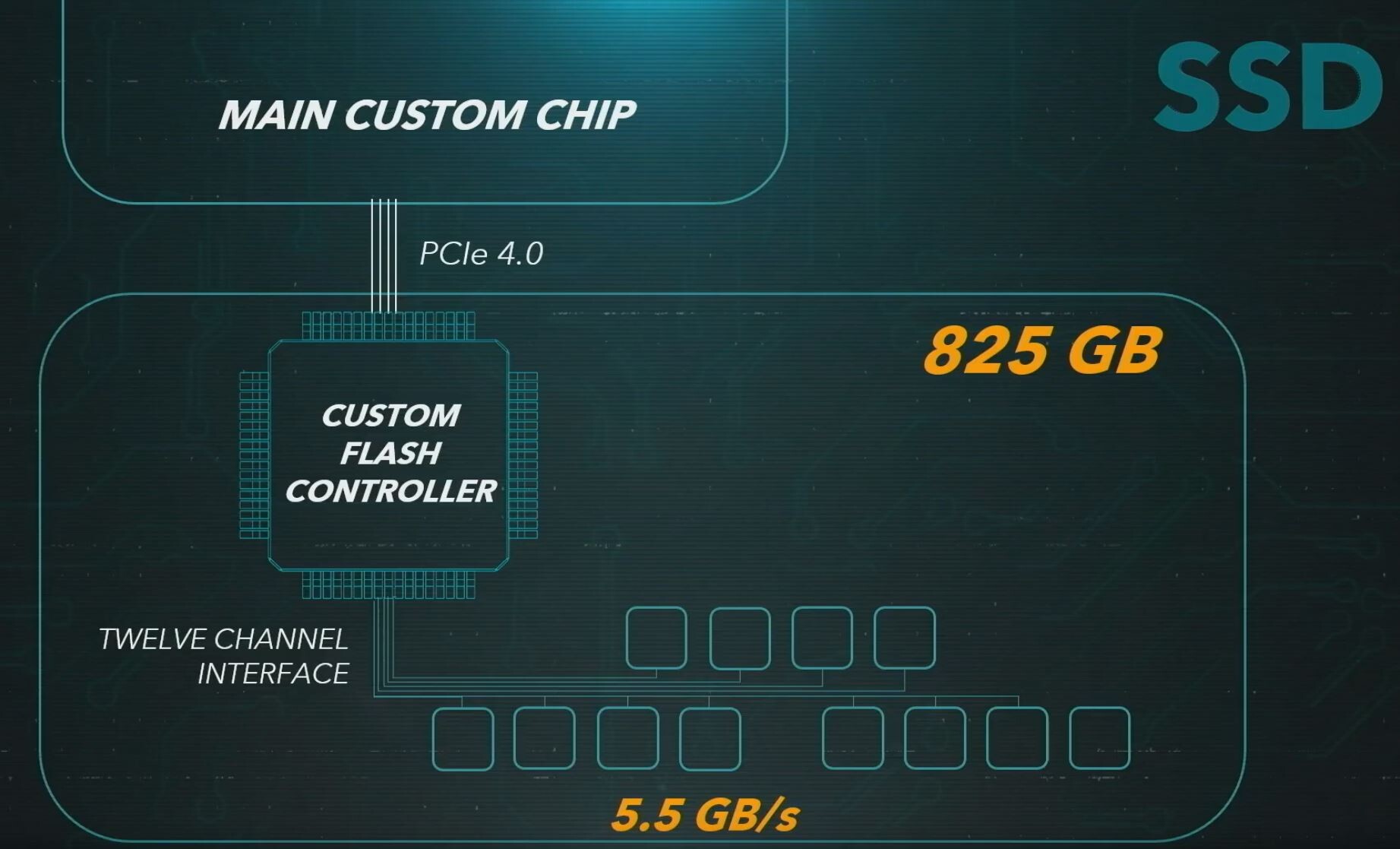
Each PlayStation 5 ships with a PCI-Express 4.0 x4 SSD with a flash controller that has been designed in-house by Sony. The controller features 12 flash channels, and is capable of at least 5.5 GB/s transfer speeds. When you factor in the exponential gains in access time, Sony expects the SSD to provide a 100x boost in effective storage sub-system performance, resulting in practically no load times.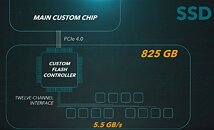
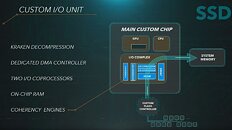

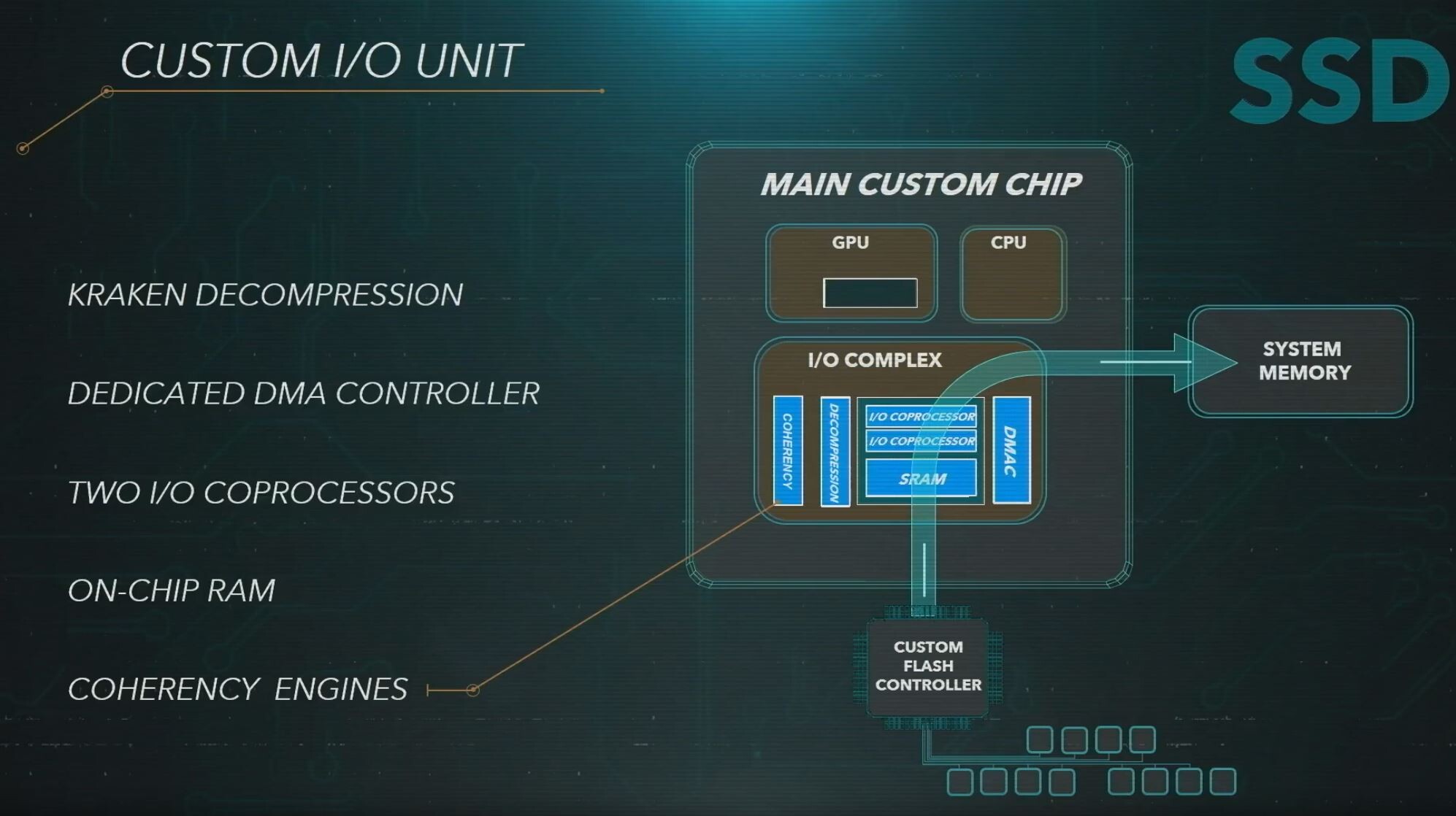
 The secret sauce here is that Sony is using its own protocol instead of NVMe, in supporting 6 data priority tiers versus 2 on NVMe. Each PlayStation 5 ships with an 825 GB SSD, which is expandable using external HDDs over USB, or a selection of third-party M.2 NVMe SSDs certified by Sony. PlayStation 4 games can run directly off your external HDD, but PlayStation 5 games have to be transferred from your HDD to the console's main SSD. Past generations of PlayStation implemented ZLib data compression on Blu-ray and HDD media. PlayStation 5 is implementing Kraken, with hardware-accelerated de-compression via fixed-function hardware built directly into the main SoC.
SoC is where Cerny sounded restrained in what he wanted to disclose. The SoC is a semi-custom chip designed by Sony and AMD, possibly on a 7 nm-class silicon fabrication process. Sony won't specify if it is a monolithic silicon or an MCM, but there are three building-blocks to it: CPU, GPU, and I/O complex. The CPU is based on AMD "Zen 2" x86-64 microarchitecture, and the GPU is based on the company's upcoming RDNA2 graphics architecture.
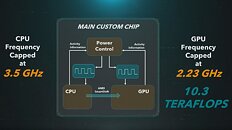
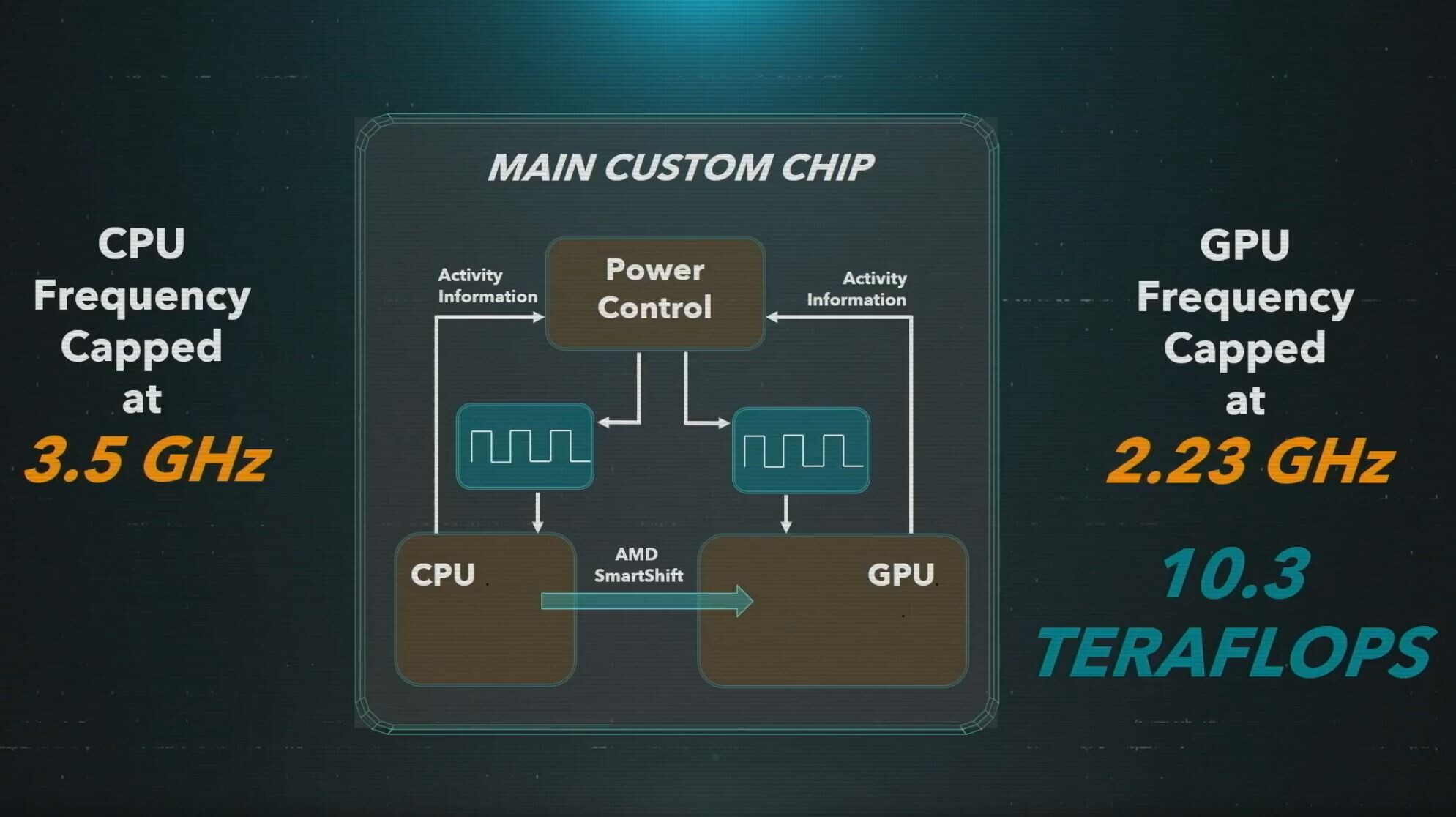
There are eight "Zen 2" CPU cores, although the company didn't mention if SMT is featured. The maximum CPU clock speed is 3.50 GHz. The GPU is a whole different story from the one on the Xbox Series X Velocity Engine semi-custom chip. Sony decided to go with 36 RDNA2 compute units ticking at up to 2.23 GHz engine clock, compared to 52 compute units running at up to 1.825 GHz on the upcoming Xbox. Sony's GPU ends up with up to 10.3 TFLOPs max compute throughput, compared to Microsoft's 12 TFLOPs.
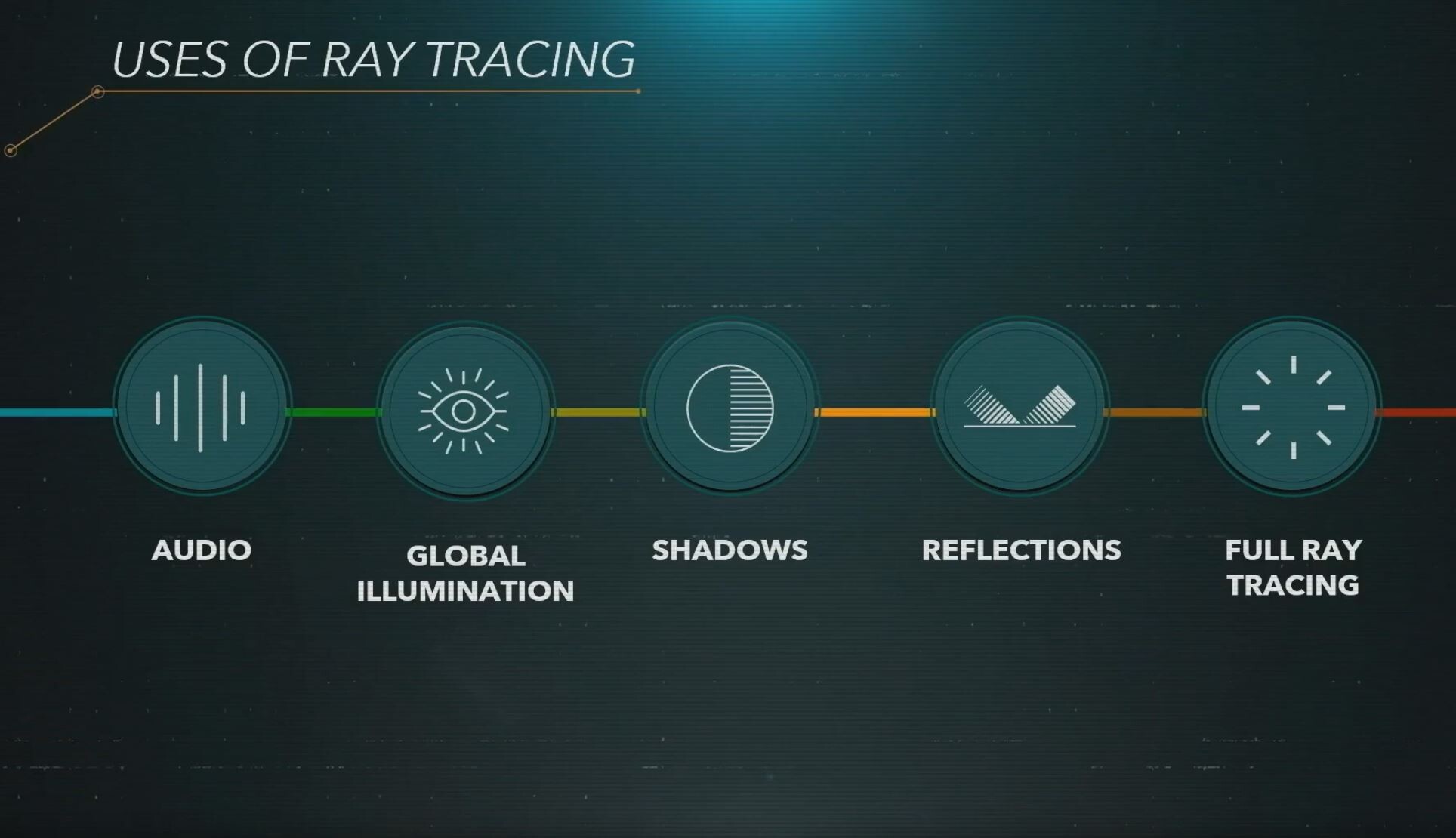
Sony also shed some "light" on the hardware-accelerated real-time ray-tracing approach AMD is taking with RDNA2. Apparently, each compute unit features a hardware component called "Intersection Engine," with roughly the same function as an RT core on NVIDIA "Turing," which is to calculate the intersection of rays with geometry (such as triangles or polygons) in a scene. This combines with a fairly standardized bounding volume hierarchy (BVH) model to achieve a hybrid of ray-traced elements in an otherwise conventional rasterized 3D scene (pretty much where NVIDIA is right now with RTX). On PlayStation 5, RDNA2's ray-tracing hardware is leveraged for positional audio, global illumination, shadows, reflections, and full ray-tracing.
The third key component of the SoC is the I/O complex. This handles all of the chip's I/O, not just with peripherals and video output, but also storage and memory. There are dedicated I/O co-processors on-silicon designed to reduce the various I/O's processing stack on the CPU cores, and reduce latencies at various stages. There's also a certain amount of SRAM that caches transfers between the various components on the I/O complex. The custom chip leverages AMD SmartShift in power-management.
PlayStation 5 uses 16 GB of GDDR6 memory. Sony did not mention the memory clock, bandwidth, or even the memory bus width. It did drop some hints about memory management. It appears like PlayStation 5 does not partition memory the way Xbox Series X does, and possibly sticks to the hUMA model of the PlayStation 4 (using a common pool of physical memory for system- and video memory).
Lastly, a large chunk of Sony's presentation focused on the next frontier for hardware innovation: positional audio. Sony is investing heavily on positional audio that takes into account the gamer's physical HRTF (head-related transfer function). The company is leveraging the vast amounts of CPU power gained from the upgrade to "Zen 2," to achieve this.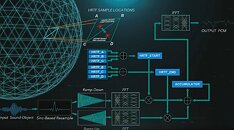 We still don't know what a PlayStation 5 console will look like.
Source:
Sony Computer Entertainment (YouTube)
Each PlayStation 5 ships with a PCI-Express 4.0 x4 SSD with a flash controller that has been designed in-house by Sony. The controller features 12 flash channels, and is capable of at least 5.5 GB/s transfer speeds. When you factor in the exponential gains in access time, Sony expects the SSD to provide a 100x boost in effective storage sub-system performance, resulting in practically no load times.
SoC is where Cerny sounded restrained in what he wanted to disclose. The SoC is a semi-custom chip designed by Sony and AMD, possibly on a 7 nm-class silicon fabrication process. Sony won't specify if it is a monolithic silicon or an MCM, but there are three building-blocks to it: CPU, GPU, and I/O complex. The CPU is based on AMD "Zen 2" x86-64 microarchitecture, and the GPU is based on the company's upcoming RDNA2 graphics architecture.
There are eight "Zen 2" CPU cores, although the company didn't mention if SMT is featured. The maximum CPU clock speed is 3.50 GHz. The GPU is a whole different story from the one on the Xbox Series X Velocity Engine semi-custom chip. Sony decided to go with 36 RDNA2 compute units ticking at up to 2.23 GHz engine clock, compared to 52 compute units running at up to 1.825 GHz on the upcoming Xbox. Sony's GPU ends up with up to 10.3 TFLOPs max compute throughput, compared to Microsoft's 12 TFLOPs.
Sony also shed some "light" on the hardware-accelerated real-time ray-tracing approach AMD is taking with RDNA2. Apparently, each compute unit features a hardware component called "Intersection Engine," with roughly the same function as an RT core on NVIDIA "Turing," which is to calculate the intersection of rays with geometry (such as triangles or polygons) in a scene. This combines with a fairly standardized bounding volume hierarchy (BVH) model to achieve a hybrid of ray-traced elements in an otherwise conventional rasterized 3D scene (pretty much where NVIDIA is right now with RTX). On PlayStation 5, RDNA2's ray-tracing hardware is leveraged for positional audio, global illumination, shadows, reflections, and full ray-tracing.
The third key component of the SoC is the I/O complex. This handles all of the chip's I/O, not just with peripherals and video output, but also storage and memory. There are dedicated I/O co-processors on-silicon designed to reduce the various I/O's processing stack on the CPU cores, and reduce latencies at various stages. There's also a certain amount of SRAM that caches transfers between the various components on the I/O complex. The custom chip leverages AMD SmartShift in power-management.
PlayStation 5 uses 16 GB of GDDR6 memory. Sony did not mention the memory clock, bandwidth, or even the memory bus width. It did drop some hints about memory management. It appears like PlayStation 5 does not partition memory the way Xbox Series X does, and possibly sticks to the hUMA model of the PlayStation 4 (using a common pool of physical memory for system- and video memory).
Lastly, a large chunk of Sony's presentation focused on the next frontier for hardware innovation: positional audio. Sony is investing heavily on positional audio that takes into account the gamer's physical HRTF (head-related transfer function). The company is leveraging the vast amounts of CPU power gained from the upgrade to "Zen 2," to achieve this.

178 Comments on Sony Reveals PS5 Hardware: RDNA2 Raytracing, 16 GB GDDR6, 6 GB/s SSD, 2304 GPU Cores
Out of these two systems I will be buying the PS5 but I would feel alot better about it if the specs where reversed I personally don't care about the cost.
NVMe standard pales in comparison, as always the PC users get less :(
Also, compared to the XSX's fixed clocks, variable clocks (even if they're using AMD's clever SmartShiftto allocate power between the CPU and GPU) are a poor fit for a console. And it's not like it will matter much when the maximum boost numbers for both parts are lower than the competition; all that tells us is that even in a best-case scenario for PS5, it's still slower across the board in both CPU and GPU power.
Even if the presentation was filmed a few days ago I am still tempted to think the PS5 engineering team spent the past 48 hours furiously overclocking their APU with the marketing team breathing down their necks :P
That SSD looks like a beast though, very interested in how good a job it does in compensating for the VRAM bandwidth deficiency. Also very interested in how they will certify m.2 drives for add-on storage considering no m.2 drive on the market is even close to those numbers in sustained performance.I agree that this drive is bonkers, but "as always PC users get less"? What on earth are you on about? The last time consoles were faster/better than PCs were in the mid-to-late 90s ...
I meant "The secret sauce here is that Sony is using its own protocol instead of NVMe, in supporting 6 data priority tiers versus 2 on NVMe."
PCs also don't get other things, but they are software related like upscaling for instance.
Another question:
The Variable Rate Shading - how much performance will it give on its own?
I personally still think Sony put way too much money into the storage system and should have focused on sustained clocks for the CPU/GPU or a wider GPU.
There is no difference in the quality. While we can assume that the PC is (much) faster, no?
You are not the wrong person ;)
Concerning the variable clocks, I don't mind it because a) it's not based on thermals, so everyone gets the same performance regardless and b) it's to keep cooling noise acceptable.
One example he gave for lowering the cpu clock is when it's executing a lot of 256-bit instructions because to maintain the clocks they would need to increase the size of the power supply and fan.
A GPU with less CUs and higher clocks will perform better in memory bound situations. And it's not uncommon that some parts of a shader contain scalar code which will also run better.
Not that it matters much in this case because PS5's GPU isn't equivalent TFLOP wise with the one in X.I can pull hundreds of examples where the games look noticeably better on such a PC, just browse Digital Foundry's YT channel and you'll find plenty examples. And we both know RDR2 was an unusually poor PC port.
Apparently Microsoft tested their system in the desert to make sure it would sustain its clocks.
At the same time these people are much smarter than me so I'm sure their reason are valid.
I don't really care much either way, since if I were to buy any console, it would be this one, because of the exclusives.
Random guess $550 US$ at least
Sony going with variable clocks at least from my point of view means developers can't depend on those max clocks in all scenarios whether that be power draw or someone sitting in a 30c room vs a 20c room.
it adds a variable to development that doesn't exist on the other console.
But I agree, Sony needs healthy profit margins because it's not sustainable to sell at a loss all the time. They have other struggling divisions, too.
PS4 was much inferior technologically, so yes, it was quite normal to be cheaper.