Wednesday, March 18th 2020

Sony Reveals PS5 Hardware: RDNA2 Raytracing, 16 GB GDDR6, 6 GB/s SSD, 2304 GPU Cores
Sony in a YouTube stream keynote by PlayStation 5 lead system architect Mark Cerny, detailed the upcoming entertainment system's hardware. There are three key areas where the company has invested heavily in driving forward the platform by "balancing revolutionary and evolutionary" technologies. A key design focus with PlayStation 5 is storage. Cerny elaborated on how past generations of the PlayStation guided game developers' art direction as the low bandwidths and latencies of optical discs and HDDs posed crippling latencies arising out of mechanical seeks, resulting in infinitesimally lower data transfer rates than what the media is capable of in best case scenario (seeking a block of data from its outermost sectors). SSD was the #1 most requested hardware feature by game developers during the development of PS5, and Sony responded with something special.
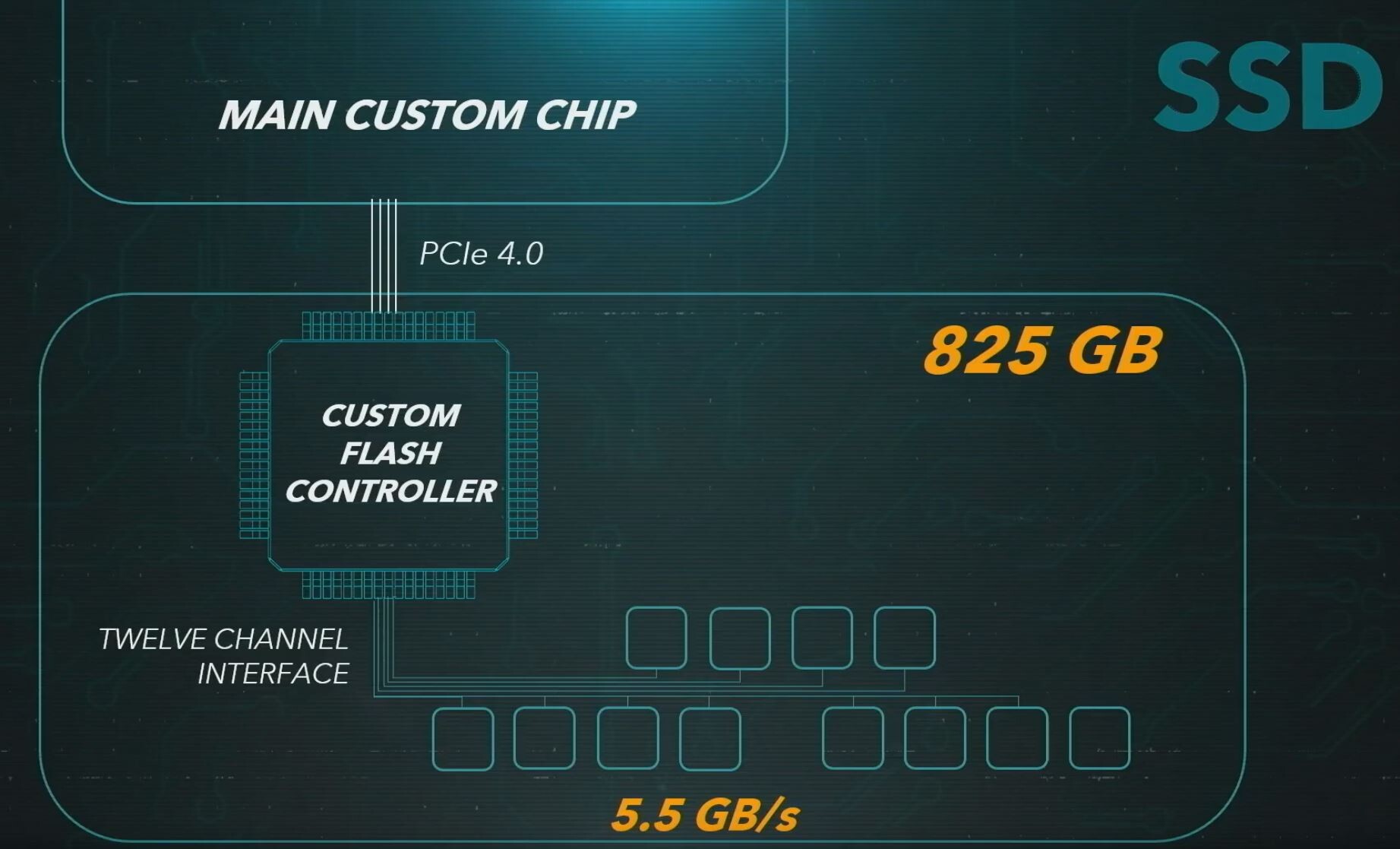
Each PlayStation 5 ships with a PCI-Express 4.0 x4 SSD with a flash controller that has been designed in-house by Sony. The controller features 12 flash channels, and is capable of at least 5.5 GB/s transfer speeds. When you factor in the exponential gains in access time, Sony expects the SSD to provide a 100x boost in effective storage sub-system performance, resulting in practically no load times.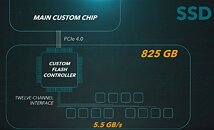
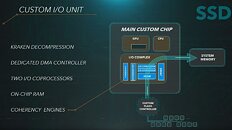

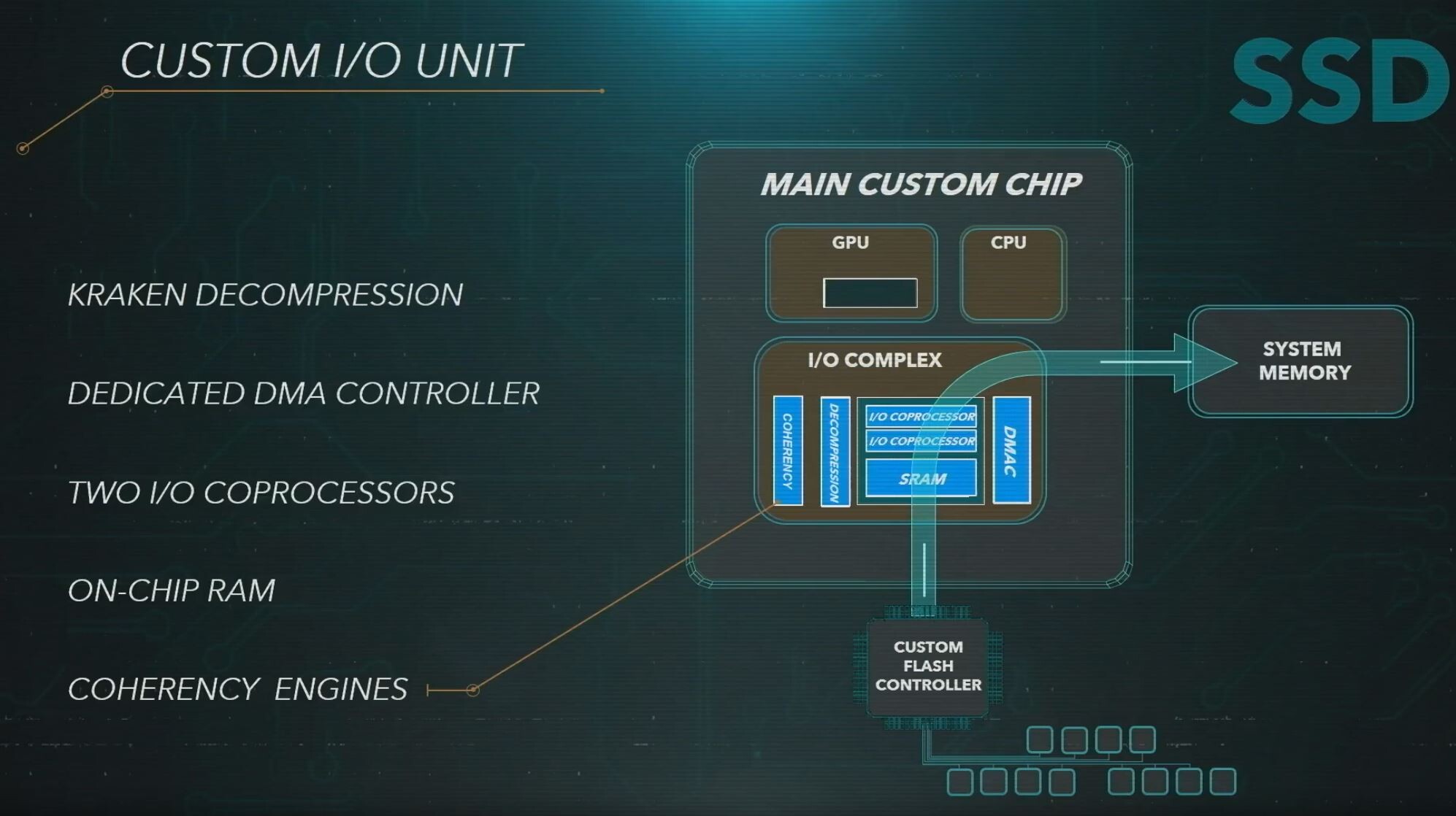
 The secret sauce here is that Sony is using its own protocol instead of NVMe, in supporting 6 data priority tiers versus 2 on NVMe. Each PlayStation 5 ships with an 825 GB SSD, which is expandable using external HDDs over USB, or a selection of third-party M.2 NVMe SSDs certified by Sony. PlayStation 4 games can run directly off your external HDD, but PlayStation 5 games have to be transferred from your HDD to the console's main SSD. Past generations of PlayStation implemented ZLib data compression on Blu-ray and HDD media. PlayStation 5 is implementing Kraken, with hardware-accelerated de-compression via fixed-function hardware built directly into the main SoC.
SoC is where Cerny sounded restrained in what he wanted to disclose. The SoC is a semi-custom chip designed by Sony and AMD, possibly on a 7 nm-class silicon fabrication process. Sony won't specify if it is a monolithic silicon or an MCM, but there are three building-blocks to it: CPU, GPU, and I/O complex. The CPU is based on AMD "Zen 2" x86-64 microarchitecture, and the GPU is based on the company's upcoming RDNA2 graphics architecture.
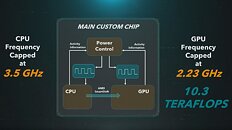
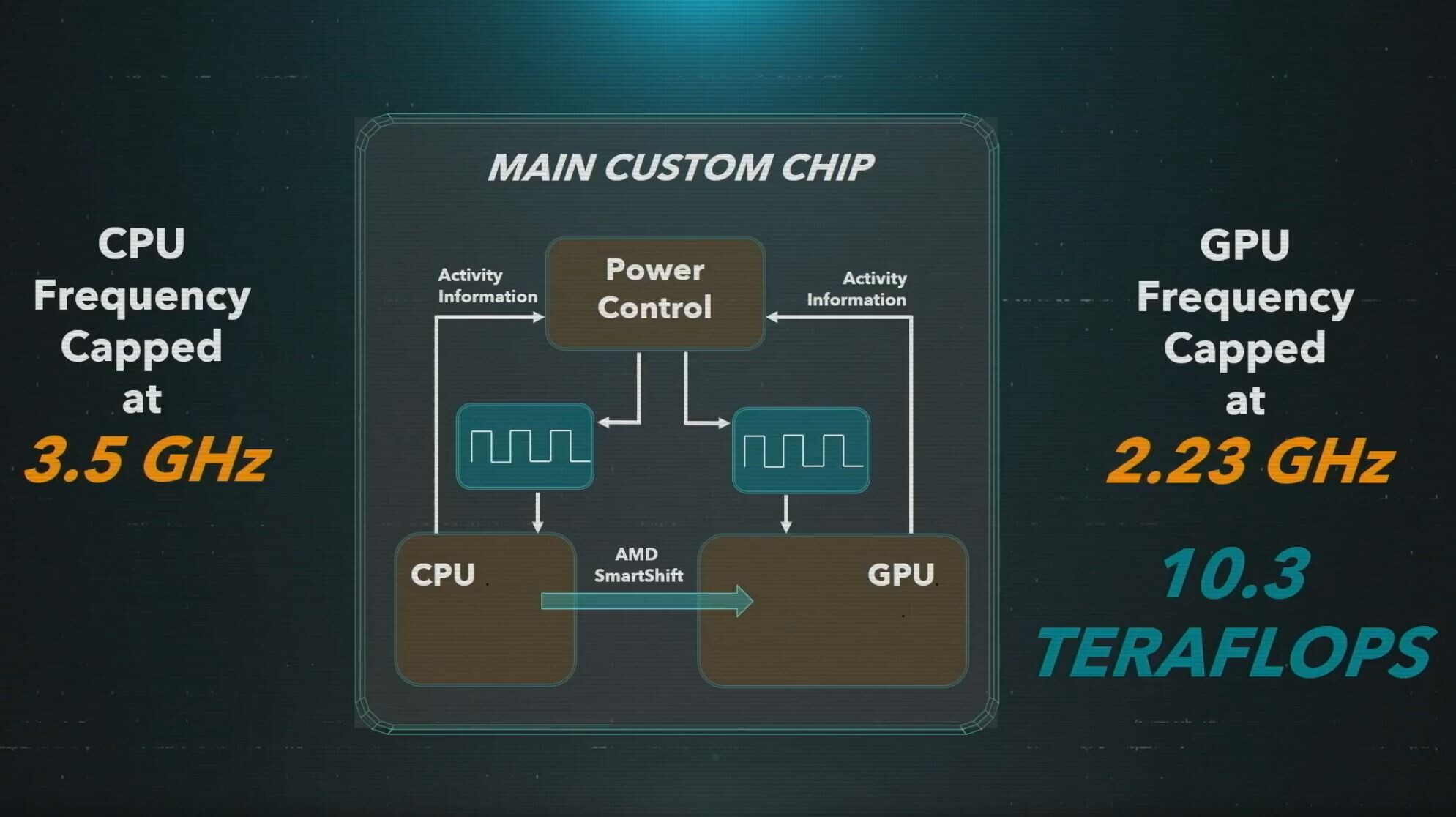
There are eight "Zen 2" CPU cores, although the company didn't mention if SMT is featured. The maximum CPU clock speed is 3.50 GHz. The GPU is a whole different story from the one on the Xbox Series X Velocity Engine semi-custom chip. Sony decided to go with 36 RDNA2 compute units ticking at up to 2.23 GHz engine clock, compared to 52 compute units running at up to 1.825 GHz on the upcoming Xbox. Sony's GPU ends up with up to 10.3 TFLOPs max compute throughput, compared to Microsoft's 12 TFLOPs.
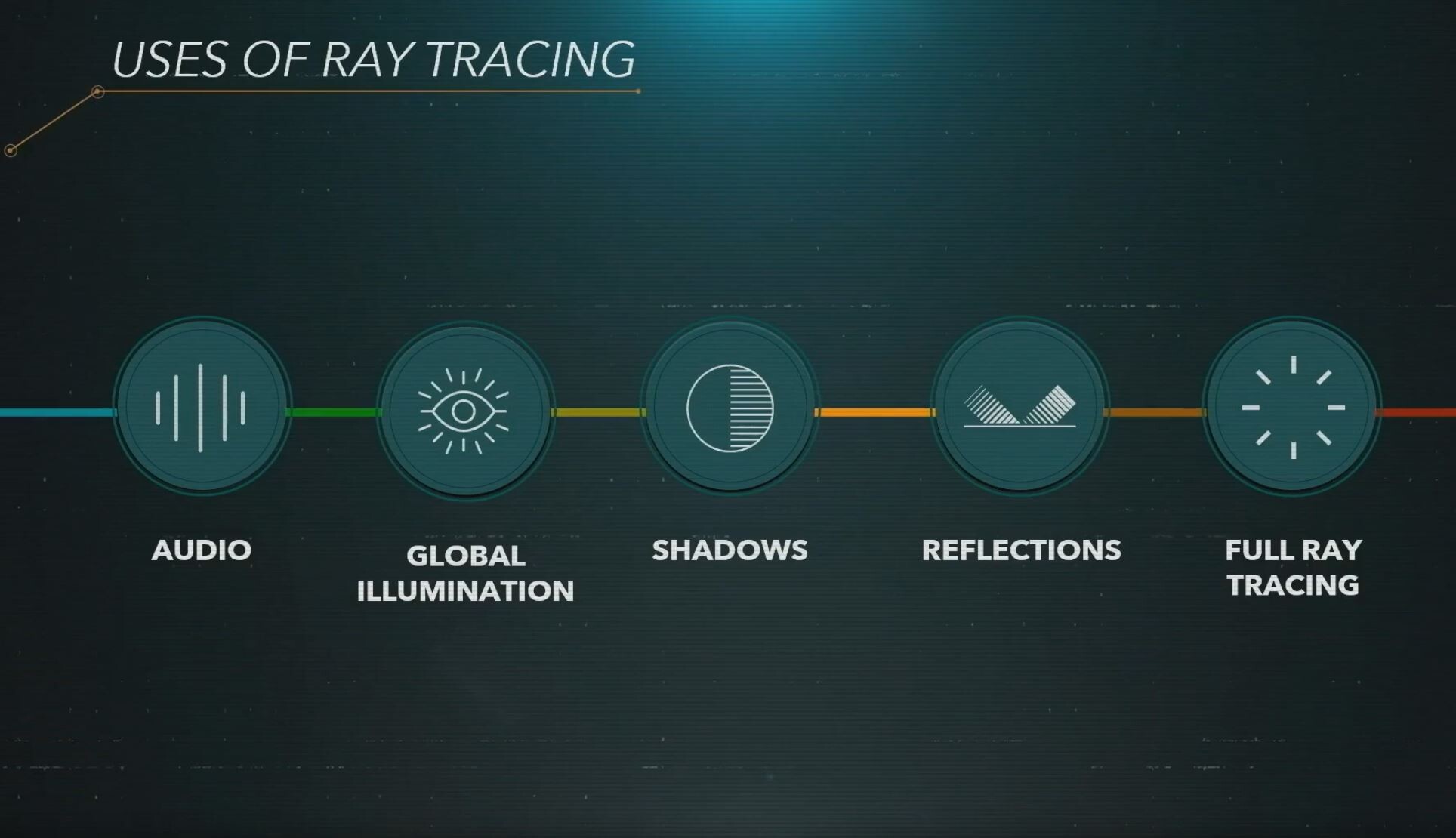
Sony also shed some "light" on the hardware-accelerated real-time ray-tracing approach AMD is taking with RDNA2. Apparently, each compute unit features a hardware component called "Intersection Engine," with roughly the same function as an RT core on NVIDIA "Turing," which is to calculate the intersection of rays with geometry (such as triangles or polygons) in a scene. This combines with a fairly standardized bounding volume hierarchy (BVH) model to achieve a hybrid of ray-traced elements in an otherwise conventional rasterized 3D scene (pretty much where NVIDIA is right now with RTX). On PlayStation 5, RDNA2's ray-tracing hardware is leveraged for positional audio, global illumination, shadows, reflections, and full ray-tracing.
The third key component of the SoC is the I/O complex. This handles all of the chip's I/O, not just with peripherals and video output, but also storage and memory. There are dedicated I/O co-processors on-silicon designed to reduce the various I/O's processing stack on the CPU cores, and reduce latencies at various stages. There's also a certain amount of SRAM that caches transfers between the various components on the I/O complex. The custom chip leverages AMD SmartShift in power-management.
PlayStation 5 uses 16 GB of GDDR6 memory. Sony did not mention the memory clock, bandwidth, or even the memory bus width. It did drop some hints about memory management. It appears like PlayStation 5 does not partition memory the way Xbox Series X does, and possibly sticks to the hUMA model of the PlayStation 4 (using a common pool of physical memory for system- and video memory).
Lastly, a large chunk of Sony's presentation focused on the next frontier for hardware innovation: positional audio. Sony is investing heavily on positional audio that takes into account the gamer's physical HRTF (head-related transfer function). The company is leveraging the vast amounts of CPU power gained from the upgrade to "Zen 2," to achieve this.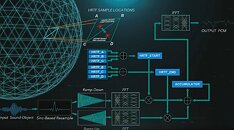 We still don't know what a PlayStation 5 console will look like.
Source:
Sony Computer Entertainment (YouTube)
Each PlayStation 5 ships with a PCI-Express 4.0 x4 SSD with a flash controller that has been designed in-house by Sony. The controller features 12 flash channels, and is capable of at least 5.5 GB/s transfer speeds. When you factor in the exponential gains in access time, Sony expects the SSD to provide a 100x boost in effective storage sub-system performance, resulting in practically no load times.
SoC is where Cerny sounded restrained in what he wanted to disclose. The SoC is a semi-custom chip designed by Sony and AMD, possibly on a 7 nm-class silicon fabrication process. Sony won't specify if it is a monolithic silicon or an MCM, but there are three building-blocks to it: CPU, GPU, and I/O complex. The CPU is based on AMD "Zen 2" x86-64 microarchitecture, and the GPU is based on the company's upcoming RDNA2 graphics architecture.
There are eight "Zen 2" CPU cores, although the company didn't mention if SMT is featured. The maximum CPU clock speed is 3.50 GHz. The GPU is a whole different story from the one on the Xbox Series X Velocity Engine semi-custom chip. Sony decided to go with 36 RDNA2 compute units ticking at up to 2.23 GHz engine clock, compared to 52 compute units running at up to 1.825 GHz on the upcoming Xbox. Sony's GPU ends up with up to 10.3 TFLOPs max compute throughput, compared to Microsoft's 12 TFLOPs.
Sony also shed some "light" on the hardware-accelerated real-time ray-tracing approach AMD is taking with RDNA2. Apparently, each compute unit features a hardware component called "Intersection Engine," with roughly the same function as an RT core on NVIDIA "Turing," which is to calculate the intersection of rays with geometry (such as triangles or polygons) in a scene. This combines with a fairly standardized bounding volume hierarchy (BVH) model to achieve a hybrid of ray-traced elements in an otherwise conventional rasterized 3D scene (pretty much where NVIDIA is right now with RTX). On PlayStation 5, RDNA2's ray-tracing hardware is leveraged for positional audio, global illumination, shadows, reflections, and full ray-tracing.
The third key component of the SoC is the I/O complex. This handles all of the chip's I/O, not just with peripherals and video output, but also storage and memory. There are dedicated I/O co-processors on-silicon designed to reduce the various I/O's processing stack on the CPU cores, and reduce latencies at various stages. There's also a certain amount of SRAM that caches transfers between the various components on the I/O complex. The custom chip leverages AMD SmartShift in power-management.
PlayStation 5 uses 16 GB of GDDR6 memory. Sony did not mention the memory clock, bandwidth, or even the memory bus width. It did drop some hints about memory management. It appears like PlayStation 5 does not partition memory the way Xbox Series X does, and possibly sticks to the hUMA model of the PlayStation 4 (using a common pool of physical memory for system- and video memory).
Lastly, a large chunk of Sony's presentation focused on the next frontier for hardware innovation: positional audio. Sony is investing heavily on positional audio that takes into account the gamer's physical HRTF (head-related transfer function). The company is leveraging the vast amounts of CPU power gained from the upgrade to "Zen 2," to achieve this.

178 Comments on Sony Reveals PS5 Hardware: RDNA2 Raytracing, 16 GB GDDR6, 6 GB/s SSD, 2304 GPU Cores
Sorry, "fanboy" may have been a bit harsh.
I just respect the uber state-of-the-art technology that is Cell and its high potential.
Another gaming console looking at a price of about $499 MAX just like the XBox Series X. Unless of course they plan on selling none with a higher price tag.Xbox Series X looks like the better performer, and I agree. But with consoles, Developers try and utilize the entire system as a whole as efficiently as possible. Every single component will be efficiently utilized in both of these gaming consoles.And that may be the differentiating factor between the PS5 & the XBox Series X, excluding game exclusives and such.
www.anandtech.com/show/14290/tsmc-most-7nm-clients-will-transit-to-6nm
Sony loaded PS5's 448 GB/s bandwidth (the same as 5700/5700 XT memory bandwidth) with additional PC CPU node and slightly higher GPU TFLOPS.
Try again.www.techpowerup.com/review/nvidia-geforce-gtx-1080-ti/34.html
GTX 1080 Ti FE has 1,777 Mhz average clock speed, which yields about 12.74 TFLOPS.
GeForce 8800 is better.
CELL CPU = half-assed in-order Atom like CPU.
CELL SPU = DSP, half-assed wannabe GPU
CELL = master of none.
I'm game for another round of PS3 vs Core 2 + GeForce 8800 debates
LOL do you know how TFLOPS are calculated? Do you also know it only takes into consideration one operation by a compute chip? It doesnt tell the whole story. Its also primarily marketing for consoles since average console player doesnt know what the hell it is. Its rarely used as an actual way of marketting a chip when it comes to PCs, etc.
Your argument mirrors Mark Cerny's PS5 defense argument, but an increase in CU count also increases TMU, TFU, SRAM and RT cores.
XSX already scaling into RTX 2080 level results with two weeks raw Gears of War 5 port's built-in benchmark at PC's Ultra settings, hence TFLOPS is scaling.
Not saying that they won't cleverly design games to fully utilize the Xbox Series X too, but at the end of all this, the XSX is the stronger console, Microsoft went all out, and seems a lot more serious over Sony this time around. And I don't blame them for such a decision, they need to gain as much market share as possible, get back to the Xbox 360 sales figures or beyond.
The only thing that will determine the success of the XSX is price. If they get that wrong, the SP5 is going to clober it.
As for Cerny's argument that a smaller, higher clocked GPU is "more nimble" - that's nonsense, plain and simple. If that was indeed the case, overclocking PC GPUs would yield higher-than-linear results, and lower-tier OC cards would outperform stock-clocked higher tier cards. What actually happens is that gains from OC's are almost universally far lower than the clock increase would indicate, with the typical recent examples being 2-3% average performance increases from 8-10% clock increases and 20-30% power increases. Sony is trying to put a positive spin on putting their money on a weaker chip.
Now, the difference between the consoles in compute power isn't massive by any means, and the PS5 will no doubt have excellent looking games, but cross-platform games will look better and/or sustain frame rates better, just like on the XOX vs. PS4 Pro.
The effects of Sony's other hardware investments (SSD and 3D Audio) will be very interesting to see, but I sincerely doubt they'll do anything to alleviate the performance bottleneck - slightly shorter loading times is good, but unless MS has really botched their implementation the difference won't be huge, and while I'm really looking forward to games implementing a good, realistic 3D audio system, it won't be what makes or breaks a game. Of course a 15-20% performance advantage isn't likely to either, but it's more immediately noticeable. Then again Sony has such a mindshare advantage that they'll really need to botch this to not still come out ahead in terms of sales.
I AGREE. :D
So far the PS5 will only be backwards compatible with PS4 games. With no added visual enhancements.
The XSX will be backwards compatible with all previous Xbox games regardless of system and will also have image quality enhancements and resolution upscaling capabilities.
Sure Sony has a large library of exclusives but Microsoft has been busy buying up game companies and has been steadily increasing its exclusive library.
And once again, stop comparing PCs with Consoles, as soon as one does this, the argument becomes mute.