Thursday, October 29th 2020

Intel Confirms Rocket Lake-S Features Cypress Cove with Double-Digit IPC Increase
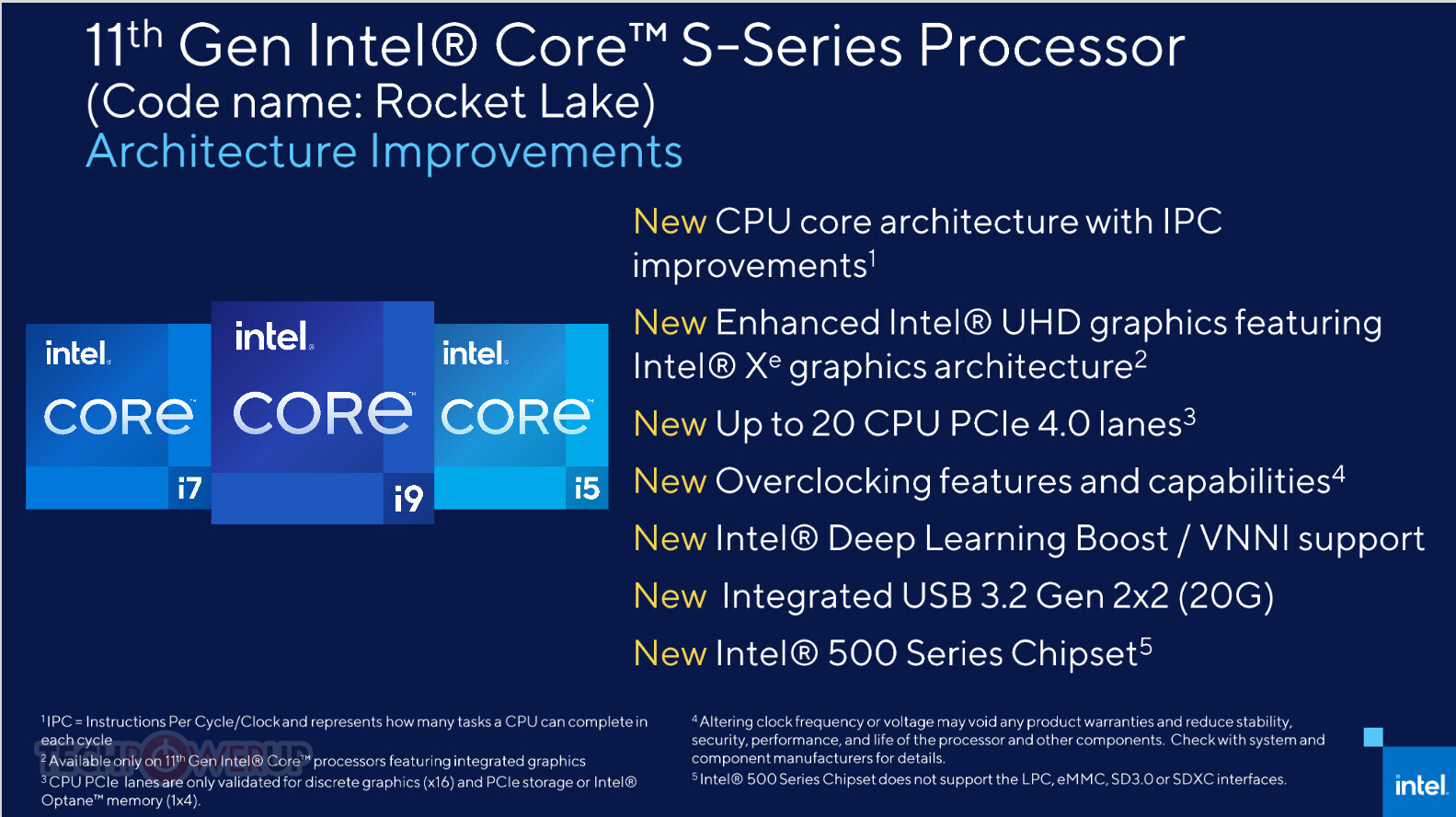
Today, Intel has decided to surprise us and give an update to its upcoming CPU lineup for desktop. With the 11th generation, Core CPUs codenamed Rocket Lake-S, Intel is preparing to launch the new lineup in the first quarter of 2021. This means that we are just a few months away from this launch. When it comes to the architecture of these new processors, they are going to be based on a special Cypress Cove design. Gone are the days of Skylake-based designs that were present from the 6th to 10th generation processors. The Cypress Cove, as Intel calls it, is an Ice Lake adaptation. Contrary to the previous rumors, it is not an adaptation of Tiger Lake Willow Cove, but rather Ice Lake Sunny Cove.
The CPU instruction per cycle (IPC) is said to grow in double-digits, meaning that the desktop users are finally going to see an improvement that is not only frequency-based. While we do not know the numbers yet, we can expect them to be better than the current 10th gen parts. For the first time on the Intel platform for desktops, we will see the adoption of PCIe 4.0 chipset, which will allow for much faster SSD speeds and support the latest GPUs, specifically, there will be 20 PCIe 4.0 lanes coming from the CPU only. The CPU will be paired with 12th generation Xe graphics, like the one found in Tiger Lake CPUs. Other technologies such as Deep Learning Boost and VNNI, Quick Sync Video, and better overclocking tuning will be present as well. Interesting thing to note here is that the 10C/20T Core i9-10900K has a PL1 headroom of 125 W, and 250 W in PL2. However, the 8C/16T Rocket Lake-S CPU also features 125 W headroom in PL1, and 250 W in PL2. This indicates that the new Cypress Cove design runs hotter than the previous generation.


Source:
Intel Newsroom
The CPU instruction per cycle (IPC) is said to grow in double-digits, meaning that the desktop users are finally going to see an improvement that is not only frequency-based. While we do not know the numbers yet, we can expect them to be better than the current 10th gen parts. For the first time on the Intel platform for desktops, we will see the adoption of PCIe 4.0 chipset, which will allow for much faster SSD speeds and support the latest GPUs, specifically, there will be 20 PCIe 4.0 lanes coming from the CPU only. The CPU will be paired with 12th generation Xe graphics, like the one found in Tiger Lake CPUs. Other technologies such as Deep Learning Boost and VNNI, Quick Sync Video, and better overclocking tuning will be present as well. Interesting thing to note here is that the 10C/20T Core i9-10900K has a PL1 headroom of 125 W, and 250 W in PL2. However, the 8C/16T Rocket Lake-S CPU also features 125 W headroom in PL1, and 250 W in PL2. This indicates that the new Cypress Cove design runs hotter than the previous generation.


74 Comments on Intel Confirms Rocket Lake-S Features Cypress Cove with Double-Digit IPC Increase
Then again, I've been disappointed before.
Still 14nm and on top of that back to max 8 cores and even throw its now only 8 cores. Power stages is still 125 watt and 250 watt. So less cores and same power efficiency and that is not positive meant.
Yeah I think my mind is ready to chose cpu for my new system. Ryzen 9 5950X here I come.
Graphics are also well accelerated with AVX512, but to a lesser extent. Graphics benefits from 'more cores' it seems, but AVX512 helps close the core-count gap between AMD and Intel. A large number of 3d modelers are based on Intel's Embree software raytracer, which is of course AVX512 optimized. Corona Renderer (3d Studio Max / Cinema 4D) uses Embree, probably a few others.
-----
Of course, the big guns are Adobe products: Photoshop, Premier, After Effects, etc. etc. All of them are AVX512 optimized (but like other graphics programs: more cores often help). The main advantage to AVX512 in this case is single-threaded performance, which is still the dominant factor for previews and live-rendering. Offline rendering benefits from higher core-counts of course, but the user-experience is felt by speedy single-threaded results.
www.pugetsystems.com/labs/articles/Ryzen-XT-and-i9-10850K-for-Adobe-CC-Are-They-Worth-It-1838/
AV1 encoding on the other hand is a first afaik and not something any other CPU/GPU/SoC has to date, although I guess it's possible the 6000-series has, but Nvidia didn't implement it. Yes, so far it's going to be a niche feature too, but I can see it being much more popular with consumers and many professionals than AVX512.
I'm finding it curious that you think that AV1 encoding is a consumer task, but don't consider Photoshop / Premier / LTSpice / Matlab to be consumer.
I think a lot more people are doing video encoding, but I guess they might be doing it on their phones, rather than their computer, which imho is madness. Then again, a lot of people don't seem to bother with having a computer and live on their phones instead. I don't understand how you do anything productive on a phone, as there are so many limitations. I guess it comes down to what you're used to, but I prefer a large screen, a mouse and a keyboard when I'm doing work. Notebook for travel and phone for quick emails and taking some snaps/video.
AV1 is supposedly the next big thing in video codecs though and someone has to provide hardware that allows anyone to encode using, rather than requiring a dedicated hardware encoder or a server farm. I believe it'll be another 3-5 years until we see it phones outside of maybe the odd flagship model.
" This indicates that the new Cypress Cove design runs hotter than the previous generation. "
Surely the last thing Intel needs to release is a 8C/16T CPU that runs even hotter than the part/s it will replace, especially given the
leaps in efficiency AMD are claiming for Zen 3?
Besides, even if Intel takes performance crown, it'll be with double the power and heat. And let's not forget, "double digit" could, and probably does mean 10%...if it was approaching the 19%+ of Zen3, Intel would be shouting that from the rooftops. So a 10% IPC increase from Intel would at best bring them to parity with Zen3.
Regardless, after this, Intel will be on 10nm, which is equivalent to TSMC 7nm, while Zen4 will be on 5nm. People "in the know" have said Intel doesn't pose a threat to AMD until 2022 at the earliest, and that seems correct to me. It'd be nicer if Intel could compete sooner for the sake of driving prices down, but I just don't see it happening.
intel/comments/jkapv5/_/gahs822
AMD must be terrified lagging so much in the slides department, having to survive on physical goods sales.
Hopefully the launch is equally short, detailed, to the point. Bringing on Ryan Shrout shaped Intel's marketing dept into 2 years' worth of wannabe-gamer-chic public embarrassment.
Double digit IPC increase and double the power consumption for the top dog. /facepalm
or is that back wards?
Intel hype whoop! :shadedshu: