Thursday, August 14th 2025

Report: AMD Now Commands One-Third of the Desktop x86 Processor Market
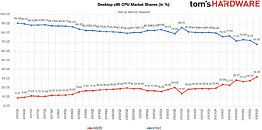
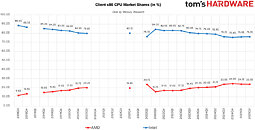
Mercury Research compiled the latest data for the second quarter of 2025, with updates across the desktop, mobile, client, and server platforms. In Q2 2025, AMD achieved its best quarter yet. AMD's desktop x86 unit share rose to 32.2%, roughly one third of the market, and its desktop CPU revenue share climbed to 39.3%. Those gains reflect strong demand for Ryzen 9000 series processors and gamers' favorite X3D models, which together have driven both unit momentum and a disproportionate share of dollars in desktop sales. Note that Intel still remains the largest desktop vendor, but its unit share of 67.8% now represents a materially narrower lead than in prior years.
The desktop picture matters because value mix, not just units, is where margins are won. AMD is capturing more high-end sockets and achieving higher average selling prices, which helps its revenue share outpace its unit share. Intel continues to outsell AMD on desktops at a ratio of approximately two to one, down sharply from ratios that were far more present in earlier cycles. That compression signals a more contested market, with AMD converting enthusiast and commercial interest into concrete wins in both retail and OEM channels. Retail and DIY buyers are buying the latest Ryzen parts for gaming and content creation, while some system manufacturers are expanding Ryzen options in their higher-performance prebuilt lines.
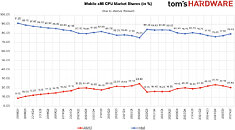
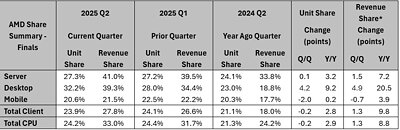 Across the broader client landscape, AMD's total consumer unit share was 23.9% in Q2, up year-over-year, even as it slipped slightly quarter-over-quarter, and its consumer revenue share rose to 27.8%. Mobile unit share weakened for AMD relative to late 2024, but desktop strength and server gains are helping offset that softness. For Intel, the decline in desktop sales shows pressure at the higher end of its product stack as AMD narrows the gap through newer architectures and focused product placement. However, notebook share is an area where Intel is regaining some market share, making it an interesting trend to observe.
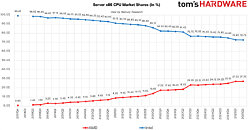
 Here are the server unit shares too:
Source:
Tom's Hardware
The desktop picture matters because value mix, not just units, is where margins are won. AMD is capturing more high-end sockets and achieving higher average selling prices, which helps its revenue share outpace its unit share. Intel continues to outsell AMD on desktops at a ratio of approximately two to one, down sharply from ratios that were far more present in earlier cycles. That compression signals a more contested market, with AMD converting enthusiast and commercial interest into concrete wins in both retail and OEM channels. Retail and DIY buyers are buying the latest Ryzen parts for gaming and content creation, while some system manufacturers are expanding Ryzen options in their higher-performance prebuilt lines.


90 Comments on Report: AMD Now Commands One-Third of the Desktop x86 Processor Market
I'm certain it's going to be a nice processor but i doubt it's going to be worth it upgrading from zen4
And if Intel manages to come out with a better mobile CPU and better integrated graphics, especially if that CPU is made in Intel fabs with good yields, AMD's market share in the mobile market will collapse.
Also according to the Steam hardware survey from July 2025, 40.39% of users have AMD CPU's.
A few things keep AMD from breaking through: limited TSMC wafer supply (so AMD prioritizes higher-margin desktop/server parts), long OEM design cycles, and the lingering “Intel Inside” ecosystem advantage from decades of deep vendor relationships. Even without the shady rebate games from the 2000s, the old antitrust era left a market where Intel still controls the bulk of laptop design slots. Add in retailer bias toward “safe” Intel SKUs, and you get the slower growth we’re seeing.
It’s not that AMD mobile is bad — it’s just still fighting a decades-old uphill battle.
I will upgrade and gonna build another PC for fun!
I doubt intel has margin on thoseThat is well within your rights, I am sorry for wasting your time.
12 high performance cores (no e-core bs) on a single CCD with IPS improvements of Zen 5 and Zen 6 stacked on top, along with a new IO Die. That "dud" ?
Even if we assume zero IPC gains he will gain 4 extra cores and 4 extra threads.
I expect a fair chunk of Intel market share is older systems.
When can we expect anti-consumer behaviour from AMD Ryzen?
Or was that just an Intel thing?
:nutkick:
None of this is AMD's fault. They're providing an excellent engine but selling it to vendors who put it into crap products. They don't have control over the finished product like Apple does.
Even for desktop it's very hard to find mobo or graphics card without RGB and childish logos. Everything is marketed to teenagers.
a 30% gain on something that only takes a couple of ms isn't exactly worth it.
If you are getting 30% on something that would take an hour, yes that would be significant
I'm sitting here with a 7950x and a 3090 which are hardly ever used to their full potential.
I do appreciate them when I'm importing and exporting media
en.wikipedia.org/wiki/Selection_bias
It’s 50.8% of people that choose to run Passmark, not 50.8% of the x86 cpu market (which this survey is about). Also, installed base <> market share.
I won't count Intel out of the game just yet - Nova Lake vs. dual X3D R9's will be the true fight for me. If AMD refuses to do dual X3D yet again, they lost by default unless the 9800X3D's successor rips so hard that it's no contest anyway.
Because you are on Zen 4 and you think you wont see much benefit from Zen 6 does not mean others wont.Says the person who's talking about Nova Lake (and presumably it's large L3) and dual X3D. As if these are established facts?
If you are allowed to dream about Nova Lake vs Dual X3D, then others are allowed to dream about 12c CCD.
As for the validity of the 12c leak. Well AMD will be making several node jumps from 4nm (5nm class) to 2nm. It is reasonable to assume that gives them more space inside the CCD to increase core counts. Yes 2nm Zen 6 is a fact. We are roughly 18 months out from Zen 6 release. At this point i would consider this a credible rumor. Not solid, but credible.