Thursday, August 14th 2025

Report: AMD Now Commands One-Third of the Desktop x86 Processor Market
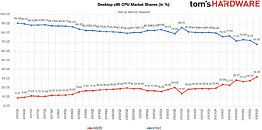
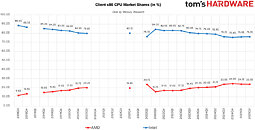
Mercury Research compiled the latest data for the second quarter of 2025, with updates across the desktop, mobile, client, and server platforms. In Q2 2025, AMD achieved its best quarter yet. AMD's desktop x86 unit share rose to 32.2%, roughly one third of the market, and its desktop CPU revenue share climbed to 39.3%. Those gains reflect strong demand for Ryzen 9000 series processors and gamers' favorite X3D models, which together have driven both unit momentum and a disproportionate share of dollars in desktop sales. Note that Intel still remains the largest desktop vendor, but its unit share of 67.8% now represents a materially narrower lead than in prior years.
The desktop picture matters because value mix, not just units, is where margins are won. AMD is capturing more high-end sockets and achieving higher average selling prices, which helps its revenue share outpace its unit share. Intel continues to outsell AMD on desktops at a ratio of approximately two to one, down sharply from ratios that were far more present in earlier cycles. That compression signals a more contested market, with AMD converting enthusiast and commercial interest into concrete wins in both retail and OEM channels. Retail and DIY buyers are buying the latest Ryzen parts for gaming and content creation, while some system manufacturers are expanding Ryzen options in their higher-performance prebuilt lines.
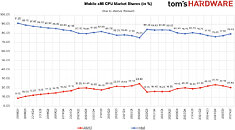
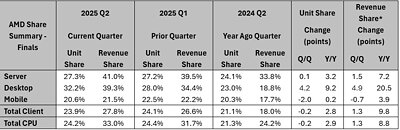 Across the broader client landscape, AMD's total consumer unit share was 23.9% in Q2, up year-over-year, even as it slipped slightly quarter-over-quarter, and its consumer revenue share rose to 27.8%. Mobile unit share weakened for AMD relative to late 2024, but desktop strength and server gains are helping offset that softness. For Intel, the decline in desktop sales shows pressure at the higher end of its product stack as AMD narrows the gap through newer architectures and focused product placement. However, notebook share is an area where Intel is regaining some market share, making it an interesting trend to observe.
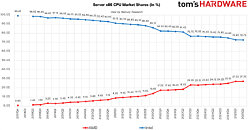
 Here are the server unit shares too:
Source:
Tom's Hardware
The desktop picture matters because value mix, not just units, is where margins are won. AMD is capturing more high-end sockets and achieving higher average selling prices, which helps its revenue share outpace its unit share. Intel continues to outsell AMD on desktops at a ratio of approximately two to one, down sharply from ratios that were far more present in earlier cycles. That compression signals a more contested market, with AMD converting enthusiast and commercial interest into concrete wins in both retail and OEM channels. Retail and DIY buyers are buying the latest Ryzen parts for gaming and content creation, while some system manufacturers are expanding Ryzen options in their higher-performance prebuilt lines.


90 Comments on Report: AMD Now Commands One-Third of the Desktop x86 Processor Market
You can clearly see how once the P cores are maxed out the E cores get loaded....no funny business it just works.
Work on researching such evidence and let us know ow what you find out. Everything else is unfiltered noise and clumsy narrative.
But like I said BF6 runs great on a lot of CPU's, even runs well on older GPU's too, besides it's pointless to argue about a game that lacks a benchmark mode or a test range to get any consistent metrics.So beamng isn't a good benchmark at all as you don't get any repeatable accurate data unless taking the time to set up a car crash exactly the same every time.That's moving the goalposts, and unsurprisingly you're downplaying the 9700X being faster, if it was the other way around you'd be bragging about the 265K being 5% faster.
And no if it was the other way around people would be whining about resolution just like what is happening in this thread.It's exactly what APO does, and Intel is still updating it, e-cores still aren't perfect and it makes no sense why people are hyping them up like they are.
In Canada the 265k is 40$ cheaper than the 9700x, so still not a fair comparison?Shows how much you really know about the game, its easily repeatable to play a game and not crash, hence why in my test loops its very easily recreated.
Of course that 1080p is the resolution of the poor and non-enthusiast | pro communities.
Hell, even if people work with larger drawings, be them AutoCAD or simple pdfs, everyone's needs are larger display with higher resolutions.
Regarding the news at hand - too little, too late. It just goes to prove again and again that Intel is still working with its dirty anti-competitive and anti-consumer tricks.
Yeah I guess we should compare it to cpu's that cost TWICE as much.........yeah I'll save 400$ and take the 265k thanks
Although even the 9700X shows how strong IPC with a more efficient architecture is resulting in AMD gaining marketshare, while Intel has fallen hard from its near monopoly back in 2016, a company still stuck in its hubris of anti-competitive greed. Intel can only compete on price and more cores marketing, what Intel needs to do for desktop is just deliver 16 full P cores with HT and not charge $1,000 for it.It isn't a matter of people being poor or uninformed, 1080P is the most balanced resolution for frame rate and GPU requirements, not everyone has $2000+ to spend on a GPU to sufficiently use a 4K monitor.
But for productivity, yeah you'll want at least 2X 1440P displays so you can more efficiently work, however according to the Steam hardware survey, 1080P is by far the most used display resolution.
Increasing number of buyers decisively prefer more platform flexibility and ability to upgrade CPU. In this department, Arrow Lake is in no man's land.
Buy if you must, but better wait for Nova Lake next year if you can, as it is alleged to support several generations of CPUs, finally a proper longevity platform from Intel. Or buy AM5 and enjoy further upgrades.
After my Coffee Lake experience, I promised myself I would never lock myself again into end-of-life platform.
One reason why 265K has become so cheap is lack of enthusiasm for Arrow Lake platform, for multiple reasons. A few would jump into cheap deals and make one-off savings, but in a wider perspective, even free CPU wouldn't make a bigger difference in today's market.Save $400 by not buying 9900X? What are you taking about?
Hopefully AMD will too now that they are a software company. Maybe then their users won’t have to use things like process lasso to manually manage their CPUs.
Thanks for letting me know!
If AMD feels threatened next gen, they might design APO-like app. We will see. If they are still ahead like now, no need for them to bring such app forward. Simple.
Incremental upgrades to an existing formula (something that Intel did with the first 10 generations of their Core i7 chips and AMD has been doing since Zen 3) is fine. But it's a boring product, and I'm not particularly fond of boring. I kept my i7-990X for almost 8 years. I want new and exciting, and unless dual X3D is brought to the table, Ryzen is anything but new and exciting.
My X99 Xeon system was exciting, back in 2017, before it became AliExpress slop. 18 cores and 45 MB of L3 when most desktop CPUs barely had 6-8 and 12-16 for show? Who'd have thought? Then I bought Ryzen. First a 3500X, then I stepped up to Zen 2 refresh with the 3900XT, and eventually the 5950X. Last one was particularly exciting, it had tons of performance in a common form factor. I meant to get Zen 4 to experience DDR5... but delays with the 7800X3D, a refusal to release a 16 core 3D chip with no compromises and early platform woes spooked me out of that idea. Cue Raptor Lake, a refined form of a genuinely innovative architecture Intel created back then - and my upgrade window just coincided with Intel's release of the special binned edition of the 13900K. I bought that.
Arrow Lake... wasn't exciting, and like AMD's split X3D processors, it had caveats and occasional performance regressions. I skipped them both. Nova Lake promises to be interesting once more. Yet I'd rather wait for a refined version of it, anyways, always keeping the door open for AMD to bring me some new and interesting technology in exchange for my hard earned money. It's not too hard to figure it out.
Here, my last all-AMD build from 5 years ago. 3900XT chip, ROG X370. That Radeon VII, as impressive tech as it was poorly supported. But that's talk for another thread. By the time I got the 5950X, I already switched to the RTX 3090... and pretty much 100% of my displeasure with AMD at any level was/is related to this specific graphics card and its "professional" predecessor, which I also owned. That, and the lying about X370 and Zen 3, but whatever, I actually don't hold grudges.
If the ability to upgrade and making savings are more important in a long run, AM5 platform is the way to go in this cycle. There's no doubt about it. Hence such big shifts in the market share in recent year. It's something we haven't seen in many years.This one is debatable because we haven't seen it in action. In the scenario without parking cores on the other CCD, any gaming workload needing more than 8 cores would still need to jump over current Infinity Fabric, introducing a small latency penalty. This, production cost and relatively super niche need for such a halo and expensive product have not brought it into markets, as yet. This may change, or not.
It looks as though Zen6 is a better ground for such CPUs, as the new Infinity Fabric already in action in Strix Halo APUs is much faster and more intimately linked to IOD, which reduces extra step latency for another cache hit on the opposite CCD. Zen6 will have this new Infinity Fabric.
Besides, it's not up to AMD to decide if it's "worth it" or not, but the customer, and there is clear demand for such a part. AMD only decides if it's worth building considering their overall product stack and how much such a processor would hurt sales of higher margin products, which I guess, a lot.
Ideally they should just give both CCDs with 3D V-Cache on X3D models as the current setup makes scheduling even more complex than it already was, assisting scheduling from hardware like Intel does nowdays could be good as well, but just giving both CCDs the same amount of cache would be better with or without hardware based assistance on those CPUs models.
No it is not what apo does at all. You realize it has been tested? APO is a lot faster than turning off ecores. That could not be the case if all it did was move traffic to pcores. Actually you can clearly tell it's not doing that if you ever actually used it but you haven't. You are just making stuff up.
Dual CCDs are far from perfect as well, I wonder why people are hyping them up. They need a bunch of software and they still are suboptimal losing to single ccd cpus. Don't see you complaining thoughThat evidence is quite obvious and if it was the other way around people would be all over them, but it's AMD so yeah let's shush about it.
Zen 1 slapped Intel around in MT performance at every price point. Actually amd was a lot faster and a lot cheaper at the same time (the 199$ R5 1600 had more MT performance than the 330$ 7700k). Fast forward to today - they are on parity at the high end and Intel dismantles amd at the mid and lower end. So clearly - in order for intel to not just close such a huge gap but actually beat amd decisively, stagnation is their favorite strategy.
Claiming that AMD shares millions of CPUs and therefore their CPUs are great is a silly argument cause by that same metric Intel sells more than double so obviously using your argument Intel has better cpus...
As far as I understand the graphs represent sales. Units sold. And if that is the case then the majority of customers come to the conclusion that Intel systems are better for them. I don't like using sales as an indication of what product is good or not but since that's what you are doing, clearly intel has better products.
:shadedshu: