Thursday, August 14th 2025

Report: AMD Now Commands One-Third of the Desktop x86 Processor Market
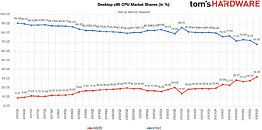
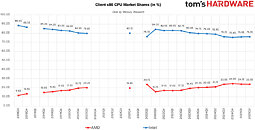
Mercury Research compiled the latest data for the second quarter of 2025, with updates across the desktop, mobile, client, and server platforms. In Q2 2025, AMD achieved its best quarter yet. AMD's desktop x86 unit share rose to 32.2%, roughly one third of the market, and its desktop CPU revenue share climbed to 39.3%. Those gains reflect strong demand for Ryzen 9000 series processors and gamers' favorite X3D models, which together have driven both unit momentum and a disproportionate share of dollars in desktop sales. Note that Intel still remains the largest desktop vendor, but its unit share of 67.8% now represents a materially narrower lead than in prior years.
The desktop picture matters because value mix, not just units, is where margins are won. AMD is capturing more high-end sockets and achieving higher average selling prices, which helps its revenue share outpace its unit share. Intel continues to outsell AMD on desktops at a ratio of approximately two to one, down sharply from ratios that were far more present in earlier cycles. That compression signals a more contested market, with AMD converting enthusiast and commercial interest into concrete wins in both retail and OEM channels. Retail and DIY buyers are buying the latest Ryzen parts for gaming and content creation, while some system manufacturers are expanding Ryzen options in their higher-performance prebuilt lines.
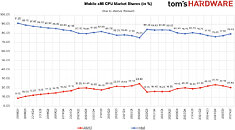
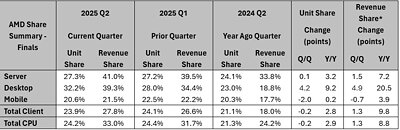 Across the broader client landscape, AMD's total consumer unit share was 23.9% in Q2, up year-over-year, even as it slipped slightly quarter-over-quarter, and its consumer revenue share rose to 27.8%. Mobile unit share weakened for AMD relative to late 2024, but desktop strength and server gains are helping offset that softness. For Intel, the decline in desktop sales shows pressure at the higher end of its product stack as AMD narrows the gap through newer architectures and focused product placement. However, notebook share is an area where Intel is regaining some market share, making it an interesting trend to observe.
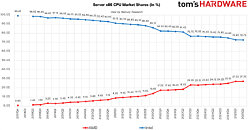
 Here are the server unit shares too:
Source:
Tom's Hardware
The desktop picture matters because value mix, not just units, is where margins are won. AMD is capturing more high-end sockets and achieving higher average selling prices, which helps its revenue share outpace its unit share. Intel continues to outsell AMD on desktops at a ratio of approximately two to one, down sharply from ratios that were far more present in earlier cycles. That compression signals a more contested market, with AMD converting enthusiast and commercial interest into concrete wins in both retail and OEM channels. Retail and DIY buyers are buying the latest Ryzen parts for gaming and content creation, while some system manufacturers are expanding Ryzen options in their higher-performance prebuilt lines.


90 Comments on Report: AMD Now Commands One-Third of the Desktop x86 Processor Market
www.tomshardware.com/pc-components/cpus/amd-ryzen-9-9950x-vs-intel-core-ultra-9-285k-faceoff-it-isnt-even-close
Plus, this very website published findings for another flagship, 9950X3D. Flagships carry the message for its generation. Differences are even higher in Linux, seen in comprehensive review by Phoronix. It's not even close.
www.techpowerup.com/review/amd-ryzen-9-9950x3d/26.htmlIf you had commanded over 90% of market share until a few years and today you command around 67% (even less, 60% according to PassMark), the question is what has happened with all those "better" products and why people buy more of "worse" products from the competitor? If you still sell better products, why is it that you cannot keep market share intact? You are still selling majority of CPUs overall, but customers are less enthused by your recent generations, for whatever reason, hence your market share is slowly, but consistently melting. This process takes years, as you know. So, the narrative that Intel has better products just because they still sell more doesn't work, I am afraid.
Besides, one of key reasons why Intel still holds higher share in server CPU is due to long cycle of rack replacements (7-8 years) and historically high CPU attachment number. Majority of companies that decided to upgrade old servers replaced old Xeon systems with EPYCs, hence such rapid increase in EPYC revenues and installation base. Parity in share is expected by the end of 2026 or in 2027. Just watch it happen with Venice and Verano CPUs. We will come back to this debate again when next quarter numbers are released, and then nwxt year, and so on. You will continue to see a gradual decline, unless something big happens, such as Nova Lake and Diamond Rapids bringing winning flagships and revived enthusiasm across the board.
Gaming : Similar 1% lows, 2% better averages for the amd, better efficiency for Intel.
ST : Intel flat out wins by 6.2%
MT : AMD leads by 2.3%!
Efficiency : AMD leads by 10-15% in MT scenarios, Intel leads by a whooping 60% in mixed scenarios.
Please, explain to me how that's a clear lead for AMD? Especially considering their starting position with zen 1, which was like 40% faster than the equivalent Intel part. Come on man, you are not being honest here.They had 90% marketshare when AMD wasn't making any CPUs my man. Obviously, once AMD started making CPUs again Intel wouldn't retain that 90%. How could they...
It brings some industry firsts like CKD RAM support, but there were way too many performance regressions, caveats and tradeoffs for it to truly be an upgrade over its predecessors. The only CPU I truly like is the U9 285 (non K), which can make an amazing, low maintenance machine for the right price, the problem being that the price hasn't been right for any of the U9 CPUs all this time, and most people overall will be better served by a 7800X3D/9800X3D with about the same power and thermal footprint, but much better gaming muscle.
As it stands I'd say Intel is a solid 5 years behind AMD in CPU technology right now, thankfully the very large, generational level performance advantage they had over Zen 3 at the time mostly covers up for this - a good 13th/14th Gen i9, and to that extent the U9 285/285K is not going to look too bad next to a 7950X, and the U7 265K more than holds its own at the pricing being practiced against the Ryzen 7 line. The 9950X/9950X3D are straight up faster overall, and I'm all too happy to concede that, caveats regarding the 9950X3D notwithstanding.
It's no surprise the 265K can often pound the 9600X and most other 8 core R7s with its 8P+12E setup, but with all the negative press and the promise of yet another generation on AMD's side, a lot of people will opt for the 9600X on that alone. The thing about Intel vs. AMD is that each type of architecture still holds an advantage at something, for example, even that 9600X is gonna look as good if not better than the 265K if your workload uses AVX-512, so it's always good to have choice, especially since to have it all right now, you're going to have to go with Threadripper.
Intel still holds the tweakers' advantage, you can extract a lot more out of the Intel chips than you can out of the AMD ones even after the release of the X870E Apex board (mostly because only their APU is tweakable to that extent), but it's only a matter of time until AMD is no longer bound by the IOD and offers the same level of tweaking ability as Intel.
I just wonder why are the U9s so bloody expensive when Intel seems able to keep relatively good stock on the 265K, for example the U9 285 costs almost double here and is almost always out of stock, the 285K then, a complete unicorn, I think I've saw 2 shipments of it since it launched, that doesn't make sense to me. Intel needed to flood the market with cheap U9 chips, but being TSMC N3B, I guess they just can't.
Fast forward, the longevity of both AM4 and AM5 platforms has proven one of key winning strategies in reclaiming market share, alongside improvements in CPUs. To be clear, not all CPUs working in those platforms are as good in performance and value, but there are enough releases that allow a lot of choices for consumers to mix-and-match. X3D CPUs have sped up the loss of market share by Intel and that's another key factor.
AMD was able to offer three lines of desktop CPUs (G APU, vanilla and X3D) while Intel continued to offer one generic line of CPUs that do it all. This diverse offer helped customers buy more specialised CPU for their daily needs, be it gaming, productivity, graphics or mix of any of those. Plus upgrade cycles.
It's not surprising that we are already hearing rumours that Nova Lake will bring proper multi-generational support and that even some Zen7 SKUs might release on AM5 platform, to further boost the longevity of the platform. We will see how this pans out.