Sunday, February 8th 2026
AMD on FSR 4 for RDNA 3 and Older GPUs: "No Updates to Share at This Time."
AMD's FidelityFX Super Resolution 4 technology, now known simply as FSR 4, is currently supported in many games, but not across all AMD RDNA GPU generations. In response to an inquiry from Hardware Unboxed, AMD mentioned that it is still uncertain whether official FSR 4 support will be extended to the Radeon RX 7000 series and older GPUs, as the company reportedly has "no updates to share at this time." AMD official product separation stems from its RDNA 4 architecture and the support for 8-bit floating point instructions. While the latest RDNA 4 hardware supports Wave Matrix Multiply Accumulate in FP8 format, older RDNA generations like RDNA 3 and RDNA 2 lack this hardware instruction support and can't process 8-bit floating point data in this format.
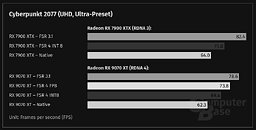
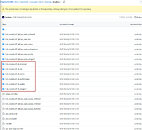
However, older Radeon GPUs can instead rely on the 8-bit integer (INT8) data formats, which Radeon RX 7000 series fully supports. AMD accidentally leaked FSR 4 INT8 on its AMD GPUOpen platform, showing that FSR 4 on older GPUs is a possibility, which is just kept hidden for now. Later on, ComputerBase tested this leaked library, finding that FSR 4 offers a balance between native image quality and FSR 3.1 performance on both RDNA 3 and RDNA 2 hardware. In tests with Cyberpunk 2077 in 4K on Ultra settings using the AMD Radeon RX 7900 XTX, FSR 4 delivered 11% faster performance than native, but was 16% slower than FSR 3.1. Interestingly, performance may be the reason why AMD is holding these INT8 FPR 4 libraries back, but another point could be product separation.
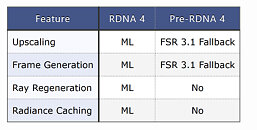 AMD already segregates its latest FSR "Redstone" suite of technologies, with features like Ray Regeneration and Radiance Caching exclusive to RDNA 4 hardware in the Radeon RX 9000 series of GPUs. Other basic technologies like upscaling and frame generation are supported on older RDNA 3/2/1 generations, but use an FSR 3.1 Fallback, with no FSR 4 support for now. However, since INT8-based FSR 4 exists, it may only be a matter of time before the company releases the capability to older GPUs, but the expected performance might not be there.
Source:
Hardware Unboxed
However, older Radeon GPUs can instead rely on the 8-bit integer (INT8) data formats, which Radeon RX 7000 series fully supports. AMD accidentally leaked FSR 4 INT8 on its AMD GPUOpen platform, showing that FSR 4 on older GPUs is a possibility, which is just kept hidden for now. Later on, ComputerBase tested this leaked library, finding that FSR 4 offers a balance between native image quality and FSR 3.1 performance on both RDNA 3 and RDNA 2 hardware. In tests with Cyberpunk 2077 in 4K on Ultra settings using the AMD Radeon RX 7900 XTX, FSR 4 delivered 11% faster performance than native, but was 16% slower than FSR 3.1. Interestingly, performance may be the reason why AMD is holding these INT8 FPR 4 libraries back, but another point could be product separation.


110 Comments on AMD on FSR 4 for RDNA 3 and Older GPUs: "No Updates to Share at This Time."
Heaven forbid we look beyond TPU for opinion (and well, it's been confirmed here too that RDNA2-3.5 users want it), and want AMD to do better so we can confidently recommend and buy their products and feel like we'll get long term support.
- owners of nVidia cards
- owners of RX 7900XTX
And who should be concerned most?
- owners of APUs where RDNA3/RDNA3.5 will last for a long long time.
nGreediaAbandon My Drivers, Inc.Will I cry on the internet because AMD doesn't spend time and money to bring it officially? No because I never bought my card with upscaling in mind, but it does leave a bitter taste...
And one benefit of the doubt you could give AMD is that they developed an INT8 variant in the first place
Otherwise, FSR4 doesn't interest me much and I don't think most Radeon owners should care. I bought my 9070 XT because I wanted something cheaper with inferior upscaling. Also the game support is pretty awful. 6 months with a 9070 XT and I've played through 1 game with FSR4. I use XeSS more often than FSR
Also, it doesn't increase FPS much on RDNA2/3 with INT8, and especially FP8 emulation, to extend the life of the cardDLSS is in ~700 games, FSR3.1 is in ~200.
FSR4 doesn't even support Vulkan, it's unimpressive imo
But the fact that brand new Products from AMD, like Strix Halo, that are based on RDNA3 variants, and therefore limited to FSR3.1 (which is absolute crap), is absolutely unacceptable!
That we are even talking about this is unacceptable!
AMD should have released FSR4 for RDNA3 Variants with the official release of FSR4, even if there are some limitations of it on RDNA3.
Everything is better that FSR3!
AMD could perfectly have spent the engineering time and resources to optimize the INT8 version to look the exact same as the final one, but they didn't. Instead they just retired driver support for RDNA 1 and 2, and then halfheartedly told their upset customers "we promise you'll still get game updates!11one" when the backlash hit, but didn't walk back one step on their plan. Instead they hid the driver versioning from download pages, and release 3 different driver versions under the same name. It would be really amusing if it wasn't sad. I understand why they did it, but I do not necessarily think they are doing right by their customers either. It's a delicate situation.
Anyone that staunchly defends this company suffers from some sort of Nvidia derangement syndrome at this point, my conviction regarding this is solid as steel
RTG has not been catering to PC gamers and tech lovers for the past decade, they just provide ramen level of GPU just so people could barely play game and most importantly participate in online arguments
Nvidia have legitimately paved the way for worse performing but better looking upscaling to be backported, to the joy of it's users, so maybe AMD can now do what they arguably do best, and copy them.The reasons are multiple, for me at least.
-I'm part of several broader communities, in which many have RDNA2-3.5 products, and of that many, many want FSR4 officially. This was also true on a specific TPU thread created to get those testimonies.
-Multiple of my friends on RDNA2-3.5 products, want FSR4 officially. If all these users want it, I want it for them.
-It speaks volumes to AMD's long term feature support for past, current and even future products, which is an important consideration for personal purchases or advice I would give anyone making a GPU purchase, both new and used.
-As a collector and system builder that's often with second hand parts, factors like these are considered when selecting or recommending parts, as they are a core feature/capability circa 2026.
But in this
day and ageforum in particular, to some, makes me an AMD hater. The constructive criticism, wanting AMD to be better and hand their existing users a big, easy win (as well as their own brand perception) is met with attempts at gatekeeping and invalidation because of irrelevant criteria.AMD Confirms Retreat from the Enthusiast GPU Segment, to Focus on Gaining Market-Share (9.9.2024, TPU).
So here you go and please understand: AMD must priorities the development on next gen RDNA to replace the current (4) in order to finally drop support to the latter and by doing so achieve their multi-year goal. You can't possibly expect tham to invest on already sold product, that obviously not how you up your market shere. You need to allocate all resources to the future, not the past.
Else, how could you drive those sub 10% market consumers to keep buy AMD?
What a shitshow.
Just goes on to show my early prejudice (caused by DLSS when I had a 3070, mind you) may just be getting in my way as tech currently evolves.
*fake tears*
This is modern AMD in a nutshell. Suits run the show, and the developers are just basically code monkeys with no real agency over their work. This has been an endless source of frustration for me, and if I may be honest, more than half the reason I dropped them after the VII."Fake frames" aren't supposed to make unplayable games playable, they're supposed to smooth the load at high refresh gaming. And if I may be entirely honest, the 7900 XTX isn't all that's cracked up to be. Could be worse for a 3 year old GPU, but if you put it next to an RTX 5080, you'll find it sorely lacking. 5090 then... it's not even a fair comparison.
But what amuses me the most is the fake empathy coming from people who do not own the hardware in question, but feel like they have to come up here and tell people how they should feel about it, just to stir the pot. If you care enough to pay attention, is the same people, over and over.
I still don't want/need FSR. See how that works?
(not that it should really matter to anyone)
Looks like His Highness' mighty ignore list isn't ignoring too good.I don't disagree, but I'm just saying it's hardly being above receiving meaningful feature upgrades. Like FSR 4's much improved FG over FSR 3's.
Personally, if they are unsure they should just say it, but leave it open. Instead they seem to flip flop around and not say anything. Like, say it's not planned or in the works right now, but they won't say no either. And that would be it. If they one day drop it, people will be happy. And if some moved on to RDNA4 specifically because of this in the meanwhile, then so be it.
Main issue with AMD is really this flip flopping around like they themselves don't know what they are doing or they just really suck at communicating. In which case, they should maybe hire new PR team. AMD released a lot of really good stuff, but they are just so bad at telling the world what they have and what they are bringing.
The lengths some will go to to minimise, deflect and excuse away, in bad faith, what AMD should do better does not help AMD or their users, past, present and future.
Selective criticism indeed.