Sunday, February 8th 2026
AMD on FSR 4 for RDNA 3 and Older GPUs: "No Updates to Share at This Time."
AMD's FidelityFX Super Resolution 4 technology, now known simply as FSR 4, is currently supported in many games, but not across all AMD RDNA GPU generations. In response to an inquiry from Hardware Unboxed, AMD mentioned that it is still uncertain whether official FSR 4 support will be extended to the Radeon RX 7000 series and older GPUs, as the company reportedly has "no updates to share at this time." AMD official product separation stems from its RDNA 4 architecture and the support for 8-bit floating point instructions. While the latest RDNA 4 hardware supports Wave Matrix Multiply Accumulate in FP8 format, older RDNA generations like RDNA 3 and RDNA 2 lack this hardware instruction support and can't process 8-bit floating point data in this format.
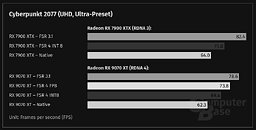
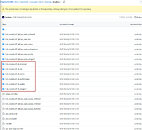
However, older Radeon GPUs can instead rely on the 8-bit integer (INT8) data formats, which Radeon RX 7000 series fully supports. AMD accidentally leaked FSR 4 INT8 on its AMD GPUOpen platform, showing that FSR 4 on older GPUs is a possibility, which is just kept hidden for now. Later on, ComputerBase tested this leaked library, finding that FSR 4 offers a balance between native image quality and FSR 3.1 performance on both RDNA 3 and RDNA 2 hardware. In tests with Cyberpunk 2077 in 4K on Ultra settings using the AMD Radeon RX 7900 XTX, FSR 4 delivered 11% faster performance than native, but was 16% slower than FSR 3.1. Interestingly, performance may be the reason why AMD is holding these INT8 FPR 4 libraries back, but another point could be product separation.
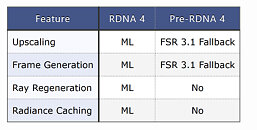 AMD already segregates its latest FSR "Redstone" suite of technologies, with features like Ray Regeneration and Radiance Caching exclusive to RDNA 4 hardware in the Radeon RX 9000 series of GPUs. Other basic technologies like upscaling and frame generation are supported on older RDNA 3/2/1 generations, but use an FSR 3.1 Fallback, with no FSR 4 support for now. However, since INT8-based FSR 4 exists, it may only be a matter of time before the company releases the capability to older GPUs, but the expected performance might not be there.
Source:
Hardware Unboxed
However, older Radeon GPUs can instead rely on the 8-bit integer (INT8) data formats, which Radeon RX 7000 series fully supports. AMD accidentally leaked FSR 4 INT8 on its AMD GPUOpen platform, showing that FSR 4 on older GPUs is a possibility, which is just kept hidden for now. Later on, ComputerBase tested this leaked library, finding that FSR 4 offers a balance between native image quality and FSR 3.1 performance on both RDNA 3 and RDNA 2 hardware. In tests with Cyberpunk 2077 in 4K on Ultra settings using the AMD Radeon RX 7900 XTX, FSR 4 delivered 11% faster performance than native, but was 16% slower than FSR 3.1. Interestingly, performance may be the reason why AMD is holding these INT8 FPR 4 libraries back, but another point could be product separation.


110 Comments on AMD on FSR 4 for RDNA 3 and Older GPUs: "No Updates to Share at This Time."
My point is that feature support and version numbers look great on paper, but aren't always necessary, or even relevant in real life. "More is better" isn't a hard rule, and a little bit of brainpower and a sense of nuance are necessary to properly judge the severity of a situation like this one.
UE5, for example, is kinda new king of game engines and engineers at Epic disliked optimising it for AMD so much that some of them left Epic for a company that don't have to work with AMD software. Happens more often YoY.
I already feel the harsh neglect on my 6700 XT. It feels leagues more obsolete now than 1080 Ti felt in 2022 when I bought it, despite the same age and despite the fact 1080 Ti is robbed of DLSS. The hand of any pragmatic buyer is forced: they will buy a green GPU. Not because they're gay for nVidia, of course not. It's because they have even less trust in AMD for plenty good reasons and because Intel are too weak at graphics.
Now add the bold statements from AMD that always end up stinky lies and... I dunno. Not my board, not my game.
The reason I'm currently with AMD is that it's miles cheaper while delivering similar performance. The fact that it's late with some features that I don't care about (like compute or upscaling) doesn't matter to me. The miles better Linux support is also a must. Nvidia is way behind on that front, but I guess I'm not allowed to say that without being branded a fanboy, right? ;)
So let's leave the brand talk out of this, shall we?That's not my problem.What neglect are you feeling that I don't on my 6750 XT?Because no other IT company lies, right? 5070 = 4090 rings a bell? :rolleyes:
C'mon man, you have to be a total idiot to give credit to any PR announcement from any company these days.
I however do mess around and do some experiments with simulations, computing and emulators (including some video system ones) with OpenGL and Vulkan and by doing so in that more in depth ways sometimes weirdness and problems can arise more quickly eventually as the APIs get outdated in such scenarios. But I'll be fair that for most normal users is not like that and it is within that threshold of two or three versions major issues happen more and more, albeit some performance can suffer somewhat before if off by one version often.
From the talk already wenr here and what I have seen and said, that's of course if there isn't an issue or too much derivation from how the driver implements some if the APIs and instructions, if a major issue appears though and isn't resolved, the software may try to resolve if they care, though that would be more of a workaround than a proper fix often. I have seen game system emulators often needing to try some workarounds between all vendors at some times for some things there and there to get some things working if the company isn't interested in fixing the problem.
As an example of implemetation issues I remember that at release Qualcomm's Snapdragon X1E and related chips they released for Windows 11 for ARM had a lot of things in Direct3D and Vulkan very broken even in fundamental parts of the implementations, thst were problemas in general, thankfully though I think these have been improved in that regards even if performance is still a bit underwhelming compared to competitors, but that's more because of the design of those SoCs integrated graphic hardware.