Sunday, February 8th 2026

AMD on FSR 4 for RDNA 3 and Older GPUs: "No Updates to Share at This Time."
AMD's FidelityFX Super Resolution 4 technology, now known simply as FSR 4, is currently supported in many games, but not across all AMD RDNA GPU generations. In response to an inquiry from Hardware Unboxed, AMD mentioned that it is still uncertain whether official FSR 4 support will be extended to the Radeon RX 7000 series and older GPUs, as the company reportedly has "no updates to share at this time." AMD official product separation stems from its RDNA 4 architecture and the support for 8-bit floating point instructions. While the latest RDNA 4 hardware supports Wave Matrix Multiply Accumulate in FP8 format, older RDNA generations like RDNA 3 and RDNA 2 lack this hardware instruction support and can't process 8-bit floating point data in this format.
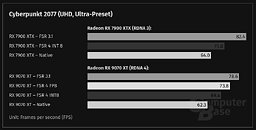
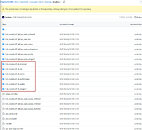
However, older Radeon GPUs can instead rely on the 8-bit integer (INT8) data formats, which Radeon RX 7000 series fully supports. AMD accidentally leaked FSR 4 INT8 on its AMD GPUOpen platform, showing that FSR 4 on older GPUs is a possibility, which is just kept hidden for now. Later on, ComputerBase tested this leaked library, finding that FSR 4 offers a balance between native image quality and FSR 3.1 performance on both RDNA 3 and RDNA 2 hardware. In tests with Cyberpunk 2077 in 4K on Ultra settings using the AMD Radeon RX 7900 XTX, FSR 4 delivered 11% faster performance than native, but was 16% slower than FSR 3.1. Interestingly, performance may be the reason why AMD is holding these INT8 FPR 4 libraries back, but another point could be product separation.
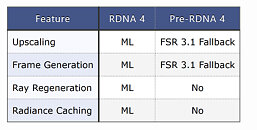 AMD already segregates its latest FSR "Redstone" suite of technologies, with features like Ray Regeneration and Radiance Caching exclusive to RDNA 4 hardware in the Radeon RX 9000 series of GPUs. Other basic technologies like upscaling and frame generation are supported on older RDNA 3/2/1 generations, but use an FSR 3.1 Fallback, with no FSR 4 support for now. However, since INT8-based FSR 4 exists, it may only be a matter of time before the company releases the capability to older GPUs, but the expected performance might not be there.
Source:
Hardware Unboxed
However, older Radeon GPUs can instead rely on the 8-bit integer (INT8) data formats, which Radeon RX 7000 series fully supports. AMD accidentally leaked FSR 4 INT8 on its AMD GPUOpen platform, showing that FSR 4 on older GPUs is a possibility, which is just kept hidden for now. Later on, ComputerBase tested this leaked library, finding that FSR 4 offers a balance between native image quality and FSR 3.1 performance on both RDNA 3 and RDNA 2 hardware. In tests with Cyberpunk 2077 in 4K on Ultra settings using the AMD Radeon RX 7900 XTX, FSR 4 delivered 11% faster performance than native, but was 16% slower than FSR 3.1. Interestingly, performance may be the reason why AMD is holding these INT8 FPR 4 libraries back, but another point could be product separation.


110 Comments on AMD on FSR 4 for RDNA 3 and Older GPUs: "No Updates to Share at This Time."
This has been argued about to exhaustion in every single related thread. I don't know why new ones keep popping up with no information content whatsoever. I also don't understand why it's only Nvidia owners who keep crying.
This is just another signaling of all the current lacking intention of giving any meaningful "long" term support from AMD to Radeon products and in this case even worse being something regarding RDNA3.
With all of the recent things I don't really like Radeon's current direction. Like the whole RDNA1/RDNA2 driver branch freeze, poor communication statements, clear lack of interest in properly updating their iGPUs hardware in any meaningful way until way later, decisions that make no sense for the firmware in Linux and others without mentioning a lot of things I have been at odds with the company decisions and doing in other aspects in their CPU divisiom, but for my judgement here I'll limit to what they do in the GPU division and teams to be fair.
While I personally don't have much interest in FSR4 and upscalers, I see people having so and regardless of is another sign of the mentality AMD has with Radeon right now, one I wish would change but I feel unless they have to without any other option to rely on won't change at all as long as Lisa Su is in charge of the company direction.
But if AMD can't provide at the very least 5 years of basic bases support since stopping high volume production and sales of the latests SKUs or in the case of RDNA2 iGPUs they still produce and sell them (and a very similar situation happened with Vega too), I can't in any way support them again with these products for my main components if they can't provide basic support for a sane long enough period of time, in which I would consider base support to API with new API extensions and features that the hardware is capable of, which they are mostly not updating anymore in the 25.10 branch for these and eventually would affect software compatibility.
Unless something changes drastically until the point I intend to change my current GPUs in my main system comes, I have an almost full and confident intention of going with NVIDIA or Intel for my next GPUs instead of AMD.
longer explanation:
does not change the facts i had to manually hack the windows 11 pro 24h2 and gnu gentoo linux to reduce the power consumption from ~40 watts in idle what i remeber in single whqd@75fps screen to something around ~6-10 watts for the msi radeon 6800 z trio.
amd never provided any bug fixes or proper driver support.
i call it modelines, other call it edid oder call it command line linux like frickling around with config files. i discovered it myself. i knew of more than 4 different other sources which discovered the same. later there were calculators implemented in excel sheets, online sheets etc.
i calculated by hand those values. i know the terminology of modelines because i started before 1996 with the linux kernel and the xorg-server. i used the same values for the same screen in windows 11 pro which i derived by hand for my gnu gentoo linux, xorg-server, mesa and the msi radeon 6800z trio for the asus proart pa278qv.
My experience with RDNA2 + FSR4 shows no sign of FSR4 withheld from "legacy" users being any valid. Used a simple hack to activate it on a 6700 XT. It works. Speed is worse than on RDNA4 but not a disaster. No additional glitches, no added instability, experience mirrors the one on an RDNA4 card.
Just... add a line of code that says "if it's an old GPU let's use INT8" and that's it. All that public drama will cost you hundredfold more dearly than hiring a scriptmonkey for 10 minutes.
It speaks volumes to me that some would rather just go ad-hominem and attack the people/their situation rather than their arguments. I covered why that's a terrible line of reasoning in the spoiler below, from another FSR4 Redstone thread too. I laid out my reasoning quite clearly here in this thread, yet that hasn't been engaged with at all, it feels so childish.
At 4K (including the custom 3840x1700 resolution I made for my vision defect reasons), regardless of the vidya I play, FSR4 starts stuttering like crazy after some time playing. Sometimes it happens after five hours, so no big deal, sometimes I only need 15 minutes, it's unpredictable and doesn't seem to depend on the game I play. Sometimes stutters go away after several minutes, sometimes they stay. I am yet to confirm or deny the same behaviour on RDNA4 but RDNA2 exhibits this problem.
'Far as I can tell from the monitoring it has nothing to do with VRAM capacity, I still have at least 1.5 GB to spare. It has nothing to do with overheat, my hottest reading is 87C on the GPU hotspot. VRAM, die, CPU, etc are colder than that. Replaced the PSU and connected directly to the power socket to eliminate this possible culprit, yet it changed nothing.
The very same issue never appears at 1440p (even if the rest of the settings is more aggressive and results in lower FPS and higher VRAM usage), nor does it bother me at 1080p. Is this an FSR4 bug or is it some RDNA2 issue, I am yet to discover. And it never happens with XeSS/older FSR versions.
In the latest AMD Software: Adrenalin Edition ""26.2.1"" in RDNA1/RDNA2 (Actual Driver Version: 25.10.41.05-260205a1-198281E-AMD-Software-Adrenalin-Edition) and that's different from 23.30 branch in RDNA3 and RDNA4, Vulkan can already be seen to be getting behind those already. Vulkan API Version is 1.4.315 in the 25.10 and I don't think AMD is going to update anything regarding it on Window again.
This is the full output of Vulkan version and extensions on this driver version in GPU-Z on a RX 6650 XT as an example, compared to RDNA3 and RDNA4 a gap has already started to form:
Going for a precedent with Vega with a Radeon Vega 8, which is GCN 5.0, but this output won't be much different in a RX 580 either. We get the latest AMD Software: Adrenalin Edition ""26.2.1"" in Polaris and Vega (Actual Driver Version: 23.19.24-251211a-197843C-AMD-Software-Adrenalin-Edition), we can see and ever more long gone and formed gap with the Vulkan API Version being at 1.3.260 for years and the hardware is indeed capable of Vulkan 1.4, support for Vulkan 1.4 in GCN 3-5 that can be seen within Linux in the Mesa RADV driver.
This is the full full output of Vulkan version and extensions on this driver version in GPU-Z from the integrated Radeon Vega 8 as another example for anyone interested:
This is something that actually kind of bothers me and eventually as the gap gets bigger will actually affect me in some ways, of course I'm not saying that it will affect everyone is up to usage and it is only one example of things regarding AMD not really updating things on those branches anymore.
But if AMD can't provide a product that fullfills my needs in this with enough long support for this that covers my needs, and a lot of recent decissions don't give me much hope of how RDNA3 will be managed in the future within Windows, I would just go for a different set of products from other companies that actually can fullfill and offer me whay my usage and needs require personally and in this case a support for such things like these in a period of time I personally see more sane and fair. And I invite anyone in the same way to decide what they choice so usually based on their usage and needs too regardless of company, wether that's NVIDIA, AMD, etc.
Unless you're ok with the utter and complete stagnation of progress. Programmers aren't magicians, they have to work around the limitations on customers' machines.
Dropping things like this when you've already on a single digit market share is begging for some big name AAA to eventually come out and say AMD graphics aren't supported, the reaction to such an announcement is guaranteed to be spicy
The only difference between us is that I don't pretend to know what I don't know.
You're looking at this from your personal angle. Did you stop to put any thought whatsoever on what developers will have to deal with in order to ship a game that works on a driver that has broken or entirely missing functionality? And as @Rulumi's post on this very thread already shows: it's already missing a few things, and it will be missing more and more as time goes on.
Would it be anything like how some GPUs don't support DX12 and can't play modern games?
Sometimes workarounds can be done with a reduction in performance or regression in stability. Even within DirectX 11 for example there are some optional extensions that can result in a dramatic change in performance figures on an otherwise identical configuration, perhaps the most infamous being deferred contexts and driver command lists. Nvidia supports both, and well, AMD... look at your GPU-Z 😉There is precedent to this scenario, you know.
And I don't think "Devs simply won't care" is very realistic either. Since, you know, it's their job to have the shipped product in full condition.
www.techpowerup.com/324171/amd-is-becoming-a-software-company-heres-the-plan
More on topic:RTG happened. They were always like that, they are a pathetic joke of a company division that WILL shoot itself in the dick WHENEVER an opportunity arises. Without fail. I have been saying this for years - Radeon GPUs are good, sometimes even excellent hardware (outlier shitshows like RDNA 1 notwithstanding). But everything around those GPUs, the entire software ecosystem is just mismanaged to the point where you wonder if AMD actually hires for RTG not on merit, but on sheer levels of mental disability in the prospects. It’s genuinely baffling. I don’t even expect them to compete with NV on software front, that boat has clearly sailed and that expectation would be extremely unrealistic. I just want them for ONCE in their pathetic existence since AMD overtook ATI (which is close to 20 years soon, btw) stop being completely self-defeating morons and take some easy Ws (just unlock INT8 FSR 4, this is embarrassing), straighten out their software side of things in the most basic of aspects (yes, like driver availability and, yes, even including proper up to date runtimes) and actually make it so that I can recommend their products without the caveat “if you run Linux, otherwise - probably nah”.