Monday, March 30th 2026

Samsung Readies PCIe 5.0 QLC SSD with a Custom RISC-V Controller

Samsung has developed a new SSD controller based on the open-source RISC-V instruction set, moving away from the Arm ISA in some of its SSD controllers. With the introduction of the BM9K1 PCIe 5.0 QLC NAND SSD, Samsung has officially created a proprietary RISC-V IP that will serve as a foundation for many SSDs the company plans to release. Announced at the China Flash Market Summit 2026, the BM9K1 SSD has been showcased with just one metric: sequential read speed. Achieving a maximum sequential read speed of 11.4 GB/s, Samsung has reached impressive speeds for QLC NAND Flash. While the sequential write speed is unknown, it is expected to be around 10 GB/s, varying slightly depending on Samsung's design. Typically, high-performance SSDs use TLC NAND, as seen in Samsung's own 9100 Pro SSD, which we reviewed. It features 3D TLC V-NAND V8 with 236 layers. While this SSD uses TLC NAND and has a proprietary Samsung Presto 5 nm controller running on Arm-based cores, Samsung might transition a significant portion of its SSD lineup to a RISC-V based design with the BM9K1, offering satisfactory performance with QLC NAND.

Interestingly, Samsung has designed this SSD with considerations for size, power, and AI. For instance, the BM9K1 PCIe 5.0 SSD replaces the previous BM9C1 PCIe 4.0 SSD controller. Although both use QLC NAND, the newer BM9K1 features a new RISC-V controller and a fresh PCIe 5.0 interface, doubling the performance in sequential reads on average. The power efficiency of the new RISC-V design is also improved. Samsung claims a 23% increase in power efficiency, thanks to the flexibility of RISC-V, which allows for greater customization and optimization of the controller firmware to match I/O patterns with the QLC NAND, resulting in nearly a quarter less power consumption. This improvement is expected to have a significant impact on small form factor PCs and client laptops. The main drawback of the design is the use of QLC NAND, but Samsung may introduce TLC NAND SSDs with RISC-V controllers in the future. For now, these remain on the 5 nm Presto Arm-powered controllers.
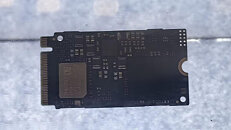
Samsung is targeting a 2027 launch for this SSD, offering capacities of 512 GB, 1 TB, and 2 TB. Pricing and exact availability are not yet known, but more information is expected throughout the year. Other specifications, such as write speeds and endurance, are still unknown.
Source: BigGo Finance
Add your own comment

33 Comments on Samsung Readies PCIe 5.0 QLC SSD with a Custom RISC-V Controller

#1
Chaitanya
Why? Its not like QLC is known to be hungry for faster interfaces.
Posted on Reply
#2
kondamin
ChaitanyaWhy? Its not like QLC is known to be hungry for faster interfaces.
No arm royalties, lower power use, all good things.

I do wonder where the rest of the capacities are at, 2tb is so 2010
Posted on Reply
#3
Bwaze
Why are they targeting launch in 2027? Is this purely for consumer drives and they can't find a use in enterprise "high-performance data storage in the generative AI era.", "workflows for local AI model inference and training", "storage needs of large AI language models", and therefore is of very low priority, might even not be released if there won't be a consumer drive section in 2027?
Posted on Reply
#4
FreedomEclipse
~Technological Technocrat~
kondaminI do wonder where the rest of the capacities are at, 2tb is so 2010
I think I might just know. It's a closely guarded secret.

Ai Data Centres world wide
Posted on Reply
#5
Kenjiro
BwazeWhy are they targeting launch in 2027? Is this purely for consumer drives and they can't find a use in enterprise "high-performance data storage in the generative AI era.", "workflows for local AI model inference and training", "storage needs of large AI language models", and therefore is of very low priority, might even not be released if there won't be a consumer drive section in 2027?
QLC has its use in AI workflows in second tier of storage data:
- first - quickest SSD for hot data, need to be fast, size is limited by price,
- second - slower SSD like QLC for partially cold data, compromise between performance and size,
- third - HDD for really cold data, size matters.
Posted on Reply
#6
Tyler-98-W68
Whats the actual steady state transfer rate? Probably around 250mb/s no thanks QLC
Posted on Reply
#7
Bwaze
According to many reports all drives are now basically sold out for the foreseeable future for the AI needs - they bought most of the capacities of SSDs and HDDs for 2026. We haven't seen the impact of this on drives currently in market because consumer space now shifts so little volume it will take some time, but apparently future prices won't be "2x the normal", but closer to "10x the normal, and rising".

Posted on Reply
#8
kondamin
BwazeAccording to many reports all drives are now basically sold out for the foreseeable future for the AI needs - they bought most of the capacities of SSDs and HDDs for 2026. We haven't seen the impact of this on drives currently in market because consumer space now shifts so little volume it will take some time, but apparently future prices won't be "2x the normal", but closer to "10x the normal, and rising".

Orders made with money they don’t have.

To be paid for by users who are unwilling to pay for the higher subscription fees and will just end up dumping the service as they lost their jobs.
Posted on Reply
#9
Bwaze
I don't think anyone plans that far ahead.
Posted on Reply
#10
Hakker
Well the first signs of collapse are already forming. Datacenters that aren't getting built. Microns stock not rising but falling. Google ai's compression algorhythm that will reduce memory bandwidth a possibly storage as well by a factor of 8. Sora being shut down because it's too expensive to maintain. The cracks are forming and it can't form soon enough.
Posted on Reply
#11
_JP_
kondaminI do wonder where the rest of the capacities are at, 2tb is so 2010
You can always ignore this and look at enterprise-grade where 7.68TB/unit is pretty common, I mean.
Posted on Reply
#12
lexluthermiester
QLC? No thank you. If they want to do this with TLC? Ok, let's look. Not until then...
Posted on Reply
#13
Oberon
QLC is more than fine for read-heavy workloads (like those 90% of you do 90% of the time.)
Posted on Reply
#14
lexluthermiester
OberonQLC is more than fine for read-heavy workloads (like those 90% of you do 90% of the time.)
No. Durability is a thing. Many of us buy an SSD and hold onto it in general use for a long time. QLC does NOT measure up. TLC does.
Posted on Reply
#15
Oberon
lexluthermiesterNo. Durability is a thing. Many of us buy an SSD and hold onto it in general use for a long time. QLC does NOT measure up. TLC does.
Read operations don't impact durability.
Posted on Reply
#16
lexluthermiester
OberonRead operations don't impact durability.
You seem to be missing the point. Read ops are not the problem.
Posted on Reply
#17
Oberon
I don't think I'm the one missing the point. Please re-read my first post.
Posted on Reply
#18
lexluthermiester
OberonI don't think I'm the one missing the point. Please re-read my first post.
So you're implying a non-OS drive with the "read-heavy" statement? Because anything is read heavy.

QLC is great for non-boot/OS incidental usage models. Anything write heavy, no. QLC is bad juju..
Posted on Reply
#19
AntiX3DGlazer
kondaminNo arm royalties, lower power use, all good things.

I do wonder where the rest of the capacities are at, 2tb is so 2010
ISA has nothing to do with power draw.
Posted on Reply
#20
shuffy_losys
AleksandarKSamsung has developed a new SSD controller based on the open-source RISC-V instruction set... Samsung has officially created a proprietary RISC-V IP
Maybe a small thing, but I do appreciate this distinction.

Or maybe I'm hallucinating that people think because something is RISC-V, all CPUs made from it are also "open."
Posted on Reply
#21
kondamin
AntiX3DGlazerISA has nothing to do with power draw.
Yes, but the article talks about 20% lower power use. So the chip will use less power than the one that was powering the previous chip
Posted on Reply
#22
bonehead123
FreedomEclipseI think I might just know. It's a closely guarded secret.
Yea, I know the answer too, but if I tellz ya, then I'd have to....well, you know, hahahaha :D

/s
Posted on Reply
#23
Tomorrow
QLC was worthless POS even before prices went to hell. It was never meaningfully cheaper to offset the massive performance and endurance penalties.
Had it been 2x the capacity with 8TB and even 16TB M.2 drives at the same price as 4TB TLC drives then people would have likely accepted the lower speed and worse endurance.

SLC > MLC > TLC was always meaningful progression. Despite the worse endurance of each generation, performance actually went up because of the interface speeds.

Now there are no interface speed ups that are meaningful for consumers. PCIe 6.0 for consumers is years away and when it does come it will only help sequential speeds. First drives will be even more expensive and hot, just like first PCIe 5.0 drives were.

QLC will likely never be cheaper than TLC to justify it's existence. PLC is nowhere.
Prices are high for years to come etc.
Posted on Reply
#24
remixedcat
AleksandarKsuch as write speeds and endurance, are still unknown
wonder if they are gonna obscure it like the SATA 840s I can't get any endurance figures for my regular 840s at all. so I have no clue how long they'll last but some ppl say those have an infamously bad controller that fails before any theoretical endurance figure would be...
Posted on Reply
#25
Prima.Vera
Wait until the PLC drives will become the new norm, considering the current market trend...
Posted on Reply
Add your own comment
Nov 11th, 2026 04:13 CST change timezone

New Forum Posts

Popular Reviews

TPU on YouTube

Controversial News Posts