Wednesday, August 12th 2026

CXMT Surpasses 90% DDR5 Yield, Challenges Industry Giants
Chinese memory giant CXMT has reportedly achieved a significant milestone in DDR5 production, with manufacturing yields now comfortably above 90%. This is comparable to what major manufacturers like Samsung, SK hynix, and Micron are achieving. According to reports, CXMT uses a 17 nm node for DDR5 chip production and has reached a 90% yield for these chips. This is only 2-3% lower than Samsung's yield on its 10 nm class node for DDR5 production, indicating that CXMT's production quality is matching that of the world's largest memory maker. This is a remarkable achievement for a company that excels in cleanroom construction time, taking only 12 months to build its fab's cleanroom compared to the two years others require. As the company plans to end the year with 350,000 DRAM wafers per month, high yields mean there is little waste or leftover.
Chinese MyDrivers also notes that PC OEMs have mixed reactions to adopting CXMT DRAM in their products. For instance, Dell has completely banned the use of CXMT in its machines, while HP only allows CXMT DRAM in its Chinese PCs. Major Taiwanese brands such as ASUS and Acer have increased adoption in some models, as they have more flexibility in supply chain procurement. However, both companies use CXMT memory for PCs sold in mainland China and some emerging markets, meaning the West is still far from receiving PCs with CXMT memory modules. PC OEMs are also cautious about procuring CXMT memory due to concerns about disrupting their relationships with the big three memory makers.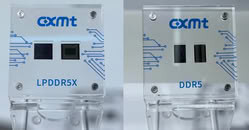 Finally, it is worth noting that all of the 2027 memory production capacity from the big three makers has reportedly been sold out, prompting OEMs to turn to CXMT for additional capacity. However, CXMT is expected to nearly match Micron's output by the end of this year, and there is no clear projection of how much DRAM the Chinese giant will produce next year. It is assumed that most of the available DRAM will be consumed domestically within mainland China, with little expected to be sold in Western markets.
Source:
MyDrivers
Chinese MyDrivers also notes that PC OEMs have mixed reactions to adopting CXMT DRAM in their products. For instance, Dell has completely banned the use of CXMT in its machines, while HP only allows CXMT DRAM in its Chinese PCs. Major Taiwanese brands such as ASUS and Acer have increased adoption in some models, as they have more flexibility in supply chain procurement. However, both companies use CXMT memory for PCs sold in mainland China and some emerging markets, meaning the West is still far from receiving PCs with CXMT memory modules. PC OEMs are also cautious about procuring CXMT memory due to concerns about disrupting their relationships with the big three memory makers.

41 Comments on CXMT Surpasses 90% DDR5 Yield, Challenges Industry Giants
Not really sure what the argument here is.
Dell using CXMT as a supplier would not make them liable in any patent/IP lawsuits, that would still be CXMT.
And if there are any blocks on imports, they just drop CXMT as a supplier and continue on as usual.
When it is socket, just remove the affected dram and use it somewhere else.
-- more supply may indicate china uses also, but not only, their own dram and the others struggle with the few remaining dram.
afaik germany already got lenovo laptops with chinese dram
The bigger hit is to the company, as it costs them more to produce. But it's not 17 vs 10. CXMT is 16nm and Samsung is 10-11nm. Also I believe they'll find an alternative to EUV to scale. China has 10x the IPOs and new graduates compared to USA.
And they don't even have to start selling in "affected" markets if non-affected markets, meaning primarily China, are large enough for them.
If, however, there are no legal proceedings, and no import restrictions in the markets where the component is being resold, I am pretty sure they would be fine legally.
That is, unless 'someone' in one of their major markets insists on causing issues for any company that uses Chinese components in any of their offerings worldwide.
But, there are assuredly no loud mouthed politicians like that anywhere, right? :slap:
EUV isnt going to be a massive game changer in the memory beyond possible throughput by reducing the amount of "double patterning" that may be required, but we arent going to see massive density/speed increases from its usage.
one narco cartel is joke vs one nand cartel (plus it's legal)
they've already been caught in 1990' but they do it again
Come on :D
Eh....I think it could scale up pretty quick especially at higher speeds
these parts up at 7-8000mhz I bet are quite thirsty in the power dept and then its the heat as well.
Power is Static + Dynamic power. Static, you can't do much about it, but dynamic power is usually dominant under load and it scales square of the increase in voltage and linear to frequency increase. So 10% increase in voltage requires 21% more power. 10% more frequency is 10% more power.
Again, CXMT is actually in line with competitors in power consumption CXMT was using 7.5W while others were in the 7-7.2W range. That's why they are being used in lower power smartphones and laptops as well. If the difference was significant, you wouldn't see much presence in mobile.Yea, scaling in DRAM is essentially dead.
But EUV does seem to make some difference in going below 15nm though, as CXMT is using multi-patterning DUV to achieve this. And obviously there's cost savings along with reduced complexity. It probably takes lot of precision and discipline to achieve this. Beyond that I'm curious to see what alternative to EUV the Chinese will come up with. There sure are alternatives as it usually is in every line of work.
While not ideal for production, China having its own internal market makes that more "expensive" processing a null point in normal usage and the AI boom makes it competitive in the rest of the world from a pricing perspective because the market rates are WAY above what production costs would normally set.
China is trying and is supposedly very close to achieving mass market EUV with domestic development/components. Again this will be more important to things like LongArch/Domestic GPUs as it gives them an equal playing field in terms of Cost/NM density etc to western designs.
Sometimes it's given up, or given up early for other reasons. Intel struggled mightly with 10nm logic process, which are multitudes larger in size than DRAM. China has 10x the graduates and startups compared to US alone. Ideas come from people.