Wednesday, July 23rd 2025

DDR6 Memory Arrives in 2027 with 8,800-17,600 MT/s Speeds

The semiconductor industry has officially accelerated its next-generation memory development, with DDR6 standard now coming soon. Although enthusiasts won't find these modules available until 2027, key players, Samsung, Micron, and SK Hynix, have already moved past prototype stages and embarked on rigorous validation cycles. In partnership with Intel, AMD, and NVIDIA, they're targeting an initial throughput of 8,800 MT/s, with plans to scale up to a staggering 17,600 MT/s, almost doubling the ceiling of today's DDR5. This increase is driven by DDR6's 4×24-bit sub-channel architecture, which requires entirely new approaches to signal integrity. Additionally, it also differs from DDR5's current 2x32-bit sub-channel structure. To overcome the physical limits that DIMM form factors faced at higher speeds, the industry is betting on CAMM2. Early indication is that server platforms will lead the change, with high-end notebooks following suit once manufacturing ramps up.

Behind the scenes, timelines are being mapped: platform validation is slated for 2026, server deployments in 2027, and broader consumer availability thereafter. This phased rollout mirrors the DDR5 journey; however, analysts predict that DDR6's architectural leap could accelerate adoption in AI and high-performance computing environments. Of course, cutting-edge technology comes with a premium: initial DDR6 modules are expected to carry price tags reminiscent of DDR5's 2021 debut, potentially limiting early adoption to hyperscale data centers and AI research labs. Yet with HPC and AI appetite for bandwidth, memory makers are targeting launch as soon as possible to satisfy the massive deployment of compute. By 2027, CAMM2-based modules running at DDR6 speeds may well define the new standard for high-performance systems.
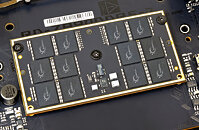
Source: CTEE
Add your own comment

196 Comments on DDR6 Memory Arrives in 2027 with 8,800-17,600 MT/s Speeds

#76
Sol_Badguy
efikkanI'm not talking about queuing batch jobs.
Sorry for the confusion/misunderstanding, I actually was (I got carried away it seems).
Even though that's not common, as it means just hammering the CPU (and inevitably the RAM) with as many workloads as you can.

The regular MT scenario you've described is the common one, where it's RAM intensive but not so much CPU intensive. Yeah everybody's doing it, even me, somehow I didn't realize, like when you forget you have the glasses on and just reach with your hand to rub your eye.

/////

Still, coming back to my first post (#61), I still consider that a two DIMM mobo offers enough RAM capacity for most people, and that if someone needs more than 128GB, surely they can afford a more expensive 4 DIMM mobo, given they afford more RAM.
And again for most people, buying larger kits initially will save them a lot of trouble down the line.
efikkanThe various companies I've either worked for or have had contact with usually uses severely underpowered hardware for their engineering staff, and above all, it's almost always lack of memory.
To be frank, it's not easy to assess RAM requirements from hardware reviews as it's highly subjective.
The easy way is to go big initially so that capacity wise the system is as future proof as it can reasonably be.
Another way is to upgrade/change the system after employee feedback. For this one I can see serious reluctance from most employers.
Posted on Reply
#77
_roman_
Macro DeviceIt's also good news because iGPUs get more room for oomph.
It all depends if the software and the cpu graphics can handle the extra DRAM speed.

in detail - why:
Three weeks ago. It seems the gnu userspace with mesa and the recent linux kernel gave me slight distortions with the ryzen 7600x cpu graphics with light overclocked DRAM.
I use now the same cable / monitor as before the mainboard swap. With the dedicated radeo 7800xt graphics with the same linux-firmware, mesa, linux kernel i do not see slight distortions.
I did not touch the DRAM settings ansmore after the mainboard swap a few weeks ago. tighter timings for DRAM. no issues in windows 11 pro gaming. No issues while compiling which stresses cpu and dram a lot in the gnu userspace. (unstable mainboard settings would very fast crash bigger packages while compiling)
slight distortions - sometimes it seems like for a split second, very rarely, a desktop line was not synron. .. hard to describe. hard to proof. happened but not that often. Still annoying.
Posted on Reply
#78
Macro Device
_roman_ryzen 7600x cpu graphics
It's a joke. Even 8700G's iGPU is a joke but this iGPU at least coulda made use of more RAM speed. Be it doubled, it woulda easily grown 15 to 35 percent faster depending on a game. Not much but significant.
Posted on Reply
#79
TheLostSwede
News Editor
thestryker6The JEDEC standards definitely get in the way of using multiple modules. The other simple way would be both sides of the CPU socket like workstation boards do. Unfortunately as I understand the standards this isn't on the table at all (at least not without adding memory channels).
Yeah, there isn't enough space for that on a standard ATX motherboard layout either, especially with today's massive VRM designs.
thestryker6I get the feeling this is only going to be viable for JEDEC compliant memory.
Why? You're just splitting the bus in half, everything else remains the same.
thestryker6Yeah it should just be the connector itself which splits the two channels at different heights. The mounting method looks the same as a regular CAMM2 module with one difference: the center hole used isn't as far down on the module. Only the D module supports single channel and given that it's the large size it is likely enterprise focused.
It's not very clear what the different modules are intended for, but you might not be wrong.
thestryker6Seeing that variants slide reminds me: has anyone even talked about dual-die packing for DDR5? I don't recall seeing it yet and would be pretty important for capacity sake. I haven't seen anything about DDR6 memory IC capacity so perhaps that's just solved for next generation.
So a two stack tall HBM package? As that's pretty much what you're suggesting.
thestryker6128GB is the maximum capacity for a CAMM2 module currently and it requires 16 packages on each side. The smaller ones max out at 64GB with 12 packages on the top and 4 on the bottom.
Keep in mind that things will changed with DDR6 and the bus with increasing, which might lead to slightly different capacities than for current DRAM.

There's still too many things that aren't entirely clear about CAMM2 and even more so when it comes to DDR6, so we're just going to have to wait and see.

That said, this is apparently a serious suggestion from someone on how toe stack multiple CAMM2 modules...

Posted on Reply
#80
mikesg
Rightness_1One day people will figure out that every time there is a new DDR standard, the latency doubles or triples... x3D cache will be mandatory for the awful latency DDR6 will come with. But hey, a couple of benchmarks will look good.
MS Flight Sim is the one benchmark where FPS scales linearly 1:1 with RAM speed. At least with Intel CPUs.
Posted on Reply
#81
thestryker6
TheLostSwedeWhy? You're just splitting the bus in half, everything else remains the same.
Temperatures from increasing voltage to get higher clocks and a lack of room to cool covered up memory packages sufficiently. This may not be as much of an issue with DDR6, but it's a problem with DDR5.
TheLostSwedeIt's not very clear what the different modules are intended for, but you might not be wrong.
All you have to do is look at the design all but D have dual pads. I think the official specification mentions single channel on B, but it also only mentions A/B/C.
TheLostSwedeSo a two stack tall HBM package? As that's pretty much what you're suggesting.
That's what "DDP" in your variants slide is referring to.
TheLostSwedeKeep in mind that things will changed with DDR6 and the bus with increasing, which might lead to slightly different capacities than for current DRAM.
Yeah I'm really curious what package capacities and module level bus width are going to end up being with DDR6.
TheLostSwedeThat said, this is apparently a serious suggestion from someone on how toe stack multiple CAMM2 modules...
I imagine signal degradation would be a real big concern stacking them on top of one another.
Posted on Reply
#82
TheLostSwede
News Editor
thestryker6All you have to do is look at the design all but D have dual pads. I think the official specification mentions single channel on B, but it also only mentions A/B/C.
Yes? I think I have mentioned this a few times with single and dual channel CAMM2s? What I meant was, which ones are intended for consumer products vs. servers etc.
thestryker6That's what "DDP" in your variants slide is referring to.
Right, if that's the case, then maybe the smaller modules will be fine for most consumers.
thestryker6Yeah I'm really curious what package capacities and module level bus width are going to end up being with DDR6.
I guess we'll find out in a year or two...
thestryker6I imagine signal degradation would be a real big concern stacking them on top of one another.
I'm not sure who though that concept was a good idea, especially with those wires as well.
Posted on Reply
#83
windwhirl
tommo1982Too soon, too fast. I still have DDR4 motherboard, simply because DDR5 ones are expensive. Changing CPU, MB and RAM to AM5/DDR5 costs as much as 3/4 of my current setup. DDR6 is going to push the price range even further.
Then don't change your setup, lol

You don't need to upgrade every five minutes.
Posted on Reply
#84
jnv11
r00tczAm I only one who finds this 24bit weird? The 32bit channel for DDR5 made a lot of sense... but here, no usual 2^n accesses are divisible by 24. For dual channel 4*24*2=192 bits per transaction, that's odd 3x 64bit words...
I wonder if the extra bits beyond the power of two could be ECC bits. If so, I hope that they eliminate the non-ECC option. Speeds are getting high enough that ECC might need to be required to improve reliability, and also ECC raises the difficulty of row hammer memory security attacks even though ECC is an imperfect defense.
Posted on Reply
#85
ARF
Rightness_1One day people will figure out that every time there is a new DDR standard, the latency doubles or triples... x3D cache will be mandatory for the awful latency DDR6 will come with. But hey, a couple of benchmarks will look good.
Yeah, "higher" number after "DDR" means planned obsolescence. DDR3 is faster than DDR4, DDR4 is faster than DDR5, and DDR5 will be faster than DDR6.
Shame is that people fall into this trap all over again.
But I will stay with my good "old" Ryzen 9 5900X 24-thread CPU with DDR4-3200 till at least 2035, because it is very fast, 5 years after my purchase back in 2020.


www.innoaiot.com/itemen-21-85.html
Posted on Reply
#86
Nhonho
efikkanI hope this CAMM2 standard doesn't get established for desktop and server. It's takes up far too much space with anything more than 2 channels.
I think the physical format of desktop motherboard RAM modules will remain the same. I think CAMM2 modules will only become popular in laptops.
Posted on Reply
#87
windwhirl
NhonhoI think the physical format of desktop motherboard RAM modules will remain the same. I think CAMM2 modules will only become popular in laptops.
I've been looking into that for a bit and the whole talk I see around seems to be that CAMM2 is gonna replace the current DIMM formats. Specially in higher-performance devices (or at least if you want high-performance memory), since it seems to have better characteristics than DIMM-style memory.

Truth be told, as long as you can slap at least up to 64 GB of high frequency, low latency RAM into a motherboard without difficulties, I think most people won't give two fluffs about whether it's DIMM or CAMM2.
Posted on Reply
#88
iuliug
If DDR6 comes in 2027, we know when AM6 releases :P. Also it means AM5 will have 2 more CPU generations (might have actually been officially confirmed if i remember correctly).
Posted on Reply
#89
Tomorrow
iuliugIf DDR6 comes in 2027, we know when AM6 releases :P. Also it means AM5 will have 2 more CPU generations (might have actually been officially confirmed if i remember correctly).
AM6 wont release in 2027. Zen 6 is still AM5 and Zen 6 releases in 2027 at the latest.

DDR6 will come to servers first in 2027.
In desktops i presume it will be 2029 with Zen 7 and you need to add another year for the supply to improve and prices to start falling.
So 2030 for most people.
Posted on Reply
#90
Rightness_1
TomorrowThat's not how that works. Latency depends not just on timings, but also the clock speed. This offsets the timings increase.
So while yes, the timings numbers do increase - the actual latency in nanoseconds stays roughly the same.

it's wrong to say latency doubles or triples.

Some examples:
DDR3-1600 @ CL9: 11,25ns
DDR4-3200 @ CL16: 10,00ns
DDR5-6400 @ CL32: 10,00ns

So what's the point of new DDR generations if the latency stays the same?
Bandwidth. DDR3-1600 was 12,8GB/s. DDR5-6400 is 51,2GB/s (single-channel numbers).
At comparable latency.

That is why each memory generation is faster despite doubling of timings.
You have to wait until pretty much the end of a new DDR standards lifespan to start getting the same latency or "slightly" faster than the previous version, as well as any tangible and meaning benefits from the bandwidth, especially with AMD. Easily the first few years are expensive nonsense.
Posted on Reply
#91
Tomorrow
Rightness_1You have to wait until pretty much the end of a new DDR standards lifespan to start getting the same latency or "slightly" faster than the previous version, as well as any tangible and meaning benefits from the bandwidth, especially with AMD. Easily the first few years are expensive nonsense.
No you dont. These speeds are so called sweet spot speeds and became available 2-3 years after launch.
Nowhere near at the end of the generation.

DDR4 came out in 2014. DDR4-3200 became available in 2017. DDR5 came out in 2021. End of life DDR4 speeds reached as high as DDR4-5333.
DDR5-6400 became available in 2023. In 2025 the highest speed is DDR5-9600 and it's likely DDR5 will break the 10'000 ceiling before DDR6 comes out.
Posted on Reply
#92
Rover4444
Why CAMM2 and not CUDIMMs? Doesn't make sense to me, one of the big benefits of a desktop system is density and I don't think anybody's going to be making 256GB CAMM2 modules out the gate. If they make quad channel a thing with two modules that'd be sweet but they won't.
tommo1982Too soon, too fast. I still have DDR4 motherboard, simply because DDR5 ones are expensive. Changing CPU, MB and RAM to AM5/DDR5 costs as much as 3/4 of my current setup. DDR6 is going to push the price range even further.
You kidding? Last gen Ryzen parts and current gen Ultras are cheap now and DDR5 has been at the same price/gb as DDR4 for a while. New DDR4 isn't being made by Micron and others are soon to follow suit, so older parts are going to ramp up in price at the high end. There would be zero reason for me to upgrade to a Zen 7 in 2027 if it didn't have DDR6.
phanbueyAgreed on the pricing.

The one saving grace on the cpu/mobo/ram side is at least the components at the mid-low end of the curve are pretty powerful in respect to software.

A used 12600k system or a 76000 (non-x) setup still slaps hard and can do everything -- great for the money whereas GPUs are completely the opposite, anything below a 4070 and you're in menus in settings to try and get things to run things smoothly.
Even with the 4070 you're adjusting settings, no VRAM for you!
Posted on Reply
#93
tommo1982
Rover4444Why CAMM2 and not CUDIMMs? Doesn't make sense to me, one of the big benefits of a desktop system is density and I don't think anybody's going to be making 256GB CAMM2 modules out the gate. If they make quad channel a thing with two modules that'd be sweet but they won't.

You kidding? Last gen Ryzen parts and current gen Ultras are cheap now and DDR5 has been at the same price/gb as DDR4 for a while. New DDR4 isn't being made by Micron and others are soon to follow suit, so older parts are going to ramp up in price at the high end. There would be zero reason for me to upgrade to a Zen 7 in 2027 if it didn't have DDR6.


Even with the 4070 you're adjusting settings, no VRAM for you!
Unfortunately it's much more expensive to buy R5 9600X, AM5 mainboard and DDR5. My old R5 3350G Pro was not as expensive as the one mentioned above, and that was during COVID and shortage. AM5 mainboard ASRock B850M Steel Legend is twice the price of B450M Steel Legend. I like to change my setup, just because I like to change it. The prices now are really high. Almost at the level it was in the 90's. A PC was beyond the reach of many people. Used stuff fills that gap now.
Posted on Reply
#94
Tomorrow
tommo1982Unfortunately it's much more expensive to buy R5 9600X, AM5 mainboard and DDR5. My old R5 3350G Pro was not as expensive as the one mentioned above, and that was during COVID and shortage. AM5 mainboard ASRock B850M Steel Legend is twice the price of B450M Steel Legend. I like to change my setup, just because I like to change it. The prices now are really high. Almost at the level it was in the 90's. A PC was beyond the reach of many people. Used stuff fills that gap now.
Why does it need to be 9600X and a B850 motherboard?

There are deals on B650 and 7000 series CPU's.

I already posted before that 7400F/7600X3D are very good deals.
DDR5 is cheap now as DDR4 has actually gone up in price.
And in terms of motherboards, yes AM5 boards are more expensive, but not to the degree that the entire platform becomes unattainable.

Compared to 3350G even 5700X3D is expensive on AM4 itself.
Besides 8400G exists for those on AM5 that want the absolute cheapest CPU.
Personally i would not suggest it to anyone as it has too many compromises.
Posted on Reply
#95
rattlehead99
TheLostSwedeIt seems like we are moving to CAMM2, so...
Unless motherboards only supports single channel CAMM2 modules, the current design only allows for a single module.
I guess CPU memory controllers could change and support two modules, maybe one on each side of the motherboard?
Since DDR5 the module count doesn't really matter, now they can put higher bus width if they wanted on a single module.
Posted on Reply
#96
rjc34
efikkanI know, I've had one. Practically disassembling the whole computer to change a SSD.
Just because the idea isn't new, doesn't change the fact that it's a terrible idea.
I mean in these cases the option is between an extra m.2 slot on the backside, or no extra m.2 at all. Sure it's a pain in the ass to get to, but I'd rather have it as an option over just giving up the slot entirely.
Posted on Reply
#97
DigitalDude
I just upgraded to DDR5 (AM5) this year. When I will be upgrading in 2030, DDR6 will be mainstream.... neat!
Posted on Reply
#98
Prima.Vera
I will personally change my current setup , only when DDR6-16,000 with timings 64-80-80-160-240-2T will be getting cheap mainstream.
Posted on Reply
#99
Rover4444
tommo1982Unfortunately it's much more expensive to buy R5 9600X, AM5 mainboard and DDR5. My old R5 3350G Pro was not as expensive as the one mentioned above, and that was during COVID and shortage. AM5 mainboard ASRock B850M Steel Legend is twice the price of B450M Steel Legend. I like to change my setup, just because I like to change it. The prices now are really high. Almost at the level it was in the 90's. A PC was beyond the reach of many people. Used stuff fills that gap now.
First off I said last gen and second off you can't tell me it's more expensive because you got your 3350G USED. The 3700X could be had for $200 a little while after the 5800x released and boards were $80-120 for cheaper X570/B550 boards. Add 16GB of 3200mhz RAM for $50 and now you're at the same price as the current Microcenter 7700X bundle. Add inflation and it's actually cheaper than those parts were back then. Prices are NOT "much more expensive."
Posted on Reply
#100
tommo1982
Rover4444First off I said last gen and second off you can't tell me it's more expensive because you got your 3350G USED. The 3700X could be had for $200 a little while after the 5800x released and boards were $80-120 for cheaper X570/B550 boards. Add 16GB of 3200mhz RAM for $50 and now you're at the same price as the current Microcenter 7700X bundle. Add inflation and it's actually cheaper than those parts were back then. Prices are NOT "much more expensive."
Didn't check my setup, did you? :)
I have:
Main: R5 5600, ASRock B450M Steel Legend, 16GB RAM, PowerColor RX7600 8GB
HTPC: R5 Pro 3350G, A520M-HVS, 16GB RAM

We're talking Euro, or PLN currency, so those prices you mentioned should have tax included. As to why? B850 for better support of future CPU's. There was a time when some motherboards released during ZEN/ZEN+ were having difficulties supporting ZEN3. It all comes down to buying something with future potential, even if it's slightly more expensive. My B450M Steel Legend proved to be a very good purchase. I could test whatever came to my mind and not worry whether it can support it.
Posted on Reply
Add your own comment
Nov 21st, 2026 22:10 PST change timezone

New Forum Posts

Popular Reviews

TPU on YouTube

Controversial News Posts