Wednesday, July 23rd 2025
DDR6 Memory Arrives in 2027 with 8,800-17,600 MT/s Speeds
The semiconductor industry has officially accelerated its next-generation memory development, with DDR6 standard now coming soon. Although enthusiasts won't find these modules available until 2027, key players, Samsung, Micron, and SK Hynix, have already moved past prototype stages and embarked on rigorous validation cycles. In partnership with Intel, AMD, and NVIDIA, they're targeting an initial throughput of 8,800 MT/s, with plans to scale up to a staggering 17,600 MT/s, almost doubling the ceiling of today's DDR5. This increase is driven by DDR6's 4×24-bit sub-channel architecture, which requires entirely new approaches to signal integrity. Additionally, it also differs from DDR5's current 2x32-bit sub-channel structure. To overcome the physical limits that DIMM form factors faced at higher speeds, the industry is betting on CAMM2. Early indication is that server platforms will lead the change, with high-end notebooks following suit once manufacturing ramps up.
Behind the scenes, timelines are being mapped: platform validation is slated for 2026, server deployments in 2027, and broader consumer availability thereafter. This phased rollout mirrors the DDR5 journey; however, analysts predict that DDR6's architectural leap could accelerate adoption in AI and high-performance computing environments. Of course, cutting-edge technology comes with a premium: initial DDR6 modules are expected to carry price tags reminiscent of DDR5's 2021 debut, potentially limiting early adoption to hyperscale data centers and AI research labs. Yet with HPC and AI appetite for bandwidth, memory makers are targeting launch as soon as possible to satisfy the massive deployment of compute. By 2027, CAMM2-based modules running at DDR6 speeds may well define the new standard for high-performance systems.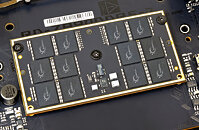
Source:
CTEE
Behind the scenes, timelines are being mapped: platform validation is slated for 2026, server deployments in 2027, and broader consumer availability thereafter. This phased rollout mirrors the DDR5 journey; however, analysts predict that DDR6's architectural leap could accelerate adoption in AI and high-performance computing environments. Of course, cutting-edge technology comes with a premium: initial DDR6 modules are expected to carry price tags reminiscent of DDR5's 2021 debut, potentially limiting early adoption to hyperscale data centers and AI research labs. Yet with HPC and AI appetite for bandwidth, memory makers are targeting launch as soon as possible to satisfy the massive deployment of compute. By 2027, CAMM2-based modules running at DDR6 speeds may well define the new standard for high-performance systems.

196 Comments on DDR6 Memory Arrives in 2027 with 8,800-17,600 MT/s Speeds
I can buy an entire 9600X bundle for what it costs to buy a 5700X3D, it's time to move on.
i would just prefer HBM2E / HBM3 modules ...
2007-2014-2020, I guess time flies, so this would be 7 years, hasnt felt anywhere near that long. Feels weird as Intel e.g. have only one gen of CPU that is exclusive to DDR5. AMD 2 gens.
This new form factor looks a bad idea, similar to M.2 being a bad idea, all that PCB space used, and a one module only system? Screws instead of slotting in. :(I am expecting I will be DDR4 -> DDR6. But not liking the look of this form factor change.
This means that AM6 and DDR6 along with Zen 8 will launch roughly in 2030.
2027 at best might be in servers in some limited capacity. Client always lags behind enterprise by several years.
Even if the AI bubble pops I'm not sure if they would ramp DDR6 or shift to DDR5 capacity. Given that all memory production seems to be locked down through next year I'm not sure AMD/Intel will be planning DDR6 controllers for their 2027 architectures.
For some reason i thought DDR always came to enterprise platforms first, but i could have confused this with PCIe instead.
I'm not as familiar with the PCIe productization past, but the PCIe future is definitely enterprise first as that's what's driving development. The development timelines are somewhat interesting: PCIe 1.0-3.0 was ~7 years, 3.0-4.0 was also ~7 years and 4.0-7.0 has been about 8 years. On the client side of things I'm not sure we'll see anything above PCIe 5.0 before the end of the decade unless there's a financial reason for it to happen.
Zen
Zen +
Zen 2
Zen 3
And Zen 3 X3D if someone wants to count that as it's separate thing. By the time AM6 comes in 2029-2030 AM5 will be 7-8 years old. Roughly the same age as AM4 was when AM5 came out. Perhaps a year or two older even.
I dont see why the current 1718 pin count would be an obstacle.
There are over 50 reserve pins available that are currently not even used yet.
More pins would be needed only if AMD decided to increase the PCIe lane count from the CPU or make bigger chiplets, but that's unlikely.
Zen 6 already increases the number of cores so it can be the core count increase either.
In any case, the problem isn't the pin count, but rather how the CPU and chipset interface with one another. Thankfully, Ryzen is a complete SoC, with most of the functionality contained within the processor itself, making it possible to work around most, although not all of the limitations a chipset would normally impose. It's just that (and I just mentioned the precedent), it doesn't make business sense for AMD to support one chipset forever.
I have no doubt that if they did become monopoly in some segment (like with Threadripper) then they would absolutely not bother with socket longevity.
Tho you were speaking about chipset longevity.
Hopefully Intel sticks around and keeps them honest and hopefully Intel itself will have longer socket longevity. Some leaks claim they will, but i will believe it when i see it.
If they deliver anything but their absolute best and Zen 6 manages to bring substantial gains over 5 (30% range), we're done for, prices will skyrocket. There is no reason to believe AMD won't sell desktop processors for $1750+ like Intel once used to if the gap between Ryzen and Core continues to widen - Threadripper pricing has doubled gen over gen, with the top tier model now exceeding $10,000.
Not to mention the prices that skyrocketed to the moon.
If Intel is able to compete in HEDT again then perhaps users who desire lots of PCIe lanes and cores can once again have systems (CPU+MB+RAM) in the low four figure ranges and CPU's that dont much pass the four figure mark themselves.
9995wx - $11,699 msrp
Where is the doubling of price?
AMD Ryzen Threadripper 2920X - $649, Socket SP3r2
AMD Ryzen Threadripper 3960X - $1399, Socket TRX4
AMD Ryzen Threadripper 7960X - $1499, Socket sTR5
AMD Ryzen Threadripper PRO 3945WX - Socket WRX8
AMD Ryzen Threadripper PRO 5945WX - Socket WRX8
AMD Ryzen Threadripper PRO 7945WX - Socket Socket sTR5
AMD Ryzen Threadripper PRO 9945WX - Socket Socket sTR5
They intentionally broke socket compatibility with 3xxx TRX4 (at 2,5x the price) and the funny thing is that this new socket didn't even stick around as already the successor 7xxx series was again on a new socket and even higher price. Because god forbid you could use older and still viable cheaper models on a new socket.
I couldn't find solid MSRP numbers for the supposedly cheapest WX models, but they screwed over 3xxx and 5xxx series owners there too as 7xxx again required a new socket.
Not that there was much pushback so i assume those buyers dont care about socket longevity and i suppose the move to DDR5 warranted a truly new socket.Interesting. I newer knew Zen 3+ actually made it to the desktop.
I started with 3800X and moved straight to 5800X3D.
Had i bough the 3800X Intel equivalent (9700K) then there's no way i could have had 5800X3D like performance on Intel within the same socket.
Only 9900KS and it was hot and expensive for not much of an uplift.
So i only made one upgrade within AM4 and already i was winning in terms of performance per $. I would have had to get 12700K with DDR5 at the very least to partly match or exceed 5800X3D wasting even more $.
I still consider refreshes as a separate generation. If i did not i could say the same about Intel how they only support one generation per socket.