Wednesday, July 23rd 2025
DDR6 Memory Arrives in 2027 with 8,800-17,600 MT/s Speeds
The semiconductor industry has officially accelerated its next-generation memory development, with DDR6 standard now coming soon. Although enthusiasts won't find these modules available until 2027, key players, Samsung, Micron, and SK Hynix, have already moved past prototype stages and embarked on rigorous validation cycles. In partnership with Intel, AMD, and NVIDIA, they're targeting an initial throughput of 8,800 MT/s, with plans to scale up to a staggering 17,600 MT/s, almost doubling the ceiling of today's DDR5. This increase is driven by DDR6's 4×24-bit sub-channel architecture, which requires entirely new approaches to signal integrity. Additionally, it also differs from DDR5's current 2x32-bit sub-channel structure. To overcome the physical limits that DIMM form factors faced at higher speeds, the industry is betting on CAMM2. Early indication is that server platforms will lead the change, with high-end notebooks following suit once manufacturing ramps up.
Behind the scenes, timelines are being mapped: platform validation is slated for 2026, server deployments in 2027, and broader consumer availability thereafter. This phased rollout mirrors the DDR5 journey; however, analysts predict that DDR6's architectural leap could accelerate adoption in AI and high-performance computing environments. Of course, cutting-edge technology comes with a premium: initial DDR6 modules are expected to carry price tags reminiscent of DDR5's 2021 debut, potentially limiting early adoption to hyperscale data centers and AI research labs. Yet with HPC and AI appetite for bandwidth, memory makers are targeting launch as soon as possible to satisfy the massive deployment of compute. By 2027, CAMM2-based modules running at DDR6 speeds may well define the new standard for high-performance systems.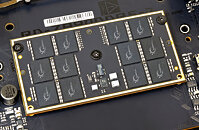
Source:
CTEE
Behind the scenes, timelines are being mapped: platform validation is slated for 2026, server deployments in 2027, and broader consumer availability thereafter. This phased rollout mirrors the DDR5 journey; however, analysts predict that DDR6's architectural leap could accelerate adoption in AI and high-performance computing environments. Of course, cutting-edge technology comes with a premium: initial DDR6 modules are expected to carry price tags reminiscent of DDR5's 2021 debut, potentially limiting early adoption to hyperscale data centers and AI research labs. Yet with HPC and AI appetite for bandwidth, memory makers are targeting launch as soon as possible to satisfy the massive deployment of compute. By 2027, CAMM2-based modules running at DDR6 speeds may well define the new standard for high-performance systems.

196 Comments on DDR6 Memory Arrives in 2027 with 8,800-17,600 MT/s Speeds
Even with my most recent build I went with 2x48GB (and bought well before the price jump).
As little as possible should be integrated on the motherboard, as it is in effect duplicated cost. You could e.g. carry over a 4 slot SATA card between multiple generations of boards, but instead we just pay for the same thing multiple times integrated on every board.
The other issue is if you have e.g. a limitation on the board, and no addon card option, the board has to be replaced to upgrade, so there is a clear flexibility downgrade with modern boards, M.x slots are a laptop type of connector that was shoehorned into the desktop space.
Adaptor cards only cost more the first time but then is money saved in the future. Of course this assumes board vendors would actually make boards, cheaper, its capitalism, they may not.
To me, include what fits on the back panel, which is probably a ethernet port, potentially wifi, and USB ports, mandate cmos reset on the back port, as well as flashback, stop these features being selective. and finally integrated graphics outputs.
Stop sound integration, everyone either uses external DAC or internal soundcard, which can last for a decade or so.
Cap CPU lanes to 16, just for first GPU slot, and put the rest on to the chipset, which has a lot of flexibility on how lanes are routed instead of the restrictive nature of CPU lanes.
PCIe lanes as standard every ATX board. Sadly hard to do more then that due to how big GPUs have become, but could probably fit a 4th 4x or 8x which is usable if fat GPU not used.
16x-dedicated
8x-\shared
8x-/shared - shared total 16x chipset lanes.
4x-|shared
This would overall be less complex than adding i/o, sound, multi networking, dedicated CPU lanes, People who dont want SATA are then not paying for it, people who love SATA can load up the system with SATA ports, can put up to 5 M.2 with a GPU or 9 without, lots of flexibility.
But things have somehow gone completely wrong, high-capacity NVMe SSDs never took off, and with this latest development? We'll be set back 30 years.
(edit)
Now that I think about it some more I guess it would be ok if they converted the lanes to a card slot.
Chipsets are extremely functional, cheap, PCIe switches which allow for so much connectivity to be integrated. Taking away the integration means the functionality has to come from somewhere else. What you're proposing wouldn't help with prices and would actually likely increase costs period.
Onboard audio should be connected via either PCIe or Intel HD Audio (using USB for connecting audio as many motherboards have done to either overcome the throughput limits of Intel HD Audio or to work around a missing Intel HD Audio interface adds a lot of latency as latency tests of various audio connections have proven so it is a poor fit for gaming), and Intel HD Audio is a dedicated bus from the chipset that is defined for motherboard use and has no sockets or slots defined. If your onboard audio is connected via USB, you should look into getting a sound card that does not use USB internally to get low latency audio. (Some sound cards use USB internally and therefore suffer the latency penalty of USB. I found that Asus sells sound cards that are nothing more than a PCIe to USB bridge that a USB sound chip connects to, all in the sound card.)
Also, modern PCs need some sort of network connectivity with Ethernet for motherboards tailored to gaming (fighting game tournaments routinely ban Wi-Fi warriors because Wi-Fi's half-duplex nature generates unacceptable latency for fighting games even with good rollback net code) or for home server use, or Wi-Fi for casual use.
I like SATA as an onboard option to be able to boot to read-only Linux or Windows installation optical discs in a pinch in case I need something that cannot be easily overwritten in case a PC must be nuked due to a malware infection. Not many USB flash drives come with a read-only switch for this kind of purpose.
The cost of implementing these common peripherals should be a lot less than making them into PCIe cards and slotting them into the PCs which can lead to additional defects which drive up costs.
Personally, I would not mind if most of these things were removed outright, i dont care for integrated audio or SATA. Give me an extra M.2-2280 and spend the excess on a 10Gb NIC
This YouTube video shows HD Audio latency not to be that bad on a Realtek S1220, an HDA audio codec:
These YouTube videos show a Realtek ALC4080, an onboard USB-based audio codec, to be terrible when it comes to latency:
Sure, there is no direct comparison between motherboards that use HDA and USB that I have found yet. That would be an interesting test to run.
Almost all of Gigabyte's X870E motherboards use HDA instead of USB.
There are definitely things that could, and should be improved with regards to motherboards. While I've never used integrated audio (I come from the era where there wasn't any and have always had internal or external cards) it just never being routed using USB ever again would be great. I'd rather there be no insufficient VRMs on motherboards, but I'd accept clearly disclosed power delivery limitations. I'm probably in the minority, but I'd love to see the removal of SATA and addition of combo ports instead. My favorite feature of the W680 board I have is the SlimSAS connector which can either be 4x SATA or 4 lanes of PCIe and I'd be absolutely thrilled if we got at least two of these on every board. I assume most people would be very angry over losing two M.2 slots however so I suspect such a thing will never appear on a client desktop oriented board.
Its easy to see, boards have got more expensive, duplication is inefficient, waste of materials, and we lose flexibility.
As for flexibility answer this one for me: with your suggested idea how would this work?
1x high speed NIC (requiring at least 4 lanes)
1x HBA (or video card)
5x NVMe SSD
4x SATA HDD
This is a configuration that can be done on pretty much any Intel Z/W platform motherboard aside from some of the cheapest.
Another note on cost with your suggestion: doubling (quadruple in the case of AMD) the lanes going to the chipset is a big cost increase. Intel is cutting the number of lanes back to 2/4 (PCIe 5.0) from 4/8 (PCIe 4.0) with the forthcoming NVL platform which is about managing cost (on both the motherboard and chipset level).