Thursday, April 16th 2026

Intel Foundry Nears Major Customer Wins as Apple, AMD, Google, and NVIDIA Weigh Deals
Intel Foundry has been attracting significant attention from the industry lately, with some of the world's largest companies expected to announce new foundry commitments this fall, according to UBS Group. The investment bank has reported that Intel Foundry is on the brink of securing many new contracts scheduled for this fall, citing the release of version 1.0 of the 14A node process design kit (PDK) as a key catalyst. There have been numerous rumors that Apple, AMD, NVIDIA, Google, and Broadcom are considering utilizing Intel's silicon manufacturing, including the 18A, 18A-P, and 18A-PT nodes, as well as the upcoming 14A node. Apple is rumored to manufacture some of its M-Series "Apple Silicon" laptop processors in 2027 using the 18A-P node, while Google might leverage Intel's EMIB and Foveros 3D advanced packaging technology for some of its TPU designs.
Companies regularly evaluate leading industry nodes but often choose TSMC's manufacturing due to its reliability, high volume capacity, and advanced packaging, which has produced numerous high-performance and low-power designs at scale. However, Intel Foundry has been investing significant resources and logistics into attracting external clients, leading UBS to anticipate multiple foundry commitments being announced this fall. Late last year, we learned that Apple was waiting for Intel to release the 18A-P PDK version 1.0 or 1.1, scheduled for Q1 and Q2 of 2026, respectively. As we are now in Q2, we are awaiting further confirmation to see if Apple proceeded with the deal, but UBS expects it did.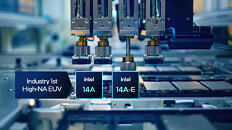 Another significant opportunity for Intel Foundry lies not only in its silicon manufacturing but also in its advanced packaging technologies. Companies can design 2D, 2.5D, and 3D building blocks with silicon using Intel's EMIB, EMIB-T, and EMIB-M variants, which can stack multiple chiplets and combine numerous HBM memory modules into a single package. Intel has even demonstrated the use of 47 tiles in a single package and envisions multi-kilowatt solutions per package. Meanwhile, TSMC's leading packaging technology, CoWoS, reportedly struggles with four reticle-sized dies, causing some production issues for NVIDIA.
Source:
MQ on X
Companies regularly evaluate leading industry nodes but often choose TSMC's manufacturing due to its reliability, high volume capacity, and advanced packaging, which has produced numerous high-performance and low-power designs at scale. However, Intel Foundry has been investing significant resources and logistics into attracting external clients, leading UBS to anticipate multiple foundry commitments being announced this fall. Late last year, we learned that Apple was waiting for Intel to release the 18A-P PDK version 1.0 or 1.1, scheduled for Q1 and Q2 of 2026, respectively. As we are now in Q2, we are awaiting further confirmation to see if Apple proceeded with the deal, but UBS expects it did.

15 Comments on Intel Foundry Nears Major Customer Wins as Apple, AMD, Google, and NVIDIA Weigh Deals
CPUs? And what if Intel’s design division secretly gains access to EPYC blueprints? At the very least, Intel would know exactly what to expect from AMD.
GPUs? Same question. What if Intel’s GPU division gets secret access to Radeon blueprints, or even worse, Instinct? What if Nvidia gets access? Intel and Nvidia are buddies now.
FPGAs? Do they even require such advanced manufacturing nodes? Intel still holds a minority stake in Altera. So, what’s left?
The only thing I can think of is AMD making a move into ARM processors. Let’s face it: Qualcomm’s chips might not have conquered the market yet, but Apple’s Macbook Neo showed that the x86 market is vulnerable - mostly due to Windows requiring tonnes of RAM just to function. With Nvidia and MediaTek also expected to enter the market soon, it’s not unlikely that by the beginning of the next decade, ARM architecture could power almost half of the laptops on the market. By the mid-to-late 2030s, x86 might only retain some advantages in the server market, or perhaps nowhere at all.
Also, Nvidia caring about Radeon/Instinct blueprints? Really? As if. They have their own designs and stuff they can do just fine. And they hold 95% of the GPU market, and the majority chunk of the AI accelerators one most likely.
Intersegment eliminations are obviously the stuff that the Foundry half sells to the Products half, but what stops them from estimating both the revenue and the costs of that part however they see fit?
the difference is in what they decide to use the limited silicon realestate and power budget for.
Even if they were to invent some novel thing, before sitting together with intel foundry engineers. Lawyers will have registered and patented everything.
And you bet your ass the first thing that happens with a competitor introduces a new product. They will scan it under an electron microscope to find anything they could have misappropriated
But with just a calculator ~160 M to be to external customer e.g. Tower Semi
The most thumb sucking number is any financial report is usually provision / goodwill / contingent ...
And I think in 2024 Intel clean a lot of those therefore it is abnormally unprofitable.