News Archive

Tuesday, May 31st 2016

Today's Reviews

Cases
CPU Coolers
Graphics Cards
Keyboards
Memory
Monitors
Motherboards
Mousepads
Processors
PSUs
Speakers
Storage

DeepCool Gamer Storm Neptwin RGB Cooler Pictured

DeepCool gave the Gamer Storm Neptwin cooler a design overhaul, with the new Neptwin RGB. This cooler features an all-black twin-tower heatsink, a pair of new custom-design 120 mm fans by DeepCool which feature an X-shaped supporting brace that crisscrosses the frame with RGB multi-color LEDs embedded in them, and a lighting/color control pod that doubles up as fan-control. The cooler also features LED lit top covers for the two fin stacks. The rest of its feature-set appears to be unchanged from the original Neptwin.

DeepCool Dukase V2 White Pictured, RGB360 Magnetic LED Strips Detailed

DeepCool is ready with its second generation Dukase chassis draped in white, with a contrasting matte black front, the Dukase V2 White. The case features all-white interiors, with a door opening up two 5.25-inch drive bays, 3.5-inch bays enclosed within the PSU compartment, and two 2.5-inch bays on top of the PSU compartment. The graphics cards hence feature over 40 cm of room, which you can alternatively use for your liquid cooling gear. DeepCool also showed off the RGB360 magnetic multi-color LED strips. Although designed for the Dukase V2, these will be sold separately. The Dukase V2 White is expected to be priced at US $79.99, while a set of three RGB360 strips being priced at $29.99.

Rosewill Cullinan Tempered Glass Panel Case Pictured

Rosewill's flagship case for this year's Computex wasn't a brutish full-tower, but a more elegant looking glass case, the Cullinan. This case features tinted tempered glass panels lining the front and side panels. It features a dual-compartment layout with the top (motherboard tray) compartment having no intrusion from drive bays, letting you either seat EATX motherboards, or standard ATX ones with lots of room to spare for your liquid cooling gear. You can install graphics cards as long as 42 cm, and CPU coolers as tall as 18 cm. Both the top- and front-panel feature vents for 360 mm x 120 mm radiators. Other features include an integrated fan-controller. The drive bays are relegated to the bottom compartment with the PSU, and behind the motherboard tray.

Rosewill Unveils the Himars Chassis with Front Hot-swap Bay

Rosewill unveiled the Himars, an entry-mainstream ATX mid-tower case with a front-facing 3.5-inch SATA HDD hot-swap bay, similar to that of the Nanoxia Basic 1. Besides this, you get a pair of 5.25-inch drive bays, room for graphics cards as long as 30 cm, CPU coolers as long as 16 cm, and a top 360 mm x 120 mm radiator mount, for a single large radiator handling both your CPU and high-end graphics card.

Rosewill Gram Entry-level Mid-tower Case Pictured

Rosewill's case lineup begins with Gram, an elegant and minimalist entry-level mid-tower. The case covers all the basics for people with their first DIY build, including a single 5.25-inch drive bay, a number of 2.5-inch drive bays along the floor of the motherboard compartment, and more 3.5-inch bays in the bottom compartment shared with the PSU bay. There's room for graphics cards as long as 36 cm, and CPU coolers as tall as 16 cm. The front panel has room for a 240 mm x 120 mm radiator. USB 3.0 ports (standard header) and HDA jacks make up the front-panel connectivity.

Rosewill Tokamak 1500W and Tokamak 1200W PSUs Pictured
Rosewill's flagship power supplies, the Tokamak 1500W and Tokamak 1200W, smile for the camera. These units are designed and manufactured using some of the choicest components, including an all-Japanese capacitor design. They feature a single +12V rail design, with a massive 100A rail on the 1200W model, and an even larger 125A rail on the 1500W. The units boast of 80 Plus Titanium efficiency, full modular cabling, with flat cables for machines with up to six graphics cards, and motherboards with two 8-pin EPS connectors, making them ideal for your HEDT/workstation build. The units feature load/temperature triggered 140 mm fans, and an LED indicator for load.

Rosewill Intros the RAWP-141209 Washable Case Fan

That's right, a case-fan that you can wash...with water. Rosewill may have solved the biggest woe of enthusiasts without access to dry-cleaning fluids to clean their fans, with the RAWP-141209. This 120 mm spinner is washable with water. Its other chops are pretty decent, too - a Teflon nano bearing, 500 to 1,500 RPM speeds, PWM support, and 64.75 CFM of maximum air flow. While it's washable, it isn't water-proof. So don't get the one idea on every DIY liquid-cooling enthusiast's mind - to immerse their radiators into a large fish-tank.

Rosewill RWC-1612 Series 120 mm Fans Pictured

Rosewill showed off its RWC-1612 series 120 mm fans. Available in blue (RWCB-1612), red (RWCR-1612), and green (RWCG-1612), the fans are characterized by circular frames that light up, hydraulic bearings on the motor, PWM control support, fan-speeds ranging between 500 to 1,500 RPM, and air-flow ranging proportionately, between 14.89 CFM to 63.1 CFM. The fans will be sold loose, and part of some of the company's latest cases, such as the Gungnir X.

Rosewill Gungnir X and Gungnir Z Cases Pictured

Rosewill showed off its Gungnir X mid-tower case, one of its first under the company's redesigned brand emblem. The case features 5.25-inch drive bays, but its 3.5-inch bays are pushed to a compartment in the bottom. This approach frees up room besides the motherboard tray, letting you use EATX motherboards, and graphics cards as long as 42 cm. The case also has room for CPU coolers as tall as 18 cm (140 mm towers should fit). Despite the top drive bay, the top-panel has room for a 360 mm x 120 mm radiator. Front-panel features include an integrated fan-controller, USB 3.0 ports, and HDA jacks. Also pictured is the Gungnir Z. This is similar to the Gungnir X for the most part, except it features tinted tempered glass side-panels on both sides.

ECS Shows off the No-frills H110S-2P

ECS showed off its the H110S-2P, a no-frills motherboard built in a form-factor that's smaller than mini-ITX, although compatible with mini-ITX cases. The board lacks add-on card expansion slots. The only expansion you can give this board is an mPCIe, and an M.2 2230, which closely passes over the PCH. You can tell from the M.2 placeholder marking on the PCB running over the PCH that even the production board could lack a PCH heatsink.

The H110S-2P supports 6th generation Core processors in the LGA1151 package, and up to 32 GB of dual-channel DDR4-2400 memory though SODIMMs. Storage connectivity, besides the M.2 slot, includes one SATA 6 Gb/s port. Display outputs (you'll need them), include one each of DisplayPort 1.2 and HDMI 1.4a. Four USB 3.0 ports, and two USB 2.0 ports complete the package.

ECS Partners with Silverstone to Develop LIVA Pro

ECS partnered with Silverstone to co-develop the LIVA Pro, a NUC-rivaling product by ECS. It consists of a custom-design all-aluminium case by Silverstone, and innards by ECS, which include an LGA1151 socket to support Intel Core "Skylake" processors with TDP of up to 65W (some Core i5/i7 low-power quad-core parts should work); Intel H110 core-logic, two DDR4 SODIMM slots, one each of M.2 and 2.5-inch SATA 6 Gb/s drive bays, gigabit Ethernet, 802.11 b/g/n WLAN, USB 3.0 type-A and type-C front-panel ports, and more.

ECS Unveils the Z170-Lightsaber

ECS Elitegroup showed off its latest flagship socket LGA1151 board, the Z170-Lightsaber, likely designed for its RGB LED product styling. The board features a 14-phase VRM powering the CPU, and expansion slots that include two PCI-Express 3.0 x16 (x8/x8 when both are populated), a third x16 (electrical x4) slot wired to the PCH, and four other x1 slots. Storage connectivity includes a 32 Gb/s M.2 with NVMe boot support, 16 Gb/s SATA-Express, and six SATA 6 Gb/s ports.

The modern connectivity on offer include two USB 3.1 ports (apparently both of them are type-A), six other USB 3.0 ports, DisplayPort 1.2 and HDMI 1.4, a gigabit Ethernet interface driven by Killer E2400 controller, and an audio solution with a 115 dBA SNR CODEC, ground-layer isolation, electrolytic capacitors, and a user-replaceable OPAMP. Overclocker friendly features include dual-BIOS with an on-demand BIOS backup/restore button, three performance preset buttons, power/reboot buttons, and a 3-digit POST error readout.

A Yacht-shaped Case from Lian-Li This Computex

Lian Li has a tradition of launching at least one off-beat, entirely unexpected case each year at Computex, to show off its design prowess. This year's offering is the PC-Y6. Available in white (PC-Y6W) and black (PC-Y6B), this yacht-shaped case made of aluminium and tempered glass, has a more boutique (less practical) design for its volume.

It measures 764 mm x 293 mm x 259 mm (WxHxD), and takes up as much space as a mid-tower. What it can enclose, though, is a mini-ITX motherboard, a video card as long as 30 cm, a CPU cooler as tall as 6 cm, a standard ATX PSU, and two each of 3.5-inch and 2.5-inch drives. There just the one 120 mm front fan mount. The rest of it is mostly open-air. This case could make for an interesting and functional prop in the luxury suite of an actual cruise ship, or a yacht.

Lian-Li Shows Off Two New High-Wattage SFX-L PSUs

Lian Li is nurturing the SFX-L form-factor of power supplies, with two new [relatively] high-Wattage PSUs. These include the 750W PE-750, and the 550W PE-550. These PSUs feature fully modular cabling, minimizing the cable clutter in your compact case, and boast of 80 Plus Platinum efficiency, APFC, and most common electrical protections. The PE-750 has enough cabling for a dual graphics card build, while the PE-550 has cabling for a single graphics card build with a high-end GPU. Both PSUs use 120 mm fans that spin only beyond a load/temperature threshold.

Lian Li PC-O8SW All Tempered Glass Chassis Pictured

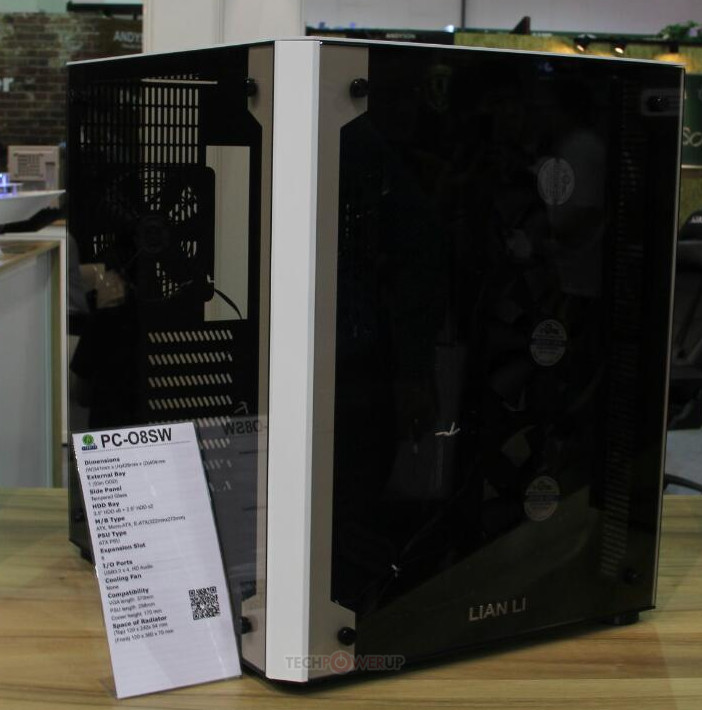
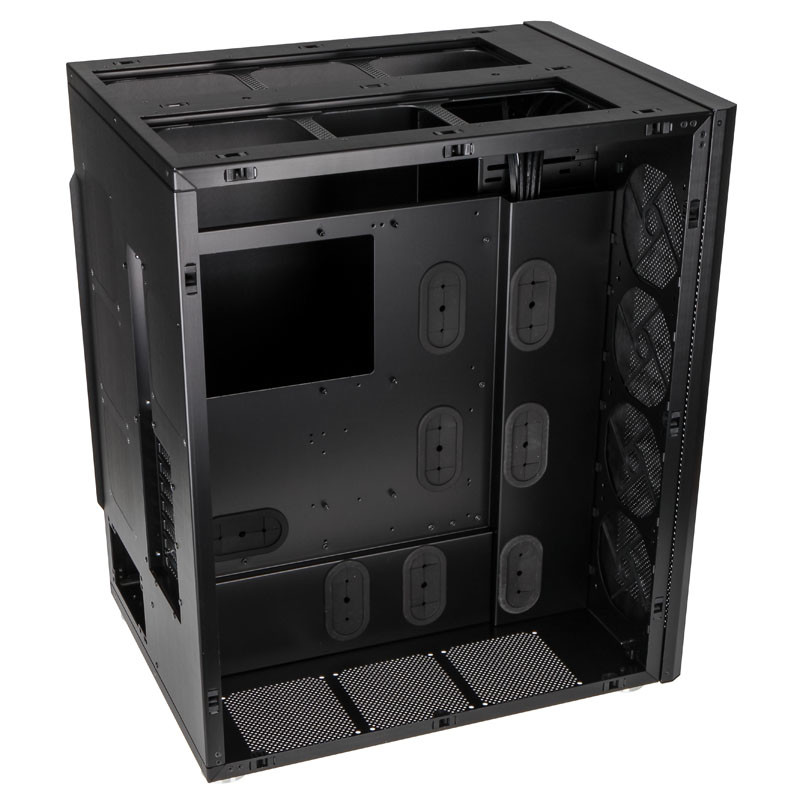
The PC-O8SW is a unique new case from Lian Li, with internal vertical compartmentalization that looks seamless from the outside, covered with tinted tempered glass on the front and side panels, while aluminium lines the top, rear, and bottom panels. Inside, you get room for an E-ATX motherboard, 29 cm long video cards, 16 cm tall CPU coolers, 420 x 140 mm radiators and more. The three tempered glass panels are supported by aluminium pillars with a brushed aluminium exterior finish.

Lian Li PC-09WRX Pictured Up Close

Tinted tempered glass appears to be the cool new material at Lian Li, and Computex in general. The traditionally aluminium case maker dressed most of its cases in the hot new material. Our tour of the booth begins with the PC-09WRX. This may not be the first dual-compartment case, but looks distinct, in that its left (motherboard tray) compartment is made almost entirely of tempered glass, while its right (PSU, drives) compartment almost entirely of aluminium. The left compartment is larger, to make room for more of the liquid cooling gear you want to show off.

The motherboard tray supports large E-ATX boards, besides common form-factors. It has room for graphics cards as long as 29 cm, and CPU coolers as tall as 29 cm. You can mount 360 mm x 120 mm radiators on both the front and top panels of this compartment. The right compartment can hold PSUs as long as 29 cm, and features six 3.5-inch drive bays, which are each convertible to 2.5-inch, and two other 2.5-inch bays. As expected, the case features an RGB LED kit.
Nanoxia Basic 1 Case Pictured

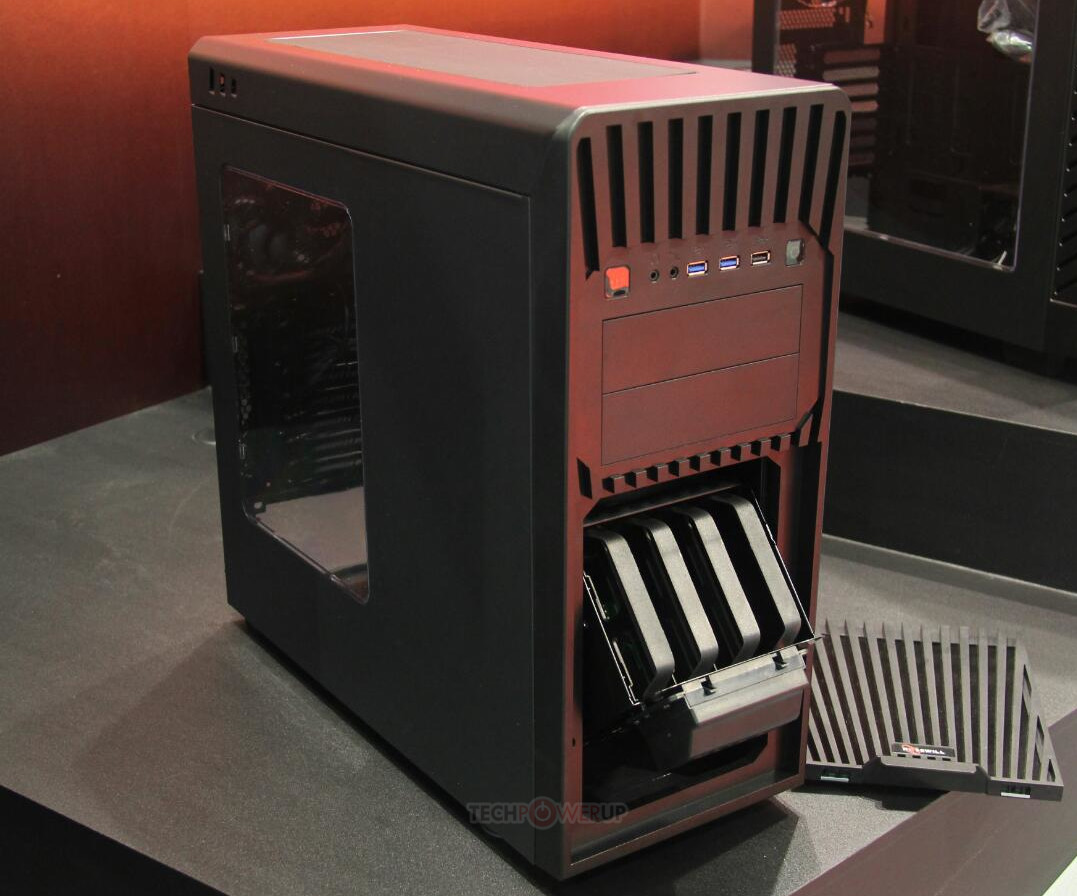
Nanoxia of the DeepSilence fame is now an established player in the casing and cooling space. The company's new entry-level case, the Basic 1, was shown off the crowds at Computex. As its name suggests, this ATX mid-tower covers all the basics of a 2016 gaming PC build, and then some. A striking new feature is its HDD hot-swap cage with five 2.5-inch bays, that's accessible from the front panel, by removing a panel cover.

AeroCool Also Intros the P7-C1 Line of Cases

The third component of AeroCool's brand unifying Project 7 series, is the case, with the company designing the P7-C1. This case is characterized by its hexagonal shaped front, with pointed top and bottom panels, and the chassis being suspended on two supporting feet, a la CM Cosmos. It's larger than most mid-towers, and closer to the league of full-towers. Primed for liquid cooling the cases feature bottom-mounted drive bays, freeing up the entire top compartment for the motherboard and your arsenal of liquid cooling components. AeroCool is preparing several variants of this case, based on primary color, LED color, and whether the case features a tempered-glass side-panel, or a more conventional SECC panel with acrylic window.

Aerocool Also Unveils Project 7 Liquid Cooling Solutions

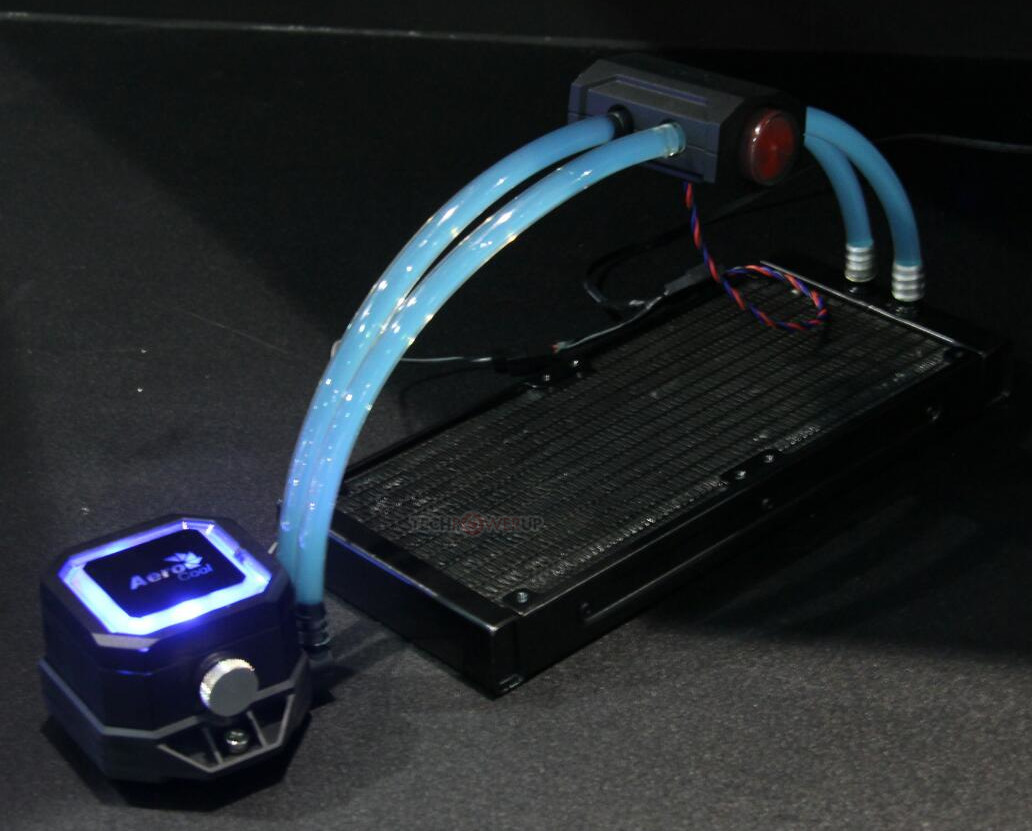
It looks like Aerocool's Project 7 covers a wider range of products than PSUs, extending to even liquid cooling. The company unveiled a mixture of closed-loop coolers and DIY liquid cooling parts under the banner. To begin with, there's the P7-W240C, which is a closed loop cooler with a 240 mm x 120 mm radiator, and a pump-block, with a regulator. It looks all too DIY, but is factory-fitted closed-loop. Next up, is the P7-W240 Pro, which appears to be a set of compatible parts so you can build a simple loop of your own, complete with a CPU block, a 240 mm x 120 mm radiator, and a cylindrical reservoir.

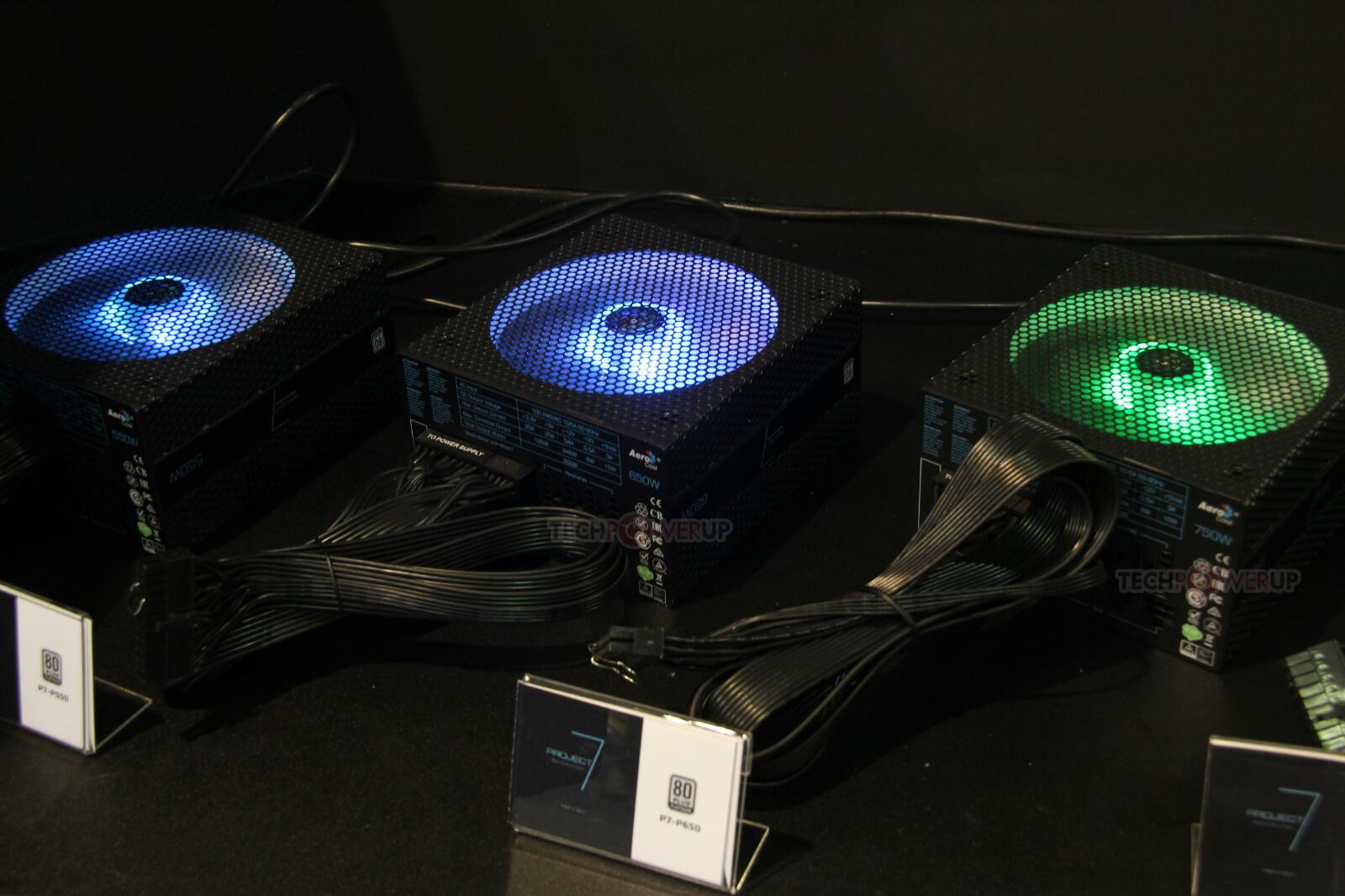
AeroCool Project 7 Series PSUs Pictured
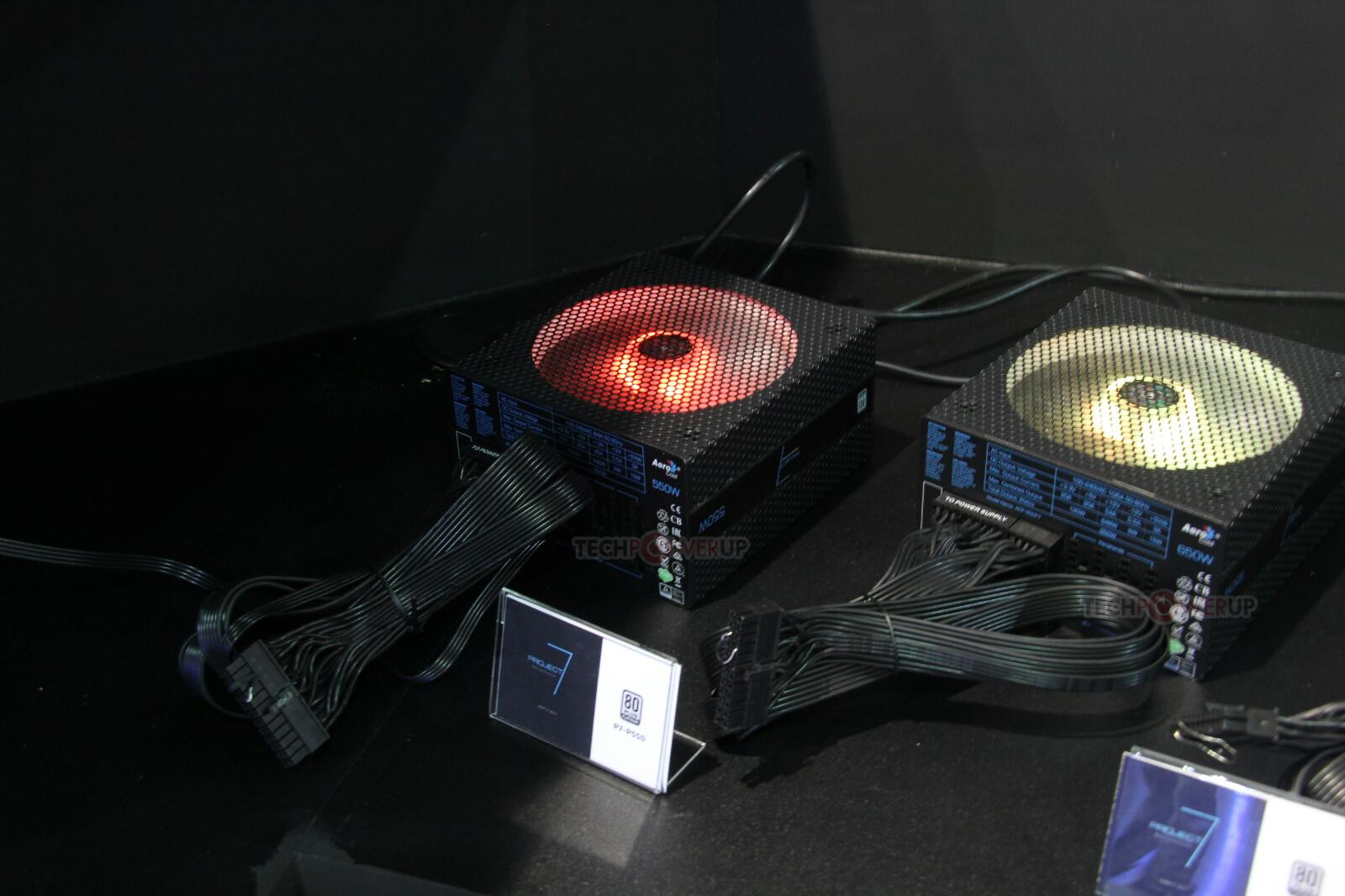
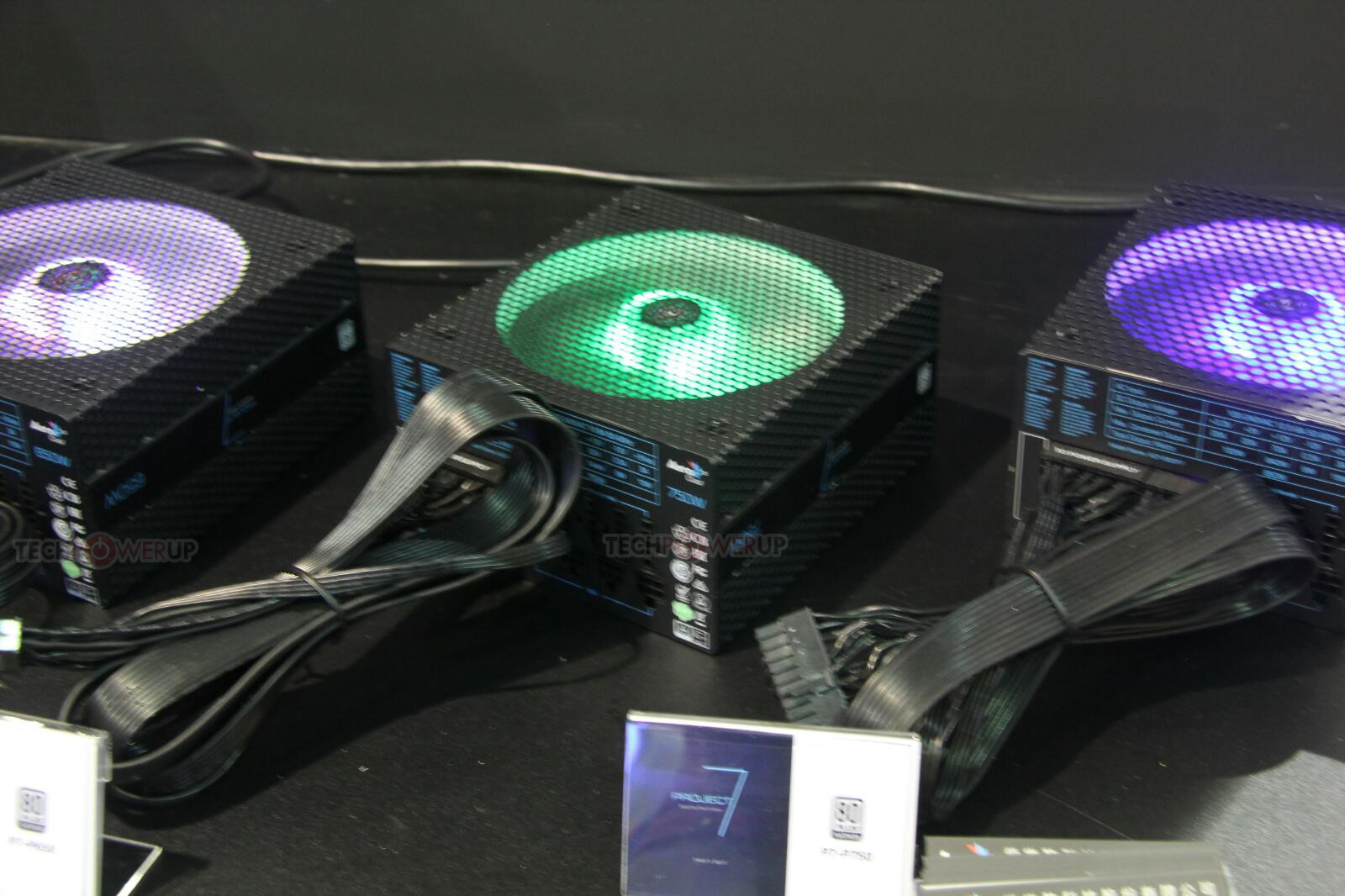
AeroCool announced the Project 7 (P7) line of power supplies, which comes in three key output capacities - 550W (P7-P550), 650W (P7-P650), 750W (P7-P750), and 850W (P7-P850). The three boast of 80 Plus Platinum efficiency, single +12V rail design, fully modular cabling, flat cables, and RGB LED-lit temperature-activated 140 mm spinners cooling the unit.

Patriot Announces New Viper DDR4 SODIMM

Patriot, a leading manufacturer of high performance computer memory, SSDs, gaming peripherals, consumer flash storage solutions and mobile accessories, today announced the release of the Viper DDR4 SODIMM. Designed to support gaming laptops and small form factor systems, such as the Intel NUC, to make gaming more accessible while on the go and free up desk space, the Viper SODIMM will provide a solid system upgrade.

The Viper DDR4 SODIMMs will be available individually in capacities of 8GB and 16GB and in dual kits of 16GB (2x8GB) and 32GB (2x16GB). With speeds ranging from 2400MHz to 2800MHz, the Viper SODIMMs will provide users with faster load times and improved response rates. The new Viper DDR4 SODIMMs also feature a high performance heat shield for superior heat dissipation to ensure solid performance during the most grueling gaming session with a low profile that offers flexibility to fit easily into virtually any system.

MSI Gaming Z and Gaming X Differentiated Some More

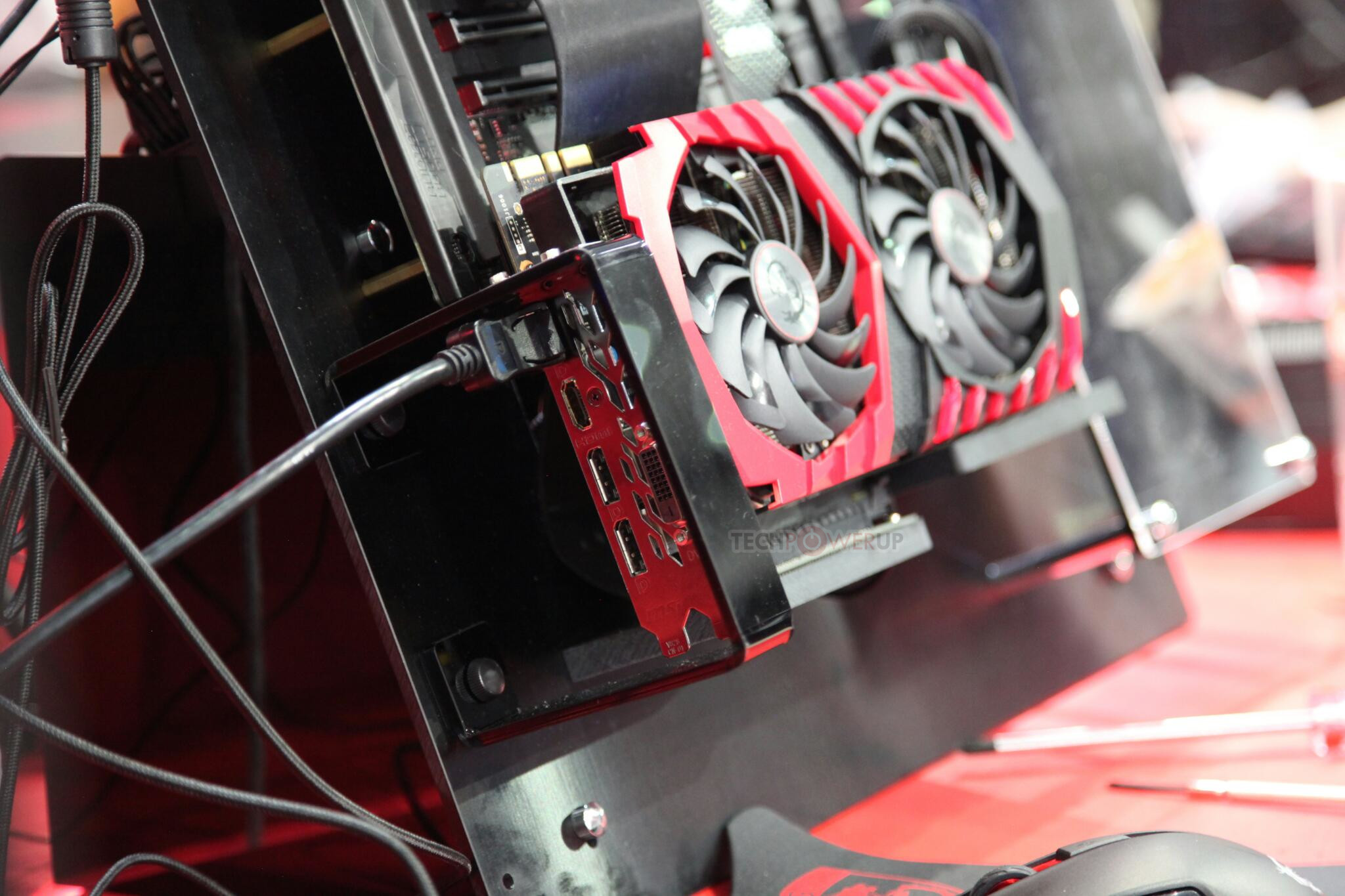
We found out more information on what sets MSI Gaming Z series graphics cards apart from the Gaming X series. The Gaming X series cards, such as the GeForce GTX 1080 Gaming X, which was part of the company's first wave of GTX 1080 cards, is the middle grade of the Gaming series. The Gaming Z series (such as the GTX 1080 Gaming Z, which is coming soon), is the top-tier variant.

The Gaming X GTX 1080 features double ball bearing fans, a few gamer-specific features though MSI Gaming Control Center, a back-plate, and a significant factory OC. The Gaming Z, on the other hand, gives you all the features of the Gaming X, but higher clock speeds, and a custom RGB LED setup lining the top logo and an MSI "Dragon" logo on the back-plate.

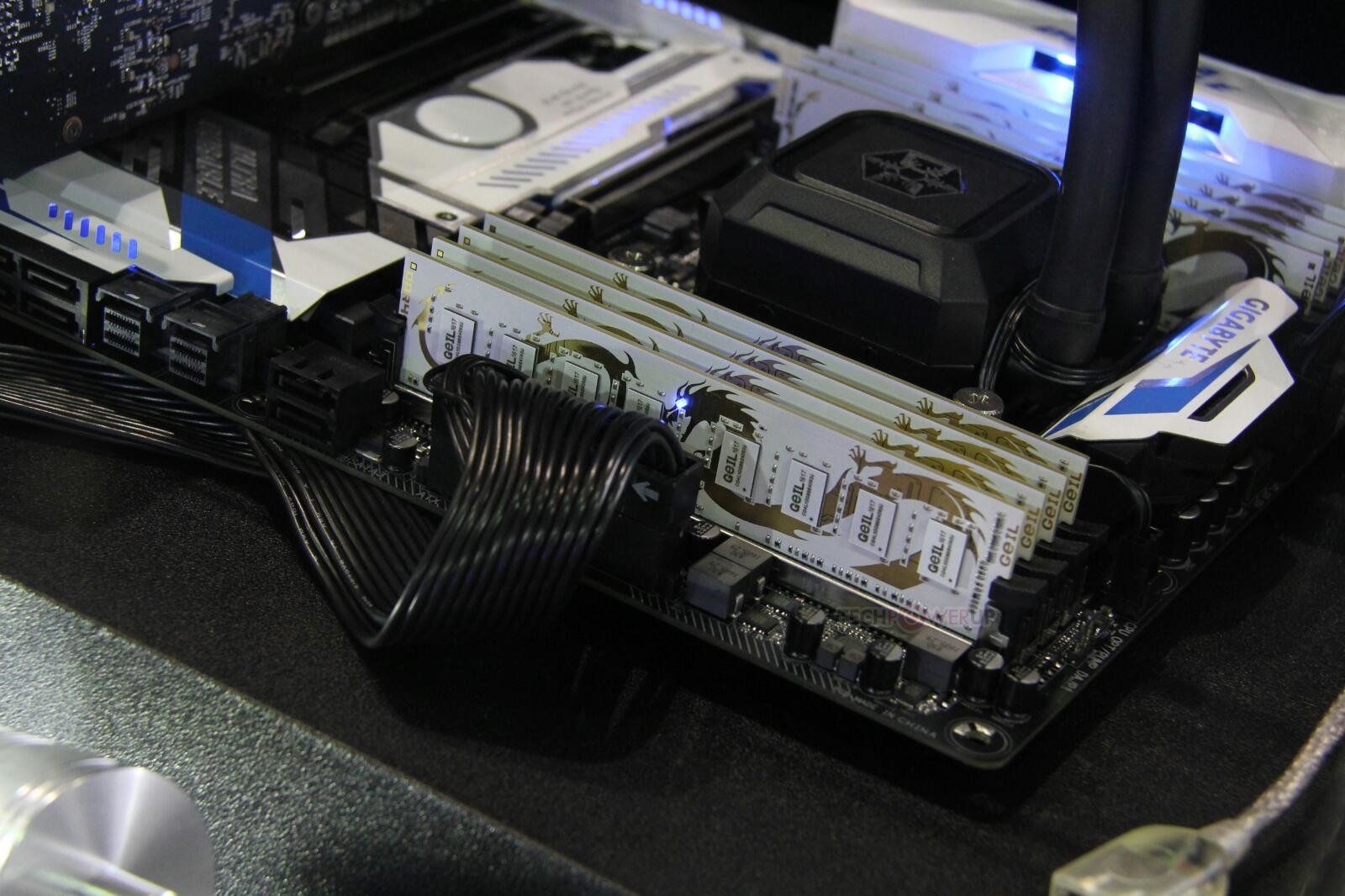
GeIL Also Shows Off the DDR4 Dragon RAM

This is one of the rare exhibits that stands out due to its minimalism, the GeIL Dragon RAM. Ideal for builders who want to hassle the HOF (GALAX Hall of Fame), the Dragon RAM features an all-white PCB, with white stickers over the DRAM chips, and a white upper PCB layer peeled off in the shape of a dragon, to expose a slightly lower golden copper layer, and a blue SMT LED near the dragon's eyes making for a subtle touch. The Dragon RAM will be available in speeds of up to DDR4-3400, and densities of up to 16 GB, making up 64 GB quad-channel kits. We expect it to be one of GeIL's more affordable modules.

GeIL EVO X Memory With Split PCB Pictured

Here are some of the first pictures of GeIL EVO-X memory with its HILM (hybrid independent light module) active. GeIL essentially split the module into two PCBs, one being the more expensive, multi-layer DIMM PCB, and the other being a fewer-layered PCB holding the RGB LED lighting, with its independent power input. That's right, EVO-X is one of the first memory modules that don't use DIMM voltage to power lighting. They instead feature a tiny power input on the lighting PCB, which draws power from any vacant USB 2.0 header you may have on your motherboard (and also interfacing with your OS to let you configure the color. The EVO-X is available in reasonably high speeds such as DDR4-3866, and in densities of up to 8 GB per module.

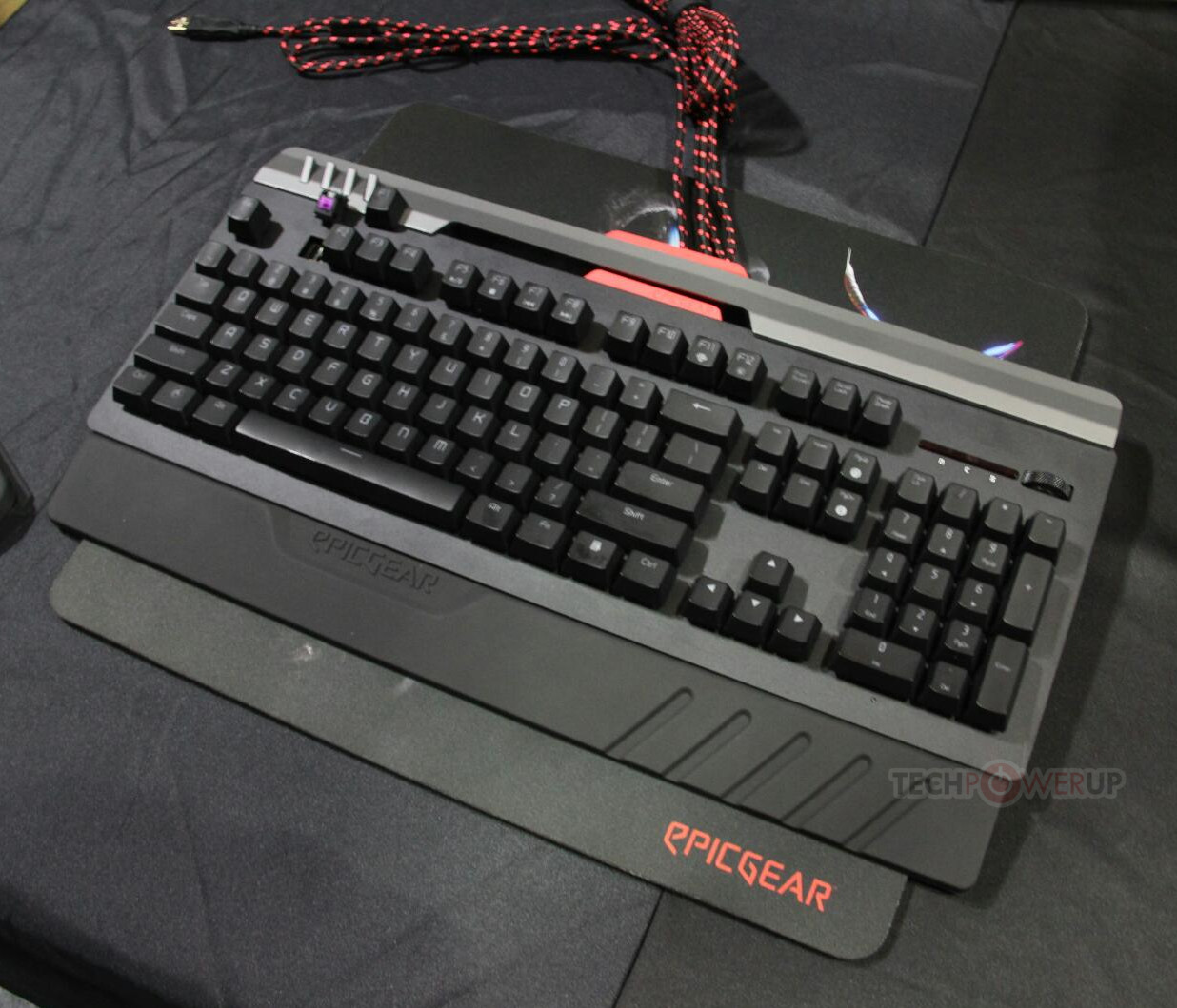
EpicGear Unveils Defiant White RGB Mechanical Keyboard

EpicGear unveiled the White RGB variant of its Defiant mechanical keyboard. This keyboard combines a black rubberized palm-rest with a matte bright white face-plate, and slightly off-white keys that have Cherry MX RGB switches under them. Each key can be made to light up in a different color. The keyboard features a simple 104-key set, with Function key enabling more media keys, but also includes a mouse scroll-wheel that acts like a volume control, and which you can push to mute/unmute. The company also showed off a gunmetal trim of this keyboard.

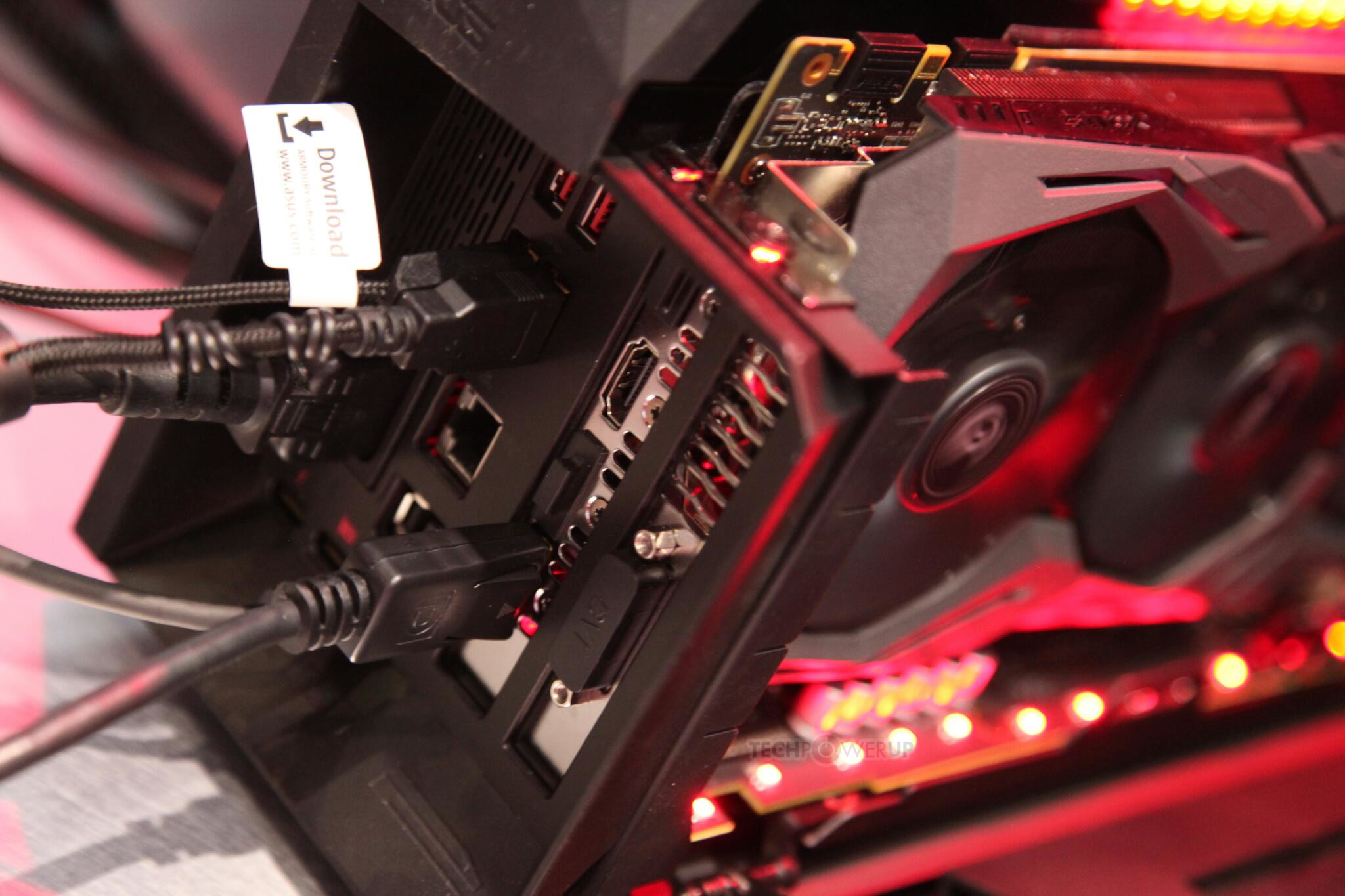
ASUS Unveils ROG XG2 Graphics Enclosure

ASUS unveiled a Republic of Gamers branded XG2 external graphics enclosure, which uses bandwidth from two USB 3.1 ports to power not just a high-end graphics card, but also additional connectivity such as a pair of USB 3.0 type-A ports, and gigabit Ethernet. One source tells us that the USB 3.1 ports are bi-directional, and can be used to increase bandwidth to the enclosure. A single Thunderbolt 3 port provides the same amount of bandwidth, but is known to post higher latencies due to protocol layer.

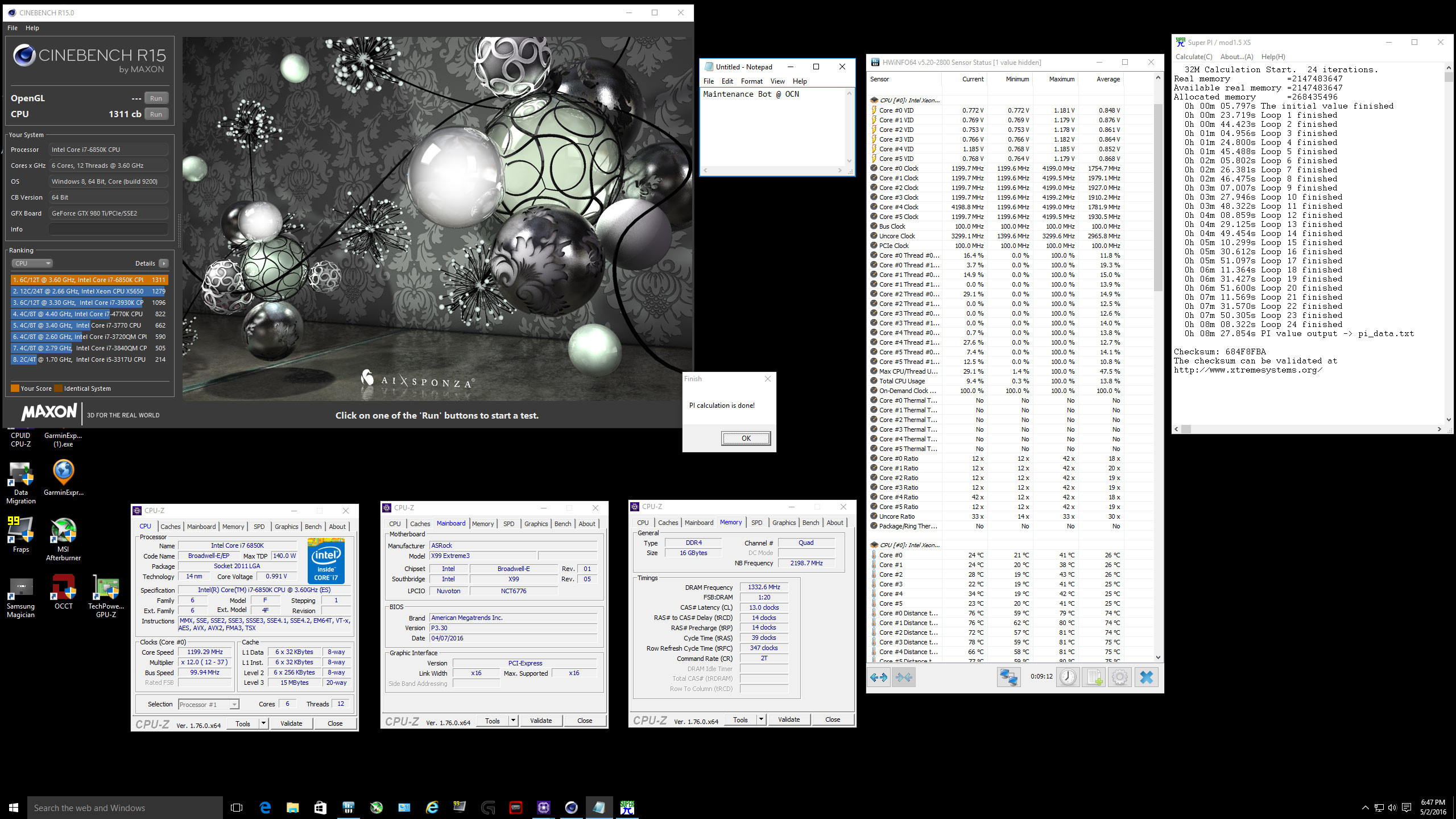
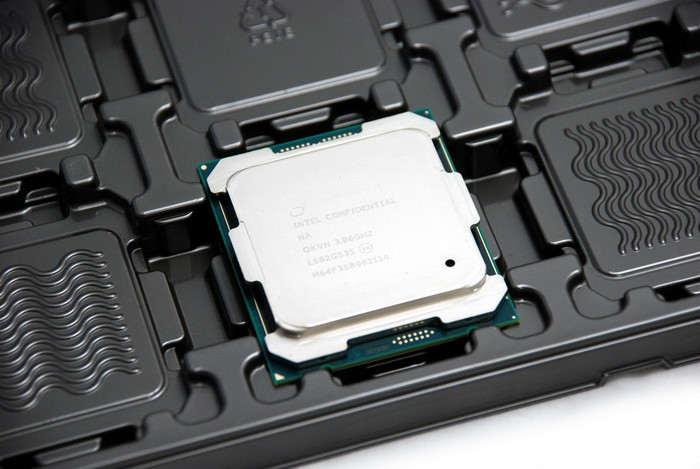
Intel Announces the Core i7 "Broadwell-E" HEDT Processor Series

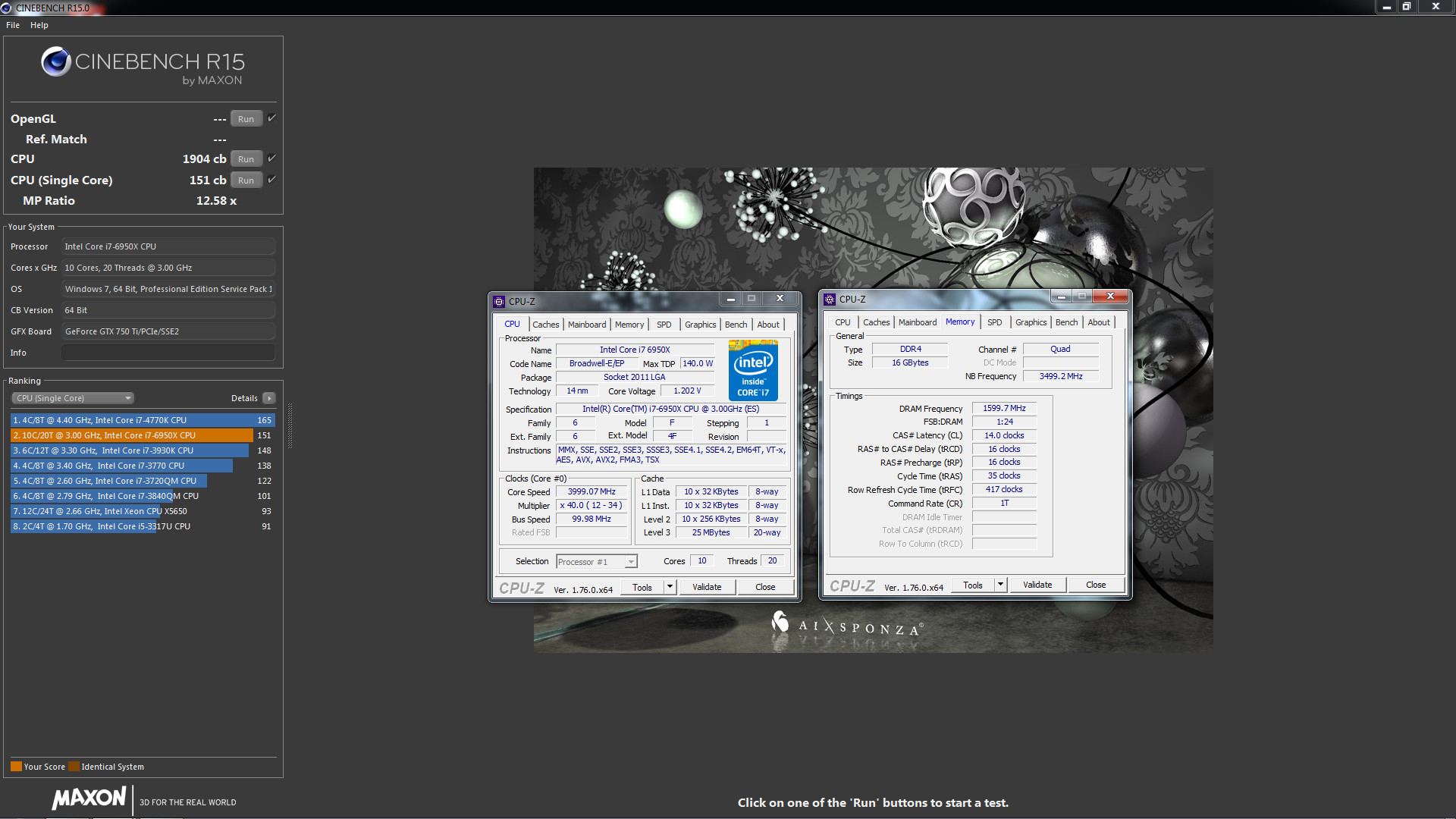
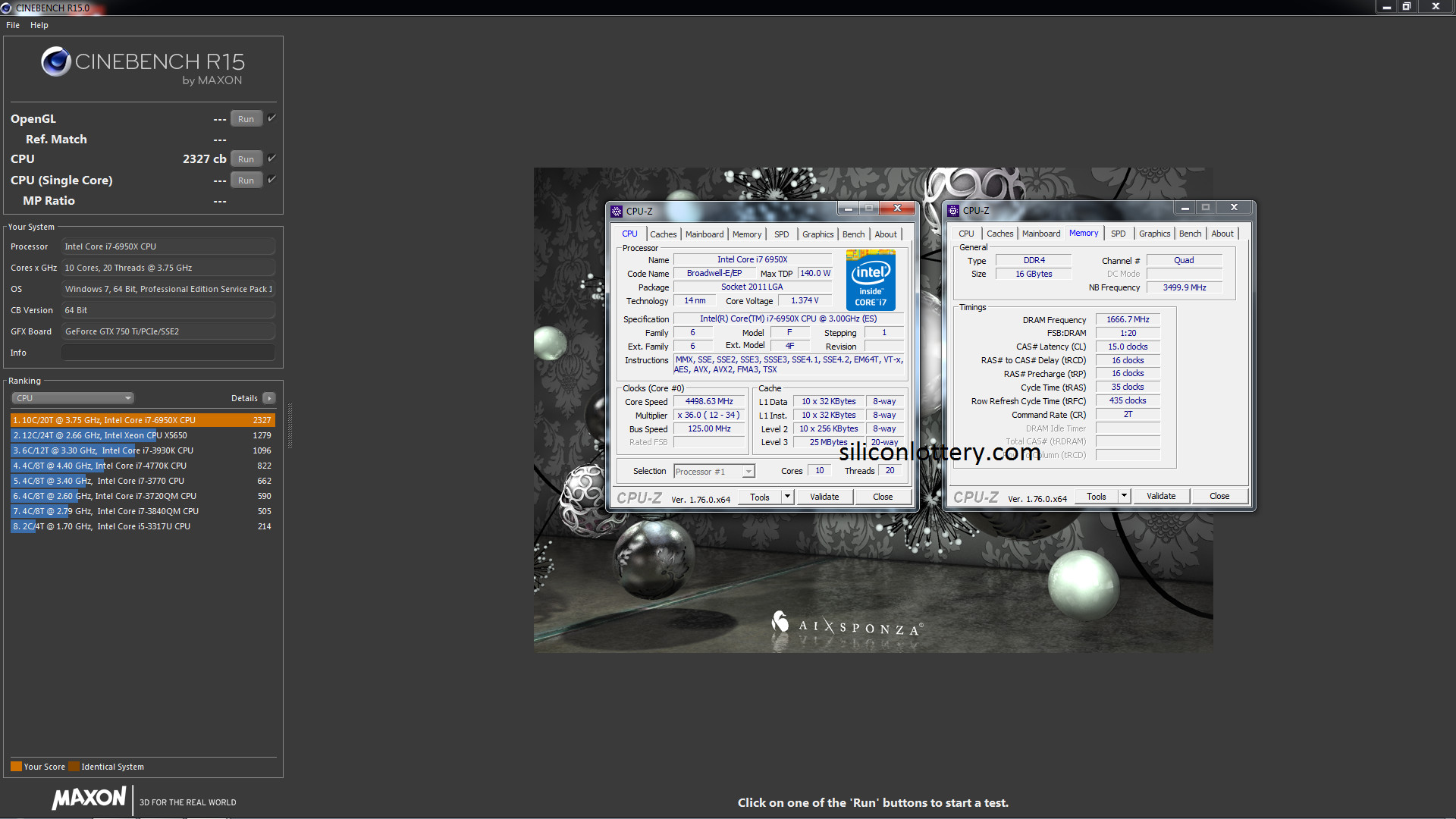
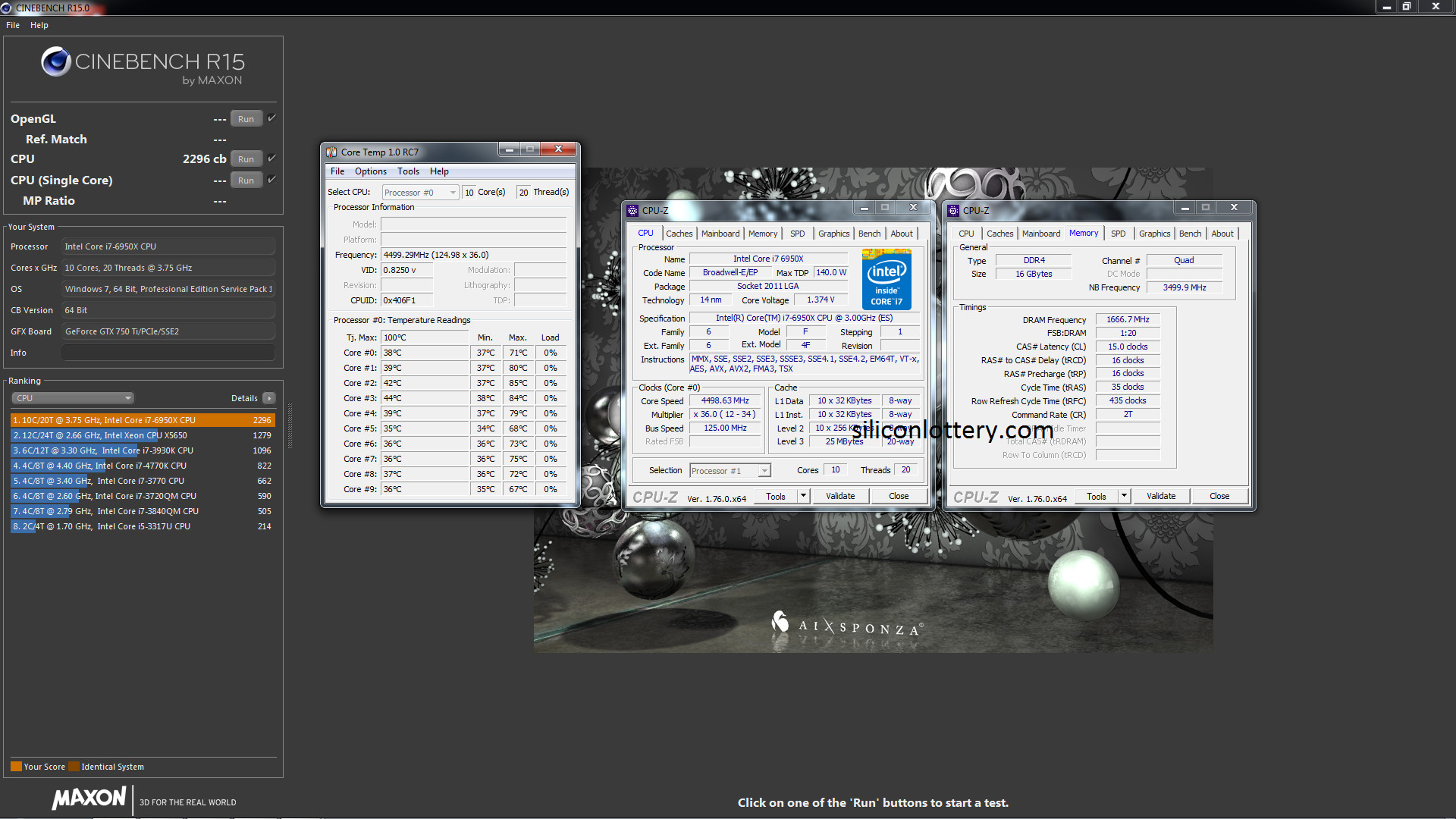
Intel today announced the Core i7 "Broadwell-E" processor series. Built in the socket LGA2011v3 package, these chips work with motherboards based on the Intel X99 Express chipset, some boards may require BIOS updates to support these chips. At the heart of the lineup is the 14 nm "Broadwell-E" silicon. Intel is launching not three but four SKUs, including two six-core, one eight-core, and one ten-core.

The lineup begins with the Core i7-6800K. This six-core chip features 15 MB of L3 cache, 3.40 GHz clocks with 3.60 GHz Turbo Boost, 28 PCI-Express lanes, and a price of US $434. Next up, is the Core i7-6850K, which is also a six-core chip with 15 MB L3 cache, but features slightly higher clock speeds of 3.60 GHz with 3.80 Turbo Boost, but more importantly, features the full 40 PCI-Express lanes of the silicon. The Core i7-6850K is priced at US $617. Further up the lineup is the Core i7-6900K, with eight cores, 20 MB L3 cache, 3.20 GHz clocks with 3.70 GHz maximum Turbo Boost, and a price of $1,089. The price-per-core dramatically shoots up from here, as we get to the Core i7-6950X Extreme Edition, the jewel in Intel's crown, featuring ten cores, 25 MB of L3 cache, 3.00 GHz clocks with 3.50 GHz Turbo Boost, and a wallet-scorching $1,723 price.

G.Skill Unveils RipJaws KM770 and KM570 MX Keyboards

G.Skill unveiled two new additions to its RipJaws gaming keyboard lineup, the KM770 and the KM550 MX (pictured in that order). The KM770 offers RGB lighting though Cherry MX RGB keys, Full NKRO with 100% anti-ghosting, the ability to reprogram every single key, dedicated media and macro keys, and an LED volume display. The KM550, on the other hand, features a simpler layout, with media keys bound to the Function key, and a single reddish orange key illumination. This keyboard comes in a variety of Cherry MX switch options.

G.Skill Unveils RipJaws Platinum High End PSU Series

G.Skill unveiled three RipJaws Platinum series high-Wattage PSUs. These include the 1200W PS1200P, the 1250W PS1250P, and the 850W PS850P. As their names might suggest, the three boast of 80 Plus Platinum efficiency. The three feature single +12V rail design, DC-to-DC switching, and 135 mm temperature-activated fans. The PS1250W and PS850W are slightly more advanced, in that they feature ripple-suppression capacitors in the 24-pin, 4+4-pin and PCIe cables; and ECO Optimized fan-control. All three feature fully-modular cabling. The 850W model is recommend for gaming PCs with up to three video cards; while the 1200W and 1250W models go well with even more cards.

GALAX Hall of Fame Custom-design SLI HB Bridge Pictured

Here's the first picture of a custom-design SLI HB (high-bandwidth) bridge by GALAX. With NVIDIA recommending a new kind of SLI bridge for NVIDIA "Pascal" GPUs to give you the smoothest possible display at high-resolutions, NVIDIA partners have taken it upon themselves to launch SLI HB bridges (which you purchase separately, of course). Following last night's MSI Gaming SLI HB reveal, we have the GALAX Hall of Fame SLI HB bridge in our hands. There's not much to the bridge besides a white PCB, two SLI contact slots with metal reinforcements, and a white LED lighting up a GALAX HOF logo on the bridge's shroud. The bridge has a 2U spacing (allowing for 1-slot gap between two dual-slot graphics cards).

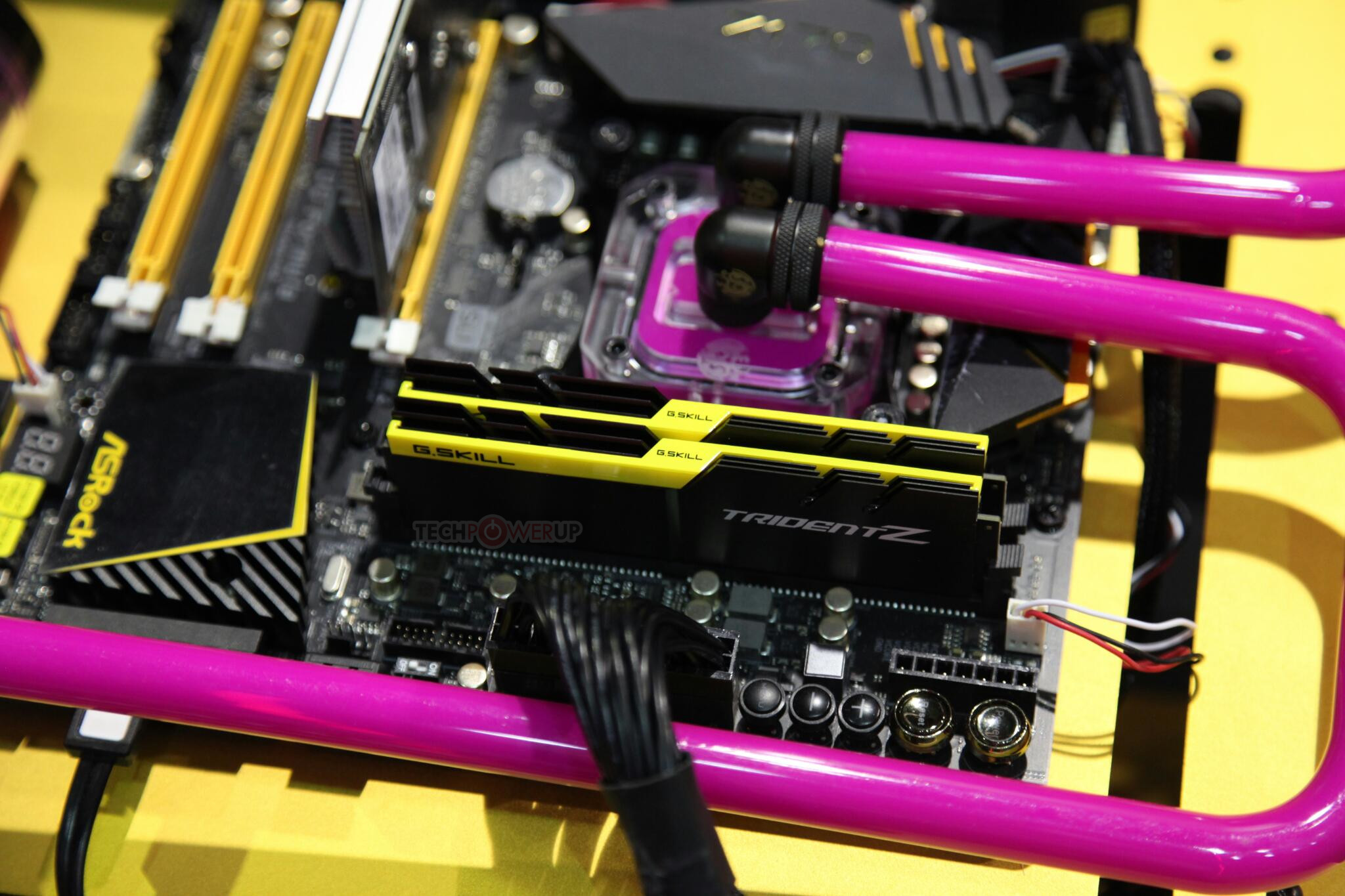
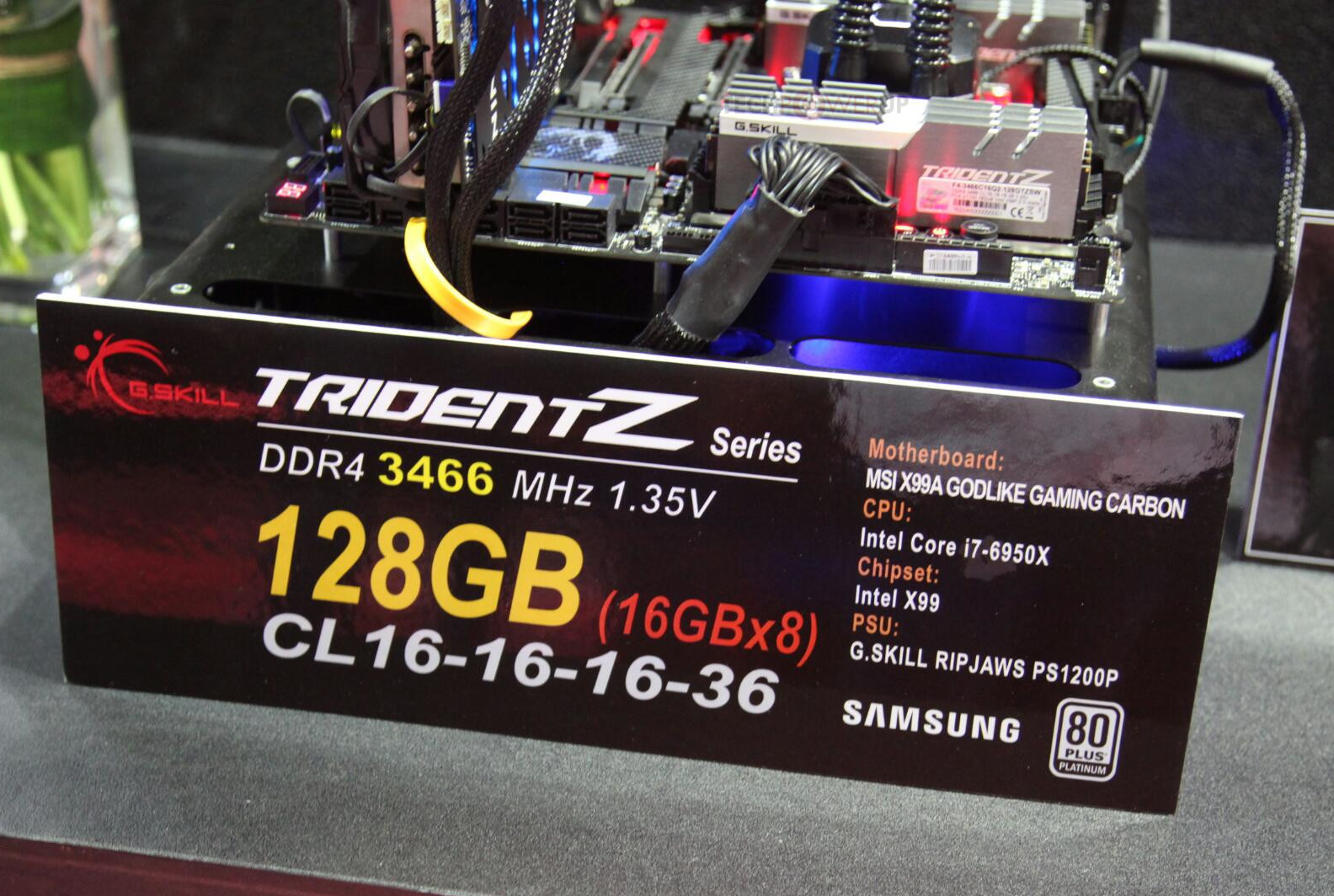
G.Skill Intros Trident Z DDR4-4500 Memory in 8GB and DDR4-3466 128GB Kit

G.Skill introduced one of the fastest 8 GB density memory modules, with the Trident Z DDR4-4500. Available in 16 GB kits of two 8 GB modules, this DIMM achieves its advertised speeds at timings of 16-16-16-36, although its voltage is still under the wraps. The company also showed off a gargantuan 128 GB quad-channel memory kit with eight 16 GB DDR4-3466 modules (one of the highest speeds for the 16 GB density). This kit too is timed at 16-16-16-36 to achieve its rated speeds.

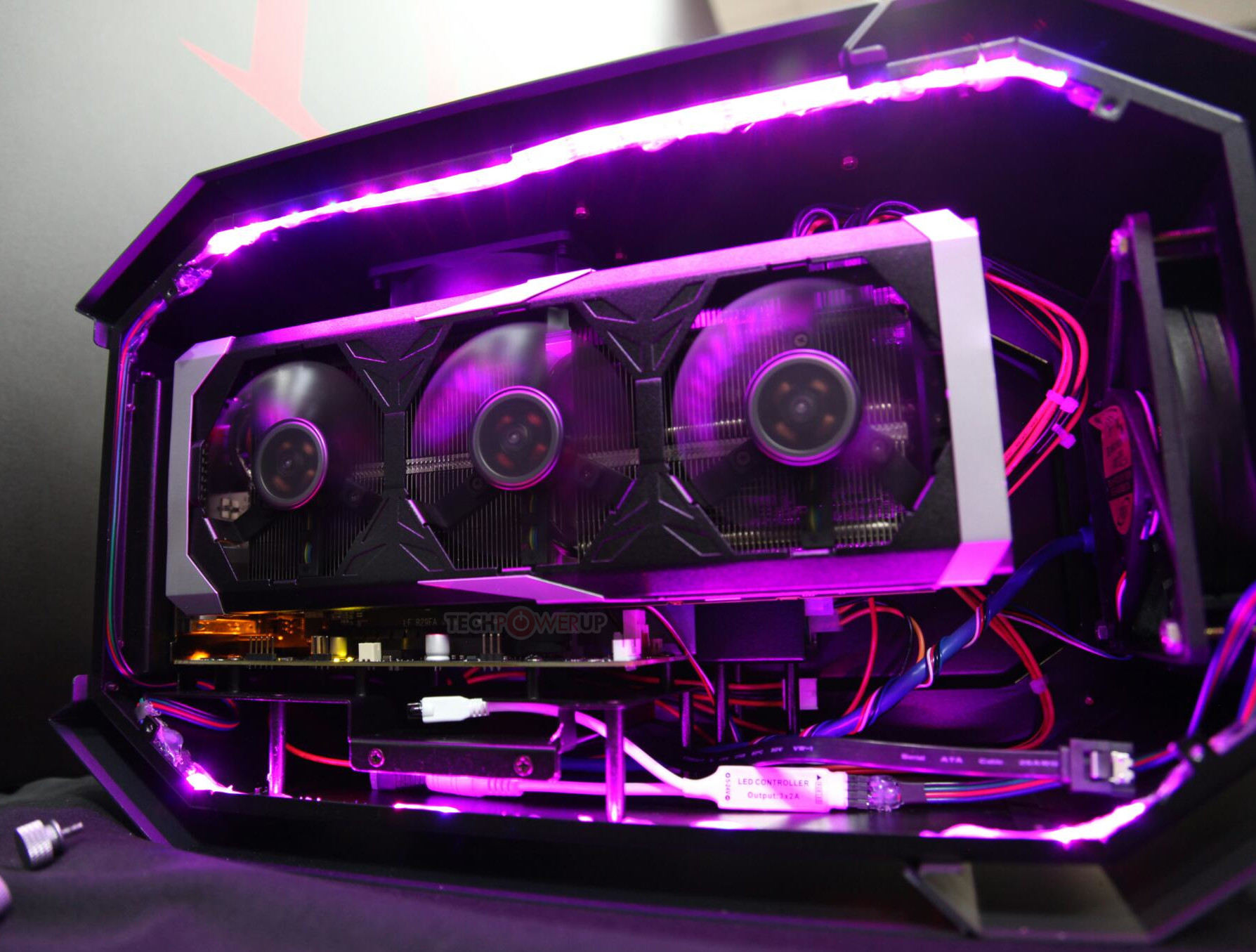
PowerColor DevilBox XConnect Enclosure Pictured

PowerColor showed off its external graphics enclosure for AMD Radeon graphics cards that take advantage of AMD XConnect technology, the DevilBox. This is more than a graphics enclosure. It plugs into the host machine over a 40 Gbps Thunderbolt 3 connection, and puts out not just a PCI-Express 3.0 x16 slot for a wide range of graphics cards, but also provides a SATA 6 Gb/s port for a 2.5-inch internal drive bay, two USB 3.1 ports (one each of type-A and type-C), four USB 3.0, and a wired gigabit Ethernet connection. Powering it all is an internal 500W power supply. You can drop in any high-end, air-cooled graphics card, including the Radeon R9 Fury, and the GeForce GTX TITAN X. Topping it all off is RGB internal lighting. Why not.

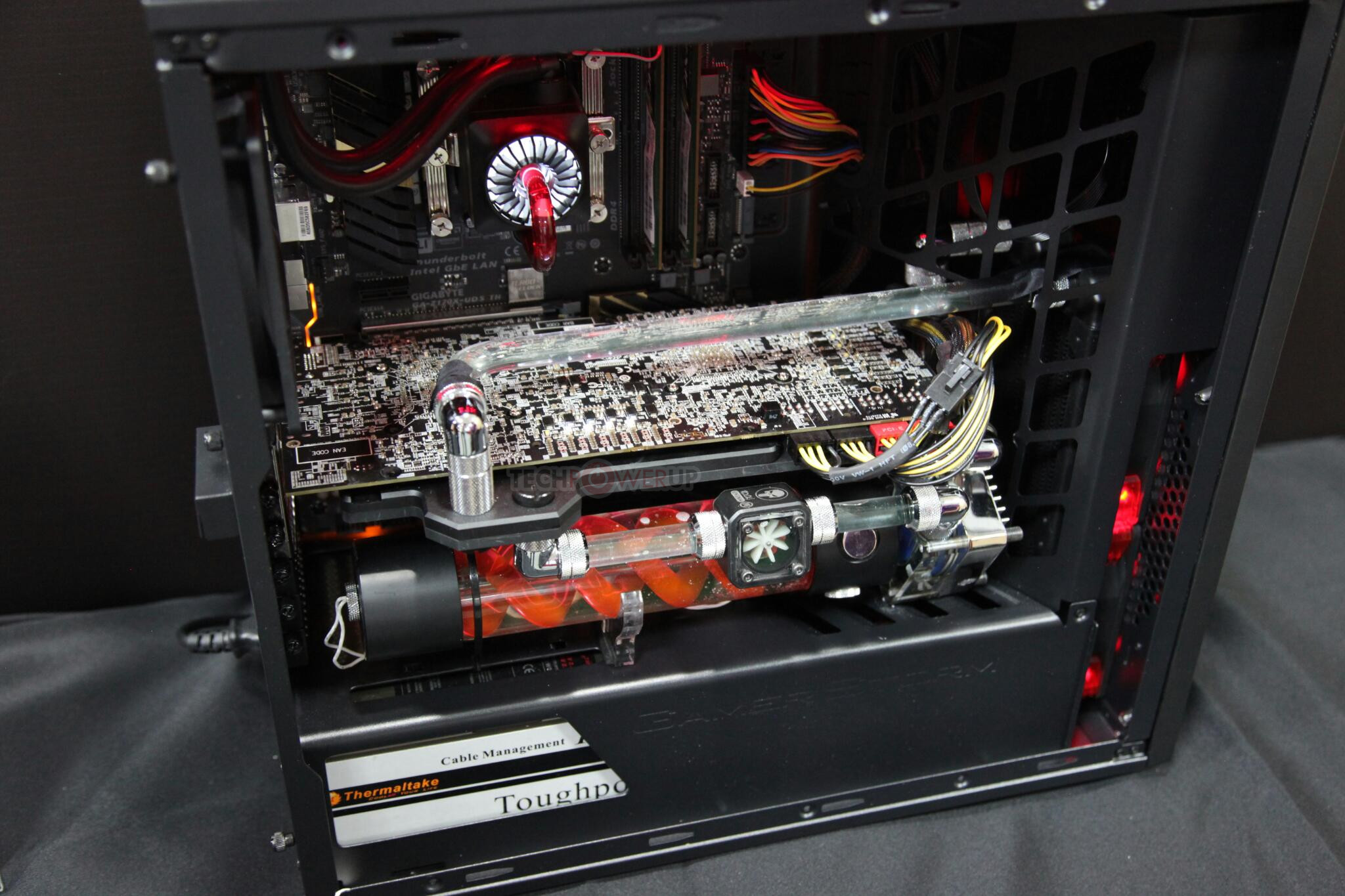
PowerColor Next-Gen LCS Liquid Cooling Solutions Pictured

PowerColor is ready with its next-generation LCS (liquid cooling system) VGA cooling solutions. The first one in the series is a close-loop all-in-one solution for single-GPU cards, which consists of a pump+block, plumbed to a 360 mm x 120 mm radiator (at least for this prototype). Much of the liquid cooling parts have "GamerStorm" design language, hinting at DeepCool being the OEM. This single-GPU cooler could be launched with upcoming "Polaris" graphics cards. Don't let the radiator size be any indication of the upcoming chip's thermal characteristics.

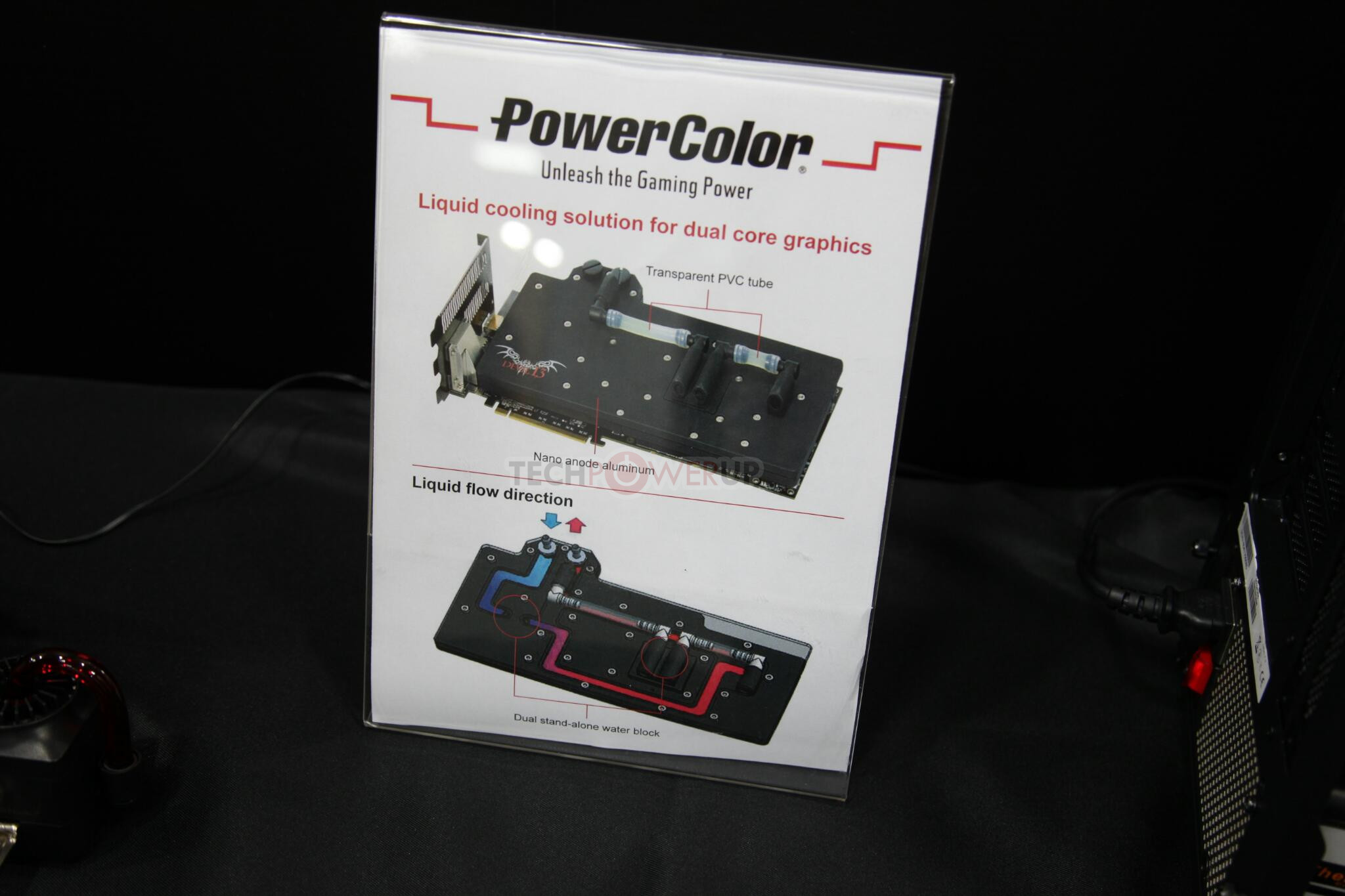
Also unveiled is a new full-coverage water block for dual-GPU graphics cards hinting at the possibility of a custom-design Radeon Pro Duo by PowerColor being under development. The block appears to be more than 1-slot thick, and uses the additional volume for two independent coolant channels, so one GPU doesn't get second-hand coolant from another GPU.

ZADAK511 Also Announces a Trio of SSDs

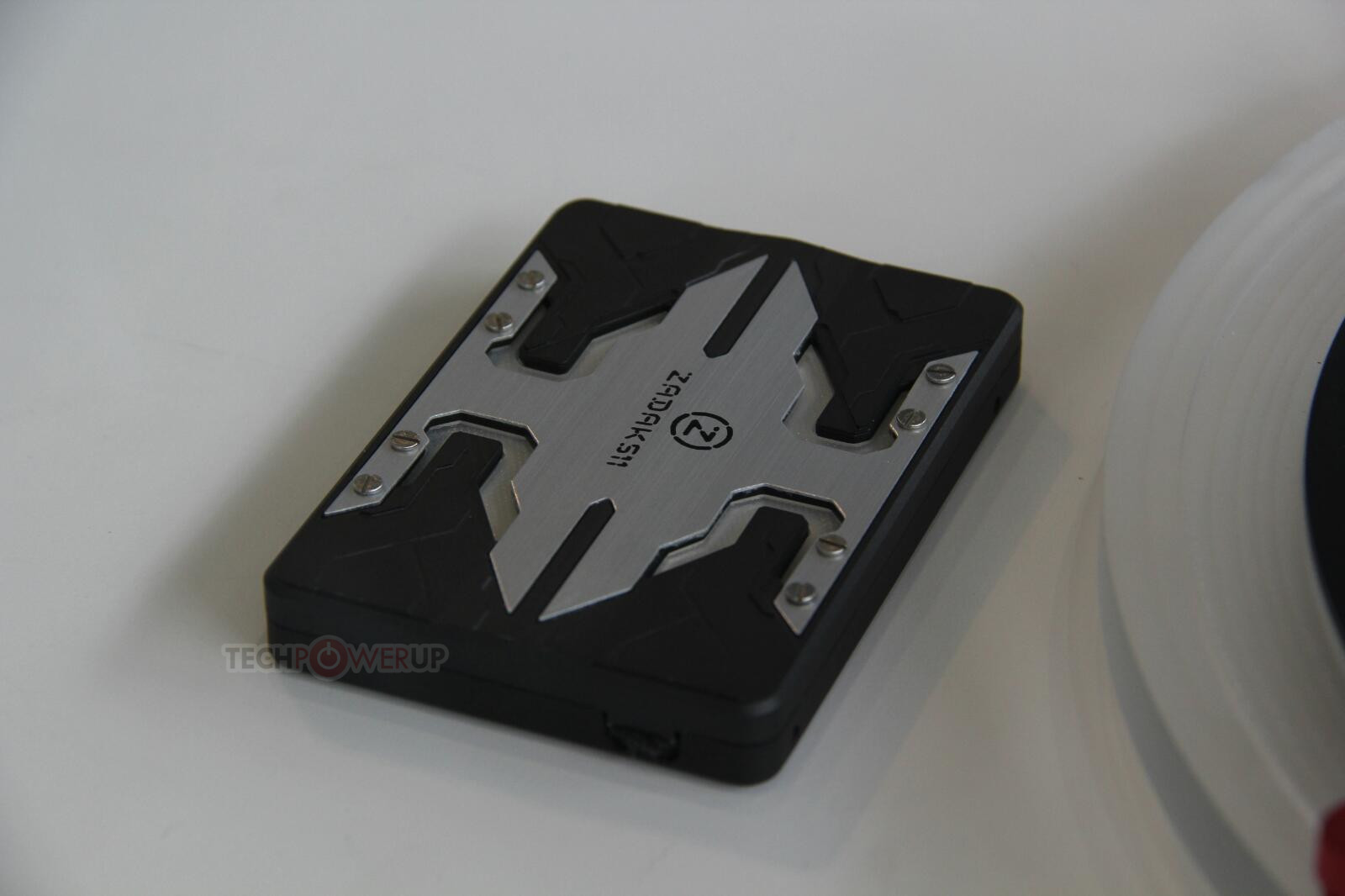
It's becoming clear that the running theme for Computex 2016 is "Must RGB Every Possible Thing!" Take ZADAK511 Shield RGB, for example. It's a solid-state drive with RGB LEDs embedded, which you can control by plugging it not just into your usual SATA interface, but also a USB 2.0 header on your motherboard. The 10 mm (12 mm?) thick drive is meant for open-air benches, or cases in which every component of your build is in plain sight - including the SSD. The design language from the Shield DDR4 memory carries over. For the more restrained enthusiasts who just want a 7 mm-thick drive, ZADAK511 has a more plain looking drive with a brushed aluminium finish.

ZADAK511 Unveils its First DDR4 Memory Kit

ZADAK511 is a new enthusiast hardware brand that's taking flight from Computex 2016. The company partnered with HWBot to launch a new memory overclocking challenge. At Computex, the company launched its first enthusiast memory kit, the ZADAK511 Shield DDR4-3000. You see a characteristic silver-on-black neo-Gothic stylic on all the company's products launched. The memory does DDR4-3000 at timings of 16-18-18-38, although its voltage is unknown. The company apparently also has a DDR4-4266 kit, which it's giving away in the HWBot contest. So far, we've only seen 4 GB densities on these modules.

Noctua Unveils Prototype Large Socket Heatsink for Xeon and Opteron Chips

Noctua unveiled a prototype fin-stack heatsink for very large CPU socket types, such as Intel Socket P (LGA3647) and AMD SP3, powering chips such as Intel Xeon Phi "Knights Landing," and upcoming AMD Opteron SP3 32-core SoCs. There will be 3U and 4U versions of this heatsink, supporting NF-A9 (92 mm) and NF-F12 (120 mm) fans. The heatsink is just a very large aluminium fin-stack, to which heat drawn from the base is fed by seven 8 mm thick nickel-plated copper heat pipes.

Noctua Readies AMD Socket AM4 Upgrade Kit

Noctua is among the first CPU cooler manufacturers to develop a retention kit for the upcoming AMD socket AM4. There are three versions of this, compatible with all existing Noctua coolers, except D0 series and NH-L9i series. This means that even 10-year old heatsinks from Noctua should be able to cool next-gen AMD chips. Noctua will be giving these away for free to all existing customers (proof of purchase required).
Monday, May 30th 2016

Today's Reviews

Cases
Cooling
CPU Coolers
Desktop PC
Graphics Cards
Headphones
Keyboards
Memory
Motherboards
Mouse
NAS
Networking
Notebooks
PSUs
SSD
Storage
G.Skill Ripjaws V 3200 MHz 32 GB (2x 16 GB) Review

G.Skill Ripjaws V 3200 MHz 32 GB (2x 16 GB) Review

With memory capacities soaring, G.Skill sent us a huge 32 GB kit out of their Ripjaws V line-up, ready to be mated with Intel's Skylake processors. This two-stick kit from G.Skill is not only huge in capacity at it is also very fast at 3200 MHz.

Noctua Adds a Splash of Color With the Chromax Heatsink Covers

Noctua is adding a splash of color with the unveiling of Project Chromax, a company initiative to develop products with color elements. The first of its kind is a line were colorful rubber spacers or their fans and now has been expanded to include heatsink covers. These devices strap onto your heatsink fin-stacks, and give the coolers your choice of three colors: red, yellow or white. Initially, Noctua will launch heatsink covers for the NH-D15S and the NH-U12S coolers.

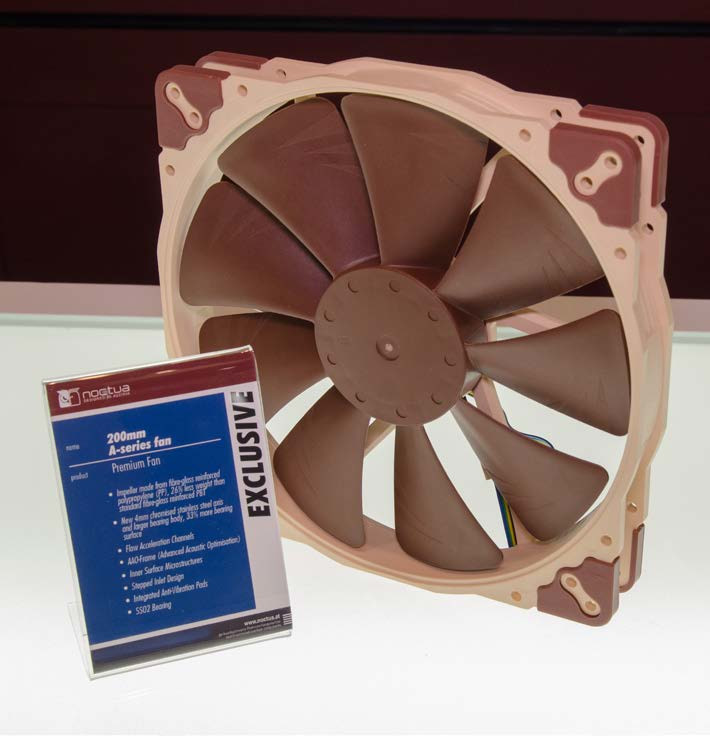
Noctua Shows Off New A-series 200 mm Fan

Noctua's fabled 200 mm A-series fan is closer to market availability, with the company greatly refining its design. In its latest prototype, the fan features a new fiberglass impeller. Fiberglass is chosen over ABS plastic as it is 26% lighter. A 200 mm ABS plastic impeller would need greater torque on the motor to get going at acceptable speeds. The motor features a larger 4 mm-dia chrome-steel axis (33% more bearing surface), and SSO2 ball bearing. Other features common along Noctua fan prototypes, such as acoustic optimization along the frame, a stepped inlet design, and vibration dampening pads are carried over.

Noctua Also Announced 15 mm Thick 80 mm, 70 mm, and 50 mm Fans

Noctua is extending the A-series 15 mm thick form-factor to several other sizes, including the popular 80 mm, 70 mm, 60 mm, and 50 mm. All four come with 20 mm thick frame adapter, should you run into trouble installing them. Much like the slim A-series 120 mm fan, these fans feature acoustic-optimized frames, double ball-bearing motors, 5V and 12V inputs (including PWM controls), and frosted translucent frames and impellers.

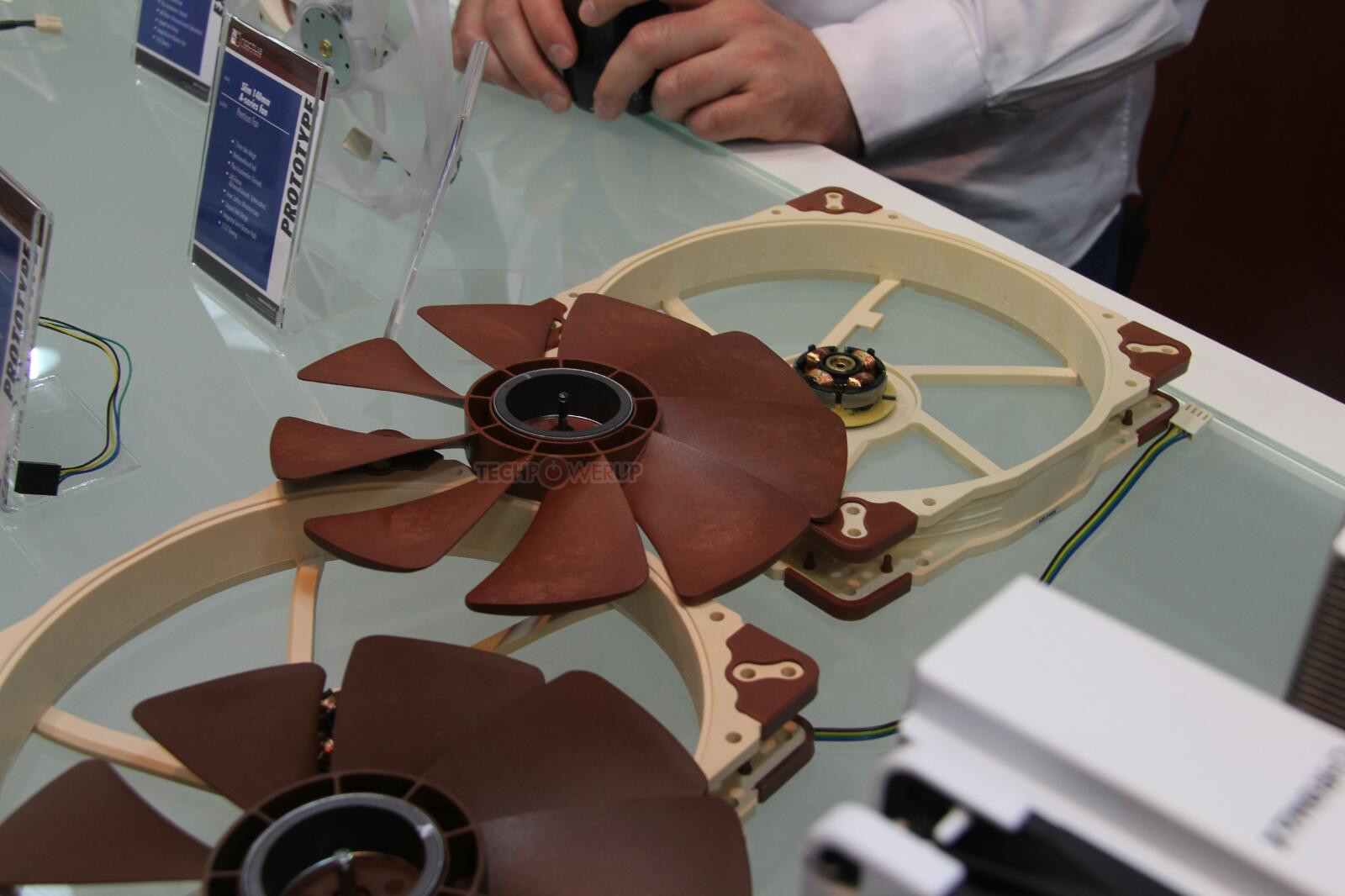
Noctua Unveils a Prototype 120 mm Slim Fan

Noctua unveiled a prototype slim 120 mm fan. The fan is just 15 mm thick (25 mm is the most common thickness for 120 mm fans). The fan features a metal reinforced hub, to make sure the hub and its four support structures don't disfigure over time. The motor features double ball bearing. The frame features a design that minimizes noise from the whiplash of the impeller. The frame further features rubber padding along the mount holes, to dampen vibration. Noctua did not put out fan-speed and air-flow numbers for this fan.

Cougar Unveils the Revenger and 550M RGB Gaming Mice

Cougar also brought two new gaming mice to Computex, with its flagship Revenger, and the new 550M RGB. The Revenger packs a 12,000 dpi sensor, a programmable trigger button next to six other programmable buttons, 1000 Hz polling rate, 1 ms response time, 512 KB onboard memory to store button maps, and two independent RGB lighting zones (one over the company logo, and another near the buttons). The 550M RGB, on the other hand, is a variant of the 550M, featuring the same 2-zone RGB LED system, while the rest of its feature-set is identical to the original 550M.

Cougar Also Unveils the Ultimus and Attack X3 RGB Keyboards

Cougar brought two new mechanical gaming keyboards to the Computex floor, the Ultimus and Attack X3 RGB. The Ultimus features a simple and elegant design with an aluminium face-plate, a simple 104-key layout with Function key enabling various system macros, full N-key rollover in USB mode, and RGB LED lighting along its Cherry MX mechanical switches. The more familiar looking Attack X3 RGB is just a variant of the Attack X3, featuring RGB LED back-lighting the the keys. Not much else has changed from the original.

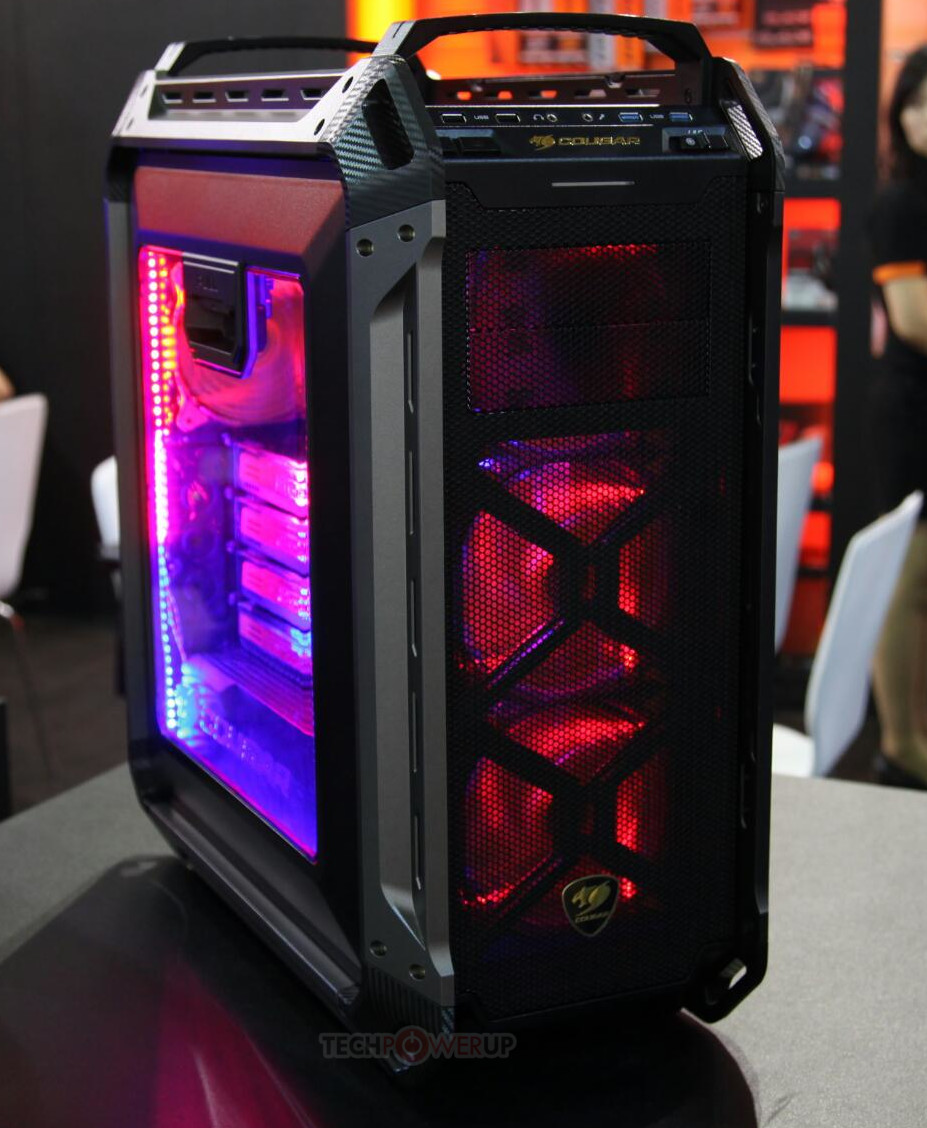
Cougar Panzer Series VR-Ready Cases Pictured

So "VR-Ready case" is apparently a thing. We immediately started looking for front-facing HDMI ports, but couldn't find any. Still, the Panzer MAX from Cougar is an impressive ATX full-tower, measuring 226 mm x 612 mm x 556 mm (WxHxD), with room for E-ATX and SSI-EEB motherboards, up to four 39 cm long graphics cards, four radiator bays, including 360 x 120 mm slots on the front and top panels; and front-panel fan controls. The case can hold up to six 2.5-inch SSDs or four 2.5-inchers + two 3.5-inch ones.

Also shown was its slightly smaller sibling, the Cougar Panzer. This ATX mid-tower seats conventional motherboard sizes, and measures 208 mm x 565 mm x 520 mm (WxHxD), with room for three 42.5 cm long graphics cards. Interestingly, it supports the same number of fans and radiators as the larger Panzer MAX.

ADATA XPG Z1 DDR4-4400 Memory Pictured

ADATA is ready with its flagship XPG Z1 memory module that belts out DDR4-4400 speeds. The modules achieve DDR4-4400 at timings of 17-19-19-39, although its DRAM voltage is not known. The module was demonstrated running at its marketed speeds. It's also interesting to note that the module doesn't use heatsinks or elaborate cooling to run at these speeds, and makes to with a rather thin heatspreader.

ADATA Also Unveils SR1030 Enterprise MLC SSD

ADATA also unveiled its SR1030 SSD targeted at workstation/enterprise builds. The drive ticks on a Seagate (ex-SandForce) SF-3514 processor, wired to 3D MLC NAND flash, and comes in capacities ranging between 128 GB to 1 TB, with sequential read/write performance rated at up to 560 MB/s reads, with up to 530 MB/s writes. You get a lot of SandForce-made features such as DuraWrite (garbage collection enhancement), Shield and RAISE (protection).

ADATA Launches Maxiotek Controller-based SU700 Value SSD

ADATA is a launch partner for Maxiotek MK8115 processor, a new entrant to the consumer SSD scene, with the new SU700 series. These drives will be ADATA's most affordable, and targeted at buyers upgrading from hard drives. The MK8115 is mated to synchronous Micron-made DRAM-less 3D TLC NAND flash memory, in capacities ranging up to 1 TB. ADATA put out CDM performance numbers for the drive, which clocks in at 554 MB/s sequential reads, and 529 MB/s sequential writes.

ADATA SX8000NP M.2 PCIe NVMe SSD Pictured

ADATA showed off its flagship M.2 PCIe SSD lineup, the SX8000NP. These drives will target a price-performance sweetspot between the fastest SATA drives, and the enthusiast M.2 ones. They're driven by a Silicon Motion SMI2260H processor, wired to 3D (stacked) MLC NAND flash memory. This drive takes advantage of PCI-Express 3.0 x4, and the new NVMe protocol, to serve up sequential transfer rates of up to 2,000 MB/s reads, with up to 800 MB/s writes. ADATA put up its own CDM performance numbers for a 480 GB variant of this drive.

Supermicro Also Unveils the C7X99-OCE Motherboard

In addition to the CZ170-OCE, Supermicro also unveiled the C7X99-OCE. This socket LGA2011v3 motherboard appears to be derived from one of its workstation boards. You can tell from the blank traces over where a remote management chip would normally rest. All that's changed is the PCB color (to black), the slots (blue+black), and more sporty looking heatsinks over the CPU VRM and the X99 PCH. The board covers all the basics of this platform, but gives you a pair of Intel-driven gigabit Ethernet connections, onboard OC fine-tuning buttons, and ten SATA 6 Gb/s ports. Missing in action is M.2 slots. We have no way of telling if Supermicro tucked away M.2 slots at the reverse side of the PCB.

Supermicro Unveils First LGA1151 Motherboard with PCIe Bridge Chip

Supermicro launched the first socket LGA1151 motherboard featuring a PCIe bridge chip that expands the board's lane budget, something that not even the $600 ASUS Maximus VIII Extreme features. The new CZ170-OCE from the traditionally server/workstation motherboard maker is based on Intel Z170 Express chipset, and features a PCI-Express gen 3.0 x48 bridge chip (likely the PLX PEX-8747), which takes the PCI-Express 3.0 x16 PEG port from the CPU, and puts out 32 lanes, which are wired to the board's three PCIe 3.0 x16 slots.

The topmost slot runs at x16 full-time, while the middle and bottom slots are x8/x8 when both are populated (x16/NC/x16 or x16/x8/x8). The designers lavishly spent its remaining lane budget on two PCI-Express 3.0 x4 slots, and a 32 Gb/s M.2-22110 slot. Besides the 32 Gb/s M.2 slot, storage connectivity includes six SATA 6 Gb/s ports. Other modern connectivity includes two USB 3.1 ports (one each of type-A and type-C), two gigabit Ethernet connections (one driven by Intel I219V and another by Intel I210-AT), HD audio, and four other USB 3.0 ports.

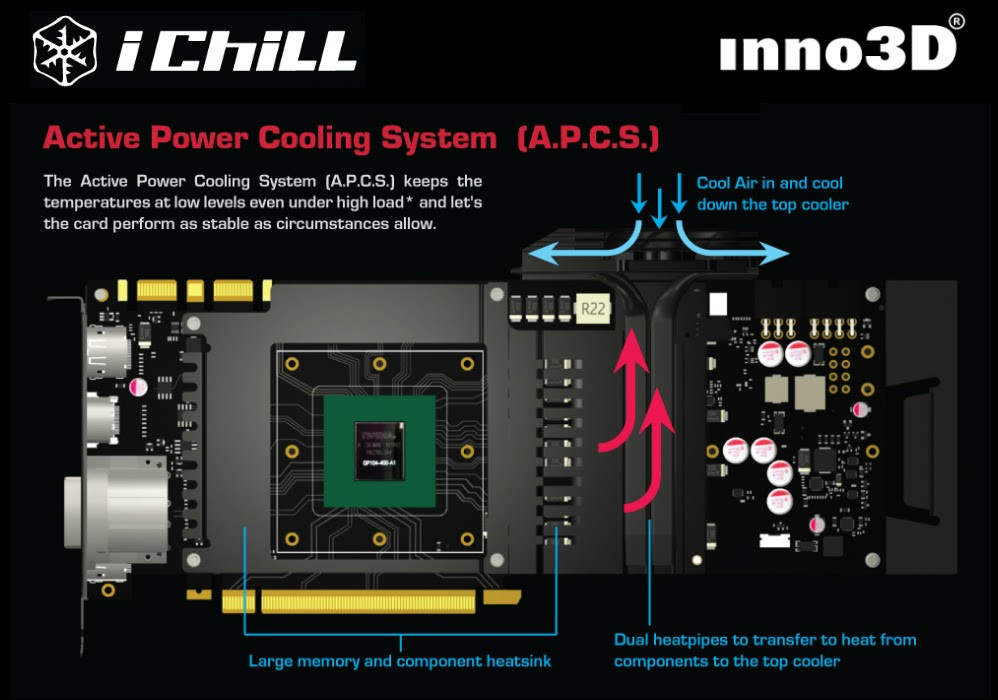
Inno3D Unveils GeForce GTX 1070 iChill X3

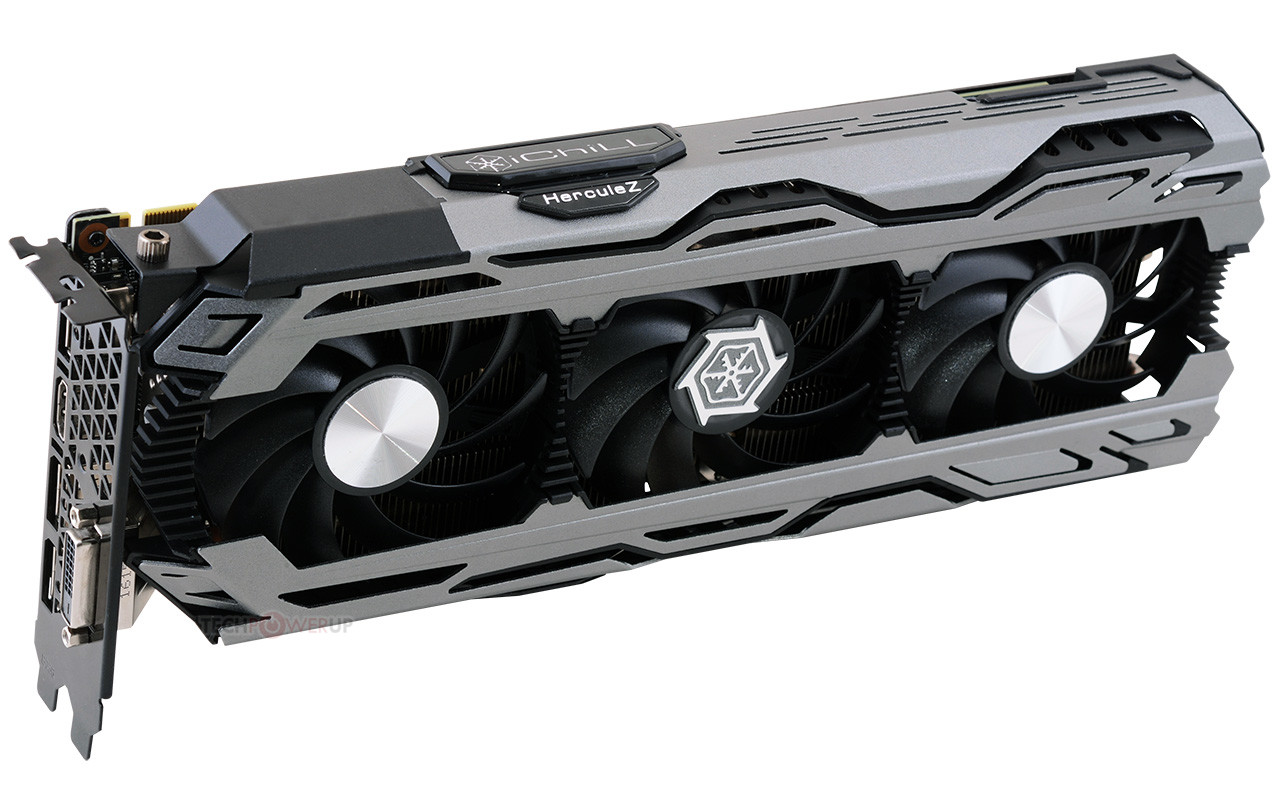
Inno3D also unveiled its fastest GeForce GTX 1070 graphics card, the GTX 1070 iChill X3. This card is based on a custom-design PCB by Inno3D, which draws power from a combination of 6-pin and 8-pin PCIe power connectors, featuring a strong VRM to support the card's high factory overclock. It features the same triple-fan >2-slot cooling solution as the one featured on the GTX 1080 iChill X3. It features an easy to open cooler shroud, which lets you clean the fans and heatsink from time to time. The card's clock speeds are unknown at this point. The card could go on sale later in June.

Inno3D Liquid-cooled GeForce GTX 1080 iChill Black Pictured, Too

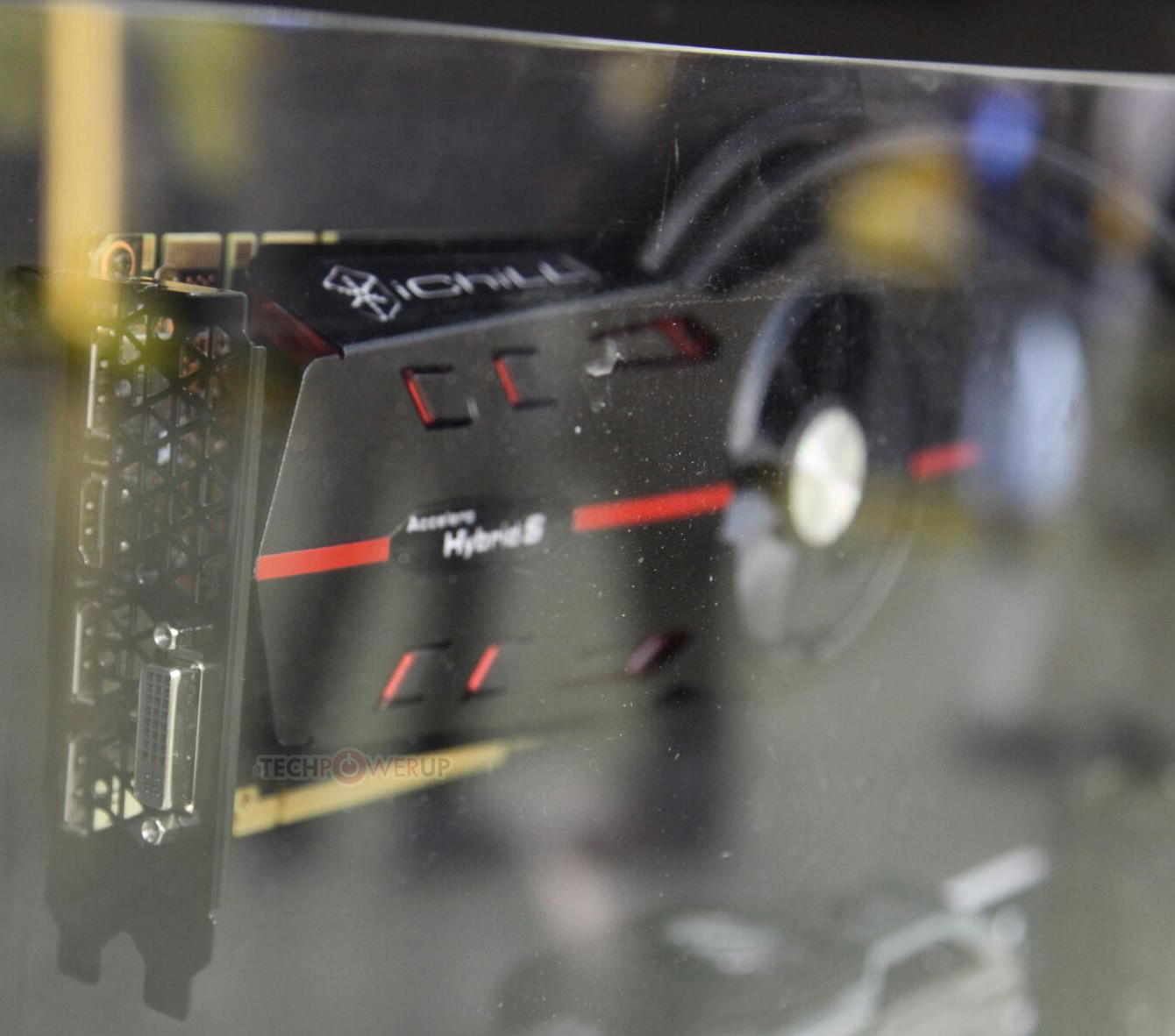
Here's the first picture of Inno3D's flagship GeForce GTX 1080 graphics card, the GTX 1080 iChill Black. Based on the reference NVIDIA PCB, the card features a liquid+air hybrid cooling solution by Arctic, the Arctic Accelero Hybrid S. It relies on a factory-fitted, closed-loop AIO block with a 120 mm x 120 mm radiator, to cool the 180W TDP GPU, while using heatsinks and a single 70 mm blower to cool the VRM and memory chips. In all likelihood, this product could be positioned above the GTX 1080 iChill X4.

Inno3D GeForce GTX 1070 Gaming OC Pictured

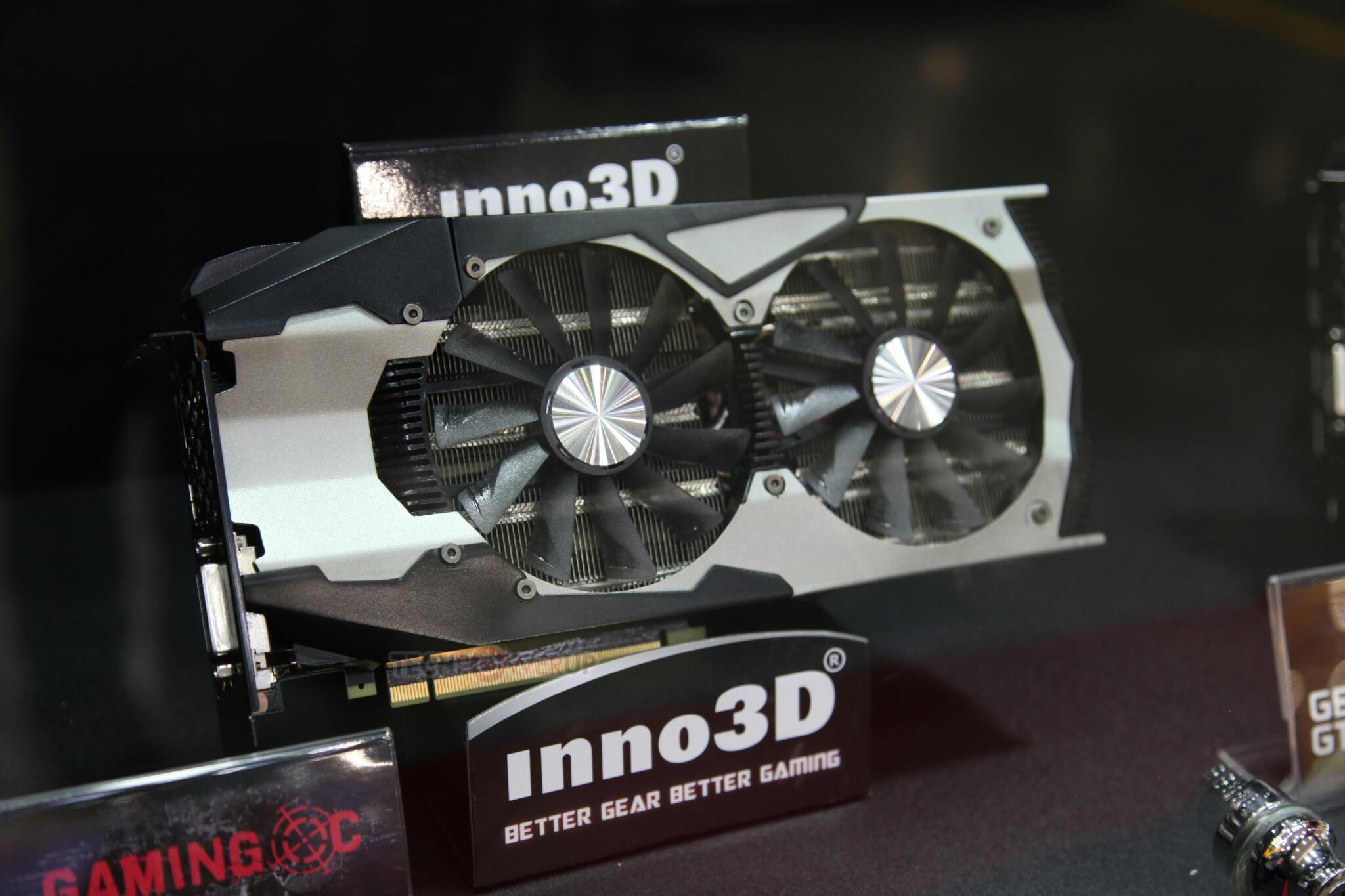
Here are some of the first pictures of Inno3D GeForce GTX 1070 Gaming OC. The card appears to be based on NVIDIA reference PCB, combining it with a simple yet elegant 2-slot, dual-fan cooling solution. The card draws power from a single 8-pin PCIe power connector, and ships with factory overclocked speeds. We expect it to be priced between the $379 baseline for the SKU and the $449 Founders Edition price, making for a smarter purchase.

AZiO Also Announces the MGK L80 RGB Keyboard

In addition to the MGK Alpha, AZiO also unveiled its flagship keyboard, the MGK L80 RGB. This mechanical keyboard features RGB LED multi-color lighting for its keys and aesthetic bits, with six lighting modes that can be set directly on the keyboard, without needing software. You also get four macro keys that are directly programmable on the keyboard. Also featured is a magnetic detachable palm-rest, and a volume control knob. The MGK L80 RGB goes on sale later this month.

AZiO Also Announces the EXO Alpha Gaming Mouse

AZiO Also announced the EXO Alpha line of gaming mice featuring a metal-frame design, with a brushed aluminium floating palm-rest that comes in three colors - red, blue, and gunmetal, and light from an RGB LED coming out from the edges of the floating rest. Under the hood is a 9,800 dpi optical sensor with 5 adjustable settings, six programmable buttons, and a management software that stores your settings on the cloud.

AZiO Unveils the MGK Alpha Mechanical Gaming Keyboard

AZiO unveiled the MGK Alpha, a high-end backlit mechanical keyboard. Away from the RGB madness, the MGK Alpha features elegant white LED back-lighting, a magnetic detachable palm-rest, a volume-control scrollwheel, an anodized-aluminium faceplate with brushed finish; and an anodized side-mesh. You get five programmable macro keys, and you can use the Function key to set even more macros using the included software. The keyboard allows hot-switching between three profiles programmed directly into it.

Klevv Announces the Fit 4 DDR4 Module

Klevv announced its new entry-level DDR4 memory module, the Fit 4. The module features an identical heatspreader design to the original Fit (DDR3) series, and features a black full-height PCB. The Fit 4 series is likely to include various sub-3000 MHz DDR speeds, densities of 4 GB, 8 GB, and 16 GB; making up dual-channel kits of 8 GB, 16 GB, and 32 GB, respectively. These could also be among the most affordable DDR4 memory you can get from this brand.

Phanteks Also Launches Tempered Glass Editions of Enthoo Evolv ATX and Pro M

Phanteks also launched Tempered Glass Edition variants of two of its most popular cases, the Enthoo Evolv ATX, and the Enthoo Pro M. Both cases feature slightly tinted tempered glass side-panels, which cover almost the entire area of the sides. The Enthoo Evolv ATX Tempered Glass Edition, in addition, features RGB LED strips that line the edges of these panels. These LED strips comply with ASUS Aura RGB specification, letting you control them with ASUS Aura software. The rest of their feature-sets are consistent with their original cases.

Phanteks Unveils Enthoo Elite Flagship Chassis

Phanteks unveiled its new flagship chassis, the Enthoo Elite. This garrgantuan full-tower is made of 4 mm-thick sandblasted aluminium sheet-metal, and slightly tinted tempered glass. It has room for large motherboard form-factors, such as HPTX, SSI-EEB, micro-ATX, and mini-ITX. If you use a micro-ATX motherboard, a portion of the motherboard tray and rear I/O can be tilted parallel to the plane of the base (perpendicular to the plane of the side panel, to make it a dual-system chassis, with the remaining slots and tray portion holding a mini-ITX system.

The Enthoo Elite serves up vast amounts of room for liquid cooling gear, including a 560 mm x 140 mm front radiator slot (which also holds a 480 mm x 120 mm radiator); and 420 mm x 140 mm / 480 mm x 120 mm radiator baysalong the top, mid-section, and the bottom panels (four radiators in all!). The case offers a total of 10+2 expansion slots; 13x 3.5-inch drive bays, and 7x 2.5-inch bays. To top it all off, you get an RGB LED lighting system that meets ASUS Aura specifications.

Phanteks Intros the Enthoo Luxe Tempered Glass Edition

Phanteks unveiled the Enthoo Luxe Tempered Glass Edition. The premium ATX mid-tower case is rooted firmly in the RGB LED generation, with multi-color LED strips lining the inner- and outer-edges of its panels. It gets its name from the tempered glass side panels, which cover nearly the entire area of the sides. The rest of its feature-set appears to be consistent with the original Enthoo Luxe.

MSI Grades its Gaming Series Graphics Card Lineup

With the GeForce 10 Series, MSI is beginning to sub-brand its Gaming series graphics cards, so it could offer them at multiple price-points. The company launched its GTX 1080 lineup with the GTX 1080 Gaming X. The "X" here denotes a middle-grade (for features and clock speeds). A notch above this, is the GTX 1080 Gaming Z (yet to be launched, comes with the most features and highest clock speeds). There will be a third brand-extension, which will succeed the "LE" extension from previous generations. It could very well just be "Gaming" (no letters next to it). These cards look custom-design, but feature reference or close to reference clock speeds. Below are the pictures of the MSI GeForce GTX 1080 Gaming Z (not yet launched), and the GeForce GTX 1070 Gaming X.

MSI Makes a Big Push into Gaming Peripherals

MSI is making a big push into the gaming peripherals market, under its MSI Gaming banner. The company dabbled with gaming peripherals for a couple of years now, but didn't manage to make a mark. That's until now. The company appears to have big marketing plans for its new lines of gaming headsets, keyboards, and mice. Below are some of the first pictures of a pair of new gaming mice, an aluminium mousepad, a mechanical keyboard, and two new headsets.

Phanteks Makes its Foray into DIY Liquid Cooling

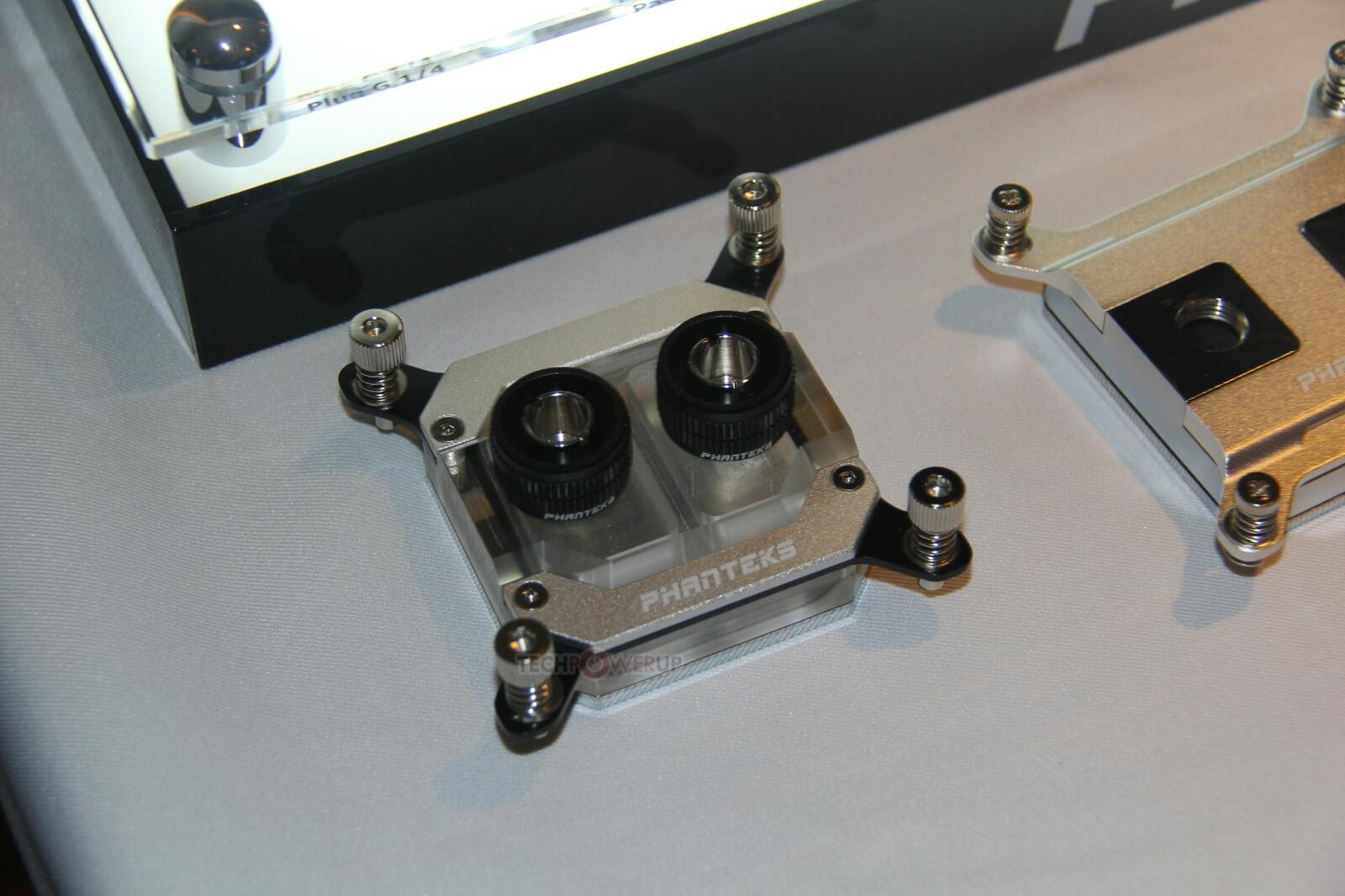
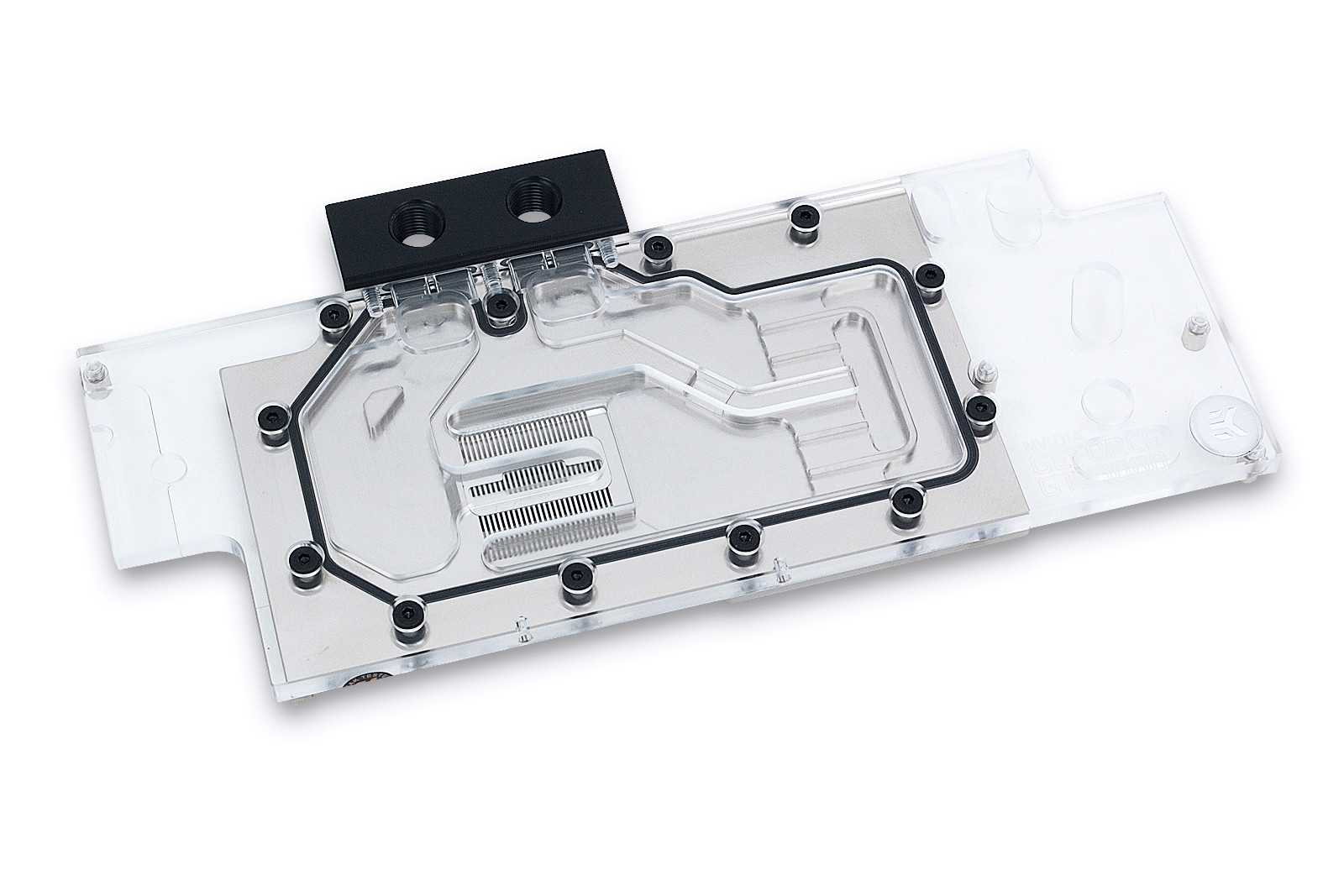
Phanteks made its major foray into DIY liquid cooling, with the launch of two new CPU blocks, a new full-coverage VGA block for the GeForce GTX 1080, and a variety of fittings. To begin with, the company showed off two new untitled CPU water blocks, one features a bulged out frosty acrylic top, and the other a flat top with POM acetal inserts near the fittings area. Speaking of which, the company launched a boat-load of plugs, extenders, and compression fittings to go with these blocks. Lastly, the company launched its first full-coverage VGA block, with one designed for the GTX 1080.

Klevv Urbane U610 SSD Pictured

Here's the first picture of an Urbane 610 SSD by Klevv, in the flesh. The performance-segment SSD is built in the 2.5-inch form-factor, with SATA 6 Gb/s interface, and serves up 560 MB/s of sequential reads, with up to 530 MB/s sequential writes (480 GB and 960 GB variants) or up to 360 MB/s writes (240 GB variant). It combines Toshiba 15 nm MLC NAND flash memory, with Phison PS3110-S10 controllers.

AeroCool Dreambox Chassis Pictured

Here's the first look at Dreambox, AeroCool's Computex Design Award winning chassis. The case is a bunch of pipes and rods that you use to put together a cubical or tower-type case of your own design, and then add from the various pieces of included tempered glass panels. It should be particularly useful for case-modders who wish their case was shaped in a certain way. Here's an example build of the Dreambox.

Lian Li PC-J60WRX Case Pictured

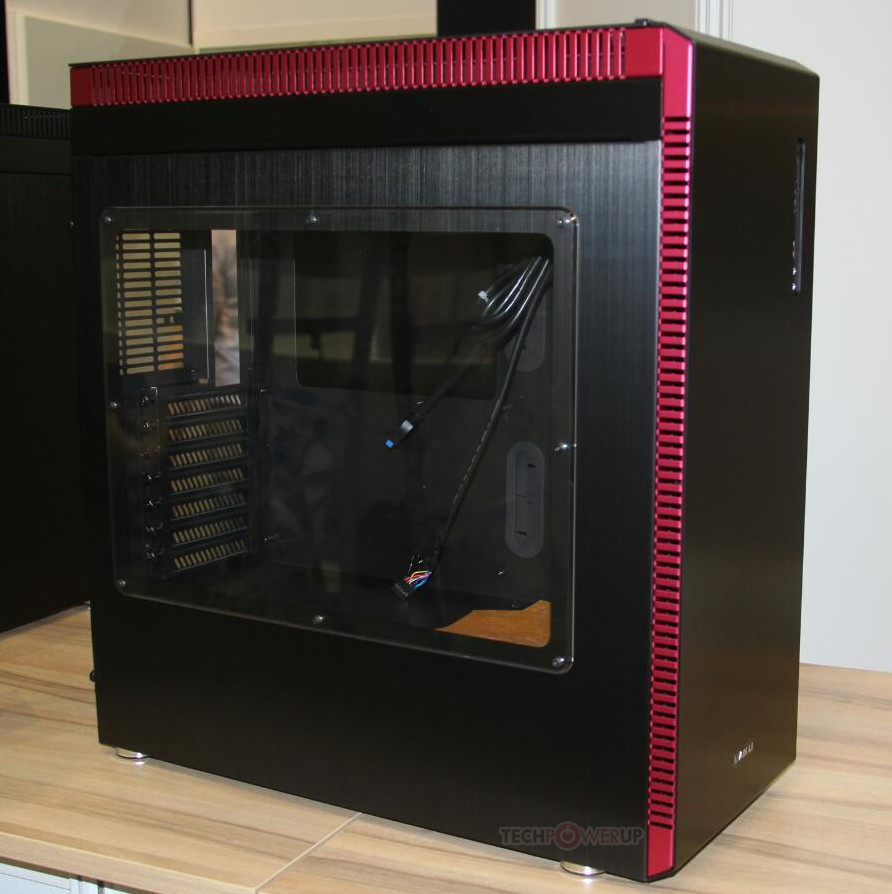
Here are some of the first pictures of the PC-J60WRX, the company's new ATX mid-tower case for the season. The case is characterized by black brushed-aluminium panels with red accents. This case too is firmly rooted in the post-5.25" era, with the forward portion having room for a radiator, and the top having a radiator bay that stretches all the way to the front. This gives you room for a 240 mm x 120 mm radiator up front, a 360 mm x 120 mm radiator on the top, and the usual 120 mm rear exhaust. The case's storage areas are lined along the bottom, with five 3.5-inch bays, and one 2.5-incher. The case measures 210 mm x 507 mm x 489 mm (WxHxD).

MSI Gaming Custom-design SLI HB Bridge Pictured

Here some of the first pictures of an NVIDIA add-in card (AIC) partner branded SLI-HB (high-bandwidth) bridge. This kind of bridge is recommended for use with GeForce "Pascal" graphics cards, at high resolutions, such as 4K @ 60 Hz with HDR, 4K @ 120 Hz, 5K, and above. Pictured here is a 2-way SLI HB bridge with 2U spacing (1-slot gap between the two cards). The bridge appears to have a red LED of its own, lighting up the MSI Gaming dragon logo. At this point it's not clear whether the bridge comes included with the cards, or if it needs to be purchased separately. The cards being bridged in these pictures are the MSI GeForce GTX 1080 Gaming Z, a notch above the GTX 1080 Gaming X the company debuted its custom GTX 1080 lineup with.

Be Quiet! Silent Loop AIO Liquid CPU Coolers Pictured

Here are some of the first pictures of the upcoming Be Quiet! Silent Loop series all-in-one liquid CPU coolers. These coolers come in sizes of 280 mm x 140 mm, 240 mm x 120 mm and 120 mm x 120 mm; and are characterized by pump+block fittings that don't move around a pivot, and come out from the top of the block. This approach clears up a lot of space around the CPU socket. This may also hint at the cooler's possible non-Asetek origins. You also get fill-ports along the pump-block and the reservoir attached to the radiator. Be Quiet! is bundling PureWings 2 PWM fans. The coolers will be backed by 3-year warranties.

ID-Cooling Enthusiast Case with Monitor Stand Spied

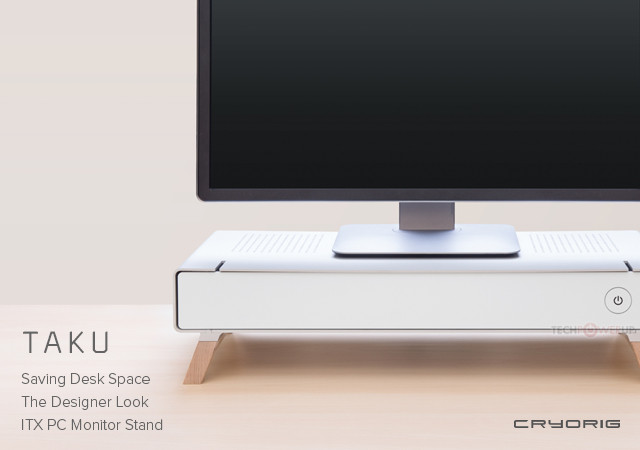
ID-Cooling is ready with a new enthusiast grade rail-type case, which doubles up as a VESA-mount monitor stand, so you could pack a real wallop behind your >27-inch display. The rail-type case features a 3-dimensional T-shaped frame, with an L-shaped frame tapering to the back. The cage has room for a mini-ITX motherboard, but with enough clearance for a long, 2-slot high-end graphics card. You also get room for a fairly big high-Wattage PSU, and enough clearance for a DIY liquid-cooling loop (including a reservoir, a 240 mm x 120 mm radiator), and the works. A tinted tempered-glass panel tops off the case from the rear. A small cutout lets you manage your cable spaghetti and route cables to your monitor.

OCZ Shows Off VT180 and TR150 2.5-inch SATA SSDs

OCZ is refining its popular consumer SSD brands to reach out to more buyers. As part of the integration with Toshiba, they rebranded their consumer SSD lines, to VT180, and the TR150, which more closely aligns with Toshiba's SSD model naming. Besides the naming, both drives are identical to the Vector 180 and Trion 150. The VT180 comes in capacities ranging from 120 GB to 960 GB, and is powered by Toshiba-made MLC NAND flash. These drives offer sequential transfer rates of up to 550 MB/s reads, with up to 530 MB/s writes, and 96,000 IOPS 4K random reads, with 90,000 IOPS 4K random writes. The TR150, on the other hand, runs TLC NAND flash memory, and although its maximum sequential speeds are rated the same as the VT180 series, their 4K random access numbers are different - 87,000 IOPS reads, and 83,000 IOPS writes.

MSI Shows Off Gaming Carbon Themed CPU Air Cooler

Want to take your MSI Gaming purism to the next level? Check out this MSI Gaming-branded CPU air cooler we found at Computex. This unnamed cooler features an aluminium fin-stack tower-type heatsink, ventilated by a pair of 120 mm spinners in push-pull configuration. The fans are 4-pin PWM ready, and the cooler itself embeds an RGB multi-color LED illuminating the MSI Gaming "dragon" logo with a faux carbon fiber background sticker. MSI is demoing this cooler on a socket LGA2011v3 motherboard, so that should tell you that this cooler has the chops to tame 140W Core i7 HEDT CPUs.

MSI X99A XPower Gaming Titanium Motherboard Pictured

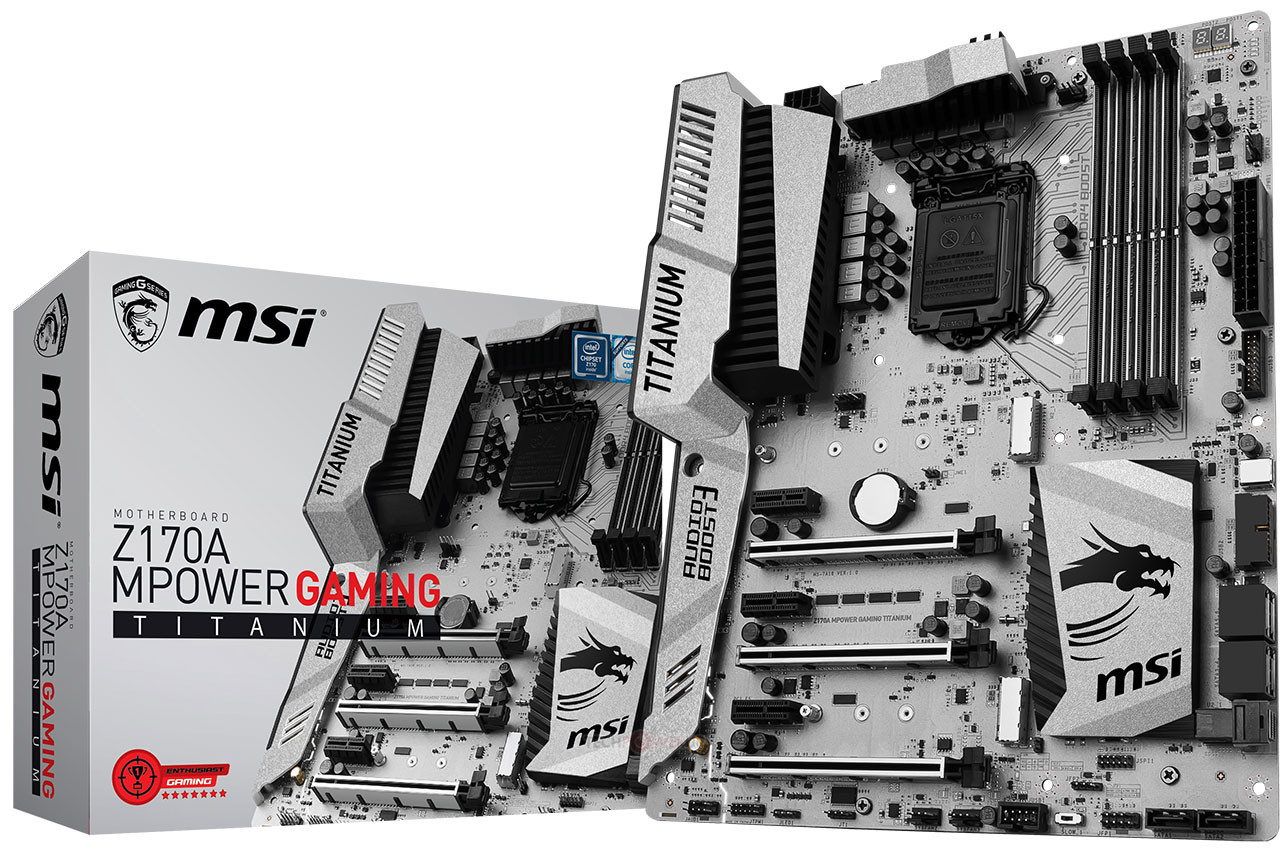
Here's the first picture of MSI's next premium socket LGA2011v3 motherboard targeted at overclockers, the X99A XPower Gaming Titanium. Likely positioned a notch below the X99A GODLIKE Gaming Carbon, and a successor to the X99A XPower AC, this board features MSI's signature metallic silver PCB, mated with silvery heatsinks denoting "Titanium." This scheme caught up with the company's recent Z170A XPower and Z170A MPower Gaming Titanium boards. The board is packed to the brim with the company's latest motherboard innovations, such as reinforcement braces along the eight DDR4 DIMM slots, five PCI-Express 3.0 x16 slots (which are ready for 4-way multi-GPU solutions), and a host of modern connectivity options, such as 32 Gb/s U.2, USB 3.1 (including type-A and type-C ports), and a 32 Gb/s M.2-22110 slot with NVMe boot support. The board comes with out-of-the-box support for Core i7 "Broadwell-E" processors.

MSI 970A Gaming Pro Carbon Motherboard Pictured

MSI's drive to "carbonate" its Gaming Pro motherboard lineup is extending to the AMD platform, with the 970A Gaming Pro Carbon. Designed with the latest features available to this platform, this board resembles the 970A Gaming Pro, with the notable exception of faux carbon fiber patterns on the metal stickers heading the chipset and VRM heatsinks. You get quite a few modern features on this AMD 970+SB950 chipset based motherboard, such as dual-channel DDR3-2133 support out of the box, 20 Gb/s M.2 with NVMe support, two USB 3.1 ports (one each of type-A and type-C), and Intel gigabit Ethernet.

MSI Teases its First Intel 200-series Chipset Motherboard

This could very well be the first picture of a socket LGA1151 motherboard based on Intel's upcoming 200-series chipset, which succeeds the 100-series. Named the Z2T0-Anniversary (is that a typo for Z270-Anniversary?), the board is likely based on the chipset that succeeds the Z170-Express (Z270-Express?), and will be timed with Intel's launch of the 7th generation Core "Kaby Lake" processors. MSI did not finalize the board's aesthetics (heatsink design, PCB markings), but the development board seems pretty loaded with features, that rival the current Z170A-Gaming M7 (we know this from the 6-layer PCB markings). MSI says that the board will be launched in November, 2016.

GALAX GeForce GTX 1080 Hall of Fame Pictured

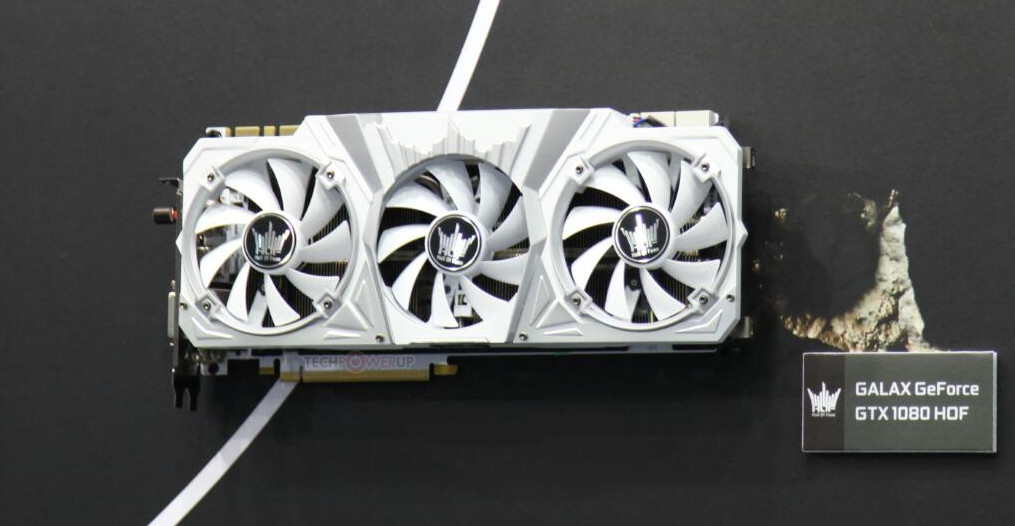
Here's the first picture of GALAX' flagship graphics card, the GeForce GTX 1080 Hall of Fame (HOF). The card features the company's strongest VRM solution for this chip, with a 12-phase setup that draws power from a pair of 8-pin PCIe power connectors, 2 GHz-scraping factory OC, and the groovy styling of a white PCB, with a mostly white colored cooling solution. One way to take advantage of the white scheme is to embed it with RGB multi-color LEDs. Enthusiasts also get features such as dual-BIOS, letting them tinker with their expensive card's BIOS. The card shown to us features a triple-slot, triple-fan cooling solution, however, it wouldn't surprise us if GALAX also launched a liquid cooling-ready variant with a factory-fitted full-coverage water block.

GALAX GeForce GTX 1070 Lineup Detailed, Readies HOF Model

It looks like GALAX has a pretty comprehensive lineup of GeForce GTX 1070 graphics cards, addressing key performance-thru-enthusiast price-points. The lineup begins with the blower-type base model. This card is built to a cost, and GALAX could look to sell it close to the $379 baseline NVIDIA set for the GTX 1070. Higher up the ladder, is the company's custom-design EXOC graphics card.

Expected to be priced close to the $450 price NVIDIA is asking for the GTX 1070 Founders Edition card, the EXOC gives you more, with a large triple-fan cooling solution, a custom-design PCB with a stronger VRM, and factory-overclocked speeds. Then there's the GTX 1070 Hall of Fame, which GALAX is still working on. The company only has its PCB (minus the ASIC) to show us. Likely priced above $500, this card will feature the company's highest factory-OC which should get its performance in the same ballpark as some of the affordable custom-design GTX 1080 cards (while looking a lot cooler).

GALAX Unveils Gamer Series DDR4 Memory

The Hall of Fame DDR4-4000 is just the tip of the iceberg, with the company giving finishing touches to a broader line of performance-segment memory kits addressing various price-points, under the colorful Gamer series. The module consists of a black PCB with a single-color crown, and its matching color LEDs glowing with a "breathing" effect. The modules come in speeds of DDR4-2133, DDR4-2400, DDR4-2666, DDR4-2800, and DDR4-3000; and in densities of 4 GB, 8 GB, and 16 GB (16 GB not available on some of the higher clocked models); making up 8 GB, 16 GB, and 32 GB dual-channel kits, respectively. The DDR4-2133, DDR4-2400, and DDR4-2666 modules are timed at 15-15-15-35 @1.2V; the DDR4-2800 module at 16-16-16-36 @1.2V; and the DDR4-3000 module at 16-16-16-36 @1.35V.

GALAX Hall of Fame DDR4-4000 Memory Pictured, Too

It looks like GALAX is also kicking the door in with enthusiast memory. The company showed off its top of the line Hall of Fame (HOF) DDR4-4000 memory, which features the company's signature white PCB, and design language along the white+chrome heatspreaders. The module comes in densities of 4 GB and 8 GB (making up 8 GB and 16 GB dual-channel kits, respectively). It achieves its marketed speed of DDR4-4000 with timings of 19-25-25-45, and module voltage of 1.4 Volts. The heatspreaders feature white LEDs with "breathing" effect.

GALAX Hall of Fame U.2, M.2, and PCIe SSDs Spied

GALAX is preparing an onslaught for the enthusiast consumer SSD space, with the new Hall of Fame (HOF) NVMe Series. Spanning three key enthusiast form-factors, namely 2.5-inch with 32 Gb/s U.2 interface; 32 Gb/s M.2, and PCI-Express 3.0 x4 add-on card; the lineup sees the company use a very powerful custom controller to churn up sequential transfer rates of 2.5 TB/s. To begin with, the 2.5-inch with U.2 form-factor drive comes in 512 GB and 1 TB sizes, offering speeds of up to 2500 MB/s reads, with 1200 MB/s writes, 300,000 IOPS 4K random reads, and 250,000 IOPS 4K random writes.

The M.2 lineup comes in two module lengths - the more common M.2-2280, and the longer M.2-22110. The M.2-2280 drive comes in capacities of up to 512 GB, and offers slightly higher write-performance of up to 1350 MB/s, while the M.2-22110 drive comes in capacities of up to 1 TB, offering the same transfer rates as the U.2 drives. Then there's the PCIe add-on card form-factor drive for those without either M.2 or U.2, which comes in sizes of up to 1 TB, and has the same performance as the U.2 drives. There's also a 2.5-inch SATA 6 Gb/s drive in this series, but its specs don't hold our attention for too long.

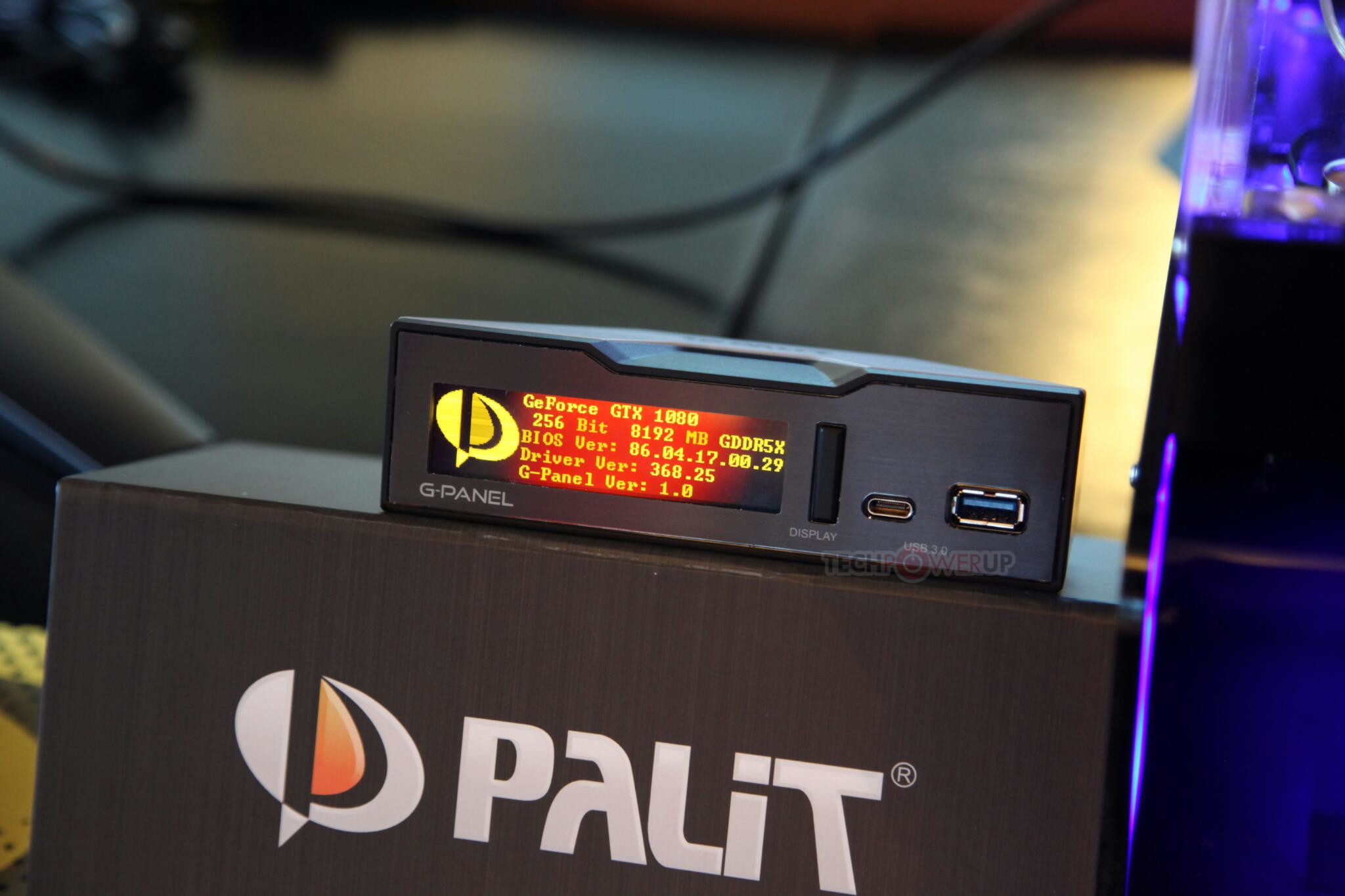
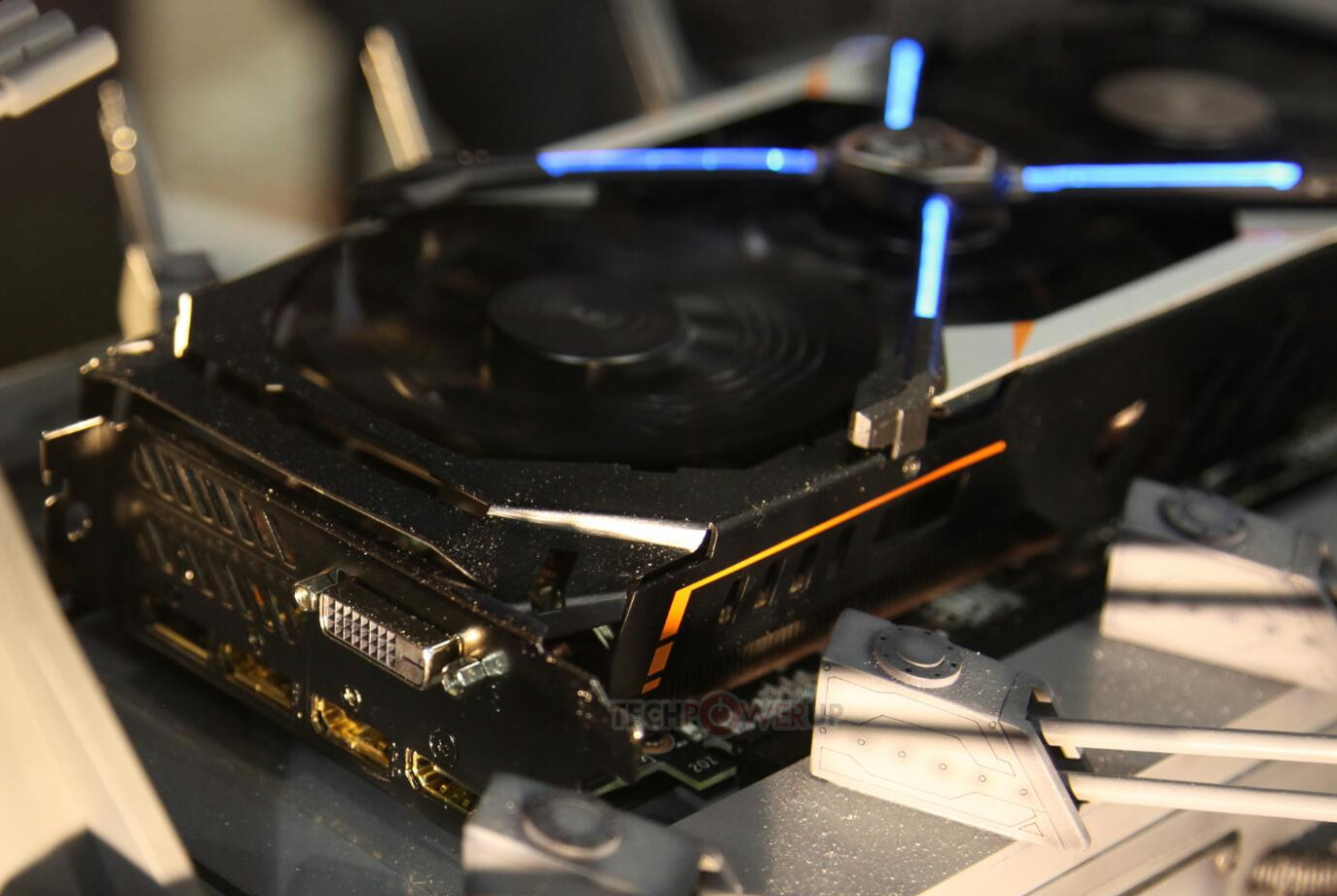
Palit GTX 1070 and GTX 1080 JetStream and G-Panel Pictured

Here are some of the first pictures of Palit's enthusiast-grade, JetStream-branded GeForce GTX 1070 and GTX 1080 graphics cards. The two cards look similar, with an identical JetStream cooling solution, with slightly different PCBs on account of different memory types between the two SKUs. These cards are not to be confused with the GTX 1080 Super JetStream, which features the company's highest possible factory OC for the GTX 1080.

Much like the GTX 1070/GTX 1080 GamerRock, the JetStream features a touch of RGB LED lighting along its cooler's top. The company also showed off the G-Panel accessory. We're not sure if this comes bundled with the JetStream cards, or is meant to be purchased separately. The module plugs into one of the USB 3.0 headers on your motherboard, or a type-A port if used externally, and puts out two front-panel USB 3.0 ports of its own (one each of type-A and type-C). The biggest feature, however, is the 2-color LCD display, which can put out five lines of text in the system font, with useful realtime temperature/clocks monitoring, general information, or simply a cool alarm clock.

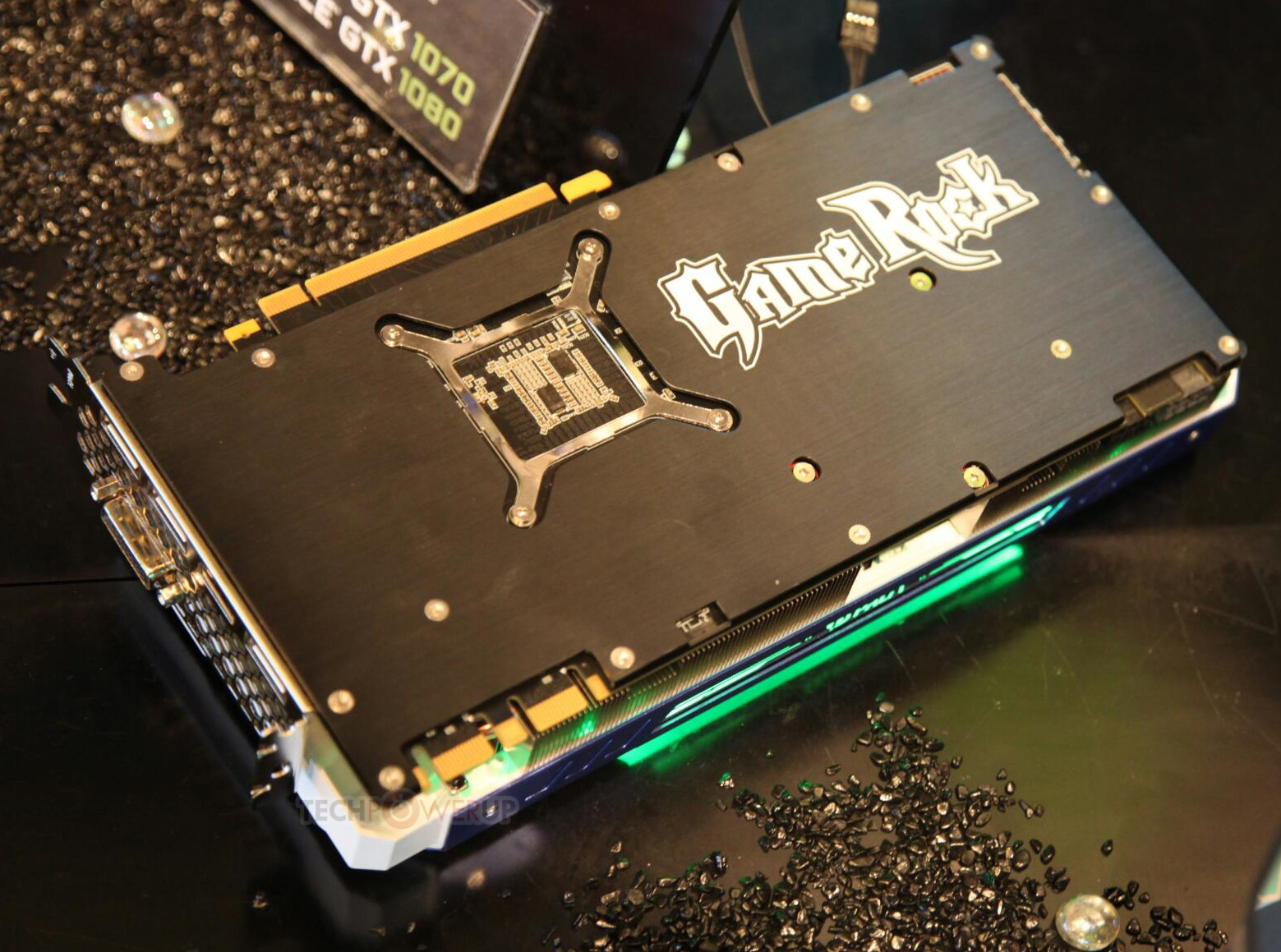
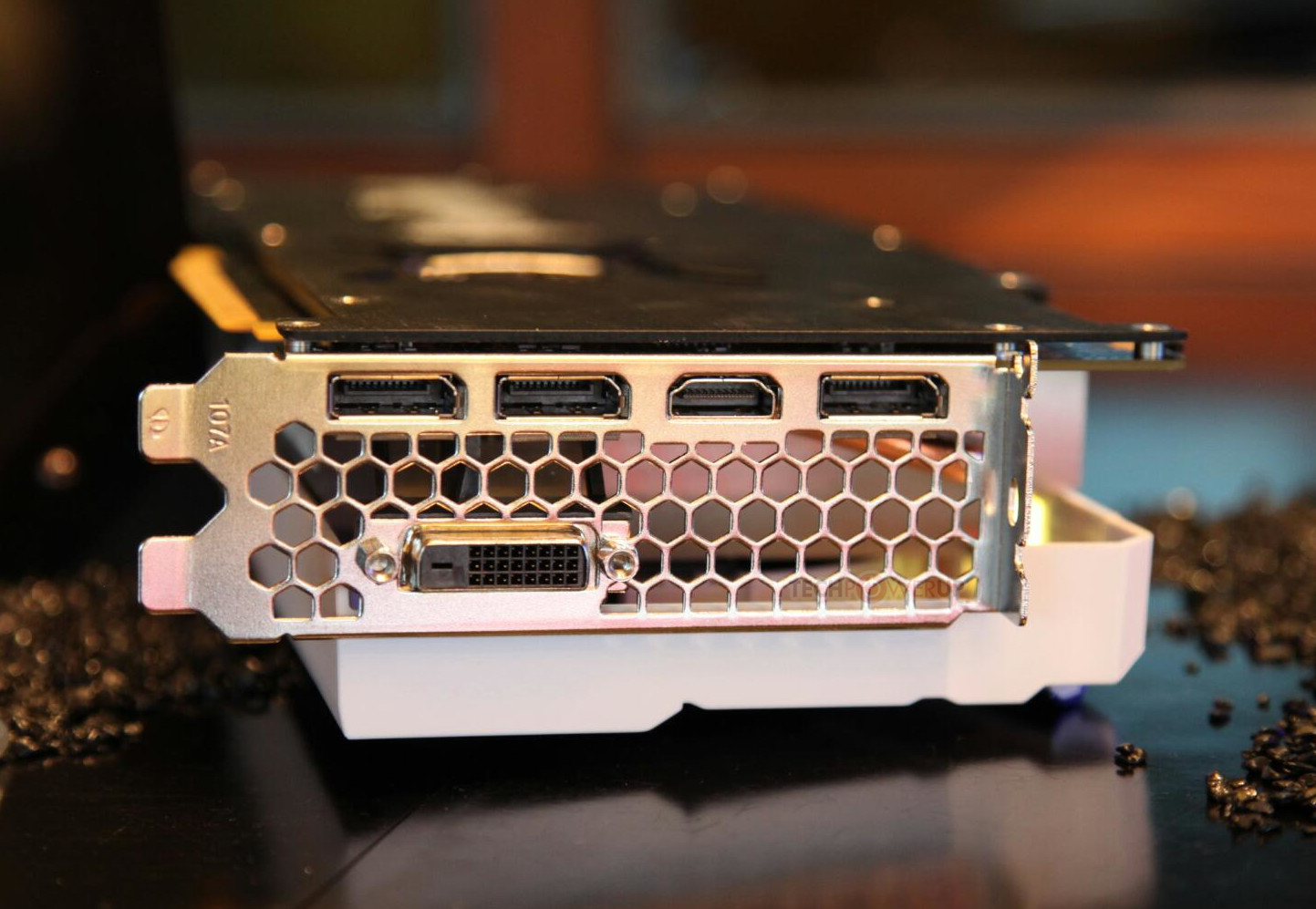
Palit GTX 1070 and GTX 1080 GameRock Graphics Cards Up-close

Here's Palit's NVIDIA GeForce GTX 1080/GTX 1070 GameRock graphics card, pictured up-close. Palit is using a common board design for both its GTX 1070 and GTX 1080 SKUs (with SKU-specific changes on the PCB). The GameRock graphics card is characterized by a minor factory-overclock, and a design-focus on RGB LED lighting that lines the card's cooling solution. The card features a reasonably meaty triple-slot, dual-fan cooling solution, lined with LEDs along the fans, top and sides. You can configure the LED lighting with the included software.

GIGABYTE BRIX Gaming UHD Pictured

GIGABYTE unveiled its latest BRIX mini-PC, which it feels is capable of gaming and the Ultra HD resolution (but not necessarily the two). The new BRIX Gaming UHD (model: BNi7HG4-950) combines a Core i7 "Skylake-U" processor with NVIDIA GeForce GTX 950. This duo should be enough for gaming at 1080p with fairly high eye-candy. The GTX 950 also enables you to plug-in 4K Ultra HD displays for smooth non-gaming 3D applications. Being a barebones desktop, you're expected to drop in your own 2.5-inch drive or M.2 SSD, and one or two DDR4 DIMMs. The unit measures 220 mm x 110 mm x 110 mm (HxWxL), and is just 2.6L in volume.

GIGABYTE XK-700 Xtreme Gaming Keyboard Pictured

GIGABYTE showed off its latest Xtreme Gaming keyboard, the XK-700, nearly completing its brand purism. This board features a minimalist design with an frosty aluminium front panel, a simple 104-key layout with a handful of macros and multimedia function keys, but underneath is a mechanical switch-set (brand currently unknown), with RGB LED lighting that not just lights up the key characters in different colors, but also puts up up a groovy light show as light from the elevated keys fall onto the aluminium panel.

GIGABYTE Also Unveils H170-Designare

In addition to the Z170-Designare and the X99-Designare, GIGABYTE unveiled the more value-oriented H170-Designare, establishing a common feature-set that constitutes the "Designare" branding. To begin with, the H170-Designare covers all the basics, with a 6-phase CPU VRM, reinforced DDR4 DIMM slots, reinforced PCI-Express 3.0 x16 slots (one runs at full-time x16, and one runs at x4), with four additional PCIe 3.0 x1 slots.

Things get interesting with the connectivity that's on offer. The board features two 10 Gb/s USB 3.1 ports driven by an Intel-made controller (one each of type-A and type-C), with 100W power delivery. The board also features an Intel I219-V gigabit Ethernet controller with cFosSpeed support. The most striking features are with its storage connectivity. You get a 32 Gb/s U.2 port, a 32 Gb/s M.2 port, and a PCI-Express 3.0 x4 slot, all of which feature NVMe booting support; with BIOS-level support for 3-drive RAID 0 arrays using three Intel SSD 750 drives.

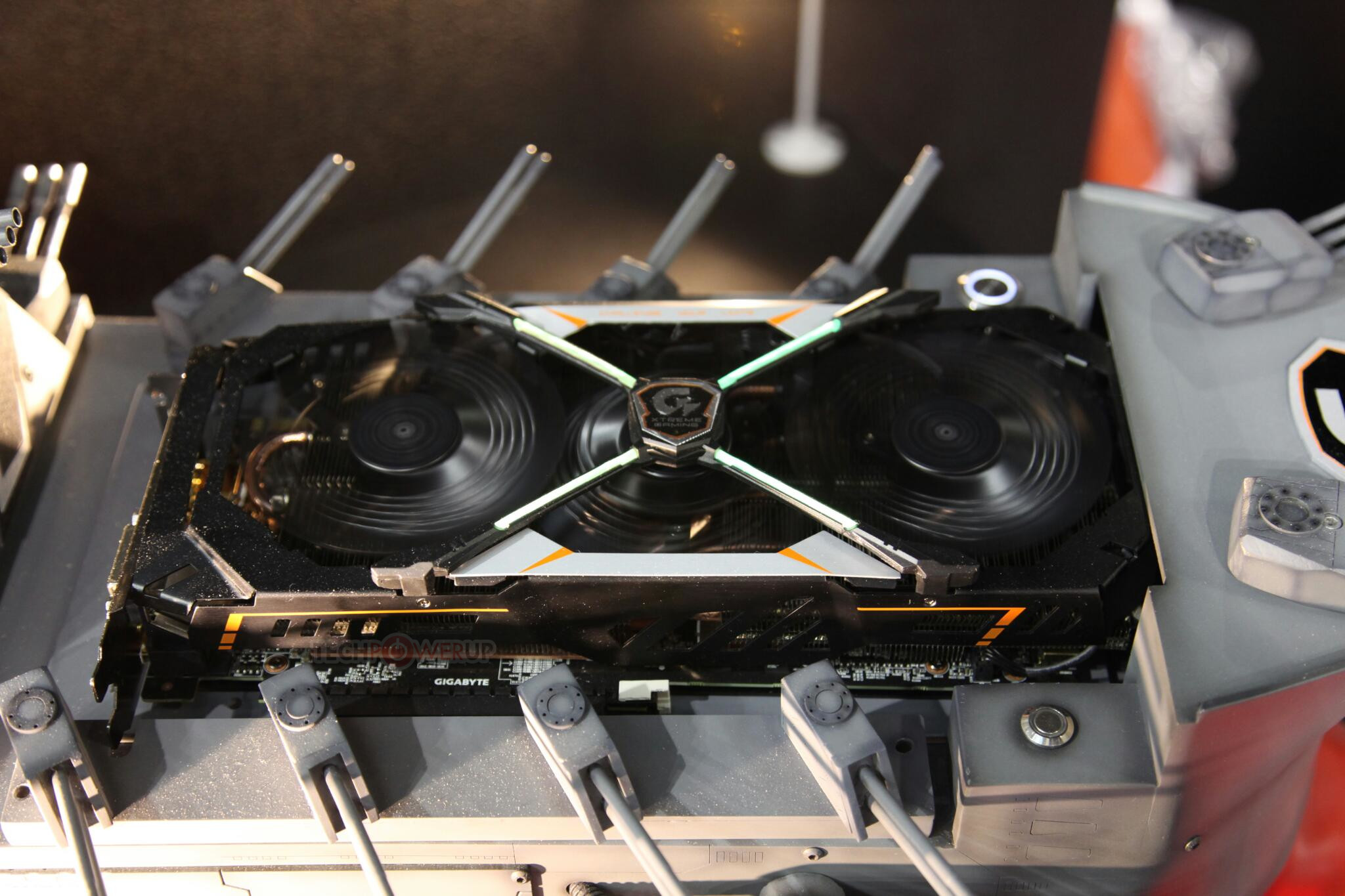
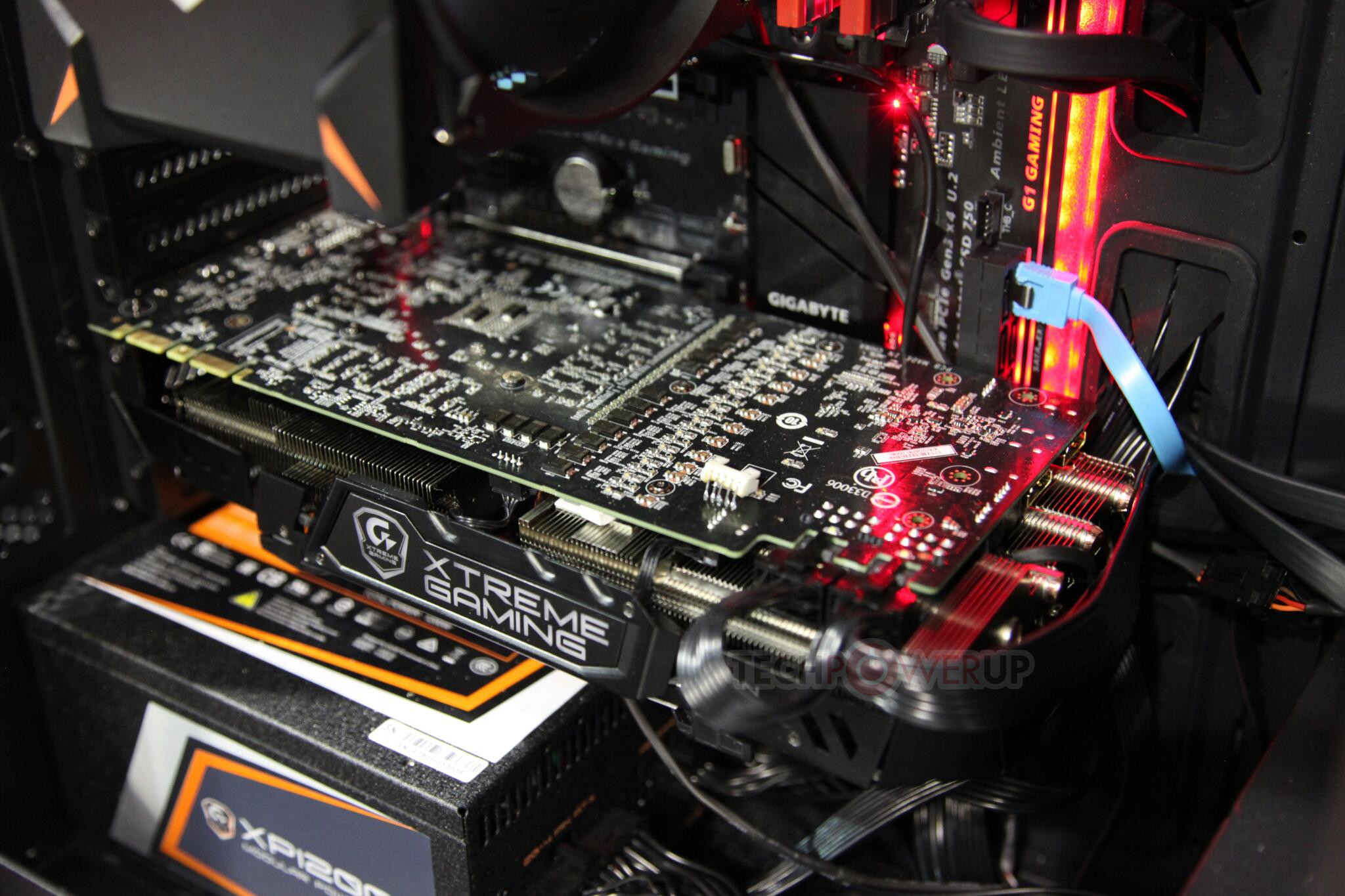
GIGABYTE GTX 1080 Xtreme Gaming Detailed Some More

GIGABYTE launched its GeForce GTX 1080 lineup with just two cards, the reference Founders Edition card, and the GTX 1080 G.1 Gaming, targeted at people who use their graphics cards for gaming. The GTX 1080 Xtreme Gaming, which was teased in older articles, however, was missing in action. It turns out that GIGABYTE wants to give this card some Computex fame before it hits the shelves as the company's flagship GTX 1080 offering (for now).

The GTX 1080 Xtreme Gaming is every bit as high-end and 'muscular' as described in our older article, but it turns out that GIGABYTE has made some major value additions. To begin with, the card will feature two front-facing HDMI ports, in addition to the one present on the rear bracket. An extended VR-link bracket lets you wire these ports out for additional HDMI ports, for your VR gear. The idea here is to let you plug in multiple HMDs to your machine, if it has enough compute power for multiple players in your game. The card also includes a more convenient 5.25-inch front-panel (if your case has them), with two HDMI ports, and two USB 3.0 ports that wire out from the motherboard's USB 3.0 front-panel header. Sadly, HMDs aren't plug-and-play, and you need to reboot your machine for your graphics card to detect and auto-configure them. The retail version of this card ships with a back-plate.

GIGABYTE Unveils Z170X-Designare Motherboard

GIGABYTE showed off the Z170X-Designare motherboard. The company's second Designare series motherboard after the X99-Designare, this board brings some of GIGABYTE's latest board design and component elements to the LGA1151 platform, such as reinforced memory and PCIe slots; and the latest storage connectivity options. Its notable features include USB 3.1 with 100W power delivery over type-A and type-C ports; a 32 Gb/s U.2 port, an extra-long M.2 22110 slot with 32 Gb/s bandwidth and NVMe support; and the company's latest UltraDurable tech, including anti-sulphur resistors, anti-rust rear I/O.

GIGABYTE Also Unveils the XC700 Gaming Chassis

In addition to the Xtreme Gaming line of PSUs, GIGABYTE also unveiled a new high-end, RGB LED-lit chassis, the XC700. GIGABYTE has had a fairly big lineup of entry-thru-mainstream mid-tower cases, but this is the company's first truly enthusiast case. Built for the post-5.25" generation, this ATX full-tower case features a contemporary aluminium silver+black front facade with a tempered-glass side-panel, and a glowing "Xtreme Gaming" badge lining the drive cage.

Instead of wasting precious real-estate on 5.25-inch drive bays, the case features a 360 mm x 120 mm radiator vents on the top-panel, with 120 mm intakes along the rear, bottom, and front panels. The case has room for large ATX and EATX motherboards, with eight expansion slots (letting you use a dual-slot graphics card on even your motherboard's bottommost slot). The star attraction here, of course, is the factory-fitted RGB LED setup, which lines key design elements of the case, including the large logo. To top it off, you get GIGABYTE's Xtreme Gaming emblem to show off your brand loyalty.

GIGABYTE Forays Into Enthusiast PSUs with New Xtreme Gaming Line

GIGABYTE is making a serious push into high-end gaming PC power supplies (PSUs), with its new Xtreme Gaming line. The company has, in the past, sold entry-thru-mid-range PSUs. The company showed off its first Xtreme Gaming PSU model, the XP1200M. This 1200W PSU features fully modular cabling, 80 Plus Platinum efficiency, an all-Japanese capacitor design, a single +12V rail, DC-to-DC switching, and a 140 mm double ball-bearing fan that stays off below a load threshold. 1200W may not be the only capacity this PSU lineup will include.
Sunday, May 29th 2016

GIGABYTE Unveils the GeForce GTX 1080 G1.Gaming Graphics Card

GIGABYTE, the world's leading premium gaming hardware manufacturer, today launched the GeForce GTX 1080 G1 GAMING graphics card (GV-N1080G1 GAMING-8GD). Powered by Pascal, the new king of graphics card is packed with legendary G1 GAMING designs to deliver unprecedented performance for next-generation gaming. Featuring Super Overclock GPU, the signature WINDFORCE 3X cooling and RGB illumination, this G1 GAMING graphics card provides a proven solution in terms of overclocking capabilities, silent cooling, and customizable lighting for an enriched gaming experience and beyond.

The legendary WINDFORCE 3X cooling system incorporates 3 pure copper composite heat-pipes with direct touch to the GPU, special fin architecture, and unique blade fan design. Together the WINDFORCE delivers an effective heat dissipation capacity for bringing out the best of Pascal while keeping the card cool. The 3D Active Fan provides semi-passive cooling, which allows gamers to enjoy gameplay in complete silence when the system is running light or idle. An LED fan indicators provides a user-friendly, instant display of the fan status.

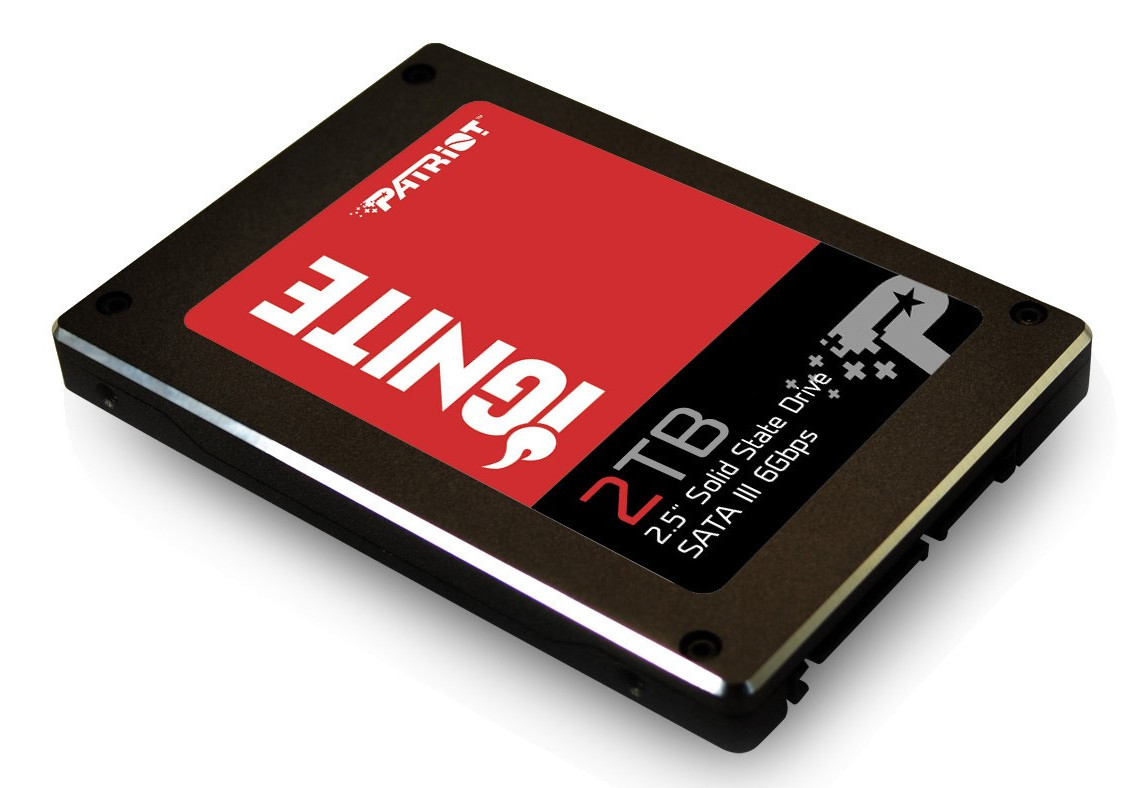
Patriot Memory Announces the 2TB Ignite SSD

Patriot, a leading manufacturer of high performance computer memory, SSDs, gaming peripherals, consumer flash storage solutions and mobile accessories, today introduced a 2 TB addition to its performance solid state drive (SSD) line, the Ignite. Patriot looks to fulfill the ever-growing demand for increased amounts of storage in consumer PCs.

Patriot originally launched the Ignite SSD in January of 2015 with top performing speeds and capacities of 480 GB and 960 GB. Since then, Patriot has added the addition of a 240GB capacity and now a multi-terabyte capacity to tackle even the most taxing data loads. With the Ignite 2 TB SSD consumers can load an entire library of PC games to their rig without having to unload and load games when storage runs out.

Patriot Presents UHS-II Capable EP PRO-II SDXC and microSDXC

Patriot, a leading manufacturer of consumer flash storage solutions, computer memory, SSDs, gaming peripherals and mobile accessories, today announced the release of the EP PRO-II SD and microSDXC cards. Equipped with UHS-II connectors, UHS Speed Class 3 and Class 10, the EP PRO-II cards will provide users with top of the line transfer speeds as well as ample storage.

Patriot's fastest cards to come to market, the EP PRO-II SDXC and EP PRO-II microSDXC cards offer users unrivaled data transfer speeds. With maximum read speeds of up to 280MB/s and maximum write speeds of up to 100MB/s the EP PRO-II cards will provide superior performance for professional videographers and photographers with advanced media devices such as the Panasonic Lumix GH4 and the Fujifilm X-T1. Available in 64GB to 512GB capacities in the EP PRO-II SDXC full card and 32GB to 128GB in the EP PRO-II microSDXC card, consumers will never miss a second due to a lack of storage space.

QNAP Partners with Canonical to Enhance NAS with Ubuntu OS

QNAP Systems, Inc. has announced today a partnership with Canonical. The partnership will provide an advanced platform for the development of services and applications for the Internet of Things (IoT) using both Ubuntu and QTS operating systems. Canonical and QNAP will cooperate to provide, promote, and enable the creation of an ecosystem of IoT applications across home, SMB, and enterprises.

QNAP leverages its NAS operating system, QTS, with its built-in, mature, and comprehensive virtualization platform and further, integrates the Ubuntu operating system to provide a complete and familiar software development platform for software developers. Users are able to enjoy simultaneously the wide variety of apps from the QTS App Center, and diversified services available on Ubuntu.

AOC Officially Unveils AGON Gaming Brand

AOC, a global leader in display technology, is announcing its new gaming brand: "AGON". All future AOC gaming product releases will be under the AGON name. AGON will also encompass AOC's future gaming-related activities and social media voice. Some of AOC's existing gaming displays, previously grouped together with other products, will be rebranded under AGON.

The name AGON represents AOC's commitment to the PC gaming segment and the spirit of competitive gaming. AGON is an ancient Greek word (ἀγών), which refers to "a struggle or contest". The name is also intended to be an acrostic that represents AOC's vision for AGON.

GeIL Announces the EVO Forza DDR4 Memory Series

GeIL, a leading global manufacturer of PC components and peripherals, presents its latest addition to the EVO hardcore gaming memory product family - the DDR4 EVO FORZA Series. Developed with GeIL's MTCD - Maximum Thermal Conduction & Dissipation technology, the FORZA heat-spreader provides superior cooling performance.

Available in Hot-rod Red and Racing Yellow, the EVO FORZA Series is designed to be compatible with the latest Z170 and/or X99 platforms with frequency of up to 3866 MHz. In order to ensure the highest quality and reliability, the EVO FORZA Series are thoroughly tested and burned-in by GeIL's own DYNA4 SLT & DYNA4 DIMM SLT fully- automatic testers.

NVIDIA GTX 1080 Founders Edition Owners Complain of Fan Revving Issues

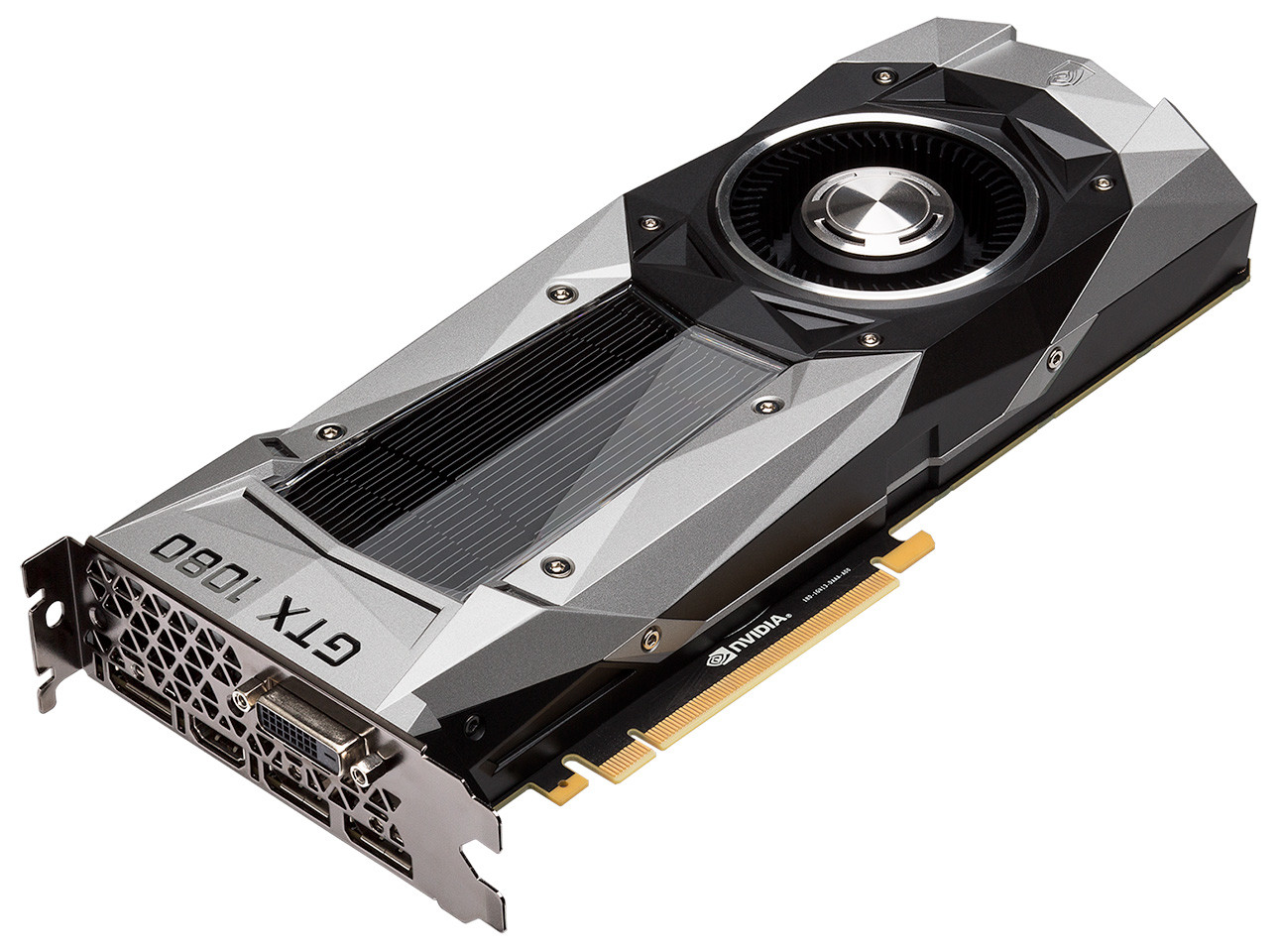
NVIDIA's decision to sell its reference-design GeForce GTX 1080 graphics card at a $100 premium over the SKU's MSRP of $599, is beginning develop cracks, with early adopters complaining of erratic default fan behavior. The GTX 1080 Founders Edition graphics card features NVIDIA's reference lateral-blower-type cooler, which didn't exactly blow us away, in our review of the card. Customers across the forumscape, including on NVIDIA's own GeForce Forums, are complaining of an issue where the fan of the cooler has a mind of its own, and revs up from 2,000 RPM to 3,000 RPM intermittently, and drops back to its idle speed. This, users complain, is particularly annoying if you're not gaming.

The users observe that these sudden and unpredictable spikes in fan-speed are not in response to rising GPU temperatures or clock speeds. Sudden variations in fan-speed are worse than gradual variations in response to legitimate triggers, as it also means sudden changes in noise, which is distracting. Users also observe that you can't even use third-party software (eg: EVGA Precision) to stabilize or override the fan-behavior, as the speed-spikes don't respect custom settings.

Next-Gen Radeon "Polaris" Nomenclature Changed?

It looks like AMD is deviating from its top-level performance-grading, with its next-generation Radeon graphics cards. The company has maintained the Radeon R3 series for embedded low-power APUs, Radeon R5 for integrated graphics solutions of larger APUs; Radeon R7 for entry-thru-mainstream discrete GPUs (eg: R7 360, R7 370); and Radeon R9 for performance-thru-enthusiast segment (eg: R9 285, R9 290X). The new nomenclature could see it rely on the second set of model numbers (eg: 4#0) to denote market-positioning, if a popular rumor on tech bulletin boards such as Reddit holds true.

A Redditor posted an image of a next-gen AMD Radeon demo machine powered by a "Radeon RX 480." Either "X" could be a variable, or it could be series-wide, prefixing all SKUs in the 400 series. It could also be AMD marketing's way of somehow playing with the number 10 (X), to establish some kind of generational parity with NVIDIA's GeForce GTX 10 series. The placard also depicts a new "Radeon" logo with a different, sharper typeface. The "RX 480" was apparently able to run "Doom" (2016) at 2560x1440 @ 144 Hz, with the OpenGL API.
Friday, May 27th 2016

Today's Reviews

Accessories
Cases
CPU Coolers
Graphics Cards
Keyboards
Motherboards
NAS
Processors
PSUs
Speakers
SSD
Zalman Z9 NEO Review

Zalman Z9 NEO Review

The Zalman Z9 NEO aims to offer a diverse and useful feature set and good looks and liquid-cooling compatibility, all at an affordable price. Add the fact that it comes equipped with a whooping 5 (!!) fans and it just got even more interesting, while the choice between a black or white version does not help curb the expectations we have diving into this review.

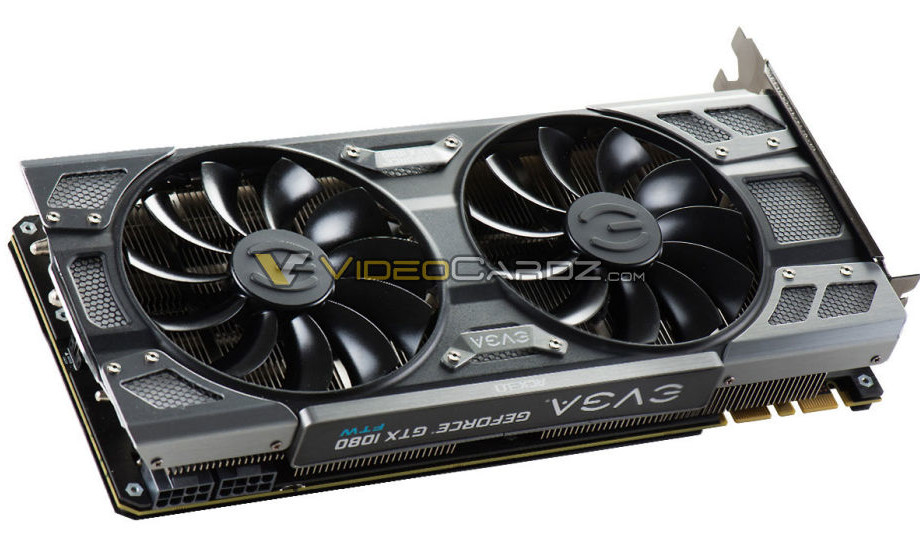
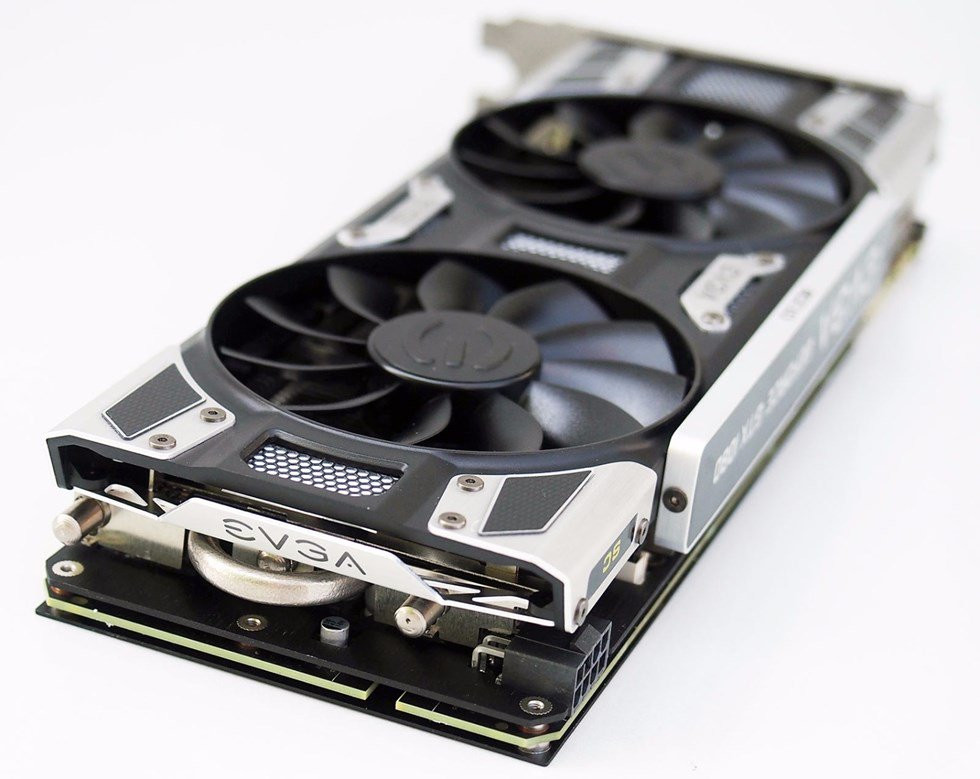
EVGA Announces its GeForce GTX 1080 Series

The EVGA GeForce GTX 1080 featuring EVGA ACX 3.0 cooling has arrived. This new graphics card features NVIDIA's new "Pascal" graphics processor which is the most advanced gaming GPU ever created. This breakthrough GPU delivers industry-leading performance, innovative new gaming technologies, and immersive, next-gen VR.

These cards also feature EVGA ACX 3.0 cooling technology. EVGA ACX 3.0 once again brings new and exciting features to the award winning EVGA ACX cooling technology. SHP 3.0 gives increased heatpipes and copper contact area for cooler operation, and optimized fan curve for even quieter gaming. Of course, ACX 3.0 coolers also feature optimized swept fan blades, double ball bearings and an extreme low power motor, delivering more air flow with less power, unlocking additional power for the GPU. Select EVGA ACX 3.0 models will even feature a 10CM fan and RGB LED, allowing complete control over the color from EVGA PrecisionX OC.

NVIDIA GeForce GTX 1070 Reference PCB Pictured

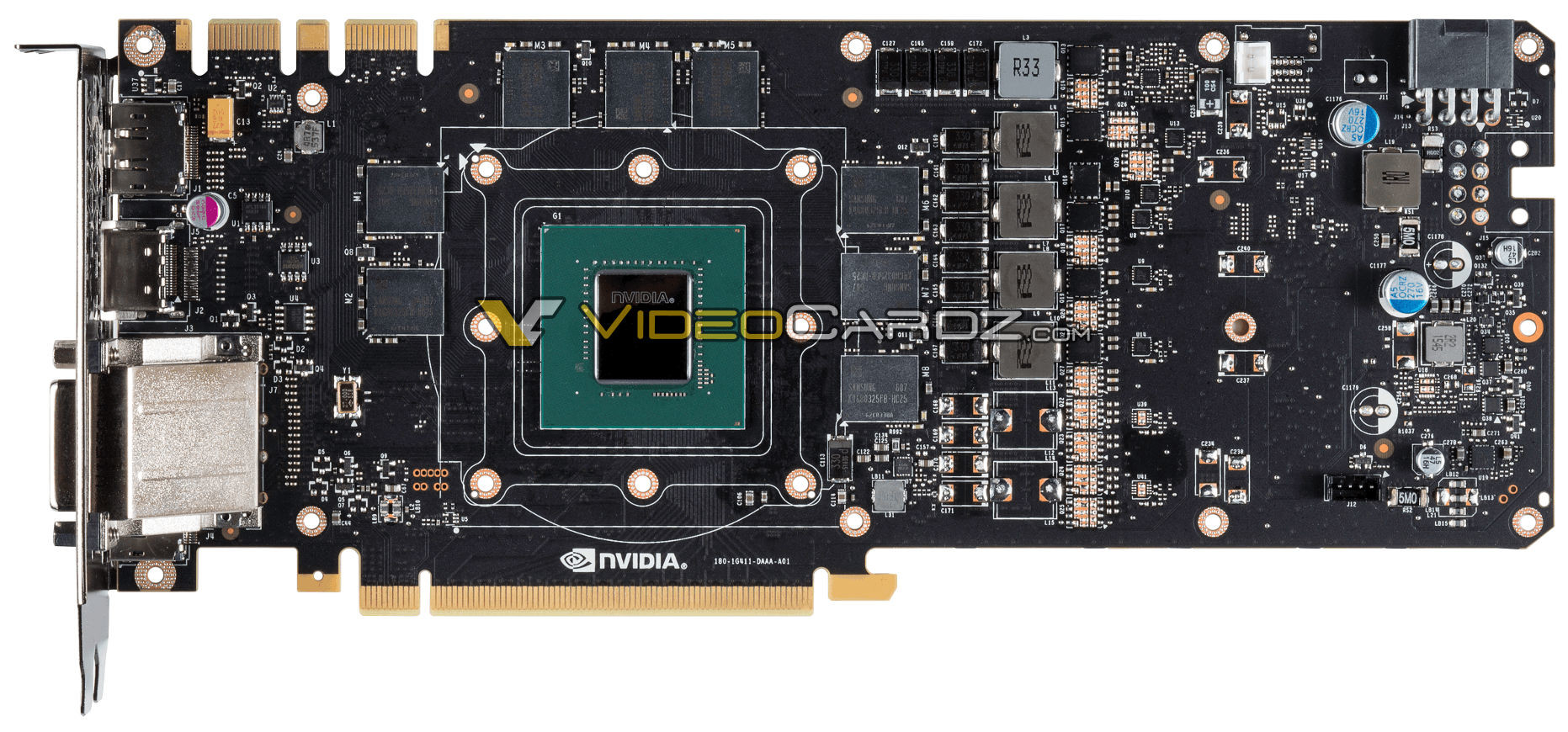
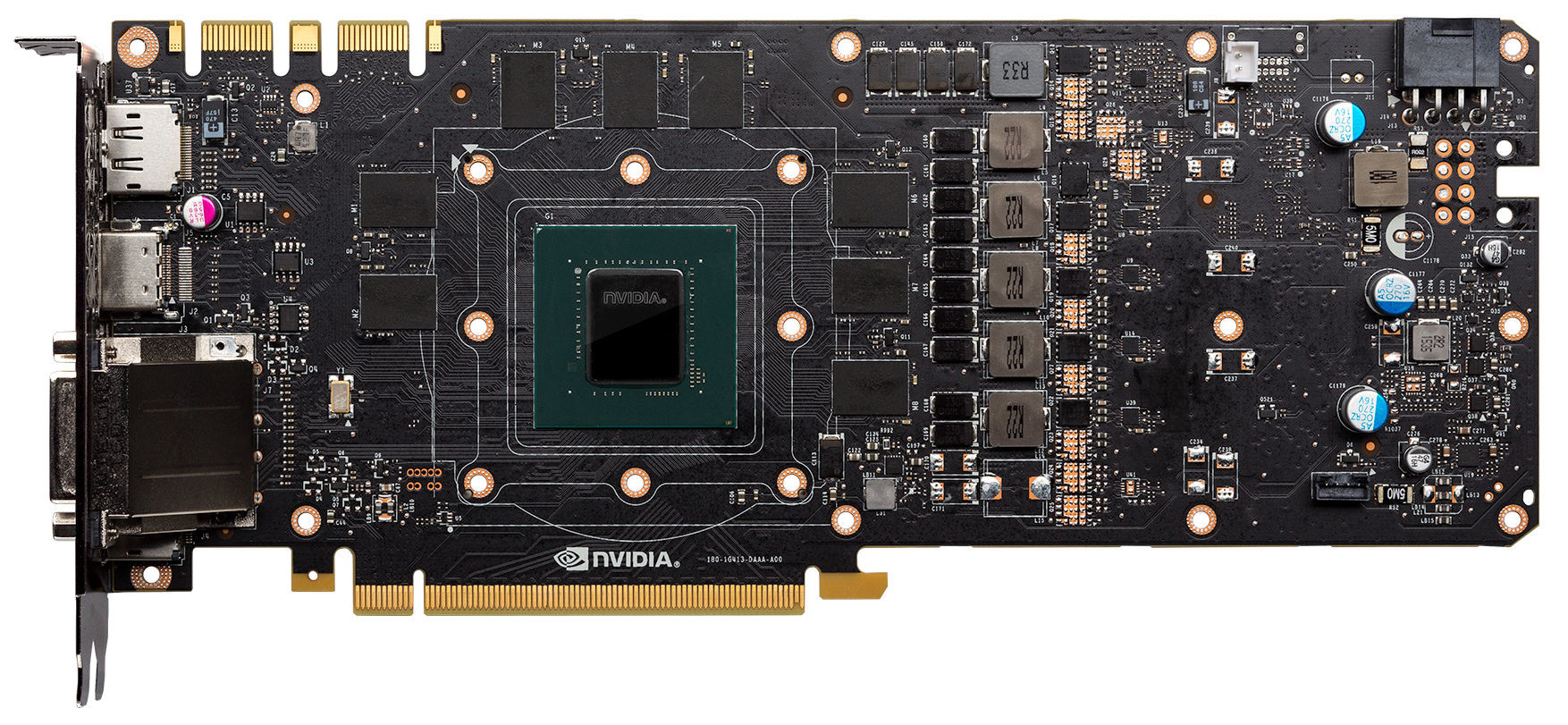
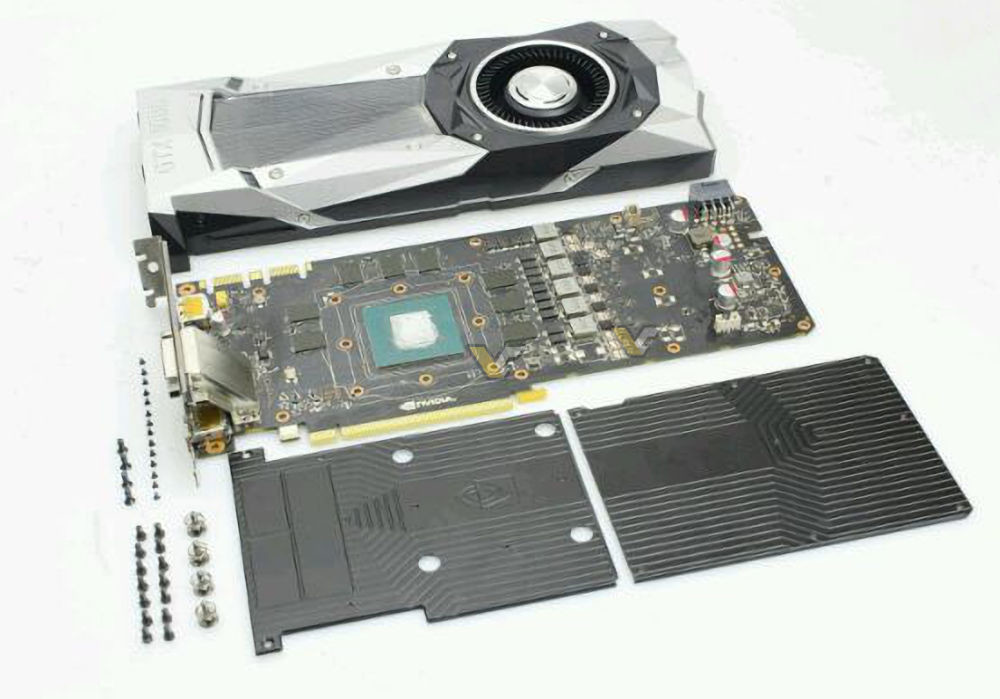
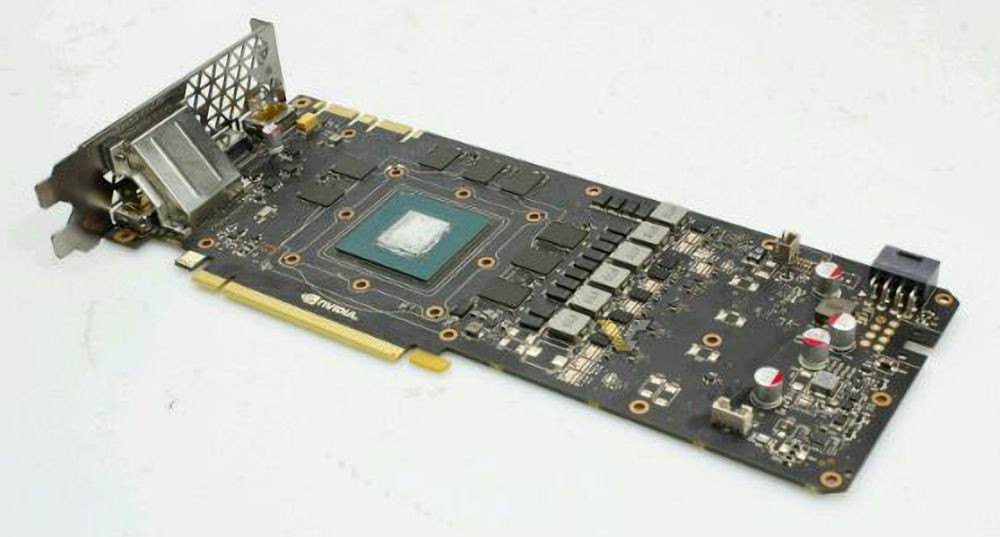
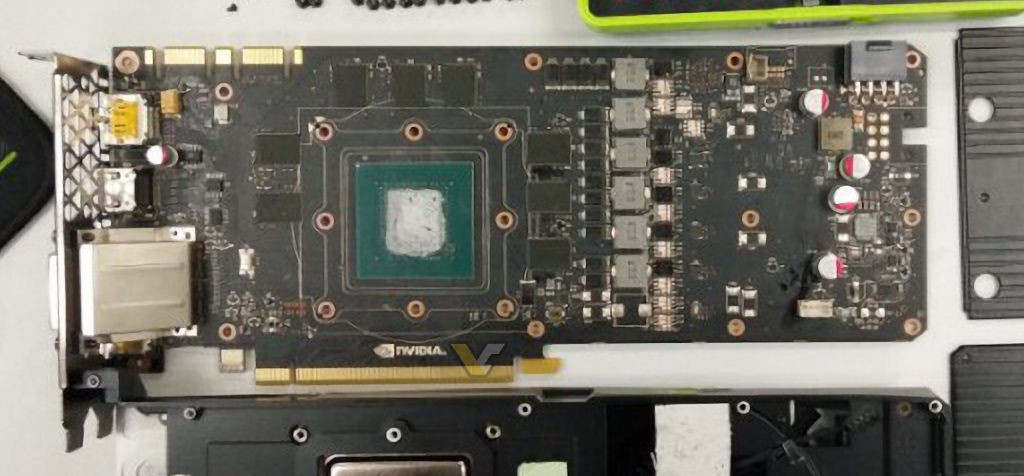
Here's the first picture of an NVIDIA reference-design PCB for the GeForce GTX 1070. The PCB (PG411) is similar to that of the GTX 1080 (PG413), except for two major differences, VRM and memory. The two PCBs are pictured below in that order. The GTX 1070 PCB features one lesser VRM phase compared to the GTX 1080. The other major difference is that it features larger GDDR5 memory chips, compared to the smaller GDDR5X memory chips found on the GTX 1080. These are 8 Gbps chips, and according to an older article, its clock speed is maxed out to specifications, at which the memory bandwidth works out to be 256 GB/s. The GeForce GTX 1070 will be available by 10th June.

MSI Announces GeForce GTX 1080 Graphics Cards

As the world's most popular GAMING graphics card vendor, MSI is proud to introduce its full line up of graphics cards based on NVIDIA's new Pascal GPU with fierce new looks and supreme performance to match. Building on the monumental success of MSI's award winning GTX 900 GAMING series, the MSI GeForce GTX 1080 GAMING X 8G premieres the impressive TWIN FROZR VI thermal design allowing for higher core and memory clock speeds for increased performance in games.

The famous shapes of the eye-catching TWIN FROZR cooler are intensified by a fiery red GAMING glow piercing through the cover, while the MSI GAMING dragon RGB LED on the side can be set to any of 16.8 million colors to match your mood or build. A completely new custom 10-phase PCB design using Military Class 4 components with an 8+ 6-pin power connectors enables higher overclocking performance to push your graphics card to the max. The classy matte black solid metal backplate gives the card more structural strength and provides a nice finishing touch.

ZOTAC Announces its GeForce GTX 1080 Series

ZOTAC International, a global manufacturer of innovation, is pleased to change the playing field of graphics cards once more with ZOTAC GeForce GTX 10 Series. The first of the new ZOTAC 10 Series is the ZOTAC GeForce GTX 1080 Founders Edition, the flagship card of the series. Using the advanced NVIDIA Pascal architecture, the performance has been tuned to incredible levels to provide users with an astonishing out-of-the-box experience.

"ZOTAC is pleased to be standing on the new page of gaming history. Pascal opens many doors to applications that we haven't seen before, especially in the scope of virtual reality," says Tony Wong, CEO, ZOTAC International. "Our engineering team has taken great measures to ensure our graphics cards continue to shine brightly, so that we can bring smiles to each gamer."

ASUS Announces the ROG STRIX GeForce GTX 1080

ASUS Republic of Gamers (ROG) today announced Strix GeForce GTX 1080, an all-new VR-ready gaming graphics card with ultra-fast gaming performance, advanced cooling and reliability, and personalized styling. Powered by the latest GeForce GTX 1080 graphics processing unit (GPU), clocked at 1936 MHz in OC mode, ROG Strix GeForce GTX 1080 delivers up to 6.5% faster performance in 3DMark Fire Strike Extreme and 7.4% faster gaming performance in Hitman.

ROG Strix GeForce GTX 1080 is packed with exclusive ASUS technologies, including DirectCU III with a patented triple wing-blade 0dB fan designed to deliver maximum airflow for 30%-cooler and three times (3X) quieter performance, and ASUS FanConnect, which features GPU-controlled fan headers for targeted supplemental cooling. Industry-exclusive Auto-Extreme technology with Super Alloy Power II components ensures premium quality and reliability.

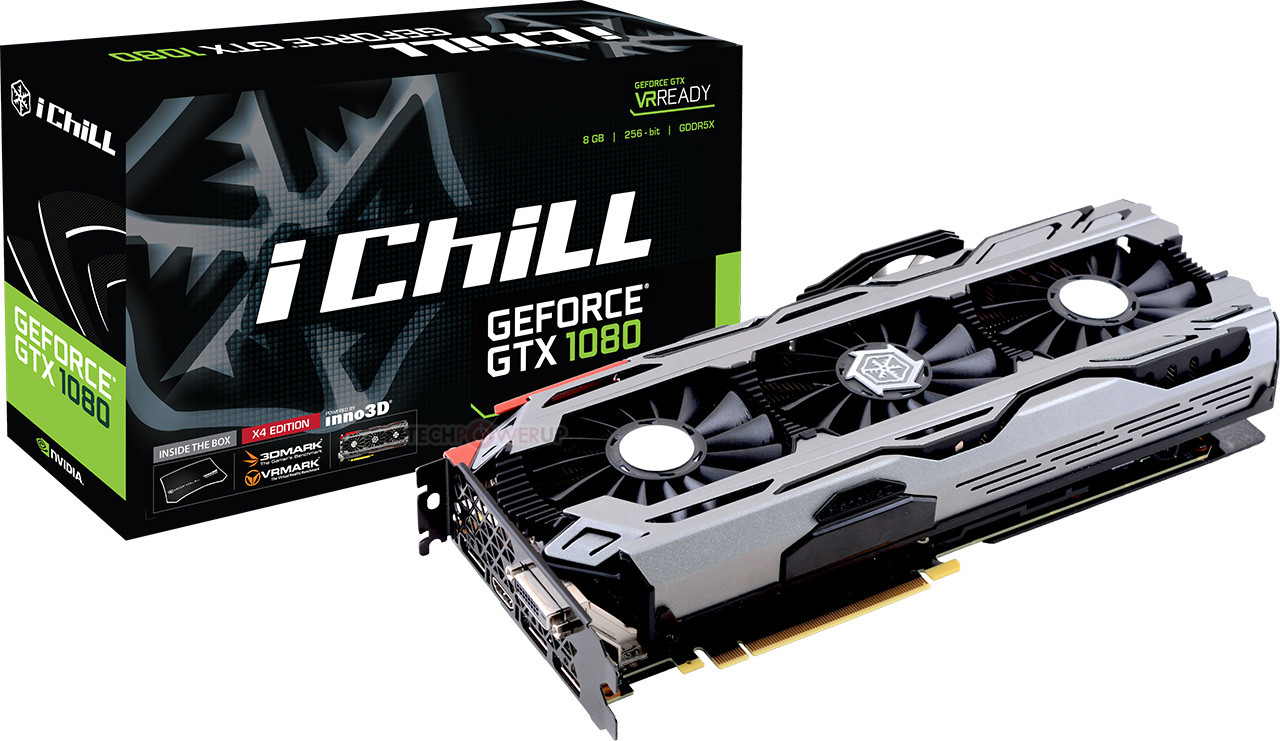
Inno3D Announces New GeForce GTX 1080 Graphics Cards

InnoVISION Multimedia Limited, a leading manufacturer of high-end hardware components and computer utilities, introduces its new line of Inno3D GeForce GTX 1080 graphics cards. The new flagship will be available in both GamingOC as well as iChiLL editions. Built for future high-end graphics, the GeForce GTX 1080 builds on NVIDIA's new Pascal architecture, where performance reaches unknown territories and provides the user unprecedented performance, power efficiency, and gaming experiences.

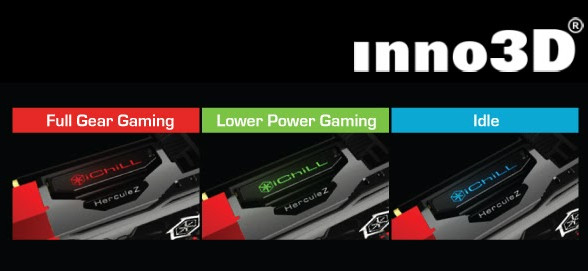
The new, and recently introduced, iChiLL X3 and X4 cooling solutions even improve the overall temperature control and come equipped with the Herculez cooling armor. As a result, the Inno3D GTX 1080 products will be capable to run at even higher clocks, fully optimizing the 2560 Cuda cores inside the GPU without losing grip on heat production. "We are incredibly proud of what we have achieved in such a short timeframe, allowing an outstanding product to evolve into an epic chapter in the history of graphics" said Ken Ho, CEO at InnoVISION Multimedia Limited. "Especially our iChiLL X3 and X4 cooling solutions will 'blow away' high-end gamers and overclockers."

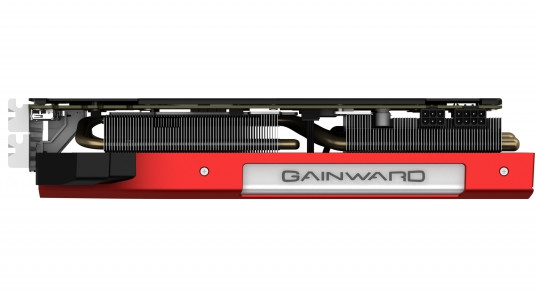
Gainward Announces the GeForce GTX 1080 Phoenix Series

As the leading brand in enthusiastic graphics market, Gainward proudly presents the brand-new GeForce GTX graphics - GeForce GTX 1080 Phoenix series. Gainward GeForce GTX 1080 Phoenix series is the most advanced graphics card, accelerated by the groundbreaking NVIDIA PASCAL architecture to deliver an unbeatable 4K and virtual reality experience. With the most advanced process - 16nm FinFET, the Gainward GeForce GTX 1080 Phoenix series deliveries powerful graphics performance with extremely high efficiency power usage. By adoption of the 10Gbps GDDR5X memory, the Gainward GeForce GTX 1080 Phoenix series gives you amazing gaming performance by two times faster than previous generation.

Gainward GeForce GTX 1080 Phoenix series comes with new Phoenix cooler design, provides extreme high thermal performance with very low acoustic level even under heavy-loading gaming environment. The cooler design is also including a LED-lighting loading indicator that gives users clear indication for the GPU temperature range. And, a "dual BIOS" design brings the confidence from a second VBIOS on the board that provides backup-BIOS to boot up whenever needed.

Palit Announces the GeForce GTX 1080 GameRock and Super JetStream

Palit Microsystems Ltd, the leading graphics card manufacturer, releases the brand new GameRock series in Palit GeForce product line-up, GeForce GTX 1080 GameRock. The revolutionary GameRock series provides the best gaming features, the best thermal solution and the best graphics card quality to deliver gamers the ultimate gaming experience.

GeForce GTX 1080 is the most advanced gaming GPU ever created , the GeForce GTX 1080 is based on the NVIDIA Pascal architecture GP104 GPU armed with 2560 CUDA cores and equipped with 8GB of GDDR5X memory running at an effective clock rate of 10Ghz on a 256-bit bus. Palit GeForce GTX 1080 series is designed to deliver 3x more performance than previous-generation video card and its breakthrough innovations in gaming give gamers new possibilities to enjoy via VR experiences.

Manli Announces its GeForce GTX 1080 Founders Edition Graphics Card

Manli Technology Group Limited, the major Graphics Cards and other components manufacturer, today announced the most advanced graphics solution for gamers - Manli GeForce GTX 1080 Founders Edition. Powered by the new NVIDIA PascalTM architecture, the Manli GeForce GTX 1080 provides top tier gaming performance for gaming enthusiast.

It built-in 2560 CUDA Cores, with core frequency is at 1607 MHz, base clock that can boost up to 1733 MHz, plus high-bandwidth memory GDDR5X technologies, and support DirectX 12 features to deliver the fastest, smoothest, and most power-efficient gaming experiences. Moreover, up to 3x faster than previous generation graphics cards in VR gaming application.

Colorful Launches the GeForce GTX 1080 iGame Graphics Card

Colorful Technology Company Limited, professional manufacturer of graphics cards and motherboards, is proud to announce the first custom-cooled GeForce GTX 1080 from the prestigious iGame series of gaming graphics card by Colorful. Based on the NVIDIA GeForce GTX 1080, the Colorful iGameGTX1080 X-TOP-8G features the latest Pascal GPU architecture boasting a 16nm FinFET fabrication process for improved efficiency and performance.

The Colorful iGameGTX1080 X-TOP-8G is factory overclocked with up to 1847Mhz frequencies to push the GTX 1080 further for faster performance in today's latest game. The new iGame cooler helps improve cooling potential thus allowing faster clock rates so you can game faster and cooler.

NVIDIA GeForce GTX 1080 Now Available

NVIDIA GeForce GTX 1080 graphics card is now available. Available in two kinds, the "Founders Edition," which is essentially the SKU's reference edition; and the various custom-design cards; the GTX 1080 starts at US $599. This is a "suggested" price by NVIDIA for how cheap custom-design cards can be sold at. The Founders Edition SKU, sold though its add-in card partners, is priced at $699. Expect most custom-design SKUs to either be priced between $599-$699, or above, making the GTX 1080 the costliest performance-segment SKU by NVIDIA. The company also put out pricing of the GeForce GTX 1070 Founders Edition, which on sale from 10th June. It's priced at $449. Custom-design boards should start around $379.

Based on the 16 nm GP104 silicon, powered by the "Pascal" GPU architecture, the GeForce GTX 1080 features 2,560 CUDA cores, 160 TMUs, 64 ROPs, and a 256-bit wide GDDR5X memory interface, holding 8 GB of memory. With its TDP rated at 180W, the reference design card draws power from a single 8-pin PCIe power connector. The GPU is clocked at 1607 MHz, with 1733 MHz maximum GPU Boost, and 10 GHz (effective) memory, working out to a memory bandwidth of 320 GB/s. The card supports modern APIs such as DirectX 12 (feature-level 12_1), Vulkan, and OpenGL.

NVIDIA Releases VRWorks SDK Update for "Pascal"

NVIDIA today released a major update to its VRWorks SDK that enables game developers to implement new VR features features introduced by the GeForce "Pascal" graphics processors, taking advantage of the new Simultaneous Multi-projection Engine (SMP). The two major features introduced are Lens-Matched Shading and Single-Pass Stereo.

Lens-Matched Shading uses SMP to provide substantial performance improvements in pixel shading. The feature improves upon Multi-res Shading by rendering to a surface that more closely approximates the lens corrected image that is output to the headset display. This avoids the performance cost of rendering many pixels that are discarded during the VR lens warp post-process. Single-Pass Stereo, on the other hand, removes the need for a GPU to render the geometry and tessellation of a 3D scene twice (one for each eye/viewport), and lets both viewports share one pass of geometry and tessellation, thereby halving the the tessellation and vertex-shading workload.
Thursday, May 26th 2016

Today's Reviews

Cases
Cooling
Desktop PC
Headphones
Input Devices
Keyboards
Motherboards
Mouse
Processors
Speakers
SSD
Storage

EVGA GeForce GTX 1080 FTW Pictured, Too

Hot on the heels of the EVGA GTX 1080 SuperClocked leak, we have the first pictures of its top-tier GeForce GTX 1080 FTW (For The Win). Unlike the GTX 1080 SC, the FTW features a fully custom-design PCB by EVGA, which features a stronger VRM that draws power from two 8-pin PCIe power connectors, instead of one. It features a bigger variant of the new ACX 3.0 cooling solution by EVGA, which is taller, and with larger fans. At this point we don't know the clock speeds of this card, but given the massive overclocking potential of the GTX 1080, they're bound to be very high. Custom-design GeForce GTX 1080 graphics cards are expected to be launched very soon, as market-availability of the SKU commences later today.

ASUS GeForce GTX 1080 STRIX Graphics Card Pictured

Here's the elusive and highly teased Republic of Gamers STRIX GeForce GTX 1080 graphics card by ASUS. The card features the company's latest DirectCU III cooling solution, which features a heatsink that's similar in size to the one found on the older generation DCU3, but with a refreshed cooler shroud that's lined by RGB multi-color LEDs that can be customized with the new GPUTweak Aura app. The card is factory-overclocked, although we don't know its clock speeds yet. NVIDIA's various add-in card (AIC) partners are expected to launch their custom-design cards very soon.

EVGA GeForce GTX 1080 SuperClocked Pictured

Here are the first pictures of EVGA GeForce GTX 1080 SC (SuperClocked) graphics card, featuring the company's new ACX 3.0 cooling solution. EVGA is apparently using NVIDIA reference PCB on some of its more affordable GTX 1080 custom-design SKUs, which draws power from a single 8-pin PCIe power connector. The new ACX 3.0 cooler loses the all matte black color scheme for a mostly brushed aluminium look, with a white LED lit badge taking up most of its top. Underneath is an aluminium fin-stack heatsink, ventilated by a pair of fans. You also get a groovy back-plate to go with it. The clock speeds are not known. NVIDIA's add-in card (AIC) partners are expected to launch their custom-design GTX 1080 graphics cards very soon.

NVIDIA Releases First WHQL-signed GTX 1080 Driver

NVIDIA posted its first official driver for the GeForce GTX 1080, ahead of its retail availability from tomorrow (27/05). The new GeForce 368.25 WHQL appears to have the same feature-set and change-log as the GeForce 368.22 WHQL posted earlier this week, with the notable exception of supporting just the GeForce GTX 1080 graphics card. It should come handy for some of the earliest adopters of the retail GTX 1080 cards. Download the driver from the link below.
DOWNLOAD: NVIDIA GeForce 368.25 WHQL for GeForce GTX 1080

GIGABYTE GeForce GTX 1080 Xtreme Gaming Pictured

A low-resolution picture of GIGABYTE's upcoming GeForce GTX 1080 Xtreme Gaming graphics card made it to the web, revealing the company's latest WindForce 3X cooling solution. The card doesn't appear to be as long as some of the older WindForce 3X based graphics cards from the company, but is taller. It features three ≥100 mm fans, compacted in a way that makes the two side fans overlap the middle fan, which is slightly receded into the heatsink, and suspended along an outwardly-static hub (the fan still blows inwards). The static hub features four LED-acrylic strips that make an "X." Not much else is known about the card. Things should clear up by the 27th, though.

ZOTAC GTX 1080 AMP! and AMP! Extreme Graphics Cards Pictured

Here are the first clear pictures of ZOTAC's upcoming custom-design GeForce GTX 1080 graphics cards, the GTX 1080 AMP! and the GTX 1080 AMP! Extreme (pictured in that order). The GTX 1080 AMP! features a simple 2-slot, dual-fan cooling solution, with a moderate factory-overclock. The GTX 1080 AMP! Extreme, on the other hand, features a meaty triple-slot, triple-fan cooling solution, a very strong VRM that draws power from a combination of 6-pin and 8-pin PCIe power connectors, and a heavy factory-overclock.

Both cards feature custom-design PCBs by ZOTAC, which are bound to feature more than one power connector; an identical display output layout of three DisplayPort 1.4, one HDMI 2.0b, and one DVI-D; and ZOTAC Freeze Technology, which powers down the fans when the GPU is idling (or under a temperature threshold). The clock speeds of both the cards are still under the wraps. Both cards are expected to be launched on May 27th.

Lian Li Unveiling New Desk, PC-O10 and New Armorsuit Chassis at Computex

Lian-Li Industrial Co. Ltd would like to extend an invitation to all interested parties to visit its booth at Computex 2016! It will display a number of new cases, including the recently announced PC-O9 and Ebonsteel series. On top of revealing the next O-series PC-O10 and long-awaited update to the Armorsuit line, Lian Li will also put the spotlight on its computer desk chassis, showcasing the DK-04 standing desk, and unveiling an all-new model.

Visitors to the booth can see the DK-04 standing computer desk chassis: an elegant, aluminum computer chassis that doubles as a standing desk for work, or a sitting desk for play. Plus, Lian Li will have a yet-unannounced, all-new DK-series desk chassis in tow. Come take a seat at the desks and try them on for size. Several years ago Lian Li unleashed the Armorsuit line: the no-holds-barred series of aluminum super tower cases with thick panels and massive component clearances. Between large form factor motherboards, robust air and water cooling schemes, multiple-VGA card builds, and elaborate RAID storage arrays - pretty much anything could be built into these cases. Nearly eight years later, Lian Li is thrilled to reveal the next Armorsuit chassis. Get ready to rumble.

G.Skill Trident Z First to Achieve DDR4-5000 - A Frequency Record

G.SKILL International Enterprise Co., Ltd., the world's leading manufacturer of extreme performance memory and gaming peripherals, announces the world's first DDR4 memory overclocking record to break past the mind-blowing 5GHz barrier, achieved with G.SKILL Trident Z Series DDR4 memory engineered with Samsung ICs and the MSI Z170I GAMING PRO AC motherboard. With this achievement in the official record books, the world's top 7 memory frequency records are now dominated by G.SKILL memory.

Surpassing the 5GHz frequency speed barrier had been the ultimate aspiration of the memory overclocking community since the last year's launch of the Intel Skylake platform. This historic milestone is finally succeeded today by the renowned Taiwanese overclocking legend, Toppc, under liquid nitrogen cooling. "We are extremely excited to achieve this great milestone together with Samsung components and MSI motherboard," says Tequila Huang, Corporate Vice President and Director of R&D, G.SKILL International. "We will continually push hardware performance to the limits and provide enthusiasts with even more advanced products."

Alphacool Announces the Aurora LED Ring

Following Alphacool's motto of "The next step in modding and style", the Aurora is an easy way to illuminate your reservoir with powerful colour. Versions are available in red, blue, green, white and also UV. This last one is especially suited to UV-active fluids, where the fluid itself begins to glow.

Two sizes are available, one for tube reservoirs with a diameter of 50 and one version for 60mm. The 50mm version is equipped with 18 LEDs, the 60mm with 24 LEDs. Due to the high number of LEDs, the illumination is normally much stronger than with the classic setup of single LEDs. Of course, you can also install two or more Auroras on one reservoir.
Wednesday, May 25th 2016

Today's Reviews

Cases
Desktop PC
Headphones
Input Devices
Mouse
Networking
SSD

Team Group Readies New T-Force Line of Memory and SSDs

Team Group is giving finishing touches to its new T-Force line of high-performance DDR4 memory targeted at enthusiast PC builds. T-Force will be an umbrella-brand for Team Group, and the company will launch Dark, Dark Pro, and Xtreem sub-branded products under it. Below is a render of the first T-Force DDR4 memory module, with Dark Pro sub-branding. The company is said to be preparing a T-Force Xtreem module that runs at DDR4-4266 MHz with timings of 18-22-22-40, and DRAM voltage of 1.4V. Team Group is also launching solid-state drives (SSDs) under the T-Force brand, which will initially include the Dark and Dark Pro sub-brands. Below is a render of a 960 GB T-Force Dark SSD.

Corsair Launches the Lapdog Portable Gaming Control Center for the Living Room

CORSAIR, a world leader in enthusiast memory, PC components and high-performance gaming hardware today announced the release of its eagerly awaited LAPDOG portable gaming control center. LAPDOG brings full-size gaming keyboard and mouse control to the living room, allowing users to mount their choice of CORSAIR K70 or K65 keyboard (not included) into its aluminium chassis, alongside a gaming mouse of choice. Backed with a removable memory foam lap cushion for supreme comfort in long gaming sessions, LAPDOG allows gamers to sit back on their sofa in front of a big screen TV and enjoy the best and most comfortable PC gaming experience to be had.

First shown at Computex 2015 and the winner of numerous "Best of Show" awards CORSAIR Lapdog brings desktop CORSAIR gaming peripheral performance to the living room. A full-size portable gaming control center, LAPDOG allows you to mount your choice of CORSAIR K70 or K65 Keyboard and mouse to enjoy the complete PC gaming experience from the comfort of your couch.

AMD Announces the FirePro S7100X Hardware-Virtualized GPU for Blade Servers

AMD today announced AMD Multiuser GPU (MxGPU) for blade servers, AMD FirePro S7100X GPU. AMD MxGPU is the industry's first and only hardware-virtualized GPU compliant with the SR-IOV (Single Root I/O Virtualization) PCIe virtualization standard. The AMD FirePro S7100X GPU is a simple, secure solution for graphics virtualization providing workstation-class experience for up to 16 users that is practically indistinguishable from a native desktop experience.

Using AMD Multiuser GPU (MxGPU) technology, the AMD FirePro S7100X GPU harnesses silicon expressly designed for graphics virtualization and conforming with the virtualization industry standard, SR-IOV to allow easy integration into existing hypervisor ecosystems. The AMD FirePro S7100X GPU is the newest addition to the AMD line of graphics virtualization products, designed in an ultra-compact form factor with a TGP of just 100W that makes it ideal for blade server deployments. Hewlett Packard Enterprise (HPE) is the first to offer the AMD FirePro S7100X GPU in HPE ProLiant WS460c Gen9 Graphics Server Blades available now.

QNAP Announces High-performance TVS-x82 Business NAS

QNAP Systems, Inc. today announced the release of the powerful TVS-x82 series, aimed at business users in need of the utmost performance and storage efficiency. Available in three different models (TVS-1282, TVS-882 and TVS-682) the TVS-x82 series adopts the latest 6th Generation Intel 14nm multi-core processors and has been designed to meet specific usage scenarios to accomplish tiered storage, application-based partitioning, and network traffic distribution with outstanding performance. The TVS-x82 series also features HDMI 2.0 output for delivering an amazing 4K 60 fps viewing experience and allows storage expansion by using the storage capacity of other QNAP NAS through VJBOD technology.

The TVS-x82 features advanced hardware for greater efficiency, including built-in SATA M.2 SSD, 2.5" SSD slots, compartmentalized smart cooling, and tool-less HDD installation. QNAP's Qtier technology empowers the TVS-x82 with auto tiering that helps continuously optimize storage efficiency across M.2 SSD, SSD and SATA drives, and these different storage media can be configured as independent partitions for different applications to ensure a sufficient throughput level for every application. With multiple network ports, it allows applications to use dedicated interfaces to meet network traffic distribution requirements.

NVIDIA GeForce GTX 1080 Ti to be Based on GP102 Silicon

It looks like NVIDIA will have not one, but two "big chips" based on the "Pascal" architecture. The first one of course is the GP100, which made its debut with the Tesla P100 HPC processor. The GP100 is an expensive chip at the outset, featuring a combination of FP32 (single-precision) and FP64 (double-precision) CUDA cores, running up to 3,840 SPFP and 1,920 DPFP, working out to a gargantuan 5,760 CUDA core count. FP64 CUDA cores are practically useless on the consumer-graphics space, particularly in the hands of gamers. The GP100 also features a swanky 4096-bit HBM2 memory interface, with stacked memory dies sitting on the GPU package, making up an expensive multi-chip module. NVIDIA also doesn't want its product development cycle to be held hostage by HBM2 market availability and yields.

NVIDIA hence thinks there's room for a middle-ground between the super-complex GP100, and the rather simple GP104, if a price-war with AMD should make it impossible to sell a GP100-based SKU at $650-ish. Enter the GP102. This ASIC will be targeted at consumer graphics, making up GeForce GTX products, including the GTX 1080 Ti. It is cost-effective, in that it does away with the FP64 CUDA cores found on the GP100, retaining just a 3,840 FP32 CUDA cores count, 33% higher than that of the GP104, just as the GM200 had 33% more CUDA cores than the GM204.

Samsung Announces SSD 750 EVO 500GB

Samsung Electronics Co., Ltd., an expert provider of advanced memory solutions for more than three decades, today announced worldwide availability of the 750 EVO solid state drive (SSD) in 120GB, 250GB and an all new 500GB capacity. The 750 EVO SSDs provide mainstream consumers and PC builders with an efficient migration path from hard disk drives (HDDs) or slow performing entry-level SSDs to a faster and more reliable storage solution for every day computer use.

"Samsung is committed to constantly evolving and providing high-quality memory solutions that fit general consumer needs," said Un-Soo Kim, Senior Vice President of Branded Product Marketing, Memory Business at Samsung Electronics. "We have seen high consumer demand for our 750 EVO in the 120GB and 250GB capacities, which have been available in select emerging markets since last year. We want to meet the consumers' expectation who seek a reliable memory solution to extend the longevity of their existing computers in an easy and effective way. By adding the 500GB version to the current 750 EVO line-up and supplying the drives to more regions, consumers who need high data consumption will be better served."

MSI Readies a "Backpack" Portable Gaming PC for VR

Get this - a portable gaming PC that's battery-powered, to which you plug in your VR headset, strap around your arms like a backpack, and walk around in an open space. MSI is tinkering with that concept, with its new untitled backpack gaming PC. The PC will be powered by cutting-edge desktop-grade Core i7 processors and GeForce GTX 980 graphics (likely GTX 1080M when it comes out?). It lets you plug in your VR gear with minimal cable clutter, and walk around without being confined to a static gaming PC. The company will detail this product further at its 2016 Computex booth.

NVIDIA GeForce GTX 1070 Faster than GTX TITAN X

NVIDIA's upcoming GeForce GTX 1070 graphics card, which NVIDIA is pinning its summer upgrade revenue on, is shaping up to be faster than the previous-generation enthusiast GeForce GTX TITAN X. 3DMark FireStrike numbers scored by VideoCardz reveal that averaged across three popular resolutions - 1080p (FireStrike standard), 1440p (FireStrike Advanced), and 4K (FireStrike Ultra), the GTX 1070 is about 3 percent faster than the GTX TITAN X.

At FireStrike (standard), the GTX 1070 scored 17557 points, versus 17396 points of the GTX TITAN X; 8327 points at FireStrike Advanced against 7989; and 4078 points at FireStrike Ultra against 3862, respectively. The performance lead is highest at 4K Ultra HD. Based on the 16 nm GP104 silicon, the GeForce GTX 1070 features 1,920 CUDA cores, 120 TMUs, and 8 GB of GDDR5 memory clocked at 8.00 GHz (256 GB/s). The MSRP for this SKU is set at $379, although its reference design board will be sold at a $70 premium, for $449, when the card goes on sale this 10th June.
Tuesday, May 24th 2016

Today's Reviews

Cases
Cooling
Desktop PC
Gaming PC
Headphones
Keyboards
Memory
Motherboards
Mouse
Notebooks
Processors
PSUs
Gigabyte XM300 Review

Gigabyte XM300 Review

The XM300 is Gigabyte's take on an RGB gaming mouse. It keeps the low price point Gigabyte's other mice have, but offers very impressive specifications with Omron switches, an optical sensor, and, of course, RGB lighting, a steal for just 40 bucks.

FSP Also Readies the Dagger Line of SFX PSUs

FSP is also giving finishing touches to its first SFX form-factor PSUs targeted at SFF gaming PC builds, with the Dagger series. These units feature fully modular cabling, with enough juice and straws for high-end CPU and graphics hardware. The series initially features 500W and 600W models, boasting of 80 Plus Gold efficiency ratings, DC-to-DC switching, and complies with the latest ATX v2.4 specifications. An 80 mm dual-bearing fan keeps the unit cool. The company will reveal more information, including tentative launch, at its 2016 Computex booth.

CORSAIR Announces Dominator Platinum ROG Edition Memory

CORSAIR, a world leader in enthusiast memory, PC components and high-performance gaming hardware today announced the latest addition to its industry leading range of XMP 2.0 certified DDR4 memory kits, the CORSAIR Dominator Platinum ROG Edition. Developed in collaboration with the ASUS Republic of Gamers team, the 16GB 4 x 4GB DDR4 kit is fitted with a unique Republic of Gamers Red and Black brushed aluminium finish, to perfectly compliment the celebrated ASUS Republic of Gamers line of motherboards.

Clocked at 3,200MHz for blistering high-bandwidth performance on Intel 100-series motherboards, CORSAIR Dominator Platinum ROG Edition also boasts a custom overclocked ROG XMP 2.0 memory profile only accessible with ASUS Z170 Republic of Gamers motherboards*, pushing the kit to an even faster 3,333MHz with just a single setting.

Xilence Announces Performance A+ Series PSUs

Xilence, specialist in cooling, power supply and noise reduction of PCs and notebooks, is introducing a new revision of its successful Performance A series. The five models of the new Performance A+ series combine excellent performance with a low noise level and high efficiency. The power supplies are especially suitable for demanding use in gaming PCs.

Xilence is using DC/DC-technology for its Performance A+ series to ensure a stable and efficient power supply. With this technology, the transformer only has to convert the AC to 12 volt DC and increases efficiency. At the same time, additional voltages are regulated by the transformer to prevent incorrect voltage increases or cuts, in particular under asymmetric load conditions (so-called crossloads). This also ensures maximum stability. The power supplies are characterized by a low standby power consumption of under 0.25 watts. All these features mean that these models correspond to the 80 PLUS Bronze certification as well as an efficiency according to the ErP2014 standard. The main wire harness is sleeved to ensure a clean look in the case.

Toshiba Launches the OCZ RD400 NVMe SSD Series

Toshiba America Electronic Components, Inc., a committed technology leader, today announces the Toshiba OCZ RD400 Non-Volatile Memory Express (NVMe) solid state drive (SSD) series. Designed for cutting-edge notebooks and PCs, the Peripheral Component Interconnect Express (PCIe) RD400 series provides improved storage bandwidth and enhanced latency resulting in a fast and responsive computing experience.

Unlike Serial Advanced Technology Attachment (SATA) based SSDs utilizing the legacy Advanced Host Controller Interface (AHCI) protocol, NVMe is the first storage protocol designed with SSDs in mind making the RD400 series one of Toshiba's fastest consumer SSDs to date. Additionally, the RD400's PCIe Gen3 x4 lane interface shatters the traditional SATA bottleneck by delivering over four times the performance of SATA SSDs. The RD400 series features sequential read/write speeds of up to 2,600 MB/s and 1,600 MB/s and random read/write performance of up to 210,000 and 140,000 4KiB input/output operations per second (IOPS).

CRYORIG Teases Two New Cases Bound for Computex 2016

For Computex 2016, CRYORIG is revealing their first foray into PC cases with two innovated and uncommon projects. The CYORIG OLA is a Mac Pro inspired cylindrical home theater lifestyle ITX PC case with focus on performance and cooling. The CRYORIG TAKU is a monitor stand PC case that focuses on maximizing desk space while slides open for easy access to hardware. Both the OLA and TAKU projects are still in early development. CRYORIG is planning on a "Ask Anything" live stream event on June 1st during Computex for user feedback on both projects.

With the OLA, CRYORIG is attempting to create a PC experience case that not only looks sleek enough for it to be a center piece of the living room but also capable of housing powerful full length GPU's. Inspired by the Mac Pro, the OLA is cylindrical with a purpose. With a Cylindrical shape the OLA achieves increased internal air volume, and zero airflow dead space. Individual compartments for the CPU, PSU and GPU prevents heat overflowing to other areas. Dual shark-gill like side air intake ducts run the length of the case to insure cool air intake for both the CPU/mainboard area and the GPU.

FSP Readies a Redundant PSU for Standard ATX Desktops

Fortron's channel brand FSP is ready with a unique new redundant power supply for standard ATX desktops. The new Twins Series PSU is an ATX-size box that encloses two hot-swappable 500W server-grade PSUs, with internal circuitry that maintains redundancy. The PSU further interfaces with your OS, giving you control over redundancy, monitoring, and programmable alerts. The PSU is ideal for home-servers and workstations with <500W power draw. Each of the two included subunits features 40 mm server-grade fans. FSP plans to reveal more information at its 2016 Computex exhibit.

Logitech Announces Ultimate Ears Roll 2 Speakers

Today Ultimate Ears continues to push the boundaries of innovation and design in its portable wireless speakers with the addition of UE ROLL 2 to its vibrant lineup of anywhere-you-go-proof wireless mobile speakers. Starting first with UE BOOM in 2013 and now reaching new heights with the introduction of UE ROLL 2, UE continues to reinvent the Bluetooth speaker category, for everything from design to sound.

Whether at the beach or backpacking, UE ROLL 2 brings even more to the party, with 15 percent more sound and an increased wireless range of 100-feet, all while keeping the sleek, disc shape design of the original UE ROLL. Weighing in at just over half a pound, UE ROLL 2 packs in more sound without adding extra size or bulk.

EK Waterblocks GeForce GTX 1080 Block Now Available

EK Water Blocks, Slovenia based premium liquid cooling gear manufacturer, is proud to introduce full-cover liquid cooling solution for NVIDIA GeForce GTX 1080 series graphics cards, based on Pascal GP104 graphics processor. EK-FC1080 GTX is a new Full-Cover water block, designed for NVIDIA GeForce GTX 1080 Founders Edition graphics cards. The block comes in four different variations and each of them directly cools the GPU, RAM as well as VRM (voltage regulation module) as water flows directly over these critical areas, thus allowing the graphics card and its VRM to remain stable under high overclocks. Performance-wise all variants of the block are the same, the only difference being the overall aesthetics. Each EK-FC1080 GTX water block covers the entire PCB of the card and with the corresponding retention backplate, users get visually stunning GPU in their system.

Every EK-FC1080 GTX water block features a central inlet split-flow cooling engine design - just like with the flagship EK-Supremacy EVO CPU water block - for best possible cooling performance. Such type of heat exchanger also works flawlessly with the reversed water flow without adversely affecting the cooling performance. Moreover, this radical design offers great hydraulic performance, allowing this product to be used in liquid cooling systems using weaker water pumps.
Monday, May 23rd 2016

Today's Reviews

Cases
Cooling
CPU Coolers
Gaming PC
Graphics Cards
Headphones
Keyboards
Mouse
NAS
Networking
Notebooks
PSUs
Storage

AMD Releases Radeon Software Crimson Edition 16.5.3

AMD released its encouraging fourth update to Radeon Software Crimson Edition for this month, with version 16.5.3 beta. The new drivers come with optimization for three games - "Overwatch," "Total War: Warhammer," and "Dota 2" with Vulkan API. The drivers also add CrossFireX profiles for "Overwatch" and "Total War: Warhammer." The drivers address a micro-stutter issue affecting CrossFire machines on "Fallout 4." Grab the drivers from the links below.
DOWNLOAD: AMD Radeon Software Crimson Edition 16.5.3 Beta for Windows 10/8.1/7 64-bit | Windows 10/8.1/7 32-bit

NVIDIA Releases GeForce 368.22 Game Ready Drivers

NVIDIA released its GeForce 368.22 WHQL drivers. These drivers are Game Ready for "Overwatch," "World of Tanks," and "War Thunder." This includes performance optimization, SLI support (for games that support multi-GPU), and GeForce Experience optimal settings. These drivers also address a stuttering issue noticed with "Tom Clancy's The Division," after 20-30 minutes of gameplay, on SLI machines. Grab the drivers from the links below.
DOWNLOAD: NVIDIA GeForce 368.22 WHQL for Windows 10 64-bit | Windows 10 32-bit | Windows 8.1/7/Vista 64-bit | Windows 8.1/7/Vista 32-bit

Aqua Computer Unveils KryoM.2 PCIe Riser, Heatsink, and Block for M.2 SSDs

M.2 SSDs offer enormous fast transfer rates but the downside is they can also become quite hot. When the temperature reaches a critical point the M.2 SSD starts to throttle which results in a reduced performance. The German-based liquid cooling specialist Aqua Computer has addressed this issue with the high quality PCIe 3.0 4x card kryoM.2 which can be also equipped with a passive heat sink or water block.

The kryoM.2 uses a multilayer PCB with gold surface where the individual layers are connected to each other to optimize the thermal management. To ensure a good quality and reliability the connector for the M.2 SSD comes from Amphenol, the PCIe contacts are plated with hard gold and the circuit paths are impedance controlled.

Integral Memory First in-store with Memory Busting 256GB MicroSD

Integral Memory is first to market with a 256GB microSD card that offers a double portion of memory for storage hungry mobile devices. Recent generations of smartphones and tablets, demand increased capacity to save high-resolution photographs and video as well as to accommodate increasing numbers of app installs and music downloads.

The arrival of the new generation of microSDXC cards is set to deliver twice the memory capacity and the fast speeds required to manage Full HD resolution files without the fear of 'maxing out'. Smartphones and tablets fitted with the new 256GB capacity memory card can now accommodate 31 hours of Full HD footage or an equivalent 43,288 photographs, allowing consumers to worry less about running out of memory and to enjoy their devices more.

MSI Announces the Z170A MPower Gaming Titanium

MSI announced its second Gaming Titanium socket LGA1151 motherboard after the Z170A XPower Gaming Titanium, the Z170A MPower Gaming Titanium. This board features a slightly lighter feature-set than its XPower sibling. It retains the silvery white color-scheme of the PCB, with silver/chrome heatsinks and heatspreaders; and even features a white back-plate on its reverse side. The rather minimalist-looking board features a 11-phase CPU VRM; and features reinforcement braces along its four DDR4 DIMM slots, and three PCI-Express 3.0 x16 slots (x16/NC/x4 or x8/x8/x4). Other expansion slots include three PCIe 3.0 x1.

Storage connectivity includes two 32 Gb/s M.2 slots, one 32 Gb/s U.2 port, and six SATA 6 Gb/s. Among its modern connectivity options are two USB 3.1 ports (one each of type-A and type-C), seven USB 3.0 (including one internal type-C port), AudioBoost 3 onboard 8-channel audio, and one gigabit Ethernet connection (driven by an Intel controller). The company didn't reveal pricing or availability.

ASUS Teases its Next-gen DirectCU III Cooler

It looks like RGB multi-color LED lighting on graphics cards is here to stay, with ASUS teasing its next-generation DirectCU III graphics card cooling solution. The animated image (embedded after the break, below), shows LED strips lining the cooler shroud, with multi-color LED lighting. This cooler could feature on upcoming ROG STRIX graphics cards running NVIDIA GeForce GTX 1080, GTX 1070, and perhaps even some of AMD's upcoming GPUs, given how ASUS captions the image as "The Future Looks Bright." ZOTAC is the other partner with multi-color LEDs lining its GTX 1080/GTX 1070 graphics cards.

AMD "Summit Ridge" Die Pictured?

At its 2016 Annual Shareholders Meeting website, AMD reportedly posted a wafer shot of its upcoming 14 nm "Summit Ridge" CPU die. The "Summit Ridge" silicon is rumored to drive a number of performance-thru-enthusiast processor SKUs for AMD. The die pictured features eight CPU cores based on the "Zen" micro-architecture, a dual-channel DDR4 memory controller, 512 KB of L2 cache per core, and 16 MB of shared L3 cache split between two blocks of four CPU cores, each.

"Summit Ridge," much like the "Bristol Ridge" APU silicon, will be a true SoC, in that it integrates the southbridge on the processor die. With "Summit Ridge," AMD is also introducing a new inter-socket interconnect replacing its ageing HyperTransport technology. The new Global Memory Interconnect (GMI) bus provides a 100 GB/s path between two sockets. The "Summit Ridge" die features two such interconnect ports.

GALAX GeForce GTX 1070 Box Pictured, PCB Renders Surface

Here are some of the first pictures of a GALAX branded GeForce GTX 1070 graphics card's box. Besides the SKU name, the box doesn't say much about the card it packs. Also pictured are renders of the GeForce GTX 1070 PCB from GALAX. This could very well be derived from NVIDIA's reference design PCB for the SKU. You can tell it's GTX 1070 looking at the bigger GDDR5 memory chips surrounding the ASIC. The card draws power from a single 8-pin PCIe power connector. The GeForce GTX 1070 goes on sale from June 10, 2016.

EK Announces New XRES Pump-Reservoir Combo as Standalone Product

EK Water Blocks, Slovenia based premium liquid cooling gear manufacturer, is proud to introduce EK-SPC Series of pump reservoir combo units. Recently debuted with Slim Series kits, EK-XRES 100 SPC-60 MX PWM with included pump is now available as a standalone product. EK-XRES 100 SPC-60 MX PWM (incl. pump) is a value oriented water cooling pump reservoir combo. It has been designed to lower the production costs yet still offer great hydraulic performance at the best price.

The core of the unit is EK-SPC 60 water pump that uses only a 4-pin PWM FAN header for operation; no MOLEX connector is required! PWM control will allow you to set automatic pump speed regulation depending on your CPU temperature. Full performance on demand or whisper quiet operation in idle mode. With the maximum pressure head at 3.2m (10,5 ft), maximum flow at 450 L/h and a very compact form, we recommend this pump reservoir combo for smaller builds, particularly if you are assembling your custom loop in a mini ITX case.

EK Also Announces CPU Monoblock for ASUS Z170 Sabertooth Mark S

EK Water Blocks, Slovenia based premium liquid cooling gear manufacturer, is releasing ASUS SABERTOOTH Z170 S motherboard monoblock. Military looking EK-FB ASUS Z170S Monoblock is here. EK-FB ASUS Z170S Monoblock is a complete all-in-one (CPU and motherboard) liquid cooling solution for Intel LGA-1151 socket Skylake CPU and the ASUS SABERTOOTH Z170 S motherboard.

Designed and engineered in cooperation with ASUS, this monoblock uses award winning EK-Supremacy EVO cooling engine to ensure best possible CPU cooling. This water block directly cools Intel LGA-1151 socket type CPU and power regulation (MOSFET) module. Water flows directly over all critical areas, providing all enthusiasts a great solution for high overclocks. Like with every EK monoblock, EK-FB ASUS Z170S features high flow design and this monoblock that can be easily used with the system using weaker water pump.

EK Water Blocks Ready with a GeForce GTX 1080 Water Block

EK Water Blocks is ready with a full-coverage water-block for the NVIDIA reference-design GeForce GTX 1080 PCB, found on the company's GTX 1080 Founders Edition graphics, and some of the more cost-effective custom-design GTX 1080 graphics cards (such as this one). The primary material is copper; the block features a common coolant channel running along the VRM, GPU, and memory areas, with a micro-fin lattice over the GPU. The block will be available in four variants: exposed copper with clear acrylic top, exposed copper with opaque acetal top, nickel-plated copper with clear top, and opaque top. The company didn't reveal pricing or availability.
Sunday, May 22nd 2016

GeIL Announces the EVO-X Series Memory with HILM Technology

GeIL, a leading global manufacturer of PC components and peripherals, presents the all new DDR4 EVO X Hardcore Gaming Memory with GeIL's latest innovation of HILM - Hybrid-Independent-Light-Module enabling dynamic RGB LED illumination. The EVO X Seires not only excels from the Super Luce Series asthetically, the technological breakthrough in high performance memory illumination transcends even further.

HILM - Hybrid-Independent-Light-Module (Figure A) fuses LEDs, micro processor, circuits, switch and dual-power-source in one modular solution, separating the entire lighting solution and circuitry from the memory module. Thus, allowing high performance DDR4 memory module to perform at its full potential and stability.

Toshiba-Samsung Stops Manufacturing Optical Drives

The Toshiba-Samsung consortium TSST (Toshiba-Samsung Storage Technology) has reportedly stopped production of optical drives. TSST manufactured CDRW+DVDR, DVDRW+BDR, and BDRW drives under the Samsung brand. Samsung and Toshiba co-founded TSST in 2004 to manufacture optical drives under the Samsung brand name, and to make unbranded OEM optical drives for use in Toshiba and Samsung branded notebooks.

Samsung had to partner with Toshiba as it held the requisite optical disc technology licenses and patents. LG Electronics similarly partnered with Hitachi, another founding-member of several optical disc standard SIGs, to make up HL-DT (Hitachi-LG Data-Storage Technology), and sell drives under the LG brand. Speaking to KitGuru, a TSST sales manager stated "it's true that TSST(Samsung ODD) stopped production from Mid-April." All is not over for TSST, though. "We will continue the ODD business aggressively to obtain about 50% of market share," and will "release a new ODD to the market," he added.
Saturday, May 21st 2016
Friday, May 20th 2016

ASUS Teases Upcoming G Series Notebooks Powered by "Pascal" GPUs

ASUS teased an upcoming Republic of Gamers G-Series notebook. It didn't stop at the teaser pics, and went on to tease performance numbers of the untitled "GXXX" graphics processor at the heart of this beast. We'll go out on a limb here and guess that it's a new mobile GPU based on the "Pascal" architecture; more so because ASUS is claiming that it's faster than even the desktop GeForce GTX TITAN X, and has 3DMark 11 Performance-present score to show for that. ASUS plans to exhibit the notebook at the 2016 Computex; and it's becoming increasingly clear that the third GP104-based SKU promised for June 2016 could be a mobile chip after all.

Colorful and Bykski Announce Liquid Cooling Ready GTX 1080 FE Bundle

Colorful and China-based liquid cooling components maker Bykski announced GeForce GTX 1080 Founders Edition graphics cards with bundled full-coverage water blocks, at a $100 premium (so that's a $100 premium over a $100 premium, over the $599 MSRP, totaling $799 for a card based on the second-biggest "Pascal" chip, kudos!). At this time, Colorful seems to be playing safe, and merely bundling the block with the card, so you could fit it yourself, just so it could get the bundle out on the shelves by May 27. In the near future (after NVIDIA has milked early adopters dry), Colorful could launch a "custom design" product (think of it as NVIDIA reference PCB with this block factory-fitted), which could likely lack the "Founders Edition" badge, and perhaps even be $100 cheaper.
Thursday, May 19th 2016

Today's Reviews

Gaming PC
Graphics Cards
Monitors
Networking
Processors
Speakers
Storage
UE BOOM 2 Review

UE BOOM 2 Review

Ultimate Ears' line of BOOM speakers recently got updated with the arrival of the BOOM 2 speaker. The BOOM 2 shares the same footprint as the original BOOM, but has been updated with a few nifty features. Among these is wake-by-bluetooth and stop/start/pause slapping capability.

AMD to Showcase Latest Technology During Computex 2016

AMD today announced it will hold a press conference and live webcast during Computex 2016 in Taipei, Taiwan. The event will begin on Wednesday, June 1, 2016 at 10:00 AM CST / 10:00 PM EDT. The event will feature launch of 7th Generation AMD A-Series Processors, Polaris updates and more.

The event is slated to feature presentations from AMD executives including AMD President and CEO Lisa Su; Senior Vice President and General Manager, Computing and Graphics Business Group, Jim Anderson; and Senior Vice President and Chief Architect, Radeon Technologies Group, Raja Koduri.

Inno3D Unveils the iChill X4 Ultra Cooling Solution for Next-gen Graphics Cards

InnoVISION Multimedia Limited, a leading manufacturer of high-end hardware components and computer utilities, introduces its new iChiLL air cooling solution built for the high end graphics cards to be launched this year. Built around 3 large 92mm super silent fans and optionally complemented by a 4th 50mm fan, the A.P.C.S. design optimizes the heat dissipation via its integrated heat-pipes and 123 aluminum cooling fins.

As a result of years of technological progress and expertise have brought the iChiLL brand to a point that we can make a difference for the high-end gamer and design creation professional achieving high performance, outstanding temperature control and at super silent noise levels.

GELID Announces the Tranquillo Rev. 4 CPU Cooler

Thermal Solutions specialist GELID Solutions unveils the latest version of the multi award winner Tranquillo. The Rev. 4 Tranquillo is a product of GELID Solution SILENT product line. The engineers of GELID Solutions have improved the last Rev. 3 Tranquillo in almost every aspect. Like the original design the Rev. 4 Tranquillo uses 4 power heat pipes and a unique heat pipe constellation but also comes with a number of new technologies implemented to achieve higher cooling performance.

The Rev. 4 Tranquillo features the Heatpipe Direct Touch Technology, a direct thermal connection between CPU core and heat pipes. The new heatsink is also improved with the Unique Heatsink Shape Technology, the result of precise software simulations and calculations which makes the air flow resistance of the new heatsink much lower. The Stacked Soldered Heatpipe and Fin Technology provides the best quality of soldered joints between heatpipe to fins and ensures the most efficient heat transfer inside the new heatsink.

G.Skill Announces Breakthrough DDR4-3200 SODIMM Kits

G.SKILL International Enterprise Co., Ltd., the world's leading manufacturer of extreme performance memory and gaming peripherals, announces an all-new high performance breakthrough in DDR4 SO-DIMM memory with an intense speed of 3200MHz CL16 in large capacity kits of 32GB (2x16GB) or 16GB (2x8GB), all at 1.35V. Built with ultra-high performance Samsung DDR4 8Gb ICs, the performance of laptops and small form factor systems will never be the same again.

Tested and validated on the latest Intel platform featuring the latest 6th Gen Intel Core processor, this new DDR4-3200MHz SO-DIMM memory kit allows you to wield the power of a desktop system in a portable laptop or mini PC, perfect for casual gaming or working on-the-go. For a screenshot of the validation, please see below.

In Win Unveils the 303 Mid-Tower Case

In Win unveiled the 303, its latest mid-tower case featuring a monolithic design with as few cuts, curves, and creases as possible. Available in matte black and glossy white, with a full tempered glass side panel; the 303 measures 500 mm x 215 mm x 480 mm (HxWxD), with room for graphics cards as long as 35 cm, CPU coolers as tall as 16 cm, up to 20 cm long PSUs, and standard ATX motherboards.

The 303 features a top-perpendicular PSU bay, covered by a 3x 120 mm (360 mm) radiator bay. There's a similar radiator bay along the base of the case. A rear 120 mm fan completes the ventilation. Drive bays include two each of 3.5-inch and 2.5-inch. Front panel connectivity includes HDA audio jacks, and two each of USB 3.0 (type-A, standard header), and USB 2.0 ports. The 303 is expected to be priced at 99€ (incl VAT).
Wednesday, May 18th 2016

Today's Reviews

Cases
Graphics Cards
Keyboards
Motherboards
Mouse
Notebooks
SSD

NVIDIA GRID Delivers 100 Graphics-Accelerated Virtual Desktops per Server

NVIDIA (NASDAQ: NVDA) today opened the path toward virtualizing all enterprise applications with the introduction of NVIDIA GRID with the new NVIDIA Tesla M10 GPU. The offering provides the industry's highest user density -- supporting 64 desktops per board and 128 desktops per server -- so businesses can deliver virtualized desktops to all of their employees at an affordable cost.

The NVIDIA GRID software lets enterprises simplify deployments of virtual applications, desktops and workstations to meet all use cases and workloads. It provides a great user experience for every modern business application, such as Outlook, Office 2016, web browsers, Adobe Photoshop and the Windows 10 operating system. In addition, the offering eases enterprise adoption through a flexible subscription model that allows organizations to balance capital and operating expenses while enjoying the lowest total cost of ownership. Ongoing software updates provide the latest innovations to customers.

NVIDIA GeForce GTX 1070 Clock Speeds Revealed

NVIDIA posted the product page of its upcoming GeForce GTX 1070 graphics card, confirming its clock-speeds, and related specifications. The card features a nominal GPU clock speed of 1506 MHz, with a maximum GPU Boost frequency of 1683 MHz. The memory is clocked at 2000 MHz (actual), or 8 GHz (GDDR5-effective), working out to a memory bandwidth of 256 GB/s. The company also rates the card's single-precision floating point performance at 6.45 TFLOP/s. Other key specs include 1,920 CUDA cores, 120 TMUs, and 64 ROPs. The GeForce GTX 1070 goes on sale, on the 10th of June, 2016.

Lian Li Announces New Ebonsteel Series Cases

Lian-Li Industrial Co. Ltd announces the Ebonsteel Series - a new line of steel cases to offer customers affordable new options with exceptional value. Three new chassis comprise this all-new case line: the PC-K5, PC-K6, and PC-K6S. All three mid tower cases are good choices for gamers on a budget; they offer competitive air and water cooling support, full ATX builds, and convenient building features.

Lian Li has been known for its signature brushed aluminum aesthetic for decades. For many years, a number of customers have requested more affordable alternatives. The Ebonsteel series is intended to provide this option for those who seek the best value in PC cases. While these chassis are built with steel rather than aluminum, they are still very much Lian Li cases - tool-less building features, grommeted panel cutouts for cable management, vibration-dampened PSU mounts and drive cages, removable mesh filters on fan mounts - they include many of the bells and whistles of a typical Lian Li case.

TP-Link Announces the World's First 802.11 ad Router, The Talon AD7200

TP-LINK, a leading global provider of consumer and business networking products, today announced the availability of Talon AD7200, the world's fastest router with the latest, most powerful wireless technology available, 802.11ad. Talon AD7200 routers run a new 60GHz band that reaches speeds significantly faster than Gigabit Ethernet. Users can now download 100 photos in less than a second, an HD movie in less than 40 seconds and a full 4K movie in less than eight minutes-all over an interference-free home wireless network. The Talon AD7200 is currently available at Newegg.com, Fry's Electronics and Micro Center retail stores.

"With the Talon AD7200, we've bringing consumers the fastest Wi-Fi ever made," said Lewis Wu, executive vice president of TP-LINK USA. "We're excited to see the response from our customers when they are able to stream and download 4K movies in the blink of an eye, or transfer huge files and photos in seconds. It's a completely different experience than most of us are used to from our network, and we're excited to deliver this innovative technology to the world for the very first time."

AMD Releases Radeon Software Crimson Edition 16.5.2.1

AMD today released its third Radeon Software Crimson Edition update for this month. Version 16.5.2.1 provides a massive 35 percent performance increase for Radeon R9 390 series graphics cards (R9 390, R9 390X) on "Doom" (2016), compared to version 16.5.2, released earlier this month. The change-log does not mention whether this is also applicable to the nearly identical Radeon R9 290 series (R9 290, R9 290X, and R9 295X2). Not much else has changed, which explains the version numbering.
DOWNLOAD: AMD Radeon Software Crimson Edition 16.5.2.1 for Windows 10/8.1/7 64-bit | Windows 10/8.1/7 32-bit
Tuesday, May 17th 2016

Today's Reviews

Cases
CPU Coolers
Desktop PC
Gaming PC
Graphics Cards
Keyboards
Motherboards
Mouse
NAS
Networking
Notebooks
Processors
SSD
NVIDIA GeForce GTX 1080 8 GB Review

NVIDIA GeForce GTX 1080 8 GB Review

NVIDIA's GeForce GTX 1080 was announced recently. Today, we have the first review! Performance is incredible, doubling GTX 970 performance levels. Efficiency is also sky high, nearly doubling everything we've seen from NVIDIA's Maxwell architecture. Our GTX 1080 review compares 10 cards in 16 games at up to 4K resolution.

Cooler Master Launches Flagship Maker Series

Cooler Master, a leader in design and manufacturing computer components and peripherals, today launched a range of products built for the PC community at large. The top-of-the-line Maker products (MasterCase Maker 5, MasterAir Maker 8, and MasterWatt Maker 1200) are designed to enable enthusiasts and professionals to build their version of the ultimate PC. With the first wave of Maker products, Cooler Master delivers an ecosystem that embeds excellent performance and superb quality within a customizable medium which gives users the freedom to explore, express and enjoy their creativity as it unfolds.

"Our newly launched products really put our fans in control. Whether it be through controlling and monitoring the MasterWatt Maker 1200 through the Cooler Master Connect software, by changing the top cover of the MasterAir Maker 8 to their own taste or by selecting a case that's specifically configured for their very own needs." said Joost Gommans, EU Marketing Manager. "It's the first step towards providing a customizable, upgradable and adjustable ecosystem for the community."

EVGA Announces the X99 FTW K Motherboard

EVGA welcomes you to the next generation of ground-breaking performance: the X99 FTW K! The X99 platform redefines high-performance with the introduction of the first ever quad-channel DDR4 architecture fueled by Intel's Haswell-E/Broadwell-E CPU family for up to 128GBs of RAM running at a maximum memory speed of up to 3200MHz+ (OC), all made possible due to the 4-layer memory T-Routing design.

The X99 FTW-K is built with an 8-layer Hybrid Black PCB, featuring a CPU socket with 150% higher Gold content powered by an Advanced 8-phase Digital VRM (IR3563B+IR3350), providing industry-leading stability for all your applications. This board also features a Killer NIC E2400 Ethernet which helps to prioritize and reduce network latency to keep you at the top of your game.

G.SKILL Announces Trident Z DDR4-4266MHz 16GB (2x 8GB) Kit

G.SKILL International Enterprise Co., Ltd., the world's leading manufacturer of extreme performance memory and gaming peripherals, is thrilled to announce a new series of high performance DDR4 kits based on 8GB & 16GB modules, from ultra low CAS Latency DDR4 3200MHz CL13 and DDR4 3466MHz CL14 to an extreme speed of DDR4 4266MHz CL19. All these new extreme performance memory are built with ultra high performance Samsung DDR4 8Gb ICs and will join G.SKILL flagship Trident Z series family.

G.SKILL is excited to continuously push the performance of DDR4 technology to the boundaries. These newly released memory kits provide PC enthusiasts, extreme gamers, and overclockers ultimate memory speed, as well as ultra high density for professional applications.

Crucial Announces Ballistix Sport LT DDR4 SODIMMs

Crucial, a leading global brand of memory and storage upgrades, today announced the availability of Ballistix Sport LT DDR4 SODIMMs. Ideal for gamers and performance enthusiasts, the new modules accelerate gaming laptops and small form factor systems by packing faster speeds into every memory slot, enabling users to run demanding games and applications with ease.

With speeds starting at 2400 MT/s, Ballistix Sport LT SODIMMs offer better latencies, reduced load times, and improved frame rates with integrated graphics. The new modules also feature a sleek black PCB and digital camo design and support Intel XMP 2.0 profiles for easy installation. "We're constantly seeking ways to empower gamers with affordable, easy-to-use products that help them gain that competitive, performance edge," explained Jeremy Mortenson, product marketing manager, Crucial. "With new platforms supporting faster DDR4 SODIMMS coming to the market, the newest Ballistix SODIMM module does just that."

NVIDIA GeForce GTX 1070 Specifications Revealed

NVIDIA's second graphics card based on its GP104 "Pascal" silicon, the more affordable GeForce GTX 1070, hits the shelves on June 10, 2016. At the May 7th event, the company was surprisingly quiet about its specifications, until now. It turns out that slower memory isn't the only thing setting the GTX 1070 apart from the GTX 1080. The company will also cut down the CUDA core count, a proportionate number of TMU count, and lower the GPU clock speeds.

NVIDIA set the MSRP for the GeForce GTX 1070 at US $379, $50 higher than the launch-price of the GTX 970, the most popular SKU based on the GM204 silicon. The company also plans to sell a premium reference-design card, dubbed the GeForce GTX 1070 Founders Edition, at $449, at a $70 premium. NVIDIA hopes to make the GTX 1070 the go-to card for Summer 2016 PC upgrades.
The specifications follow.

ENERMAX Ostrog ADV LED Chassis Now Available

ENERMAX, a leading manufacturer of computer hardware products, is thrilled to launch a new mid-tower computer case: Ostrog ADV. Built to be the ultimate LED fortress for gaming systems, Ostrog ADV capitalizes on ENERMAX's latest innovation, MaxBriteTM LED Technology, to make the chassis stand out vividly from its peers. ENERMAX is constantly pushing the development with cutting edge product designs that feature the latest technologies to help gaming enthusiasts create a personalized look that matches their styles.

The most charming feature of Ostrog ADV is the ultra-bright LED strips. Leveraging years of experience and knowledge in developing and manufacturing circular-type LED fans, ENERMAX's R&D team has successfully utilized the MaxBriteTM LED Technology and Nano Diffusant to create ultra-bright LED effects, delivering consistent and uniform luminance. The incredible smooth and even lighting effect with no visible LED spots makes it hard not to indulge.
Monday, May 16th 2016

Today's Reviews

Accessories
Cases
Desktop PC
Graphics Cards
Headphones
Keyboards
Memory
Motherboards
Mouse
NAS
Networking
Notebooks
Processors
PSUs
SSD
FSP Hydro X Series 550 W Review

FSP Hydro X Series 550 W Review

The Hydro X line consists of three members with capacities ranging from 450 W to 650 W. All feature Gold-certified efficiency and Japanese electrolytic caps, but aren't equipped with modular cables in an effort to reduce cost. The 550 W Hydro X model will be put to the test today.

BIOSTAR Announces the J3160MD System Board

BIOSTAR proudly announces its small yet powerful motherboard from the new motherboard featuring integrated Intel Braswell Refresh SoC processors. Featuring the new Celeron J3160 quad-core processor which has clock speeds of 1.6Ghz and has a Turbo clock up to 2.24Ghz, this little machine can deliver unprecedented performance from a SoC-based system. To help improve performance, support for DDR3L-1600 DIMM modules is now possible with a maximum supported capacity of 16GB per slot giving the BIOSTAR J3160MD great memory flexibility.

The latest generation Intel HD graphics is baked into the new BIOSTAR J3160MD featuring peformance improvements over last-gen Intel IGPs. This gives the board excellent performance and support to play 4K UltraHD content and deliver a stunning multimedia experience from a small package.
Friday, May 13th 2016

Today's Reviews

Cases
CPU Coolers
Desktop PC
Headphones
Keyboards
Motherboards
Mouse
Networking
Processors
Storage
Corsair K70 RGB RAPIDFIRE Keyboard Review

Corsair K70 RGB RAPIDFIRE Keyboard Review

Corsair is back with a new version of the K70 RGB keyboard. This time, Corsiar has partnered with Cherry to create a brand-new switch type called the Cherry MX Speed RGB. This switch has been created to meet the demands of hardcore gamers who value every millisecond.

TechPowerUp Releases GPU-Z 0.8.8

TechPowerUp released the latest version of GPU-Z, the popular graphics subsytem information, monitoring, and diagnostic utility that no PC enthusiast can leave home without. Version 0.8.8 adds a plethora of new user-interface features, and support for new GPUs. To begin with, we've consolidated all 'expert' features and settings into a convenient new "settings" dialog box, which appears when you click on the "hamburger" menu around the top-right corner of the main tab (next to the "screenshot" button). This is where you'll be able to configure how GPU-Z gets along with your machine, customize the "sensors" tab, and also use the refreshed "ASIC quality" information utility.

In addition to displaying your GPU's ASIC quality, GPU-Z now tells you how your ASIC compares to similar GPUs recorded in our GPU-Z validation database. GPU-Z can now read ASIC quality of AMD "Tonga" and "Fiji" GPUs. Support is added for NVIDIA GeForce GTX 1080, GTX 980 (desktop on laptop), GTX 965M, 940M, 910M, GT 755M, Quadro M6000 24 GB, M4000M, K3100M, M500M, Tesla M40, and M60. GPU-Z can now correctly read BIOS from GPUs installed on motherboards/graphics cards with PLX PEX8747 PCIe bridge chips. Support is also added for Intel Iris Pro 530 "GT3e" graphics. More details in the change-log below.
DOWNLOAD: TechPowerUp GPU-Z 0.8.8 | GPU-Z 0.8.8 ASUS ROG Themed

The change-log follows.

More Polaris10 and Polaris11 Specifications Revealed

Industry sources revealed to TechPowerUp some pretty interesting specifications of AMD's two upcoming GPUs based on the 4th generation Graphics CoreNext "Polaris" architecture. The company is preparing a performance-segment GPU and a mainstream one. It turns out, that the performance-segment chip, which the press has been referring to as "Ellesmere," could feature 32 compute units (CUs), and not the previously thought 40.

Assuming that each CU continues to consist of 64 stream processors (SP), you're looking at an SP count of 2,048. What's more, this chip is said to offer a single-precision floating point performance of 5.5 TFLOP/s, as claimed by AMD. To put this into perspective, the company had claimed 5.2 TFLOP/s for the "Hawaii"/"Grenada" based FirePro W9100, which launched earlier this February, and that SKU featured all 2,816 SP present on the chip. So this chip is definitely faster than most "Hawaii" based SKUs.

Colorful Releases its GeForce GTX 1080 Founders Edition Graphics Card

Colorful Technology Company Limited,professional manufacturer of graphics cards and motherboards, proudly debuts the world's first GeForce GTX 1080 graphics card. Announced May 6th, the new GeForce GTX 1080 will feature NVIDIA's latest GPU architecture codenamed Pascal boasting a 16nm FinFET fabrication process.

The GeForce GTX 1080 is based on the GP104 GPU armed with 2560 CUDA cores and will have a base engine clock of 1607 MHz and can boost up 1733 MHz. Complementing it will be 8 GB of GDDR5X video memory running at an effective clock rate of 10 GHz on a 256-bit bus. The GeForce GTX 1080 is designed to deliver 3x more performance than previous-generation graphics card and its breakthrough innovations in gaming give gamers new possibilities to enjoy via VR experiences.

NVIDIA Releases the GeForce 365.19 Game Ready Drivers

NVIDIA released its latest GeForce "Game Ready" drivers. Version 365.19 WHQL comes with optimization for "Doom" (2016), "Homefront: The Revolution," and "Master of Orion." This includes optimization, SLI profiles (if the game engine supports it), and GeForce Experience optimal settings. This is perhaps the last driver release before NVIDIA GeForce 10 Series. Grab them from the link below.

DOWNLOAD: NVIDIA GeForce 365.19 WHQL for Windows 10 64-bit | Windows 10 32-bit | Windows 8/7/Vista 64-bit | Windows 8/7/Vista 32-bit
Thursday, May 12th 2016

Today's Reviews

Cooling
Graphics Cards
Headphones
Motherboards
Mouse
NAS
Speakers
SSD

MSI Announces the X99A GAMING Pro Carbon Motherboard

MSI is proud to announce the latest X99 Performance GAMING motherboard, the X99A GAMING PRO CARBON, world's first motherboard offering front USB 3.1 Type-C. This new motherboard has been built from the ground up and has a completely new design for its heavy plated heatsinks and covers, based on the latest CARBON look & feel. Besides this totally new design, the X99A GAMING PRO CARBON motherboard also comes packed with several new and unique MSI features such as new Mystic Light with smartphone control over WIFI including a Mystic Light extension RGB cable and pin header.

Onboard Turbo U.2 is present to support the latest and greatest SSDs available in the market supporting NVMe. DDR4 Boost is accompanied by DDR4 Steel Armor to ensure the best memory performance. The X99A GAMING PRO CARBON is the first X99 model featuring Game Boost with 8 gears up to 5 GHz of one-second-overlocking! Last but not least, this model has been designed and optimized for next-generation Intel "Broadwell-E(P)" processors. So whether looking for extreme performance or endless customization, the new X99A GAMING PRO CARBON is sure to deliver.

NVIDIA Announces Financial Results for First Quarter Fiscal 2017

NVIDIA today reported revenue for the first quarter ended May 1, 2016, of $1.30 billion, up 13 percent from $1.15 billion a year earlier, and down 7 percent from $1.40 billion in the previous quarter. GAAP earnings per diluted share for the quarter were $0.33, up 38 percent from $0.24 a year ago and down 6 percent from $0.35 in the previous quarter. Non-GAAP earnings per diluted share were $0.46, up 39 percent from $0.33 a year earlier and down 12 percent from $0.52 in the previous quarter.

"We are enjoying growth in all of our platforms -- gaming, professional visualization, datacenter and auto," said Jen-Hsun Huang, co-founder and chief executive officer, NVIDIA. "Accelerating our growth is deep learning, a new computing model that uses the GPU's massive computing power to learn artificial intelligence algorithms. Its adoption is sweeping one industry after another, driving demand for our GPUs.

Synology Announces the DiskStation DS916+ NAS

Synology Inc. today launched DS916+, a 4-bay scalable NAS designed for professionals and growing businesses. Powered by a quad-core CPU, DS916+ performs high-speed computing and data encryption tasks. With flexible scalability up to 9 drives, DS916+ is able to handle rapidly growing storage capacity needs. Equipped with DiskStation Manager (DSM) 6.0 and versatile add-on packages, users are able to perform seamless file syncing and sharing, productive collaboration, and smooth disaster recovery on DS916+.

DS916+ delivers outstanding performance exceeding 225 MB/s reading and 221 MB/s writing. When transferring encrypted data, DS916+ also achieves 225 MB/s reading and 209 MB/s writing and can handle a wide range of computing tasks in a secured and robust working environment. DS916+ comes with two memory options, 2 GB and 8 GB for more flexibility in concurrent connections and virtualization.

Western Digital Completes Acquisition Of SanDisk

Western Digital Corporation today announced that its wholly-owned subsidiary Western Digital Technologies, Inc. has completed the acquisition of SanDisk Corporation. The addition of SanDisk makes Western Digital Corporation a comprehensive storage solutions provider with global reach, and an extensive product and technology platform that includes deep expertise in both rotating magnetic storage and non-volatile memory (NVM).

The Company also indicated that the debt financing associated with this transaction has been consummated and that the previously obtained funds from this financing have been released from escrow to Western Digital Technologies, Inc. "Today is a significant day in the history of Western Digital," said Steve Milligan, chief executive officer of Western Digital. "We are delighted to welcome SanDisk into the Western Digital family. This transformational combination creates a media-agnostic leader in storage technology with a robust portfolio of products and solutions that will address a wide range of applications in almost all of the world's computing and mobile devices. We are excited to now begin focusing on the many opportunities before us, from leading innovation to bringing the best of what we can offer as a combined company to our customers. In addition, we will begin the work to fully realize the value of this combination through executing on our synergies, generating significant cash flow, as well as rapidly deleveraging our balance sheet, and creating significant long-term value for our shareholders."

AMD Releases Radeon Software Crimson Edition 16.5.2

AMD posted its second Radeon Software Crimson Edition release for this month, version 16.5.2 Beta. The drivers add optimization for "DOOM" (2016), the season's hottest shooter and a revival of the epic FPS franchise. The drivers also add CrossFire profiles for "Battleborn," letting it take advantage of multiple GPUs, and dual-GPU graphics cards, such as the Radeon Pro Duo. The drivers also fix texture corruption issues in "Star Wars: Battlefront," and "League of Legends" in CrossFire mode. Grab the drivers from the links below.
DOWNLOAD: AMD Radeon Software Crimson Edition 16.5.2 for Windows 10/8.1/7 64-bit | Windows 10/8.1/7 32-bit

Micron GDDR5X Memory Chip Pictured Up Close

Here are some of the first pictures of a Micron-made GDDR5X memory chip, up close. The picture reveals the 8-gigabit chip's package number "6HA77Z9TXT-2N3Y." The company's part number is "MT58K256M32." The GeForce GTX 1080 is the first production graphics card with GDDR5X memory, and Micron is the first to market with these chips. The GTX 1080 uses eight such 8-gigabit chips across its 256-bit wide memory interface, to make up its 8 GB standard memory amount. The reference-design GTX 1080 features a memory clock speed of 2.50 GHz (actual), or 10 Gbps (effective). The memory bandwidth for the GTX 1080 is a staggering 320 GB/s.

In its company blog post, Micron states: "Designed by our specialized team of Graphics memory engineers in Munich, GDDR5X provides NVIDIA with an unprecedented level of memory bandwidth for their new GeForce GTX 1080. The bandwidth delivered by Micron's GDDR5X memory is the result of thousands of hours of teamwork by some of the most brilliant minds in our two companies." Not only is GDDR5X faster, but also more energy-efficient than the 7 Gbps GDDR5 chips from the previous generation. This particular chip has a module voltage (VDDQ) of 1.35V, its package measures 14 mm x 10 mm x 1.1 mm (LxWxH).

GALAX Semi-custom GeForce GTX 1080 Graphics Card Pictured

GALAX is ready with a custom-design (technically semi-custom) GeForce GTX 1080 graphics card. Pictured below, the card combines a custom-design lateral-flow, blower-type cooler, with what appears to be the NVIDIA reference PCB (board # PG411). Like the reference "Founders Edition" card, the GALAX GTX 1080 draws power from a single 8-pin PCIe power connector.

The card lacks a back-plate, and bears a minimalist cooler design that could make it an ideal buy for those seeking a "no frills" GTX 1080 card at close to the $599 MSRP NVIDIA set for this SKU. Normally, NVIDIA and AMD have their reference-design cards priced at the MSRP for the SKU, but this time around, the company is monetizing its reference-design, by selling it at a $100 premium. The GeForce GTX 1080 goes on sale from May 27, 2016.

ZOTAC Teases its GeForce GTX 1080 PGF Graphics Card

ZOTAC teased its GeForce GTX 1080 PGF non-reference design graphics card. Built on a custom-design PCB, the card goes big on multi-color LED lighting along not just its top, but also along edges of its acrylic-based back-plate, which looks like a neon strip along its edges. These cards are expected to be factory-overclocked, and ZOTAC appears to be using a 6+8 pin PCIe power connector layout, compared to a single 8-pin on the reference "Founders Edition" card. From the looks of the tantalum multi-phase capacitor sticking out through the back-plate, ZOTAC could be giving this card a strong VRM area.

NVIDIA to Focus on 2-way SLI with GeForce "Pascal"

At its GeForce GTX 1080 launch event, NVIDIA is said to have told the press that with its GeForce "Pascal" series, the company will focus on 2-way SLI "for maximum performance," implying an uncertain future for 3-way and 4-way SLI. The company's new SLI HB bridge introduced with the GTX 1080, enables higher bandwidth between two graphics cards in SLI, letting them more reliably render games at high resolutions. On the downside, this new bridge occupies both SLI contact points on each card, in 2-way SLI.

It might still be possible to do 3-way and 4-way SLI using a classic 3-way or 4-way bridge included with your motherboard. You'd be at the mercy of applications somehow being able to take advantage of 3-4 GPUs, NVIDIA on its part, will likely only optimize its drivers for 2-way SLI. The knight in shining armour here is DirectX 12 native multi-GPU, which doesn't care how many GPUs you're using, or if they're even the same kind (as long as the GPUs and the app support Direct3D 12).

SanDisk Announces Final Regulatory Approval for Acquisition by Western Digital

SanDisk Corporation (NASDAQ: SNDK) today announced that the Ministry of Commerce of China ("MOFCOM") has approved the acquisition of SanDisk by Western Digital Technologies, Inc., a wholly-owned subsidiary of Western Digital Corporation (NASDAQ: WDC). All necessary regulatory approvals for the acquisition have now been received and the transaction is expected to close on Thursday, May 12, 2016. SanDisk stockholders previously voted to approve the transaction at a special meeting of stockholders held on March 15, 2016.

"We are pleased that the final regulatory approval has been received and we can now proceed with the planned combination with Western Digital," said Sanjay Mehrotra, president and chief executive officer, SanDisk. "We thank our stakeholders for their support of this transaction and look forward to contributing to the success of Western Digital as it transforms into the leading storage solutions company."

ZOTAC Announces the ZBOX PI221 and PI220 PC Sticks

ZOTAC International, a global manufacturer of innovation, is pleased to introduce the dongle sized Mini PC, the ZOTAC PC Stick. Joining the lineup of pocket-sized PICO solutions, the PC Stick comes in two ready-to-go solutions: ZBOX PI220 and the award winning ZBOX PI221. With space increasingly becoming a luxury, size is a critical factor in determining the solution for your needs. Often times this means compromising between size and functionality. The PI220 and PI221 pack the functionality of a full size PC in the form of a stick. Equipped with Intel's 14nm Cherry Trail quad core processor, performance and power efficiency are improved over previous generation processors.

The PI220 and PI221 deliver the same network performance as users would expect from a full size PC. Both models come with 802.11ac WiFi capability with external antenna and a full size Ethernet port for an always-on connection. Bluetooth 4.0 also comes standard. ZOTAC is pleased to introduce the high speed USB 3.0 to the tiniest computing solution. Both PI220 and PI221 are equipped with a USB 3.0 port, so users can expand storage space or connect peripherals to augment the PC's functionality on the go. Micro SD/SDHC/SDXC memory card slot is also a standard feature for quick data transfer or easy storage expansion.
Wednesday, May 11th 2016

Today's Reviews

Accessories
Cases
Headphones
Keyboards
Motherboards
Mouse
PSUs
Sound Cards
SSD

Noctua Expands its 5V Fan Lineup

After introducing its first 5V 40mm fan 18 months ago, Noctua today presented 5V versions of its award-winning quiet NF-A6x25 60mm model. While the new NF-A6x25 5V runs at a fixed speed of 3000rpm, the NF-A6x25 5V PWM also supports PWM for precise, convenient speed control. Both models feature Noctua's proprietary AAO (Advanced Acoustic Optimisation) frames as well as sophisticated aerodynamic design measures such as Flow Acceleration Channels and come with a 6-year manufacturer's warranty. At the same time, Noctua announced that it will further expand its 5V line-up in the near future in order to meet the growing demand from industrial partners and DIY customers.

"5V applications are becoming more and more common in various fields, so it's no wonder we're seeing a growing demand for 5V fans," says Roland Mossig (Noctua CEO). "For example, our NF-A4x10 5V is now being used in different home automation devices as well as network and storage solutions. What's more, it has become very popular among DIY users who run it on single-board computers such as the Raspberry PI or replace noisy fans in various devices such as NAS units, switches and DVRs. We've had lots of requests from all of these areas, so we are now starting to expand our 5V range with the new NF-A6x25 5V and 5V PWM."

Lian Li Announces the PC-O9 Dual-Compartment Chassis

Lian-Li Industrial Co. Ltd announces the PC -O9 chassis, the latest in its esteemed O-series open-air chassis. This new mid tower case features a distinctive dual-compartment design: one side uses all aluminum panels, the other is wreathed in beautiful tempered glass.

The PC-O9 is split into two sections for optimized cooling, organization, and style - it's like two different cases fused together as conjoined twins. Similar to the PC-O8, the primary compartment uses two large tempered glass panels spanning the sides of the case to showcase the motherboard, VGA cards, and overall flashiest components. The secondary compartment houses the PSU and drive rack in a windowless aluminum exposure. Both compartments are separated by a band running down the middle of the chassis, which contains the inputs and power button. No other case lets builders isolate different components into organized compartments to this degree.

No Takers for VR: TechPowerUp New GPU Survey

The latest TechPowerUp front-page survey springs up some interesting findings on what our readers are most looking forward to, with the upcoming GPUs. Timed ahead of market availability of new GPUs from both NVIDIA and AMD, this poll gains relevance. At the time of writing of this article, we had received 4,650 votes over a week-long period, which amounts to a reasonable sample size. Some of the findings were surprising.

An overwhelming 60 percent of the respondents find price/performance most important. Interestingly, only 7 percent find efficiency/noise important. The second most popular choice, at 14 percent, was "4K Playability" (the ability for the GPU to play games at 4K Ultra HD resolution, at playable frame-rates). Our readers are seven times more likely to invest on 4K Ultra HD monitors (which start at $300 if you look in the right places), than picking up a VR (virtual reality) headset. A negligible 2 percent of our readers find VR most important.

NVIDIA GeForce GTX 1080 Reference PCB Pictured

Here are some of the first pictures of the reference GeForce GTX 1080 PCB. NVIDIA is selling the reference-design card at a $100 premium, branded as "Founders Edition." Pictures reveal the PCB to be less crowded than the GTX 980 reference PCB. The PCB appears to feature a 6-phase VRM with DrMOS chips, drawing power from a single 8-pin PCIe power connector; the 16 nm GP104 ASIC, with a smaller die than the one featured on the 28 nm GM204, neighbored by eight 8 Gbit GDDR5X memory chips, which feature smaller packages than the ones GDDR5 chips usually come in. We wish someone zoomed in on its VRM controller.

Microsoft Adds New Game-centric Features to Universal Windows Platform

Microsoft added two new features to its Universal Windows Platform (UWP), the company's non-Win32 application environment built around the Windows Store and modern UI. With the latest update to Windows 10, Microsoft updated UWP to support adaptive-sync technologies such as NVIDIA G-SYNC and AMD FreeSync; and removed frame-rate limits. Games built on UWP (such as "Quantum Break") suffered from frame-rate caps.

UWP continues to be criticized for taking a "walled-garden" approach to third-party apps, restricting them to Microsoft APIs such as DirectX. The platform continues to suffer from several limitations for games, such as support for APIs such as OpenGL and Vulkan; and proprietary multi-GPU technologies such as SLI and CrossFire; or support for game-mods.

AMD Pulls Radeon "Vega" Launch to October

In the wake of NVIDIA's GeForce GTX 1080 and GTX 1070 graphics cards, which if live up to their launch marketing, could render AMD's high-end lineup woefully outperformed, AMD reportedly decided to pull the launch of its next big silicon, Vega10, from its scheduled early-2017 launch, to October 2016. Vega10 is a successor to "Grenada," and will be built on the 5th generation Graphics CoreNext architecture (codenamed "Vega").

Vega10 will be a multi-chip module, and feature HBM2 memory. The 14 nm architecture will feature higher performance/Watt than even the upcoming "Polaris" architecture. "Vega10" isn't a successor to "Fiji," though. That honor is reserved for "Vega11." It is speculated that Vega10 will feature 4096 stream processors, and will power graphics cards that compete with the GTX 1080 and GTX 1070. Vega11, on the other hand, is expected to feature 6144 stream processors, and could take on the bigger GP100-based SKUs. Both Vega10 and Vega11 will feature 4096-bit HBM2 memory interfaces, but could differ in standard memory sizes (think 8 GB vs. 16 GB).

MasterCase Maker by Cooler Master Now Available

Cooler Master launched its MasterCase Maker case. Having debuted way back in June 2015 alongside the MasterCase series, the MasterCase Maker features modular body panels based on the company's proprietary "Free Form" modular inner-chassis. It features contact points for a variety of optional top-, front-, and side-panel covers.

The company is also hosting a community of case-modders with a selection of community-sourced designs that you can make yourself with a 3D printer. Compared to last year's MasterCase 5 and MasterCase Pro 5, the new case offers a few additional features, such as an updated front-panel with type-C USB 3.1 ports, an internal fan-controller with five fan channels, and acoustic dampening material. The MasterCase Maker starts at US $220 for the base platform, with optional accessories available on Amazon and Newegg.

Samsung Introduces the EVO Plus 256GB MicroSD Card

Samsung Electronics Co., Ltd., an expert provider of advanced memory solutions, today unveiled its newest memory card globally - the EVO Plus 256GB microSD card. The EVO Plus 256GB offers the highest capacity for a microSD card in its class, delivering fast speeds and an expanded memory storage for use in premium smartphones and tablets, 360-degree video recorders, action cameras, and drones. Consumers can now record up to 12 hours of 4K UHD video or 33 hours of Full HD video on their mobile device or action camera without needing to change or replace the memory card, allowing them to experience more and worry less about running out of memory.

The EVO Plus 256GB raises the bar for capacity and performance of microSD cards thanks to Samsung's advanced V-NAND technology, offering high read and write speeds of up to 95MB/s and 90MB/s, respectively. This level of performance will provide general consumers and professionals with superb user convenience for storing heavy-loaded, high-resolution photography and 4K video recording, as well as graphic intensive multimedia like virtual reality (VR) and gaming.

CRYORIG Unveils Origami Case Depth Checker, Case Compatibility Made Simple

PC Thermal solutions expert CRYORIG is releasing the second Origami based compatibility checker. Following the industry acclaimed CRYORIG Origami Tester that was initially released in 2014 for testing mainboard and component compatibility with CRYORIG products, CRYORIG has pushed the limits of paper folding innovation again with the CRYORIG Origami Case Depth Checker.

The CRYORIG Origami Case Depth Checker is a simple to build tool to help PC builders measure their case's CPU Cooler Tolerance Height, as there are still many case manufacturers who for some reason choose to omit this in their product page. Without this critical information, PC builders are left in the dark regarding wither or not a certain cooler will fit their case or not.

MSI Teases the X99 Gaming Pro Carbon Motherboard

The battle for multi-color LED lit motherboards intensifies, since apparently, having $1300 ten-core processors and a pile of overpriced reference-design next-gen graphics cards won't impress people at LANs as much as multi-color LEDs in your machine! Hot on the heels of ASUS ROG STRIX X99, MSI is readying the launch of its equally (or more) colorful X99 Gaming Pro Carbon. Slated for launch on May 13, this board is expected to feature the most modern connectivity, with a broad stroke of product design. The company posted a teaser video for the board.
The teaser video follows.

Radeon AIB Partners "Frustrated" at AMD

Troubles mount for AMD as its Radeon add-in board (AIB) partners have reportedly expressed frustration at the company's lack of competition for NVIDIA GeForce GTX 1080 and GTX 1070 graphics cards, and the timing of the company's May 26 unveiling of its Polaris 10 graphics card, which could be missing in action at the 2016 Computex expo. NVIDIA recently launched its GeForce GTX 1080 and GTX 1070 graphics cards, which are impressive on paper, with timely market availability by May 27 (for GTX 1080) and June 10 (for GTX 1070).

AMD hasn't launched a new performance-segment GPU since 2012. The company has been continuously re-branding its big high-end chips as performance-segment chips of future generations, which inevitably lose out on performance/Watt against NVIDIA, which has been launching new performance-segment chips since the GeForce "Kepler" architecture. AMD reportedly hasn't shared any strategy to counter the GTX 1080 and GTX 1070 with its partners, nor has it named a successor to its R9 Fury series. It is, however, pacifying partners with good price-performance gains for its upcoming "Polaris" chips, which should help it win key mid-range and the lower-end of the performance-segment.
Tuesday, May 10th 2016

Today's Reviews

CPU Coolers
Headphones
Keyboards
Monitors
Motherboards
Mouse
Processors
PSUs
Speakers
SSD
Kennerton Audio Jimo In-ears Review

Kennerton Audio Jimo In-ears Review

Kennerton Audio's Jimo is a new high-end dual dynamic driver in-ear. The Jimo features aluminum housings and comes with several different ear tips to suit your every need.

Thermalright Announces the Le Grand Macho RT CPU Cooler

Thermalright annouced the Le Grand Macho RT CPU cooler. With the Le Grand Macho RT we offer an actively cooled version of our famous semi-passive flagship. Thanks to the silent-running TY 147 B with fluid dynamic bearing, the Le Grand Macho RT can cool up to 280 Watt. The design of the heat sink has not been changed and is still asymmetrical. This offers the highest possible compatibility to the most recent motherboards. Thus it is guaranteed that the Le Grand Macho RT neither blocks the RAM spaces, nor the top-most PCIe slot on current ATX-boards.

Visually, the Le Grand Macho RT is top of the line. The heatsink shines in silver nickel plating and features a black anodized top fin, combined with the black and white fan. The Le Grand Macho comes with a TY 147 B PWM fan included. The fan is a slightly upgraded version of the TY 147 A. It uses an FD bearing and is, also thanks to the side vents in the fan frame, even more silent than the TY 147 A. At 14 - 20 dB(a) the fan moves up to 125 m³/h through the cooler. The fan speed ranges from 300 - 1,300 rpm.

ASUS Announces ROG Strix and All-New X99 Signature Motherboards

ASUS and Republic of Gamers (ROG) today announced ASUS Signature X99-Deluxe II, X99-A II and X99-E, and ROG Strix X99 Gaming from the latest lineup of ROG Strix series - all-new four ATX motherboards based on the Intel X99 chipset and loaded with exclusive technologies to maximize the potential of the latest LGA 2011-3 Intel Core i7 X-series processors.

Commenting on the new product line-up, Joe Hsieh, ASUS Corporate Vice President & General Manager of Motherboard Business Unit said: "Our X99 motherboards have won awards from many respected publications and editors around the world, with ASUS consistently praised as the number-one motherboard brand. We are keen to offer best-selling, easy-to-use, stable and trusted motherboards - that's why we call them BEST. And we're proud to introduce our all-new X99 motherboards allowing users to customize their experience and maximize performance in ways that simply aren't possible with any other brand of motherboard."

Be Quiet! Equips its Power Supplies with Black Cables

Be quiet!, the market leader in PC power supplies in Germany for ten consecutive years, has optimized the look of several power supplies by switching to all-black cables from now on. In addition to high-quality technology, stable power supply, and first-class workmanship, the design is a key component of each be quiet! product. Therefore, the German company has decided to equip the PSU series Dark Power Pro 11, Straight Power 10, Pure Power 9 and System Power 8 (some bulk versions excluded) with black cables. This allows for a modern look through a clean interior design of the PC. There have been no technical changes.

Black cables were an often-heard wish of the customers, who value a high-quality look of their computer. Therefore, the Pure Power 9 and System Power 8 models were already fitted with these cables at market launch. Now be quiet! has upgraded the Dark Power Pro 11 as well as the Straight Power 10 series by equipping them with black cables. The product name remains unaffected, as well as the price.

FSP Announces 80PLUS Gold Certified Hydro X Power Supply Series

FSP, the performance power specialist, announces the release of its Hydro X Series 80PLUS Gold certified power supplies. These ATX PSUs use premium components and Japanese-made electrolytic capacitors made to exacting standards in order to provide users excellent cooling performance at high efficiency with minimum noise.

Both +3.3V and +5V modules use a custom DC-DC design with solid capacitors for efficiency, voltage stability, and high system compatibility. This design is also optimized for the latest power-saving 6th Generation Intel Skylake processors. A bespoke variable resistor (VR) design better controls the balance point of the +12V rail for tight regulation. Hydro X series PSUs ensure the output voltage is regulated within 1% under any load change. A thermometer monitors the internal temperature and automatically adjusts the speed of the 120mm double ball bearing fan to provide optimal cooling.

Phanteks Announces Enthoo Pro M Acrylic Titanium Green and Anthracite Grey

Phanteks today introduced the new Titanium Green and Anthracite Gray Enthoo Pro M Acyrlic Edition. The new color will be available for immediate release. The PRO M Acryclic Window Edition has a full acrylic window, front and top brushed aluminum look panels, and the innovative radiator bracket. The I/O port now resides on the side of the front panel creating a simple but elegant design without the cost.

The PRO M Acrylic Window Edition will feature a large interior to support full ATX. A innovative top radiator bracket to allow easy installation of the radiator and/or fans like the Enthoo EVOLV ATX and the EVOLV ITX. The PRO M Acrylic Window Edition comes with the all new HDD mounting system that can support multiple storage with the optional HDD bracket (PH-HDDKT_02).
Monday, May 9th 2016

Today's Reviews

Cases
Cooling
CPU Coolers
Desktop PC
Graphics Cards
Harddisks
Headphones
Keyboards
Monitors
Motherboards
Mouse
Networking
Notebooks
Processors
Speakers
SSD
Storage
Silentium PC Fortis 3 HE1425 Review

Silentium PC Fortis 3 HE1425 Review

SilentiumPC is on top of their game with the release of the Fortis 3 HE1425. Available in both a standard and Malik Customs edition, it offers exceptional bang-for-the-buck performance with the option of extra customization.

EK Radeon Pro Duo Full-coverage Water Block Now Available

EK Water Blocks, Ljubljana based premium computer liquid cooling gear manufacturer, is releasing a new Full-Cover water block, designed and engineered specifically for AMD RADEON Pro Duo graphics cards. Radeon has done it again by creating the fastest gaming card in the world. Improving over the Radeon R9 295 X2, the Radeon Pro Duo card is faster and uses the 3rd generation GCN architecture featuring asynchronous shaders enables the latest DirectX 12 and Vulkan titles to deliver amazing 4K and VR gaming experiences.

And now EK Water Blocks made sure, the owners can get the best possible liquid cooling solution for the card as well. Enclosed single-slot I/O bracket will transform the AMD RADEON Pro Duo from a dual slot card into a single slot card. EK-FC Radeon Pro Duo water block features EK unique central inlet split-flow cooling engine with a micro fin design for best possible cooling performance of both GPU cores. The block design also allows flawless operation with reversed water flow without adversely affecting the cooling performance. Moreover, such design offers great hydraulic performance, allowing this product to be used in liquid cooling systems using weaker water pumps.

GIGABYTE, GALAX, and Inno3D Announce GTX 1080 Founders Edition Cards

GIGABYTE, GALAX, and Inno3D announced their GeForce GTX 1080 Founders Edition graphics cards. With the GeForce 10 Series, NVIDIA is selling its reference-design GeForce GTX 1080 and GTX 1070 cards at a $100 premium over the "suggested" starting price of non-reference cards, branded as "Founders Edition." These are merely reference-design cards that look good, but will not have any technical advantage over non-reference cards. NVIDIA is milking the crowd that loves the NVIDIA brand, and prefers reference-design cards. The GTX 1080 Founders Edition card will be priced at US $699, when it goes on sale, on May 27, 2016. Non-reference cards will start at $599.

ASUS Announces the ROG Sheath Deskpad

ASUS Republic of Gamers (ROG) today announced ROG Sheath, an extra-large mouse pad optimized for all kinds of gaming mice. ROG Sheath features a woven surface that gives it excellent mouse tracking qualities for smooth, precise control. Designed for the marathon gaming sessions, ROG Sheath has a non-slip ROG-red rubber base that secures it firmly to any desktop surface, and stitched edges that resist fraying.

ROG Sheath has been engineered for a smooth mouse glide, and its finely-woven surface works well with almost all types of mouse sensors to give gamers pixel-precise control. Its surface reflects its gaming roots, bearing the famous ROG logo and Mayan-inspired markings found on other ROG products. To ensure its durability, ROG Sheath has been subjected to a variety of stress tests, including a mouse glide test with a distance equivalent to over 250 km, as well as exposure to temperature extremes of -30°C and 60°C for over 57 hours.

GIGABYTE GeForce GTX 1080/GTX 1070 Xtreme Gaming Teased

GIGABYTE teased a silhouette of its upcoming GeForce GTX 1080 Xtreme Gaming graphics card. This could very well also be a teaser for its GTX 1070 Xtreme Gaming. Not only is NVIDIA allowing custom-design GeForce GTX 1080 and GTX 1070 graphics cards from day-one, but is also incentivizing choosing them. The MSRP for GTX 1080 is set at $599. You won't get the reference card for this price. That's being sold at a premium, for $699, as "Founders Edition."

NVIDIA "suggests" that the cheapest custom-design cards at launch will be $100 cheaper than the reference-design card. From the looks of the silhouette, the GTX 1080 Xtreme Gaming could feature the same WindForce 3X cooling solution as the one featured on the company's GTX 980 Ti Xtreme Gaming. The GTX 1080 goes on sale from May 27, with the GTX 1070 following on June 10, however, GIGABYTE's Xtreme Gaming cards arrive no sooner than June.

Innodisk Launches New Generation M.2 Network Card

Innodisk, the service-driven provider of flash, memory and peripheral module for industrial and embedded systems, launches a new generation M.2 LAN card. M.2 (known as the NGFF -- Next Generation Form Factor) is a new generation of specifications for embedded extensions designed to support PCIe and USB 3.0 interface. High-speed bandwidth comes as a standard specification of mini-STX and NUC.

It may be used on type 2280, 2260 and other various modules. Innodisk announced the world's first M.2 LAN card EGUL series at the end of last year and was awarded Electronic Design's "Product of the Week." We launched its extension line EGPL series to support PCIe, type 2280 and additional operating platforms such as Linux, FreeBSD, Android and VxWorks.

AMD to Launch First "Polaris" Graphics Cards by Late May

The first AMD Radeon graphics cards based on the company's "Polaris" architecture are slated for a late-May launch, according to Thai tech-site Zolkorn. The company is reportedly planning an elaborate launch event in Macau, China, days ahead of the 2016 Computex trade-show in Taipei. AMD has reportedly already sent invites to media outlets, although to a very limited number (in comparison to, say, NVIDIA's GTX 1080 event in Austin, US). The event could see a paper-launch of the first Radeon R9 400 series graphics cards based on the 14 nm "Ellesmere" and "Baffin" chips, with AIB-branded cards being exhibited at Computex, and market-availability following shortly after.
Sunday, May 8th 2016

Doom (2016) Supports Vulkan API, Demoed on GeForce GTX 1080

At its pre-Dreamhack launch show for the GeForce GTX 1080, NVIDIA treated the audience with a fairly long gameplay segment from the "relentless" campaign of Doom (2016). The big takeaway from that reveal is that Doom will support the Vulkan API. Projected on a large-format screen at 1080p, with its details maxed out, Doom was shown running at upwards of 110 frames per second (fps), never dropping below 60 fps. The brief gameplay reveals that Doom could feature a pretty fun single-player campaign for fast-paced, almost Serious Sam-like, rapid monster-bash. You use unique new weaponry to take on hordes of monsters that come out of nowhere. We were at the event, and took a brief video.

NVIDIA GeForce GTX 1080 Does Away with D-Sub (VGA) Support

NVIDIA appears to have done away with support for the legacy D-Sub (VGA) analog connector, with its latest GeForce GTX 1080 graphics card. The card's DVI connector does not have wiring for analog signals. Retail cards won't include DVI to D-Sub dongles, even aftermarket dongles won't work. What you get instead on the card, are one dual-link DVI-D, an HDMI 2.0b, and three DisplayPort 1.4 connectors. NVIDIA's rival AMD did away with D-Sub support on its high-end graphics cards way back in 2013, with the Radeon R9 290 series.
Saturday, May 7th 2016

NVIDIA GeForce GTX 1080 Specifications Released

After launching its shockingly fast (claimed) GeForce GTX 1080 and GTX 1070 graphics cards, NVIDIA posted specifications of the former. The two are based on NVIDIA's swanky new 16 nm "GP104" silicon, derived from its "Pascal" GPU architecture. The architecture is detailed in our older article, here. The GeForce GTX 1080 leads the pack, featuring four graphics processing clusters, holding 2,560 CUDA cores. The core runs at a scorching 1607 MHz, with a GPU Boost frequency of 1733 MHz. In one of its demos, NVIDIA overclocked this chip to over 2100 MHz, on its reference air cooling, and the GPU barely scraped 67 °C under stress. The GTX 1080 features a 256-bit wide GDDR5X memory interface, holding 8 GB of memory. The memory is clocked at 2500 MHz (10 GHz effective), working out to a memory bandwidth of 320 GB/s.

API support includes DirectX 12 (feature-level 12_1), OpenGL 4.5, and Vulkan. Display outputs include three DisplayPort 1.4 connectors, one HDMI 2.0b, and one dual-link DVI. The reference-design card is 10.5-inch long, and double-slot. It draws power from a single 8-pin PCIe power connector, and its typical board power is rated at 180W. With the GeForce "Pascal" family, instead of caving in to DirectX 12 native multi-GPU, NVIDIA developed its SLI technology further, with the new SLI HB (high-bandwidth) bridge standard. It's essentially a 2-way bridge in which both SLI fingers of the card are used. This doubles bandwidth between the two cards, allowing higher display resolutions, and multi-display setups between high-resolution monitors. The GeForce GTX 1080 will be available from May 27, 2016, starting at US $599. The $379 GTX 1070 specifications will be revealed closer to its June 10, 2016 market availability.
Friday, May 6th 2016

Today's Reviews

Cases
Cooling
Desktop PC
Graphics Cards
Headphones
Keyboards
Memory
Monitors
Motherboards
Mouse
Notebooks
PSUs
Speakers
SSD
Storage

NVIDIA GeForce GTX 1080 Reference Pictured, Just 1 Power Connector

At its pre-Dreamhack launch event, we caught a glimpse of a GeForce GTX 1080 reference-design graphics card working. The card looks a lot better in the flesh than some of its early pictures, and in our opinion, looks better than even the NVTTM cooler NVIDIA used on some of its earlier generation graphics cards. It also features a solid-looking backplate.

There are two stunning attractions here - firstly, the GeForce GTX 1080 draws power from a single 8-pin PCIe power connector! This speaks volumes about its energy-efficiency. Secondly, it features a similar display connector layout as the previous generation, but the connectivity is revamped. It features three DisplayPort 1.4 (that's right, one point four) connectors, which supports insanely high resolutions; an HDMI 2.0 connector and a dual-link DVI port.

NVIDIA Also Announces $379 "Faster than TITAN X" GTX 1070

Hot on the heels of the GeForce GTX 1080, the company also announced its second fastest GPU, the GeForce GTX 1070. Based on the same 16 nm GP104 silicon as the GTX 1080, the GTX 1070 features 8 GB of GDDR5 memory, and has 3 quarters the single precision performance (6.5 TFLOP/s vs. 9 TFLOP/s) of the GTX 1080. NVIDIA claims that just as the GTX 1080 is faster than the GTX 980 SLI, the GTX 1070 is faster than the GTX TITAN X, making it the second fastest GPU in existence. Available on June 10, the GTX 1070 will be priced at US $379, with a "founder's edition" (reference-design) card going for $449.

NVIDIA Announces the GeForce GTX 1080, Faster than GTX 980 SLI

NVIDIA announced its next-generation GeForce GTX 1080 graphics card. Based on the "Pascal" architecture, this chip is built on the 16 nm FinFET process. It uses GDDR5X memory at 10 GHz (GDDR5-effective) clock speed. NVIDIA announced major improvements to the VRM that drives graphics cards, that increases switching efficiency. NVIDIA announced that the GeForce GTX 1080 is faster than a GeForce GTX 980 SLI, and a GeForce GTX TITAN X. The air-cooled GTX 1080 runs at a very high clock speed or 2.11 GHz, with 10 GHz memory clocks, at a temperature of 67 degrees C. Available on May 27, it's priced at $599.
More pictures after the break.

NVIDIA Works on Path-traced Audio, VR Works Audio

NVIDIA introduced a path-graced audio technology. Modeled along the lines of ray-tracing, this technology takes into account the 3D scene being rendered, and renders audio in an acoustically-accurate way by mapping the way audio interacts by objects in your 3D scenes, resulting in natural-sounding audio. This is the world's first physics-based acoustics simulation. More on this soon.

NVIDIA Introduces ANSEL In-game Photography Tech

NVIDIA introduced a new in-game camera system that lets you freeze your games for in-game photography, called ANSEL. This software feature will be built into the driver. The feature takes advantage of your GPU to accelerate your in-game screen-shooting. You get an in-game camera, Photoshop filters, and a full 360° stereo 3D stills. When it's enabled, it works at the push of a printscreen button. ANSEL is game-specific, and games need to support it. More on this soon.

G.Skill Introduces 5 New Color Schemes to Trident Z Series DDR4 Memory

G.SKILL International Enterprise Co., Ltd., the world's leading manufacturer of extreme performance memory and gaming peripherals, is introducing 5 new color schemes to the highly popular extreme performance Trident Z series to select specifications. Aside from the classic Trident Z design of silver and black brushed aluminum heatspreader with a red top-bar highlight, the new color schemes include a black brushed aluminum body paired with orange, yellow, or white top-bar or a silver brushed aluminum body with white or black top-bar.

With a rise in popularity of modding and cases with window designs, these 5 new Trident Z color schemes are developed for enthusiasts, gamers, and modders who not only wish to include high performance memory in their systems, but also to add attractive visual appeal and show off their unique selection of hardware. Available in yellow, orange, white, and black highlights, these new color schemes pair exceedingly well with modern motherboard designs based on the X99 and Z170 chipsets.

BIOSTAR Announces New Motherboards with "Braswell" Refresh Processors

BIOSTAR proudly announces a new line up of motherboards featuring the new 14nm Intel Braswell Refresh SoC processors that feature many improvements from its older 22nm counterpart Baytrail SoC. The new 14nm processors offer a more efficient yet powerful experience than its predecessor whilst consuming less power and producing less heat. The various improvements also introduce new performance enhancements for both CPU and GPU guaranteeing a more refined visual experience.

With the new processor architecture comes new enhancements over the older-generation of processors. Besides improvements in processing speed, Braswell Refresh boasts a new 14nm fabrication process which gives the SoC a smaller die that needs less power (6w) and produces less heat. A heavily improved 8th-gen Intel HD Graphics processor with 12 Execution Units (EUs) is baked into the SoC compared to the 4 EUs of the older gen model. Connectivity is also improved with native support for DDR3L-1600 speeds, SATAIII and up to 4 USB3.0 devices.

AMD Releases CrossFire API on GPUOpen

AMD posted resources that help game developers take advantage of the AMD CrossFire multi-GPU technology, through its GPUOpen initiative. In a detailed blog post on its GPUOpen website, AMD detailed that since its Radeon Software Crimson Edition drivers, the company has been offering CrossFire API as an extension of DirectX 11. While it posted a detailed CrossFire Guide with developer resources, in its GPUOpen blog post, AMD also posted the basics of the simplest way to take advantage of a multi-GPU setup - alternate frame rendering (AFR), in which GPUs render alternating frames of a 3D scene, theoretically multiplying frame-rates.

NVIDIA New GTX 1080 Cooler Shroud Design Confirmed

It looks like the over-the-top, edgy design of the reference-design cooler of NVIDIA's GeForce GTX 1080 and GTX 1070 graphics cards, which was extensively pictured, is real. Pictures of the aluminium cooler shroud first surfaced in April, when a CNC mill worker leaked pictures of two cooler shrouds fresh out of a machine. A render of this design formed the background image of GeForce website since its most recent update, announcing today's Livestream of the NVIDIA GeForce "Pascal" launch event.

Transcend Announces Industrial-grade SuperMLC microSD Cards

Transcend Information, Inc., a leading manufacturer of industrial-grade flash and DRAM products, is proud to announce the release of its industrial-grade SuperMLC microSD cards. Positioned between its SLC and MLC NAND flash offerings, Transcend's exclusive SuperMLC technology features a cost-effective solution that offers performance close to that of SLC NAND flash. The newly-released SuperMLC microSD cards boast high-performance, exceptional endurance, and wide temperature tolerance (-40°C to 85°C) at affordable prices, ideal for industrial applications such as medical devices, surveillance systems, and POS terminals.

Combining the benefits of both Single-Level Cell (SLC) and Multi-Level Cell (MLC) NAND flash, Transcend has successfully developed SuperMLC technology by reprogramming the two bits per cell of MLC into one bit per cell, greatly boosting its performance. The transfer speed of Transcend's new UHS-I Class 1 SuperMLC microSD cards can reach up to 95MB/s, double the speed of MLC flash chips. Although total capacity is reduced, SuperMLC offers a good balance for industrial applications that demand quality that is comparable to SLC NAND flash at a cost-effective price.

Aerocool XPredator Series PSUs Now Available

Aerocool announced that its XPredator line of high-performance PSUs are now available. The series includes the 1000W XPredator 1000GM, and the 750W XPredator 750GM. The lineup features 80 Plus Gold efficiency, semi-modular cabling, a single +12V rail design, DC-DC switching between the various voltage outputs, and a temperature threshold-triggered fan profile. The 1000W model features eight 6+2 pin PCIe power connectors, while the 750W model features four. The XPredator 1000GM is priced at US $169.99, while the XPredator 750GM goes for $109.99.
Thursday, May 5th 2016

Today's Reviews

Cases
CPU Coolers
Graphics Cards
Keyboards
Mouse
NAS
Notebooks
PSUs
Speakers

NVIDIA GeForce GTX 1080 Put Through 3DMark

Some of the first 3DMark performance numbers of NVIDIA's upcoming GeForce GTX 1080 graphics card made it to Futuremark's online database. The results page hint at samples of the GTX 1080 running on early drivers, on two separate machines (likely from two different sources). The first source, who ran the card on a machine with a Core i7-5820K processor, scored P19005 on 3DMark 11 (performance preset). The second source, who ran the card on a machine with a Core i7-3770K processor, scored 8959 points on 3DMark FireStrike Extreme. Both scores point at GTX 1080 being faster than a GTX 980 Ti.

Microsoft Botches Up UEFI Support for Windows 7 on ASUS Motherboards

Microsoft inadvertently bricked a vast number of PCs running Windows 7, by changing the priority of an erroneous software update. Earlier this month, Microsoft changed the priority of an obscure-sounding security update for Windows 7 from "Optional" to "Recommended," (which by default gets automatically downloaded and installed). This update, KB3133977, bricks machines running ASUS motherboards, in the UEFI mode.

Windows 7 inherently does not support Secure Boot, a feature introduced with Windows 8, which takes advantage of UEFI to provide users with a layer of system integrity throughout the boot process. With KB3133977 installed on Windows 7 machines that use UEFI boot, the motherboard senses a Secure Boot violation, and invalidates the boot device (refuses to boot from it). ASUS recommended a BIOS setting with which you can deactivate Secure Boot while making your motherboard continuing to boot in UEFI mode.

QNAP Announces the TS-831X 8-bay Quad-Core NAS

QNAP Systems, Inc. today announced the release of the powerful 8-bay business NAS TS-831X that features two built-in 10GbE SFP+ ports to fully support 10GbE high-speed networks as a cost-effective NAS solution. The TS-831X further supports VJBOD (Virtual JBOD) to introduce an economical way to utilize unused NAS storage space for expanding the storage capacity of other QNAP NAS. Taking advantage of TS-831X's native support of Container Station, organizations can rapidly develop and deploy Internet of Things (IoT) apps to create more business opportunities.

The TS-831X uses an Annapurna Labs Alpine AL-314 quad-core 1.4 GHz ARM Cortex-A15 processor, and features 8GB/16GB DDR3 RAM (upgradable to 16GB), RAID 5/6 support, hardware-accelerated encryption and an SSD cache. It is 10GbE-ready with two built-in 10GbE SFP+ ports, and allows users to install a third 10GbE port via the extra PCIe slot for flexible high-speed network deployment.

AMD "Summit Ridge" Silicon Reserved for 8-core CPUs Initially

Sources tell Bits'n'Chips that AMD could use a common 8-core CPU die based on its upcoming "Zen" architecture over multiple CPU SKUs, at least initially. AMD will have two distinct kinds of processors, those with integrated graphics (APUs) based on the "Bristol Ridge" silicon, and those without integrated graphics (CPUs), based on the "Summit Ridge" silicon. Since products based on both the dies will use a common socket on the desktop (socket AM4), consumers looking for 2-4 CPU cores will be presented with APU options, while those looking for more powerful CPU solutions will be made to choose 8-core CPUs based on the "Summit Ridge" silicon.

Intel Core i7-6950X Tested Against i7-5960X

Silicon Lottery at OCN got their hands on Intel's upcoming flagship high-end desktop (HEDT) processor, the Core i7-6950X. Based on the 14 nm "Broadwell-E" silicon, the processor offers a staggering 10 cores, with HyperThreading enabling 20 logical CPUs, 25 MB L3 cache, and a quad-channel DDR4 memory controller. The i7-6950X is expected to occupy a price point that's above the $999 traditionally reserved for the top-end HEDT chip. Silicon Lottery successfully overclocked the i7-6950X to 4.50 GHz, from its rumored stock frequency of 3.00 GHz, and compared it to a previous-generation Core i7-5960X 8-core processor. The common platform consisted of an ASUS Rampage V Extreme motherboard, 16 GB of quad-channel DDR4-3000 memory, and GeForce GTX 750 Ti graphics.

At its top overclock of 4.50 GHz, the i7-6950X achieved a Cinebench R15 score of 2327 points. At 4.00 GHz, it scored 1904 points, 19.5 percent higher than the i7-5960X at the same clocks (the i7-6950X features two extra cores). The two chips were also put through AIDA64 memory tests. The memory read speeds were nearly the same, but the memory write speeds were found to be a staggering 37 percent higher on the i7-6950X. The memory copy speeds, however, were 10.5 percent lower on the i7-6950X. Intel is expected to launch its next-generation Core i7 HEDT lineup, including two six-core, one eight-core, and one ten-core chips, in a few weeks from now.

AMD Releases Radeon Software Crimson Edition 16.5.1 Beta

AMD released the Radeon Software Crimson Edition 16.5.1 Beta, the unified suite of drivers and system software AMD Radeon GPUs. Version 16.5.1 adds optimization for "Forza Motorsport 6: Apex," with the company noting up to 27 percent increase in performance compared to the older drivers (16.4.2), when tested on a Radeon R9 Fury X. Grab the drivers from the links below.

DOWNLOAD: AMD Radeon Software Crimson Edition 16.5.1 Beta for Windows 10/8.1/7 64-bit | Windows 10/8.1/7 32-bit

Innodisk Announces DDR4 Mini DIMM Series DRAM

Innodisk, the service-driven flash and DRAM module provider, introduces a brand new DDR4 Mini DIMM DRAM that is fully compliant with ATCA (Advanced Telecom Computing Architecture). Featuring a 228 pin (a mere 0.72" in height) and a capacity of up to 16GB, it is simply the best choice for small, high-speed, large-capacity storage devices.

Innodisk uses original ICs in DDR4 Mini DIMM and has upgraded the transfer speed up to 2400MHz. Its ECC modules are designed to detect and correct single-bit errors that may occur during data storage and transmission. In addition, the DDR4 Mini DIMM series' built-in thermal sensor provides temperature monitoring and system reliability. Innodisk also utilizes value-added conformal coating on the module that protects against moisture, contaminants, dust and acid materials, thus ensuring high-performance operation in harsh environments.

DisplayLink Announces Native Support in Google Chrome OS

DisplayLink, the leading provider of USB graphics technology, today announced its docking stations and adapters work with Chrome OS Release 51 onwards. A demonstration of the native plug-and-display capability will be shown at Interop 2016, Las Vegas showcasing the latest Chromebooks from industry leaders such as Dell and HP. For a demo, visit the DisplayLink booth at Interop Las Vegas Expo, between May 4th and May 5th.

"DisplayLink is truly excited to announce native OS support in Google's Chrome OS from today onwards," said John Cummins, Senior Vice President Sales and Marketing. "No driver is required, just plug in any DisplayLink device and it just works. As Chromebooks have expanded across education and corporate markets, we've experienced strong demand to enable Chromebooks with the DisplayLink installed base of millions of devices. A Chromebook and DisplayLink multi-head docking station enables multiple monitors for a true productivity desktop experience. We are proud to have worked closely with Google to deliver this new functionality to customers worldwide."
Wednesday, May 4th 2016

Today's Reviews

Cases
Cooling
Desktop PC
Graphics Cards
Headphones
Motherboards
Mouse
NAS
Notebooks
PSUs
SSD
Storage
Corsair RMi Series 650 W Review

Corsair RMi Series 650 W Review

The RM650i is a high-end PSU from Corsair with a digital interface, amazing performance, and silent operation. The cherry on top is the ten year warranty, which is now provided with all Corsair AXi, HXi, RMi, and RMx models.

Hitman DirectX 12 Support Restored with Latest Patch

IO Interactive today released a 130 MB patch for the PC version of Hitman (2016), through Steam. The patch fixes DirectX 12 API support, which was broken by the recent April 26th update, that installs the game's second episode "Sapienza, Italy." After the update, Hitman appears to be working in DirectX 12 mode, in both its in-game benchmark, and the game itself, on both our GeForce GTX 970 SLI (365.10 drivers) and Radeon R9 290 (16.4.2 drivers) machines.

8Pack Unleashes the Lian Li PCD888WX Chassis on OCUK

Overclockers UK stocks the first ever case developed by Ian '8Pack' Parry, in conjunction with Lian Li he unleashes the PCD888WX ATX Cube PC Chassis to the market. The D888WX has an astounding mix of looks, hardware support and watercooling potential and is fully 8Pack approved for only the best hardware the market has to offer.

The PCD888WX has phenomenal liquidcooling support, with no less than 6 separate radiator mount options including up to 360mm radiators on the bottom and rear of the case, two 360mm radiators on the top of the case, a further 120mm radiator on the rear of the case and a 480mm radiator on the front of the case, all of which can support push/pull configurations if required, which gives the user a vast amount of cooling potential to create some amazing watercooled setups, especially with integrated mount space for a pair of pumps.
Tuesday, May 3rd 2016

Today's Reviews

Cases
CPU Coolers
Gaming PC
Graphics Cards
Harddisks
Headphones
Keyboards
Mouse
PSUs
Speakers
SSD
Storage
CM Storm Quick Fire XTi Gaming Keyboard Review

CM Storm Quick Fire XTi Gaming Keyboard Review

CM Storm's Quick Fire line of products includes a wealth of different options. Today, we will take a look at their fully sized multi-color backlit gaming keyboard dubbed the XTi. Like other recent Quick Fire keyboards, it uses Cherry MX key mechanisms and has a standard US-layout.

AMD Intros the Radeon R3 Series Value SSDs

AMD made additions to its Radeon-branded SSD lineup, with the new R3 Series. Targeted at the entry-level segment, these drives come in capacities of 120 GB, 240 GB, 480 GB, and 960 GB; and combine TLC NAND flash memory with Silicon Motion SM2256KX controllers. The 120 GB, 240 GB, and 480 GB variants offer read speeds of up to 520 MB/s, the 960 GB variant up to 510 MB/s. The 120 GB variant writes at up to 360 MB/s, the 240 GB and 480 GB variants at 470 MB/s, and the 960 GB variant at up to 450 MB/s. The drives are built in the 7 mm-thick 2.5-inch form-factor, and feature the SATA 6 Gb/s interface. The 120 GB, 240 GB, and 480 GB variants are priced at US $40.99, $69.99, and $136.99, respectively. Prices of the 960 GB variant are not known.

ASUS Intros the Monstrous PCE-AC88 PCIe Wireless Adapter

ASUS announced its flagship PCI-Express wireless networking adapter, the PCE-AC88. The card is the first in the market to offer dual-band 4x4 AC3100 Wi-Fi, with speeds of up to 2.1 Gbps at 5 GHz, and 1 Gbps at 2.4 GHz. It takes advantage of 4x4 NitroQAM (1024-QAM) to offer such speeds. A 3x3 adapter would serve 1.3 Gbps. The PCE-AC88 includes a set of four antennae that you can directly attach to the card (ideal for to use the card as a WLAN client), as well as an external, router-looking module for the antennae, letting you use your card (your machine) as a WLAN router, using the included software. The card features a PCI-Express 2.0 x1 bus interface. The company didn't reveal pricing or availability.

Intel Core i7-6850K Pictured, Tested

Intel's upcoming Core i7-6850K six-core processor made its way to the hands of an enthusiast on OCN, who wasted no time in picturing the chip, and putting it through a few handy tests. Built for the LGA2011v3 socket, the i7-6850K is based on the 14 nm "Broadwell-E" silicon, and features six cores, HyperThreading enabling 12 logical CPUs, 15 MB of L3 cache, and a nominal clock speed of 3.60 GHz. To begin with, while the i7-6850K is pin-compatible with existing socket LGA2011v3 motherboards (and logically features an identical pin-map to "Haswell-E,") the package is slightly different. Its fiberglass substrate is slightly thinner (1.12 mm vs. 1.87 mm of "Haswell-E,"). Its thickness is made up for by a chunkier IHS (integrated heatspreader).

The i7-6850K sample was installed on a machine with ASRock X99 Extreme3 motherboard (BIOS: P3.30), 16 GB of quad-channel DDR4-2133 memory, and a single GeForce GTX 980 Ti graphics card. It was compared to a Core i7-5820K processor on the same setup. The i7-6850K based setup was barely (~1%) faster at 3DMark FireStrike Extreme in its final score, however, its CPU-intensive Physics score was 14.9% higher. Moving on to the community favorite Cinebench R15, the i7-6850K yielded a 10% higher score. To test its single-core performance, the chip was put through SuperPi 32M, where the i7-6850K crunched through the test in 8m 27.854s, compared to 8m 38.866s by the i7-5820K.

Crucial Readies the MX300 Performance SSD

Crucial is reportedly readying a successor to its best-selling MX200 performance-segment SSD. The new MX300, which will initially be launched in a 750 GB capacity (model: CT750MX300SSD1), will feature 3D (stacked) NAND flash memory. This particular model serves up sequential transfer speeds of up to 530 MB/s reads, with up to 510 MB/s writes. Looking at the way Crucial is pricing the drive in Japan (JPY ¥24,000), its stateside pre-tax MSRP could very well be sub-$200, working out to a price/GB of at most $0.26. According to the source, the drive could launch later today.

Shuttle Computer Group Exhibits New SZ170R8 at InterOp

Shuttle Computer Group, Inc., a world leader in the design of small form factor computers, announced its new SZ170R8 Cube PC that continues Shuttle's cube legacy and incorporates a new internal design that accepts up to four 3.5" hard disk drives as well as extra room for oversized PCI-E X16 cards. The SZ170R8 will be showcased in Booth #746 at InterOp, the IT and Networking Expo, at the Mandalay Bay Convention Center in Las Vegas, May 5-6, 2016.

This new high performance Mini PC supports Intel 6th Generation Skylake LGA1151 95W processors, and the expanded storage is perfect for applications that require large capacity storage like high-end graphics, CAD/CAM and 4K media files. Combined with Intel's Rapid Storage Technology, the SZ170R8 load time is lightning fast. Its internal design provides more flexibility and oversized slots can accept large graphics cards, video surveillance cards, RAID cards and others.

NVIDIA and Samsung Agree to Settle All Outstanding IP Litigation

NVIDIA and Samsung have agreed to settle all pending intellectual property litigation between the two companies, NVIDIA announced today. The agreement will lead to the immediate dismissal of all pending IP litigation in U.S. district courts, the U.S. International Trade Commission and the U.S. Patent Office between the companies. The settlement includes the licensing of a small number of patents by each company to the other, but no broad cross-licensing of patents or other compensation. Further details of the agreement are not being disclosed.

Turtle Beach Announces the Elite Pro Tournament Headset

A decade ago Turtle Beach Corporation (NASDAQ: HEAR), a leading audio technology company for over 40 years, pioneered the console gaming headset category and is set to do so again in 2016 with its revolutionary Turtle Beach Elite Pro Tournament Gaming Headset, Elite Pro Tactical Audio Controller (T.A.C.) and Elite Pro accessories designed for competitive gamers, which establishes a new standard for eSports gaming audio performance and comfort. Turtle Beach's "Elite" series products represent the highest level in audio and build quality, and the all-new Elite Pro Headset, T.A.C.and Elite Pro accessories are the Company's all-new line of competitive gaming audio gear created to meet the demands of today's professional and aspiring pro teams and players.

The Elite Pro Headset's journey began in 2013. Seeing the consistent growth and popularity of eSports, Turtle Beach launched a comprehensive scientific research program to deeply examine the needs of professional and hardcore gamers as it pertained to game audio, communicating with teammates, and overall comfort. The result is the all-new Elite Pro Tournament Gaming Headset - a ground-up redesign of the competitive gaming headset that brings to market multiple first-and-only innovations in the core mechanics of headset design, weight and fit. Not only does the Elite Pro Headset provide Turtle Beach's best-in-class game audio and chat performance, but also delivers groundbreaking comfort-driven technologies, including the ComforTec Fit System with multiple adjustment points for a truly personalized headset fit and feel, Aerofit Ear Cushions that stay cool in the heat of battle, and Turtle Beach's all-new patented ProSpecs Glasses Relief System that finally makes wearing a gaming headset comfortable for players who wear glasses.

Intel Intros "Crystalwell" IGP Based Core "Skylake-R" Embedded CPUs

Intel introduced a trio of embedded CPUs for SFF desktops and industrial PCs (IPCs), based on its "Skylake-R" silicon. This variant of Skylake features the largest integrated GPU Intel ever made - the Intel Iris Pro 580. This IGP features 72 execution units (compared to 24 on, say, the i7-6700K), and relies on a 128 MB eDRAM L4 cache for fast frame-buffering operations. The IGP uses this tiny yet fast cache, in conjunction with its traditional UMA system memory share, as video memory. The "Skylake-R" package is a multi-chip module of the main die with four "Skylake" CPU cores and the 72-EU IGP, and a second die housing the L4 cache.

Among the three "Skylake-R" chips Intel launched are the Core i7-6785R, the Core i5-6685R, and the Core i5-6585R. The i7-6785R features HyperThreading enabling 8 logical CPUs, 8 MB of L3 cache, and 3.30 GHz nominal clock speed, with 3.90 GHz Turbo Boost. The i5-6685R and the Core i5-6585R lack HyperThreading, and feature just 6 MB of L3 cache; the former features clock speeds of 3.20 GHz nominal with 3.80 GHz Turbo Boost, while the latter offers 2.80 GHz nominal with 3.60 GHz Turbo Boost. All three feature iGPU clocks of 350 MHz nominal, with up to 1150 MHz boost. The 14 nm chips further feature TDP of 65W, and feature dual-channel memory controllers that support both DDR4 and DDR3L memory. Sold in the OEM channel, the i7-6785R, i5-6685R, and i5-6585R, are priced at US $370, $288, and $255, respectively, per-piece, and in 1000-unit tray quantities.

HP Announces New Pavilion PC Line-up

Today HP Inc. unveiled a new Pavilion PC portfolio in a bold color palette featuring new convertibles, notebooks and desktops with sleek designs and more power ideal for students, millennials and families. The new portfolio lets customers reflect their sense of style and delivers the power they need to be productive and entertained at a price that delivers value.

"Some customers want thin and light PCs for on the go while other customers want power and performance to create and store," said Kevin Frost, vice president and general manager, consumer personal systems, HP Inc. "HP's redesigned Pavilion PCs offer affordability and a variety of options for customers to get the functionality they need in a PC packed with style and personality."

ADATA Launches XPG Dazzle LED DDR4 Memory Modules

ADATA Technology, a leading manufacturer of highperformance DRAM modules and NAND Flash products, today launched XPG Dazzle,itsfirst line of LED DDR4 memory modules. The modules feature illuminated LED strips and DDR4 specificationsforan exciting look that complements their high performance and power efficiency. Utilizing patented LED memory module technology by AVEXIR, XPG Dazzle makes PCs much more eye-catching to meet growing demand by case modders, PC enthusiasts, and gamers for unique, colorful, and vibrant system builds.

XPG Dazzle LED DDR4 memory modules maintain and evolve the aggressive but sleek style of XPG products, featuring a tough outline, cool color combinations, and their own unique highlight in the form of a shining LED strip built into the heatsink. With a special design and alluring red LED, XPG Dazzle accentuates chassis appearance and revitalizes performance PCs, whether for overclocking, gaming, or pure case modding showcases. XPG Dazzle memory modules are available in different kits: 8GBx2, 8GB x4, 16GBx2, and 16GBx4, giving users greater flexibility when assembling high-end systems.
Monday, May 2nd 2016

Today's Reviews

Cases
Cooling
CPU Coolers
Desktop PC
Game Controllers
Gaming PC
Graphics Cards
Headphones
Keyboards
Monitors
Motherboards
Mouse
Mousepads
NAS
Networking
Notebooks
Processors
PSUs
Speakers
SSD
Storage
AMD A10-7860K 65W APU Review

AMD A10-7860K 65W APU Review

AMD's APUs have been refreshed, some now featuring lower power consumption and a new thermal solution, so they draw less power and are quieter. AMD's A10-7860K supports HSA, DirectX 12, Vulkan, and Mantle. With a maximum turbo clock of 4.0 GHz, the AMD A10-7860K isn't just a CPU, it does graphics, too.

Acer Steps up its Digital Signage Solutions with Its BYOC Platform

With the global digital signage market expected to grow at a compound annual growth rate (CAGR) of 5.6% over the next five years, Acer, with its expansive offering of hardware, software, and services, will continue to provide solutions that evolve with the ever-growing demand for innovative display solutions.

Building on decades of experience in computing and communication, Acer has a complete technology offering supporting digital signage solutions, including hardware such as LFDs (Large Format Displays, up to 65 inches), PCs, and software and cloud services via its highly-scalable Build Your Own Cloud (BYOC) platform. This total solution offering combined with a global sales and support network makes Acer the ideal digital signage partner for system integrators (SI) and content providers.

Today's digital signage solutions combine the power of technology to broadcast content at scheduled times, and allow content providers to push out changes across a network of displays almost instantaneously. They are used to show a nearly unlimited variety of messages in public areas, such as timetables and at check-in information at airports and stations; directions or meeting notices at the reception and entrances of schools, hospitals, and hotels; special promotions and floor plans at retail stores, restaurants, entertainment venues, and more.

GIGABYTE Improves Performance of EL-20 Series IoT Gateways

GIGABYTE Technology, a leading creator of high performance products for IT professionals and an associate member of the Intel Internet of Things Solutions Alliance, is pleased to announce that its current line-up of EL-20 series IoT Gateway solutions will phase in new Intel Pentium and Celeron processors based on the Braswell D stepping.

The new Intel Pentium N3710 and Intel Celeron N3060 will be phased in to deliver higher performance on both compute tasks and graphics, while maintaining their current thermal and power envelopes, thanks to improvements of Intel's 14 nm process. The new D-stepping Braswell processors now fall under the Intel Embedded Options, delivering longer availability lifetime for those seeking to invest in a long-term platform.

AMD Radeon R9 480 (non-X) Performs Close to R9 390X

In all the 16 nm NVIDIA "Pascal" GPU fervor, it would be foolish to ignore AMD's first "Polaris" GPUs, built on the more advanced 14 nm process. Hot on the heels of reports that a fully-equipped "Ellesmere" GPU based Radeon R9 490 performs close to NVIDIA's GeForce GTX 980 Ti (and AMD's own R9 Fury X), with nearly half its power-draw, new numbers from an early GFXBench run suggests that its cut-down R9 480 (non-X) sibling performs close to the Radeon R9 390X. The R9 480 succeeds the currently-$200 R9 380, and its prospect of offering performance rivaling the $400 R9 390X at half its power-draw appears to meet AMD's "generational leap" claims for the "Polaris" architecture. Similarly, the R9 490, based on a better-endowed "Ellesmere" chip, offering performance rivaling current $600 GPUs at a $350-ish price-point (succeeding the R9 390), appears to meet expectations of a generation leap.

NVIDIA Teases "Pascal" Launch with "Order of 10" Puzzle

NVIDIA just sent reviewers a curious looking briefcase with pieces to an elaborate puzzle under the ominous-sounding Order of 10 website. Besides the puzzle, the site has a countdown that ends on 6th May 2016. The solution to the "Order of 10" puzzle, along with several other highlights, such as a Battlefield 5 reveal, could form highlights of NVIDIA's GeForce GTX 10-series graphics cards. The company plans to unveil its next-generation "Pascal" architecture-based GeForce GPUs, beginning with the GeForce GTX 1080, and the GTX 1070, as early as on 6th May, with reviews and market-availability slated for early-June.

NVIDIA Releases the GeForce 365.10 Game Ready Drivers

NVIDIA released the GeForce 365.10 WHQL drivers. These drivers are game-ready for "Forza Motorsport 6," "Overwatch: Open Beta," "Paragon Beta," and "Battleborn." These include NVIDIA SLI profiles (on games which support them), GeForce Experience optimal settings. The drivers also include all the game-specific fixes from 364.96 Beta. Grab them from the links below.
DOWNLOAD: NVIDIA GeForce 365.10 WHQL for Windows 10 64-bit | Windows 10 32-bit | Windows 8/7/Vista 64-bit | Windows 8/7/Vista 32-bit

NVIDIA to Unveil GeForce GTX 1080 and GTX 1070 This Week

That's right, the launch (or at least unveiling) of NVIDIA's next-generation "Pascal" architecture based GeForce GTX 1080 and GTX 1070 could be a lot sooner than the "early-June" date making rounds. According to sources with an invite to an event in Austin, Texas; NVIDIA could talk the money-making end of the "Pascal" architecture (GeForce products), on May 6th.

This is when NVIDIA will give the GTX 1080 and GTX 1070 at least a paper-launch. Availability of add-in card (AIC) partner branded cards, as well as reviews of the two cards, could still be slated for early-June. What's more, EA-DICE' "Battlefield 5" (working title) unveiling is scheduled around the same time. Could it be that NVIDIA could pull off something big? Think Battlefield 5 at 4K, with a single card?

Intel Core i7-7700K "Kaby Lake" Processor Detailed

It looks like Intel's 7th generation performance desktop processor, the Core i7-7700K, will be a quad-core part, like the seven generations before it. Leaked SiSoft SANDRA benchmark leaderboards reveal interesting details about the chip. To begin with, this quad-core part will feature HyperThreading enabling 8 logical CPUs for the OS to deal with. It will be clocked at 3.60 GHz, with a TurboBoost frequency of 4.20 GHz. Compare this, to the 4.00 GHz nominal and 4.20 GHz TurboBoost clocks of the current-generation i7-6700K. Bear in mind that this is a pre-release engineering-sample, and may not be accurate for the production chips.

The IMC of the i7-7700K will be clocked at 4.00 GHz, and its integrated graphics core will feature 24 execution units, much like "Skylake-D." The cache setup is unchanged, too, with 256 KB per-core L2, and 8 MB shared L3 caches. The "Kaby Lake" silicon will be built on Intel's 14 nm node, and is rumored to be slightly more energy-efficient than "Skylake." It will be built in the LGA1151 package, and will be compatible with current Intel 100-series and future 200-series chipset motherboard. "Kaby Lake" is the third mainline CPU architecture by Intel on the 14 nm node (after "Broadwell" and "Skylake"). The first 7th generation Core processors could launch later this year.

Antec Announces the P9 Window Case

Antec, Inc., California-based manufacturer of high-performance computer cases, power supplies and mobile accessories, announced today the availability of the P9 Window, the latest addition to Antec's award-winning Performance series. The enclosure is now commercially available at a price of £69.99 (MSRP including VAT). The P9 Window is a fusion of stylish design and a sophisticated cooling system. Like all models in the series, the P9 Window is specially equipped to dampen system noise to the point where the computer is almost inaudible even when the fans spin at a higher speed.

The P9 Window excels in combining a sleek, modern design with noise dampening features for silent computing and provides maximum performance and functionality for gamers when pushing the system to the limits. It is perfect for users of silent computing looking for the bare essentials. However, this chassis is also easily capable of supporting high-end hardware for gaming systems. As part of the Performance Series, the P9 Window brings the same level of performance as its predecessors at an affordable price while offering a wide variety of high-end features.

Crucial Unveils the Ballistix Sport LT Red DDR4 Module

Crucial unveiled the Ballistix Sport LT Red DDR4 memory module. Available in densities of 4 GB, 8 GB, and 16 GB, and in kits of single-module, dual-channel, and quad-channel; the module offers PC4-19200 (DDR4-2400 MHz) speeds, with timings of 16-16-16, and module voltage of 1.2V. The module is characterized by a full-height black PCB, and a racy red heatspreader, with a very G.Skill-like styling. The company didn't reveal pricing or availability.
Sunday, May 1st 2016

Third NVIDIA GP104 SKU Could be GTX 1060 Ti with 192-bit Memory Bus

NVIDIA is rumored to launch three SKUs based on its "Pascal" GP104 silicon, in June. The first two parts, slated for early-June, could be the GTX 1080 and GTX 1070, which have been detailed in our older articles. The third SKU, slated for mid-June, remained a mystery. It was earlier speculated to be a mobile GPU, but it's becoming clear that NVIDIA is attempting to fix its $200-$300 problem area.

To ensure there's no repeat of the vast canyon of performance/price between the GTX 960 and GTX 970, leaving its $200-$300 segment up for the taking by AMD, with its R9 380 and R9 380X, NVIDIA is preparing a third SKU based on its GP104 silicon, which could likely target this price-segment. Likely called the GTX 1060 Ti, it could be built to a cost, and could be heavily cut-down from even the GTX 1070. ChipHell speculates that the SKU could even feature 6 GB of video memory, likely over a 192-bit GDDR5 memory interface, compared to 8 GB on the GTX 1070 and GTX 1080. The GTX 1060 Ti could feature the ASIC code "GP104-150-A1." SKUs based on the even smaller GP106 silicon, driving sub-$200 SKUs, could follow in Autumn 2016.

Intel Core i7-6950X Engineering Sample Sells for $1950

Ahead of their launch, industry partners with engineering samples (ES) of unreleased processors make a killing on Ebay. The same was true for one lucky user of a Core i7-6950X ten-core processor ES. Listed for auction on Ebay, the chip sold for $1,950. High-resolution pictures of the chip reveal that it could ship with a core clock speed of 3.00 GHz, which is not surprising considering how low Intel has been clocking its high core-count chips to respect 140W TDP, over the past few generations. The i7-6950X is based on Intel's 14 nm "Broadwell-E" silicon, and will be compatible with existing socket LGA2011v3 (X99 chipset) motherboards, with BIOS updates, when it hits the shelves later this month. Intel's policy on engineering samples, which its partners agree to before receiving samples, states that engineering samples issued by the company, are its property.

Sapphire Unveils the Radeon R9 390 TOXIC Graphics Card

Sapphire unveiled its highest tuning air-cooled TOXIC variant for the Radeon R9 390. Targeted at the Greater China region (PRC, Hong Kong, Taiwan), this card features a swanky new VaporX vapor-chamber cooling solution, and the highest factory-overclock by the company for this chip. The core is clocked at 1120 MHz against reference clocks of 1000 MHz, and an untouched 6.00 GHz (GDDR5-effective) memory clock.

The cooling solution consists of a large vapor-chamber plate, from which a number of 8 mm-thick copper heat pipes convey heat to two aluminium fin stacks, which are ventilated by three 100 mm spinners. A chunky, ridged, aluminium base-plate covers nearly every other part of the PCB, cooling the VRM and memory chips. Based on the 28 nm "Grenada" silicon, the R9 390 features 2,560 stream processors, 160 TMUs, 64 ROPs, and a 512-bit wide GDDR5 memory interface, holding 8 GB of memory.

AMD Teases Polaris 10 and Polaris 11 ASIC Images

AMD posted a new webpage for its upcoming "Polaris" GPU architecture, outlining its various innovations - 4th gen. Graphics CoreNext, 4K H.265 60 Hz game-streaming, next-generation display engine with support for DisplayPort 1.3 and HDMI 2.0, XConnect Technology, and the foundation of GPUOpen. In this page, the company inadvertently leaked pictures of its upcoming Polaris 10 "Ellesmere" and Polaris 11 "Baffin" ASICs.

The mast image of the page has a faded 3-quarter shot of a "small" GPU with a die that's almost 30% of the package area. This hints at Polaris 11 "Baffin." This chip is rumored to feature a 128-bit GDDR5/GDDR5X memory interface, and so its pin-count, and conversely, package-size is less. Then in its "4th gen GCN" heading image, AMD showed a picture of a bigger GPU. At first glance, you could assume that it's either "Tonga XT" or "Tahiti" looking at its support brace, but VideoCardz observed that the on-package electrical components in this image are arranged nothing like on the "Tonga" or "Tahiti." This could very well be Polaris 10 "Ellesmere."

ASRock Intros the H110M-HDVP Motherboard

ASRock introduced the H110M-HDVP entry-level socket LGA1151 motherboard with additional legacy connectivity for office PC builds to cope with old peripherals. The board is built in the slim micro-ATX form-factor, drawing power from a combination of 24-pin and 4-pin ATX power connectors, conditioning it with a basic 3+1 phase VRM. The board features two DDR4 DIMM slots, supporting up to 32 GB of dual-channel memory.

Expansion slots on the H110M-HDVP include one each of PCI-Express 3.0 x16, legacy PCI, and two PCIe 2.0 x1. Storage connectivity includes four SATA 6 Gb/s ports. Display outputs include one each of HDMI, D-Sub, and DVI. Among its legacy connectivity options are two RS-232 serial COM ( one on the rear panel, one via header), parallel LPT (through header), and separate PS/2 mouse and keyboard ports. Four USB 3.0 ports (two via headers, two on the rear panel), 6-channel HD audio, and gigabit Ethernet, make for its modern connectivity. Expect a sub-$80 price.

Lian Li Intros PC-O5SW Black-White Case

Lian Li introduced a black-white variant of its PC-O5SW case, featuring matte black interiors contrasting white aluminium exteriors, and a large, clear-acrylic window on its side panel. The SFF case has room for a mini-ITX motherboard, with risers wiring out four expansion slots along the plane of the motherboard (ideal for triple-slot graphics cards), a slimline optical drive, three 3.5-inch drive bays through a detachable drive rack, and two 2.5-inch bays behind the motherboard tray, which convert to one 3.5-inch bay.

An SFX PSU is needed to power your rig up. Ventilation includes two 120 mm top exhausts, and a 140 mm right side-panel fan. The case supports graphics cards with 19 cm length with the 3x 3.5-inch HDD rack in place, and up to 31 cm with it removed. PSUs as long as 140 mm are supported, and CPU coolers as tall as 85 mm. Measuring 384 mm x 465 mm x 148 mm (WxHxD), the case weighs 6.4 kg. Front-panel connectivity includes two USB 3.0 ports (standard header), and HDA jacks. The PCIe riser supports PCIe gen 3.0 standard.
Nov 28th, 2026 15:23 CST change timezone

New Forum Posts

Popular Reviews

TPU on YouTube

Controversial News Posts