Thursday, May 7th 2026
PC Motherboard Sales Face Sharp 25%+ Decline Amid Weak Demand
PC motherboard sales are on track for some of the biggest corrections in recent times as manufacturers struggle with weak demand, according to a DigiTimes report. What began as AI data center expansion quickly started affecting consumer PC DIY endeavors, as severe silicon shortages across the industry drove DRAM and CPU demand so high that prices have increased significantly for DDR4 and DDR5 memory kits, while regular CPUs have also seen a large price increase. In response, PC motherboard makers are caught in the middle of this shortage, seeing their motherboard unit sales revised down significantly. The report notes that all Taiwanese motherboard makers have significantly lowered their 2026 shipment targets, with some experiencing more than a 25% decrease in projected unit sales.
Interestingly, it's not only CPU and memory shortages driving this lowered demand; there are indications that consumers have slowed down their NVIDIA GPU upgrade cycles, which is impacting new motherboard sales. Particularly with the "Blackwell" GPU generation, consumers began purchasing PCIe 5.0 motherboards to achieve the greatest performance increase. However, as these GPUs became rarer and more expensive due to the global DRAM shortage, consumers have become reluctant to upgrade. ASUS is projected to sell about 10 million motherboards in 2026, while MSI and GIGABYTE are now projecting sales of less than 10 million units each. This represents about a 25% yearly decrease from 2025 sales. The worst position is estimated for ASRock, which is expected to see a 30% decrease according to the report.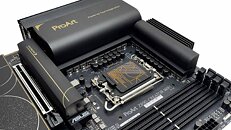 Adding to the complexity of the situation, the economics of building PCs have changed completely since memory prices increased, with DRAM kits now accounting for over 30% of PC costs. In the DIY PC sector, the shortage of AMD and Intel CPUs has also impacted PC builders' chances of buying new motherboards, leaving uncertainty about when the overall supply chain will start to ease. Consumers are pulling back from making major upgrades in these market conditions, so gaming PCs will likely take a significant hit in the coming months. Even AMD's CEO, Dr. Lisa Su, noted that gaming demand will decline in the second half of the year, leaving little positive outlook for the grim state of the PC DIY market.
Source:
DigiTimes
Interestingly, it's not only CPU and memory shortages driving this lowered demand; there are indications that consumers have slowed down their NVIDIA GPU upgrade cycles, which is impacting new motherboard sales. Particularly with the "Blackwell" GPU generation, consumers began purchasing PCIe 5.0 motherboards to achieve the greatest performance increase. However, as these GPUs became rarer and more expensive due to the global DRAM shortage, consumers have become reluctant to upgrade. ASUS is projected to sell about 10 million motherboards in 2026, while MSI and GIGABYTE are now projecting sales of less than 10 million units each. This represents about a 25% yearly decrease from 2025 sales. The worst position is estimated for ASRock, which is expected to see a 30% decrease according to the report.

60 Comments on PC Motherboard Sales Face Sharp 25%+ Decline Amid Weak Demand
Audio codecs have improved marginally over the last decade. PCIe changes from 3.0 to 5.0 have incurred minimal cost changes for vendors. Post purchase poor BIOS support is still the same. Although costs have increased for wood & extra plastic panels and more RGB because everyone needs that...
When new mobos are priced at 60-100% at the cost of a new high performance CPU, e.g, 9800X3D, that is the problem. Pure greed. I hope the vendors choke on low sales for a while and bring more cost effective products to market.
Sad times...
These days it's like consumers, unless you are super rich, are screwed six ways to Sunday.Why pay extra when you can simply just turn them off? ;)
Actually, most mid to low range motherboards don't have much RGB lights on them except Asrock motherboards.There is already a significant consolidation of motherboard manufacturers that sell directly to the DIY market in the last twenty years.
Compared to the early 00s when the market was very fragmented, now we have a market that is dominated by the big four Taiwanese brands who would do just fine because they made more than just motherboards.
One of my problem is that they're constantly stuck in this arms race, just trying to outdo each other by adding a few more VRMs or MOSFETs (which is wasting over a point), to achieve the best overclock,
While I believe they should feature more 20Gbps+ USB ports and at least 5Gbps LAN.
Additionally, robust heatsinks should be provided for all M.2 SSDs,
Not just the first slot. Any board in the $400+ range should come with heatsinks similar to this,
AXAGON CLR-M2XL:
2nd well, no - I don't buy low end stuff and no, even the bottom tier boards are full with that sh*t :D
Lack of innovation due to all the major players sucking on the teat of AI plus sky high prices mean no major tech purchases for me or anyone I know anytime in the near future.
The AI bubble burst cannot happen soon enough!
They are in panic mode, because there are no new lithography options, or the wafer prices start at $30,000 a pop for some nasty improvements which won't sell.Except that there is another, more serious barrier - PHYSICS and no possibility to shrink the transistor any further. Those "2nm", "1.4nm", "1.0nm" are a pipe dream and we don't know if we will see working products on them, and how much improvement they will offer at what prices.
and one of these ram kits was $165cad just over a year ago.
so from $490 for both to $1893 (not incl 13% taxes)
People are going to start going dumpster diving for old business laptops soon for the ram.
Here in New Zealand, a basic 32GB DDR5 kit costs more than a 16gb radeon 9060xt.
I am stuck on the laptop I have for however long this shit lasts now, I miss my 5800X3D + 3080 so much *sorrowful tears*
I have a 5900xt (16c/32t) cpu, 128gb ram, and a nice ASUS board with no rgb, as my main system; once my media server is set up, the sound card moves down a slot & I can finally fit in the 5070ti I got at walmart (stupid triple slot card) last black friday.
I have an x99 Huananzhi board that will handle my piddling around with AI and 3d rendering with Blender & Poser 14. It has two x16 slots, so I can go multi-gpu.
The gaming rig will have the 5700x replaced with a 5500x3d, and a b580 for 1440p gaming.
When i bought my mid X670E board as soon as Zen4 came out, the prices where already crazy high, i paid nearly 200$ for a relatively low end mb, at that price before you could get a high end mb.
And you could tell corner cutting like not including 7-segment displays for boot diagnostics and only LEDs, or cheap-ish realtek audio with not good isolation.
And that was, what, 5 years ago? give or take.
So imagine the overpriced MB industry crashing because of unchecked insane greed
You use what is given to you to make a better you in life. For 7 years my AM4 runs beautifully. It is so balanced in performance/value/energy usage that it has made me a lot of money in my investments and can run a few games or watch movies/documentaries here and there when I have time.
I still have my 1800X as backup and I still have my HP G4 printer as back up. The printer is 26 years old and still runs great.
IMHO the reason why the AM4 is still a viable option is because Tech has not advanced enough for the average consumer to make that change to AM5.
Hell the only reason why I'm almost ready to build a AM5 rig is because I have a tendency to buy certain things when that certain value/performance hits my buying goal within a certain monthly budget. So I have all of the parts needed (except memory) for a AM5 that would be comparable to my AM4 in concept.
The other reason for these price increase is simple GREED.
$1500 dollars in 2019 for a multimedia mid tier computer that I built, should cost around $1800 now if you are using the standard basic inflation rate of around 3% per year.
Well unforntunately to build my rig to my specs with current tech of today. I am looking at around $2400 in todays prices. Give or take a few hundred.
That is a 60% increase instead of an 18% price increase. And in many cases you are not getting that 60% increase in performance/energy cost/value.
I can afford this. That's not the issue. It's the knowledge and usage of the data I use and how marketing works in this day and age of society.
An example of my comment above is Hardware unboxed comment of Ray Tracing which I fully agree with.
I knew this was nothing but a gimmick. But too many people bought into the hype. So sucks to be you.
I'll stick with the tried and true methods of evaluating investmensts, which tech components are.
IF you got an AM4 IMHO stay with it for awhile. The real tech improvements have stagnated. If you want a AM5 IMHO make a monthly budget and by within that budget and carry over their excess to the next month.
Again 1+ years of casual purchases and within a certain montly budget.
And I almost have a nice AM5 mid tier rig that has an upgradable path.
They started the overpricing 7~8 years ago with small increments which ended up doubling the whole original price.I said more of those, more ports, regarding LAN: one should be enough, but 5Gbps should be the standard for some timeThere is no reason to not give the primary M.2 slot a chunky one.
On the rest, under the first PCIe sure - the GPU will cover a lot,
but the lower parts will seldom see a second card, there should be no problem to give a good heatsink for 2 more M.2.
Still doesn't quite justify paying over 200 for a board but ok.