Thursday, May 7th 2026
PC Motherboard Sales Face Sharp 25%+ Decline Amid Weak Demand
PC motherboard sales are on track for some of the biggest corrections in recent times as manufacturers struggle with weak demand, according to a DigiTimes report. What began as AI data center expansion quickly started affecting consumer PC DIY endeavors, as severe silicon shortages across the industry drove DRAM and CPU demand so high that prices have increased significantly for DDR4 and DDR5 memory kits, while regular CPUs have also seen a large price increase. In response, PC motherboard makers are caught in the middle of this shortage, seeing their motherboard unit sales revised down significantly. The report notes that all Taiwanese motherboard makers have significantly lowered their 2026 shipment targets, with some experiencing more than a 25% decrease in projected unit sales.
Interestingly, it's not only CPU and memory shortages driving this lowered demand; there are indications that consumers have slowed down their NVIDIA GPU upgrade cycles, which is impacting new motherboard sales. Particularly with the "Blackwell" GPU generation, consumers began purchasing PCIe 5.0 motherboards to achieve the greatest performance increase. However, as these GPUs became rarer and more expensive due to the global DRAM shortage, consumers have become reluctant to upgrade. ASUS is projected to sell about 10 million motherboards in 2026, while MSI and GIGABYTE are now projecting sales of less than 10 million units each. This represents about a 25% yearly decrease from 2025 sales. The worst position is estimated for ASRock, which is expected to see a 30% decrease according to the report.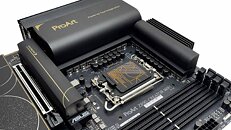 Adding to the complexity of the situation, the economics of building PCs have changed completely since memory prices increased, with DRAM kits now accounting for over 30% of PC costs. In the DIY PC sector, the shortage of AMD and Intel CPUs has also impacted PC builders' chances of buying new motherboards, leaving uncertainty about when the overall supply chain will start to ease. Consumers are pulling back from making major upgrades in these market conditions, so gaming PCs will likely take a significant hit in the coming months. Even AMD's CEO, Dr. Lisa Su, noted that gaming demand will decline in the second half of the year, leaving little positive outlook for the grim state of the PC DIY market.
Source:
DigiTimes
Interestingly, it's not only CPU and memory shortages driving this lowered demand; there are indications that consumers have slowed down their NVIDIA GPU upgrade cycles, which is impacting new motherboard sales. Particularly with the "Blackwell" GPU generation, consumers began purchasing PCIe 5.0 motherboards to achieve the greatest performance increase. However, as these GPUs became rarer and more expensive due to the global DRAM shortage, consumers have become reluctant to upgrade. ASUS is projected to sell about 10 million motherboards in 2026, while MSI and GIGABYTE are now projecting sales of less than 10 million units each. This represents about a 25% yearly decrease from 2025 sales. The worst position is estimated for ASRock, which is expected to see a 30% decrease according to the report.

60 Comments on PC Motherboard Sales Face Sharp 25%+ Decline Amid Weak Demand
But now on your comment I checked, the AI goldrush even individual electronic parts (capacitors, mosfets etc) got a price hike of 30% in the last year, but it was mostly flat before.
Since I bought my current mainboard in 2024 I did not really follow those prices, but it was already painful 2 years ago...
I still think that the other parts' price increase cutting into the market of mainboard market (mostly GPU prices), as many of us holding out longer on an old platform, hoping for better prices or just a bigger leap between performance.
There's really only two ways to radically improve that:
1. Move away from 4K block sizes to larger 16K or 32K sizes.
2. Move to better underlying technology, like the now-dead Optane tech. Intel really missed an opportunity with this one. Aimed badly with hard drive accelerators when for the premium price it could have been targetted towards enthusiasts as slow RAM. Dedicated page file storage, RAMdisk replacement, supplementing existing RAM. Calling it Optane Memory and making it a hard drive accelerator....
The DRAM version had 300nS read and 500us-1000uS write latencies. That's 250x lower read latency and 80x lower write latency when compared to fastest NVMe SSDs. Eventually OS could have been installed in such a version and have near-instantaneous, true power off "sleep" mode. The NVMe version had still low 8us read/write latencies. Someone who capped their system memory to 2GB told me that with Optane drive installed the performance was acceptable, meaning the much faster DRAM version would have been a perfect OS-only drive that would have boosted performance for everybody seriously.
It should have been two marketing phases:
-Gen 1 NVMe version for Dedicated page file storage, RAMdisk replacement, supplementing existing RAM
-Gen 2 DRAM version for OS installs, and some application/game installs. Since it doesn't need to load into memory, the OS could have a new mode where it boots up instantly. And games/applications made for it would load instantly.
Instead, we got more of the same. No wonder PC sales aren't improving. Novalake could be 2x as fast in single thread. It still won't dramatically boost sales, because computers have been fast enough for long time. I would say we've reached a phase where things are starting to get worse. Mandatory age verification turning into full Digital ID, spyware built into hardware. Features like Windows 11 Recall becoming mandatory.
Since performance is enough, we now should ask for more open source, more upgradeable, more repair friendly and more user accessible and configurable devices.
Who would have thought so?
It's a slightly better version of the USB memory drives that advertise 3.0 interface speeds but can only sustain that for 5 seconds before it plummets to a speed barely saturating USB 1.0 speeds at 12 megaBITS per second. Depending on what you transfer sometimes you see it dip down into the kilobytes range.