Thursday, October 1st 2026

Intel Core Ultra 4000 "Nova Lake-S" Lineup Leaks With 28-Core 4970K BFC
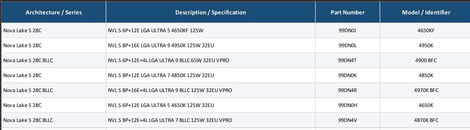
A new leak by @laurentschoice lists seven desktop Nova Lake-S processors under what looks like Intel's new four-digit Core Ultra 4000 naming, led by a Core Ultra 9 4970K BFC. It apparently has 8 P-cores, 16 E-cores, and 4 LPE cores for 28 in total, plus bLLC (big last-level cache), a 125 W rating, and a 32 EU iGPU. That puts it above the Core Ultra 9 4950K, which first surfaced in a CPU-Z leak in August as a 28-core chip. This list shows the 4950K with 24 cores (8 P-cores and 16 E-cores), without LPE cores or bLLC.
The rest of the list follows a similar pattern. The Core Ultra 7 4870K BFC has 24 cores and bLLC, while the 4850K gets 20 cores without it. There is also a Core Ultra 9 4900 BFC with 22 cores, bLLC, and a 65 W rating. We currently don't know what BFC stands for, although the models carrying it appear to be the ones with bLLC, which Intel is introducing as its answer to AMD's 3D V-Cache. Intel hasn't confirmed any of these names, so they may well change before Nova Lake's official launch.
 Earlier reports said the single compute tile models would arrive before the 52-core flagship, and the 28-core bLLC chip was reportedly set to pull up to 296 W at PL2 despite its 125 W rating. Regardless, Nova Lake's launch is inching closer and closer, with qualification samples now showing up in programs like HWiNFO. Earlier reports point to a Q1 2027 launch window for Nova Lake-S CPUs, with the 52-core flagship arriving later.
Sources:
LC Tech Leaks on X, via Videocardz
The rest of the list follows a similar pattern. The Core Ultra 7 4870K BFC has 24 cores and bLLC, while the 4850K gets 20 cores without it. There is also a Core Ultra 9 4900 BFC with 22 cores, bLLC, and a 65 W rating. We currently don't know what BFC stands for, although the models carrying it appear to be the ones with bLLC, which Intel is introducing as its answer to AMD's 3D V-Cache. Intel hasn't confirmed any of these names, so they may well change before Nova Lake's official launch.


103 Comments on Intel Core Ultra 4000 "Nova Lake-S" Lineup Leaks With 28-Core 4970K BFC
Marketing person 1: "we could go back to 4 numbers, but we've broken the sequence, so we'll have to start over"
Marketing person 2: "yeah, that's great, but we can't go back to 1000, these were supposed to be the "4th" gen of "core ultra", so we should just add a 0 to the 3-digit numbers we were going to use"
Marketing person 3: "aren't people sick of us changing the numbering system regularly? Shouldn't we just stick with what we have and focus on the product improvements?"
Marketing Manager: "1 and 2, I love this energy, great stuff! person 3...turn in your badge and gun and get the hell out of here"
AMD and Intel should try naming them like cars with a trim level, something normal people can remember. Instead of using these cryptic SKU numbers out of a parts list.
Maybe instead of model numbers, CPUs should get bar codes directly. You can scan those and get all the relevant info :P
Most of the characters in modern CPU names is useless junk. The 0s and Xs for example. Or the Core "9" or Ryzen "9" number.
Come on, release it already!
Core i7-4960X, i7-4930K, and i7-4820K... aren't these going to look like they're in the same series if you don't take the i7 or the X into account?Intel's current HEDT is Granite Rapids-W e.g. 658X, it has octa channel memory and you want quad channel memory back???C = Large L3 cache (consistent with the i7-5775C having L4)
D = Dual compute tiles + 175 W TDP (ignore the fact that the i7-5500DU and i7-6498DU exists)
P = P Core-only (Alder Lake-P is gone, and don't they all feature LPE cores?)
G = 12 Xe3 cores (weren't they shelved for desktop?)
F = No IGP
S = Special edition (e.g. 12900KS, 13900KS, 14900KS)
K = 125 W TDP + Unlocked, 65 W specifically for the 6P Ultra 9 and 175 W for the dual compute tiles
T = 35 W TDP
E = Embedded
L = LGA package for U and H parts (e.g. 120HL, 120UL)
A = Who knows?
8P+16E+4LPE
6P+12E+4LPE
Single
Single
36 MB/144 MB
108 MB
2C Xe3 GT1
2C Xe3 GT1
65 W/125 W
65 W
485KC, 485KFC, 485KCG, 485K, 485KF, 485
475KC, 475KFC
485P, 485G, 485F
475PKC, 475KCG
4P+8E+4LPE
Single
18 MB
2C Xe3 GT1
35 W/65 W
455, 455T, 455E, 455F, 455TE
455TF, 455TEF
4P+4E+4LPE
4P+0E+4LPE
Single
Single
15 MB
12 MB
2C Xe3 GT1
2C Xe3 GT1
35 W/65 W
35 W/65 W
435, 435T, 435F, 435E, 435TE, 435A, 435TA
425, 425T, 425F, 425E, 425TE
435TF, 435TEF
425EF, 425TF
If the Processor 300, 310, and the 300T doesn't get a successor, then the Core Ultra 1 wouldn't or shouldn't exist. The last digit according to present Intel is usually a refresh marker like how it was done in Comet Lake-S (e.g. i3-10105F). Now it's either nonsensical (e.g. Core Ultra 5 230F), a refresh (e.g. Core 5 250K Plus), a marker for better graphics (e.g. Core Ultra 5 338H), or a marker for less processor cores and graphics cores (e.g. Core Ultra 5 322). I wonder how is that going to work out?
On a more positive note, I could live with weird, long numbers, if they found a way to keep that for all their generations, not having to learn a new scheme every 5 years or so. If you add how many times these have changed and recall the changes were always driven by "simplicity" and "more clarity", you'd think a first grader can read these today effortlessly.
That is why we home users only need CPUs with P-cores.