Thursday, October 1st 2026

Intel Core Ultra 4000 "Nova Lake-S" Lineup Leaks With 28-Core 4970K BFC
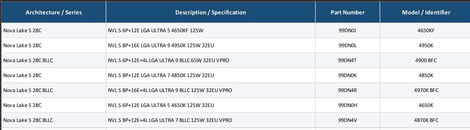
A new leak by @laurentschoice lists seven desktop Nova Lake-S processors under what looks like Intel's new four-digit Core Ultra 4000 naming, led by a Core Ultra 9 4970K BFC. It apparently has 8 P-cores, 16 E-cores, and 4 LPE cores for 28 in total, plus bLLC (big last-level cache), a 125 W rating, and a 32 EU iGPU. That puts it above the Core Ultra 9 4950K, which first surfaced in a CPU-Z leak in August as a 28-core chip. This list shows the 4950K with 24 cores (8 P-cores and 16 E-cores), without LPE cores or bLLC.
The rest of the list follows a similar pattern. The Core Ultra 7 4870K BFC has 24 cores and bLLC, while the 4850K gets 20 cores without it. There is also a Core Ultra 9 4900 BFC with 22 cores, bLLC, and a 65 W rating. We currently don't know what BFC stands for, although the models carrying it appear to be the ones with bLLC, which Intel is introducing as its answer to AMD's 3D V-Cache. Intel hasn't confirmed any of these names, so they may well change before Nova Lake's official launch.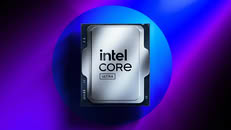
 Earlier reports said the single compute tile models would arrive before the 52-core flagship, and the 28-core bLLC chip was reportedly set to pull up to 296 W at PL2 despite its 125 W rating. Regardless, Nova Lake's launch is inching closer and closer, with qualification samples now showing up in programs like HWiNFO. Earlier reports point to a Q1 2027 launch window for Nova Lake-S CPUs, with the 52-core flagship arriving later.
Sources:
LC Tech Leaks on X, via Videocardz
The rest of the list follows a similar pattern. The Core Ultra 7 4870K BFC has 24 cores and bLLC, while the 4850K gets 20 cores without it. There is also a Core Ultra 9 4900 BFC with 22 cores, bLLC, and a 65 W rating. We currently don't know what BFC stands for, although the models carrying it appear to be the ones with bLLC, which Intel is introducing as its answer to AMD's 3D V-Cache. Intel hasn't confirmed any of these names, so they may well change before Nova Lake's official launch.


103 Comments on Intel Core Ultra 4000 "Nova Lake-S" Lineup Leaks With 28-Core 4970K BFC
I mean they'll probably have another official meaning, but I'm 100% certain it means Big F*ing Cache and that it's a nod to Doom/Quake.
Seems like marketing just to compare to the competition.
Also, why are some people already saying here they'll replace their hardware, if you havent seen any benchmarks yet?
Trying to understand the hype: is it the cache or the cores? Whenever I see cpus with such power draw I get an "oh well", becase they seem rather inefficient. Of course time will tell and hopefully these bring great competition against AMD :)
As you can see from the review, a tiny single tower 30$ cooler can handle 285 watts
www.techpowerup.com/review/fsp-np5-black-cpu-air-cooler/8.htmlPower draw is the most irrelevant thing on a cpu cause it's one of the few things that is completely up to you to change. Not only does it takes 5 seconds to change the power limit, you can also buy a non k sku that comes with lower power limits from the factory.
It has nothing to do with efficiency. In order to properly compare efficiency you need to put 2 Cpus at the same power level and see which one is faster.
The 285 W is right at the throttle point (100°C) and at max rpm.
For noise normalized 250 W corresponds to 92.6°C.
This is in the following conditions:And in this type of "case":
tpucdn.com/review/fsp-np5-black-cpu-air-cooler/images/installed2.jpg
Good luck getting the same temps at 24°C ambient and in a regular mid-tower case.
en.wikipedia.org/wiki/Arrow_Lake_(microprocessor)#Desktop
en.wikipedia.org/wiki/Zen_5#Desktop
But there's no reason to go for a 280mm AIO unless it's for heavy overlocking, as a tower cooler with more heat pipes will do just fine, if not better in practice. My go-to option is the Noctua NH-U14S, which should be fine for any of these models, and likely upcoming Nova Lake and Zen 6 too, unless they have even worse thermal distribution. But there are many cheaper options too. For reference, the workstation version of NH-U14S tops out at 680W, so the limiting factor here is the heat transfer between the die and the cooler.Which will only skew the real world results in favor of tower coolers;
- Realistically, very few cases have air flow to accommodate a 280+mm AIO at a capacity where it beat a good tower cooler.
- Buying a high-performing tower cooler will leave room in the budget to upgrade the case fans, which will be the limiting factor anyways. For sustained loads the case cooling should exceed the thermal capacity of the CPU cooler, otherwise you're just wasting money. Even a $30 tower cooler with the right case cooling will be wiser than a hefty AIO with low case airflow (which most buyers have).
- Having a good setup with case fans will even help the efficiency of the tower cooler vs. an open test rig.
Anyway, I digress.
Intel's naming scheme changes are usually done to differentiate from AMD, who commonly follow in Intel's footsteps.
Power draw does fucking matter. Arrow lake at 210w doesn't perform like amd at 210w if you get rid of thier node advatgae with math. It actually performs like shit comparatively. You loose quite a bit of multithread if you power limmit arrow lake, where it barley matches the 9950x before it now looses by quite a bit.Amd chiplets packed closer together, intel got e cores which are more spread out, and power draw too. 293 vs 220w, and intrl shaved its dies and interfaces as close as possible going all the way back to 10th gen, so this is unsuprising.
If not, you are wrong, move on.
R23 Efficiency
270k plus > 285k > 9950x
CPU Temperature
9950x >> 285k > 270k plus
Node performance
N3B <= N4P
N3B +10% vs N5
N4P +11% vs N5
AMD uses SMT while Intel does not, and SMT is extremely beneficial for improving MT efficiency, even in this case, where Intel and AMD use nodes with similar performance, the efficiency of the 9950x is lower than that of the 285k.
I expect that for novalake and zen6, the MT performance and efficiency of the Ultra 5 4650K will be much higher than a full 12 core Ryzen 7.
If I understand your graph correctly, a 270k at 35w matches the 9700x at 160 watts. So the 9700x needs 500% more power.... But people are trying to convince me amd is efficient. Oh well
For an Intel CPU with much higher MT performance, consuming about the same amount of power in gaming as AMD shows that AMD has not controlled chipset power consumption well.
At 18000 points:
- the 270K draws 35 W
- the 285K about 38 W
- 265K and 250K about 42 W
- the 245K draws 50 W
- the 9700X about 87-88 W
- and the 9600X can't reach 18000 even at 130 W
Was even fx that far behind?
The top graph with the 9950X makes more sense for this kind of comparison. But even then, AMD had better step up the game with Zen 6, as the 270K seems to be a winner here, too (it would have been nice to see the two in the same graph, but it's fine).
Imagine Nvidia introduced a 4gb VRAM GPU for 1k$ and I said" one does not buy a 4gb vram GPU for games". Well yeah, cause it's crap. It shouldn't have 4gb or it should be considerably cheaper.
But to entertain the thought, what does someone buy the 9700x for? It's inferior to everything compared to other products in its price range, is it not?
But you know what's worse than an 8-core CPU for £250? An 8-core CPU for £450, the 9800 and 9850X3D. Nobody seems to be roasting those two for some reason, although I think they would deserve it more than the 9700X does.