Thursday, September 3rd 2026

AMD Ryzen 7 7800X3D Swells and Burns Again, This Time on an ASUS Crosshair X670E Hero
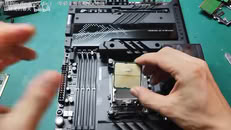
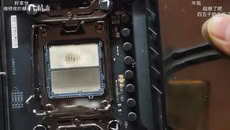
Another Ryzen 7 7800X3D has reportedly swollen and burned, while also damaging the ROG Crosshair X670E Hero motherboard in the process. UNIKO's Hardware flagged the case, citing a video posted to Bilibili as the original source. The video shows a Ryzen 7 7800X3D CPU with clear swelling on the underside where it made contact with the CPU socket. There is discoloration on both the CPU and the socket itself. Moreover, the socket pins are warped and damaged in the middle, presumably due to the pressure of the swelling. One peculiar finding is that one of the notches on the CPU socket looks slightly off. Perhaps more importantly, the board's BIOS version wasn't confirmed, which is directly relevant due to AMD's proposed fix.
This kind of failure first showed up in April 2023, when several 7800X3D and 7950X3D chips bulged and took their sockets with them on X670E boards. AMD pinned it on SoC voltage running too high and rolled out AGESA firmware that capped it at 1.30V across AM5 motherboards. This new case might be straightforward if the BIOS hadn't been updated at all. However, even after the BIOS fix, the reports never fully stopped. Just weeks ago, a 7800X3D reportedly burned out on an MSI PRO X870-P WIFI board running the latest BIOS, with EXPO enabled and nothing else touched. We have even seen reports of Ryzen 7 9800X3D CPUs burning in the exact same manner. If you're running a 7800X3D, it's probably worth checking that you're on the latest BIOS and keeping an eye on SoC voltage.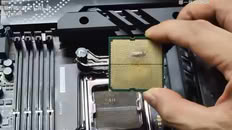
Source:
UNIKO's Hardware on X
This kind of failure first showed up in April 2023, when several 7800X3D and 7950X3D chips bulged and took their sockets with them on X670E boards. AMD pinned it on SoC voltage running too high and rolled out AGESA firmware that capped it at 1.30V across AM5 motherboards. This new case might be straightforward if the BIOS hadn't been updated at all. However, even after the BIOS fix, the reports never fully stopped. Just weeks ago, a 7800X3D reportedly burned out on an MSI PRO X870-P WIFI board running the latest BIOS, with EXPO enabled and nothing else touched. We have even seen reports of Ryzen 7 9800X3D CPUs burning in the exact same manner. If you're running a 7800X3D, it's probably worth checking that you're on the latest BIOS and keeping an eye on SoC voltage.


160 Comments on AMD Ryzen 7 7800X3D Swells and Burns Again, This Time on an ASUS Crosshair X670E Hero
But generally speaking 3d chips are not for people who wanna push stuff to the limit - then stuff like the article happens. You wouid probably be happier with intel, where you have to fiddle with everything all the time to get decent performance, than a plug and play 3d chip :p
But i am yet to see it happen on a 7800x3d running stock settings, always people running iffy settings.
Zen4 was most notorious with ASUS, though it's only happening on X3D for the most part.
5800X3D was the first version, so maybe their tolerance margins were much higher to ensure it works.
The x3d chip is extremely sensitive to voltage and to electron migration. I wouldnt be surprised if the cache gets destroyed in 6-8 years making the cpu an expensive paperweight.
The bulge is directly on the spot of the CCD chip.
I dont knock you for running a stock system, why are you giving me a hard time for tuning my system?
Edit: My curve is -40 AC :D
I just have expo enabled with trefi at 30k, and all voltages as low as they go, to ensure chip longevity.
As far as voltages go, i noticed your mem voltages are very high - is your vddio equally high? But impressively low curve, asssuming it's stable :)
There are ram bandwidth heavy games like star citizen where it makes a difference, but in most games the difference is negible.
I would only use expo with a low voltage kit though. I would never ever run high voltage for a tiny performance difference. As i posted here, my voltages are quite close to stock.
Yes, you need a bit higher soc voltage with higher memory speeds. But mostly memory speed and voltage affects the needed vddio voltage (memory controller), which should ideally be the same as mem vddq.
Has Intel not had these problems in the past for their way early generations?
They look stock to me.