Thursday, September 3rd 2026

AMD Ryzen 7 7800X3D Swells and Burns Again, This Time on an ASUS Crosshair X670E Hero
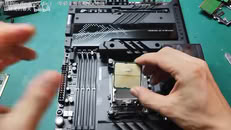
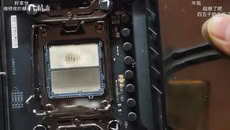
Another Ryzen 7 7800X3D has reportedly swollen and burned, while also damaging the ROG Crosshair X670E Hero motherboard in the process. UNIKO's Hardware flagged the case, citing a video posted to Bilibili as the original source. The video shows a Ryzen 7 7800X3D CPU with clear swelling on the underside where it made contact with the CPU socket. There is discoloration on both the CPU and the socket itself. Moreover, the socket pins are warped and damaged in the middle, presumably due to the pressure of the swelling. One peculiar finding is that one of the notches on the CPU socket looks slightly off. Perhaps more importantly, the board's BIOS version wasn't confirmed, which is directly relevant due to AMD's proposed fix.
This kind of failure first showed up in April 2023, when several 7800X3D and 7950X3D chips bulged and took their sockets with them on X670E boards. AMD pinned it on SoC voltage running too high and rolled out AGESA firmware that capped it at 1.30V across AM5 motherboards. This new case might be straightforward if the BIOS hadn't been updated at all. However, even after the BIOS fix, the reports never fully stopped. Just weeks ago, a 7800X3D reportedly burned out on an MSI PRO X870-P WIFI board running the latest BIOS, with EXPO enabled and nothing else touched. We have even seen reports of Ryzen 7 9800X3D CPUs burning in the exact same manner. If you're running a 7800X3D, it's probably worth checking that you're on the latest BIOS and keeping an eye on SoC voltage.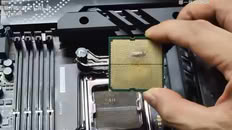
Source:
UNIKO's Hardware on X
This kind of failure first showed up in April 2023, when several 7800X3D and 7950X3D chips bulged and took their sockets with them on X670E boards. AMD pinned it on SoC voltage running too high and rolled out AGESA firmware that capped it at 1.30V across AM5 motherboards. This new case might be straightforward if the BIOS hadn't been updated at all. However, even after the BIOS fix, the reports never fully stopped. Just weeks ago, a 7800X3D reportedly burned out on an MSI PRO X870-P WIFI board running the latest BIOS, with EXPO enabled and nothing else touched. We have even seen reports of Ryzen 7 9800X3D CPUs burning in the exact same manner. If you're running a 7800X3D, it's probably worth checking that you're on the latest BIOS and keeping an eye on SoC voltage.


160 Comments on AMD Ryzen 7 7800X3D Swells and Burns Again, This Time on an ASUS Crosshair X670E Hero
Vddp above 1.0v is unsafe though, and yours is at 1.05v.
of course you can always add 0.05V DC until you hit 1.55V DC.
MY kit runs with 1.35V DC, 1.30V DC is flankfy for 6000 / 6200 mt/s on both cpus in the past.
I lost my opportunity as DRAM is even more expensive, whataboutism. some claim active cooling allows such numbers, etc, 2nd whataboutism
-- Let's clal it personal opinion. roman degrades silicion with every power on hour, the degradion increases with higher voltages which are not needed for certain settings. I got that impression with different ryzen 5800x / 7600x / 7700x. (i will limit my scope to those cpus)
I restrict my statement to the values i personally consider safe. How to ruin am4 or am5 cpus is the expertise of others.
I consider a cpu defective when it does not boost properly anymore, cpu boost clock or when it does not hit certain dram clocks anymore.I agree. I still remember some shitty cpus where the thermal fuse did not work and the cpu was dead what i read. On the positive side, amd implemented with msi the behaviour correctly.
The thing is, our understanding of safe values, and what are actually safe values may or may not be the same. I'm not gonna put my tinfoil hat on and base my understanding of these CPUs on what we, a bunch of random dudes, discuss on a forum, instead of what AMD and motherboard makers set up. We don't know the settings that bloke in the article ran his CPU at before it blew up, which gives us no reason to believe that he ran default values. It may as well be social media sensationalism coming from a heavy OCer, if all I care.
But honestly, it amazes me that you have been this many years on a tech site, and managed to not learn the fact that increased voltage increases the rate of chip degradation...
As someone pointed out, this blew up at the ccd location on the chip, rather than the soc location, so this guy probably forced through some core overclocking, which amd tried to block, but some people in their infinite wisdom is doing through blck overclocking anyways.
Anyways, the higher the voltage, the higher the odds are that it will catastophically fail. Amd put in a voltage restriction for the vsoc, which they think will prevent the soc from outright exploding, but motherboards can still exceed it in various ways. And the rest of the chip can also still get unlimited amounts of voltage, so someone who doesn't know what they are doing, could easily blow up their chip.
As for expo with 1.2v vsoc and 1.45v vddio being safe - no, it deffo isn't. It may not make your cpu blow up, but it deffo won't live a long life.
As for amd not doing it if they knew it reduces chip lifespan... i think they are entirely ok with it dying from accelerated degradation, as long as it does so after the warranty expired. Much like was the case with intel and their 13th and 14th gen cpu's.
Expo is the sweetspot for chip performance, not chip longevity. But you can drastically improve that by lowering the voltages - they never need to be as high as expo sets them to. They are just that high to make sure that even the worst chip in existance can run expo without crashing.
I didn't say that - more that if the consequence of people using expo means that cpu's dies right after warranty expires, then that's not something they will change their recommondation for. Dying within a year would have been a different matter.
That said, is it really far fetched with planned obscelescence ? It's literally a thing with all electronics today.
Edit: Is VDDIO/VDDQ tied with RAM voltage? If so, 1.1 V isn't possible with EXPO.
But no, you can't run vddio at 1.1v with mem at 6000 - but you can run it alot lower than the default expo profile. As said, i run vddio at 1.25v.
Eh, why do I even bother? :confused:Hm, maybe, maybe not. We'll see.Thanks for specifying all that. :)
I'm still on the opinion that EXPO wouldn't be a thing if it wasn't safe long term, but really, we'll see.
Yeah, tweaking resistances get quite beyond the scope of the average person.
Well it deffo is a thing with IMC degradation on zen3 for people who is running expo, hence that massive thread.
You're welcome :)
I think you give corporations like AMD too much credit. Thing to always remember : they want your money, not your friendship. They needed expo to get ahead of intel performance wise, and thus get the sales.
People still using am4 platform have been using it for many years at this point, and there are vast issues with IMC degradation on them for people who have been running expo without fixing voltages - and considering that amd is using a comparably weak IMC on am5, i reckon we will see alot of issues after about 4-5 years of use, if people used default expo profiles without reducing voltages.
But the voltage tolerated by the IMC is about the same (has nothing to do with memory speed).
Man, I'm tempted to just disable EXPO and call it a day. I sure can't be asked to manually fiddle with voltages. At least I'd get slightly higher CPU core clocks that way, thanks to the increased power budget. How much is the performance loss on a 9700X with 4800 MHz RAM compared to 6000, does anybody know? :D