Sunday, September 13th 2026

ASRock's TempGuard Failed to Stop a PSU-Side Connector Meltdown on a $15,000 RTX PRO 6000 Rig
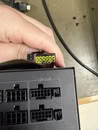
A repair shop technician has reported another melted 16-pin power connector on an ASRock Taichi TC-1650T PSU, paired with a $15,000 NVIDIA RTX PRO 6000 Blackwell Workstation Edition GPU. The former ships with native 12V-2x6 cables carrying ASRock's own NTC temperature sensor. According to the technician's Reddit post, the connector failed catastrophically on the PSU side and melted into the socket itself, even though both ends of the cable were fully seated. The GPU reportedly survived, and the damage was confined to the power supply side. The technician also says the sensor is mounted on the wrong side of the cable, on the ground line rather than the 12 V side it's supposed to watch, which would explain why it apparently never caught the rising heat in time.
ASRock added the NTC sensor and TempGuard system to its 12V-2x6 cables specifically to shut a system down before a connector melts. This time the system failed to catch the rising temperatures, but it has worked in the past. TempGuard reportedly caught a shunt-modded RTX 5090 pulling over 1,300 W, saving its power connectors from melting. On the flip side, this isn't the first time this exact GPU and PSU pairing has run into trouble either, as a similar melting incident on the same combo surfaced back in March. If the sensor placement is really off on at least some cables, that's a bigger concern than one bad unit, especially when paired with a card that costs as much as a used car.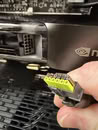
Source:
Reddit
ASRock added the NTC sensor and TempGuard system to its 12V-2x6 cables specifically to shut a system down before a connector melts. This time the system failed to catch the rising temperatures, but it has worked in the past. TempGuard reportedly caught a shunt-modded RTX 5090 pulling over 1,300 W, saving its power connectors from melting. On the flip side, this isn't the first time this exact GPU and PSU pairing has run into trouble either, as a similar melting incident on the same combo surfaced back in March. If the sensor placement is really off on at least some cables, that's a bigger concern than one bad unit, especially when paired with a card that costs as much as a used car.


169 Comments on ASRock's TempGuard Failed to Stop a PSU-Side Connector Meltdown on a $15,000 RTX PRO 6000 Rig
?
The ground pins are just as susceptible to heating as the 12V pins.
www.igorslab.de/en/the-imbalance-of-current-flows-in-the-pc-why-only-certain-pins-of-the-12vhpwr-melt-and-via-ground-lines-on-detours-investigative/
www.techpowerup.com/330765/asrock-showcases-atx-3-1-pcie-5-1-power-supply-units-at-ces-2025#g330765-4
Sure, one can have a 12V current and a 5V current and these combine at the ground wire, but here we have only 12V,
so the two currents (12V and Ground) must match as is confirmed by igor's measurements.
But here we only need conservation of charge and not the loop law.
There are cases of the grounded side being melted also, and no part of the cable should get hot enough to melt or burn.
Let's say one pin is suffering a voltage drop and so is heating up; does one really want to force it to then carry a full load?
Buildzoid explained why the 12v2x6 connector is a downgrade from the initial 12vhpwr connector design, load balancing the connector into 3 separate 12V lines helps balance the load.
Although I assume this wouldn't be perfect either, not with how much power is going through a connector that at best should be limited to 300W, because of heat cycles possibly causing pins to lose contact.
but I do recall how putting bridge rectifiers in parallel has the same load
balancing issue with the same (less than idea) solution of adding resistance.
Group prayer for 12v recall anybody??
There's also a situation, improbable but possible, where ALL six +12V pins suffer a voltage drop of a similar magnitude. To protect against this, you need even more complicated solutions, which involve either a temperature sensor and overheating protection, and/or an additional voltage sense wire, which carries +12V with no current from the PSU to the GPU.
I wonder if some manufacturer, that really takes care to make the plugs properly - so that the contact tubes grip the pins really well, even exists today.