Sunday, September 13th 2026

ASRock's TempGuard Failed to Stop a PSU-Side Connector Meltdown on a $15,000 RTX PRO 6000 Rig
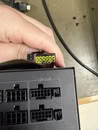
A repair shop technician has reported another melted 16-pin power connector on an ASRock Taichi TC-1650T PSU, paired with a $15,000 NVIDIA RTX PRO 6000 Blackwell Workstation Edition GPU. The former ships with native 12V-2x6 cables carrying ASRock's own NTC temperature sensor. According to the technician's Reddit post, the connector failed catastrophically on the PSU side and melted into the socket itself, even though both ends of the cable were fully seated. The GPU reportedly survived, and the damage was confined to the power supply side. The technician also says the sensor is mounted on the wrong side of the cable, on the ground line rather than the 12 V side it's supposed to watch, which would explain why it apparently never caught the rising heat in time.
ASRock added the NTC sensor and TempGuard system to its 12V-2x6 cables specifically to shut a system down before a connector melts. This time the system failed to catch the rising temperatures, but it has worked in the past. TempGuard reportedly caught a shunt-modded RTX 5090 pulling over 1,300 W, saving its power connectors from melting. On the flip side, this isn't the first time this exact GPU and PSU pairing has run into trouble either, as a similar melting incident on the same combo surfaced back in March. If the sensor placement is really off on at least some cables, that's a bigger concern than one bad unit, especially when paired with a card that costs as much as a used car.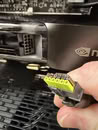
Source:
Reddit
ASRock added the NTC sensor and TempGuard system to its 12V-2x6 cables specifically to shut a system down before a connector melts. This time the system failed to catch the rising temperatures, but it has worked in the past. TempGuard reportedly caught a shunt-modded RTX 5090 pulling over 1,300 W, saving its power connectors from melting. On the flip side, this isn't the first time this exact GPU and PSU pairing has run into trouble either, as a similar melting incident on the same combo surfaced back in March. If the sensor placement is really off on at least some cables, that's a bigger concern than one bad unit, especially when paired with a card that costs as much as a used car.


169 Comments on ASRock's TempGuard Failed to Stop a PSU-Side Connector Meltdown on a $15,000 RTX PRO 6000 Rig
Why are you writing these nonsensical things? Is it on purpose and what is the purpose?
Fretting is well known behaviour under thermal stress. It happens everywhere, even in PC connectors, when you have combination of heat and metal connectors.
Read, learn. Only after that you can afford to be rude.
P. S.
Safety limits exist for the reason. If you design bridge with 14% safety limit, you go to jail.
If you add preservative in food with 14%safety limits, you go to jail.
Only in this crazy world, bunch of you shining armor knights defend 14% safety limit in connector as something acceptable.
The only interesting and relevant information from the article is THE CRITICAL IMPORTANCE OF THE PROPER CONTACT FORCE. The deformation and loss of contact force is also nicely illustrated, stressing the importance of good materials that are not too easy to deform.
I have been talking about the possibly problematic easy to deform material used to make contact tubes from the beginning of the discussion of the problem. I mentioned it like TWENTY TIMES ALREADY.
Again and again and again: the problem of melting connector is purely mechanical problem of loose connectors, that for whatever reason lost or were made with insufficient contact force.
The pins are moving slightly: left, right, up and down from their initial mould injection position. Because the pin is moving the resistance is increasing so the heat is up as a result.
Why moving?
Amphenol connector tech specs - 85 C, so at high and prolonged heat mould is loosing structural strength and is softer so becomes permissive to pin movement talking in consideration expanding/ dilation pin mats. Crimple can't hold the pin into initial position and will move along.
All this will result in an abnormal position and higher resistance.
When connector is cooling down is too late, DMG is done, pin and crimple moved. Next heating cycle, the process repeats and aggravate the situation, because already one connection/pin is malfunctioning now the other pins take the load of the malfunctioning pin and they overheat leading to other bad connections.
EDIT: as much as you take contracting and dilation on electronic parts that strain soldering joints and lead free soldering is bad idea, you taking in consideration same factors for the connectors, plastic around pins is losing integrity.
As I said in other post and thread oxidation is co-factor which can exacerbate the first but comes late in the life of the connector if didn't melt already.
But, since it is too long and complicated to you, I will make a short version: HIGH TEMPERATURE = MICROSCOPIC MOVEMENTS = CHANGE IN PIN CONTACTS = MELTING.
Hell, you can apply only so much force before breaking everything, and still it is not enough. Conclusion is that connector is flawed.
I hope that you at least get paid for all this trolling. Because if you do it for free... dude...
So what failure rate you calculated and what was the point of your graphs, except to play coy and muddy the water?
Some people may think that the pins are firmly molded in a socket body made from a tough engineering plastic, but some other people have different ideas.
This thread became a bizzare clown club and I am outta here.
You posted a graph claiming a 4% failure rate was high, as long as it's AMD's failure rates it's bad, but when it comes to Nvidia your made up failure rate in your head isn't high enough. I'm not the one making things up here, the derailing, false claims, and then the victimization is getting tiring.People keeping track of and reporting news of when failures happen is exactly what a journalist does, I don't trust anyone wanting to hide and downplay the problem.Those pins are so loose in the socket body that people like Jaystwocents and Steve from HW Unboxed have been able to work pins out of the socket with their hands.
It's bizzare how people keep wanting to minimize the problem because it's criticizing their favorite brand, or maybe there's some other agenda from GPU and PSU manufacturers.
And you conveniently overlook wattage part 😊 Ccc... I hope you get paid, really. Otherwise, it is pathetic.It is not wigling pin theory, it is well known behaviour of metal under thermal variations. It is known for at least 50 years... They better spend money on proper engineers than on paying random guys on internet to defend their junk, don't you think?I know to what his keyboard is NOT connected, for sure...
radeon/comments/1mx5weg/melting_12vhpwr_connector_claims_its_first_amd_rx
I mean, if it only happens to 500w++ cards, I have good news for you. There is only one card that draws that much, the 5090. I don't think you were planning on buying it regardless, so what exactly is the issue? Don't buy a 5090 and you are good, no issue with the connector at all since it doesn't happen to the rest of the cards, right? :D
Backpedalling in 3....2.....1....
Or him
Alex from the first link he called out recall 3 years ago.
Enjoy
Or ask Amphenol, they tested the connectors before marketing them.
12VHPWR and 12 V2x6
But also there are changed specs which are important inbetween the 2 versions....
For 12VHPWR we have operating temps 85 C and 13.5 A/pin while for 12V 2x6 we have OT 105 C but only 9.5 A/pin
How come the operating temps changed from 85 to 105 C in between the 2???
Because 12VHPWR was melting too fast? They changed the moulding plastic quality?
Why is 12V 2x6 only 9.5A/pin compared to the previous 13.5A .
Because 13.5 A was not realistic?
Now, you still believe in this whole circus, we are the clowns, well, at least 4 of us according to you.
The last question is: What are you exactly?
On the last question don't need to answer but to yourself, after you look in the mirror.
Now where I did get it from ... Yes I remember now, was online that I received my SIM, but was not great...
How about your EE? Care to share your experience with us?
I just used AI to scour through reddit and find all the reports. Reports of 12vhp cable since 2022 - a little bit below 100
Reports of the 9800x 3d (specifically and exclusively, lol) blowing up and / or killing it's motherboard, more than 150.
Then I took a look at official figures. Cablemod had an angled adapter that was fully problematic and they had to recall it. The failure rates on this specific adapter which was highly problematic was 1,07% according to their own numbers. Let me repeat that, the failure rate on a PROBLEMATIC adapter was 1,07%, and that percentage was so high according to cablemod that they had to issue a recall for that product. Which means that the failure rate on 12vh as a whole has to be much lower than 1,07%.
Northridge fix - whos video you posted, has less than 100 cases. 100 out of millions of cards.
So I started digging even further. According to Gamersnexus own poll, the failure rate difference between 12vh and the regular 8pin was 0,7% (3,3 vs 4).
Inno3d, which is the 2nd largest GPU provider (part of the PC partner group which involves Zotac manli etc) publicly said that they had less than 15 cases of melted connectors across EU, and that user damaged cards (liquid metal blowing up the core and other similar stuff) was way more common in their RMAs.
At this point believing that there is a hidden conspiracy and cards are melting left and right is, well, not based on reality.