Sunday, September 13th 2026

ASRock's TempGuard Failed to Stop a PSU-Side Connector Meltdown on a $15,000 RTX PRO 6000 Rig
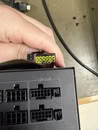
A repair shop technician has reported another melted 16-pin power connector on an ASRock Taichi TC-1650T PSU, paired with a $15,000 NVIDIA RTX PRO 6000 Blackwell Workstation Edition GPU. The former ships with native 12V-2x6 cables carrying ASRock's own NTC temperature sensor. According to the technician's Reddit post, the connector failed catastrophically on the PSU side and melted into the socket itself, even though both ends of the cable were fully seated. The GPU reportedly survived, and the damage was confined to the power supply side. The technician also says the sensor is mounted on the wrong side of the cable, on the ground line rather than the 12 V side it's supposed to watch, which would explain why it apparently never caught the rising heat in time.
ASRock added the NTC sensor and TempGuard system to its 12V-2x6 cables specifically to shut a system down before a connector melts. This time the system failed to catch the rising temperatures, but it has worked in the past. TempGuard reportedly caught a shunt-modded RTX 5090 pulling over 1,300 W, saving its power connectors from melting. On the flip side, this isn't the first time this exact GPU and PSU pairing has run into trouble either, as a similar melting incident on the same combo surfaced back in March. If the sensor placement is really off on at least some cables, that's a bigger concern than one bad unit, especially when paired with a card that costs as much as a used car.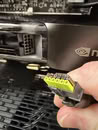
Source:
Reddit
ASRock added the NTC sensor and TempGuard system to its 12V-2x6 cables specifically to shut a system down before a connector melts. This time the system failed to catch the rising temperatures, but it has worked in the past. TempGuard reportedly caught a shunt-modded RTX 5090 pulling over 1,300 W, saving its power connectors from melting. On the flip side, this isn't the first time this exact GPU and PSU pairing has run into trouble either, as a similar melting incident on the same combo surfaced back in March. If the sensor placement is really off on at least some cables, that's a bigger concern than one bad unit, especially when paired with a card that costs as much as a used car.


169 Comments on ASRock's TempGuard Failed to Stop a PSU-Side Connector Meltdown on a $15,000 RTX PRO 6000 Rig
If so few cards fail, then I wonder why all of these companies have to come up with things to prevent connectors from melting.
The same way some consumers have an opinion that the problem with melting cables is horrible and serious and therefore they need to buy extra equipment to solve the "problem" even if the problem really exists mainly in their head and melting connectors are comparable with all other possible GPU failures.
These connectors are melting, and it is horrible and serious, especially now on GPU's being 40% over MSRP to have a connector melt with little or no warning. This issue exists and is well documented, even on 9070XT's and 5070Ti's running at 300-350W.
However, we know that failure occurs in RTX 5090 cards mainly, because they can push connector well over 600W. RTX 5080 usually can not do that.
And we also know that there were no 50 millions of sold RTX 5090 cards, so...
The power sense pins should have been proper data pins that could actually communicate usefull information between the power supply and GPU like throttle the gpu if the AC power browns out or power supply is overheating as well as detailed information about the power supply that it can use to set its consuption.
Why do companies come up with unneeded products? To sell them is the answer. Delid kits, new heatspreaders, liquid metal and all kinds of crap have been around to solve "problems".
These cables are needed because the company who enforced this standard refuses to fix it, the problem is real and a matter of time until these connectors fail on cards with high power draw, it's obvious planned obsolescence.
It needs just around 85 + C on 12V heat and then cold cycles to change the position of those pins and than increase the resistance to the next warm up and so on, till it melts.
An then
maybe the 6090 will get dual connectors, but I highly doubt that Nvidia would actually want to change connectors
In the past Nvidia needed to continuously sell GPUs to stay in business and had to turn up the clocks to sell something better than a 10% improvement, but now that their business is 90% funded by AI they can actually do the reverse. Sell a new generation every 5 years, turn down the clocks/TDP, and have a 25% improvement.
Out of that number, there is subset of graphics with 12 HPWR connector.
Out of that second number, there is subset of graphics that actuall pull 500W or more, where connector failure can be expected... It for sure won't appear on graphics that pull 300W, no?Desktop, yes. All desktop. Including 150W graphic cards, etc...
So, we are not looking at 50 million of GPUs that are potential issue, but less than million... maybe even half a million of GPUs that could have this issue.
Given what we know now, it is realistically to expect that number of RTX 5090 surviving couple of years of usage will be very small.
So, you can twist numbers as much as you want, situation is clear. It is nVidia and PCI-SIG mistake, and it shoud be corrected ASAP. It won't be, because no-one cares about consumers anymore...
The cases I see reported just quite reliably prove, that the problem exists, but nobody knows, how serious this problem is, unless we have REAL RELIABLE DATA as real failure rate in comparison with other possible GPU failures.
I'm actually starting to think Jensen Huang is The Emperor and Nvidia is the start of Warhammer 40.000's Imperium; all the ingredients are there! Blind devotion of its cult following, a blind hatred for the red hordes of Chaos that occasionally have corrupted GPUs coming from the Warp... and all the Xenos trying to buy those damn GPUs along the way which Humanity really needs for their data centers.
Mind blown right hereMelting isn't failure, the product's just trying to get attached to its buyer. It just loves you so much it never wants to leave