Sunday, September 13th 2026

ASRock's TempGuard Failed to Stop a PSU-Side Connector Meltdown on a $15,000 RTX PRO 6000 Rig
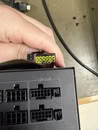
A repair shop technician has reported another melted 16-pin power connector on an ASRock Taichi TC-1650T PSU, paired with a $15,000 NVIDIA RTX PRO 6000 Blackwell Workstation Edition GPU. The former ships with native 12V-2x6 cables carrying ASRock's own NTC temperature sensor. According to the technician's Reddit post, the connector failed catastrophically on the PSU side and melted into the socket itself, even though both ends of the cable were fully seated. The GPU reportedly survived, and the damage was confined to the power supply side. The technician also says the sensor is mounted on the wrong side of the cable, on the ground line rather than the 12 V side it's supposed to watch, which would explain why it apparently never caught the rising heat in time.
ASRock added the NTC sensor and TempGuard system to its 12V-2x6 cables specifically to shut a system down before a connector melts. This time the system failed to catch the rising temperatures, but it has worked in the past. TempGuard reportedly caught a shunt-modded RTX 5090 pulling over 1,300 W, saving its power connectors from melting. On the flip side, this isn't the first time this exact GPU and PSU pairing has run into trouble either, as a similar melting incident on the same combo surfaced back in March. If the sensor placement is really off on at least some cables, that's a bigger concern than one bad unit, especially when paired with a card that costs as much as a used car.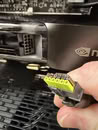
Source:
Reddit
ASRock added the NTC sensor and TempGuard system to its 12V-2x6 cables specifically to shut a system down before a connector melts. This time the system failed to catch the rising temperatures, but it has worked in the past. TempGuard reportedly caught a shunt-modded RTX 5090 pulling over 1,300 W, saving its power connectors from melting. On the flip side, this isn't the first time this exact GPU and PSU pairing has run into trouble either, as a similar melting incident on the same combo surfaced back in March. If the sensor placement is really off on at least some cables, that's a bigger concern than one bad unit, especially when paired with a card that costs as much as a used car.


169 Comments on ASRock's TempGuard Failed to Stop a PSU-Side Connector Meltdown on a $15,000 RTX PRO 6000 Rig
This is your factual data? :roll: :roll: :roll: :roll: :roll:
Mate, I'm just responding in kind to your drivel ;)
The bottom line is, you are literally just pulling numbers out of your ass and then try to sell them as 'factual data' to somehow make a point that is damaged almost daily by new examples about failing connectors. You are trying to bring legitimacy to your downplaying of that by using supposed facts that simply do not exist.
Apparently nuance is not in your dictionary. Yes, a 2-4% fail rate instead of the usual <1% is a major uptick in fail rate and yes, it does mean the connector or the card behind it, is lacking something. Nobody is talking about 10 million failures but you, again, another 'factual' number of yours pulled out of nowhere.
/thread
This connector is almost exact derivative of badly designed NVidia's connector used in RTX 3090 cards, but that cards used 3 split power circuits using 2 pins each thus avoiding problem.
NVidia's design is source of the problem and this design is plain wrong.
Similar connectors existed previously, but not the same exactly. They have different terminals and permissible current which makes great difference.
Let's say you are right, it's only the 5090 / 4090s. Let's say they make up only 1% of sales (you think it's lower than that?). That's still 1.3m GPUs. I multipled the failure rate (the reported ones) by 1000x. That's 50.000 GPUs. We end up at a failure rate of 0,038. With a 1000x multiplier.....
Totally huge issue
You're failing to see the objective evidence here and in other threads while trying to downplay the connector failures because it isn't high enough in your opinion. It is an issue compared to 8 pin molex that we weren't constantly getting reports of melted connectors.
Of course 12HPWR is fit for 300W, but it is not fit for 600W and that is point.
Should we explain to knights in white satin why only 600w cards should be considered?
The average failure rate across these 7 generations is around 4%. This is "normal". You think every 100 GPUs (high end ones) 4 of them melt their connectors? :D
Im done with you, you are too far gone. Don't expect a reply again
For example the worst case:
Cable: low quality, custom reworked, braided, supplied by another manufacturer
Age of the cable: old
Insertions: number well above specs
Handling of the cable: plugs strained, used in multiple systems
Combined with: RTX 5090 overclocked
Failure rate: high
The best case:
Cable: high quality, factory made, supplied by PSU manufacturer
Age of cable: quite new
Insertions: very low number
Handling of the cable: according to intended use of the cable and good installation practice
Combined with: RTX 5090 default
Failure rate: very low, comparable with other GPU failures
If we have a space of possible GPUs, cable manufacturers, quality, user handling and most of the failures concentrate in the very small area of high power GPUs, low quality cables, cables used not according to their intended use, looking just at this specific area is simply wrong.I find some of the recent posts from some people quite bizzare. I am not even sure that the posters really believe what they write...
We are past due for a change in my opinion...