Tuesday, September 8th 2026

Redditor's AMD Ryzen 9 9950X3D Reportedly Dies Shortly After Changing Motherboards
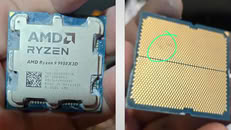
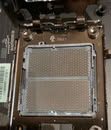
A Ryzen 9 9950X3D has reportedly died just an hour after being moved into an ASUS ROG Crosshair X670E Hero motherboard. According to Reddit user SpecialistConcept423, posting in r/GamersNexus, the chip had been running fine for about a year and a half in an ASRock X670E Taichi Carrara before the swap. After switching to the new board, no manual overclocking or voltage tweaks were applied; only one of the board's built-in memory presets was enabled for a set of SK hynix 6200 MHz modules. After saving that setting and rebooting, the board threw a "00" Q-Code and refused to post. Pulling the CPU and inspecting it revealed two brown marks on its contacts, which all but confirmed the catastrophic failure.
Things got stranger when the user resorted to an older Ryzen 5 8500G that had previously worked fine on the same board. That chip apparently now throws a "4D" code too, pointing at the motherboard itself as the culprit, not just the CPU. There's no confirmation yet on whether a faulty BIOS, a bad batch of boards, or something else is to blame, and ASUS hasn't commented on this specific case. It is worth noting that the ASUS board was not new, and it had undergone USB-related repairs and a BIOS rewrite. The user has since contacted AMD in Brazil for an RMA, but has shared no updates yet.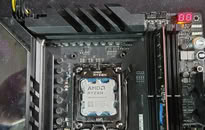
 Interestingly, this isn't the first CPU failure tied to this exact board either. We covered a Ryzen 7 7800X3D that swelled and burned on the same ROG Crosshair X670E Hero model just days ago, and last year ASRock also admitted that overly aggressive PBO current limits fried a wave of Ryzen 9000 chips on its own boards. It's too early to say if these share a root cause, but there is certainly a pattern here. In this particular case, the X670E Hero claimed not one but two CPUs, and it only needed a single setting change to do so.
Source:
Reddit
Things got stranger when the user resorted to an older Ryzen 5 8500G that had previously worked fine on the same board. That chip apparently now throws a "4D" code too, pointing at the motherboard itself as the culprit, not just the CPU. There's no confirmation yet on whether a faulty BIOS, a bad batch of boards, or something else is to blame, and ASUS hasn't commented on this specific case. It is worth noting that the ASUS board was not new, and it had undergone USB-related repairs and a BIOS rewrite. The user has since contacted AMD in Brazil for an RMA, but has shared no updates yet.


207 Comments on Redditor's AMD Ryzen 9 9950X3D Reportedly Dies Shortly After Changing Motherboards
I contacted another repair shop, he said he'll be glad to analyze both boards and try to repair (if it's possible to repair), i'm thinking maybe if he repair the motherboard (even taichi or hero) i think insn't safe to use both anymore :(
i'm not AMD hater or lover, i'm just a user who knows the Asus board could kill the chip, but already had suspicious about the ASRock board was killing the cpu either
I think it's possible that you encountered some slow degradation, or a faulty CPU back then, and your Asus board fried the new CPU with the idiotic memory profiles.
Again, mobo makers did get specification from AMD but have not acted accordingly. Mobo makers settled for applying overvolting when EXPO was enabled. No one really held a gun near their heads to do so. Mobo makers are professionals, not regular users. Therefore they should know what they are doing even without AMD locking eveything for them. And they should know the risks, too.
That is my point of view.
We're talking about the type of overcurrent that causes the substrate to bloat and the LGA to ignite, like if you put 12 V straight through or something.
There clearly is a problem on AMD's end because it cannot be that every motherboard under every segment from every manufacturer irrespective of chipset is seeing problems. To pretend this is an AsRock or ASUS problem affecting only overclocked PCs at this point is just shielding AMD.
This either means that AMD's own guidelines and documentation issued to OEMs are incorrect or there's an errata in the hardware/bug in AGESA.
Just my opinion.
EXPO was never meant to touch anything non-memory related. The CPUs burn with EXPO enabled, because mobo makers implemented it their own way. I think AMD, not even in their darkest dream, thought that anyone would touch VSoC voltage when applying EXPO profile.
As for BIOS, there are maybe 2 BIOS creators, then it gets forked for particular mobo makers. 7800X3D was introduced later after main non-X3D lineup. They released new BIOS just by adding new CPU ids and did not care about any other differences originating from 7800X3D's delicate difference, because when 5800X3D was released, adding new ids was enough.
You can easily fry any CPU or any memory, just dial up voltage enough. With CPU, the temp protection might be fast enough to kick in, but still, I doubt that after manually setting 1.8V for Zen the chip will survive. Memory does not have such temperature protection mechanism, as many of the memory modules don't even have temp sensors, except for PMIC. If you dial up VDIMM voltage to 1.8V, your may fry the modules. The thing is, it's not locked. If you fry it, who's to blame? Intel or AMD for not locking it? If Asus' BIOS developer fucks up the BIOS - they accidentally screw up VDIMM voltage mapping table and instead of 1.45V the VRM gets PWM command to 1.65V, who's to blame?
Do you have anything of value to add, or did you pop up just to annoy me again?
It’s obvious, don’t think your agenda is hidden, you aren’t that good.
You guys sweeping it under the "AMD bad" rug isn't helping.
2. Who's changing the subject now?
3. Can we just focus on helping OP? Please?
The case is pretty much closed. She's already purchased a 270K+ as a replacement, there's not much to help. She'll get a new CPU, the two motherboards seem to be toast, the faulty CPU probably finished them off. Fortunately the RAM kit survived. Knowing her she'll probably flip the RMA replacement or just build another rig in the future.
1. Why the first CPU died is still unexplained, and
2. The common settings that we're using could be unsafe too, while we still keep thinking that they're fine, and recommending them to others. Heck, we may have another Intel style degradation issue on our hand, just in AMD flavour this time.
People who sweep it under the "AMD bad" rug don't realise that they're only giving way for more damage by never finding out the actual cause of the problem. Pointing fingers never helps.I thought she wanted to find out why the first CPU died. My bad.
Partially related to the subject here.
It's primarily about RAM (ASRock board involved), but CPUs dying are also discussed alongside potentially murderous mobos (ASRock again being mentioned).
INTEL AX200 and INTEL AX210 were broken on my motherboards (more than one motherboard). AMD has also issues with usb. wlan sometimes work with usb also on motherboards.
MY motherboards were not defective, some wlan chips, especially intel ones are crap.
Other users claim other WLAN cards as problematic. I had massive issues in gnu gentoo linux, windows 10 pro and 11 pro nope.
that wlan bluetooth topic I will ignore it, as I had it myself and such small intel cards can be replaced for less than 35€. ax210 notebook small add in card with the notches are sold for 35€ on amazon.de in the past.
--
Ethernet
Same some intel Ethernet motherboard chips are shit, also intel.
Note: I learnt it from gnu gentoo linux, usb tethering. A core feature of Android, you share your mobile internet connection while charging to your computer. That was the way i saw intel wireless was shithouse, the ax200 (good bye msi b550 gaming edge wifi) and intel ax210 (collecting dust - sad face for the 35€)
--
BUT Running out of spec BUS speeds, which indicate by the user setting stuff themselves. I will not now check and make screenshot of my uefi. When you run out of the range, i think it is 100mhz, the bus speed on both of my asus and msi motherboards, you will also get issues for usb and other peripherals. Did the user do that? most likely not. But it could be an influence factor. I did run 101mhz, i think at 105mhz it gets flaky, unstable shit zone.
--
www.thermaltake.com/th420-v2-argb-sync-all-in-one-liquid-cooler.html
I do not know. Is it only a fancy RGB led cooler? or has it a display? It looks more like a RGB only pump header.
--
argb no idea. never used. do not care. RGB needs software and maybe the windows software is shit problematic. I do not care and it does not matter, exceot when it is usb related. but software bugs could exists or windows bugs.
--
thanks for giving us details.
No idea what F10 does on your motherboard. I assume it is one of those buttons which ASUS and MSI has, but is it the build in uefi key, the build in uefi bootloader key or something else?
--
Taichi board, That seems to be ASROCK one and different hardware.
I will focus on the, what i read days ago, ASUS overclocker wannabe hero motherboard with amd cpu. i will ignore the asrock one
-- I would also buy something else in your situation. Whose fault it is, hard to tell. ASUS - i hate asus - shit support - problematic ASUS proart monitor and the asus prime motherboard is also garbage. Asrock questionable brand, very questionable. // Anyway you decide what you want to buy or use etc.
The previous ryzen 7600x was more oc friendly, my ryzen 7700x wants too high settings and that is the reason i have to keep it at 6000 mt/s cl32, not cl30. The 6000 mt/s cl30 setting the user claimed could have set other higher settings as usual. I see it very biased from my motherboards and my 7000 cpus withotu 3d cache.
The costs of dead hardware would drive me nuts, I assume two questionable or dead high end motherboards + 1x amd cpu on the very expensive end. :(
Note i deleted some lines from the quote, not a full quote.
--
Days later - I saw my motherboard got another agesa. And only one source pointed to changes for transient voltages. It could be amd fault
- AGESA PI-1.3.0.1d updated.
note: check the other post from myself in the security section where i quoted that.
-- some higher voltages can faster degrade silicion. I think we do not need to discuss basics, like water is wet.
Stuff is slowly changing over the time when in use. when we really need to argue about that, it calls for an ignore list spot. that are basics. that was in books from 1990 or 1995 when i read those.
-- x3d seems problematic for some users. how the influence is because some users set stuff whcih tehy should not - who knows. And i do not have access to all working settings, and how long these settings work.
A new purchase of a intel board / intel cpu just starts the game fresh. New period to degrade the silicion, parts etc.
If intel allows more oc? I do not know? is intel more forgiving for certain settings? i do not know.
-- xmp and qvl nonsense. I only care for the dram chip type. than look up the values. I have hynix a die and therefore i wasted too much time reading checking hynix a die settings. I had on ddr4 micron wahtever and i also checked only those settings.
the user bought nice high quality parts, expensive ones.The motherboard should not be dead. When it does not work, RMA it
I obtained by not legal ways the boardview for my msi motherboard. Voltage regulators, chips, etc are all unrelated to the cpu. that stuff has to work, if not, the motherboard is faulty. especially with your overclocker or wannabe overclocker boards. I know the asus is a wannaybe overclocker one, the asrock one, i think tachi is also a wannabe overclocker board.
The board generates most of the clocks and also all voltages, the current is just a result for the voltages.
when the board brands refuse the rma, post it on reddit. Except like asus, they insist on the two year only period, like europe has. no warranty for second hand purchases, etc.
+ I would carefully remove those heatsinks etc and look carefully on both motherboards if i would find blown parts, missing parts like capacitors, resitors, etc, burn marks, etc. I would also check if I (i talk about myself only here!) have accidentically scratched the motherboard with a screwdriver or any RMA denying stuff on the motherboard.
a screwdriver slice on the board and cut traces and cuts the circuit. blown or missing parts also break functionality of the circuit.
i would also before i do that, replace the cmos cell, measure properly if the cmos battery has the desired voltage. And test again.
--
asus is shit brand and asrock also.
i bought 1x asrock challenger radeon 6600xt 8gb d graphic card which had not working PWM fans when the radeon 6600XT cards were released in austria. the quality does not exists for asrock and asus.
i had some emails from the past when i asked asus for help for my asus notebooks / asus prime motherboard.The reason for passive coolers on DRAM. And some put fans near the DRAM to cool them down.1 = 100% agree . the only explanation, higher values guarantee that the hardware post and works in most cases.
I doubt AMD knows it themselves what is a save value, or they do not care or the motherboard brands do not care.
The reason i run default first, to check two weeks and than try to read what i do before i set a value and hit safe and exist
turning off secure boot, ethernet chip, tpm are user settings which should not impact the life of the hardware.
anything which sets voltage or has something related needs reading before i personally set something.
skatterbencher - someone who does overclock and guides. i did ignore that user, i stumbled over it several times.
-- ------
I wrote it earlier, the socked is flipped, as I learned from the boardview, pinout, vs which side you look at the cpu, from top or bottom. It is like x-rax.
Some boards have extra clock generators for more overclock games, so the main clock has not one but several clcok generators for different board parts. as can be seen on some motherboard homepages. that is a feature sold by the motherboard. i assume some asus hero motherboards ship with such features.I saw it a few days ago, the Be Quiet Thermal Paste does not stick and makes small lines. I had to remove and put the Arctic Pump header several times on the socket because it refused / did not fit on the first try.
do not blame me that be quiet has not usual viscosity. igorslab has always nice arcticles in german on how the thermal paste sticks or not sticks, how it moves etc under pressure.
-- I have it much easier to cleanup as the red aluminum is not the motherboard, it is the aftermarket cpu socket. + non conductive. my sold asus g75vw notebook was full with thermal paste between the gpu dram chips over the years.
only such new fancy, was not available in the past, graphene sheet can prevent the thermal paste mess in the long run.I disagree with that E statement. nope
without x670 and X670e i agree on your statement. i have both, 2x amd chipsets, X670E is only pcie 5 on the gpu slot what my X670 only have Pcie 4 on the graphic card slot.the gentoo wiki has multiple sections, about problematic ryzen 1000 issues with the linux kernel.
I am partly glad i did not bought ryzen 1000, i looked at ryzen 1000 / 2000 / 3000 and only bought ryzen 5000 and ryzen 7000 later.
-- I personally consider ryzen 1000 chips, any, as defective for a linux box.
note: i do not care to read every single issues to the last bit. I saw it multiple times but that stuff is hardly told or reported.
the ryzen 3100 i bought and sold later, i ignored ryzen 1000, was much cheaper anyway as ryzen 1000 and 2000I really wonder how fast and what voltages you used?
The DRAM kit is a very expensive one.
www.corsair.com/us/en/p/memory/cmp64gx5m2x6600c32w/dominator-titanium-rgb-2x32gb-ddr5-dram-6600mt-s-cl32-intel-xmp-memory-kit-white-cmp64gx5m2x6600c32w
A very nice kit and relative safe values with
Tested Voltage
1.40V
I can not verify if those are Hynix-A die. Those values are safe values. The dram is not to blame. When the motherboard sets something else as 1.40V DC for the usual fields at 6600mt/s or below than it is the motherboard and the user fault. These are selected chips, 1.40V DC is very plausible, a very nice and expensive DRAM kit.I know, and MSI uefi is also like ASUS, bad. note, i talk about my msi x670e gaming plus wifi vs asus prime x670-pNothing wrong with that. I want an open field. The user should not be an idiot to set stuff and than cry
I wanted to fry my ryzen 3100 in year 2023. some silicion clocks much better. ~40 or 45€ cpu and i was moving to am5 anyway in a few months later. that second hand ryzen 3100 with the original box, same as my other ryzen 5800x, clocked much better.
Ryzen 5000 and ryzen 7000 was much more sensitive as the ryzen 3100 i had. At that point i had plenty of knowledge about my mciron ddr4 kit with the previous 5800x / 3700x / fresh bought antoher 5800x on that board.
--
Consumers
( do not dare to write kids! roman)compalin about no Overclock settings for ryzne 5800x3d. Now we have those settings and now we have more issues. I do not take responsibility and blame only AMD. Not asus and asrock and not the user. AMD is to blame not to tell others on what are the max values and what to set. Regardless that ASUS sold the motherboard and set all the firmware bits.the hole concept of overclocking is to destroy the hardware when something gets wrong.
Risking your hardware for possible 10 to 20% performance gain on such new expensive hardware? It is the consumers choice.
I wrote it in teh past several times, amd should make an overclocker one time trigger fuse to deny any rma. big warning box, are you sure, this will void your warranty and blow the one time only overclocking fuse.
AMD for sure asks for more money from everyone for those X3d chips etc because of the possible RMA rate from some users. I forgot, of course i could buy a tray cpu without warranty vs a box cpuI assume it is the same DRAM Kit. As we all can see, DRAM works fine.
I would not mix apples with banana. AM4 was more durable, root cause, different manufacturing method / physics
That screenshot also shows me, i beg your pardon when i offend you, i am sorry, you are a heavy overclocker user.
nothing wrong with that. Seeing such intel high overclock values makes me wonder what you did or not did to your am5 parts.
-- i had 3 ryzen 5800x, and all 3 showed degradation. that is an amd flaw. I restrict myself to 500 amd chipset and msi motherboards only to the rzyen 5800x. Not hitting the max clock anymore etc. I am glad i got rid of two of those. The 3rd one is indirectly mine, i build the box and it still works as an office box.I have boardview of my board.
When the repair shop is transparent and does not tell lies like my car repair shop it is safe to use.
What was changed, how was it verified that it was dead. some analogue components do look fine, but they are faulty and can only be measured when removing those.
i would only go the rma route or sell the boards, when the rma is denied.
--------
-- windows 11 pro never showed me any issues, windows 11 pro can run and game for a long time with not stable settings.
i really wonder if the user here, stable tested the hardware.
sometimes libreoffice would compile and it would fail on the installation phase, sometimes it will fail while compiling. gcc and gnu gentoo linux are far more reliable to show myself how stable teh setup is as windows 11 pro.
Other posts from the hardware owner also imply, possible unstable overclock settings usage. I get the feeling / impression the stability was never tested and re verified.
i have it much more easier as i compile two gcc versions every week which tests my hardware and other software. i use a lot the dram.
corrupt downloads etc ... BTRFS will cry, other indicators will show me in the log
i watch actively my system log on another screen regularly.
I am still reading this topic, for over 2 hours by now. The impression that the hardware owner may set too much overlock and did not stable test gets stronger. I read too many defective components, etc. and i see too high overclock settings.
I read it as this time I have the rare chance to maybe interact with the hardware owner of the reddit post with the defective parts.It could be also shit schematics by ASUS and ASrock.
I also made an error in calculcations for a coil which fried any PIC ucontroller i put in my self made programmer.
We should never assume ASUS and Asrock, they do not provide schematics and source code for their firmware, and datasheets for all parts in questions, did make a correct schematic.
Feel free to post those novuton and other novuton related datasheets and coding manuals here when you disagree.
AGESA is one factor but what the board does and the board schematics is also important. The board feeds all voltages and data lines to the cpu and dram and all the other peripherals.
Overclock motherboard on the very expensive end and sold with overclock motherboard firmware which my lying around asus prime x670-p does not have. A product segmentation. Prime vs Hero from ASUS has big differences regarding schematic, firmware, uefi firmware, overclock settings, if extra hardware components like extra clock generators exists, etc.
I would never ever only blame AMD.
asus can set what they want, they can overrule. AGESA and novuton just initialise the hardware. what asus and asrock does is not always in the influence of AMD. asrock ans asus were known for "enabling" features which were not there in the first place. more cpu cores as stated on the box cpu when bought, etc.intel cpus were rotten from the inside, regardless of the operation values.
so far i have not heard that amd or any other non intel brand cpus were rotten = "short cirucit" - insulation not working anymore
that was a hidden defect caused by improper engineering, no quality department, refusing, lack of knowledge, bad manufacturing process, etc.
-- i understood, i agree with the following. reasonable operating values are safe values. operating the cpu or hardware out of spec may degrade the hardware faster which causes some defects in some time frame. long term defects caused by unsafe operations. i state, hard to give facts or proof, so it is my personal opinion, that shows up in 6 months to 3 years usually, when operating values were not safe
-- nice argument, but the core is, intel cpus fail on any values. AMD on same operating values. That shows itself that it rott from inside after a certain power on / usage hours on intel.I do not want to test. I am sure i can fry my ryzen 7700x on my msi board with only once save and exit step in uefi.
My only excuse of knowing what i set. MSI has not like ASUS a restore from USB feature when changing the firmware. I have to set every field by hand again, a 10 to 15 minutes progress to check my screenshots and type the values. For every uefi upgrade on msi.
When you do not know aht you set in uefi the most likely root cause is the "newbie" autooverclock feature of the asus and asrock motherboard and using default values. The default - i do not care - dangerous values for most of the cases. We have multiple users here who state, the default values are far too high in regards of power consumption and other issues.
The only default values I deem acceptable are teh 4800 mt/s cmos reset default values for my asus and msi motherboard/s.
AMD is not to blame on what ASUS and Asrock overrules on their fancy ASUS hero overclocker 800€ or costing more motherboards. AMD does not control what the ASUS motherboard does with the novuton chip, and what the circuitry does on the asus motherboard. you can amd for the agesa and the hidden transient spikes what they fixed. You can not blame for a flaky shitty circuit design which includes overvoltage set by the user on asus and asrock motherboards.
I bothered myself to figure out what sensors read out, how the cirucit is. When the circuit is such unprecise on my msi motherboard it is very likely it is the same on asus. So many users correct me and say i am wrong. motherboard sensor read out values are not a "correct / accurate" measurement. What i remember from 01 / 2026. it seems novuton only has a ADC resolution of 10 bit with 2048 values in the given resistor divider section wiht the given resistor accuracy. Feel free to check out the cryptic post i did in the linux section around 01/ 2026 about sensors and msi x670E mootherboard
when you measure shit, what asus and msi do on my motherboards, do not expect they set correct values to the cpu.
i state the same, and i state it again, motherboard readouts are not valid measurements. any true rms multimeter has accuracy statement for the given measurement range + tollerances, - tollerances and digit errors. So a user can calculate the error margin when the measurement build was done correctly.
I saw it a few hours ago, what nonsense my msi x670e gaming plus wifi motherboard showed me for pwm and voltages while setting up my arctic aio cooler.
the hole concept of the motherboard novuton measurement is only, to check, is the 12V DC, etc. in the given range to bootup the box. it is not a valid measurement. novuton chip only checks during bootup, the datasheet can not be obtained anyway, are the voltages in operating values so the cpu can be bootup. when the voltages are incorrectly shown in uefi do not expect accurate DC Voltages on the am5 socket.
i think hwinfo is the windows software called, no voltage jumps in 1 ADC step, lets assume, from 12.000 V DC to 12.024V DC. no voltage does this. not on an oscilloscope, not on a true rms multimeter whicn only usualyl do 3 samples per second.
I explained it in details with screenshot in the linux section around 01/ 2026.
TLDR: inaccuracte motherboard sensor readout will cause inaccurate voltage and current regulations on the motherboard also very likely.
The basics are explained in any PIC ucontroller ADC application notes etc. That is generic knowledge regardless of which chip. It is generic ADC knowledge and generic electronics knowledge. PIC =microchip company
Their 13th and 14th gen CPUs came out from their factory this way (part of the design to achieve 6 GHz).
As for AMD, I have serious doubt that ramping up VSoC voltage was part of the design. It's an absolutely unnecessary step to do to guarantee officially recommended 3:2:2 6000/3000/3000 memory setting.
There's no real reason why AMD would do this themselves, as for 99% Zen 4/5 CPUs, 2000 FCLK is perfectly doable at <1.2V VSoC and rest will need default 1.25V, which is absolutely safe.
Besides, if you do RAM OC manually (you apply timings, memory frequency and VDIMM voltage), VSoC won't go past 1.25V.
I own Assuss mobo with some integrated memory tuning profiles/presets (apart from EXPO ones) in BIOS. It's a damn stupid thing to include this in BIOS.
There are like 7 Hynix A, B profiles. There is no guarantee that user's particular Hynix A chips can do what other users achieved with them.
I once tried to apply such setting, just out of curiosity. No warning whatsoever. I still think, that kind of this presets and wrong implementation of EXPO logic fucked up 7800X3Ds back then.
I also found it a just a bit strange that 2 X3D CPUs died on the same board (same model) within a week or two.
Assuss releases BIOS for this board once per week, always fixing something as poor Dell does on my company laptop (man, BIOS and driver updates very week).
This deployment frequency of fixes/patches does say something about it.
To wrap it up, we have different opinions and I won't change mine and I think you won't change yours.
When more information about this case emerges, we might come back and discuss it further.
For know, I think there's no reason to talk about it anymore, as we're both stubborn as f*ck. :laugh: