With looks fit for a king and performance to match, the new Trident Z Royal line from G.SKILL promises premium in every sense. Featuring topnotch XMP specs and glamorous looks, this kit looks great on your shelf or in your benchmarks.
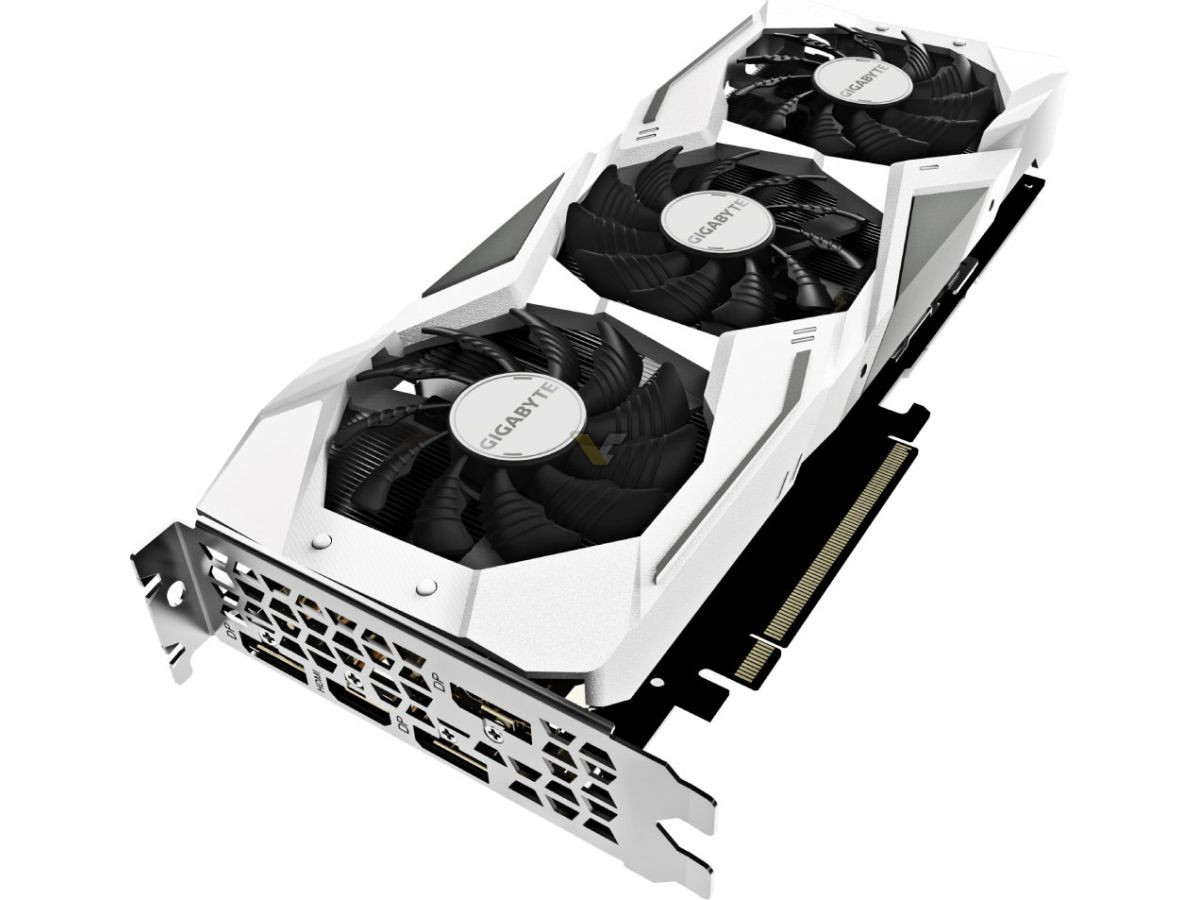
GIGABYTE extended its all-white trim to its third graphics card from the RTX 20-series, the RTX 2070 Gaming OC White (model: GV-N2070GAMINGOC WHITE-8GC). This follows similar trims for the RTX 2060 Gaming OC Pro White and RTX 2070 Gaming OC Pro White. As with the others, the card's USP is its mostly-white cooler shroud with chrome inserts, and a matching white metal back-plate. Contrasting them are a trio of 90 mm matte-black fans with chrome hub stickers, and the black PCB carried over from the original Gaming OC series.
As with the RTX 2070 Gaming OC, this card offers a factory-overclock of 1725 MHz boost, compared to 1620 MHz reference. The memory is untouched at 14 Gbps (GDDR6-effective). The cooler offers 0 dBA mode (idle fan-stop). The card draws power from a combination of 8-pin and 6-pin PCIe power connectors. Display outputs include three DisplayPort 1.4, one HDMI 2.0b, and a USB-C VirtualLink. Based on the 12 nm "TU106" silicon, the GeForce RTX 2070 offers 2,304 CUDA cores, 288 tensor cores, 36 RT cores, 144 TMUs, 64 ROPs, and a 256-bit wide GDDR6 memory interface, holding 8 GB of memory. GIGABYTE is offering a unique 4-year warranty with this card, if you register your purchase with them.
Remember that story we brought you regarding the United States government, via its Department of Commerce, banning all exports from national companies to China-based Fujian Jinhua Integrated Circuits Ltd? Well, fast-forward three months, and the Financial Times is reporting, citing two sources close to the matter, that the ban has been too much for the company to take, limiting its ability to import needed parts and tools for its DRAM production. This is tough news for a company that was investing towards finishing construction of a $5.7 billion factory in China's Fujian Province.
If the Financial Times is true, this is one potential player in the DRAM market that goes out the proverbial window. The original reasons given by the Department of Commerce for the export ban referred to the company being supported by "likely U.S.-origin technology", reportedly of Micron origin. Well, now it seems as if it isn't being supported at all.
Swiftech is looking to make it easier for users to build their own custom-loop water cooling solutions via the introduction of its Boreas kits. The Boreas kits take a gander at using predetermined hardware parts sold in a kit, which allow users to build their own custom loops without having to worry about part compatibility or any manual fabrication of their own. It also promises a straight upgrade part within Swiftech's ecosystem, with many of the parts being separately available.
As with everything, the Boreas line of products includes addressable RGB options, controlled by Swiftech's IRIS (you think game launchers are bad? Just look at how many RGB controller solutions are on the market these days). The kit comes with everything you might need for a custom cooling loop, and is available from Swiftech starting at $259.95.
Intel Corporation (NASDAQ: INTC) today announced that its board of directors has named Robert (Bob) Swan as chief executive officer. Swan, 58, who has been serving as Intel's interim CEO for seven months and as chief financial officer since 2016, is the seventh CEO in Intel's 50-year history. Swan has also been elected to Intel's board of directors. Todd Underwood, vice president of Finance and director of Intel's Corporate Planning and Reporting, will assume the role of interim chief financial officer as the company undertakes an internal and external search for a permanent CFO.
"As Intel continues to transform its business to capture more of a large and expanding opportunity that includes the data center, artificial intelligence and autonomous driving, while continuing to get value from the PC business, the board concluded after a thorough search that Bob is the right leader to drive Intel into its next era of growth," said Chairman Andy Bryant. "The search committee conducted a comprehensive evaluation of a wide range of internal and external candidates to identify the right leader at this critical juncture in Intel's evolution. We considered many outstanding executives and we concluded the best choice is Bob. Important in the board's decision was the outstanding job Bob did as interim CEO for the past seven months, as reflected in Intel's outstanding results in 2018. Bob's performance, his knowledge of the business, his command of our growth strategy, and the respect he has earned from our customers, our owners, and his colleagues confirmed he is the right executive to lead Intel."
Intel has unceremoniously, through a product change notification (PCN), discontinued the Itanium family of microprocessors. The Itanium 9700 "Kittson," which was released in 2017, is the final generation of Itanium, and its sales to new customers have stopped according to the PCN. The series has been marked "end of life" (EOL). Existing customers of Itanium who already have their IT infrastructure built around Itanium 9700 series, have an opportunity to determine their remaining demand of these processors, and place their "Last Product Discontinuance" order with Intel. The final LPD shipments would go out mid-2021.
With this move, Intel has cast uncertainty over the future of the IA-64 microarchitecture. IA-64 was originally conceived by Intel to replace 32-bit x86 at the turn of the century, as an industry-standard 64-bit processor architecture. AMD laid the foundation for its rival standard AMD64, which could go on to become x86-64. AMD64 won the battle for popularity over IA-64, as it maintained complete backwards-compatibility with x86, and could seamlessly run 32-bit software, saving enterprises and clients billions in transition costs. Intel cross-licensed it as EM64T (extended memory 64-bit technology), before standardizing the name x86-64. Itanium dragged on for close to two decades serving certain enterprise and HPC customers.
NVIDIA is in the process of rolling out the first implementations of its RTX 2000 series GPUs in mobile form, and if the going is as is being reported, it's going to be a little rough for users to actually extrapolate their performance from product to product. This is because manufacturers are apparently getting a whole lot of leeway in how to clock their products, according to their solution's thermal characteristics and design philosophy.
What this means is that NVIDIA's RTX 2080 Max-Q, for example, can be clocked as low as 735 MHz, which is a more than 50% downclock from its desktop counterpart (1,515 MHz). The non-Max-Q implementation of NVIDIA's RTX 2080, for now, seems to be clocked at around 1,380 MHz, which is still a close to 200 Mhz downclock. Of course, these lowered clocks are absolutely normal - and necessary - for these products, particularly on a huge chip such as the one powering the RTX 2080. The problem arises when manufacturers don't disclose clockspeeds of the GPU in their particular implementation - a user might buy, say, an MSI laptop and an ASUS one with the exact same apparent configuration, but GPUs operating at very different clockspeeds, with very different levels of performance. Users should do their due research when it comes to the point of choosing what mobile solution sporting one of these NVIDIA GPUs they should choose.
Sharkoon Technologies is an international supplier of PC components and peripherals which boasts performance at a reasonable price. Sharkoon introduces their new ATX midi tower series: VG6-W. This PC case series is designed for budget-conscious users with air-cooled systems. The VG6-W is equipped with either three single-color illuminated LED fans or three RGB illuminated fans as well as a striking exterior plus acrylic front and side windows.
The front panel of the VG6-W should especially appeal to gamers, which gives the case a unique retro-futuristic finish. The eye-like LEDs above on the front panel lend an expressive character. The angular acrylic window underneath brings the pre-installed LED fans to the fore. The side panel of the Sharkoon VG6-W has a large acrylic window to present the built-in components of the system. All possible modifications inside the case can be optimally presented.
The NZXT E Series 650 W is a modified and slightly more expensive version of the Seasonic SSR-650FX. It features digital monitoring and limited controls, as well as an interesting look. Read the review to figure out whether it is worth spending about $10 more on over Seasonic's offering.
Intel is in the fray to acquire Israeli networking infrastructure manufacturer Mellanox Technology for $6 billion in cash and shares, which constitute a 35 percent premium over its most recent valuation. Mellanox designs and manufactures infrastructure-scale networking hardware, such as high-bandwidth switches, adapters, and other data-center networking hardware, and when acquired by Intel, could give the company sufficient IP and manpower to take on Chinese networking equipment giant Huawei, in the gold-rush to bring 5G to the world, in addition to sustaining the cloud-computing boom. Huawei has been banned in several western nations (particularly NATO member states) for political or strategic reasons, and a large vacuum has been built that's being approached by other "Kosher" players such as Mellanox, Cisco, etc.
Samsung Electronics, the world leader in advanced memory technology, today announced that it has begun mass producing the industry's first one-terabyte (TB) embedded Universal Flash Storage (eUFS) 2.1, for use in next-generation mobile applications. Just four years after introducing the first UFS solution, the 128-gigabyte (GB) eUFS, Samsung has passed the much-anticipated terabyte threshold in smartphone storage. Smartphone enthusiasts will soon be able to enjoy storage capacity comparable to a premium notebook PC, without having to pair their phones with additional memory cards.
"The 1 TB eUFS is expected to play a critical role in bringing a more notebook-like user experience to the next generation of mobile devices," said Cheol Choi, executive vice president of Memory Sales & Marketing at Samsung Electronics. "What's more, Samsung is committed to assuring the most reliable supply chain and adequate production quantities to support the timely launches of upcoming flagship smartphones in accelerating growth of the global mobile market."
CHERRY, the specialist for computer input devices, introduces the DW 9000 SLIM, a wireless desktop set with rechargeable battery. The mouse-keyboard set combines innovative features, outstanding craftsmanship, and a trendy, ultra-flat design. For flexibile use, both Bluetooth and 2.4 GHz wireless connections are supported. The CHERRY DW 9000 SLIM desktop set has a modern look, characterised by an ultra-flat design to ensure fatigue-free work sessions. The mouse and keyboard have a matching visual design and look great on the desk of every style-conscious consumer.
MSI, a pioneer and global leader in gaming, continues to innovate its desktop product line and has built upon its strong heritage of delivering the first desktop built for Pro gamers. Today, MSI proudly introduces the brand new Trident X Series with the latest MSI GeForce RTX 2080 graphics card and the Intel 9th Gen Core K series processors.
The MSI Trident X series is the first compact desktop PC to incorporate an SFX power supply and the breathtaking latest MSI GeForce RTX graphics card, into a case only 10 liters in volume. Trident X series targeted gamers who demand the highest game performance from PC. With the Intel 9th Gen Core K series processors and MSI GeForce RTX graphics card, Trident X series can provide impressive performance for any task including gaming and video editing.
MSI, world's leading manufacturer of true gaming hardware is proudly announcing its new edition of Infinite X Gaming desktop. Featuring the Intel 9th generation processors up to i9-9900K, the MSI Infinite X 9th can overlock its system, offering addictive power for any gameplay. Together with the MSI's renowned RTX graphics cards, Infinite X 9th put its users ahead of any others right before their game has started. To keep a system with all this power cool, the Infinite X 9th uses MSI's exclusive Silent Storm Cooling 3 thermal design, making its cooling efficiency unmatched and as quiet as an assassin. If you are the gamer who like to explore the never-ending possibilities for gaming and multitasking, Infinite X 9th is the one you shouldn't miss.
This godsend rig also maintains its "Stand above the rest" spirit from its predecessor, as the system offers ultimate convenience for upgrading as new components appear in the market. And as always, MSI has added its own gaming DNA features such as a tempered glass side panel and RGB Mystic Light to customize this gaming desktop to your own liking.
In time with Intel's launch of the new Xeon W-3175X 28-core workstation CPU today, Asetek has announced their first, and only to date, certified CPU cooler for the processor. The cooler, code-named 690LX-PN, is a closed loop liquid cooler developed in collaboration with Intel, and approved by the latter to be used with the 28-core behemoth that no doubt needs more ample cooling than most of Intel's desktop offerings. It is rated for a 500 W TDP, thanks to the use of a triple 120 m radiator (copper/brass instead of aluminium, for a change) with fans pre-installed, and their latest Gen6-s pump integrated with a copper cold plate.
The cold plate in question is fairly large relative to the pump, which indicates that the cooling engine itself is not necessarily optimized for the larger heatspreader on the CPU. The cooler is only compatible with this CPU platform, and is also the only cooler approved by Intel for the platform as of the time of this post. It is available for purchase on the Asetek web shop, and comes with a 2-year warranty.
G.SKILL International Enterprise Co., Ltd., the world's leading manufacturer of extreme performance memory and gaming peripherals, is exhilarated to announce new ultra-fast, ultra-high capacity Trident Z Royal DDR4 RGB memory specifications designed for use with the latest unlocked 28-core Intel Xeon W-3175X processor. Operating in hexa-channel with 6- or 12-module kit configurations, these new 6-channel Trident Z Royal memory kits can reach insane memory speeds of up to DDR4-4000 CL17-18-18-38 at 1.35V, which feature extreme performance Samsung B-die memory ICs. With fast memory speed and massive capacity, these hexa-channel memory kits are perfect for heavy-workload workstations when paired with the 28-core Xeon processor.
As computing technology improves, the amount of processed data also increases, leading to a demand for more memory channels and higher bandwidth. For the first time, this new platform introduces hexa-channel memory support to the larger consumer market, which was previously only found in server-class systems. While operating under 6-channels, the extreme performance DDR4-4000 CL17 96GB (8GBx12) memory kit reaches a blazing fast read bandwidth speed of 122GB/s - a substantial increase over currently available quad-channel platforms. See below for a screenshot of the bandwidth result from the AIDA64 memory benchmark:
The Intel Xeon W-3175X processor is available today. This unlocked 28-core workstation powerhouse is built for select, highly-threaded and computing-intensive applications such as architectural and industrial design and professional content creation. Built for handling heavily threaded applications and tasks, the Intel Xeon W-3175X processor delivers uncompromising single- and all-core world-class performance for the most advanced professional creators and their demanding workloads.
QNAP Systems, Inc. (QNAP ) today released MediQPACS, an application that turns a QNAP NAS into a private PACS (Picture Archiving and Communication System) server to help users securely back up DICOM (Digital Imaging and Communications in Medicine) files from hospital modalities and allows for quick viewing and complete management of medical images. MediQPACS provides healthcare facilities with a budget-friendly alternative for their PACS server in HIS (hospital network systems) with 24/7 availability, central management, and dependable storage of all DICOM files.
"DICOM files containing patient data are generally large-sized, leading to potential storage challenges in hospitals, clinics and other healthcare facilities. With the MediQPACS app for QNAP NAS, these massive DICOM files from connected medical modalities and AET can be securely and centrally stored. QNAP NAS also features various methods for expanding capacity to fit future data storage requirements," said Anay Badavne, Product Manager of QNAP.
When Steam hit critical mass in the mid 2000s, digital distribution of games was close to non-existent, Internet speeds were too low to transmit 8-10 GB games that would ship in DVDs, and game patching was a mess. Steam solved many of these problems by offering distribution, DRM, aftersales support (automatic updates), and even multiplayer services across its network. Steam didn't become popular on its own, though. Valve Software was mainly a game developer, and it marketed Steam by making its AAA smash-hits "Half Life 2" (and its episodes), "Counter Strike," and "Left 4 Dead," exclusive to the DRM platform. Even if you bought those games on DVDs, they would have to be installed and supported through a Steam account. Those games served as tech-demonstrators for Steam, and how efficient an all-encompassing DRM platform can work.
Steam maintained its dominance for a good 8-odd years until big game publishers such as EA and Ubisoft wised up to the concept of multi-brand distribution platforms Steam mastered. Steam operates on a revenue-sharing model. For every Dollar spent on a game, a percentage of the money is retained by Steam toward its services. EA and Ubisoft figured it wasn't rocket-science to copy Steam, and came up with their own platforms, EA Origin, and Ubisoft UPlay, both of which are multi-brand. They figured their capital-expenditure toward running these platforms was less than what they'd pay Steam at scale. EA restricted all its titles to Origin, while Ubisoft made some of its games available on Steam, even though UPlay would remain a concentric DRM layer to those games. Then something changed in 2018.
Razer, the leading global lifestyle brand for gamers, today unveiled the latest high-performance gaming gear and accessories to be given the popular Quartz Pink treatment. Razer's Quartz Pink colorway was first launched in 2018 to the delight of gamers, streamers and influencers worldwide. With a humble lineup of 4 peripherals to choose from, it was the beginning of a 'pink phenomenon'.
Fans on the quest for Quartz began to refresh their setups with bold color themes - balancing power in pink. We've paid attention. With more than double the gear available this year, one can enjoy a new series that lets you stand out even further from the crowd…in style. "Our fans told us they could not get enough of our Quartz Pink editions," said Razer Co-Founder and CEO Min-Liang Tan. "We listened and we have given the stunning pink treatment to our latest gaming gear, giving you the unfair advantage in both performance and looks."
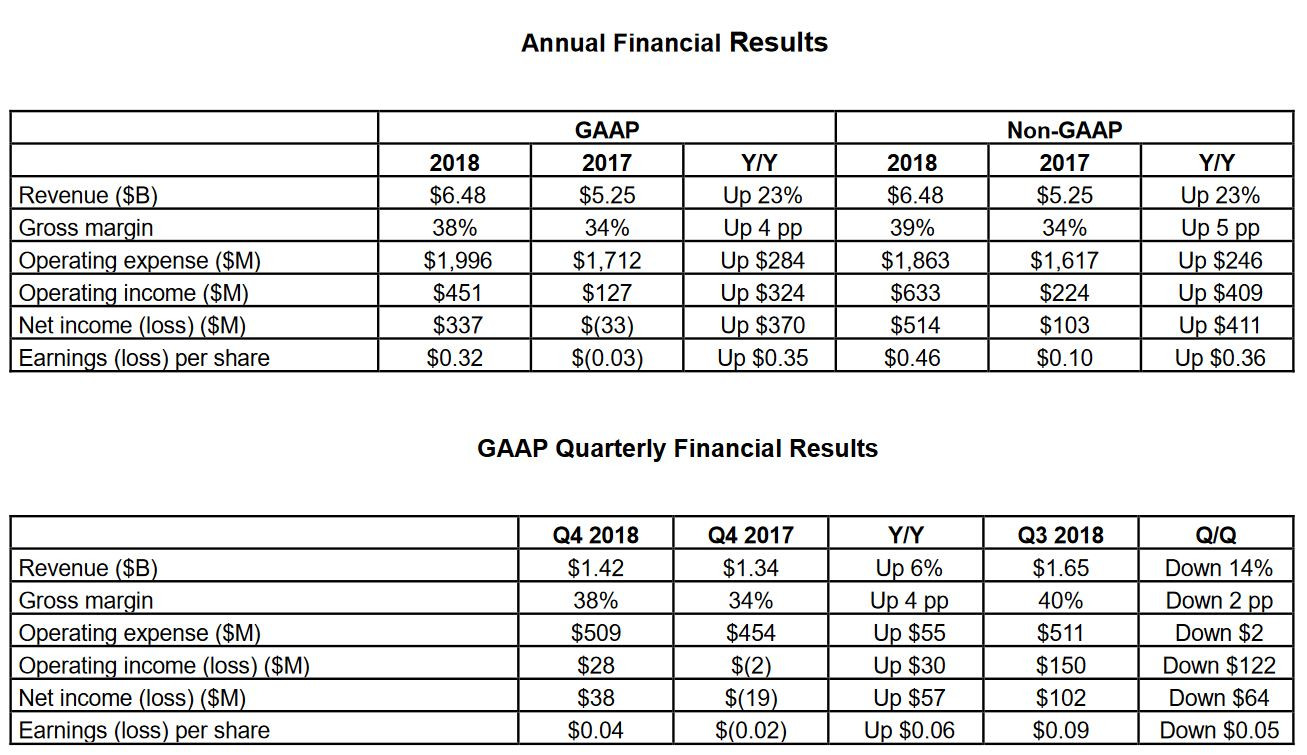
AMD (NASDAQ:AMD) today announced revenue for fiscal year 2018 of $6.48 billion, operating income of $451 million, net income of $337 million and diluted earnings per share of $0.32. On a non-GAAP basis, operating income was $633 million, net income was $514 million and diluted earnings per share was $0.46.
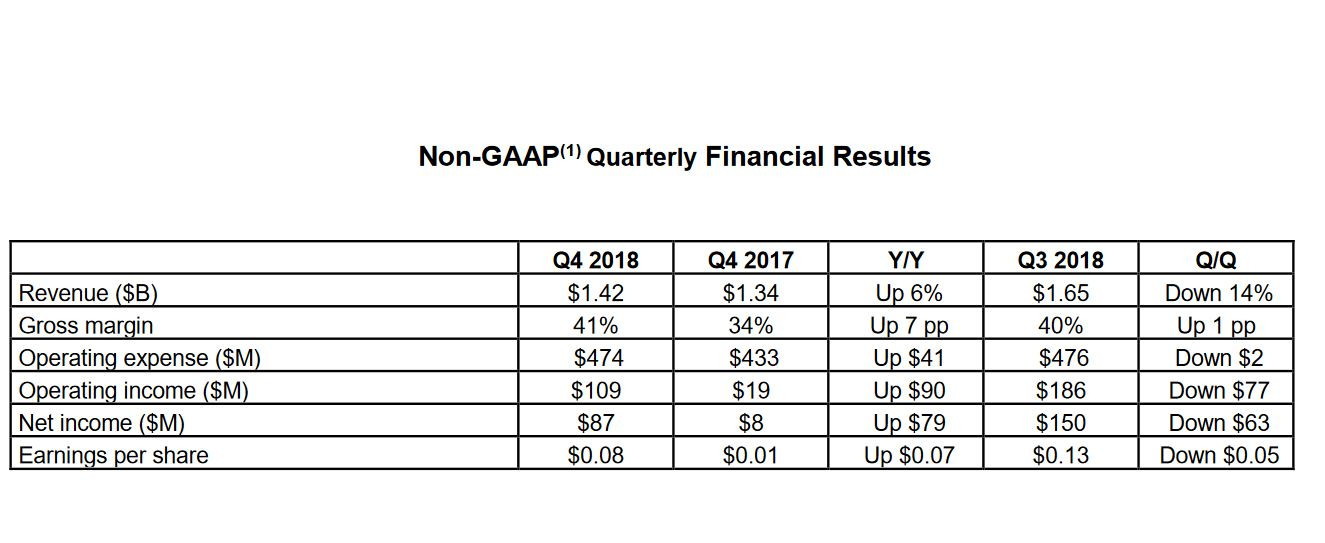
For the fourth quarter of 2018, the Company reported revenue of $1.42 billion, operating income of $28 million, net income of $38 million and diluted earnings per share of $0.04. On a non-GAAP basis, operating income was $109 million, net income was $87 million and diluted earnings per share was $0.08.
Cooler Master releases their first mechanical keyboards using the elusive Cherry MX Low Profile RGB switches. The SK630 is a TKL form factor keyboard built with portability in mind that retains a strong configuration over function and form alike via both software driver support and onboard controls.
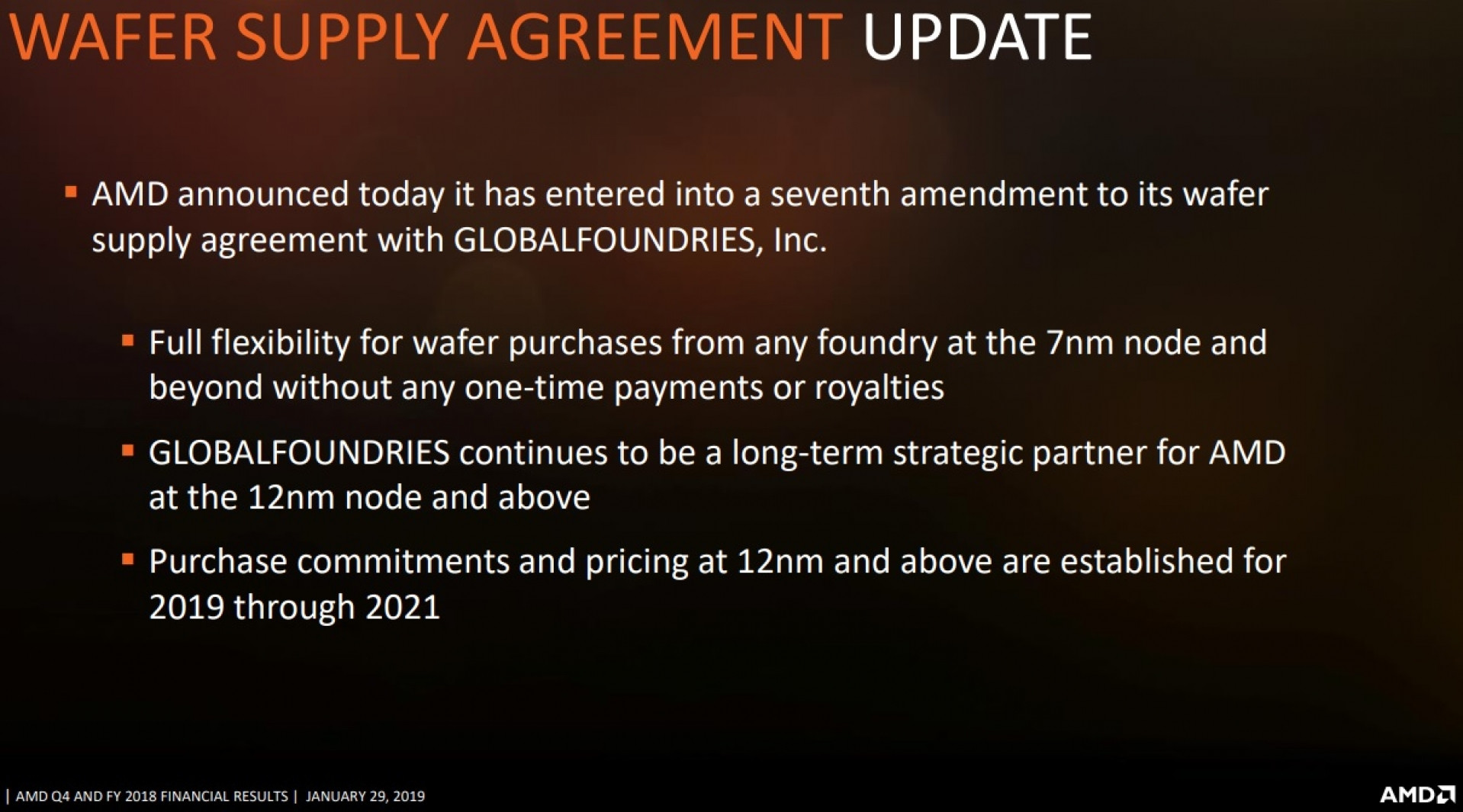
AMD in its Q4-2018 Earnings Report disclosed that it has amended its Wafer Supply Agreement (WSA) with GlobalFoundries that frees it from paying a "7 nanometer tax." Under the older version of WSA, AMD would have had to pay a penalty to GlobalFoundries if it sourced processors from any other semiconductor foundry. The company got preferential pricing in return for the exclusivity. With GlobalFoundries discontinuing development of cutting-edge processes such as 7 nm and 5 nm, it makes sense for AMD to seek out other foundry partners, such as TSMC, and an amendment to the WSA was needed. With this amendment in place, AMD can go ahead and source 7 nm dies from TSMC without paying penalties to GlobalFoundries (GloFo).
With its "Zen 2" microarchitecture, AMD is going big on multi-chip modules, in which only those components that can tangibly benefit from the switch to the 7 nm node, namely the CPU cores, would be built on 7 nm dies, called "CPU chiplets," while components that don't need the miniaturization just yet, such as the processor's memory controller, PCIe root-complex, etc., will be built on separate dies called "I/O controllers." These dies will continue to be 14 nm, and likely supplied by GloFo. Final packaging of 7 nm CPU chiplets from TSMC, and 14 nm I/O controllers from GloFo, will happen at GloFo's facilities in China or Malaysia. AMD in its amendment committed to purchasing 14 nm and 12 nm chips from GloFo between 2019 and 2021, which means the MCM approach to processors is here to stay.
OWC has released the second generation of its super-fast ThunderBlade external SSD, with a lower price point and improved performance. For creative professionals and prosumers who work to capture and process 4K or 8K video, the updated ThunderBlade Gen 2 can be the difference between staying under budget and on-schedule on a project or not.
The new ThunderBlade is stackable and runs cooler than the previous iteration, while still maintaining a near-silent environment with its fanless operation, all factors that can be critical in an operation on the go or in a tight space. With dual Thunderbolt 3 ports users can daisy-chain up to five additional ThunderBlades, and by connecting more than one drive with SoftRAID, speeds can be increased up to 3800MB/s. The newest ThunderBlade can complete a 1TB content transfer in under four-and-a-half minutes.
With the current growth of the industrial control equipment, industrial computers, surveillance system, POS system, gaming machines, edge computing, and IoT device field markets, the needs for Flex ATX specification power supplies are also increasing. FSP has great advantages in the Flex ATX power supply product markets; not only does it have the most complete Flex ATX products (with over 30 models in this form factor), most of these products also complies with the 80PLUS requirement, offering a variety of efficiency ratings ranging from bronze to platinum.
FSP's Flex ATX models are available in standard direct output and modular cable configurations, and include the most modular models selections in the industry. The modular design can improve the ease of use of power supply. Customers can configure their power cables according to the system needs, and if the power supply is damaged in the future, they only need to replace the power supply. The special plug-in design for cables and jacks improves the convenience of replacement. The design of full modular connectors also allows users to quickly disassemble cables, locate issues and save debugging time whenever the system experiences problems.
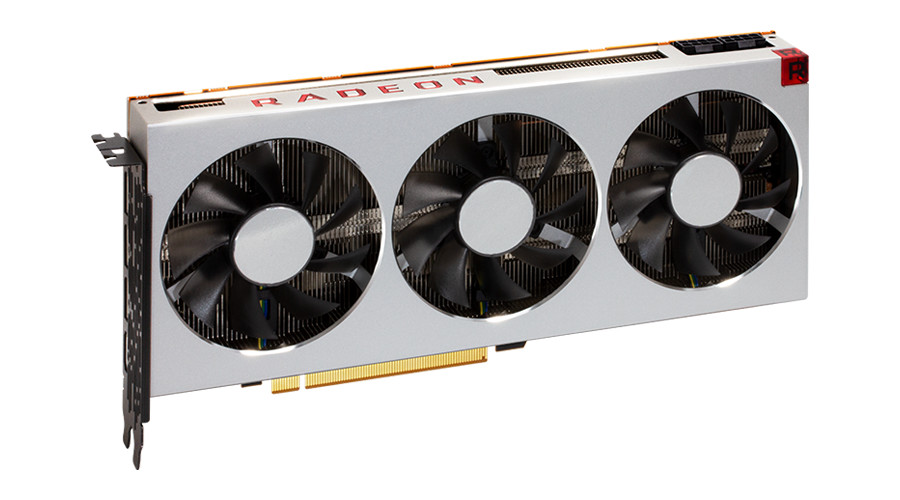
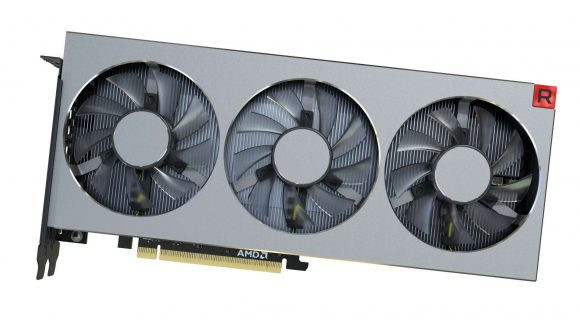
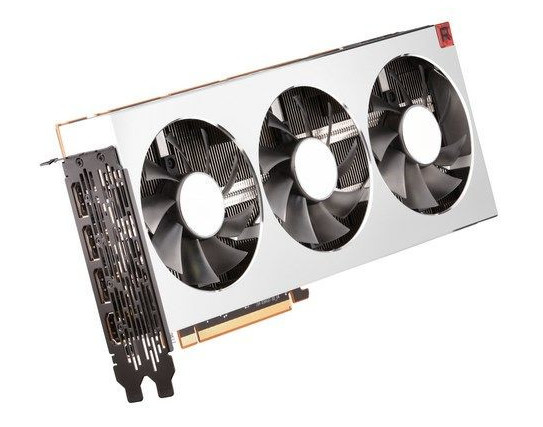
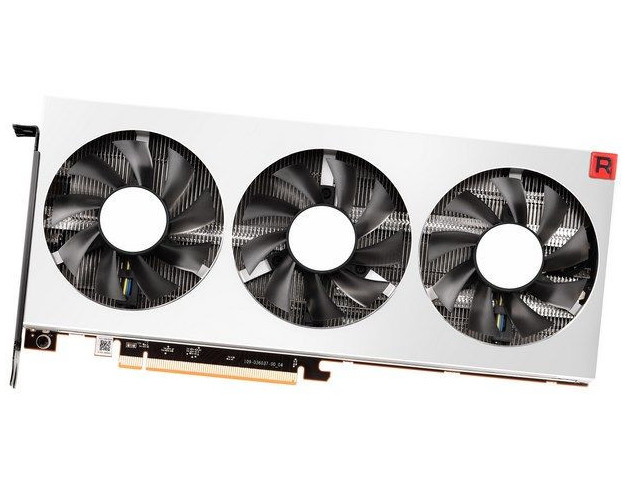
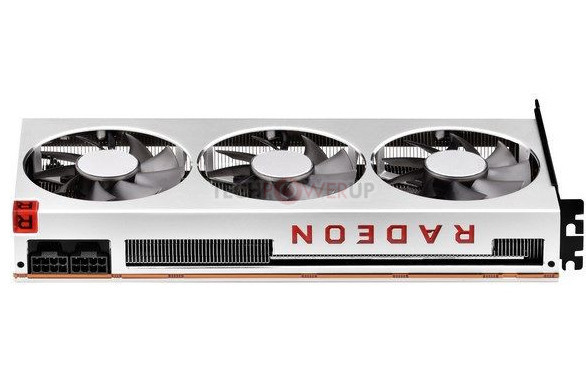
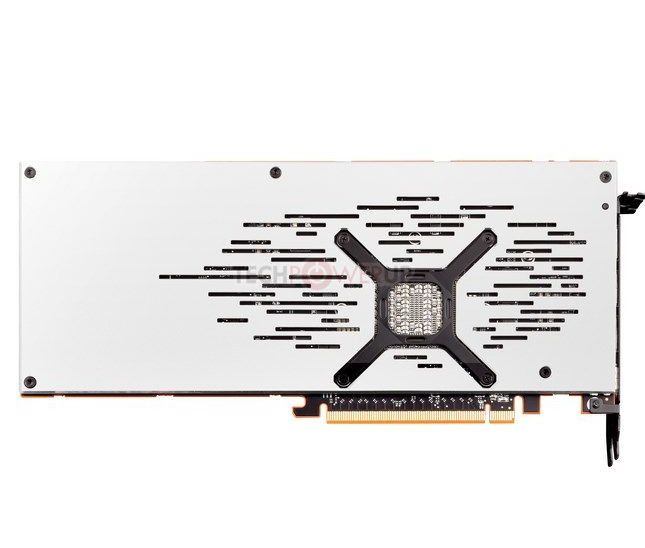
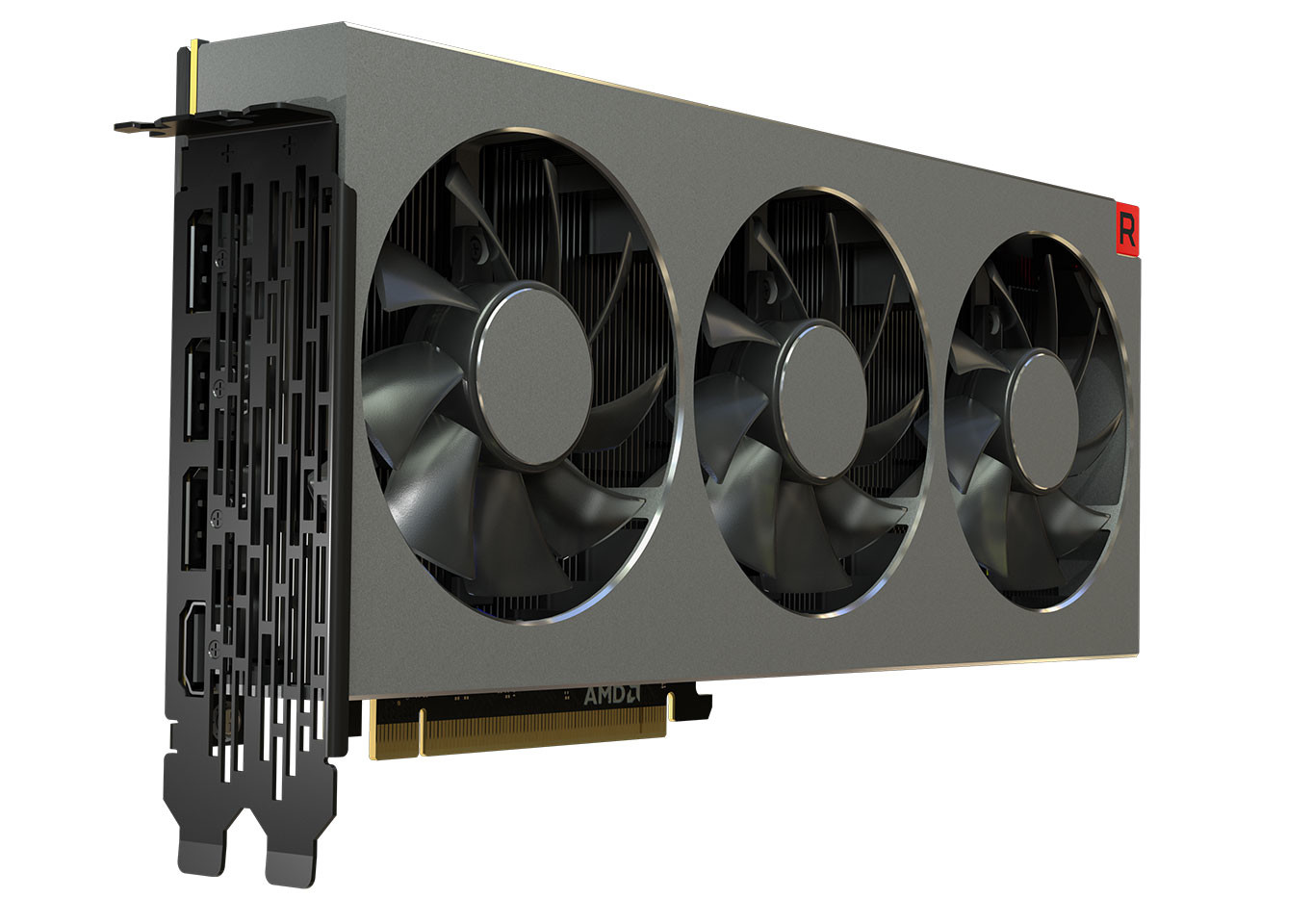
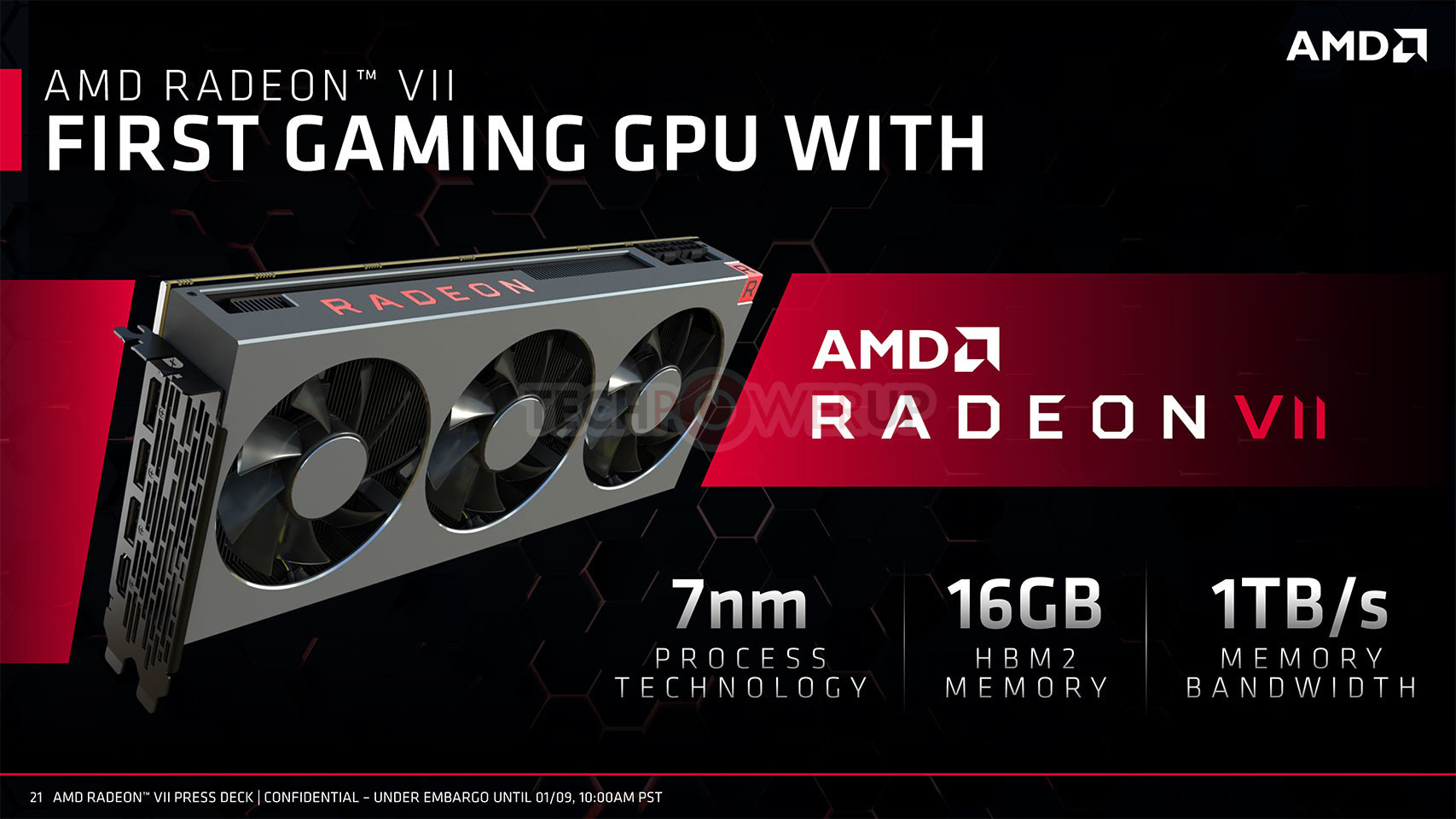
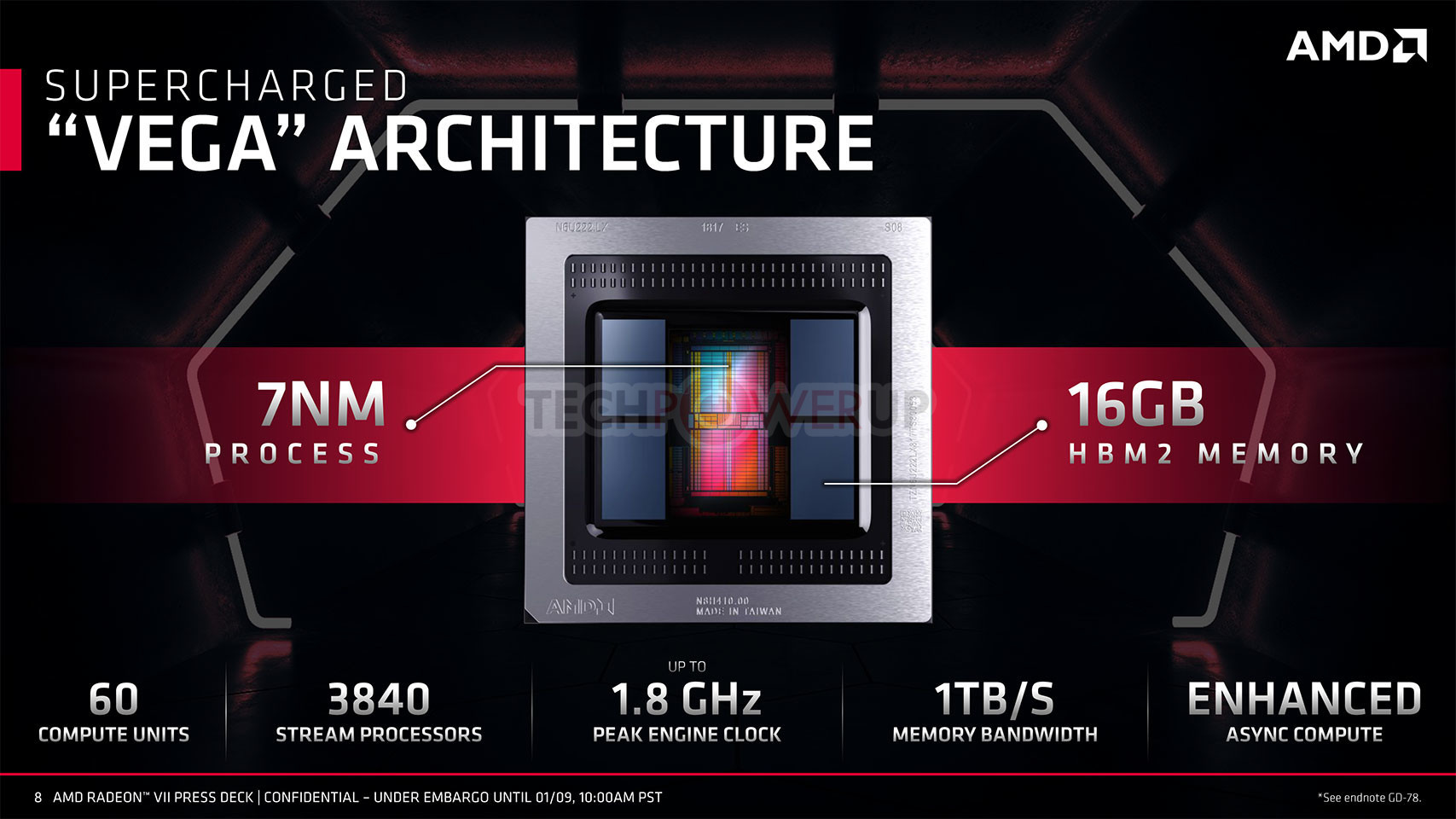
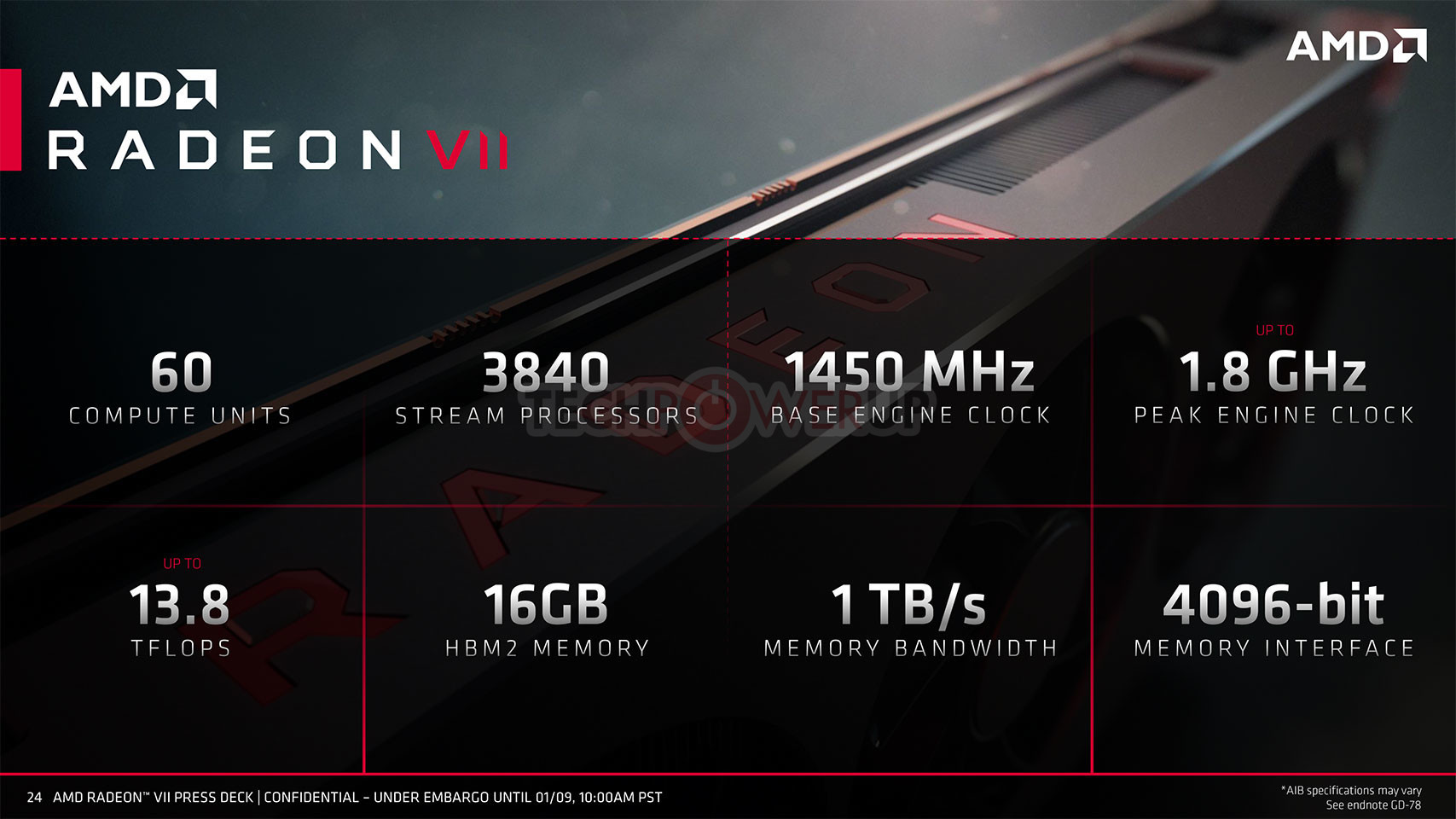
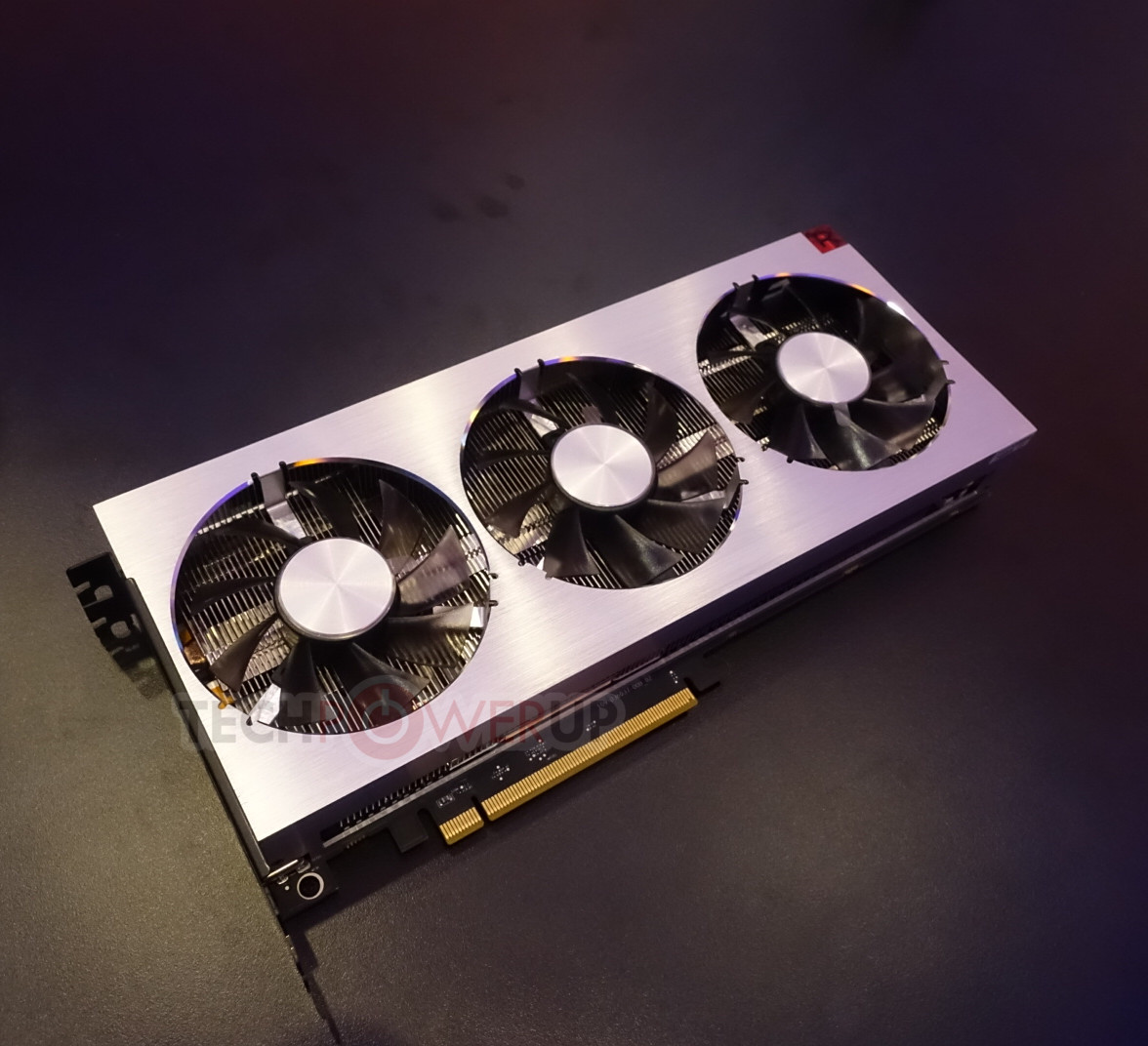
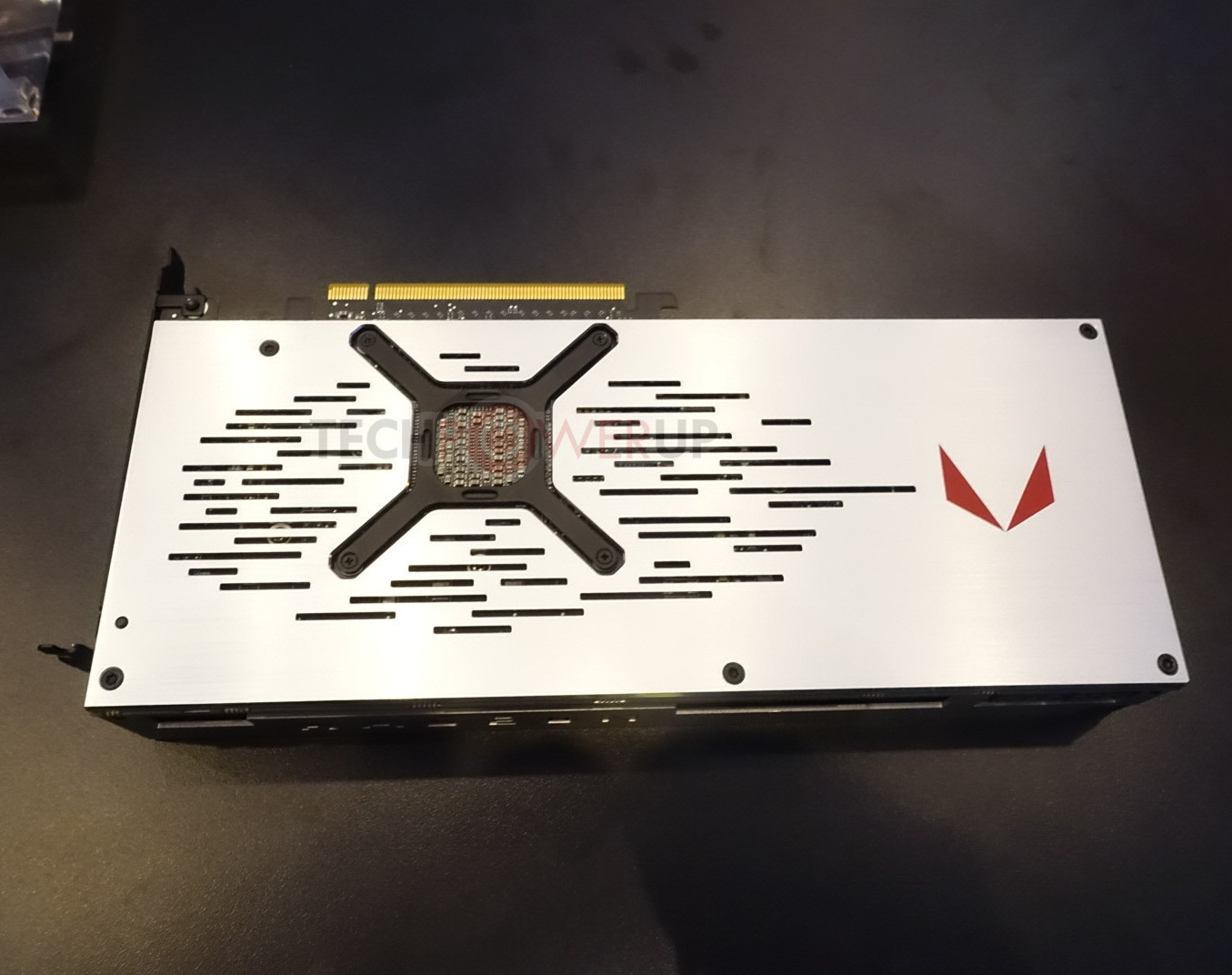
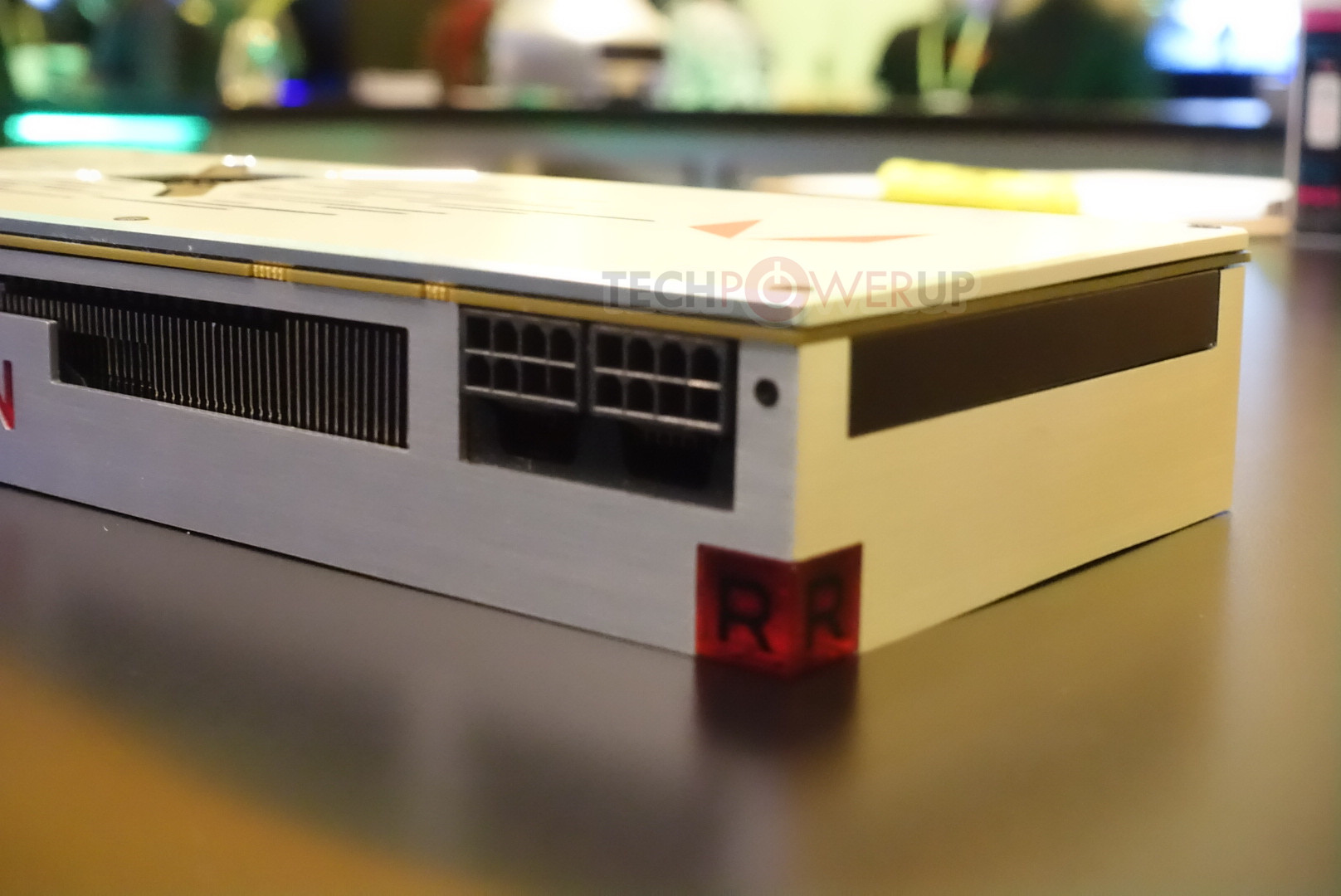
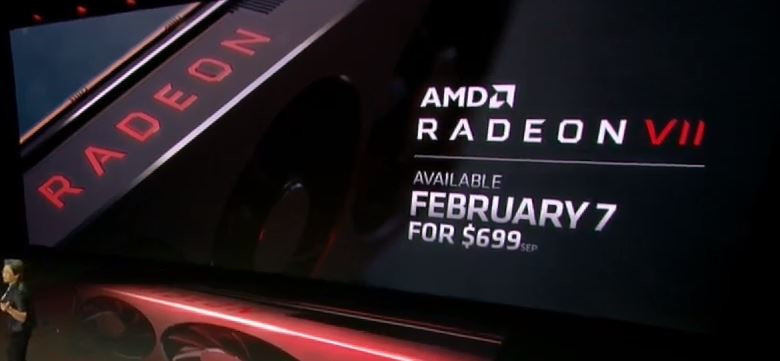
Amidst breaking news about PowerColor designing what could be the first custom-design Radeon VII graphics card, the company also unveiled its reference-design Radeon VII card, the AXVII 16GBHBM2-3DH. This card sticks to AMD's reference design clock speeds of up to 1750 MHz boost, and up to 1800 MHz "peak" clock speeds, with the memory ticking at 1000 MHz. It implements the slick, solid-aluminium triple-fan stock cooling solution AMD designed for this card. Drawing power from a pair of 8-pin PCIe power connectors, the card puts out three DisplayPort 1.4 and an HDMI 2.0b. Based on the 7 nm "Vega 20" silicon, the Radeon VII packs 3,840 stream processors, 240 TMUs, 64 ROPs, and a 4096-bit wide HBM2 memory interface, holding 16 GB of memory. It's likely that PowerColor will sell this card close to AMD's MSRP for this card, USD $699.
PowerColor, one of AMD's foremost AIB (Add-in-Board) partners, is preparing at least as many as five different SKUs based on the latest, upcoming AMD graphics chip. While AMD did say that initial availability of the new, shrunk-down Vega graphics card would be limited to base design models, it's clear that at least PowerColor wants to bring its years of R&D on cooling solutions to bear.
The product codes for PowerColor's in-development SKUs stand as AXVII 16GBHBM2-3DH (reference model), AXVII 16GBHBM2-2D2H (RedDragon Triple Fan), AXVII 16GBHBM2-2D2HD (RedDevil Triple Fan), AXVII 16GBHBM2-2D2H/OC (RedDragon Triple Fan OC, and AXVII 16GBHBM2-2D2HD/OC (RedDevil Triple Fan OC). Whether PowerColor is moving the fastest, has the best relations with AMD, or is just the one company whose beans have been spilled is uncertain for now, but you can expect other brands to join in on the SKU development, if they aren't doing so already (highly, highly doubtful at that).
Update (30/01): A PowerColor representative on Reddit stated that the company is not planning to launch any custom-design Radeon VII in the immediate future. "We did clarify to the media, that at this moment we will only carry AMD reference design and at the moment we do not have custom model planned in the immediate future," they said. PowerColor didn't completely shut off the possibility of a "Red Devil" branded Radeon VII. "Obviously there's quite of you guys out there wanting our Red Devil series on the Vega VII and we will always consider the option. Just not at this point," the statement read.
Philips today announced another entry into their ultrawide monitors, with the SuperWide 499P9H piece of kit. This monitor packs a 32:9 aspect ratio, 49", 5120 x 1440 (dual Quad HD) VA panel for accurate colors and unmatchable horizontal screen real-estate. Its 1800r curvature ensures that more of the panel stays in your field of view (and at the same overall distance) without any color gradation or change - which would be hard on a VA panel anyway. It features VESA's HDR 400 certification, the lowest attributable to any monitor, a pop-up webcam for the privacy-minded amongst us with support for Windows Hello.
A USB 3.1 type-C docking station, an RJ45 port por secure communication between devices, and ergonomic features such as a height-adjustable stand with swivel and tilt functions, VESA mount, Flicker-Free technology and LowBlue Mode also make their appearances to round out the package. Connections are taken care by 1x DisplayPort 1.4 and 2x HDMI 2.0 b. The Philips 499P9H will be available starting from £989.00.
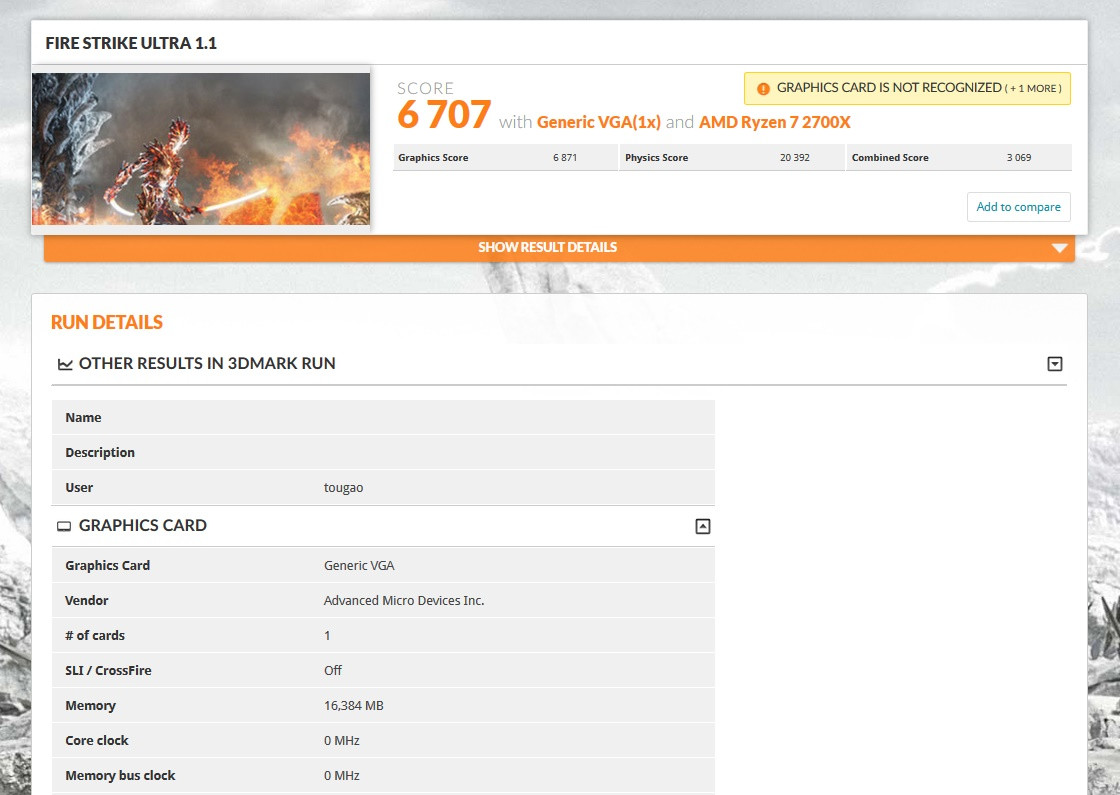
Benchmarks of AMD's upcoming Radeon VII graphics card have surfaced, courtesy of the one and only, graphics card info and results leaker extraordinaire Tum Apisak. In these scores, and looking purely at the graphics portion of the benchmarks, AMD's solution really does seem to bring the fight to NVIDIA's RTX 2080 - no small feat, considering that it's mostly a shrunk-down version of AMD's previous-gen Vega with overcharged memory and core clocks.
The Radeon VII scores, according to Tum Apisak (take it with a grain of salt), 27400 on the FireStrike test; 13400 on the FIreStrike Extreme bench; 6800 on the FireStrike Ultra test; and finally, 8700 points on Time Spy. Consulting 3D Mark's database, it seems that factory-overclocked RTX 2080 graphics cards usually score around 27000 points on the FIreStrike base and 6400 points on the FireStrike Ultra tests, which means that at least in this synthetic scenario, AMD's graphics card ekes out a win.
We reported yesterday how Metro Exodus unceremoniously left Steam for a year-long exclusivity deal on the Epic Game store, one of many steps that Epic and Tencent are taking to challenge the Goliath of PC gaming storefronts itself. Valve was quick in putting out a rare statement yesterday, which has been updated since to reflect the status of the game on Steam, and it can be seen below verbatim, with THQ Nordic's take on this matter past the break.
Notice: Sales of Metro Exodus have been discontinued on Steam due to a publisher decision to make the game exclusive to another PC store. The developer and publisher have assured us that all prior sales of the game on Steam will be fulfilled on Steam, and Steam owners will be able to access the game and any future updates or DLC through Steam. We think the decision to remove the game is unfair to Steam customers, especially after a long pre-sale period. We apologize to Steam customers that were expecting it to be available for sale through the February 15th release date, but we were only recently informed of the decision and given limited time to let everyone know.
It seems only yesterday that we were discussing a Turing microarchitecture-based TU116 die that would power the yet-to-be-confirmed GeForce GTX 1660 Ti. With no RTX technology support, this was speculated to be NVIDIA's attempt to appease the mainstream gaming market that understands the GPU does not have enough horsepower to satisfactorily drive real-time ray tracing in games while still maintaining an optimal balance of visual fidelity and performance alike. Reports indicated an announcement next month, followed by retail availability in March, and today we got word of more concrete evidence pointing towards all these coming to fruition.
It appears that trade listings in various organizations are going to be a big source of leaks in the present and future, with MSI GeForce GTX 1660 Ti SKUs, including the Gaming Z, Armor, Ventus, and Gaming X, all listed on the Eurasian Economic Commission (EEC). The listing covers the associated trademarks, all awarded to MSI, and is one of the last steps towards setting up a retail channel for new and upcoming products. Does the notion of a Turing GTX GPU without real-time ray tracing interest you? Let us know in the comments section below.
Cooler Master, a global leader in designing and manufacturing innovative gaming peripherals and computer components, announces it's the addition of its two new tenkeyless (TKL) mechanical keyboards, the MK730 and CK530. "As a mainstream company to pioneer one of the first tenkeyless form factor keyboards, it was a no brainer to offer our two best-selling keyboards in TKL form." says Bryant Nguyen, Peripheral General Manager.,"
[Editor's note: Our own review of the Cooler Master SK630 is published here for those interested.]
Cooler Master, a global leader in designing and manufacturing innovative gaming peripherals and computer components, today launched two low profile mechanical keyboards from its new SK series, the SK650 and SK630. "We created the SK series with design and functionality in mind. Especially for those who are workers by day and gamers at night." says Bryant Nguyen, Peripheral General Manager.
The SK650 and SK630 are slim profile mechanical keyboards with the perfect balance of "work and play." The SK series features Cherry MX low profile switches that provide a reduced travel distance and actuation point with the same signature durability and precision as a standard red switch. The boards are equipped with Type-C USB for convenience. Per-key backlighting, surrounding light bars, and macros can be fully customized through Cooler Masters easy to use Portal Software Application. On-the-fly-controls allow real-time adjustments to lighting and macros without the need of software, including Windows Lock On/Off to prevent accidental actuation during game play. Users can choose from two sizes depending on preference. The SK650 is a full layout keyboard while the SK630 is its little brother, a ten keyless layout for users with limited desk space.
De-noising is a vital post-processing component of ray-traced images, as it eliminates visual noise generated by too few rays intersecting pixels that make up an image. In an ideal world, a ray should hit every pixel on the screen, but in the real world, computing hasn't advanced enough to do that in reasonable/real-time. Denoising attempts to correct and reconstruct such images. Intel today launched a free Open Image Denoise (OIDN) library for ray-tracing.
Governed by the Apache 2.0 license, OIDN is part of Intel Rendering framework. From the looks of it, the library is CPU-based, and leverages 64-bit x86 CPU (scaling with multi-core and exotic instruction-sets), to de-noise images. Intel says OIDN works on any device with a 64-bit x86 processor (with at least SSE4.2 instruction-set), although it can take advantage of AVX2 and AVX-512 to speed things up by an order of magnitude. The closest (and closed) alternative to OIDN would be NVIDIA's AI De-noiser. NVIDIA "Turing" GPUs use a combination of ad-hoc deep-learning neural networks and GPU compute to de-noise. You can freely access OIDN on Intel's Git.
SteelSeries, the global leader in gaming peripherals, today announced its newest full-size, multi-platform controller, the Stratus Duo. Gamers can swap between the low latency 2.4GHz wireless connection for gaming on Windows, and Bluetooth for mobile gaming on Android, Oculus Go and Samsung VR. Gamers can utilize the Stratus Duo in multiple ways using the 2.4GHz wireless, Bluetooth and wired connections. With its Bluetooth connection, the Stratus Duo supports Android, Samsung Gear VR and Oculus Go. Gamers no longer need to struggle with awkward touchscreen controls while playing mobile games on their Android devices.
The Stratus Duo allows gamers to enjoy playing on their Android device via Bluetooth or on their PC via the 2.4GHz wireless connection with no additional software needed for setup. "The gaming ecosystem is continuing to evolve and grow beyond PC and consoles to include mobile devices and VR systems," said Tino Solberg, SteelSeries CTO. "The Stratus Duo allows gamers to easily navigate across several platforms through wireless and Bluetooth technology to create a truly seamless experience."
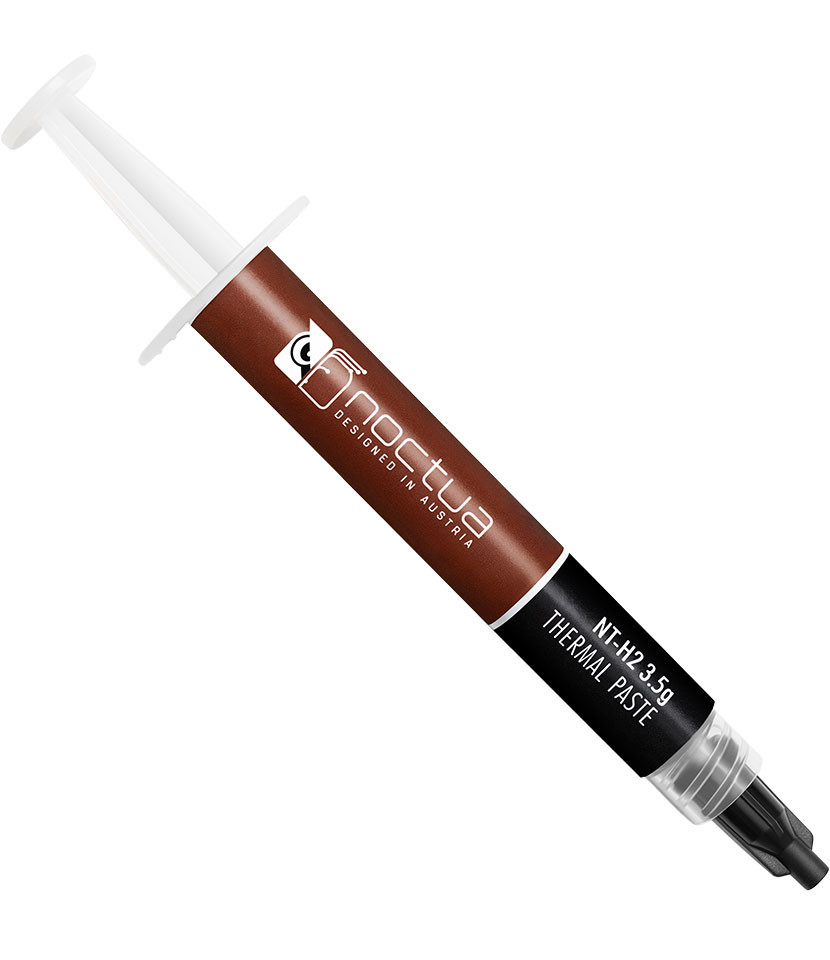
Noctua today introduced NT-H2, the further improved second generation of its award-winning hybrid thermal compound. Combining the iconic NT-H1's proven features, superb ease of use and renowned long-term stability with a novel, fine-tuned formula of microparticles for even better thermal performance, NT-H2 is an enthusiast-grade paste for the highest demands. At the same time, Noctua also presented a new, large 10g pack of NT-H1 as well as NA-SCW1, a set of 20 cleaning wipes that are ideal for removing thermal compound in a quick, clean and efficient manner.
"First introduced in 2007 and shipped with our premium-quality CPU coolers for more than 10 years, our NT-H1 thermal compound has proven its excellent performance in countless tests and reviews," says Roland Mossig (Noctua CEO). "It's chosen again and again by overclockers and hardware enthusiasts around the globe, not only for its efficiency but also for its ease of application and cleaning. Today, we're proud to present the new, second-generation NT-H2 that provides even better performance!"
With a combination of tax-sops and State support, Intel loosened its purse-strings for a massive investment in Israel, where the company already has substantial investments in manufacturing and R&D. The investment consists of a 40 billion Shekel (~USD $11 billion) semiconductor foundry. "Intel's global management has informed us about its decision to invest another 40 billion shekels in Israel, an unprecedented decision that is expected to bring thousands of jobs to the south (of Israel)," said the country's Minister of Finance, Moshe Kahlon.
This $11 billion investment closely follows news of Intel committing $5 billion last year toward expanding its existing facility in Kiryat Gat. Expansion of this plant in the southern part of the country, is expected to complete by 2020. As part of that agreement, Intel will spend $3 billion on sourcing materials, labor, and services from local Israeli businesses. The new factory is slated to come up in the same city, although it's not known if the site is contiguous with the existing factory. Intel is one of the largest multinational employers in Israel.
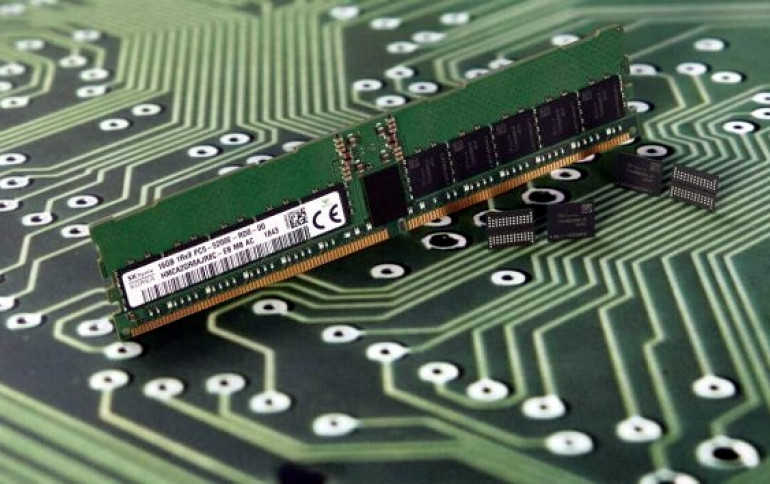
The PC5 DDR5 main memory standard could enter the market by 2020, according to SK Hynix research fellow Kim Dong-Kyun. The first such memory standard will be DDR5-5200, which offers nearly double the bandwidth of DDR4-2666. "We are discussing several concepts of the post DDR5," he said. "One concept is to maintain the current trend of speeding up the data transmission, and another is to combine the DRAM technology with system-on-chip process technologies, such as CPU," he added, without offering any additional information. SK Hynix had in 2018 developed a working prototype of a 16-gigabit (2 GB) DDR5 DRAM chip ticking at 5200 MT/s, at 1.1 Volts. A 64-bit wide memory module made with these chips could offer bandwidth of 41.6 GB/s.
SK Hynix is developing its own innovations that could make its DDR5 chips more advanced than the competition without going off-standard. "We have developed a multi-phase synchronization technology that enables keeping the voltage during a high-speed operation in a chip at a low level by placing multiple phases within the IP circuit, so the power used on each phase is low but the speed is high when combined," Kim said. He also mentioned that development of the DDR6 PC memory standard is already underway, with the design goals of doubling bandwidth and densities over DDR5. Advancements in DRAM are propelled not just by the PC ecosystem, but also handhelds and self-driving car electronics.
Razer, the world's leading lifestyle brand for gamers, is pleased to announce that the Razer Gold virtual credits platform is adding leading Chinese gaming company NetEase Games to its strong lineup of partners. Razer Gold, one of the world's largest virtual credit services for gamers, is bringing in a new payment channel to NetEase Games' titles, and is working with NetEase Games to bring more special offers to gamers.
The global partnership between Razer Gold and NetEase Games further consolidates Razer Gold's position as a preferred partner for games and content companies, especially in emerging markets. Titles developed by NetEase Games, including the bestselling hit "Rules of Survival1" on both PC and mobile versions, will be powered by Razer Gold across all markets. Gamers can make in-game purchases with Razer Gold and score exclusive Razer-branded in-game items by topping up with Razer Gold. Razer Gold will work closely with NetEase Games to bring a suite of exclusive and highly-customized offers to gamers, leveraging Razer's brand position and unique understanding of gamers' behavior.
FSP, a leading manufacturer of power supplies and PC equipment, is pleased to announce the availability of the CMT340 RGB PC Gaming case, the world's smallest mid-tower chassis that can fit a 360 mm radiator. With four amazing looking and addressable RGB fans and two "galaxy dark" tempered glass panels, the CMT340 is a beautiful proposition for gamers on a budget. The CMT340 is a compact version of the award-winning CMT510 ATX mid-tower but with several improvements. It features a gorgeous black coated, sturdy SPCC steel frame, which holds the same distinctive features and flexibility as the one in the CMT510. It supports a wide variety of radiators, ranging from 120/140/240/360, for liquid cooling, or air cooling fans. The CMT340's four RGB fans are fully addressable and compatible with Asus Aura Sync, and MSI Mystic Light Sync.
The CMT340 is engineered for gamers, its design is sleek, with flush transparent glass panels and straight edges to fit on the desk of every self-respecting gamer. Besides its broad support for cooling options, it features three separate dust filters to keep the system squeaky clean. It supports Mini-ITX, MicroATX and regular ATX size motherboards (7 PCI slots).
AMD's socket AM4 and socket TR4 chipsets are originally designed by ASMedia. With its "Zen" family of processors being full-fledged SoCs, the motherboard "chipset" only serves to increase connectivity, and ASMedia already holds certifications for key groups such as the PCI-SIG, USB-IF, SATA-IO, NVM-Express group, etc. It's being reported now that ASMedia will develop some, if not all 500-series chipsets, with the exception of X570. The X570 will be an in-house design by AMD, which will use its own foundry partners (likely GloFo 14 nm) to manufacture it. This presents AMD with an opportunity to harden it against vulnerabilities, and have greater control over pricing, not to mention overcoming key design shortfalls of "Promontory," such as downstream PCIe connectivity.
This flies in the face of speculation that AMD would discontinue ASMedia's supply of chipset, especially in the wake of the "Chimera" vulnerability affecting "Promontory" 300-series and 400-series chipsets. The supposedly security-hardened 500-series chipset will feature PCI-Express gen 4.0 certification. What this means is that the chipset bus between the AM4/TR4 SoC and the chipset will be PCI-Express 4.0 x4 (64 Gbps), translating to double the bandwidth. It remains to be seen if the downstream PCIe lanes put out by the chipset are gen 4.0, too. Current 400-series chipsets continue to put out stale gen 2.0 lanes, compensated for by additional gen 3.0 lanes put out by the SoC. Sources also mention that ASMedia-supplied chipsets will only hit the market toward the end of 2019, which means AMD X570 could be the only 500-series chipset option between the mid-2019 launch of 3rd generation Ryzen, and late-2019. You should be able to run these processors on older socket AM4 motherboards via BIOS updates, though.
Sometime mid-2019, AMD will launch its 3rd generation Ryzen "Zen 2" processors with core counts of up to 16 cores in the AM4 package. These processors will launch alongside the new AMD 500-series desktop chipset family, led by the X570. AMD assures backwards compatibility of these processors with older chipsets provided motherboard vendors support their customers with BIOS updates. You'll probably need a 500-series chipset motherboard to use PCI-Express gen 4.0 connectivity, while older chipsets will limit connectivity to gen 3.0 (not that there are any GPUs that use gen 4.0).
ASRock is developing as many as nine motherboard models based on the AMD X570, according to a list scored by VideoCardz. These include the X570 Phantom Gaming X and X570 Taichi leading the top-end; X570 Phantom Gaming 6, X570 Phantom Gaming 4, and X570 Extreme4 covering the mid-range, and the entry-level of the lineup consisting of the X570 Pro4/R2.0 and X570M Pro4/R2.0.
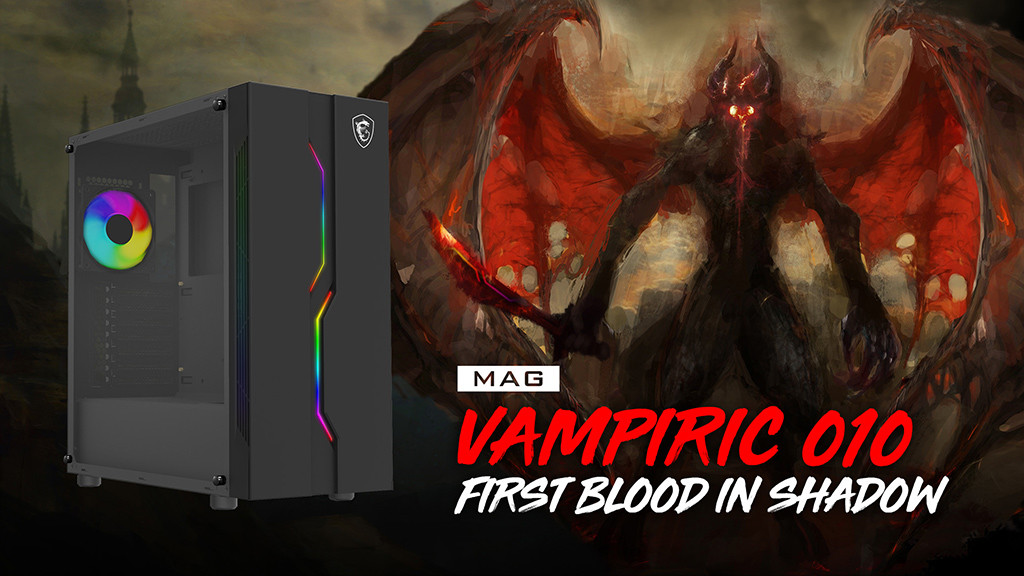
MSI, world leading gaming brand, is proud to introduce the brand-new product line - case to build a stronger connection among MSI products. This time, MPG GUNGNIR and MAG VAMPIRIC series are ready to shine. The MPG GUNGNIR 100 case is inspired by the sharp look and feel of "Gungnir," the legendary spear wielded by the Norse god Odin. This advanced case adopts plain industrial design, featuring a 4mm tinted tempered glass panel to showcase its internals, accentuated with an ARGB fan. With a 1 to 8 addressable RGB LED hub, the MPG GUNGNIR 100 offers unlimited customization options and can light up any room with MSI's Mystic Light APP. Support for 3D-printable parts delivera new level of personalization. Dial in optimum cooling with support for up to 7 system fans.
The MAG VAMPIRIC 010 case originates from the concept of the King Vampire - Dracula. With black and grey tones, the appearance invokes the mystique of silent castles. The dual blade shape on the front is the symbolism of coat of arms, combining with Mystic Light SYNC to display RGB lighting effects. Featuring a light grey 4mm tinted tempered glass panel, an ARGB fan, a magnetic filter on the top, and up to 6 system fans to strictly on ventilation. , the MAG VAMPIRIC 010 showcases the diverse temptation and charm of vampires.
This piece of news is slightly off the beaten path for our usual coverage of solely PC hardware or gaming, but I think that Samsung's overall size in the worldwide market merits a headline. Sustainability efforts have been increasing for a number of years now (albeit slower than many of us would like), and Samsung, being the giant corporation that it is with threads in all sorts of product lines, has taken a bold step in achieving environmental sustainability. Plastic used for product packaging is being phased out with recyclable, environmentally-friendly products. Some plastic usages will be kept, though even those will see a revised, recycled-plastic or bioplastic materials.
TSMC's Fab 14 B has been affected with a chemical contamination that has put a considerable number of wafers in suspend mode. Fab 14 B essentially produces 12 and 16 nm, 300 mm wafers for 14 companies, including NVIDIA, MEDIATEK, Huawei and Hisilicon. Reportedly, between 10,000 and 30,000 wafers have been affected (though not scrapped, so there might be salvageable bits and pieces here and there). Of course, every wafer will have to go through a thorough certification process, and the fab will have to go down for the company to purge any remains of these botched chemical compounds.
To put things into perspective, though, Fab 14 B is one of TSMC's Gigafabs, which have a rated monthly output of 100k wafers - so production worth between three and ten days could be affected already, with the additional downtime accruing lost potential fabrication. This event isn't expected to significantly affect availability of any of the products for any of the companies, but these are becoming, at the very least, late inventory - this could well play into some speculative increases in pricing from some players in the market.
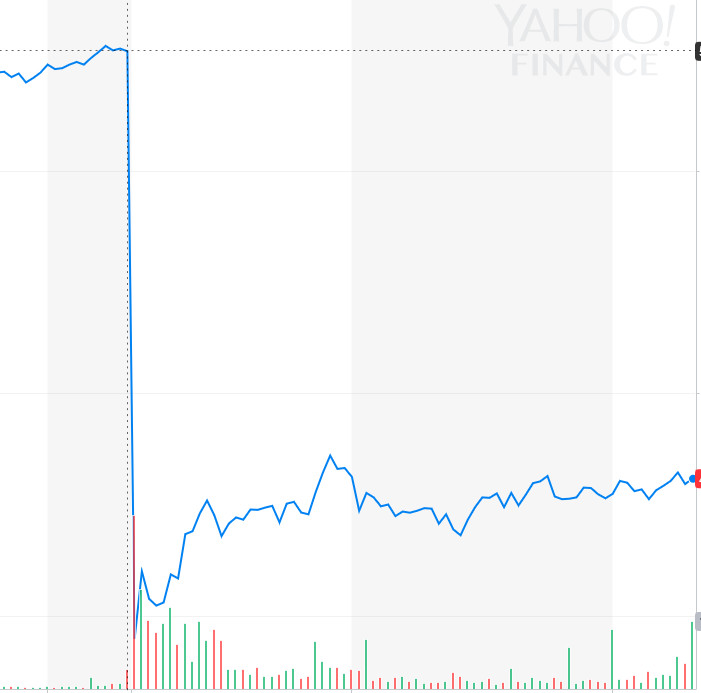
NVIDIA's stock value has been falling precipitously in the last several months. We reported in December that the company lost some 48.8% in value between October and December, moving from an all-time peak of $289.36 on October 1st, to just under $149 on December 14th. At the time, excess inventories were the cause, alongside a less than glamorous reception to their new RTX series of graphics cards. Now? NVIDIA cites "deteriorating macroeconomic conditions, particularly in China" as harming demand for their gaming GPUs. But this now comes alongside a its datacenter business also falling short of expectations - that's two of NVIDIA's most lucrative markets being put towards the red, or at least, with lower than expected income revenues.
This led the company to revise its financial outlook for the year, lowering revenue estimates by $500 million, down to $2.2 billion from its initial $2.7 billion forecast. Gross margins have been lowered by some 7%, which means lowered earnings for investors. Since the December plunge, NVIDIA's stock had recovered up to around $160 per share, but has now dived 14.52%, down to $136.90 - even lower than before. The company has seen its market valuation shrink by more than 50% inside of four months - while the company is still well in the green side of the limbo, so to speak, these certainly don't serve to improve the company's spirit.
Intel will be relasing IPG-less versions of their most popular desktop processors soon, if some retailers' listings of the CPUs are anything to go by. The i9-9900KF and i7-9700KF CPUs will bring about Intel's best-performing architecture to date in an integrated GPU-less package, which will allow the company to bring prices down for the end user. Of course, this has all the hallmarks of a bid for a more competitive positioning of its products against AMD's upcoming Zen 2 products, whilst simultaneously (and likely) increasing profit on every processor sold (we'd expect the savings passed on to the customer to be inferior to Intel's saved costs at the foundry level).
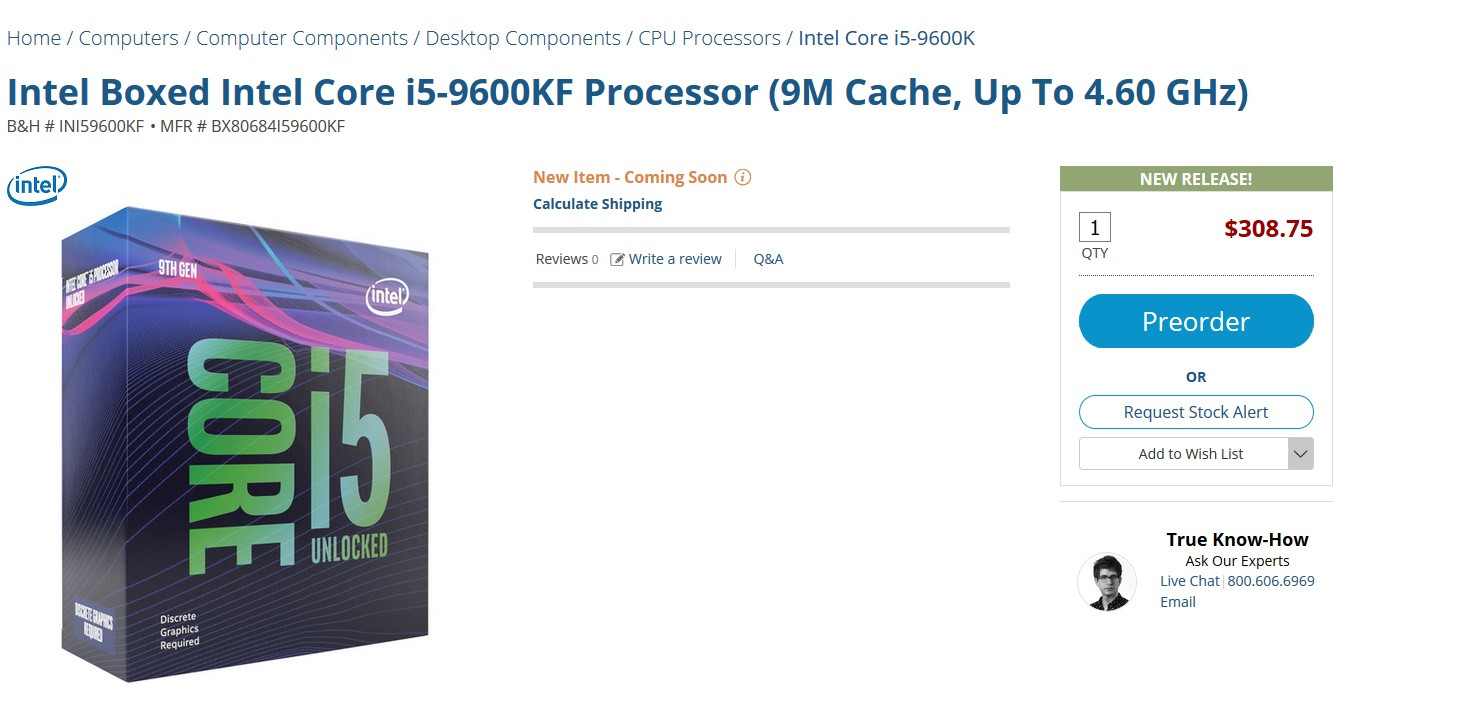
The i9-9900KF has been found online for $582.50, more than $50 above the i9-9900K's $530 street pricing, while the 9600KF is listed at $308.75, more than $60 over the street pricing of Intel's i7-9600K. Remember that these prices are gouged on account of limited availability on the market; when these are more widespread and the market sees stocks in line with demand expectations, these should bottom down. But then again, we've seen Intel's products being price-increased for a while as the company struggled to keep its production up to the demand, amidst a constrained and supposedly already second-line 14 nm process.
Metro Exodus is an upcoming post-apocalyptic first-person shooter that could be a trilogy finale. Just weeks ahead of its launch on the PC platform, 4A Games made a groundbreaking announcement: that the game will not be available to order on Steam, at least from tomorrow through Feb 14, 2020, and that its PC version will be an Epic Games Store timed exclusive. The game will launch at USD $49.99 in North America, and 59.95€ in the EU.
Pre-order sales of the game have stopped on Steam, however, those who bought the pre-order on Steam have the option of either receiving the game upon launch, or canceling their pre-order for a full refund. Those who choose to stick to Steam will get their game as usual, including update patches, and support on Steam Community. Epic Games Store is vacuuming game studios in droves due to a favorable revenue sharing deal compared to Steam, when lets developers keep 88 percent of the sales.
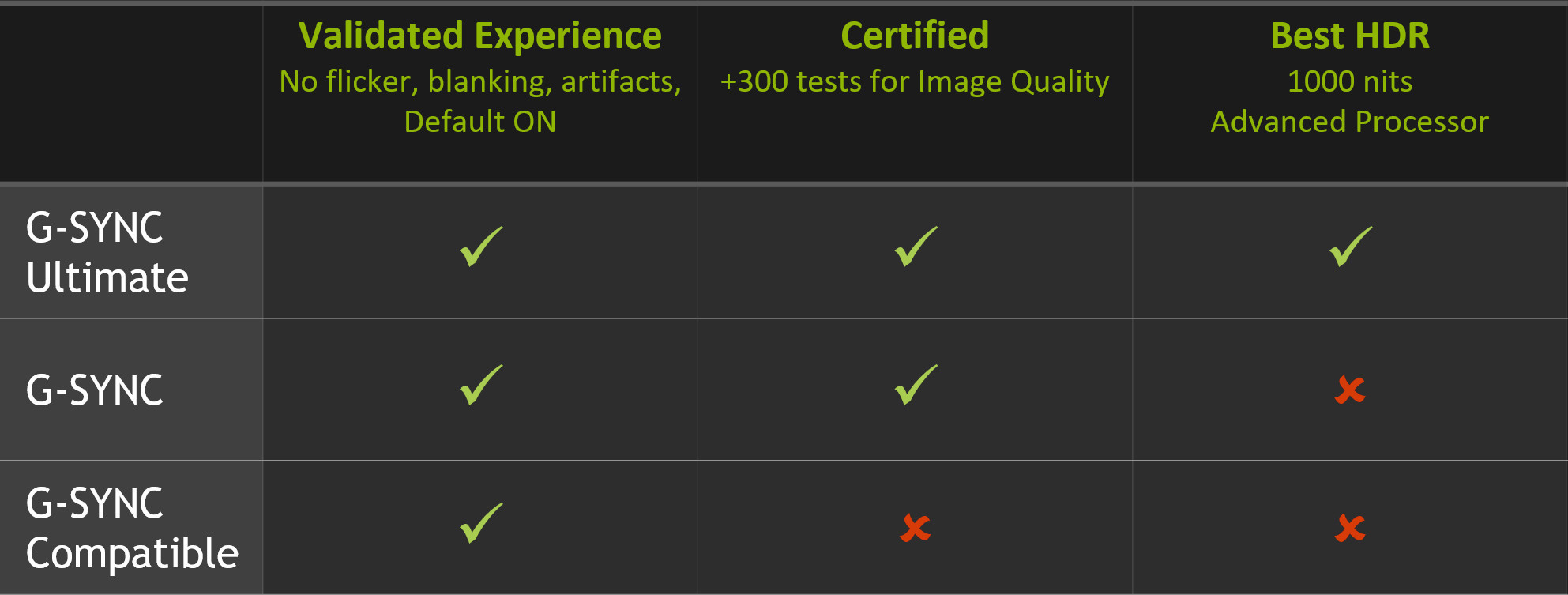
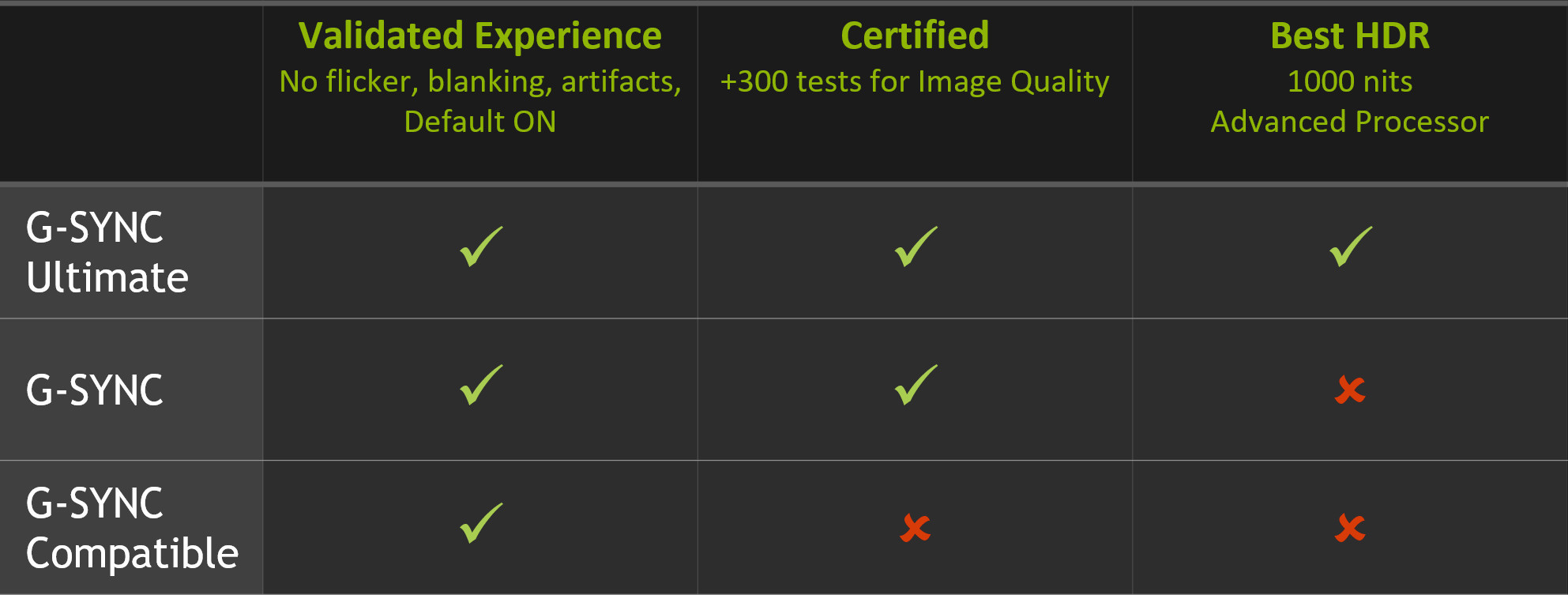
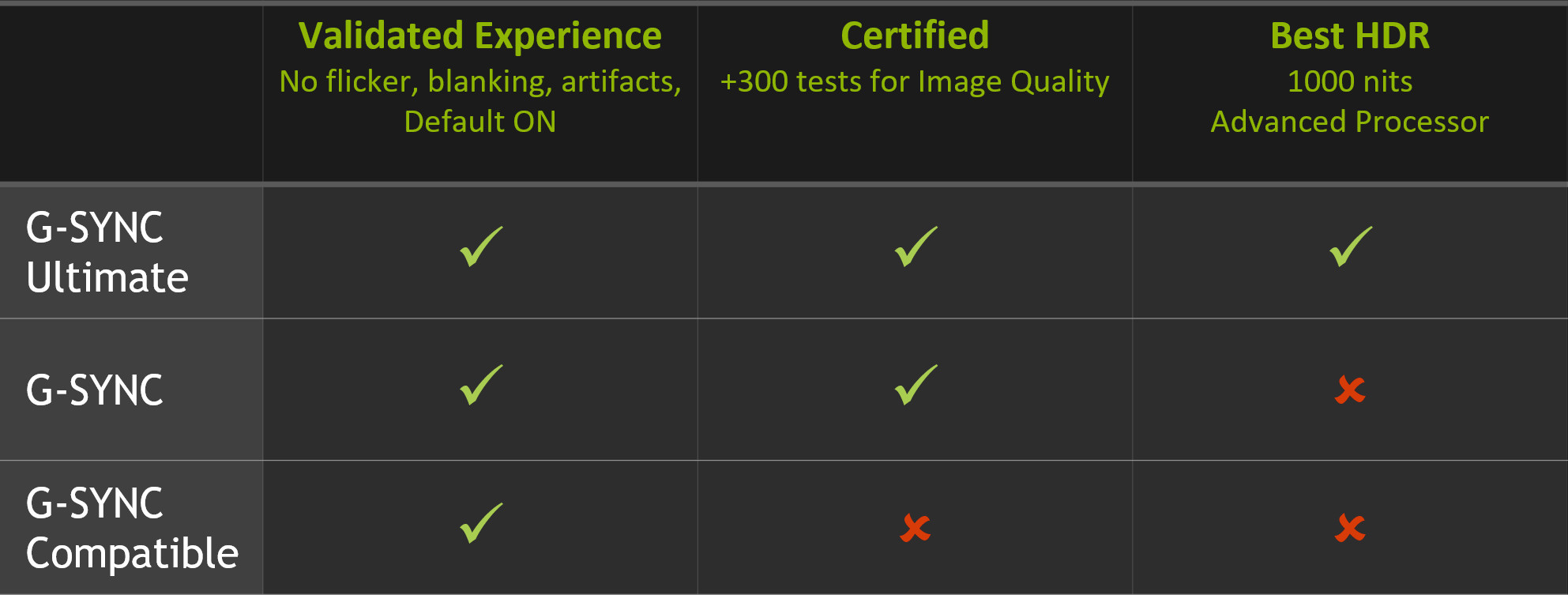
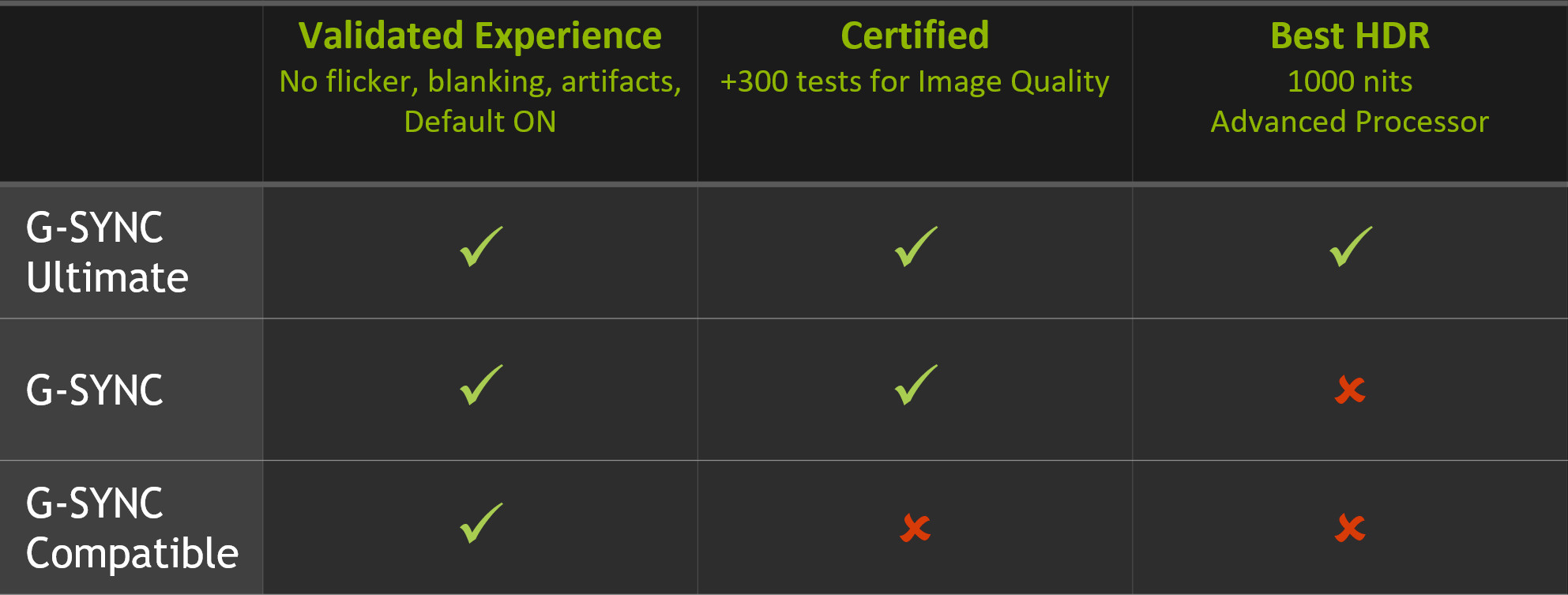
Following NVIDIA's announcement of their newest drivers, MSI monitors are effectively G-Sync Compatible! This technology allows G-Sync to be used on Adaptive Sync monitors. G-Sync, an anti-tearing, anti-flickering and anti-stuttering monitor technology designed by NVIDIA, was once only exclusive to monitors that had passed the NVIDIA certification. With the newest release of NVIDIA GPU driver, NVIDIA now allows G-Sync to be used on monitors that support Adaptive Sync technology when they are connected to an NVIDIA graphics card.
CDKOffers is a new online retailer selling genuine license keys to popular software and games, letting you save over 80% on your software costs for new PC builds. Licenses to popular software such as Windows 10 Pro operating systems and Office 2016 Professional Plus productivity suite are so cheap, that you'd rather buy new keys than hassle porting your old OEM key between motherboards. Globally-valid Windows 10 Pro OEM keys go for as less as USD $14.52, while globally-valid lifetime Office 2016 Professional Plus keys go for $36.87, which is less than half what you'd pay for an annual subscription for Office 365. While you'd on the site, you can also check out their jaw-dropping deals on game keys and in-game credit vouchers, which you can redeem on popular DRM platforms such as Steam, UPlay, Xbox Live, etc.
Intel is giving finishing touches to its new family of compact WLAN cards for portables and motherboards, under the "Cyclone Peak" family. These include the Wireless-AX 22260 sold under Intel's main brand, and two re-branded or differentiated products by RivetNetworks: Killer Wireless-AX 1650x (22260NGW), and Killer Wireless-AX 1650W (22260D2W). Device IDs for these cards were recently added to the IWLWIFI repository by Intel software teams. "Cyclone Peak" offers 802.11ax Wi-Fi connectivity, in addition to Bluetooth 5. 802.11ax provides about 37 percent higher data-rate than 802.11ac, but improved effective bandwidth due to better spectrum utilization.
The leading global motherboard and graphics card manufacturer, ASRock, pleasure to announce the world's first AMD based Mini STX Platform - DeskMini A300 at CES 2019. It adopts with AMD A300 chipset, not only supports AMD AM4 65W APU, but also provides up to 32GB DDR4-2933MHz high-speed memory, which leads to outstanding computing power and 3D performance. DeskMini A300 offers up to 4 storage interfaces, supports three display outputs simultaneously, M.2 Wi-Fi module and various accessories within 1.9 Liter compact size. DeskMini A300 is an ideal choice to build a home entertainment PC and mini data center.
DeskMini A300 features the brand new A300M-STX motherboard. Continuing the design of the ASRock DeskMini series, the AMD AM4 socket is able to support the Bristol Ridge and Raven Ridge's 65W APU, as well as two DDR4 SO-DIMM slots, which can support up to 32GB of capacity. With overclocking memory module, it will power up 20% of 3D gaming performance even more . Moreover, the DeskMini A300 supports three display outputs simultaneously, greatly improves the user experience.
The leading global motherboard manufacturer, ASRock, is proud to introduce the new ASRock Steel Legend motherboard series. ASRock Steel Legend motherboards are built around the most demanding specs and features to provide a wide array of materials, components, and features that ensure stable and reliable performance. Steel Legend motherboards stand out from the crowd through its massive and luscious XXL Aluminum Alloy Heatsinks, I/O Armor, PCI-E Steel Slot, Polychrome Sync (Addressable RGB LED) support, and detailed PCB print on Sapphire Black PCB for mainstream users, gamers, and professionals that choose to work and play in style. With support for the latest AMD Ryzen processors, as well as high-quality audio featuring the highest quality Nichicon golden audio caps and signal shielding integrated into the PCB.
ASRock has gone to great lengths to ensure optimum stability and protection. With ASRock Full Spike Protection on all USB, Audio and LAN ports, users are always protected from Lightning/ESD damage, which is a comforting thought when using Steel Legend motherboards in challenging environments. Use of Premium 60A Power Chokes and Nichicon 12K Black Caps means not only that the B450 Steel Legend and B450M Steel Legend will remain rock solid no matter the task, but it also keeps your system stable when overclocking, for extra performance, whether you're gaming or rendering professional content.
LG introduced the 32UL750-W, a 32-inch (technically 31.5-inch) 4K Ultra HD monitor boasting of VESA DisplayHDR 600 certification, and support for AMD FreeSync. The monitor also offers an internal feature that attempts to convert SDR content to HDR via post-processing. Based on a VA panel, the monitor offers 178°/178° viewing angles, 4 ms (GTG) response-time, support for 1.07 billion colors (10 bpc), and up to 60 Hz refresh-rate.
Other key panel specs include 3000:1 static-contrast ratio and 400 cd/m² maximum brightness. Display inputs include two HDMI 2.0, a DisplayPort 1.4, and USB type-C (with DisplayPort wiring). If this USB connection also includes USB link-layer wiring, the monitor will use it to drive a 2-port USB 3.0 (type-A) hub. The monitor is expected to be priced around $750.
Corsair over the last week sneaked in a variant of its Carbide 275 mid-tower chassis that comes with noise-reduction, the Carbide 275Q. The new model is generally available on Amazon for USD $89.99, a $20 premium over the original that features tempered glass panels. Much of the premium isn't just toward the noise-dampening, but also the included 5-channel fan-controller. The Carbide 275Q features noise-absorbing foam along the inner walls of its side panels, which are now opaque matte-black. Much like the original, the 275Q features three 120 mm front fan intakes that guide air through the top and rear exhausts. You get room for graphics cards up to 37 cm in length, and CPU coolers up to 17 cm in height. You still get two vertical expansion slots in addition to 7 normally located slots, even though there's no window to show off your graphics card. The rest of its features are carried over from the original.
GIGABYTE is readying the GeForce RTX 2060 Gaming OC Pro White graphics card (GV-N2060GAMINGOC WHITE-6GC). A variant of the RTX 2060 Gaming OC Pro, the card features a white cooler shroud with chrome inserts, and an all-white metal back-plate. Contrasting the white is matte-black fan impellers capped with chrome hub stickers, and a black PCB that's carried over from the original.
The cooling solution features three aluminium fin-stacks arranged along four 6 mm-thick copper heat pipes that make direct contact with the GPU at the aluminium base. Heat drawn from the memory and VRM are transferred to this base by a secondary aluminium plate. Three 90 mm fans spinning in alternate directions (albeit same airflow direction), ventilate the heatsink. The card features idle fan-stop, which spools down the fans below a load/temperature threshold. The card draws power from a single 8-pin PCIe power connector. Display outputs include three DisplayPort and an HDMI 2.0. The card features GIGABYTE's highest factory-overclock for the RTX 2060, with 1830 MHz GPU Boost, although the memory frequency is untouched. The RTX 2060 Gaming OC Pro White could feature a minor $10-20 premium over the $379 MSRP of the original.
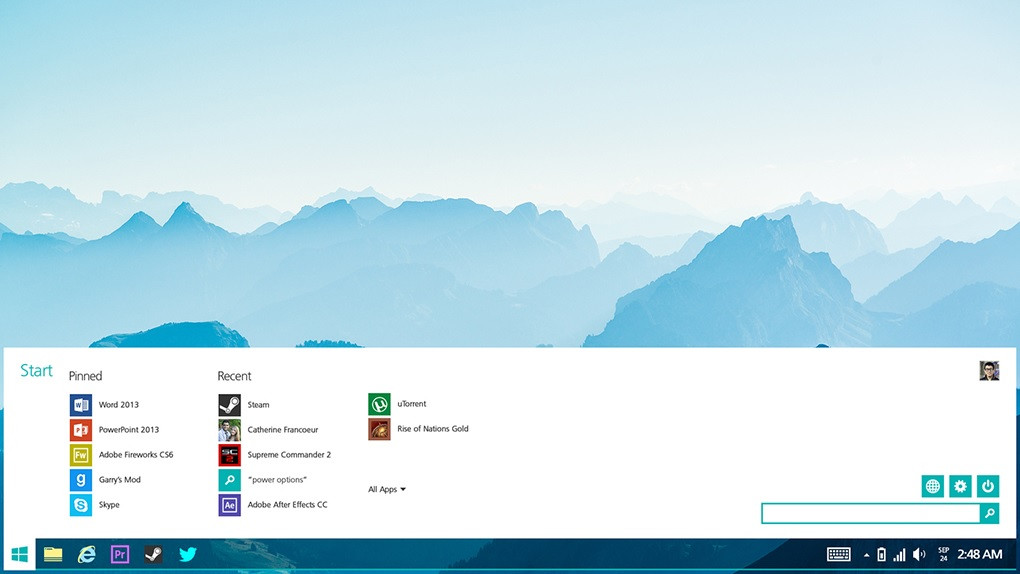
Windows Lite is a new upcoming PC operating system by Microsoft designed as a competitor to Google's ChromeOS, and being designed for machines with extremely slim hardware specifications. The OS could also target devices that work as "edge computers," with much of their processing being performed over the cloud. ChromeOS beats the bloated Windows 10 in one key department - a lightweight and uncluttered user-interface. This is the area where much of Microsoft's design efforts lie - UI elements and graphics that are lightweight not just on memory, but also Internet bandwidth, if the device is streaming a remote session (a la Citrix). Below is a concept by UX designer Jay Machalani.
The Windows Lite desktop looks familiar, with a taskbar and app buttons, and a Start menu, but one that's been redesigned without live tiles, but a simple list of icons. At this point it's unclear just how far Microsoft intends to go with the lightweight OS concept without cannibalizing sales of Windows 10 Home. The OS definitely features UWP, and from the looks of the screenshot doing rounds, also appears to support legacy Win32 apps, however, Microsoft has in the past restricted functionality of its cheapest OS products so as to not kill pricier Windows versions. Microsoft is innovating two brand new Windows user-interfaces for launches through 2019-2020, codenamed "Polaris" and "Andromeda."
QNAP Systems, Inc. (QNAP), a leading computing, networking and storage solution provider, today launched the TR-004, a 4-bay hardware RAID storage expansion device that can be attached to PC or NAS via USB 3.0 Type-C. The multipurpose TR-004 can be used to add storage space to a QNAP NAS, and can also serve as hardware-based RAID storage for PCs and NAS. The TR-004 offers convenient cross-platform file sharing and high flexibility for users, acting as a high-efficiency and intuitive storage expansion option.
The TR-004 supports individual, JBOD and RAID 0/1/5/10 storage configurations. QNAP NAS users can use the TR-004 with their NAS, including setting RAID parameters and creating a storage pool by using the "Storage and Snapshots" app within QTS. Alternatively, the TR-004 can be used as an external storage device of the NAS. The TR-004 can also be used with computers to facilitate file sharing and exchange, and supports the exFAT file system. Computer users with limited storage upgrade options can also use the TR-004 as an expansion unit, and a specialized QNAP External RAID Manager utility (Windows/macOS) can help them view disk health, change RAID configurations, check logs, and update the firmware of the TR-004.
Intel succeeded in bringing down the TDP of its 8-core/16-thread "Coffee Lake-Refresh" silicon all the way down to a staggering 35 W, from its currently rated 95 W, which in real-world usage easily exceeds 110 W, given Turbo Boost, and other performance enhancements enabled by DIY motherboards. The new Core i9-9900T achieves its TDP with a combination of significantly lower clock-speeds, and an aggressive on-die power-management system. Its nominal-clock is down to 1.70 GHz from 3.60 GHz of the original i9-9900K, while 1~2 core Turbo Boost frequency is down to 3.80 GHz from 5.00 GHz of the original. The all-core Turbo clock-speed could be as low as 3.30 GHz. Intel hasn't tinkered with the L3 cache amount, which is still set at 16 MB, and the UHD 630 iGPU retains its EU count and clock-speeds. The chip features its 4-character product code of QQC0.
Emerging PC case and accessories powerhouse DIYPC and TechPowerUp bring you a chance to change your least-often upgraded parts: cases and case-cooling, and take a plunge into the bright and colorful world of RGB LED aesthetics. Three lucky winners receive DIYPC hardware upgrades. The first winner receives DIYPC Trio-GT RGB case, while two other winners get a Rainbow-RGB 120 mm case fan, each. The Trio-GT RGB is DIYPC's flagship case that incorporates tempered glass, a contemporary interior layout, and up to four included RGB LED case fans. The Rainbow-RGB 120 mm fan embed addressable RGB LEDs into a silicone diffuser along the frame, coupled with high-durability bearings. To enter, simply fill in a short form to help us to get back to you; the three winners will be randomly selected and announced after February 8th, 2019.
Yesterday, EA launched the VIP demo for their highly anticipated title "Anthem". The VIP demo is only accessible to Origin Access subscribers or people who preordered. For the first hours after the demo launch, many players were plagued by servers crashes or "servers are full" messages. Looks like EA didn't anticipate the server load correctly, or the inrush of login attempts revealed a software bug that wasn't apparent with light load.
Things are running much better now, and we had time to run some Anthem benchmarks on a selection of graphics cards, from AMD and NVIDIA. We realized too late that even the Anthem Demo comes with a five activation limit, which gets triggered on every graphics card change. That's why we could only test eight cards so far.. we'll add more when the activations reset.
The Input Club Kira keyboard arose as a design with lofty goals and even higher expectations from the community that helped crowdfund it. Now as a retail product, it is available in a variety of switches, case frames, colors, and even as a kit. No matter the choice, the final product does justice to light, its name, in more ways than one.
Let me be the first to say that the two may not be directly related, but it is an awfully strong coincidence that both pieces of news come out on the same day. Indeed, earlier in the day AMD put out a press release (full release past the break) announcing "multiple organizational changes focused on strengthening the company's senior leadership team and accelerating growth." Several familiar names have been promoted within the company to be in charge of more products and visions across their CPU and GPU business units. Mark Papermaster, for example, is now an executive VP as well as CTO of AMD, and the company has also hired in new talent, including industry veteran Sandeep Chennakeshu, as executive VP of "Computing and Graphics responsible for the company's high-performance PC, gaming and semi-custom businesses".
Perhaps all this re-structuring and new hiring comes in handy, at a time when we have seen several people leave AMD for Intel or otherwise. Indeed, shortly after that press release went out, word got to us that James Prior, Senior Product Manager for AMD, and an ardent employee for nearly 6 years, is no longer working for the company. We have no word yet on what is next for James, but it was more than a small surprise to know that the person you just spoke with at CES, and had a long conversation of AMD's desktop processors, is gone just like that. We have known James for many years now, and can attest to his work ethics as well as being a great guy all-round. We wish him the best in his future ventures, and look forward to also seeing how AMD's re-structuring turns out.
The system requirements for 4A Games' Metro: Exodus, the studios' first open-world effort that comes with baked-in NVIDIA RTX support, have been outed. The minimum system requirements for 1080p gaming at 30 FPS uses the Low IQ settings, and should be achieved by an i5-4440 CPU, paired with a 2 GB VRAM graphics card (GeForce GTX 1050 or Radeon HD 7870) and 8 GB of RAM.
For the Extreme IQ settings, at 4K 60 FPS, though, you'll require, obviously, a beast of a system. An Intel Core i9-9900K is the CPU of choice here, paired with 16 GB of RAM and the top of the line NVIDIA RTX 2080 Ti. These requirements pressupose the absence of any RTX features, however, so prepare to see your maximum resolution with those features on coming down quickly as you scale the ray tracing capabilities. RTX-specific performance profiles will be released by 4A Games in the coming days.
AMD yesterday released the latest version of their Radeon Adrenalin Graphics Drivers. Version 19.1.2 adds support for the remaster of Resident Evil 2, a long-awaited title, as well as for Tropico 6 and Anthem's Early Access build. Anthem support brings with it an additional 7% performance uplift at 1080p resolution with AMD's RX 580 graphics card. Some issues such as black screens on reboot and flickering issues in rocket League with FreeSync have also been fixed. Follow the link below to download the drivers, and check after the break for additional fixes and known bugs in this release.
ROCCAT kicks off the new year with two-wide orientation mousepads. Having an organized and sleek gaming desktop has become a growing desire for many gamers over the years. The Taito Control and Sense mousepad series are already well-known gaming surfaces, offering exceptional control and precision. The new wide variations within the series are a natural evolution for ROCCAT's mousepad portfolio.
ROCCAT Taito Control XXL
The Taito Control features a smooth surface with enhanced command, perfect for those who prefer more resistance. With just the right amount of glide and utilizing only the finest materials, the Taito Control ensures perfect consistency. The TaitoControl XXL has dimensions of 860 × 330 × 3.5mm. The Taito Control XXL is available now at the price of 39.99€/ 39.99$
ZADAK, in association with NVIDIA Taiwan, wowed visitors at the opening of the Taipei Game Show 2019, presenting a scratch build from up and coming Taiwanese modder AK. Inspired by the popular Fallout 76 PC game, the Pip-Boy mod is composed of leather, aluminum and 3D-printed acrylics. It marks the first collaboration between ZADAK and NVIDIA Taiwan, showcasing the flagship MOAB II Water-cooled PC from ZADAK, and the latest NVIDIA GeForce RTX 2080 Ti gaming graphics card.
G.SKILL, the world's leading manufacturer of extreme performance memory and gaming peripherals, is delighted to announce high-frequency, high-capacity RGB memory kits at DDR4-4266MHz CL18-22-22-42 with 64GB (8x8GB) capacity. These ultimate specification memory kits are built with high performance Samsung B-die components and will be available under both Trident Z RGB and Trident Z Royal series.
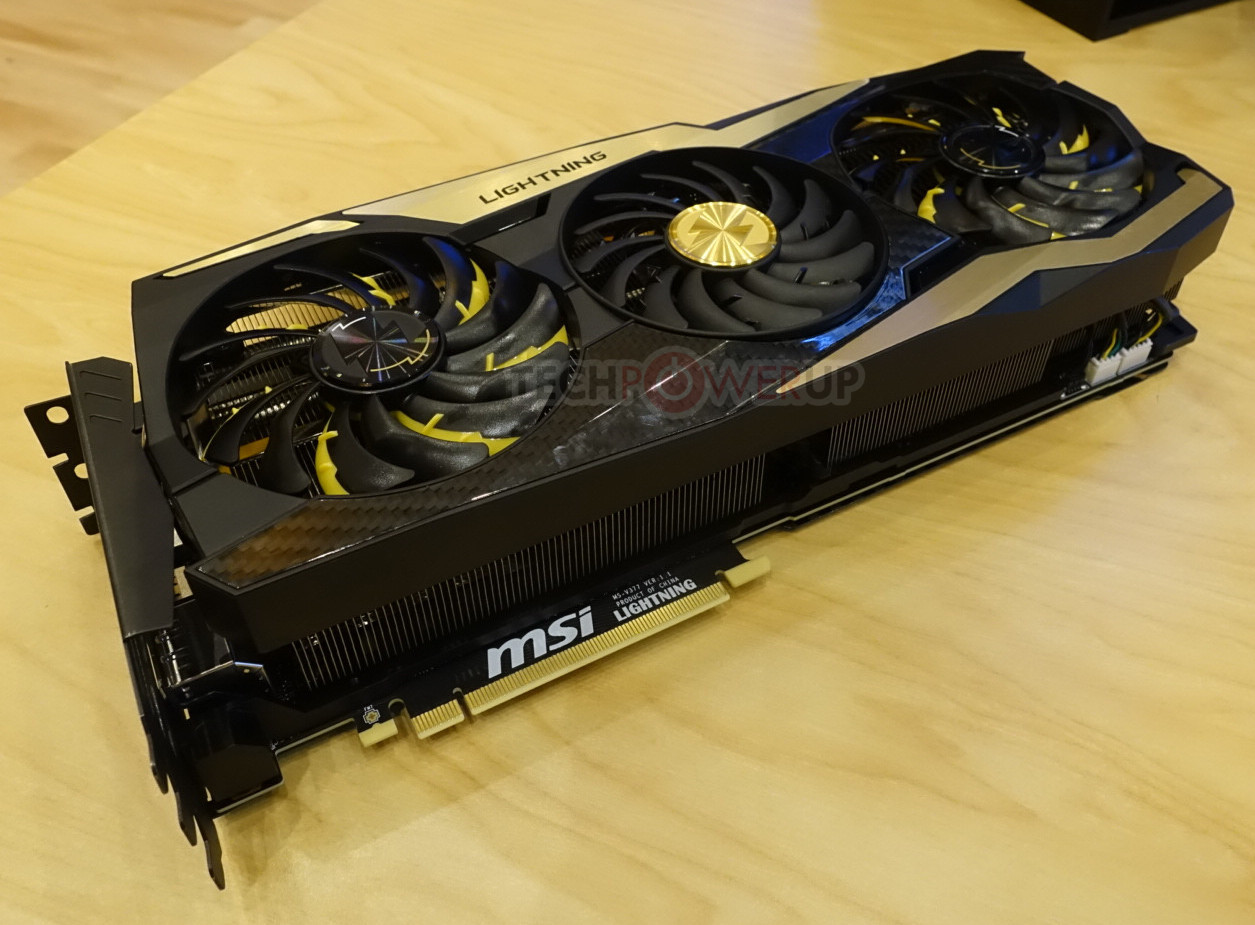
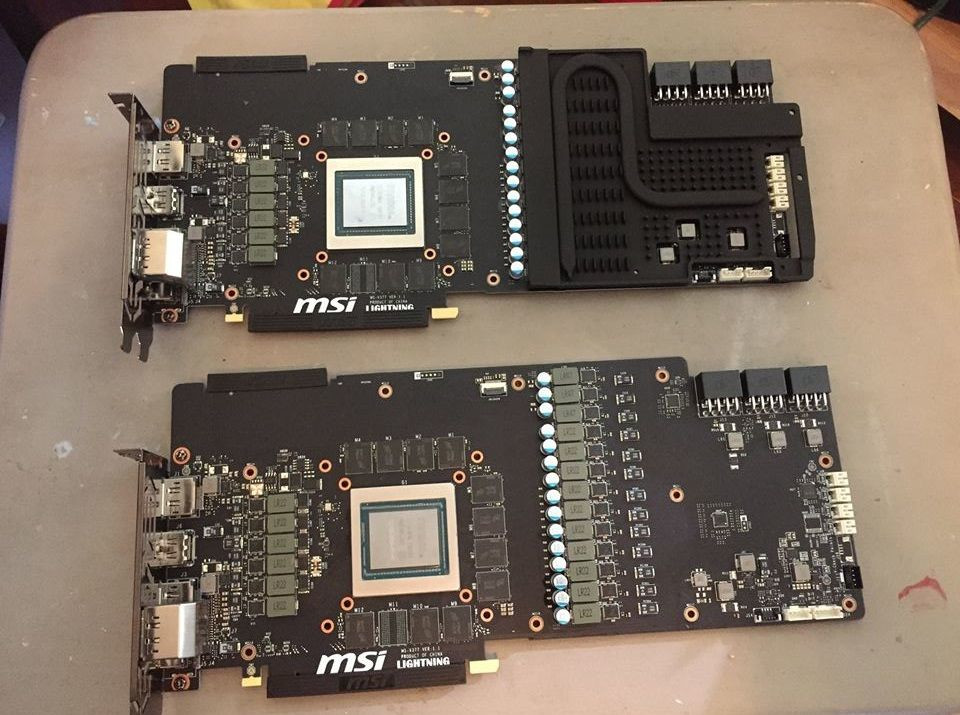
MSI's GeForce RTX 2080 Ti Lightning Z is the company's flagship RTX 2080 Ti. Its out of the box overclock is larger than on most other cards, and it actually provides significant performance gains. MSI also added a lot of features for overclockers, and RGB is present, too.
The Apacer AS2280P2 is an M.2 NVMe PCIe 3.0 x2 SSD built using Toshiba 15 nm 3D TLC flash and a Phison PS5008-E8 controller. Priced at around $100 for the 480 GB version, this solid-state drive is one of the more affordable ways to join the NVMe crowd.
Intel Corporation today reported fourth-quarter and full-year 2018 financial results. The company also announced that its board of directors has approved a five percent increase in its cash dividend to $1.26 per-share on an annual basis. The board declared a quarterly dividend of $0.315 per-share on the company's common stock, which will be payable on March 1 to shareholders of record on February 7.
"2018 was a truly remarkable year for Intel with record revenue in every business segment and record profits as we transform the company to pursue our biggest market opportunity ever," said Bob Swan, Intel CFO and Interim CEO. "In the fourth quarter, we grew revenue, expanded earnings and previewed new 10nm-based products that position Intel to compete and win going forward. Looking ahead, we are forecasting another record year and raising the dividend based on our view that the explosive growth of data will drive continued demand for Intel products."
The Independent has conducted an investigative report into the underwold's usage of Fortnite as a venue for money laundering. This likely won't come as a surprise - Fortnite has pretty lax acquisition restrictions for its in-game content and V-bucks, and the world's most popular multiplayer game moves millions of players through its servers daily. with such a deep pool of likely buyers for anything Fortnite at under Fortnite-store pricing, the stage is set for an almost untraceable money laundering scheme.
ASRock is a relatively new entry into the graphics card market with its Phantom gaming brand, but has already delivered on AMD's previous-generation hardware with interesting solutions. The company, alongside Sapphire, has been one of the first to showcase their take on AMD's upcoming Radeon VII high-performance graphics card, which will slot in above the company's RX 580 graphics cards in terms of performance.
This is a reference design through and through, so it's more of a question of whether or not you like AsRock's stickers better than their competitors', though some changes to the backplate could have been made as well, in order to expand on ASRock's branding. The Asrock version of AMD's Radeon VII should be available come launch, on February 7h (see what they did there?) for $699.
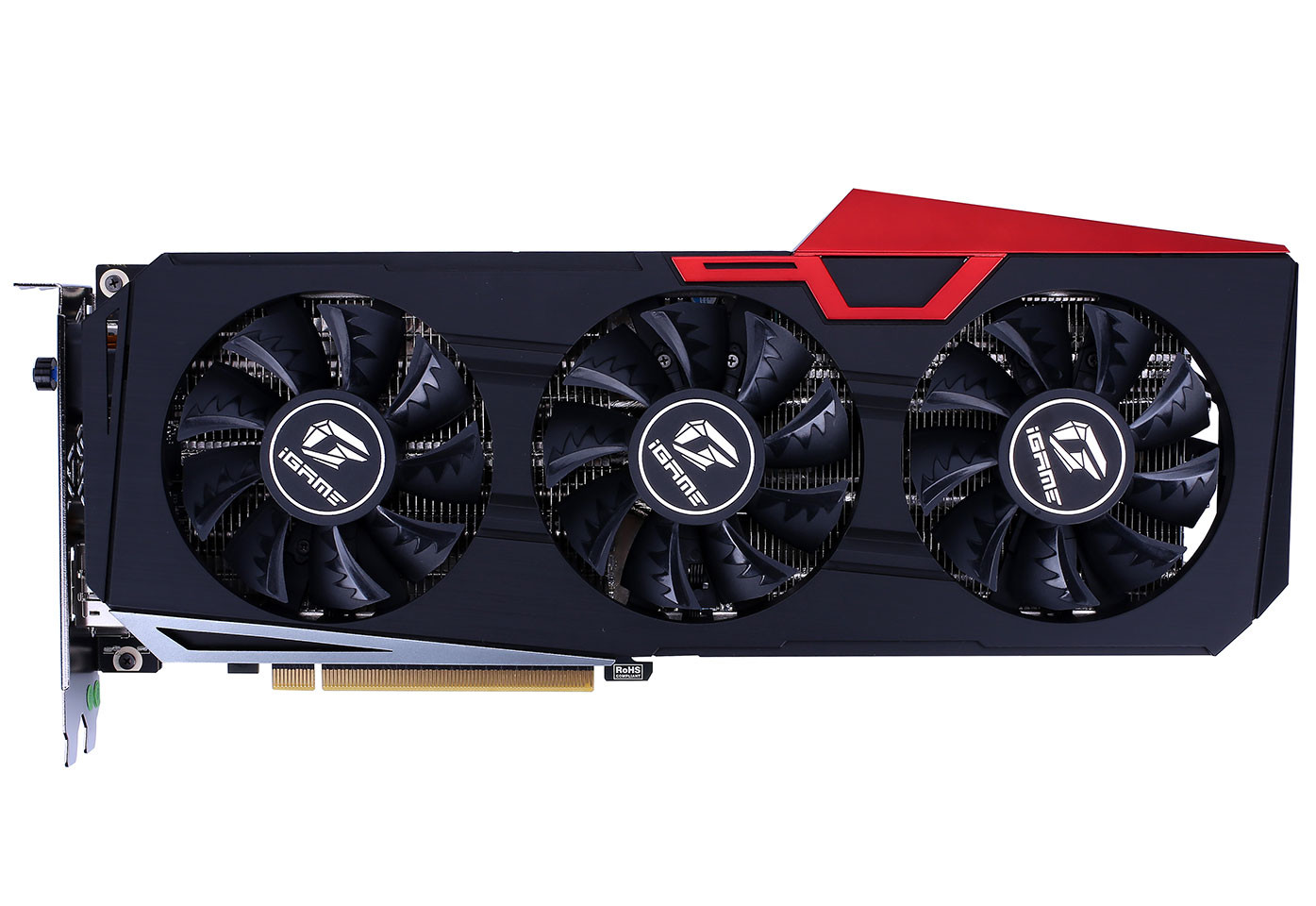
Colorful will be offering a cooler-less version of their RTX 2080 iGame Vulcan Advanced graphics card. The engineering effort on this graphics card is simple: just take off the entire triple-fan cooling solution that usually ships with the graphics card, lower the pricing by the appropriate reduction in BOM costs (or close to it), and offer a slightly cheaper alternative for users that would be investing in a watercooling solution anyway.
Colorful, being one of the biggest players in the Chinese market, where iCafes are all the rage, offers these particularly interesting cooler-less versions for those businesses that want to keep heat dissipation through the room to a minimum. It seems the graphics card' design closely mimics that of NVIDIA's reference deign, which should maximize waterblock compatibility.
A report from HardOCP could be shedding a floodlight-like amount of details on NVIDIA's lineup plans for the lower end, and their current generation of Turing videocards. The site, citing industry sources, claims that NVIDIA's GTX 1660 Ti, which has been shown to improve upon NVIDIA's previous-gen GTX 1060 by some 16%, is reported to gon on sale at a previously reported sub-$300 pricing of $279 (lower than the skeptically expected $299). This graphics card is expected to go on sale as early as February 15th.
Other details that shore up information on NVIDIA's plans include the purported early March launch of the slightly slower GTX 1660, which will see its pricing cut down to $229, and the much slower GTX 1650 later on that same month, for $179. Expect performance reviews from your favorite hardware website on the galaxy when those do come out (Commander Shepard would be proud of this endorsement).
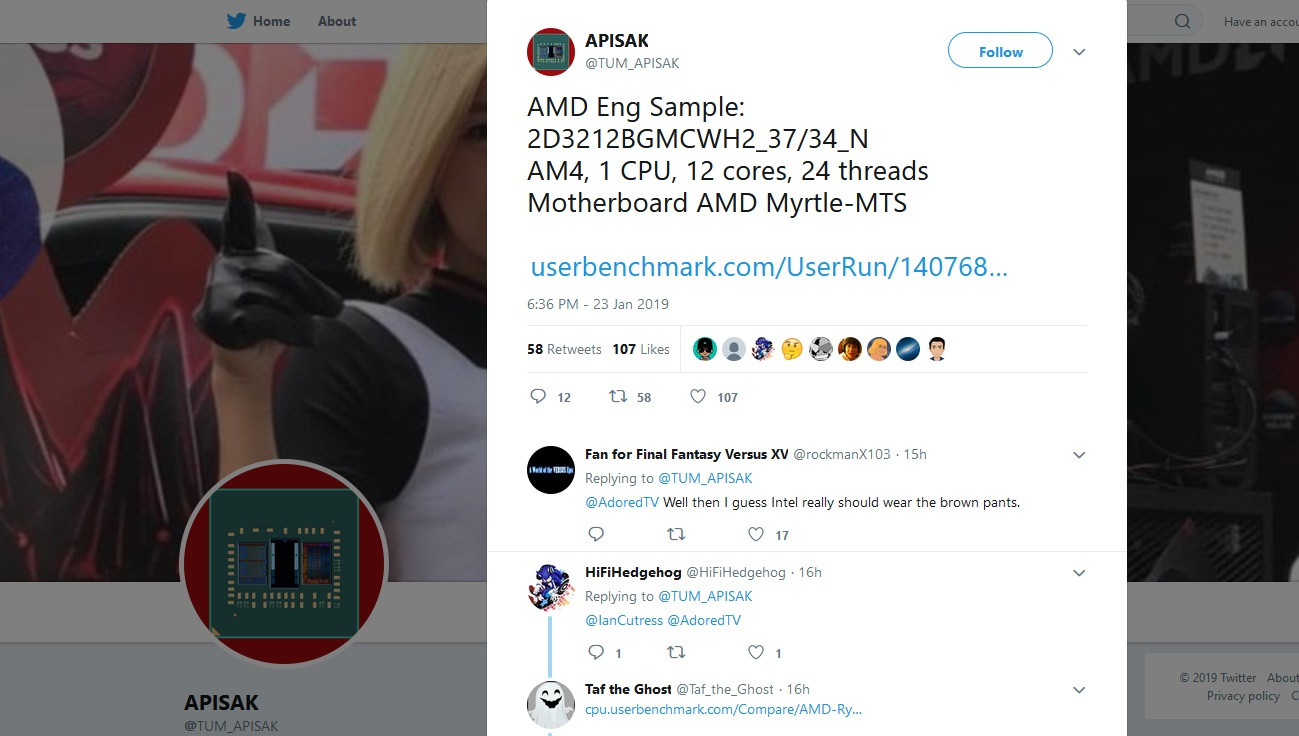
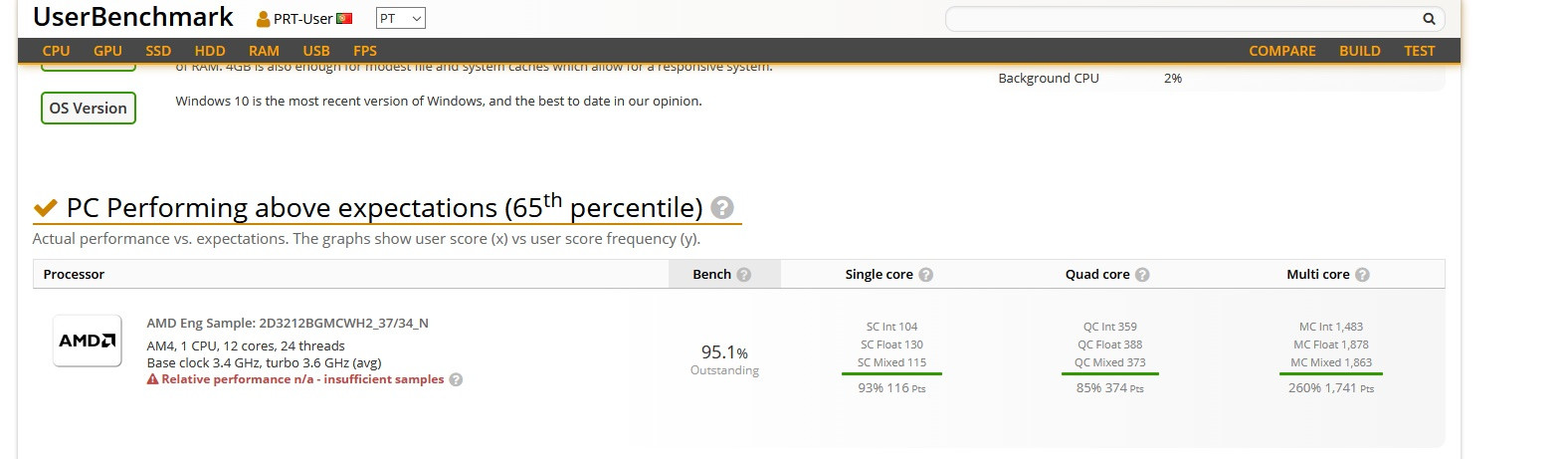
A new development could shake up our expectations on AMD's new Ryzen 2 CPUs, which if true, could mean that previous rumors of much increased core-counts at the top of AMD's offerings were true. User TUM Apisak, who has been involved in multiple information leaks and scouting for the hardware world, has digged enough to find a submitted UserBenchmark that screams of a 12-core, 24-thread AMD Matisse part (an engineering sample at that, so keep your hats on for the presented clock speeds).
The benchmark list the used CPU via product code 2D3212BGMCWH2_37 / 34_N (H2 is indicative of a Matisse CPU The benchmark is listing a base clock speed of 3.4 GHz and an average boost clock speed of 3.6 GHz. The rest of the system specs are very, very basic, with 4 GB of 1333 MHz DDR4 memory being used on a new AMD platform, based on the Myrtle-MTS based chipset. The processor is listed having a 105 watts TDP and 32 MB of L3 cache.
CORSAIR , a world leader in PC gaming peripherals and enthusiast components, today announced a collaboration with video game publisher Ubisoft and developer Massive Entertainment to incorporate dynamic, system-wide lighting integration into Tom Clancy's The Division 2, the upcoming sequel to 2016's massively popular, open world online shooter RPG, Tom Clancy's The Division . Through the use of CORSAIR iCUE software, PC players can enhance their gameplay experience and become fully immersed in the game with real-time lighting effects across all of their compatible CORSAIR components and peripherals.
Set seven months after a deadly virus was released in New York City, Tom Clancy's The Division 2 raises the stakes for players by launching them into a fractured and collapsing Washington D.C. - built as a one-to-one recreation of the city. In the wake of the virus, storms, flooding and subsequent chaos have radically transformed the city. From flooded urban areas to ravaged historic sites and landmarks, players will plunge into a dynamic open world with a wide variety of environments and biomes. As veteran Division agents, players are the last hope against the complete fall of society as enemy factions vie for control of the city. If Washington D.C. is lost, the entire nation falls.
This story has been going around the online media for a few hours now, with some arguably baseless speculation on the future of the hotly-anticipated Cyberpunk 2077 game added. Indeed, the facts are only that Sebastian Stępień, who has been with CD Projekt Red for over 12 years, has listed also a new job position as Creative Director for Blizzard Entertainment as of this month. He has been the Narrative and Setting Director for everyone's favorite Polish game outfit, and there is no word yet on whether he has actually quit this position, or whether there is a transition period in place wherein he will continue to be involved as necessary for Cyberpunk 2077 to go gold.
It is unlikely that such a transition period will exist, however, if only because such roles in the corporate ladder involve a physical move- especially when the companies are over an ocean apart. There is no reason to speculate that this will affect the finished product as far as the game goes, if only because the role of narration is essentially over with when this late in the development cycle. There is also speculation galore on how future DLC might get affected, which is valid, but sources in the game industry suggest that storyboards are already in place, and overall plans will not be affected much. We should be more interested in what he brings to Blizzard Entertainment, which has been sorely lacking in new IP in the past decade.
The Fractal Design Meshify S2 may look like the original Meshify at first sight, but is essentially a Define S2 with a new, cooler front and mesh top cover, which is actually great as that case is an excellent, award-winning base to build the Meshify S2 on!
Unruly Heroes is a side scroller puzzler/beat 'em up that sits squarely between Trine and Child of Light. You play as four interchangeable heroes without almost-but-not-quite unique skills, and charge through some extremely large and vertical levels, smashing your way through puzzles and hidden areas.
Creative finally brings to market its Super X-Fi technology built over 20 years of R&D. It aims to be a radical new change to the audio world by not only offering extremely convincing surround sound using stereo headphones, but generally enhancing the audio experience even for mono recordings provided you have a certain set of compatible devices.
Transcend Information Inc., a leading manufacturer of storage and multimedia products, is proud to announce the MTE220S PCIe M.2 Solid-State Drive. This SSD utilizes PCI Express Gen3 x4 interface and is compatible with NVM Express (NVMe) specifications. Utilizing this interface means never-before-seen transfer speeds of 3,500 MB/s read and 2,800 MB/s write are now a reality. Using 3D chips and packing into a M.2 2280 form factor, the MTE220S SSD is the must-have for gaming enthusiasts and high-end applications.
Transcend's MTE220S SSD comes equipped with DDR3 DRAM cache memory. This means that commonly used programs load much faster, and boot time is greatly reduced. Utilizing SLC caching, the MTE220S SSD can reach astonishing read/write speeds of 3,500 MB/s and 2,800 MB/s, respectively, and 4K Random performance is also significantly improved. In addition to speeds, reliability is also enhanced with the Low Density Parity Check code in place.
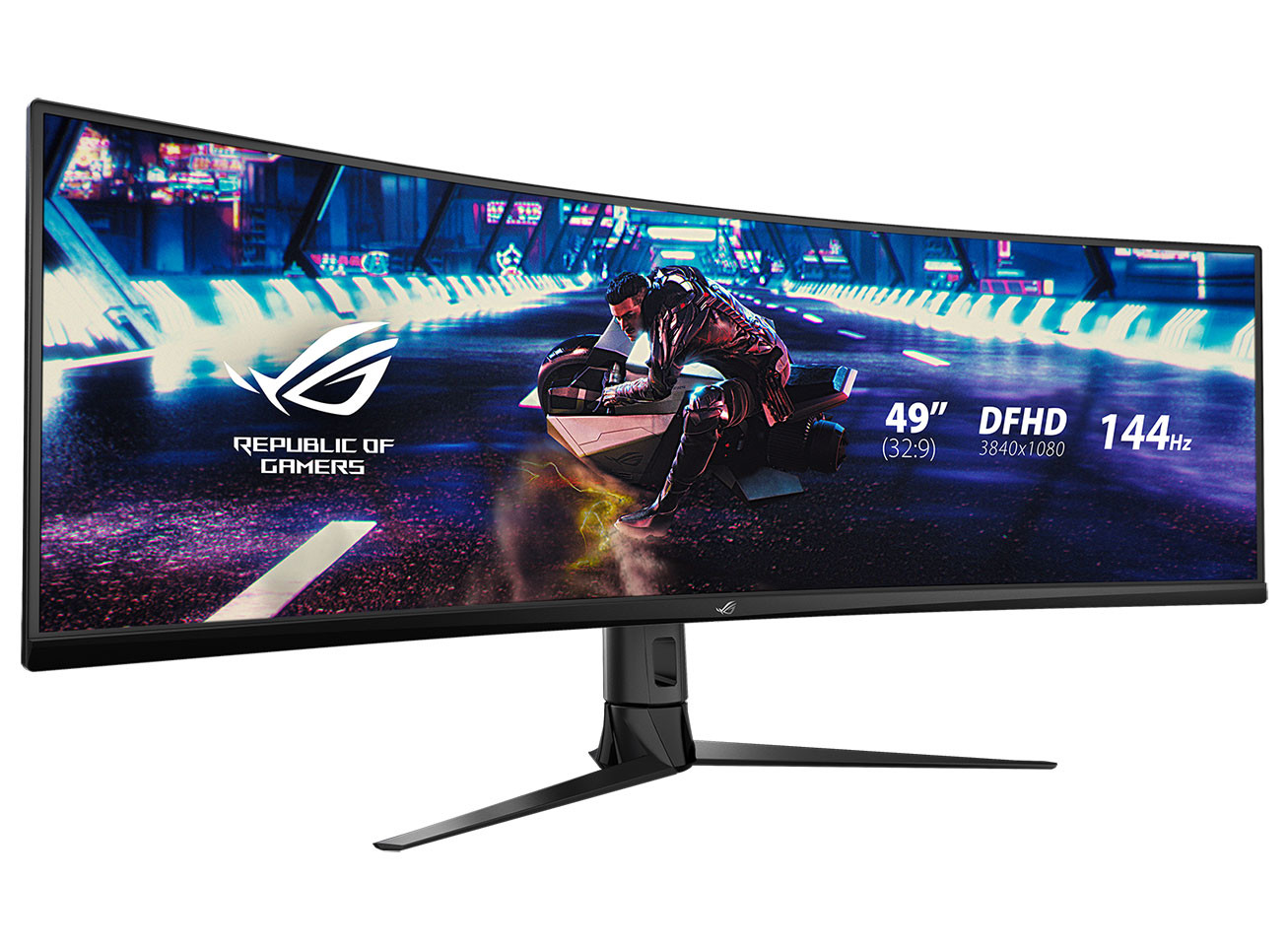
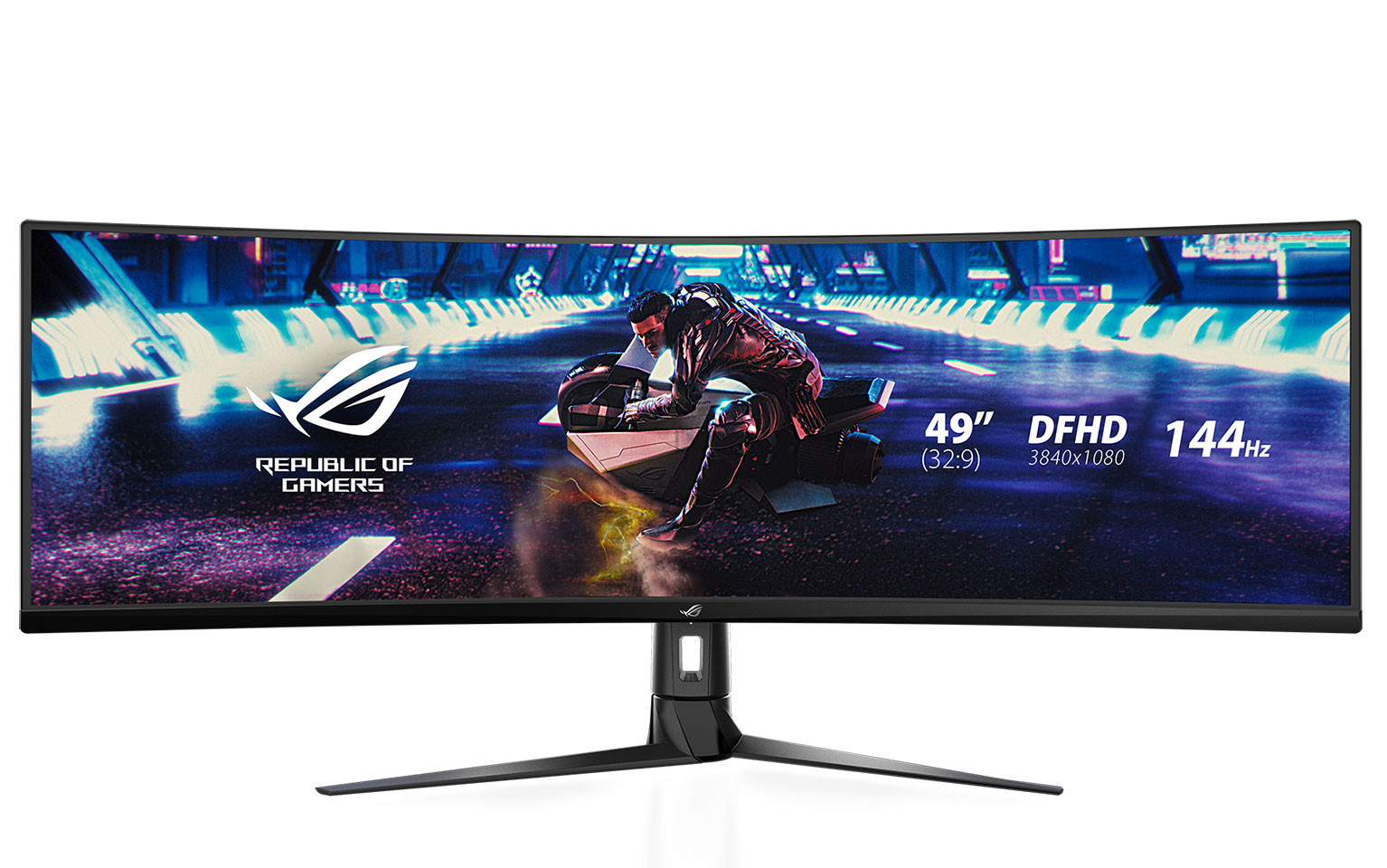
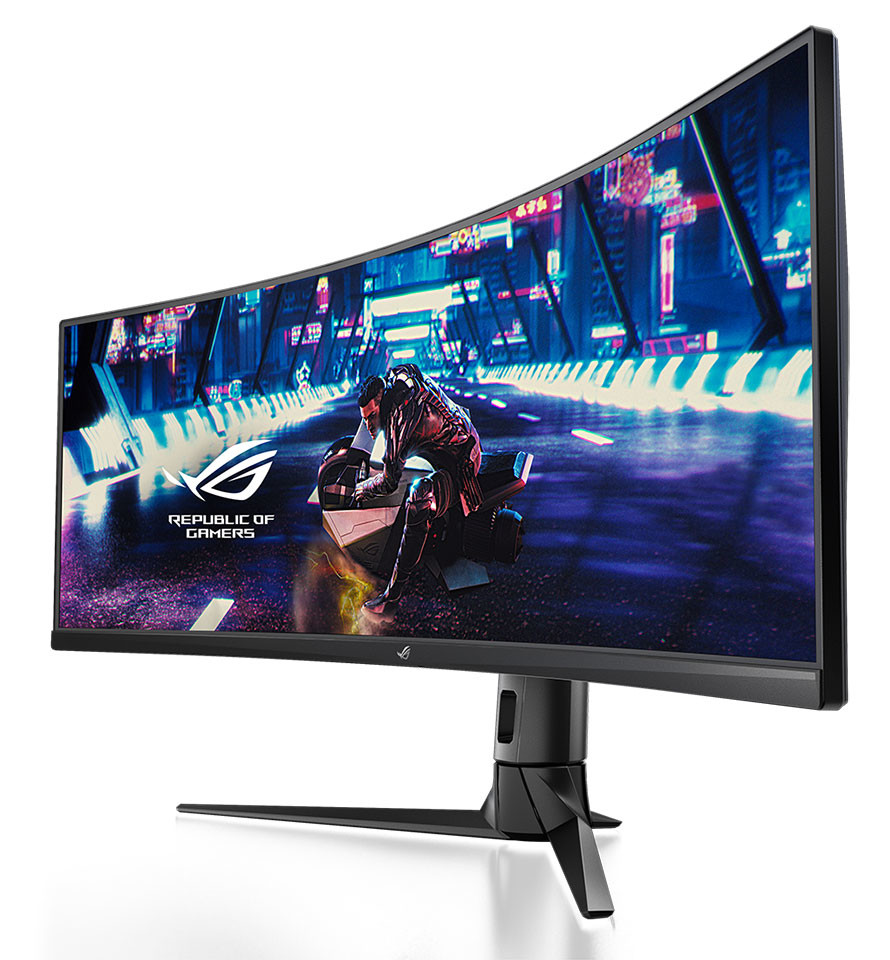
ASUS today unveiled the obscenely wide ROG Strix XG49VQ 49-inch curved gaming monitor, with an aspect ratio of 32:9, or what you'd get if you put two 16:9 monitors side-by-side. With a resolution of 3840 x 1080, or half the pixels of 4K UHD, the monitor features an 1800R curvature. There are two notable branded features associated with this display: VESA DisplayHDR 400, and AMD FreeSync HDR. There are some impressive display specifications on tap, too, such as 144 Hz maximum refresh-rate, 178°/178° viewing-angles thanks to its VA panel, 4 ms (GTG) response time, and 450 cd/m² maximum brightness. Display inputs include DisplayPort 1.2a, and two HDMI 2.0 ports. The monitor features the full suite of ASUS GameFirst OSD utilities. You also get 5 W stereo speakers a 2-port USB 2.0 hub. The company didn't reveal pricing.
Sapphire is among the first AMD add-in-board (AIB) partners to launch a Radeon VII graphics card. The card sticks to AMD reference board design, which the company unveiled at its CES 2019 keynote. Interestingly, its GPU engine boost frequency is set at 1750 MHz, which is less than the 1800 MHz boost frequency figure that was mentioned by the company earlier. Could it be that AMD is reserving 1800 MHz for cards directly sold on AMD.com? The memory frequency is unchanged at 1000 MHz, which works out to an HBM2 memory bandwidth of 1 TB/s. Sapphire's box for this card lists out key specifications upfront, and also features the Vega II logo. It's likely that the card will be sold at the baseline price of $699, given that there are no other variants of this card, not even custom-design.
ZOTAC Technology, a global manufacturer of innovation, today releases a new generation of MAGNUS E Series Mini PC built for hardware enthusiasts. The MAGNUS is re-engineered to give powerful performance for creators and prosumers in a compact and lightweight enclosure. With an 8th Generation Intel processor, a discrete GeForce RTX 2070 graphics card and equipped with premium connectivity, the all-new MAGNUS E Series Mini PC powers everything from demanding workloads, creative workflows, home entertainment experiences, and much more.
The MAGNUS EC52070D features a 6-core Intel Core i5-8400T processor with boost up to 3.3GHz, giving it the power to handle simultaneous, compute-intensive, multithreaded workloads. Users can get responsive processing on creative workflows such as photo post-processing, illustration, audio processing, video production, live-streaming, and more. With ready support for up to 32GB of high-speed DDR4 memory, NVMe M.2 SSD, 2.5-inch large capacity storage and Intel Optane memory technology for high performance storage, MAGNUS is capable of loading files and applications faster.
Antec Inc., a leading provider of high-performance computer components and accessories for the gaming, PC upgrade and Do-It-Yourself market, presents the latest mid tower entry-level gaming case: Antec GX202. The case is now commercially available at USD$44.99.
Featuring a unique mesh pattern in appearance, the brilliant design can easily enhance the air-intake. In addition to its styling look, the GX202 case is designed with a detachable front panel - providing a better thermal performance. The front panel includes two USB 3.0 ports, power bottom and MIC/HD AUDIO jacks. The GX202 is made mostly from SPCC steel with plastic and has a fully transparent side window to show the interior gaming style. Measuring with 450 x 205 x 435 mm (DWH), the GX202 supports ATX, Micro-ATX and ITX motherboard formats, and its weight comes in at around 4 kg.
ENERMAX, a leading designer and manufacturer of high-performance PC hardware products, is expanding the acclaimed RGB liquid cooler series, LIQFUSION, with the addition of a 360mm AIO cooler. After the launch of the 240 variant, LIQFUSION has got users' attention and recognition for its cooling performance and brilliant lighting effects. With the larger cooling surface, LIQFUSION 360 is able to easily handle a large amount of heat produced by the overclocked CPUs. Moreover, LIQFUSION comes with an addressable RGB-sync waterblock featuring patented flow indicator, which allows the users to monitor the status of coolant flow. Along with ENERMAX addressable RGB fans, LIQFUSION can create visual appealing lighting effects.
LIQFUSION can sync the RGB lighting with motherboards featuring addressable RGB headers (4-pin assignment: +5V/D/-/G). Users can select preferred effects via the motherboard RGB software with 16.8 million color options. On the other hand, for those who use non-RGB motherboards, they can use the included RGB control box to select preferred lighting color, speed, and effects (10 pre-set effects).
BIOSTAR, a leading manufacturer of motherboards, graphics cards, and storage devices, introduces a solution for edge computing, the BIOSTAR A10N-8800E system-on-chip (SoC) mini-ITX motherboard, for faster data access and computing over traditional cloud solutions. The BIOSTAR A10N-8800E integrates the AMD FX-8800P processor, typically found in AMD mobile computing, for superb processing performance and power efficiency. Even with a mini-ITX form factor, it includes features such as dual channel DDR 4 2133 support, USB3.1 Gen. 1, PCI-e M.2 16Gb/s and HDMI output. The BIOSTAR A10N-8800E is an excellent motherboard for edge computing applications for home, office or online gaming.
ARCTIC today introduced the new Freezer 34 air cooler series. Development of the new Freezer series focused on increasing cooling capacity. With static pressure optimized P-fans and the improved heatsink, the Freezer 34 series offers high quality products with high-powered performance. The series consists of the standard Freezer 34 model; the Freezer 34 CO, a new tower CPU cooler; the Freezer 34 eSports; and the Freezer 34 eSports DUO.
The Freezer 34 coolers come with all the perks of ARCTIC's high static pressure P-fans: an extended shelf life, a wide RPM range, lower power consumption, high quality bearings and less vibration. Plus, when the PWM signal falls below 5%, the passive 0 dB mode is activated. With newly developed fans, a streamlined cooling fin design, and offset direct-touch heatpipes that distribute heat more efficiently, the Freezer 34 delivers robust cooling for high-end processors with up to 18 cores. During internal testing, at a normalized 28db(A) noise level, the Freezer 34 models achieved results up to 4° C cooler than their predecessor series.
Phanteks today announced the release of the latest addition to the Eclipse Series product line, the Eclipse P600S. A hybrid solution for silent and high airflow PC systems. The Eclipse P600S offers both minimum noise or maximum airflow configurations that can be easily switched around when needed. Bringing Phanteks' High-Airflow fabric into the design allows for maximum airflow performance. The P600S also includes effective soundproofing panels that reduce noise considerably. Other features that are included: hinged tempered glass panel, dual system support, optimized cable management, PWM fan controller hub, vertical GPU mounting support, modular silent covers, and extensive liquid cooling locations.
Toshiba Memory Corporation, the world leader in memory solutions, has started sampling[1] the industry's first Universal Flash Storage (UFS) Ver. 3.0 embedded flash memory devices. The new line-up utilizes the company's cutting-edge, 96-layer BiCS FLASH 3D flash memory and is available in three capacities: 128GB, 256GB and 512GB. With high-speed read/write performance and low power consumption, the new devices are suitable for applications such as mobile devices, smartphones, tablets, and augmented/virtual reality systems.
The new devices integrate 96-layer BiCS FLASH 3D flash memory and a controller in a JEDEC-standard 11.5 x 13.0 mm package. The controller performs error correction, wear leveling, logical-to-physical address translation and bad-block management for simplified system development.
Today, Intel announced a major milestone in global inclusion - achieving gender pay equity across our worldwide workforce while also adding stock-based compensation to its pay equity analysis. Our commitment to achieving gender pay equity is central to making Intel a truly inclusive workplace, which we believe is a key factor in employee performance, productivity and engagement. A diverse workforce and inclusive culture are essential to our evolution and growth.
Intel defines pay equity as closing the gap in the average pay between employees of different genders or races and ethnicities, where data is available, in the same or similar roles after accounting for legitimate business factors that can explain differences, such as performance, time at grade level and tenure.
COLORFUL Technology Company Limited, professional manufacturer of graphics cards, motherboards and high-performance storage solutions is proud to announce the debut of their latest graphics cards aimed for mainstream gamers who want the best value for their gaming needs. NVIDIA's new GeForce RTX 2060 GPU offers their raytracing and DLSS at an accessible price range and COLORFUL is bringing their iGame touch to improve the performance and cooling of the GeForce RTX 2060. Today, the COLORFUL iGame family welcomes their newest addition: the iGame GeForce RTX 2060 Vulcan X OC and the iGame GeForce RTX 2060 Ultra OC. Both cards will feature NVIDIA's new 12nm TU106 GPU with 1920 CUDA cores and 6GB of GDDR6 memory. The new COLORFUL GeForce RTX 2060 graphics cards will have full support for NVIDIA's real-time raytracing via RTX technology as well as DLSS and Ansel.
For gamers that want amazing card performance and cooling, the COLORFUL iGame GeForce RTX 2060 Ultra OC provides an incredible balance of feature and performance. The card features a triple slot cooler which gives excellent cooling even under load.
AMD in 2012 launched the FX-8150, the "world's first 8-core desktop processor," or so it says on the literal tin. AMD achieved its core-count of 8 with an unconventional CPU core design. Its 8 cores are arranged in four sets of two cores each, called "modules." Each core has its own independent integer unit and L1 data cache, while the two cores share a majority of their components - the core's front-end, a branch-predictor, a 64 KB L1 code cache, a 2 MB L2 cache, but most importantly, an FPU. There was much debate across tech forums on what constitutes a CPU core.
Multiprocessor-aware operating systems had to be tweaked on how to properly address a "Bulldozer" processor. Their schedulers would initially treat "Bulldozer" cores as fully independent (as conventional logic would dictate), until AMD noticed multi-threaded application performance bottlenecks. Eventually, Windows and various *nix kernels received updates to their schedulers to treat each module as a core, and each core as an SMT unit (a logical processor). The FX-8350 is a 4-core/8-thread processor in the eyes of Windows 10, for example. These updates improved the processors' performance but not before consumers started noticing that their operating systems weren't reporting the correct core-count. In 2015, a class-action lawsuit was filed against AMD for false marketing of FX-series processors. The wheels of that lawsuit are finally moving, after a 12-member Jury is set up to examine what constitutes a CPU core, and whether an AMD FX-8000 or FX-9000 series processor can qualify as an 8-core chip.
EKWB releases an all-new product lineup under the EK Classic name including a more budget-friendly EK-Supremacy Classic RGB CPU block. It aims to provide a minimalist design while retaining RGB-lighting support and good value for money by offering high coolant flow and good thermal performance alike.
MSI is proud to officially announce the latest of its legendary LIGHTNING series graphics cards. Built to be perfect, the new GeForce RTX 2080 Ti LIGHTNING Z combines cutting edge new technology with proven features such as Tri-Frozr design with all new TORX 3.0 Fans, Phantom of LIGHTNING LED effect, Dynamic Dashboard OLED panel and full carbon backplate. The GeForce RTX 2080 Ti LIGHTNING Z is nothing short of an engineering masterpiece.
With an innovative design, the RTX 2080 Ti LIGHTNING presents an all-new level of visual customization. Via MSI's Dragon Center software, the LED colors and blades on the fans can be controlled to cycle predefined profiles. The fans not only dazzle you with vibrant colors and effects but also cool this beastly card in silence.
Samsung today introduced the Samsung 970 EVO Plus, the newest enhancement in its Non-Volatile Memory Express (NVMe) SSD portfolio. With industry-leading performance and up to two terabytes in capacity, Samsung's 970 EVO Plus sets a new bar for high-performance storage, enabling IT professionals, tech enthusiasts and gamers to handle intensive workloads on PCs and workstations with more ease.
"Since introducing the first NVMe SSDs to the consumer market in 2015, Samsung has continued to challenge technical barriers in SSD design and performance," said Dr. Mike Mang, vice president of Brand Product Marketing, Memory Business at Samsung Electronics. "The new 970 EVO Plus powered by Samsung's latest fifth-generation V-NAND technology will now offer unrivaled performance in its class when taking on demanding tasks like 4K content editing, 3D modeling and simulation as well as heavy gaming."
DIYPC, leading professional manufacturer of computer cases and accessories (case fan, hub, headset, mouse) base in China which mainly focus on overseas market. DIYPC is thrilled to share with everyone the announcement of its latest addition to its gaming line of chassis for gamers and enthusiast PC builders. The DIY-SD1-RGB features a stylish, aggressive front panel in a compact ATX tower format. This is perfect for gamers and builders looking for an aggressive, gaming build with great features but at a smaller footprint than traditional, larger midtowers. The DIY-SD1-RGB features tempered glass panels to showcase the components of your build and includes preinstalled RGB fans for further lighting customization that is sure to be a great foundation for your build.
Be Quiet!, the market leader in PC power supplies in Germany since 2007, announces two new fans: the new Shadow Wings 2 series for users who appreciate a very silent system and the expansion of the entry-level Pure Wings 2 range with high-speed models.
Shadow Wings 2 is a slowly spinning and highly optimized case fan and the most silent fan series in the be quiet! lineup. It relies on an array of features to keep its noise level as low as only 15.9 dB(A) at maximum speed. Airflow-optimized fan blades provide reliable cooling and whisper-quiet operation. A new anti-vibration mounting system and rubberized fan frame ensure easy installation and decoupling from the case frame. High-grade rifle bearing technology guarantees a lifespan of up to 80,000 hours. Shadow Wings 2 comes in 120 mm and 140 mm sizes, with 3-pin connectors or PWM control. Maximum rotational speed for the 120 mm models is 1,100 rpm, and 900 rpm for its 140 mm sibling.
Thai PC enthusiast TUM Apisak posted a screenshot of an alleged GeForce GTX 1660 Ti Ashes of the Singularity (AoTS) benchmark. The GTX 1660 Ti, if you'll recall, is an upcoming graphics card based on the TU116 silicon, which is a derivative of the "Turing" architecture but with a lack of real-time raytracing capabilities. Tested on a machine powered by an Intel Core i9-9900K processor, the AoTS benchmark was set to run at 1080p and DirectX 11. At this resolution, the GTX 1660 Ti returned a score of 7,400 points, which roughly compares with the previous-generation GTX 1070, and is about 16-17 percent faster than the GTX 1060 6 GB. NVIDIA is expected to launch the GTX 1660 Ti some time in Spring-Summer, 2019, as a sub-$300 successor to the GTX 1060 series.
Today Starblaze announced the availability of the STAR1000P NVMe solid state drive (SSD) controller for high-end client and entry-level enterprise applications. Performance optimizations enable the new controller to achieve sequential reads at 3.6GB/second and sequential writes at 3.2GB/second, up to 50% higher than Starblaze's previous generation controller, STAR1000. The STAR1000P achieves random reads at 750K input/output operations per second (IOPS) and random writes at 600K IOPS, up to 120% higher than Starblaze's STAR1000. The STAR1000P features PCIe Gen3x4, NVMe 1.3 and eight flash channels to support up to 32 terabytes (TB) of storage. The STAR1000P also incorporates a multicore implementation of Synopsys' DesignWare ARC HS38 processor, taking advantage of ARC's extensible architecture with custom instructions that improve scheduling efficiency.
"Enterprise SSD applications need increasing processor performance to support much higher throughput with reduced latency," said John Koeter, vice president of marketing for IP at Synopsys. "Synopsys' ARC HS processors deliver the scalability that Starblaze needs to extend the performance of their STAR1000P platform for the rapidly evolving SSD controller market."
Palit's GeForce RTX 2070 GameRock Premium is the company's highest-specced RTX 2070 variant. It comes overclocked out of the box to 1815 MHz boost and features a large triple-slot cooler that delivers excellent temperatures. With $600, pricing matches that of the NVIDIA Founders Edition.
1STPLAYER is a relatively unknown Chinese brand wanting to grab attention globally with their new keyboards. The Bullet Hunter MK6 mechanical keyboard offers RGB backlighting, extensive onboard controls, a software driver, and hot-swappable switches at a good price point, making it a strong contender for their goal.
ASUS today introduced an "affordable" GeForce RTX 2070 graphics card and a variation of its cheapest RTX 2070 product, the Turbo EVO. This card looks almost identical to the RTX 2070 Turbo ASUS launched last September, but comes with a handful physical changes. To begin with, its 80 mm lateral-blower fan comes with a double ball-bearing motor, and an IP5X-compliant dust-proof impeller. The build quality is also improved since ASUS is building the card on a fully-automated process it calls "Auto Extreme," coupled with a 144-hour stress-test for each card. Also, while the original RTX 2070 Turbo draws power from a combination of 8-pin and 6-pin PCIe power connectors, the new RTX 2070 Turbo EVO only needs a single 8-pin PCIe power input.
There is a catch, though. Unlike the original RTX 2070 Turbo, the new RTX 2070 Turbo EVO lacks a USB type-C VirtualLink connector. The clock-speeds of both cards are identical, with 1620 MHz GPU Boost, and 14 Gbps (GDDR6-effective) memory. You can tell the two cards apart on a store shelf by paying attention to the box. The EVO's box features an "Auto Extreme" graphic on the front face, and carries the model number "TURBO-RTX2070-8G-EVO," while the original RTX 2070 Turbo goes with "TURBO-RTX2070-8G" (no "EVO"). The company didn't reveal pricing, although it wouldn't surprise us if both the cards are sold at the same baseline price of USD $530.
Antec today released its Dark Avenger 601 ATX mid-tower chassis for gaming PC builds high on RGB LED illumination. The case is characterized by a faux-aluminium ornament on the front panel that conceals the front fan intakes, a tempered glass left side-panel, and an in-built addressable RGB LED lighting controller. The front ornament is studded with aRGB LED strips that make up an "X" shape. The lighting can either be wired to the in-built controller which cycles lighting presets at the push of a button on the front-panel, or be directly plugged in to your motherboard over a standard 3-pin aRGB header.
The DA601 features a conventional partitioned layout, with the motherboard tray serving up room for ATX motherboards with 7 expansion slots, graphics cards up to 40 cm in length, and CPU coolers up to 16 cm in height. Storage areas include two 3.5-inch/2.5-inch trays in the bottom compartment, and four 2.5-inch drive mounts behind the motherboard tray. Cooling features include three 120 mm fan mounts each along the front- and top-panels, and a rear 120 mm exhaust. Antec includes two fans with the case, an aRGB illuminated Prizm along the front intake, and a regular 120 mm spinner at the rear. The case measures 480 mm x 220 mm x 500 mm (DxWxH). Front panel connectivity includes two USB 3.1 type-A ports, HDA jacks, and the RGB controller cycle button. The company didn't reveal pricing.
System software code used for detecting and installing AMD's upcoming Radeon "Navi" family of graphics processors surfaced in the latest Apple MacOS "Mojave" beta. Version 14.2 beta of the operating system packs preparation for AMD's next-generation GPUs through a device identifier "0x73101002." A similar piece of code surfaced on early versions of MacOS "Sierra" some 6 months prior to Radeon "Vega" family launch, which perfectly aligns with this release of Mojave preceding the speculated mid-2019 launch of "Navi."
The code makes four references, Navi 16, Navi 12, Navi 10, and Navi 9. We're not quite sure if these are brand names or ASIC codes pointing to the number of next-generation compute units enabled on the silicon. If they are the latter, and assuming AMD hasn't changed the number of stream processors per NGCU, we're looking at the possibility of these chips being mid-range performance successors to the "Polaris" family, and it's likely they'll find place in Apple's upcoming generation of iMac, and possibly even MacBooks.
AMD late Monday released WHQL-signed Radeon Software Adrenalin 19.1.1 drivers. These drivers are identical in features and changes to January 11 release of Adrenalin 19.1.1 as a Beta. Among the key changes over the previous 18.12.3 drivers include performance optimization for "Fortnite," bug fixes for Virtual Super Resolution (VSR), graphics card fan zero-fan mode not correctly engaging when toggled on/off in Radeon Settings, incorrect software update notifications in Radeon Settings Advisor, and multi-monitor systems experiencing a mouse pointer lag when one of the displays is enabled but powered off.
Kingston at CES 2019 also showcased their high-tier KC2000 series SSD. These differ from the likely market-warping A2000 series SSDs in terms of pure performance, for those that only care for that metric. While the A2000 series has the potential to bring SATA SSDs completely out of the equation (if promises of lower pricing paired with three to four times higher performance come true), the KC2000 will be gunning for the upper tiers of the market in terms of performance.
The KC2000 PCIe 3.0 x4 NVMe SSDs will be available in capacities ranging from 256 GB to 2TB, boasting performance of 3 GB/s read and 2 GB/s write. Unlike their lower-tier counterparts, which make use of a variety of lower-tier controllers and Toshiba's 3D TLC NAND, these will contain the SMI SM2262en controller paired Intel 3D TLC NAND flash memory. These SSDs should be released sometime in Q2 2019 and will have a security software suite included.
eGPUs may not have made quite as much of an impact on the market as one might expect - but maybe that's because of incorrect expectations. The idea of having an external GPU box to increase a given machine's frame output when it's stationary is all well and good, but that begs the question of why not just buying a more powerful machine outright, which will allow users to keep their mobility and portability.
It seems GIGABYTE is readying another eGPU solution, after their work on their RX 580 gaming box. The box is equipped with a GIGABYTE-engineered GeForce RTX 2070 graphics which features 1x HDMI, 3x DisplayPort, 1x USB-C, 1x ThunderBolt 3 and 3x USB 3.0 ports, so it also serves as an extender for your laptop's (or mini-ATX) functionality.
Kingston at CES 2019 demonstrated its A2000 NVMe SSDs, which the company has developed with a specific goal in mind - undercut SATA-based SSDs. This has, until now, been impossible, due to increased costs of NVMe controllers over their SATA counterparts, but such is the trend with any technology - prices do come down after a product is first introduced. Some NVMe solutions have used cut-down controllers that only supported PCIe x2 buses, but not the A2000 - they will use full-fledged PCIe 4x lanes, and will be available in 240, 480, or 960 GB capacities.
The A2000 series will make use of different controllers, which means Kingston is sourcing from more than one manufacturer (Silicon Motion's SM2263-series and Phison's low-cost controllers). While that could introduce performance variations, Kingston says that they will be making sure the experience and performance stays consistent between differently-sourced products, and that the only reason for this is to decrease overall BOM costs to achieve a lineup-wide below-SATA cost. NVMe drives typically require less materials than SATA drives, and as a plus, aren't constrained by link bandwidth limitations. This is huge news for the industry, because if Kingston manages to do its bidding 2Q2019, as they expect, the industry will follow suit - they won't be leaving the lowest-priced, and consequently, likely highest-volume product, to a single player. Kingston is quoting up to 2000 MB/s sequential read speeds as well as up to 1500 MB/s sequential write speeds.
Kingston Digital, Inc., the Flash memory affiliate of Kingston Technology Company, Inc., a world leader in memory products and technology solutions, announced today the Managed model of IronKey D300 Serialized (D300SM) encrypted USB Flash drive is now available. A fully-encrypted managed USB drive is an essential component in following industry standards and the strong data encryption of the D300 series is what makes this drive compliant for data storage under GDPR and the NY financial regulations.
IronKey D300SM requires IronKey EMS or SafeConsole by DataLocker allowing central management of drive access and usage across thousands of drives. Either cloud-based or on-premises, it enforces drive-specific policies, such as password strength and retry limits, lets administrators remotely disable lost or stolen drives, reset passwords when forgotten and more. This is the first IronKey drive that is supported on SafeConsole, allowing it to be used by customers who already have SafeConsole installed.
CORSAIR, a world leader in PC gaming peripherals and enthusiast components, today announced the availability of a wide range of new PC enthusiast accessories to help complete the look of a custom PC: CORSAIR Premium Individually Sleeved PSU Cables, Premium Sleeved Front Panel Extension Kit, Premium Sleeved SATA Cable, Premium PCIe 3.0 x16 Extension Cable, and TM30 Performance Thermal Paste. From custom paracord cables available in a range of colors, to flexible PCIe mounting and dependable thermal paste, the new range of accessories are the perfect way to build and complete a stunning professional-looking custom PC.
GIGABYTE TECHNOLOGY Co. Ltd, a leading manufacturer of motherboards and graphics cards, announced that its Z390 and C246 motherboards now fully support 32GB Unbuffered memory per DIMM slot for up to 128GB total memory capacity on 4DIMM configurations, providing increased memory capacity for users. Additional BIOS updates will soon be rolled out to enable support for other 300 series motherboards.
Up until now, 32GB memory per DIMM slot was primarily limited to workstation ready motherboards with registered memory for users to fulfill memory-intensive tasks on their system. GIGABYTE has worked closely with Intel to ensure that GIGABYTE Z390 series motherboards paired with 9th Gen. processors can support 32GB memory per DIMM slot.
RAIDMAX today rolled out the Magnus, a premium ATX full-tower case characterized by its mostly-white body with contrasting black, and a brushed aluminium panel dominating its front. The interiors feature a semi-partitioned layout, with the bottom partition only enclosing the PSU bay, while a 2-drive 3.5-inch cage sits besides it, which is detachable. Four additional 2.5-inch drive mounts are located beside and behind the motherboard tray. The motherboard tray can house ATX and E-ATX boards, with eight expansion slots, and two additional vertically oriented slots to show off your graphics card (PCIe riser not included). You get room for graphics cards up to 42 cm in length, and CPU coolers up to 17.8 cm in height. Ventilation includes either three 120 mm or two 140 mm front intakes, three 120 mm or two 140 mm top exhausts, and a 140/120 mm rear exhaust factory-fitted with an NV-120FB RGB fan.
Intel is giving final touches to a "Crimson Canyon" fully-assembled NUC desktop model which combines the company's first 10 nm Core processor, and AMD Radeon discrete graphics. The NUC8i3CYSM desktop from Intel packs a Core i3-8121U "Cannon Lake" SoC, 8 GB of dual-channel LPDDR4 memory, and discrete AMD Radeon RX 540 mobile GPU with 2 GB of dedicated GDDR5 memory. A 1 TB 2.5-inch hard drive comes included, although you also get an M.2-2280 slot with both PCIe 3.0 x4 (NVMe) and SATA 6 Gbps wiring. The i3-8121U packs a 2-core/4-thread CPU clocked up to 3.20 GHz and 4 MB of L3 cache; while the RX 540 packs 512 stream processors based on the "Polaris" architecture.
The NUC8i3CYSM offers plenty of modern connectivity, including 802.11ac + Bluetooth 5.0 powered by an Intel Wireless-AC 9560 WLAN card, wired 1 GbE from an Intel i219-V controller, consumer IR receiver, an included beam-forming microphone, an SDXC card reader, and stereo HD audio. USB connectivity includes four USB 3.1 type-A ports including a high-current port. Display outputs are care of two HDMI 2.0b, each with 7.1-channel digital audio passthrough. The company didn't reveal pricing, although you can already read a performance review of this NUC from the source link below.
Western Digital over the weekend refreshed its high-end client-segment SSD lineup with the WD Black SN750. Built in the M.2-2280 form-factor with PCI-Express 3.0 x4 interface and support for the NVMe 1.3 protocol, the drive combines a refreshed in-house developed controller with SanDisk-made 64-layer 3D TLC NAND flash memory, cushioned by up to 2 GB of DRAM cache. The biggest change this drive offers over last Summer's WD Black 3D series, however, is the optional aluminium heatsink originally made by EK Waterblocks, which improves the drive's thermals and possibly sustained performance. You can opt to buy the drive without this heatsink.
Available in capacities of 250 GB for $80, 500 GB for $130, 1 TB for $250, and 2 TB for $500, the WD Black SN750 offers sequential transfer rates of up to 3470 MB/s reads on the 500 GB and 1 TB models. The 250 GB model reads at up to 3100 MB/s, and the 2 TB model up to 3400 MB/s. Sequential write speeds, too, are improved across the board, with up to 3000 MB/s for the 1 TB model, up to 2900 MB/s for the 2 TB model, up to 2600 MB/s for the 500 GB model, and up to 1600 MB/s for the 250 GB model. 4K random-access numbers can be as high as 515,000 IOPS reads. All models are backed by 5-year product warranties.
MSI's GeForce RTX 2060 Gaming Z is the best RTX 2060 custom-design we've reviewed so far. It comes with idle-fan-stop and a large triple-slot cooler that runs cooler than the Founders Edition. Noise levels are excellent, too; it's the quietest RTX 2060 card to date.
The gift that is CES keeps on giving! We go over the NETGEAR suite, and it was more of an entire floor, in this article with the company showing off their involvement in every networking sector imaginable- the professional environment, consumer and retail networking solutions, and smart home devices. Indeed, stepping off the elevator itself led to a hallway lined with Meural canvasses, which are very well built frames that have an integrated display to show off images of your choosing. This public hallway had generation 2.0 canvasses, with the new-for-CES generation 3.0 series inside the show room that encompasses four different frame options in two different sizes- the currently available 27" version, and the newer 21.5" size for those wanting something smaller.
Meural canvasses can be used in landscape or portrait configurations, and supports a library of over 30,000 curated art images at an optional membership cost of $49.95/year. The new generation is available from August 2019, with the new screens having a wider color gamut and a truer-to-life display, that was impressive. These are definitely for a niche audience, however, but I can appreciate NETGEAR wanting to provide more use cases for their networking solutions. The current Gen 2.0 27" canvas starts at $595 (dimensions with the frame are larger than 27"), and an optional pivoting stand with more display I/O options is an additional $49.95 for when you want to have your own images connected to it. For the rest of the tour, be sure to read past the break!
TSMC's introduction of its 7 nm fabrication technology has essentially propelled the company to silicon manufacturing heights. Every company - particularly in the mobile space - is after the most minute increase in transistor density and power consumption improvements the latest and greatest can bring. AMD themselves have become a major TSMC partner in pursuit of its newfound competitiveness against Intel, and has apparently leveraged the 7 nm process as a way to keep its high-performance GPU offering minimally competitive with NVIDIA's solution - at a much lesser die area requirement, if the Radeon VII vs RTX 2080 estimates are something to go by.
As a consequence of the market interest for the 7 nm process, it has rapidly become TSMC's biggest revenue generator as soon as 4Q18. The company said that 7 nm already generated 10% of the company's entire 2018 revenue, despite the process only having been ramped up in June of the same year. Other less dense technologies still generate a lot of revenue for the company, and are likely much higher volume. However, TSMC is most likely riding on much increased ASP for 7 nm wafers than for other technologies.
EK , the leading premium liquid cooling gear manufacturer, announces the global launch of their new Classic Product Line. It includes an NVIDIA RTX 2000 series GPU block, CPU blocks for both the most popular AMD and Intel platforms, and a pump-reservoir combo unit. Whether you only care about cooling performance, or just prefer the clean and timeless design of EK, the Classic Line will fulfill all your needs.
For users who want to experience the core essence of liquid cooling, the EK CLassic Line of products will offer excellent value regarding performance that is accompanied with simple and minimalistic looks. While designing and engineering the portfolio of the Classic Lineup, the performance of the products was not compromised at any moment.
Is it worth spending $270 on a motor-driven desk that will allow you to work in a standing position? Should you consider spending an additional $40 on an anti-fatigue mat if you need to work in a standing position for several hours a day?
There's no better way to kick off 2019 with the launch of new products, the motherboards featuring Intel B365 chipset launched during CES 2019 aims mostly at mainstream market but with huge improvement on not only functionality but also aesthetics, the product line are formed by total of 5 motherboards including Mini-ITX, the ever popular PRO series and the latest Phantom Gaming motherboards, giving a wide range of selection for everyone.
As M.2 NVMe SSDs get ever more attractive through affordability, capacity and performance, it is certain that these lightning fast storage devices will soon be a must have solution for gaming or even everyday use. ASRock has seen this trend and went all out to be the first to include the M.2 heatsink as standard equipment for the mainstream motherboard, the B365 Phantom Gaming 4 even has two separate M.2 heatsink for secondary high speed M.2 SSDs.
DIYPC, leading professional manufacturer of computer cases and accessories (case fan, hub, headset, mouse) base in China which mainly focus on overseas market. DIYPC is proud to introduce its latest gaming chassis for every gamer featuring high-quality tempered glass and multi-color RGB fans. Featuring a steel body and support for ATX, mATX and mITX motherboards, the DIYPC Tri-GT-RGB chassis ensures gamers plenty of options for their build with extensive support for custom cooling as well as customization and its well-designed cable management and airflow will be sure to be a charm to those who want a great value case for an attractive cost. The DIYPC Tri-GT-RGB will have an MSRP of $109.99.
The DIYPC Trio-GT-RGB features excellent premium features to excite builders that will be sure to impress your friends and fellow gamers as well. The Trio-GT-RGB features dual swing door side panels allowing you to easily access the components and rear panel of your build. The side panels are made of 4 mm thick tempered glass to allow you to show off not just your internal components but your cable management as well. DIYPC has a 29mm gap in the back of the motherboard tray to allow ample space to manage your cables and the chassis has tie-down provisions so you can further secure your cables.
What happens when Google, AMD, and Ubisoft get together? Aside from pleasantries, it leads to Project Stream- a surprise announcement in late 2018 from the online giant, which clearly was part of their getting into the gaming space. Google had teased entries into more dedicated gaming hardware and software alike, with those presumably on the way, and Project Stream is going to be a big part of that equation in 2019, if not the gaming market in general.
Picture being able to play AAA games at 1080p and 60 FPS on an internet browser, with the only requirements being a decent enough internet connection (the test called for 25 Mbps down, and no mention on minimum upload speeds) and a controller or keyboard/mouse combo. This would have been a pipe dream even with NVIDIA's own take on this, GeForce Now, having been announced significantly earlier. However, that has yet to come out of a private beta test, and even so shows no sign of leaving a limited test region centered around the USA and EU. Perhaps it was fitting then that AMD, with their RadeonPro GPUs providing the horsepower, helped lay the ground for the most convincing public test of game streaming to date.
Phanteks today announced the launch of two new Glacier series GPU blocks, corresponding backplates, a vertical GPU bracket and flat riser cables to add to their product portfolio. This includes the Glacier G2080Ti XTREME and the Glacier G2080Ti STRIX for the Gigabyte AORUS Extreme RTX 2080/2080 Ti and the ASUS Strix RTX 2080/2080 Ti respectively. Both of these blocks use a minimalist design that extends the length of the PCB, allowing for a full cover fit to cool the GPU, VRAM and VRMs alike. Integrated digital RGB lighting coupled with an anodized or chrome-plate cover plate, a polished acrylic top, and a nickel-plated copper cold plate round off the aesthetics.
Phanteks made sure to give some love to the NVIDIA Founders Edition RTX 2080(Ti) cards as well with Glacier G2080Ti backplate that is designed to work with their own Glacier G2080TiFE water block, since the AIC cards come with their own backplate that can be re-used with the GPU blocks mentioned above. We get two color options here, and the backplate extends the entire length of the PCB again. The GPU blocks will be available for $149.99 each and the backplate costs $29.99/39.99 for the black/chrome versions towards the end of this month. Read past the break for more on their new accessories.
It happened. Finally, after years of waiting, NVIDIA opened up its G-Sync proprietary solution to support for VESA's VRR (Variable Refresh Rate) Adaptive Sync technology - where AMD's FreeSync tech is based upon. The news came from NVIDIA's own Jensen Huang, in a market that has consistently seen its G-Sync capable monitors being sold for (at the very least) $100 more than their FreeSync-capable counterparts. The added cost came from monitor manufacturers having to source a G-Sync chip from NVIDIA, which added to the overall cost and difficulty of implementation.
However, with momentum for Adaptive Display technologies swinging ever more in favor of the open-standards approach of VESA's Adaptive Sync and AMD's royalty-free FreeSync, the market developed in a ways that made NVIDIA lose control of the ecosystem. With HDMI 2.1's implementation of the Adaptive Display standard, and Microsoft's own push for VRR and AMD FreeSync support, it seemed as if only a matter of time until NVIDIA capitulated.
PLEXTOR, a leading developer of award-winning solid-state drives (SSDs) and other high-performance digital storage devices, today announced the introduction of its latest line of PCIe and SATA SSDs at this year's CES.
The new M10Pe PCIe SSD Series offers a new level of speed and performance targeted for all PC gamers and applications intensive users. The new series combines advanced 96-layer 3D NAND flash and industry leading controller to deliver awesome sequential read/write speeds up to 3,200/2,500 MB/s and random read/write speeds up to 410,000/320,000 IOPS.
ASUS today rolled out a pair of entry-level motherboards based on Intel B365 Express chipset for 8th and 9th generation Core processors. The B365 has been extensively detailed in our older article as trading off features such as integrated USB 3.1 gen 2 and an older version of Management Engine, in exchange for significantly more downstream PCIe lanes than the B360 Express. Intel's decision to fallback to the 22 nm node for chipsets resulted in the B365. Among ASUS' new motherboards include the Prime B365M-A and Prime B365M-K. The company is also working on three quasi gaming-grade motherboards targeting gaming i-Cafes, namely the B365M-KYLIN, B365M-BASALT, and the B365M-PIXIU, which are essentially cosmetic variations of the B365M-K with one less SATA port.
The Prime B365M-A is the slightly better endowed of the two micro-ATX boards launched today. Pulling power from a 24-pin ATX and an 8-pin EPS, it uses a 4+2 phase CPU VRM. The CPU is wired to four DDR4 DIMM slots, and the board's sole PCI-Express 3.0 x16 slot, which features a metal reinforcement brace. Two additional gen 3.0 x1 slots wired to the PCH make for the rest of the expansion. Storage connectivity includes an M.2 slot with PCIe gen 3.0 x4 and SATA 6 Gbps wiring, and six other SATA 6 Gbps ports. As expected, there are no USB 3.1 gen 2 ports, as the chipset lacks it. You get four USB 3.1 gen 1 (5 Gbps) ports, two of which are on the rear panel, and two via headers. A 1 GbE interface pulled by a Realtek RTL8111H controller, and 6-channel HD audio handled by an entry-level Realtek ALC887 make for the rest of it. The Prime B365M-K is the more cost-effective of the two Prime B365M-series boards, and is built with a narrower PCB, and hence only serves up two DDR4 memory slots. You also lose out on Vcore VRM heatsink, and metal reinforcement on the PCI-Express 3.0 x16 slot.
At CES this year, EVGA announced their long-teased entry to the dedicated audio market with the NU Audio sound card. A result of a collaboration with Audio Note, this preview goes over the unboxing experience, and we disassemble the NU audio card to gain technical insights and learn about its components.
TechPowerUp met over 50 brands at CES this year, more than anyone else we know of, and thus our coverage of the trade show continues on. EK Water Blocks (EKWB) had a grand showing at Computex last year, with a room full of updates and new products. Some of these showed up in a different form at CES, and others presumably are still being developed. As it turned out, EK had another room full of products this time too, including some products that we were not expecting necessarily.
Beginning our tour was a demo of the Quantum Distro PC 305 system, an EK-assembled system sold at Microcenter stores in the USA. As the name suggests, this uses an InWin 305 case and the current setup has an Intel Core i9-9900K on an ASUS ROG Maximus XI Hero combined with an NVIDIA RTX 2080 Ti. These systems are not budget friendly, but if you wanted to get an EK-distribution plate then this is currently the only way to do so. Next to these was the EK-Connect, which appears to be the final version of the long awaited fan controller project they had teased years back. The EK-Connect, as 2019 demands it, is a combination LED and fan controller, and will be supported by a software driver when ready. At the trade show, the setup just showed multiple different LED strips and fans connected, and it appears to be powered by an in-set SATA connector for power. Read past the break for more!
It looks like RTX technology won't make it to sub-$250 market segments as the GPUs aren't fast enough to handle real-time raytracing, and it makes little economic sense for NVIDIA to add billions of additional transistors for RT cores. The company is hence carving out a sub-class of "Turing" GPUs under the TU11x ASIC series, which will power new GeForce GTX family SKUs, such as the GeForce GTX 1660 Ti, and other GTX 1000-series SKUs. These chips offer "Turing Shaders," which are basically CUDA cores that have the IPC and clock-speeds rivaling existing "Turing" GPUs, but no RTX capabilities. To sweeten the deal, NVIDIA will equip these cards with GDDR6 memory. These GPUs could still have tensor cores which are needed to accelerate DLSS, a feature highly relevant to this market segment.
The GeForce GTX 1660 Ti will no doubt be slower than the RTX 2060, and be based on a new ASIC codenamed TU116. According to a VideoCardz report, this 12 nm chip packs 1,536 CUDA cores based on the "Turing" architecture, and the same exact memory setup as the RTX 2060, with 6 GB of GDDR6 memory across a 192-bit wide memory interface. The lack of RT cores and a lower CUDA core count could make the TU116 a significantly smaller chip than the TU106, and something NVIDIA can afford to sell at sub-$300 price-points such as $250. The GTX 1060 6 GB is holding the fort for NVIDIA in this segment, besides other GTX 10-series SKUs such as the GTX 1070 occasionally dropping below the $300 mark at retailers' mercy. AMD recently improved its sub-$300 portfolio with the introduction of Radeon RX 590, which convincingly outperforms the GTX 1060 6 GB.
Creative Technology today announced the launch of the follow-up to the critically-acclaimed Creative SXFI AMP - the Creative SXFI AIR series. Comprising the SXFI AIR and SXFI AIR C, these are the very first headphones featuring built-in Super X-Fi technology, the game-changer which has captured the imagination of users by delivering the listening experience of a high-end multi-speaker system, simply through a pair of headphones.
"After the SXFI AMP, it was a natural next step to develop headphones with built-in Super X-Fi technology. With the SXFI AIR series, users can now enjoy the magic of headphone holography, complemented by the best of our headphone engineering. The SXFI AIR is meant to pave the way for the headphone industry to adopt Super X-Fi into all future headphones," said Sim Wong Hoo, CEO of Creative Technology.
Gryphon Online Safety, Inc. is a 2-year old company that, by its very name, hints strongly towards the product lineup and design philosophy. We met the CEO and CTO of the company at their booth at CES 2019, and were greeted by the Gryphon router that was built with content filtering and online secutiry in mind. They have nearly five decades of combined experience behind the Gryphon, leveraging manufacturing in China, software teams in India, and customer support in the USA to deliver a user-friendly router and mobile app which also supports mesh networking.
The Gryphon was designed with the intention of fitting in a living room, with the sharp looks akin more to a trophy or showpiece. It definitely caught our eye, especially given how hard it is to carve out a unique look with routers these days without looking like an alien artifact. The router is rated for AC3000 operation with one 2.4 GHz band for Wireless N and two 5 GHz bands for Wireless AC networking, with the second 5 GHz band being a dedicated backhaul akin to the NETGEAR Orbi to make full use of the mesh networking feature without losing performance when connected to the satellite unit. The mobile app especially makes it very handy for the average end user to allow, and control, content to their desire. We will have a full review of the Gryphon networking solution on TechPowerUp sooner than later, but for those interested, there is more information to be found on their website. The Gryphon retails for ~$215 for a single unit, and $400 for a twin-pack.
ViewSonic Corp., a leading global provider of visual display products, announces a new sub-brand of professional gaming monitors. ViewSonic Elite gaming products are specifically engineered with a sleek and minimalist aesthetic, while boasting practical gamer-centric designs. With decades of display technology experience and heritage, ViewSonic Elite will deliver next-level gaming products that fit the needs of today's multifaceted gaming community.
"Gamers are defined by many factors, one being their gaming setup. With ViewSonic Elite, we want to represent maturity in style and high-performance gaming, as the industry continues to evolve," said Kevin Chu, Global Gaming Marketing Manager. "The ViewSonic Elite line of gaming monitors provides users with the latest spec requirements, and are designed to fulfill the diverse needs of gamers."
During our visit with ECS at CES 2019, we had the opportunity to check out some of their Mini-PCs. The first one we looked at during our tour was the M520 which comes equipped with an Intel Apollo Lake SoC and support for up to 8 GB of DDR3L via 2 SODIMM slots. Expansions options consist of an M.2 E key 2230 slot (PCIe, USB) and an M.2 M key 2242/2280 PCIe x1 slot. It offers HDMI and mDP for video output and even has two Gigabit LAN ports along with wireless connectivity and Bluetooth 4.0. Onboard storage consists of eMMC configured as 64 GB or 32 GB, and a 2.5-inch HDD/SSD as an option. It also has 4x USB 3.1 Gen 1 ports for peripherals and device connectivity along with an ES-232/422/485 port. In general, this particular system is quite tiny, but even with that in mind, we have to wonder why a 32 GB version is also an option considering Microsoft has gone so far as to say 32 GB of storage is inadequate for Windows 10.
Next up was the LIVA M520 not to be confused with the model previously discussed this option is quite a bit larger but features similar specifications. It comes equipped with a Celeron N3350 and up to 8 GB of DDR3L via 2x SODIMM slots. Storage consists of the same 32 GB, or 64 GB of eMMC and a 2.5-inch HDD/SSD is optional. The rest of the specifications are also quite similar with the LIVA M520 having an HDMI + mDP for video output, 4x USB ports, and 2x Gigabit LAN ports. Where it differs is the USB ports are only USB 3.0, not 3.1. For expansion, it includes the same M.2 E key and M.2 M key slots as the other M520 system.
Computer Upgrade King demoed 2 new extremely powerful and colorful mATX gaming desktops at CES that release in Spring 2019. On display at Patriot's suite, they featured their Continuum Mini which has an intense infinity mirror front panel with large side vents to ensure excellent air flow. Inside, there was an NVidia RTX 2080 TI GPU and an Intel i9-9900K CPU with their own custom cooling system consisting of an RGB CPU water block, anodized brushed aluminum reservoir and pump combo, front mounted 240mm radiator and lotus style ARGB fans.
On display at AMD's suite, they featured their Stratos Mini which has a triple RGB fan front panel with metal blade design to ensure excellent air flow. Inside, there was a Gigabyte Vega 56 GPU, an AMD Threadripper 2950X CPU with their own custom cooling system, a Team Group T-Force Delta RGB SSD, and halo style RGB fans.
SilentiumPC introduces a new series of proprietary all-in-one CPU liquid cooling solutions. The Navis RGB series is available in three variants with the different radiator sizes 120, 240 and 280. The units focus on great built-quality, reliability and performance while incorporating discreet RBG illumination. Compatibility to latest CPU sockets and easy installation assure that even novice users are able to enjoy all the advantages of the new all-in-one CPU liquid cooling solutions.
Navis RGB water block features professional-grade copper bearings and 9-pole motor pump to ensure smooth and noise-free operation. Copper cold-plate with series of flow-optimized channels enable efficient heat transfer to an all-aluminum, single or dual 120/140 mm radiator. High static pressure Sigma HP RGB fans are the perfect match for the radiators, as they are offering optimum airflow through the fin matrix. All the units are equipped with 380 mm long and extremely durable yet flexible tubes, allowing for multiple installation options, either in front, top or rear of the case.
More news coming in on AMD's upcoming high-end graphics card, the Radeon VII, with Chinese media reporting that AMD's initial production run for the card is set to ship just 5,000 pieces worldwide. This comes hot on the heels of another report that the Radeon VII won't come in custom-designs by AMD's add-in board (AIB) partners, and that only the reference design will be repackaged and sold by them. What's worse, the source which leaked this production size also revealed that AMD is selling the card below cost-price, i.e., with each card sold, AMD is losing money. This probably explains Wall Street's cold response to the Radeon VII launch, but with a batch size of just 5,000 (roughly $3.5 million in sales at $699 a piece), this card has a negligible impact on AMD's bottom-line.
AMD posted a swift denial to both pieces of news, the size of its production run and the product's profitability. In a statement to MyDrivers, AMD said (translated): "We will not release production figures, but when released on February 7, AMD.com official website and AIB vendor partners will have products on sale, and we expect the supply of Radeon VII to meet the needs of gamers." In short, Radeon VII is shaping up to be the card you'd want to buy if you've sworn a blood-oath never to buy an NVIDIA product, and you need something to play games in 2019 at 4K with.
In case anyone's been living under a rock (and in these times, if you can do that, I probably envy you), NVIDIA at CES 2019 announced it was opening up G-Sync support to non-G-Sync totting monitors. Via adoption of VESA's open VRR standard (Adaptive Sync, on which FreeSync is based), the company will now add support for monitors that usually only support FreeSync. The company also vowed to test all configurations and monitors, with a whitelist of automatically-enabled panels and manual override for those that don't pass the certification process or still haven't been subjected to it.
Now, via a post on NVIDIA's GeForce forums, ManuelGuzmanNV, with a Customer Care badge, has said, in answer to a users' question on Variable Refresh-Rate support for NVIDIA's 9000 series, that "Sorry but we do not have plans to add support for Maxwell and below". So this means that only NVIDIA's 1000 and 2000-series of GPUs will be getting said support, thus reducing the number of users for which VRR support on NVIDIA graphics cards is relevant. At the same time, this might serve as a reason for those customers to finally make the jump to one of NVIDIA's more recent graphics card generations, in case they don't already own a VRR-capable monitor and want to have some of that smoothness.
Sapphire has reportedly developed an odd-ball Radeon RX 570 graphics card, equipped with 16 GB of GDDR5 memory, double the memory amount the SKU is possibly capable of. The card is based on the company's NITRO+ board design common to RX 570 thru RX 590 SKUs, and uses sixteen 8 Gbit GDDR5 memory chips that are piggybacked (i.e. chips on both sides of the PCB). When Chinese tech publication MyDrivers reached out to Sapphire for an explanation behind such a bizarre contraption, the Hong Kong-based AIB partner's response was fascinating.
Sapphire in its response said that they wanted to bolster the card's crypto-currency mining power, and giving the "Polaris 20" GPU additional memory would improve its performance compared to ASIC miners using the Cuckoo Cycle algorithm. This can load up the video memory anywhere between 5.5 GB to 11 GB, and giving the RX 570 16 GB of it was Sapphire's logical next step. Of course Cuckoo Cycle is being defeated time and again by currency curators. This card will be a stopgap for miners until ASIC mining machines with expanded memory come out, or the proof-of-work systems are significantly changed.
SUSE today announced support for Intel Optane DC persistent memory with SAP HANA . Running on SUSE Linux Enterprise Server for SAP Applications, SAP HANA users can now take advantage of high-capacity Intel Optane DC persistent memory in the data center. Users can optimize their workloads by moving and maintaining larger amounts of data closer to the processor and minimizing the higher latency of fetching data from system storage during maintenance. Support for Intel Optane DC persistent memory, currently available in beta from multiple cloud service providers and hardware vendors, is another way SUSE is helping customers transform their IT infrastructures to reduce costs, deliver higher performance and compete more efficiently.
"Persistent memory technology will spark new applications for data access and storage," said Thomas Di Giacomo, SUSE CTO. "By offering a fully supported solution built on Intel Optane DC persistent memory, businesses can take greater advantage of the performance of SAP HANA. SUSE continues to partner with companies like SAP and Intel to serve customers worldwide who are looking to fuel growth by transforming their IT infrastructure. It is their needs that drive the direction of our innovation."
BIOSTAR, a leading manufacturer of motherboards, graphics cards, and storage devices announced the S100 Plus series SSD, an affordable solid state drive (SSD) with outstanding performance for laptop and desktop computer upgrades. Built in a beautifully designed 2.5-inch unibody with ultra-slim 7.0mm casing, featuring an ultra-stable shock-proof design. The S100 Plus Series SSDs are available in 240GB and 480GB, making upgrading or replacing previous generation storage more accessible than ever.
With the SATA3 6GB/s interface, the S100 240GB Plus has sequential read/write speeds of 510MB/s and 370MB/s, and the S100 480GB Plus with read/write speeds of 540MB/s and 460MB/s to achieve ultra-fast game or software access. Compared with traditional hard drives, the read/write speed is an improvement of up to 200-300% in performance, which offers a whole new gaming and work experience.
Sharkoon Technologies is an international supplier of PC components and peripherals which boasts performance at a reasonable price. Sharkoon presents the SilentStorm Cool Zero. This is an 80 PLUS Gold certified PC power supply with modern and superior components. Its high-quality features enable an efficient power supply and adjustable cooling.
80 PLUS Gold Certification
The SilentStorm Cool Zero has been certified 80 PLUS Gold for its efficiency of up to 92 percent at 230 volts. This verifies that the power supply unit operates cost-effectively and is ideal for energy-conscious users.
The PC requirements for the upcoming Far Cry: New Dawn, a re-invented, re-visited post-apocalyptic interpretation of Far Cry 5's Montana, have been outed by the developer. Ubisoft has taken a Far Cry: Primal approach to development, it seems, and these are usually some of the more experimental Far Cry games (Far Cry 3: Blood Dragon also comes to mind). Read on after the break for the system requirements, but note that Ubisoft hasn't mentioned NVIDIA's new generation of RTX-enabled 2000-series graphics cards.
A report via Tom's Hardware.de says that AMD's plans for the upcoming Radeon VII are somewhat one-dimensional, in that only reference designs will be available for this particular rendition of the Vega architecture. And this doesn't mean"initial availability" only on reference cards, like NVIDIA has been doing with their Founder's editions; the report claims that at no point in time will there actually be a custom-designed Radeon VII. The quantity of Radeon VII GPUs will apparently be "strictly limited" come launch - a likely result of the decision to make use of TSMC's 7 nm process, which will have to serve not only AMD's Ryzen 3000 and Epyc CPUs when those are actually launched, but all of TSMC's other clients.
This is in contrast with AMD CEO Lisa Su's words during her CES keynote, who said that Radeon VII would be available from "several leading add-in board partners plan to offer the cards". According to a Tom's Hardware.de Taiwanese source, "You cannot leak anything that does not exist" in regards to third-party designs. And another Chinese source said "the quantity of Radeon VII is strictly limited… not sure if AMD wants to open AIB to have an own design later".
Corsair has released their first own-branded thermal paste solution, which joins the already dozens of products on the market. Thermal paste (or any sort of TIM - Thermal Interface Material) essentially serves to increase thermal conductivity between two surfaces, such as your CPU and your cooler's heatsink.
Corsair says the TM30 thermal paste they've released features low viscosity (needed to fully penetrate microscopic abrasions in the interfaced materials and pushing low-conductivity air out), and is based on a zinc-oxide compound. Corsair say TM30 offers up to 6º of cooler operation compared to the admittedly ambiguous "common thermal paste". Corsair also said that TM30 can and will last for years without drying, cracking, or change in consistency, thus ensuring a long lifespan in the best thermal conductivity conditions possible. Corsair's TM30 is available for €6.90 / $7.98 per syringe. Sadly, quantities aren't mentioned.
GIGABYTE TECHNOLOGY Co. Ltd, a leading manufacturer of motherboards and graphics cards, has launched the world's first tactical gaming monitor, AORUS AD27QD, today. Heading into a new market, AORUS is well prepared and confident that the exclusive features on the monitor can give gamers a tactical advantage over their enemies while gaming. AORUS AD27QD is a 27inch flat screen frameless monitor.
It uses an IPS panel with QHD (2560x1440, 2K) resolution and a 144Hz refresh rate in 1ms (MPRT) response time. Not only is the view angle up to 178 degrees, it also meets 95% DCI-P3 standards along with 10bits color, so the monitor can provide users astonishingly beautiful pictures. On top of that, the monitor has passed VESA certified DisplayHDR 400 standards which gives users spectacular display quality; With AMD Radeon FreeSync technology, the monitor can provide the most fluent gaming experience to let you enjoy your gaming without picture stripping.
Palit's GeForce RTX 2060 Gaming Pro OC is the most affordable custom design RTX 2060 we've reviewed so far, yet it comes with the best cooler, reaching temperatures of only 68°C under load. Unfortunately, idle-fan-stop is missing, but the card makes up for it with extremely quiet idle noise levels.
ASUS dabbled with cases from time to time, and its latest creation is the Republic of Gamers (ROG) Strix Helios, an ATX mid-tower to go with your other ROG Strix-branded hardware. Built with brushed-metal finished steel and tinted tempered glass, the Strix Helios features an elaborate aRGB LED illuminated front embellishment that includes the ROG logo, which can be directly plugged in to the 3-pin aRGB header of your motherboard. It also comes with four USB 3.1 front-panel ports, one of which is type-C, all of which plug into your motherboard's standard USB 3.1 headers. You also get LED and fan-controls.
Although marketed as a mid-tower, the ROG Strix Helios is large, measuring 249 mm x 564 mm x 592 mm (WxHxD), and supports E-ATX motherboards in addition to smaller form-factors. Inside, you get a horizontally partitioned layout. Storage areas include two 3.5-inch/2.5-inch trays, and four additional 2.5-inch mounts. Among the cooling features are three 140 mm front intakes, which come with three factory-fitted fans, two 140/120 mm top vents that are vacant, and a 120 mm rear exhaust, which has a factory-fitted fan. In addition to 8 expansion slots, you get 2 vertically oriented slots so you can show off your graphics card better (PCIe riser cable not included). The company didn't reveal pricing.
Years after year, MSI dominates the memory frequency record to show the strength on overclocking performance. Just in the beginning of 2019, MSI's in-house overclocker, Toppc, pushes the DDR4 speeds to 5.6GHz, setting another barrier using Kingston memory and the MSI Z390I GAMING EDGE AC motherboard by liquid nitrogen cooling. Undoubtedly, this is a revolutionary breakthrough for the Intel 9th generation processors for the first time. This world record not only shows MSI's dominant position on performance for Intel 9th generation processors by using MSI MPG Z390I GAMING EDGE AC and MSI's unique and patented DDR4 Boost technology, but also reveals team-up power with Kingston DDR4 memory.
While at CES 2019 we had the opportunity to check out Riotoro's new flagship case the Morpheus which uses a new convertible design making it an actual departure from traditional cases. Out of the gate, it sets itself apart with support for 2x USB 3.0 Type-C and 2x USB 3.0. The inclusion of USB Type-C was a nice change of pace considering the adoption of the new connector has still been a bit slow. That said they maintained the status quo in other ways by including headphone and microphone jacks along with RGB controls for good measure. Obviously, the final features and hardware support will depend entirely on the end users configuration of the chassis as it can be resized depending on user choice. The case itself is a dual chamber design that uses perforated mesh on all sides for superior cooling, with support for up to 240 mm liquid coolers. Motherboard support includes everything mini-ITX all the way up to EATX with the entire chassis offering tool-less assembly. It also provides support for up to 2x 3.5-inch drives and up to 4x 2.5-inch drives. Out of the box it comes with 2x 120 mm red LED intake fans, and a single 80 mm exhaust fan. The case is available now with a price tag of $189.99 directly from Riotoro.
LucidSound, the fastest growing gaming headset brand, announced today shipping of the LS41 Wireless Surround Headset, a premium surround sound, multi-format headset and a new flagship model for the Company. Available now via Amazon and other leading gaming retailers, the LS41 features wireless audio when used with PlayStation 4 and Xbox One, and can also be used with Nintendo Switch and other mobile devices via the 3.5mm wired connection.
Rapoo, a leader in Wireless peripheral technology, announces the launch of its advanced '8000 Wireless Mouse and Keyboard Combo', exclusive to those who are on the go.
The slim keyboard isn't just sleek; but truly compact and on the go! Experience the high-level architecture, meshed with customizable Multimedia Keys that supports 1000 DPI High-Definition Tracking Engine which brings responsive and smooth cursor control. The pocket -size keyboard features a familiar key shape, size, and feeling. It comes with a palm rest and adjustable tilt legs to keep you comfortable all the time.
Cooler Master, a global leader in designing and manufacturing innovative gaming peripherals and computer components, today announces the launch of its new gaming mouse, the MM830, making it the second product within the M800 series to hit the market following the MP860 dual sided RGB mousepad.
The MM830 is Cooler Master's first MMO mouse weighing at 162g. It features dynamic four zone RGB lighting effects and is designed with a top-of-the line 3360 Pixart optical sensor for accuracy and speed, with up to 24,000 DPI. Its durable PBT chassis reduces wear and tear, while Omron switches provide a 20M click reliability. Located in the thumb-rest area, the hidden D-Pad grants fast access, especially useful in MMOs. Its OLED screen permits further customization. Users can program the screen to display graphics, track APMs, reflect DPI settings and more.
Manli Technology Group Limited, the major Graphics Cards and other components manufacturer, today unveiled the new GeForce RTX 2060 family - Manli GeForce RTX 2060 with three solutions: blower style fan, twin cooler design and overclocking version. Manli GeForce RTX 2060 family is powered by the NVIDIA Turning GPU architecture and delivering ray tracing technology. Moreover, it is built-in 1,920 CUDA Cores which has increased up to 50% compared with previous generation, and the core frequency is at 1365 MHz which can boost up to 1680 MHz.
Manli GeForce RTX 2060 Gallardo & Manli GeForce RTX 2060 with Twin Cooler: Manli GeForce RTX 2060 Gallardo & RTX 2060 are both built with dual 8 cm fan and three copper heatpipes which provide effective heat dissipation. Specially, Manli GeForce RTX 2060 Gallardo is features of up to 5% more overclocking clock compared with standard version.
NVIDIA today released its latest version of GeForce software. Version 417.71 WHQL is the first public driver to add support for the new GeForce RTX 2060 graphics card. More importantly, it makes good on CEO Jen-Hsun Huang's promise to make NVIDIA GPUs, "Pascal" and "Turing," compatible with VESA Adaptive-Sync (AMD FreeSync) monitors. NVIDIA maintains this repository of monitors it has tested to support Adaptive Sync, although any compatible monitor meeting the cable requirements can be made to run G-Sync. The only feature only supports single-displays for now, and NVIDIA plans to add multi-display Adaptive-Sync support later.
NVIDIA also addressed a number of issues. To begin with, it fixed the problem of the GeForce GTX 1080 not dropping down GPU clock-speed to idle when three displays are connected. Also addressed is a black-screen noticed on monitors connected via DisplayPort, when resuming from S3 sleep. Also fixed is black screen noticed on BenQ XL2730 when the refresh-rate is set to the monitor's advertised 144 Hz. A Windows 7-specific error in which game frame-rates drop when both G-Sync and the in-game V-sync are enabled. Multiple apps throw up artifacts on Windows RS5 when resolution is changed, on machines with RTX 2080, which NVIDIA fixed with this release. An occasional crash on "Shadow of the Tomb Raider" with the game running in DirectX 12 mode was fixed.
EVGA's RTX 2060 XC Ultra is the company's flagship RTX 2060, priced at $379. It comes with the largest overclock of all RTX 2060 cards: 1830 MHz. You may also raise the board power limit to 217 W, which is almost the maximum capability of the 8-pin PCIe power input configuration.
ZOTAC's GeForce RTX 2060 is the first custom-design RTX 2060 we review. It comes with a decent overclock out of the box and has the Samsung memory we love so much because it overclocks like crazy. Priced at $379, the card isn't much more expensive than the NVIDIA Founders Edition.
ASUS today announced that its Z390 motherboards will support a maximum DRAM capacity of 128GB via a UEFI BIOS update that's being rolled out from today on the ASUS support site. ASUS will bring this increased memory support to all Z390 motherboards via additional BIOS updates that will be available soon.
Previously, support for 128GB of DRAM was available only on high-end desktop (HEDT) motherboards with eight DIMM slots, such as the Intel X299 platform. Intel recently updated its memory reference code (MRC), enabling the memory controller in 9th Gen Intel Core processors to increase the supported capacity of each DIMM from 16GB to 32GB, resulting in a total system memory capacity of 128GB when populated with two DIMMs per channel (2DPC) on both memory channels. This increased memory support gives users more flexibility for running memory-intensive applications and tasks.
Akasa unveiled the Vegas RAM Mate, the company's entry to the lucrative RGB memory heatspreader market. Borrowing a lot of design ideas from G.Skill's Trident-Z series, this heatspreader consists of two brushed aluminium plates that sandwich a silicone RGB LED diffuser at the top, with eight diodes. The RGB setup supports both 4-pin RGB and 3-pin addressable-RGB connectors. The heatspreader itself supports both VLP 18.3~18.7 mm-tall, and standard 30 mm-tall memory modules, which could be anything DDR1-thru-DDR4, as long as it's standard width (and not SO-DIMM). Akasa appears to be selling these in single-unit quantities, as opposed to some other companies selling their products in 2-piece kits. We expect it to be priced around USD $20-25.
If you had not heard of Sonarworks prior to this or the press release that went out last week, you may not be alone. The Latvian company is a little over 6 years old, and has since already managed to grab attention of some of the largest players in the audio market, including car makers interested in stereos, DJs, music producers, and of course more typical headphone and speaker makers. Their True-Fi desktop program claims to calibrate headphones to where everyone is able to hear the same sound no matter where they are- provided you use a supported headphone. This makes use of software sound processing and filtering, and the process works well enough to where they say over 30,000 recording studios worldwide currently use their technology.
At CES 2019, Sonarworks demonstrated the mobile version of their True-Fi program, currently in the Apple and Google Play stores as unreleased versions that will remain free until ready, following which it will cost $3.99/month or $99 for a lifetime license (the desktop version costs $79 by itself at this time). I was able to try out the app at their suite, and then also at home on my own phone, and came out impressed with the changes made. I did happen to have one of the ~300 currently-supported headphones though, and Sonarworks say they are working on adding more all the time. Users can also specifically request support to their own headsets if not on the list, although that might involve round trip shipment to Latvia. Read past the break for more, including their equally exciting personalized audio feature coming later this year.
China-based Hisense came out at CES 2019 with quite an ingenious new display solution that has (speculatively) a much better chance of faster PC monitor integration that OLED. OLED's implementation in PC monitors has been excruciatingly slow despite recent developments of the technology - mainly due to some underlying problems for PC's mostly fixed-image use-cases with its UI elements. As a result, display technology in the monitor space has been somewhat stagnant. Hisense, with its dual-panel ULED XD solution, whoever, could have a much cheaper and easier to implement solution that could bring another technology player to the PC monitor market.
The ULED XD solution basically crams two panels in front of the LED array. One is a 4K, RGB VA panel. This is your run-of-the mill implementation. However, there's a second panel sandwiched between the RGB and LED array in the form of a greyscale, 1080p resolution panel. What does this particular implementation offer, you ask? Well, it just so happens that different lighting conditions across the same RGB image are expanded upon by the grayscale monitor, even if it works at a lower resolution - it only serves to increase contrast if high and low luminosity areas, with black areas being supported by the blacks of the grayscale monitor. And even at that resolution, look at these as local dimming zones - over 2 million of such across a single panel.
Whether Activision-Blizzard's split from Destiny and Destiny 2 developer Bungie was caused by an overzealous grip on Bungie's creative vision or not is something that will likely never be clarified. But one thing is for certain: in the stock market, it doesn't really matter how something happened, but really what the effects are of it happening. And Bungie splitting from Activision-Blizzard means that the industry behemoth now finds itself with one less IP under its belt, thus constraining its revenue sources to a couple of high-profile IPs. Less sources of income = less versatility and resilience to market fluctuations, and that is something Activision-Blizzard was immediately hit back for from investors.
The company's stock decreased by as much as 11% in the wake of the Bungie split, from a high of $51.35 down to a low of $45.19, as investors reduced their trust in the company's profit volume and momentum. It has since recovered, but is still some 9% down. Whether Activision actually expected this much of a fall or not only the company knows. It'll be interesting to see the company's next financial report, though.
While adoption of NVIDIA's RTX ray tracing technology has been slow, the potential for the technology is undeniable. Games like Battlefield V have shown us how some increased optimization work can bring interesting, improved visuals at even the lowest setting of the technology. More games will eventually come out with NVIDIA's RTX technology - Metro: Exodus being one of the most hyped, high-profile one, but one other gem was presented when NVIDIA announced their RTX series: Atomic Heart.
At CES 2019, developer Mundfish outed another trailer that shows off the ray tracing capabilities embedded in this China Miéville-esque game. An FPS game with USSR inspirations, NVIDIA's RTX will be used for accurate reflections and deeper shadows, much like in Remedy's also upcoming Control. The game is still ways, ways off, though - Jensen Huang does say this is what "next-generation gaming will look like"; and it's expected that the developer will only release a closed beta for the game come 4Q 2019. That's a lot of time between it being showcased as an NVIDIA RTX title and its actual release. Still, take a look at the video below for some more renditions of NVIDIA's RTX tech and what ray tracing can bring to the table.
Display specialist AOC is proud to announce the arrival of the curved AG273QCG (Nvidia G-SYNC) and AG273QCX (AMD FreeSync 2 HDR) monitors of the third AGON generation. AOC's revamped and redesigned premium gaming monitor series is available starting from January 2019.
Designed for hardcore gamers, the AGON 3 models carry on with features of the past AGON displays such as refresh rates of up to 165 Hz, a high responsiveness of 1 ms, and now includes latest technologies such as AMD FreeSync 2 HDR and a refreshed sleek design, which in case of the AG273QCG has contributed to winning the "Red Dot Design Award 2018". Thanks to very high refresh rates of 165 Hz (AG273QCG) and 144 Hz (AG273QCX), very fast response times and variable refresh rate technologies both monitors are suited for fast-paced games.
AMD's upcoming Radeon VII high-end consumer graphics card lacks full FP64 compute capabilities available to the company's other products targeting the enterprise-compute market, such as the Radeon Instinct MI60. Radeon VII offers an FP32 peak compute throughput of 13.8 TFLOP/s single-precision, which, given its hardware resources, should normally work out a double-precision throughput of 6.7 TFLOP/s. However, with the feature disabled for the Radeon VII, the FP64 throughput will be closer to 860 GFLOP/s. Disabling FP64 capabilities for client-segment graphics cards is a common practice among both AMD and NVIDIA.
For gamers, PC enthusiasts, and even creative professionals, double-precision floating-point performance of a graphics card remains completely irrelevant. The disabling of DPFP ensures gamers have access to Radeon VII, lest every cloud compute provider and their dog would soak up Radeon VII inventory owing to its $699 list price, had it offered 6.7 TFLOP/s rivaling compute accelerators 10-15 times more. Radeon VII is the world's first consumer graphics processor built on the 7 nm silicon fabrication process, with company-claimed performance rivaling NVIDIA's RTX 2080. It will be available from February 7.
G.SKILL International Enterprise Co., Ltd., the world's leading manufacturer of extreme performance memory and gaming peripherals, is excited to announce a new memory specification of DDR4-3466 CL18-22-22-42 with 32GB (4x8GB) capacity configuration at 1.35V for the high performance AMD Ryzen Threadripper processor and X399 platform. This memory kit will join the G.SKILL "Trident Z RGB (for AMD)" series, also known as the TZRX models.
Previously, the highest DDR4 speed available for the AMD X399 platform from G.SKILL was DDR4-3200. G.SKILL is now expanding the specifications to DDR4-3466 under the quad-channel configuration. This kit has been validated with the ASUS ROG ZENITH EXTREME ALPHA motherboard and AMD Ryzen Threadripper 2950X processor, as shown in the screenshots below.
HTPC case maker HDPLEX unveiled the DC-ATX 800W, a nano-ATX form-factor power-converter. This accessory, roughly as big as a power brick, takes in 6-pin PCIe, 8-pin PCIe, and 8-pin EPS connectors from your main rig, and depending on how many connectors you plug-in, puts out up to 800 Watts of power through a 24-pin ATX, and three downstream PCIe/EPS connectors, with the unit itself handing DC-to-DC switching of 12V to 5V and 3.3V voltage domains. This accessory is ideal if you have a high-Wattage power supply with multiple vacant EPS and PCIe connectors, and want to power a second mini-ITX machine, while saving a lot of space on the side. It uses some pretty high-grade components to ensure 24x7 operation, including Sanyo Japan-made solid-state capacitors, Infineon-made MOSFETs, Würth Elektronik inductors, and controller chips supplied by National Semiconductor and MPS. Available in the coming weeks, the DC-ATX 800W is priced at $190.
After checking out MSI's newest graphics cards, we took a closer look at their laptops including the 17.3-inch GS75 Stealth which just so happens to be their most potent ultra-thin gaming notebook. It comes packing up to an 8th generation Intel Core i7 processor and an NVIDIA GeForce RTX 2080 Max-Q to deliver the best possible gaming performance. In order to facilitate that MSI also used a 144 Hz 1080p display. The system also supports up to 32 GB of DDR4-2666 memory and has 2x NVMe M.2 / SATA-SSD combo slots and 1x NVMe M.2 SSD slot. It also features MSI's Cooler Boost Trinity+ technology which improves cooling for maximum performance. Meanwhile, the touchpad has a 35% larger surface area features a glass surface, and it also has support for multi-touch gestures. The keyboard is by SteelSeries and offers per-key RGB illumination, while sound is handled by Dynaudio using a passive radiator design. All in all, it has some beefy specifications for an ultra-thin to say the least.
The Vive Cosmos was not the only major announcement coming out of HTC's Vive business unit at CES this year. While that has massive mainstream appeal, the company was quick to let us know that it was still to early to comment further than what has already been covered in the aforelinked news post. Instead, they invited us to their suite to take a closer look at the Vive Pro Eye- one of the few things that really stood out for us at the trade show.
The Vive Pro Eye is, as the name would suggest, a new SKU with integrated eye tracking in the Vive Pro HMD. Working together with Tobii, the Vive Pro Eye allows for a more natural control mechanism within VR via eye controls, which in turn means a revamped menu navigation system is possible. This allows for increased accessibility to end users with disability, more optimization on VR performance, and detailed analysis of VR experiences for both the client and the businesses alike. Read past the break for a breakdown of our experience with the Vive Pro Eye, and the various demos on hand to showcase the feature.
MSI showed off their GeForce RTX 2080 Ti Lightning at CES 2019. This latest and greatest offering from them is built around overclocking with the graphics card having been designed with a 19-phase power delivery subsystem and 3x 8-pin power connectors. It offers a dual BIOS support with the default BIOS coming with a factory overclock of 1770 MHz while the second BIOS is configured for LN2 and comes with NVIDIA's reference clock speeds but offers a boosted power limit of 350-watts. Display connectivity options consisted of 3x DisplayPort, 1x HDMI and 1x USB Type-C output for VirtualLink.
We were invited to take a look at the Kanto Audio suite at CES by their PR firm, and the brand itself has been on my mind for a while now- offering good quality powered monitor speakers at various price points. This year they are bringing out their new high-end TUK powered speakers, which were first shown off last year, and the entire spec sheet reads like a must-have for many audio enthusiasts, including yours truly. The TUK comes in white or black color schemes, is rated at 130 W RMS for the pair, and features AMT tweeters with 5.25" aluminium concave cone drivers coupled with an on-board DSP and a Class D amp.
I/O includes Bluetooth 4.2 with Qualcoom AptX HD and AAC codec support for those who need it, but most will end up using one of the several wired options encompassing optical TOSLINK, RCA and Phone inputs, a USB DAC for us PC users, subwoofer out, and a headphone jack. So if you fancy connecting a turntable to it to play some old vinyls, go for it! Oh, it also has a USB charger to use with portable media players as well. Read past the break for more on the TUK and other Kanto Audio products we saw this past week.
Razer a dominant player in the PC peripherals market is looking to make their mark when it comes to monitors with their all-new Razer Raptor gaming monitor. Its a 27-inch display featuring an IPS panel with a resolution of 2560x1440. It comes with support for FreeSync and has a refresh rate of 144 Hz. Response times are listed as 7 ms typical and 4 ms with Overdrive. The contrast ratio is 1000:1 and the screen has a max brightness of 420 nits. It also offers 95% of the P3-D65 color gamut, and yes it has support for HDR. Connectivity consists of 1x HDMI 2.0, 1x DisplayPort 1.4, 1x USB Type-C with power delivery and 2x USB 3.0.
The design features a wide stand that offers excellent stability while also providing channels for cable routing giving the system a clean and unique appearance especially with those bright green cables. As expected of Razer the Raptor monitor also supports Chrome-powered lights in the base which will sync with the rest of Razer's Chrome gear including, mice, keyboards and even laptops and speakers. In regards to availability, no date has been set just yet; however, Razer said it would be made available later this year with an MSRP of $699.99.
Hexgears is, in their own words, "a global gaming brand with influences from the USA, Germany, and China". We briefly covered them before thanks to their first adoption of the new Kailh Sun switches, and at CES 2019 they had a booth on the showfloor for this very keyboard and other products. The GK760 from Hexgears is still the only keyboard announced to use those new Sun switches, which effectively allows for a central backlighting similar to Omron switches, while still retaining Cherry MX keycap compatibility. The GK760 is a full-size keyboard with 104 keys and ABS plastic keycaps, which also appear to be low in profile even though the actual switches are not necessarily so. There is an entire column of programmable G-keys (macro keys), as well as a dedicated volume scroll wheel and a thick plushy wrist rest. Read past the break to know more about the products they showed off at CES.
Mad Catz Global Limited, leading gaming hardware innovators for nearly 30 years, announced an all-new line of S.T.R.I.K.E. professional gaming keyboards, including a S.T.R.I.K.E. with ultra-reliable mechanical keys, ideal for the Esports community. Expected to begin shipping from Spring 2019, the S.T.R.I.K.E. range is a perfect addition to the Company's recently announced range of G.L.I.D.E. gaming surfaces and R.A.T. mice., forming part of a complete PC eco-system. With two S.T.R.I.K.E. keyboards to choose from, gamers can pick the keyboard that suits their preference and budget.
Armed with Cherry mechanical switches, the S.T.R.I.K.E.4+ is the gamers' new secret weapon. Tested to withstand at least 50 million hits, the Cherry switches provide perfect travel and precision every time. With anti-ghosting featuring on every key, gamers can combine with the powerful F.L.U.X. software, which allows for staggering customization and control over every aspect of the keyboard including individual key lighting and control over the USB report rate. Chameleon RGB Lighting baths the keyboard in 16.8 million colors, fully adjustable and customizable via the F.L.U.X. software and creating a new standard in keyboard lighting.
Dongguan City Kaihua Electronics Co., Ltd, more familiarly known for the Kailh brand, had their own booth at CES in the design and source section far away from the rest of the consumer-centric show floor. Indeed, this section was more for brands to get B2B relations onboard but that did not stop us from visiting the switch maker that is now responsible for providing switches to more brands than any other today. Kailh had not one, but four new switches under the so-called China style moniker. These are limited edition switches that presumably were made with certain specific customers in mind already, possibly to specific requests to be used with limited edition keyboards as well. The China style BOX switches include the linear Chinese Red switch rated at 45 gf actuation, the tactile and clicky Noble Yellow rated at 65 gf actuation, a lighter weight tactile and clicky Glazed Green switch at 50 gf, and a much heavier linear Ancient Gray switch at all of 95 gf actuation. All four switches have interesting names in common, along with a rated 1.8 mm actuation distance and 80 million keystroke lifetime.
CES may have officially ended but our coverage from the trade show continues. Bitspower had invited TechPowerUp to come visit their suite, mentioning there would be something new and unexpected, and that indeed was the case. Our tour began with the customary showcase of the new GPU water blocks compatible with reference, and board partner designs, for the new NVIDIA GeForce RTX 2060 and relatively new AIC RTX 2070/80(Ti) cards as well. These feature integrated RGB lighting compatible with all major motherboard lighting solutions for control, and adopt the split central-inlet flow design as well.
To go with their monitors and laptops Gigabyte also had multiple high-end motherboards and numerous graphics cards on display at CES 2019. Two of the motherboards that caught are attention were enthusiast offerings including the Z390 AORUS Xtreme which offered a 16 phase IR Digital VRM solution with Pow/Rstage. To go with the beefy VRM, they used a new cutting edge thermal design which uses a fins-array heatsink with a direct touch heat pipe and a NanoCarbon baseplate. Wireless networking has been included via an onboard Intel CNVI 802.11ac 2x2 Wave 2 Wi-Fi with AORUS Antenna. Meanwhile, standard networking is handled by an AQUANTIA 10 GbE BASE-T LAN and Intel Gigabit LAN with cFosSpeed. Other additions include Intel Thunderbolt 3, exclusive RGB Fan Commander and OC Touch. Finally rounding out its features is the 127dB SNR AMP-UP audio with high-end ESS SABRE 9018K2M DAC, LME 49720 and OPA1622 OP-AMP, and WIMA audio capacitors. Just be prepared to pay the price of entry as this motherboard comes with a $599 price tag.
Taking things a step further, Gigabyte also had the AORUS Z390 Xtreme Waterforce motherboard on hand as well. It offers many of the same features as the Z390 AORUS Xtreme but adds in an AORUS all-in-one monoblock for both the CPU and PCH area. It also has Triple Ultra-Fast M.2 slots with PCIe Gen3 x4 interfaces along with their Triple Thermal Guards. To afford this high-end board unless you are an extreme enthusiast you might need to sell a kidney considering its eye-watering $899 price tag. Other motherboards on hand included both the X299 AORUS Master and Z390 AORUS Master which are already available at retail.
GIGABYTE at CES 2019 took the lid of its ultra-secret AORUS monitor, which we covered earlier in January. It's now confirmed to be built around a 27-inch 1440p IPS panel with the flaunted 10-bit color and 144 Hz refresh rate with FreeSync support (here's hoping NVIDIA's G-Sync will support it as well). It is certified with VESA's DisplayHDR 400 (peak brightness of 400 nits). There's RGB lighting throughout the carcass of the monitor, a 90º swivel, gaming features such as Aim Stabilizer, Black Equalizer and Super Resolution, and the AORUS monitor is expected to roll out around $599.
The Epic Games Store with its aggressive developer earnings program is drilling away at Steam's already-installed hegemony as the PC gaming platform of choice. A mere 12% royalty for the storefront means much more money goes back to the developers, and the more copies are sold of a given game, the bigger the profit will become. This is why some games have already even left Steam's shores to find a home on the Epic Games Store, and now, a AAA title in The Division 2 will be skipping Steam entirely. With launches on Ubisoft's own store and an 88% cut on the Epic store, Ubisoft will be looking to maximize their profits.
That part of the story is done; Ubisoft has also outed the system requirements for the PC version of The Division 2, which, for a minimum of 30 FPS at 1080p, will require either an AMD FX-6350 or Intel Core I5-2500K CPU, 8 GB of RAM, and 2 GB of video RAM on an AMD Radeon R9 270 or Nvidia GeForce GTX 670.
While visiting Patriot, we also took a moment to examine their latest PC gaming peripherals which included the absurd yet genuinely excellent RGB rollout mouse pad. Available in two sizes (350 x 260 x 3 mm and 900 x 420 x 3 mm) it is made of a polyester and natural rubber with a PCBA and optical fiber material for those sweet RGB LED effects. Speaking of the RGB effects, it offers two zones via software allowing for customization of color and brightness along with flash and breathing modes. Using a button switch will manually allow for seven color options and auto breathing. Overall it was a unique offering that grabbed our attention. Regardless of if you love or hate the RGB fad on some products here it just feels fitting oddly enough.
AMD's CTO Mark Papermaster, in an interview with TheStreet, confirmed AMD's plans with 7 nm for their graphics offerings are just beginning with Radeon VII. When inquired on AMD's plans for their graphics division, Papermaster said that "What we do over the course of the year is what we do every year. We'll round out the whole roadmap." he then added that "We're really excited to start on the high-end... you'll see the announcements over the course of the year as we round out our Radeon roadmap."
So these comments form papermaster seemingly confirm two things: first, that AMD plans to "round out" its lineup using the 7 nm process technology, which means increasing offerings at different price points. The use of the word "refresh" almost takes the breath away, since refreshes are usually based on the same previous architectures. However, AMD does have plans for a new mid-range chip to finally succeed Polaris in Navi, which should become the next AMD launch in the 7 nm process for graphics technologies.
SilentiumPC offers a new variant of the Armis AR7 PC Chassis with tempered-glass to satisfy the strong market demand. The new Armis AR7 TG inherits all the advanced features from the Armis AR7 base model and gives users the advantage of displaying their high-end and RGB-enabled components through the new side-panel. The roomy full-tower cleverly blends minimalistic styling with performance features. Armis AR7 TG comes with three pre-installed Sigma Pro 120 mm case fans for high-volume, non-restrictive airflow. For simple maintenance, all vents are covered with easily removable custom dust filters.
Antec Inc., a leading provider of high-performance computer components and accessories for the gaming, PC upgrade and Do-It-Yourself market, presents the latest addition to their renowned Performance One Case series: The P101 Silent. The case is now commercially available from US$109.99.
The Performance Series is synonymous with performance, silence, and build quality. The P101 Silent continues the legacy with sound insulating components and a host of features designed for high-end configurations. The frame measures 527 mm x 232 mm x 506 mm (L x W x H). The side panels of this ATX mid-tower feature sound dampening foam lining on the top, side and front panels to block noise.
At CES 2019 Audio-Technica is exhibiting an unprecedented number of new products. The wide variety of products on exhibit include the company's standard-setting ATH-M50xBT wireless studio monitor headphones, an all-new turntable lineup, the new top-of-the-line QuietPoint ATH-ANC900BT wireless noise-cancelling headphones and much more. The recently introduced ATH-M50xBT wireless over-ear headphones (SRP: US$199, available now) bring Bluetooth wireless technology to one of the world's most acclaimed pro audio and consumer headphones, the ATH-M50x. The ATH-M50xBT offers the same sonic signature that has made the ATH-M50x an audio industry standard, along with the convenience of on-the-go wireless operation.
The closed-back ATH-M50xBT's 45 mm large-aperture driver, rare-earth magnets and copper-clad aluminum wire (CCAW) voice coils deliver studio-quality sonic accuracy and musical enjoyment. The ATH-M50xBT utilizes Bluetooth 5.0 and is compatible with aptX and AAC codecs for the best-possible wireless audio reproduction. Controls mounted on the left earcup provide easy handling of phone calls and music listening. An internal battery provides up to 40 hours on a full charge, and the headphones can also be used in wired mode. Like all of Audio-Technica's new wireless headphones, the ATH-M50xBT is compatible with Audio-Technica's new Connect smartphone app, which provides an array of convenient tools and features.
Zotac continues to update their mini-PC lineup with the addition of the ZBOX CI660 Nano. It features an Intel i7-8550u with user-selected memory and storage with the barebones model. A Plus model offers 4 GB of DDR4 and a 120 GB SSD for those looking for something a bit tamer. Either selection provides not only exceptional performance but an entirely silent operation if you can handle the price.
AMD pulled off a surprise at its CES 2019 keynote address, with the announcement of the Radeon VII client-segment graphics card targeted at gamers. We went hands-on with the card earlier this week. The company revealed a few more technical details of the card in its press-deck for the card. To begin with, the company talks about the immediate dividends of switching from 14 nm to 7 nm, with a reduction in die-size from 495 mm² on the "Vega 10" silicon to 331 mm² on the new "Vega 20" silicon. The company has reworked the die to feature a 4096-bit wide HBM2 memory interface, the "Vega 20" MCM now features four 32 Gbit HBM2 memory stacks, which make up the card's 16 GB of memory. The memory clock has been dialed up to 1000 MHz from 945 MHz on the RX Vega 64, which when coupled with the doubled bus-width, works out to a phenomenal 1 TB/s memory bandwidth.
We know from AMD's late-2018 announcement of the Radeon Instinct MI60 machine-learning accelerator based on the same silicon that "Vega 20" features a total of 64 NGCUs (next-generation compute units). To carve out the Radeon VII, AMD disabled 4 of these, resulting in an NGCU count of 60, which is halfway between the RX Vega 56 and RX Vega 64, resulting in a stream-processor count of 3,840. The reduced NGCU count could help AMD harvest the TSMC-built 7 nm GPU die better. AMD is attempting to make up the vast 44 percent performance gap between the RX Vega 64 and the GeForce RTX 2080 with a combination of factors.
A quick trip to see Patriot at CES 2019 netted us a chance to look over a massive number of products from SSDs and DDR4 memory, to flash drives and Micro SD cards. In general, when it comes to anything memory or storage related they had everything but the kitchen sink on hand. That said, let's start with system memory. To begin with, they had their Signature Line on hand which uses a simple black aluminum heatshield and comes in capacities up to 16 GB per module with speeds up to 2666 MHz. For a single 16 GB stick at 2666 MHz the listed the timings at 19-19-19-43. Next was the new Viper Steel DDR4 SODIMMs with capacity that ranged from 8 GB to 32 GB and feature XMP 2.0 support for automatic overclocking. As for speeds they top out at 3000 MHz for these kits. Next up was the Viper RGB memory which comes in speeds of up to 4133 MHz and with timings listed at 19-21-21-41. They are also compatible with motherboard RGB sync applications and have been tested on the latest Intel and AMD platforms. Last but not least were the Viper Steel kits which top out at 4400 MHz with 19-19-19-39 timings.
While at CES 2019 we had the opportunity to visit with PowerColor who were showing off their latest external GPU enclosures including the TBX-180/240FU, and the TBX-750FA. Starting with the TBX-750FA this external GPU enclosure uses a Thunderbolt 3 (40Gbps) connection and has a 750-watt internal power supply. Due to the size of not only the enclosure but the power supply as well, graphics cards measuring up to 335 x 170 x 58 mm (13.18 x 6.69 x 2.28 inches). When you factor in maximum GPU power is rated at 500-watts pretty much any GPU on the market should work with this enclosure like a cat with a box if it fits it sits. Connectivity options consist of the 1x Thunderbolt 3 port for connection to the host system, 1x Gigabit Ethernet, 5x USB 3.0 (3 up front, 2 in back), 1x SD 4.0, and finally 1x SATA. Overall the enclosure measures in at 359 x 179 x 198 mm and supports Windows 10 and MacOS 10.13.4 or later.
Reports were trickling in throughout the industry that relations between Bungie and its publisher Activision weren't going well right from the start. The developer has had, historically, strained relations with anyone wringing money over their heads; Microsoft, and now Activision, have been on that side of the equation already, with the developer choosing to part ways both times. Whether this comes from external pressure towards the studios' team or Bungie's own internal culture is something that's still unclear; either way, the champagne bottles that were reportedly opened by Bungie employees right after the studio broke the news to the team today speaks volumes (or should that be liters) on the prevailing feeling.
The split has meanwhile been officially announced by Bungie via a blog post, and Activision has already said its goodbyes in social media as well. Bungie says that the roadmap and Destiny 2's integration with Battle.net won't be affected, and that they'll be bringing exciting news to gamers following this split. What exactly results from this for Bungies' post-roadmap plans remains to be seen; whether an ever-expanding MMO experience or more franchise installments, at least now Bungie have no-one but themselves to blame on any shortcomings that befall the Destiny IP in the future.
While AMD has enjoyed tremendous success in regards to their Ryzen, Threadripper, and EPYC processors penetration into the mobile market has been a bit slow. However, judging by the number of systems on display at CES 2019 that is about to change. Models from Honor, Acer, Samsung, Lenovo, Dell, ASUS, and HP. The one that immediately caught our eye was the Acer Nitro 5 which packs an AMD Ryzen 5 2500U CPU and an AMD Radeon RX 560X GPU. It also comes configured with 8 GB of memory, 256 GB SSD, IPS display and a backlit keyboard. Overall it looks to be a reliable entry level gaming system.
Next up was Dell's two offerings which were the Inspiron 5000 15 and 5000 14 2-in-1. The Inspiron 5000 15 was equipped with a 4c/8t Ryzen 5 3500U with Radeon Vega 8 graphics (512 shaders). It was also fully kitted out with 32 GB of DDR4 memory, 512 GB SSD, and a 1TB HDD making it an excellent option for productivity and heavy multitasking. Meanwhile, the 2-in-1 was equipped with a Ryzen 7 3700U which is a 4c/8t processor with Vega 10 graphics (640 shaders). It also came loaded with 16 GB of DDR4, 2 TB HDD and a 256 GB SSD giving it plenty of memory and storage space considering its more compact size.
So, that news title may be slightly too flashy for the actual product, but bear with me here: OLED is such an improvement over current mainstream display technologies that its transition to the PC monitor space is one of the most sought-after unicorns in this market. Alienware, via a partnership with LG (that's almost obvious), will be making this particular unicorn come to reality. The Alienware 55 OLED gaming monitor will feature 4K resolution @ 120 Hz, Variable Refresh Rate support via HDMI 2.1 (FreeSync? G-Sync? - all's still up in the air), DisplayPort 1.4, and 98 percent coverage of the DCI-P3 RGB spectrum with a candy of HDR support thrown in the mix.
ASRock at CEs announced what has become the world's first Mini STX PC to employ an AMD Ryzen APU. In the form of the DeskMini A300. With just 1.9 liters, it makes use of AMD's A300 chipset to guarantee support for both AMD's Ryzen (Raven Ridge) processors, as well as A-series Bristol Ridge processors with up to 65 W TDP. Take care that an integrated cooling solution isn't shipped with the A300, though - you'll have to find a cooling solution no taller than 45 mm.
2x DDR4 SO-DIMM slots allow for up to 32 GB of DDR4-2400 or DDR4-2933 memory (Ryzen or A-series). For the small form-factor, 2x M.2-2280 slots for SSDs (PCIe 3.0 x4 and x2/x4) and 2x 2.5-inch bays for SATA SSDs or HDDs sems more than plenty (RAID 0 and 1 modes are supported). No support for MXM graphics cards here - only integrated graphics can drive your displays, via 1x DisplayPort 1.2, 1x HDMI 2.0, or 1xD-Sub outputs. There's a RealtekRTL8111H GbE network connection, 2x USB 3.1 Gen 1 Type-A and 1x Type-C port, 1x USB 2.0 Type-A connector, as well as 1x M.2-2230 slot for a Wi-Fi + Bluetooth module. Power is delivered by an external, 120 W power-brick, which should help keep in-chassis temperatures in check.
FSP at CES made its case for computer cases (ahem) and power supplies alike, looking to cement itself as a viable, gamer-oriented choice in some of its design principles and product styling. The CMT 520 Plus, for example, is an ATX case with support for up to seven system fans that has four preinstalled ARGB fans, compatible with RGB controller software form most motherboard vendors for a seamless experience. Tempered glasses on the black body design take a subdued, mass-market approach which, nevertheless, doesn't get old.
The CMT 340 features much the same design principles, though some additional material touches present on the CMT 520 Plus are now absent, and the footprint of the chassis is now reduced, which brings the maximum number of supported system fans down to four.
AMD today released the Radeon Software Adrenalin 2019 Edition 19.1.1 beta drivers. This latest release brings performance improvements for Fortnite of up to 4% for the Radeon RX 580 at 1080p and up to 3% for the Radeon RX Vega 64 at 1080p compared to the previous 18.12.3 drivers. On top of this there are numerous fixes this time around including; Virtual Super Resolution not showing up on 1440p Ultra-Wide displays, system lag when using Alt-Tab during gameplay, performance metrics overlay feature not scaling correctly when changing resolution in-game just to name a few.
That said, AMD still has a few bugs to squash, as of right now Battlefield V players may still experience character outlines being stuck on screen after they are revived. Meanwhile uninstalling the Radeon Software may result in its failure to remove the Radeon settings. For full details, you can view the entire changelog after the break.
Mushkin has been focusing most of its product offerings on the storage area, with multiple product tiers in the SSD space. At CEs 2019, the company put together a booth where it showcased some of its more recent advancements in this product category.
The Pilot-E is an internal NVMe SSD available in 250 GB to 2 TB capacities, with an astonishing up to 3.4 GB/s read and 2.5 GB/s write speeds, powered by an SMI SM226EN controller and 3D TLC NAND. Another lower-tier interpretation of the Pilot-E is the Pilot, which ranges from 120 GB - 2 TB, but uses a slower Silicon Motion SM2262 controller which brings the performance numbers down to 3.2 GB/s and 1.9 GB/s in sequential read and write, respectively.
"The EVGA Z390 DARK is a 3rd generation model built exclusively for ultimate performance with improved and upgraded component selections, VRM, NVMe I/O, and PCB layout, compared to the flagship X299 DARK."- Illya "TiN" Tsemenko
The power of the DARK side of EVGA's Z390 motherboards is now available! After setting the bar with the X299 DARK, EVGA went back to work to design the next generation of motherboards designed exclusively for the world's top overclockers... or those looking to become one of the world's top overclockers. No effort was spared to improve the power design, layout, or features of the Z390 DARK.
PC World managed to get a hold of NVIDIA CEO Jensen Huang, picking his thoughts on AMD's recently announced Radeon VII. Skirting through the usual amicable, politically correct answers, Jensen made his thoughts clear on what the competition is offering to compete with NVIDIA's RTX 2000 series. The answer? Vega VII is an "underwhelming product", because "The performance is lousy and there's nothing new. [There's] no ray tracing, no AI. It's 7nm with HBM memory that barely keeps up with a 2080. And if we turn on DLSS we'll crush it. And if we turn on ray tracing we'll crush it." Not content on dissing the competition's product, Jensen Huang also quipped regarding AMD's presentation and product strategy, saying that "It's a weird launch, maybe they thought of it this morning."
Antec Inc., a leading provider of high-performance computer components and accessories for the gaming, PC upgrade and Do-It-Yourself market, presents the latest addition to their range of enclosures: the Antec NX100. The case is now commercially available with grey or yellow color accents from 34,29€ (suggested retail price including VAT).
The new Antec ATX case ensures an easy building experience, supports high end components without breaking the bank. It features a full-sized plastic side window panel to show off your components. The entry-level enclosure measures 430 mm x 190 mm x 462 mm (D x W x H) and is compatible with ATX, micro-ATX and mini-ITX motherboards. The NX100 is available in grey and yellow and supports VGA cards with a length of up to 350 mm and CPU-radiators with a maximum height of 155 mm. It accommodates up to a total of five 120mm fans, and includes one 120mm rear exhaust fan to start with. Furthermore, the NX100 offers space for a 240mm water-cooling radiator in the front and a 120mm radiator at the rear.
ASUS unveiled its new flagship motherboard for the AMD platform, designed with out-of-the-box support for 2nd gen Ryzen Threadripper WX and X processors, the Republic of Gamers (ROG) Zenith Extreme Alpha. This board features an updated design aesthetic that's aligned with the company's latest ROG Extreme motherboards on Intel Z390 motherboards. The underlying PCB layout is entirely new, and different from the original Zenith Extreme, as are the heatsinks and shrouds covering various parts of the board, including a portion of its reverse side.
The I/O shroud which runs the entire length of the board is contiguous with a large RGB LED studded shroud covering the board's two M.2-2280 NVMe slots between PCIe slots. You get a U.2 port, and additional M.2 NVMe slots through the DIMM.2 riser accessory that's included with the board. ASUS has designed the CPU VRM of this board. It's still 10-phase on paper, but uses a high-end controller; and is tuned for overclocking the beastly Threadripper WX processors. Another killer feature with this board is 10 GbE wired Ethernet, driven by an Aquantia AQC-107 controller. You still get a 1 GbE driven by an i211-AT. ASUS appears to have done some cost-cutting with the WLAN card, though, which now only supports up to 1.73 Gbps 802.11ac MU-MIMO, compared to the original Zenith Extreme's 802.11ad draft controller with 4600 Mbps top-speed. The onboard audio solution is unchanged.
Creative's audiophile and studio brand E-MU unveiled two new around-the-ear monitors featuring user-replaceable wood enclosures. Headphones and monitors with wood enclosures are sought after for sounding more natural, with deeper lows and crisper mid-range; compared to most common headphones with ABS plastic enclosures. Among the two headphones launched are the heavier E-MU Teak and lightweight E-MU Walnut. The E-MU Teak features 50 mm neodynium drivers with bio-cellulose diaphragms, while the E-MU Walnut features smaller 40 mm drivers with the same quality of magnets and diaphragms as as the E-MU Teak.
The star attraction here is their enclosures, which are made of specialized single-origin woods - teak, walnut, rose, etc. The outer surface is polished for protection, while the inner one facing the driver is exposed. The enclosures ship in separate airtight, dehydrated jewel-cases. The E-MU Teak has an astounding frequency range of 5 Hz to 45 kHz, 106 dB sensitivity, and 25 Ω impedance. The E-MU Walnut, on the other hand, provides 10 Hz to 30 kHz frequency range, 103 dB sensitivity, and 30 Ω impedance. Both ship with 1.2-3 m long deoxygenated copper cables.
A new addition to ASRock's excellent Phantom Gaming lineup aims to bridge the gap between gaming and professional workloads with the new ASRock X399 Phantom Gaming 6. Has ASRock managed to walk the tightrope and balance gaming flare with productive pragmatism?
While many have watched or at the very least seen our coverage of AMD's live stream at CES 2019, it just can't compare to seeing the latest graphics card from the company up close and personal. Therefore as soon as we had the opportunity, we took a closer look at the AMD Radeon VII and let us just say the reference card is indeed a bit fancy. The shroud itself is made of metal and has a very similar look and feel to the one used on the Radeon RX Vega 64 liquid cooled reference cards. However, instead of using an AIO for this release AMD instead opted for three uniform fans and a massive heatsink. Not only does this make the card more compatible with small form factor systems, it is also less of a hassle to install. Display outputs consist of 3x DisplayPort and 1x HDMI. Sadly AMD did not include a VirtualLink port (USB Type-C) like NVIDIA for VR headsets, which is rather odd considering AMD is also part of the VirtualLink consortium.
Power delivery is handled by two 8-pin PCIe power connectors giving the card access to a theoretical limit of 375-watts which is 75-watts more than its 300-watt TDP. Considering the Radeon VII has the same power level as the Vega 64 it offers 25% more performance at the same power level. Compute unit count falls between the Vega 56 and Vega 64 at precisely 60 CUs. That said, a few missing CUs are of no consequence when you consider how close the Vega 56 performed to the Vega 64 once tweaked. As for clock speeds AMD has stated the Radeon VII will have a 1.8 GHz core clock, while the 16 GB of HBM2 will deliver 1 TB/s of memory bandwidth over the 4096-bit memory interface.
At CES 2019 we had the opportunity to look at Lian Li's revised PC-O11 Dynamic ROG V2 case which sees numerous improvements compared to previous iterations. It offers a tool-less quick release for all side panels along with improved radiator installation thanks to changed made to the bottom fan mount. Installing a GPU vertically is now a possibility with Lian Li going a step further by also including a seamless anti-sag bracket for stable GPU mounting. Even the dust filters have seen upgrades with the bottom fan filter now being equipped with a plastic frame for increased stability and better usability.
Enthusiasts will be happy to see improved water cooling capabilities with all radiator locations now capable of fitting thicker radiators. They also improved support allowing for the use of up to 360 mm radiator options as well. Those not interested in water cooling can instead use an included plate for more storage space while also hiding the side fan mounts. Overall it is a larger more luxurious case that has seen numerous improvements.
Beyerdynamic had a lot for us to check out at CES 2019 including their new Soul BYRD In-ear Headset which they debuted at the event. Designed to be an all-rounder it delivers well-balanced sound along with a universal three-button remote with microphone that allows for full functionality with Android and iOS devices giving users access to both platforms respective virtual assistants along with the flexibility of media playback, and phone calls. They use a closed design to prevent sound penetrating out while still being focused on comfort via its ergonomic shape that gives users a snug fit. It even has aluminum faceplates giving the Soul BYRD a clean, premium feel. To accommodate various ear shapes and sizes, Beyerdynamic includes five in ear tip sizes from XS to XL. MSRP is listed as $89.00.
Next up during our little tour was the Beat BYRD which is another in-ear design that focuses on delivering balanced sound and powerful bass. It uses an ergonomically shaped housing for a secure fit much like the Soul BYRD with flexible cabling for extended comfort during use. The ones on display featured bright orange wiring indeed living up the high-flier moniker in the placard. However, unlike the Soul BYRD, the Beat BYRD in-ears are just headphones. Meanwhile, the Blue BYRD offering gets rid of the wires altogether and instead uses Bluetooth for connectivity. Like the Soul BYRD, it offers a universal three-button remote and microphone. They also had an active noise canceling Blue BYRD ANC on hand as well which is a neckband in-ear option that makes use of Bluetooth.
During our visit with Toshiba at CES 2019, we were shown not only new technologies that they will be rapidly deploying but a large number of SSDs for various market segments. The biggest draw was their 96-layer BiCS Flash with 4-bit-per-cell quadruple-level cell (QLC) technology. Toshiba is now pushing the boundary for capacity as a single chip device can reach 1.33 Tb (Terabits) while a single package device with 16-dies stacked architecture can reach 2.66 TB. That said, they are already sampling their 1 TB NVMe single package BG4 series SSDs to PC OEM customers in limited quantities.
These latest drives with their new BiCS FLASH technology incorporate everything into a tiny SSD that offers class-leading storage with sequential read performance reaching up to 2250 MB/s. Random read performance can also hit exceptional levels reaching up to 380,000 IOPS. For now, these BG4 based drives are targeted at ultra-thin PC notebooks, IoT embedded systems and will be made available in four capacities including; 128 GB, 256 GB, 512 GB and finally 1 TB. To meet expected demand, Toshiba will also be opening a facility in Japan dedicated to this latest technology in order to bring even higher capacities per NAND module.
At its CES 2019 keynote, AMD unveiled two killer client-segment products, the Radeon VII graphics card, which beats the GeForce RTX 2080; and a sneak preview of the 3rd generation Ryzen socket AM4 processor based on the company's "Zen 2" microarchitecture. As part of the unveil, CEO Lisa Su demonstrated an 8-core/16-thread 3rd generation Ryzen prototype processor in a head-to-head CineBench nT face-off with the Intel Core i9-9900K processor, which has the same core-count. The Ryzen narrowly beat the Intel flagship. Following this, Dr. Su held up a de-lidded sibling of the processor that was tested, revealing not one, but two dies.
This confirms that AMD is taking the heterogeneous multi-chip module approach to building its 3rd generation Ryzen processors, much like its 2nd generation EPYC processors that were unveiled late last year. The MCM of the processor Dr. Su held up had two chips, the smaller chip is an 8-core CPU chiplet built on the 7 nm process, that appears to have the same die-size as the 8-core chiplets that make up the 64-core 2nd gen EPYC MCMs, the larger die is an I/O controller logic built on the 14 nm process. This die controls the memory, PCIe, and SoC connectivity of the package. We noticed something curious about the way the two dies are arranged on the package substrate.
The pace of innovation can't stand still, and if there's one space that needs cost-cutting and new product injection to increase its install base is the VR ecosystem. HTC took to CES 2019 to reveal their new take on the VR, a semi-portable VR headset that has been designed not only for room-scale VR, but also for home use and, cryptically, on-the-go (holy moly, the headset flips up towards your forehead!).
Apparently, the Cosmos will have the ability to be powered by your smartphone and perhaps other devices - not all that surprising when you think of the RAM and computing power that it holds right in the palm of your hands (I'll say. My smartphone is a much better performer than my work PC...). And HTC says the Cosmos will be their sharpest VR headset ever - which should mean that it should feature higher resolution than the Vive Pro's 2880×1600 (1440×1600 per eye) display. A smartphone would likely only be able to power some sort of augmented reality graphics on that resolution, though - but I might be wrong.
Today EPI, the brand license partner for Philips displays and audio, announces two new high-performance monitors to add to its Philips Brilliance Collection. The Philips Brilliance 49'' SuperWide Curved LCD Display with Dual Quad HD 5120 x 1440 resolution and the Philips Brilliance 32" 4K LCD Display are being unveiled at the Consumer Electronics Showcase in Las Vegas.
4A Games is taking advantage of the hype surrounding CEs to increase hype for their upcoming open-world take o the Metro universe. Based on Dmitriy Glukhovsky's novels of the same name, Metro: Exodus brings a new open-world design, improved game systems and graphics, featuring support for ray tracing via NVIDIA's RTX. The new story trailer showcases both the game's graphics and gloomy, yet hopeful atmosphere, and the screenshots show exactly how it can look in the best scenarios. Look for the trailer after the break.
Metallicgear, a division of Phanteks, took to CES in expanding their case and fan offerings with a number of different designs. The new NEO series provides uncompromised value and function in three different styles. The new Neo Series includes the Neo Silent, Neo Air, and Neo-G mid-ATX cases, all catering to different build paradigms. The Silent comes with a silent front panel design with sound insulation; the Air comes with MG's characteristic mesh design that offers high-airflow performance and has 2x Skiron 120 RGB fans already installed; and the NEO-G features a tempered glass front panel with addressable RGB fans - with 2x Skiron 120 Digital fans.
Metallicgear also announced a new series of system fans, the SKIRON series, with three different cameos in the form of the SKIRON, SKIRON RGB, and SKIRON D-RGB fans.
AMD today announced the Radeon VII (Radeon Seven) graphics card, implementing the world's first GPU built on the 7 nm silicon fabrication process. Based on the 7 nm "Vega 20" silicon with 60 compute units (3,840 stream processors), and a 4096-bit HBM2 memory interface, the chip leverages 7 nm to dial up engine clock speeds to unprecedented levels (above 1.80 GHz possibly). CEO Lisa Su states that the Radeon VII performs competitively with NVIDIA's GeForce RTX 2080 graphics card. The card features a gamer-friendly triple-fan cooling solution with a design focus on low noise. AMD is using 16 GB of 4096-bit HBM2 memory. Available from February 7th, the Radeon VII will be priced at USD $699.
CPUs or GPUs? Ryzen 3000 series up to 16 cores or keeping their eight? Support for raytracing? Navi or die-shrunk Vega for consumer graphics? The questions around AMD's plans for 2019 are still very much in the open, but AMD's Lisa Su's impending livestream should field the answers to many of these questions, so be sure to watch the full livestream, happening in just a moment.
18:33 UTC: Looking forward, Lisa mentioned a few technology names without giving additional details: "... when you're talking about future cores, Zen 2, Zen 3, Zen 4, Zen 5, Navi, we're putting all of these architectures together, in new ways".
18:20 UTC: New Ryzen 3rd generation processors have been teased. The upcoming processors are based on Zen 2, using 7 nanometer technology. AMD showed a live demo of Forza Horizon 4, using Ryzen third generation, paired with Radeon Vega VII, which is running "consistently over 100 FPS at highest details at 1080p resolution". A second demo, using Cinebench, pitted an 8-core/16-thread Ryzen 3rd generation processor against the Intel Core i9-9900K. The Ryzen CPU was "not final frequency, an early sample". Ryzen achieved a score of 2057 using 135 W, while Intel achieved a score of 2040 using 180 W.. things are looking good for Ryzen 3rd generation indeed. Lisa also confirmed that next-gen Ryzen will support PCI-Express 4.0, which doubles the bandwidth per lane over PCI-Express 3.0. Ryzen third generation will run on the same AM4 infrastructure as current Ryzen; all existing users of Ryzen can simply upgrade to the new processors, when they launch in the middle of 2019 (we think Computex).
Ryzen third generation uses a chiplet design. The smaller die on the right contains 8-cores/16-threads using 7 nanometer technology. The larger die on the left is the IO die, which consists of things like the memory controller and PCI-Express connectivity, to shuffle data between the CPU core die and the rest of the system.
Phanteks will unveil the new Eclipse P600s, the successor to the original Enthoo Luxe, and water cooling solutions at CES 2019.
ECLIPSE P600s - Bringing you the best of two worlds
The Eclipse P600s mid-tower gaming case is Phanteks' newest hybrid design forged between a silent and high-performance case. Find the optimal configuration in any situation by switching between quiet or performance mode. Designed with effective sound proofing panel and Phanteks' new highly breathable technical fabric, the Eclipse P600s offers the full potential of two opposites, minimum noise and maximum airflow. Based on the award winning Evolv X chassis interior, the Eclipse P600s comes with tons of features such as extensive watercooling support for up to 420 mm radiators, PWM fan controller hub, hinged (tempered glass) side panels and dual-system upgrade support. Available in Satin Black / Anthracite Grey / Glacier white / Closed panel edition.
Thermaltake, a leading brand in PC cooling solutions, today released the latest all-in-one liquid cooling product- Water 3.0 ARGB Sync Edition Series. The Water 3.0 ARGB Sync Edition Series comes with three different versions including 120 ARGB Sync Edition with one 120 mm fan, 240 ARGB Sync Edition with two 120 mm fans, and 360 ARGB Sync Edition with three 120 mm fans.
NVIDIA's GeForce RTX 2060 doesn't seem cheap at $349, but this new card has enough steam to beat AMD's RX Vega lineup at better pricing and with much better power/heat/noise. Actually, the RTX 2060 obsoletes much of NVIDIA's GeForce 10 Pascal stack, too.
Corsair's small-sized entry-level mouse, the Harpoon, has been facelifted, and it's nowhere near entry level now. The Harpoon RGB Wireless—as its name suggests—now doesn't need a wire to operate. It features a PMW3325 optical sensor, Omron switches rated for 50 million clicks, and RGB lighting as well.
Toshiba Memory Corporation, the world leader in memory solutions, today announced the BG4 series, a new line-up of single package NVMe SSDs with capacities up to 1,024 GB, which places both innovative 96-layer 3D flash memory and an all-new controller into one package to deliver best-in-class read performance. The BG4 series is currently sampling to PC OEM customers in limited quantities, with general sample availability expected later in the second calendar quarter of 2019.
This new series of single package SSDs, featuring PCIe Gen 3.0 x4 lanes, offers sequential read performance up to 2,250 MB/s, and with improved flash management delivers industry-leading random read performance up to 380,000 IOPS. The BG4 single package SSDs are suitable for compact and performance-oriented systems, such as ultra-thin PC notebooks, IoT embedded systems and server boot in data centers.
During our visit with Silverstone, we had the opportunity to check out their new case lineup which consists of numerous new designs including an all-new Raven prototype. Keeping the unique internal layout established by the previous generations alive, the new Raven has the motherboard I/O pointed towards the top with two 180 mm air penetrator fans located at the bottom operating as intakes with a single 120 mm fan at the top as an exhaust. The design makes use of the simple concept that heat rises to great effect. Drive space is limited to a single 3.5" or 2x 2.5" drives, meaning as of now builders eyeing this new design will want to stock up on M.2 drives. While we don't have official specifications in regards to radiator support, we can say there is plenty of room to set up a water cooling loop multiple mounting points provided near the back and sides of the chassis.
Moving on the side panels are both tempered glass which gives the case a uniform look, however, thanks to that, you can forget about hiding your wire mess behind a solid back panel. Instead, the Raven Prototype will be better suited for those who meticulously route their cables keeping things exceptionally neat and tidy. As for the front panel I/O, it is located on the top left above the side panel and consists of 2x USB 3.0 ports and the usual microphone and headphone jacks. In general, the angular design of the previous Raven cases remains but has been toned down just a bit, giving this latest iteration a sleeker, stealthier appearance.
ZOTAC Technology, a global manufacturer of innovation, is excited to present exclusive unveiling of the newest innovation from ZOTAC and ZOTAC GAMING at CES 2019. Awaiting in ZOTAC's suite at Caesars Palace will be live demonstrations of the latest gaming and computing hardware, including the very first ZOTAC GAMING GeForce RTX liquid-cooling ready graphics card, a line-up of next-gen ZBOX Mini PCs, the MEK MINI Gaming PC, and much more.
THE SMALL AND STRONG GAMING PC
In the limelight at CES will be MEK MINI, the diminutive addition to the ZOTAC GAMING MEK Gaming PC series that challenges to be one of the world's smallest desktop gaming system with desktop-class performance. Alongside will be unique editions of MEK MINI with a splash of color that will debut exclusive to CES.
InWin packed up some of their new products for this year's CES, and showcased a number of cases - though none as extravagant as their Z Tower (though that one did make her cameo appearance, if you look, and not even that closely). The 928, for example, packs a "luxury, modern, masculine design" of the super tower type, with GPU risers allowing for that full-on look on some of today's most design-focused shrouds.
While we have covered the MonsterLabo "The First" case earlier this year with it appearing at Computex 2018 and again with further details later, it was also on the showroom floor at CES, meaning we were able to get a closer look. While the design promises passive cooling, the system that was opened for viewing on the showroom floor was equipped with a single 140 mm Noctua fan (can't-miss that color scheme). Which means we can't consider it a passive cooling case as shown. However, it is likely that with lower TDP parts it is entirely possible. Even so, with the use of a single low noise 140 mm fan it handled the configured systems just fine. One system used an Intel Core i5-8600K and an NVIDIA GeForce GTX 1060 (Far West mod), while another (white) system featured an Intel Core i5-8500 and a GeForce RTX 2070.
Update: We have some exclusive images of the case in the hot Nevadan desert, managing to still look cool.
EVGA has already started teasing their Z390 Dark motherboard back in December, showing off its overclocking capabilities. It's not a coincidence that it set the CPU benchmark - the motherboard is built to be EVGA's top-of-the-line offering, with a 17 phase VRM planted on a 10-layer PCB, an EVGA-embedded wireless solution, 3x reinforced PCIe x16 slots, 150% reinforced socket gold content... it's all in for this one.
There are a multitude of connectors on this motherboard, and it has everything you'd expect a high-end motherboard to pack in an E_ATX form-factor, including 3x M.2 key slots (2x 110 mm and 1x 32 mm), an integrated Creative Sound Core3D Quad-Core Audio Processor, 8x SATA 6 Gbps ports, a multitude of USB ports... And it even smiles for the camera.
EVGA took to CES 2019 to showcase their lineup of NVIDIA's RTX 2060 graphics card. The company showcased their three interpretations of NVIDIA's silicon, with increased performance and/or engineering across the lineup. The RTX 2060 SC is naturally the most "basic" of the three graphics cards, with a single-fan cooling solution and lower clocks than the RTX 2060 XC, which is slightly above it in EVGA's lineup.
The RTX 2060 XC, of course, takes the performance and temperature department home, with its dual fan cooling solution. It says something about manufacturers' design choices that some decided to max out their RTX 2060 with three fans, while others deemed a dual-fan setup as sufficient. Food for thought.
Lenovo also showed off their Legion Y44w 3840x1200 ultra-wide monitor at CES and quite honestly it is vast measuring in at the 43.4 inches. The display makes use of a WVA borderless 1800R curved panel which offers a crisp image as it covers 99% of the sRGB, BT.709 and DCI-P3 color gamuts. Max brightness was listed as 450 cd/m2 with support for the HDR 400 (Vesa) standard. Naturally, in today's market, no gaming monitor would be caught dead at 60 Hz as such the Legion Y44w supports a maximum refresh rate of 144 Hz with a gray to gray response time of 4 ms with Overdrive enabled. Oh, and it supports AMD FreeSync 2 technology just for good measure.
Creature comforts include a stand that offers lift, tilt and swivel functionality alongside detachable Harmon Kardon powered speakers. There is no shortage of input options either which consist of 2x HDMI 2.0, 1x DisplayPort 1.4, 1x USB 3.1 Type-C (Gen2), 1x USB 3.1 Type-C(Gen1), Audio out, 4x USB 3.0 port Hub (1 with BC1.2). General availability is expected in April 2019. No information on pricing was available during our visit.
Perhaps gliding through the tech-infused CES week, UL Corporation has just announced that the much-expected Port Royal, the world's first dedicated real-time ray tracing benchmark for gamers, is now available. Port Royal uses DirectX Raytracing to enhance reflections, shadows, and other effects that are difficult to achieve with traditional rendering techniques, and enables both performance benchmarking for cutthroat competition throughout the internet (and our own TPU forums, of course), but is also an example of what to expect from ray tracing in upcoming games - ray tracing effects running in real-time at reasonable frame rates at 2560 × 1440 resolution.
Seagate at CES 2019 unveiled its first NAS-grade solid state drives, under the Ironwolf 110 series. A "NAS-grade" HDD/SSD is typically that which has its durability or endurance rated halfway between client- and enterprise segments. The Ironwolf 110 series boasts of 1 DWPD endurance, and comes in capacities of up to 3.84 TB. Backing these endurance chops is a 5-year warranty. The drive is also designed keeping in mind the rigors of 24x7 operation and RAID environments. Although built in the 7 mm-thick 2.5-inch form-factor with SATA 6 Gbps interface, Seagate understands that a lot of home/SOHO NAS devices only feature 3.5-inch caddies. It's likely that these drives will include a simple accessory that lets you use them with 3.5-inch trays.
Available in capacities of 3.84 TB, 1.92 TB, 960 GB, 480 GB, and 240 GB, the Ironwolf 110 incorporates 3D TLC NAND flash memory. All variants are capable of up to 560 MB/s sequential reads, and barring the 240 GB variant that writes at up to 345 MB/s, all variants offer up to 535 MB/s sequential writes. The 4K random access read performance ranges between 85,000 to 90,000 IOPS for the 960 GB thru 3.84 TB variants, and between 55,000 to 75,000 IOPS for the 240 thru 480 GB ones.
Being a Bioware game, and especially a new IP from the same company that has, in recent times, brought us the Mass Effect and Dragon Age IPs, expectations for Anthem are both high and very, very cautious. No matter how cautious we are, though, not being able to play it in our rigs means we won't even be able to create our own opinion on what is one of the most anticipated titles of 2019. Now, Bioware has revealed the official system requirements for Anthem, and we know what sort of hardware the company thinks is needed for a good experience. As an added Bonus, the developers have also announced that they're working with NVIDIA towards implementing DLSS into the game.
At CES 2019, Silverstone updated its portfolio of unique short-length high-Wattage PSUs with the new Strider Titanium 1550W (ST1550-Ti) and Strider Platinum 2000W (ST2000-Pt). Their biggest USP is their high power density and short lengths, in the 18-19 cm range. The ST1550-Ti, as its name suggests, boasts of 80 Plus Titanium efficiency. It's a minor update to the ST1500-Ti the company launched in 2017. The ST2000-Pt, on the other hand, puts out 2000 Watts of power using a single 166A +12V rail. Owing to its short length, it ends up with a stellar 861 Watts/liter power density. Both models feature a large number of PCIe and EPS connectors to power heavily overclocked HEDT builds with multiple graphics cards.
Silverstone shows us the Argon AR12-RGB, a modernization of its Argon 12-series tower-type cooler to keep up with the times. Its fan carries with it most of the design chops with a translucent white making up the impeller, the inner bore of the frame, and cushioned fan-mounts. The fan features a refreshed fan-blade design that increases air-flow which you can trade in for lower noise. A standardized addressable-RGB header lets you control its RGB LED lighting. Another nice touch is the white top-plate for the fin-stack. The 154 mm-tall tower-type cooler features heatpipe direct touch base, and can handle thermal loads of up to 125 W (TDP), with support for most modern mainstream desktop CPU socket types, including AM4 and LGA115x.
While we covered some of Lenovo's products at CES already, we took a closer look at the Legion series of laptops which includes the Y740 and Y540 models. The Y740 comes in 17-inch and 15.6-inch flavors and is the offering most likely to intrigue enthusiast gamers as it comes with up to an Intel Core i7-8750H processor which has 6c/12t, 2.2 GHz base clock and 4.1 GHz boost clocks. To go with that is an NVIDIA GeForce RTX 2070 Max-Q for that should have no problems delivering an exceptional gaming experience considering Lenovo has paired it with a solid 1080p, 300 nits, 144 Hz, G-Sync display. Potential buyers also have the choice of a Dolby Vision HDR 400 500 nit display as well. Memory capacity ranges from 8 GB all the way to 32 GB of 2666 MHz DDR4. The choice for faster 3200 MHz Corsair memory is also available.
When it comes to storage, there are multiple choices including up to a 512 GB PCIe SSD/ 512 GB SATA SSD or 2TB HDD. Powering it all is a 57 Wh 3 cell battery in the 15.6-inch model while the 17-inch gets a 76 Wh 4 cell battery. All told the unit's base configuration starts at 2.2 kg / 4.8 lbs and 2.9 kg / 6.3 lbs for the 15.6-inch and 17-inch respectively. In terms of size the smaller of the two measures 362 x 267 x 19.95 mm (14.2 x 10.5 x 0.78 inches) while the larger offering is 413 x 305 x 21.95 mm (16.25 x 12 x 0.66 inches). Connectivity options are quite plentiful on the Y740 and include 1x USB-C ( Thunderbolt, DisplayPort, USB 3.1), 1x HDMI, 1x LAN, 3x USB 3.1 Gen2 and finally a single mini-DP port. Other features include an anti-ghost Corsair ICUE RGB backlit keyboard, RGB chassis lighting, Killer WiFi, Bluetooth 4.1 and a solid aluminum chassis. The Lenovo Y740 should be available starting in February.
The VisionTek Thunderbolt 3 Mini eGFX Enclosure is ideal for creative professionals, IT/enterprise power users, professional users in healthcare, finance, scientific research labs, etc., and gaming enthusiasts seeking the ultimate GPU performance improvement to Thunderbolt 3 equipped laptops. Delivering up to 40 Gbps of bandwidth, Thunderbolt 3 is the industry's fastest interface that is rapidly becoming popular on new generation of laptops and mini PCs. VisionTek's Mini eGFX combined with a graphics add-in card significantly boosts the GPU performance of a Thunderbolt 3 enabled laptop, via a plug and play connection to the enclosure.
What's this? A new high-end internal sound-card launch? From EVGA? We must be dreaming! The NU-Audio internal sound card is the most unexpected product from our visit to EVGA's suite on Monday. Developed in partnership with British audiophile hardware maker Audio Note and sold under the EVGA badge, the NU-Audio is a full-height internal sound card with PCI-Express 2.0 x1 bus interface. At its heart is an XMOS xCORE 200 PCIe audio processor with an Azalia-like pipeline. The main DAC is an Asahi Kasei AK4493, fronted by an Analog Devices OP275 OPAMP for the main headphones channel, and AD8056 for the line-out channel.
The card has some serious input chops as output, with the main line-in powered by an Asahi Kasei AK5572, and a Cirrus Logic CS53456 for the microphone-in channel. As an analog sound card, you only get 2 channels. You'll need optical TOSLINK for 5.1 channels. A combination of WIMA and Audio Note electrolytic capacitors are used across the card. The electrical area is ground-layer isolated, draws power from a SATA power input, and uses a Texas Instruments TPS7A47 voltage regulator. All connections between the electrical and audio areas are filtered, and copper EMI shielding covers vital audio components, in addition to the outer shroud. The PCB itself is chunky (possibly 4-layer with 2 oz copper layers).
Players expect higher performing hardware to get the most out of their systems -- whether they're competitive eSports players, PC gaming enthusiasts, or those interested in massive multiplayer experiences or looking to play their favorite single-player titles at the highest settings. Based on feedback from the gaming community, performance is the number one thing they value most. To fulfill gamers' needs, Lenovo is turning user feedback into product ideas. And to ensure our products continue to meet and exceed users' evolving needs, we continually fine tune and improve our innovations. As a result, the latest Lenovo Legion gaming line-up is more powerful than ever -- with a new range of high-performance PCs and an entire family of re-designed gaming accessories and monitors.
ASUS is excited to reveal the Republic of Gamers (ROG) Strix CTRL and TUF Gaming K7 gaming keyboards. The ASUS TUF Gaming K7 optical keyboard is no slouch either with faster actuation, near-instantaneous switch response time, and durability that exceeds anything mechanical switches can offer. In addition, ASUS is also introducing the ROG Gaming Keycap set (pictured below), which will allows users to personalize and add some more bling to their rigs.
If you're one of those flight afficionados (or even if you just want to take your flight skills or training as seriously as serious can get, outside of any professional training solutions), this partnership between MAINGEAR and Honeycomb Aeronautical should be right up your alley. The solution features a fully powered PC which includes a copy of X-Plane 11 pre-installed (and of which the hardware specs aren't disclosed as of yet). The most interesting parts of the partnership though, aren't even PC-related, as any user can build their own with a much more satisfying, personal experience.
Seagate eyes itself a slice of the M.2 NVMe SSD market targeting DIY gaming PC builders in 2019. It's come up with slightly more imaginative branding than arch-rival WD, with the FireCuda 510 and BarraCuda 510. The FireCuda 510 is the company's flagship drive, built in the M.2-2280 form-factor, and featuring a PCI-Express 3.0 x4 interface. This drive offers stellar sequential transfer speeds of up to 3450 MB/s reads, with up to 3200 MB/s writes, and random-access numbers of up to 620,000 IOPS reads, with up to 600,000 IOPS writes; which upstages even existing segment leaders such as Samsung 970 PRO and WD Black 3D, at least on paper. It comes in capacities up to 2 TB, and is backed by 5-year warranties.
The BarraCuda 510 isn't far behind its sibling, and despite its deceptive "green" branding, isn't a drab M.2-SATA drive. It's out to compete with the likes of the Samsung 970 EVO. With speeds of up to 3400 MB/s sequential reads, up to 3100 MB/s sequential writes, and a 5-year warranty, this drive debuts in just two models initially - 256 GB and 512 GB, with more models in the pipeline. Retail availability is expected to be in March, 2019 and pricing is not yet confirmed.
ADATA Technology at CES announced that it has overclocked its XPG SPECTRIX D80 RGB DDR4 memory module to a frequency of 5584 MT/s, thus setting a new world record. The milestone was achieved with an Intel Core i9-9900K processor and MSI MPG Z390I GAMING EDGE AC motherboard in an LN2-cooled configuration.
This is the first time a memory frequency record has been set with a 9th Gen Intel Core i9 processor, and comes on the heels of the recent establishment of ADATA's XPG Overclocking Lab (XOCL) late last year. The lab is the first facility of its kind among worldwide DRAM makers and is an expansion of ADATA's continued effort towards achieving record-breaking memory speeds. This latest milestone has been published on HWBot.
Thermaltake at CES has just spread its wings towards another slice of the market: the system memory one. With their new WaterRam, the company is trying to offer a unique product that fuses watercooling and RGB lighting with the memory kits for both seamless performance and looks. Thermaltake says these are the world's first two-way cooling DDR4 memory, with a software-controlled water-block capable of displaying 16.8 million colors with 12 lumens. They say this cooling solutions lowers RAM temperature by 37% "compared to traditional natural passive cooling solutions, which ensures stable and instant performance and longer lifespan."
Thermaltake, an expert in PC DIY, liquid cooling components, and gaming gear, announces that three new third-party partners, Razer, TEAMGROUP and ViewSonic, have joined the compatibility list of its well-known, patented RGB lighting technology, TT RGB PLUS software.
The TT RGB PLUS ecosystem is expanded with ViewSonic's latest gaming monitors (ELITE XG240R and XG350R-C) and five members of TEAMGROUP's T-FORCE family (XCALIBAR RGB DDR4, DELTA RGB DDR4, NIGHT HAWK RGB DDR4, DELTA RGB SSD, and DELTA S RGB SSD) coming aligned with TT RGB PLUS software programs that enable customizable RGB illumination capabilities; meanwhile, the Thermaltake TT RGB PLUS products (chassis, power supply, cooler, gaming gear, and accessories) are in collaboration with Razer Chroma. Users who have installed both the TT RGB PLUS and Razer Synapse 3 can experience synchronized gaming and RGB lighting effects on their TT RGB PLUS liquid cooling system and gaming gear. TT RGB PLUS software, together with its existing partner, Amazon Alexa, and the three new third-party brands, Razer, TEAMGROUP and ViewSonic, will bring countless possibilities to your rig and take gaming experiences to the next level!
TEAMGROUP, the world's leading memory brand, today joins forces with motherboard leader ASRock and release the cobranded Phantom Gaming RGB solid state drive and RGB memory. Both of them are certified and strictly tested by ASRock Phantom Gaming and their lighting effects can be both synchronized with motherboard and officially presented in CES 2019.
The read/write speed performance of T-FORCE DELTA Phantom Gaming RGB SSD(5V) is fully evolved, you can upgrade your computer easily; T-FORCE XCALIBUR Phantom Gaming RGB luminous memory uses high quality OEM IC chips, and also has an eye-catching 120° wide angle RGB lighting range. The easy overclocking feature also receives top recommendations from gamers.
Intel finally disclosed specifications of its entire 9th generation Core "F" extension desktop processor SKUs. The ARK pages confirm the lack of integrated graphics solutions, although they won't mention if the iGPU is merely disabled or physically absent. Among these SKUs are the Core i9-9900KF, Core i7-9700KF, and Core i5-9600KF, which have the same exact CPU clock speeds as the the i9-9900K, i7-9700K, and i5-9600K, respectively.
The Core i3-9350K is a new kid on the block. This 4-core/4-thread chip ticks at 4.00 GHz, with 4.60 GHz Turbo Boost, and features 8 MB of shared L3 cache. The Core i5-9400F, again, is practically the same CPU as the i5-9400, with the exception of iGPU. Another interesting specification to note with these SKUs is their maximum memory amount, which has been reduced to 64 GB from 128 GB on the original "K" SKUs. As Intel announced in its Monday evening presentation, These six new SKUs will be rolled out over Q1-2019, beginning with the i5-9400 later this month. The "KF" and "F" SKUs will only come out after January, but before April.
Thermaltake, a world renowned PC DIY components manufacturer announced the release of four high-quality water cooling kits today at the Venetian Hotel Veronese 2402 Suite from January 8th (Tue) to 11th (Fri), including Pacific C240 DDC Hard Tube Water Cooling Kit, Pacific C360 DDC Hard Tube Water Cooling Kit, Pacific C360 DDC Soft Tube Water Cooling Kit and Pacific C240 DDC Soft Tube Water Cooling Kit. All kits are efficient and high-quality combo kits that can sync with ASUS Aura Sync, GIGABYTE RGB, MSI Mystic Light Sync and ASRock Polychrome.
Pacific C240/C360 Hard Tube Water Cooling Kit includes Pure 12 ARGB Sync Radiator Fans, a Pacific W4 ARGB CPU Water Block, Pacific PR15-DDC Pump/Reservoir Combo, Pacific C240/C360 Radiator, a bottle of T1000 Coolant Pure Clear, six C-Pro G14 PETG 16mm OD Compressions, eight V-Tubler PETG Tubes, an ARGB LED controller, and other accessories. As for Pacific C240/C360 Soft Tube Water Cooling Kit, it includes Pure 12 ARGB Sync Radiator Fans, a Pacific W4 ARGB CPU Water Block, Pacific PR15-DDC Pump/Reservoir Combo, Pacific C240/C360 Radiator, a bottle of T1000 Coolant Pure Clear, six Pacific 1/2'' ID x 3/4'' OD Compressions, two meters of V-tubler 4T 1/2''(12.7mm) ID x 3/4''(19mm) OD Transparent Tube, an ARGB LED controller, and other accessories.
ADATA Technology, a leading manufacturer of high-performance DRAM modules, NAND Flash products, and mobile accessories today announces the XPG EMIX H20 gaming headset. Featuring virtual 7.1 surround sound, high-fidelity 50 mm drivers, and RGB lighting, the EMIX H20 offers gamers a new level of immersion and awareness for more exciting gaming experiences.
Having situational awareness is key to winning on the battlefield. Without it, your adversaries will gain the upper hand and ambush you when you least expect it. The EMIX H20 helps tip the scales in favor of the user with virtual 7.1 surround sound, which allows them to hear their friends and foes alike, whether in front of or behind them, so they're never caught off guard. Combined with its high-fidelity 50 mm drivers, the EMIX H20 delivers crystal-clear sound quality with a wide range, excellent accuracy, and optimized bass for total aural immersion.
Today, Fujitsu Computer Products of America, the sole authorized seller of REALFORCE in the U.S., announced the new REALFORCE R2 RGB premium gaming keyboard line. The REALFORCE R2 RGB features various customization settings, allowing users to experience a completely immersive gaming experience.
Designed for speed and responsiveness, REALFORCE R2 RGB keyboards feature Topre's best-in-class capacitive key switches which allows for maximum gaming performance. The REALFORCE R2 RGB keyboards feature customizable backlighting with over 16 million color combination options and come in tenkeyless and full-sized models, perfect for any type of gaming environment. The keyboard is also equipped with an ergonomic shaped frame and key settings that reduce hand and finger fatigue. The double shot keycaps improve key texture and makes key legends fade resistant.
Toshiba announces MG08 Series, the industry's largest capacity 16 TB Conventional Magnetic Recording (CMR) HDD. With 33% more capacity than today's widely adopted 12 TB drives, and 14% more capacity than prior 14 TB models, MG08 16 TB drives are compatible with the widest range of applications and operating systems, and adapted to mixed random and sequential read and write workloads in both cloud and traditional datacenter environments.
The MG08 Series is Toshiba's second-generation helium-sealed HDD family, and eighth-generation Enterprise Capacity HDD family. Toshiba has delivered its industry-leading 16 TB capacity and improved power efficiency by utilizing the 9-disk helium design, introduced last year in 14 TB models, and its own advanced precision laser welding process to ensure the helium remains sealed inside the drive case. The MG08 features 7,200 rpm performance, a 550 TB per year workload rating, a 2.5 million-hour MTTF, a 512 MB cache buffer, and a choice of SATA and SAS interfaces-all in an industry-standard, 3.5-inch form factor.
Colorful Technology Company Limited, professional manufacturer of graphics cards, motherboards and high-performance storage solutions is proud to announce its most powerful graphics card to date with the latest entry bearing the title of KUDAN. The COLORFUL iGame GeForce RTX 2080 Ti KUDAN brings NVIDIA's Turing GPU architecture to the absolute extreme with all its feature including real-time raytracing. The new iGame GeForce RTX 2080 Ti KUDAN features the best that COLORFUL has to offer and has been engineered to near perfection to give gamers a great gaming experience.
The iGame GeForce RTX 2080 Ti KUDAN makes its worldwide debut during COLORFUL GAMES UNION 2018 held in Hunan, China. COLORFUL's new iGame GeForce RTX 2080 Ti KUDAN will be a limited release with only 1000 units being made.
MSI, a world leader in gaming hardware, debuts an industry-leading selection of gaming products at CES 2019, including the brand new GS75 Stealth laptop with the latest NVIDIA GeForce RTX GPU and the PS63 Modern Prestige laptop, designed for business executives and content creators. "MSI is devoted to gaming and our new lineup reaffirms our position as an industry leader endorsed by gamers and eSports teams worldwide," said Charles Chiang, MSI's new global CEO. "We are honored to be recognized by the CES awards panel and will continue to push boundaries to achieve extreme performance, superior design, and maximum reliability." MSI will also be debuting exclusive gaming technologies with next-level interactive functions designed for full immersion. Partnering with Ubisoft, MSI will enrich the gaming experience of Assassin's Creed Odyssey with RGB light dancing synced to the game and haptic feedback underneath the palm to generate vibration upon in-game events such as gunshots.
GS75 Stealth: The Game Just Got Real
Experience extreme performance with realistic in-game lighting on the go with this thin & light 4-sided thin bezel gaming laptop. Equipped with the latest Intel Core i7 CPU, NVIDIA GeForce RTX 2080 GPU, a 17.3" 144HZ IPS-level display, and an extra-large, highly responsive and accurate touchpad, the GS75 stuns in an impressive aluminum alloy body. Highlighted by an internal passive radiator that delivers earth-shaking audio with booming bass, the GS75 measures only 0.75 inches thick. The GS series breaks the stereotype of bulky and heavy gaming laptops, offering an exceptional and portable gaming experience. MSI will also be unveiling the revamped version of the award-winning GS65, a 15.6" gaming laptop armed with the latest CPU and GPUs while weighing less than 4.19 lbs.
The renowned MM300 line of Corsair mouse pads went through a facelift, and now, there are two new models available. There's a large and an extended version, both of which feature an extremely smooth surface material, stitched edges, 5 mm thickness, and a non-slip base.
Corsair's most well-known gaming mouse, the M65, is back! Its newest iteration features a new high-end optical sensor, the PixArt PMW3391. The mouse also comes with Omron switches rated for 50 million clicks, adjustable weights, and two-zone RGB lighting.
Even though its name might suggest otherwise, the Ironclaw is a huge palm-grip-oriented mouse, and it's the newest creation of Corsair. It comes with an all-new top-notch optical sensor called the PixArt PMW3391. The mouse also features Omron D2FC-F-K switches with a nominal lifetime of 50 million clicks, two zone RGB lighting, and a robust, highly durable shell.
Intel today expanded its 9th generation Core "Coffee Lake Refresh" socket LGA1151 desktop processor lineup with six new SKUs. The first of these will begin rolling out in stores toward the end of January 2019. These include the Core i5-9400 6-core/6-thread processor clocked at 2.90 GHz with 4.10 GHz Turbo Boost, and 9 MB of shared L3 cache. The company is yet to list out model names of its other five models, although these are expected to include Core i3-9350KF, Core i5-9600KF, Core i7-9700KF, and Core i9-9900KF, besides a possible Core i3-9300. The "KF" SKUs are targeted at the DIY channel and the gaming pre-built ODM market, and are expected to lack integrated graphics.
Update: Intel also revealed its Core i5-9400F processor, which has the same specifications as the i5-9400, with the exception of no iGPU. Intel's own list price for this chip is USD $182.
Alphacool showed off an entirely new pump/reservoir combo at CES 2019, which they dubbed the Eisball. Just a quick look at this thing will tell you it is like nothing else you have seen before. Paired with their VP755 V3 pump which was recently updated, means not only is it entirely new from the ground up, it also has a truly unique appearance. Of course no product is complete without RGB LEDs, and the Eisball is no exception with the metal ring located on the outside hiding them from prying eyes while delivering bright illumination that will have no problems being visible in any case with a window.
All cabling for the LEDs and pump are thankfully sleeved in black which which is nice since no one likes mustard and ketchup cabling. There are four ports located on the unit two of which are on the front bottom and are clearly marked inlet and outlet, while another port is located on the opposite side. The last port is in the obvious location which is up top. In general, the Eisball is a unique pump/reservoir combo that will likely garner more than a few looks at CES this year. That said, all I can see when I look at it is R2D2 maybe I am just crazy? Let me know in the comments.
Intel today unveiled a killer new product with which it hopes to bring about as big a change to mobile computing as Ultrabook did some eight years ago. This effort is a combination of a new mobile computing form-factor codenamed "Project Athena," and an SoC at its heart, codenamed "Lakefield." Put simply, "Lakefield" is a 10 nm SoC that's integrated much in the same way as today's ARM SoCs, which combine IP from various vendors onto a single PoP (package-over-package) Foveros die.
The biggest innovation with "Lakefield" is its hybrid x86 multi-core CPU design, which combines four Atom-class low-power cores, with one Core-class "Sunny Cove" core, in a setup akin to ARM's big.LITTLE. Low-power processing loads are distributed to the smaller cores, while the big core is woken up to deal with heavy loads. The SoC also integrates a Gen 11 iGPU core, partial components to accelerate 802.11ax WLAN, 5G, an PoP DRAM and NVMe storage devices. The reference motherboard based on "Lakefield" is barely larger than an M.2 SSD!
To meet demands of the 1U server market and extreme enthusiasts Alphacool had on display their Eisblock Flatboy CPU block. While this latest solution is predominately targeted at servers with support for Intel's LGA3647 and LGA 2066 and AMD's TR4. That said, enthusiasts running a Threadripper system can also easily make use of the block as well. The only detailed specifications we have currently is that It measures in at 79 mm x 63.8 mm x 25.5 mm and offers multiple G1/4" connection options including 3x in and 5x out.
EVGA has been teasing its flagship GeForce RTX 2080 Ti Kingpin graphics card for well over a month now, and we've finally had a chance to pick one up in the flesh. This card is every professional overclocker's liquid-cooled wet-dream, with a PCB designed with inputs from Vince "Kingpin" Lucido, and a hybrid AIO-CLC cooling solution. The PCB features a 19-phase VRM that pulls power from three 8-pin PCIe power connectors located at the tail end of the card. The CLC makes contact with the GPU, while a copper base-plate, mated with several copper heatsinks over the memory and VRM areas, offload some of their heat to the block. A 100 mm fan ventilates some of these heatsinks.
A 120 mm radiator is on the other end of the card's CLC. This time around, the cooler actually serves a significant function besides being something you rip apart to install your LN2 evaporator: the shroud is studded with an LCD display with a limited feature-set resembling that of the EVBot. Right next to this LCD are diagnostic LEDs, voltage measurement points, a BIOS selector switch, and headers for a full-featured EVBot-like device. The GPU and memory chips are hand-binned for this card, and most of its electrical components are sourced from top bins. These come together for an ungodly amount of overclocking headroom not just with exotic DIY cooling, but also out of the box.
The ongoing 2018-19 U.S. Government Shutdown has had a direct impact on CES 2019, with many exhibitors, including American companies, rendered unable to execute their CES strategies for the year. Several companies we interacted with today, with whom we had scheduled appointments weeks ahead to visit their showfloor or private-suite exhibitions, either had nothing to show us (substituted in the last minute with existing products bought off stores), or they had far fewer exhibits than they expected to put out.
The U.S. Government shutdown has caused severe delays in U.S. Customs and Border Protection clearing imports of CES exhibit samples and prototypes, even for American companies trying to get their unreleased product prototypes into the country from offshore manufacturing sites across Asia. SeaSonic USA, a respectable power supply manufacturer, was completely stripped of samples, with all their exhibits held up in customs. Some companies like Alphacool managed to get some of their exhibits through well in time. We're hearing similar horror-stories from several manufacturers.
While we covered the Alphacool Eisbaer Extreme at Computex earlier this year, it was once again on display at CES 2019. This sleek and fully encased 280 mm all-in-one liquid cooler comes ready-to-go out of the box and features an expandable all copper design. Rather than use ordinary fans, Alphacool has partnered with be quiet! to deliver high-quality, low noise cooling with two 140 mm Silent Wing 3 fans taking center stage. They max out at 1300 RPM. The quick release fittings provided for expansion with Eisbaer ready products have also seen improvements in terms of appearance. They now come in all black and are smooth, compared to more angular red and blue color coded versions seen on the Eisbaer LT. The matte black tubing features a high kink resistance, while the rest of the fittings are of course industry standard G1/4".
Cooling of the CPU is handled by Alphacool's Eisblock XPX which is the same here as what they sell directly for those building custom loops. Too keep coolant flowing Alphacool has paired the Eisbaer Extreme with their latest VPP755 pump which supports PWM functionality. In order to keep the entire unit looking clean Alphacool has encased it in an all aluminum housing that encloses and protects the radiator, fans, pump, and reservoir. The system is also fully compatible with Alphacools entire family of Eisbaer ready porducts. Availability is expected soon.
Be Quiet invited us to its product unveil suite on the sidelines of CES 2019. The company unveiled six new products, most of which are variations or improvements of existing products in the company's stack. The lineup begins with Dark Base 700 White Edition, limited-edition (3,000 units) ATX mid-tower. The case combines all-white interiors with mostly-white exteriors, black mesh accents along the sides, with RGB LED embellishments, and clear tempered glass. The case retains the remaining feature-set from the Dark Base 700, and is expected to be priced at 189.95€.
Also shown here is a Dark Rock Slim 120 tower-type CPU cooler with a single fan. This cooler is rated to handle thermal loads of up to 180 W (TDP), and hence only supports mainstream-desktop CPU sockets such as LGA115x, AM4, and probably even LGA2066. The fin-stack features a high-clearance fin design that curves inward. Slated for Q2-2019, the cooled is expected to be priced around 50€. Three color variants of the company's existing fan lineup were shown, including matte-black and all-white variants of Shadow Wings 2, and a new high-RPM version of Pure Wings 2, with up to 1,600 RPM for the 140 mm variant, and up to 2,000 RPM for the 120 mm one. Available from January 2019 (later this month), prices of these fans could range between 12.50-13.90€.
NVIDIA late Sunday announced the GeForce RTX 2060 graphics card at $349. With performance rivaling the GTX 1070 Ti and RX Vega 56 on paper, and in some cases even the GTX 1080 and RX Vega 64, the RTX 2060 in its top-spec trim with 6 GB of GDDR6 memory, could go on to be NVIDIA's best-selling product from its "Turing" RTX 20-series. At the CES 2019 booth of NVIDIA, we went hands-on with a few of these cards, beginning NVIDIA's de-facto reference-design Founders Edition. This card indeed feels smaller and lighter than the RTX 2070 Founders Edition.
The Founders Edition still doesn't compromise on looks or build quality, and is bound to look slick in your case, provided you manage to find one in retail. The RTX 2060 launch will be dominated by NVIDIA's add-in card partners, who will dish out dozens of custom-design products. Although NVIDIA didn't announce them, there are still rumors of other variants of the RTX 2060 with lesser memory amounts, and GDDR5 memory. You get the full complement of display connectivity, including VirtualLink.
Corsair showed off their ONE series of desktops at CES with the ONE PRO i180 workstation for content creators taking center stage. Also on display were the ONE i160, and ONE i140 for prosumers which round Corsair's ONE series of desktop systems. The internal design for this release has been entirely revamped, allowing for exceptional performance with support for processors of up to 165-watts and graphics cards of up to 300-watts without increasing noise or size. Compared to their older Corsair ONE Elite, the new systems are faster quieter and cooler running across the entire range. The ONE i140 packs an Intel Core i7-9700K alongside an NVIDIA GeForce RTX 2080, 32 GB Corsair Vengeance LPX DDR4 2666 memory, 480 GB NVMe SSD, 2TB HDD, and a 600-watt SF600 80-PLUS Gold power supply for $2999 and is available immediately.
Cooler Master this CES unveiled the XG-series Gold Advanced power-supply series. The company has re-imagined the various components that go into building a standards-compliant modern PC power-supply that's also feature rich in efficiency and protections. The XG series PCB gets rid of many of the components PSU designers would add as redundancies to compensate for lower quality, and switch to fewer but higher quality components. The company has also incorporated DC-to-DC switching to get rid of separate switching stages for lower voltage domains such as +5V and 3.3V. The new XG-series PSU PCB also features fewer but higher capacity wiring. The biggest dividend would be improved airflow within the PSU, which could be traded in for lower fan speeds and lower noise. Pictured below is a 750-Watt model compared to the PCB from one of Cooler Master's older generation 750 W 80 Plus Gold-level PSUs. Harsh steel alloy surfaces make way for lightweight acrylic panels held by steel frames. The company will launch this sometime in May.
Cooler Master has a formidable presence at this year's CES, with the company unveiling 7 new cases. These include co-branding iterations of existing case models with the likes of ASRock Phantom Gaming and ASUS TUF Gaming Alliance. The MasterBox Q300L from last year gets TUF Gaming Alliance bodywork, which includes variations to the front panel mesh, streaks of TUF yellow, and a matte-black (somewhat gunmetal) finish for the metal bits. The ASRock Phantom Gaming renditions of the MasterBox K500 and MasterCase H500P Mesh swap out plain silver with chrome-like shades of brighter silver metallic finish, with red accents, a few more crease lines, and ASRock's favorite shade of red illuminating the fans, out of the box. This keeps up with the design scheme of ASRock Phantom Gaming series motherboards.
The new MasterBox NR400 and NR600 ATX introduce a new direction in which Cooler Master is taking its case designs - matte black, with very few creases or accents, and a subtle contrasting gray opaque band running across the mesh. The NR600 ATX is a conventional tower with a horizontally partitioned layout. The NR400 is a micro-ATX tower with a similar layout as its bigger sibling. Lastly, there are the MasterBox Q500L and Q500P, which are stretched out variations of the Q300 series, and designed for ATX builds, while retaining the cube-like appearance of their predecessors.
Corsair at CES 2019 unveiled two new innovations, the Slipstream wireless interface, and Capellix high-density aRGB LEDs. The company implemented the two across its upcoming gaming peripherals. These include three new mice, and a new keyboard. Among the mice is the new 2019 Harpoon Wireless RGB, detailed in our older article, M65 RGB Elite mouse, Ironclaw RGB, and a new variant of its K68 keyboard that implements both Slipstream and Capellix.
The M65 RGB Elite is a claw-friendly packs a PMW-3391 sensor with 18,000 dpi resolution, 97-115 dpi adjustable weights, and an improved side button cluster. This mouse is expected to be priced at $59.99. The Ironclaw, despite its name, is optimized for palm grips, with the same PMW-3391 sensor as the M65 RGB Elite, 105 g fixed weight, and the same $59.99 price-tag. The K68 RGB Elite Slipstream is a variant of the K68 that's been refined with two of Corsair's latest innovations, although Corsair didn't mention price.
Capellix is an innovation new RGB LED design by Corsair, which has significantly reduced size, power-draw, while offering increased brightness and durability, compared to conventional SMD LEDs. You can read all about these in our older article. The first product to implement Capellix is Corsair's upcoming flagship memory series, the 2019 Dominator Platinum RGB. These modules each feature 12 individually addressable Capellix aRGB LEDs, which take up significantly lower PCB real-estate than SMD LEDs on older generations of Corsair memory modules.
A silicone diffuser puts out light from these diodes through slits along the sides and top of the modules. The LEDs are fully compatible with Corsair iCUE software, in addition to pretty much any addressable-RGB software. The modules themselves feature hand-binned DRAM chips, cooled by die-cast, micro-arc oxidized anodized aluminium heatspreaders. The first of these could be out in February 2019.
Capellix is the second of Corsair's two big innovations unveiled at CES 2019, the other being the Slipstream wireless technology. Capellix is a new LED that is considerably smaller than a conventional surface-mount (SMD) RGB LED, with a volume of just 0.2 mm³ versus 2.8 mm³ of SMD LEDs. Such small sizes are achieved by stripping away the package layer of the diode, and bringing its substrate layer directly in touch with the PCB. Corsair has some big numbers to speak for Capellix.
A Capellix LED, according to Corsair, is up to 60 percent brighter, up to 60 percent more efficient, up to 40 percent lower power-draw, and has up to 35 percent higher service life than an SMD LED. Its smaller size also lets designers place more of them in a limited PCB area, increasing the number of diodes putting out light through a silicone or acrylic diffuser, thereby increasing the "resolution" if you will, of the RGB LED embellishment. The biggest use-case of these diodes, however, would be wireless peripherals, which could benefit from the lower power draw to improve battery life. Corsair will implement Capellix across its entire lineup of RGB LED illuminated products, including memory modules, case fans, wireless gaming peripherals,
ASUS at CES showcased their upcoming lineup of ROG Strix gaming monitors specifically crafted for usage with AMD's FreeSync 2. The new monitors look to cater to most of the market with their diagonals and resolutions. These are premium solutions, with the smallest, the XG32VQR, sporting a 32" 1440p panel, 144 Hz native refresh rate, and VESA's HDR400 certification. The XG438Q ups the ante to a 43" panel and 4K resolution screen, with a 120 Hz base refresh rate (overclockable up to 144 Hz) and HDR 600, while the XG49VQ is of the ultra wide variety, featuring a DFHD (3840 x 1080) resolution, 144 Hz base refresh rate, and HDR 400.
All monitors feature a FreeSync 2 range of 48-120/144Hz, all employ a VA panel and a 4 ms response rating. The 43-inch sports 10-watt speakers, the 49-inch model has a pair of 5-watt speakers and the 32-inch XG32VQR lacks the completely. No pricing was available at time of writing, but these are ASUS' premium offering s for the FreeSync ecosystem, and with those specs, they likely won't come cheap.
Elgato, the leading provider of hardware and software for content creators, today unveiled Elgato Key Light, Screen Link, Stream Deck SDK, and Thunderbolt 3 Pro Dock, combining to make up the biggest launch in the company's history. From advanced lighting and connectivity to mobile streaming and increased software accessibility, Elgato is making it easier than ever for creators to produce and broadcast their own professional, high-quality video content.
Elgato Key Light is the first of its kind: an LED light panel developed specifically for modern content creators. Key Light easily clamps to your desk, adding professional lighting to your setup while taking up a fraction of the space of traditional light boxes or lamps. Key Light wirelessly communicates with your PC or Mac, letting you instantly control lighting brightness and warmth via Elgato's convenient Control Center app or a key press on Elgato's highly acclaimed Stream Deck. Key Light shines with 80 premium OSRAM LEDs that output a massive 2,500 lumens while generating practically no heat.
Corsair at its CES 2019 presser detailed key in-house, under-the-hood innovations that will be part of its gaming peripherals for years to come. The first of these is called Slipstream, and is developed to improve latencies (in turn responsiveness) of wireless gaming peripherals such as keyboards, mice, and even headsets. It combines existing physical-layer technologies such as 2.4 GHz radio, with a proprietary protocol-layer by Corsair that delivers twice the packets per millisecond, thereby reducing latency. This protocol-layer is different from Bluetooth, although all Slipstream devices will maintain compatibility with Bluetooth.
At the heart of what Corsair is trying to do, is a technique called IFS (intelligent frequency switching), a process that continuously scans the spectrum for radio channels that are most optimal (have least interference and best strength), and switches to that frequency/channel. This switching happens at a sub-millisecond rate, and the effective response-times claimed by Corsair are impressive - 0.5 ms to move a packet of data from the peripheral to the receiver (or vice versa). Corsair is also working on improving wireless signal strength of all devices that implement Slipstream, so your peripherals can work flawlessly up to 20 meters (65 ft) away from your PC (bodes well for living room gamers).
Product context: HP showcased their new and upcoming Omen X Emperium 65 at CES, an NVIDIA BFGD (Big Format Gaming Display) with all the features the company deems premium and attractive to gamers: 4K resolution, a huge, 65" diagonal AMVA panel, HDR (1,000 nits of peak luminance and 95 percent of the DCI-P3 color gamut) , G-Sync, and 120 - 144Hz refresh rate (144 Hz is overclocked) with a gray-to-gray response time is rated for 4ms. It features an incorporated sound bar with 120 W of power and three amps. An integrated NVIDIA Shield makes an appearance as well as a multimedia juggernaut solution. All of this in a $4,999 body, launching in February 2019.
Thoughts: Rollback. A $4,999 price-tag. Maybe this is just me, but NVIDIA seems to be finally introducing their BFGDs at the worst possible time, considering the company has just formally announced that their GeForce graphics cards would be finally supporting VESA's VRR (Variable Refresh Rate) standard. This brings with it FreeSync support - for monitors and, we'd expect, TV's as well, considering that the driver solution will be toggable by users even in a non-NVIDIA certified display.
If you've just experienced deja vu, it's because the HyperX Orbit S headset we went hands-on last evening packs Audeze-made planar magnetic drivers, and features head-tracking. Californian audiophile headphones and DAC maker Audeze fancies a bigger slice of the gaming audio pie, and has swan-dived into the competitive market with a feature-packed monstrosity, the Mobius.
The Audeze Mobius is an around-the-ear gaming headset that packs the company's finest 50 mm-class planar-magnetic drivers that have been tuned with a gaming-optimized sound-stage; and incorporates head-tracking positional audio technology, much like the HyperX Cloud Orbit S. On the software side of things, a virtual surround DSP takes in real-time input from the headset on the exact spatial position of your head compared to a static display (much like a VR HMD), and accordingly moves the audio perspective. The software is pretty intuitive and lightweight, and doesn't come with too much DSP bloat. We went ears-on with one of these, and the sound-quality blew our minds first, and the realism the head-tracking feature adds to gameplay took care of the rest. Head-tracking audio headsets could gain popularity among gamers who don't want a display within an inch of their eyes.
ASUS is looking to one-up the competition in the flagship graphics card market with its ROG MATRIX rendition of the RTX 2080 Ti interpretatioin of NVIDIA's silicon. The ROG MATRIX GeForce RTX 2080 Ti will incorporate an AIO watercooling solution complete with waterblock, pump, radiator and fans in a triple-slot design. ASUS claims the Infinity Loop cooler will bring about performance equivalent of that of an external 240mm AIO - a bold claim, since physics and proximity of the radiator and fans themselves to the PCB and die should dictate a higher temperature than an otherwise completely external solution.
That said, the design of the Infinity Loop is likely one of the most interesting graphics card cooling designs in some time, with a completely self-contained solution. The shroud and side of the graphics card feature laser cutouts and LED-illuminated elements (because 2019 wouldn't be much different from 2018 in that regard). Out-of-the-box clocks are set at 1815 MHz before any additional overclocking, and the card takes power from 2x 8-pin power connectors. The cost? North of $1600. Now that's design, even in the price-tag.
Immersive 5.1.4 sound and deep bass that has to be heard to be believed: Sennheiser's new AMBEO Soundbar will be available from May. Created by the audio specialist to be one of the world's best soundbars, the AMBEO Soundbar places the listener inside the sound experience with incredible realism, delivering 3D sound that blurs the line between playback and reality from a single all-in-one device. Visitors to CES can experience the AMBEO Soundbar at the Sennheiser booth.
Sennheiser's soundbar has been developed under the audio specialist's AMBEO trademark. The AMBEO 3D audio technology program is dedicated to creating immersive audio solutions that deliver the ultimate in audio capture and reproduction to transform the way users experience content. Bringing this transformation to the living room, the AMBEO Soundbar is another milestone in the program. "We are thrilled to be introducing the AMBEO Soundbar as Sennheiser's first foray into the home entertainment speaker category. We have developed it with the ambition to create one of the best soundbars on the market - an elegant all-in-one solution for all those seeking an immersive 3D, audiophile-grade home entertainment experience," said Stephane Hareau, Global Head of Products - Consumer at Sennheiser.
Cooler Master, a global leader in designing and manufacturing innovative gaming peripherals and computer components, will be showcasing its new line up of wireless peripherals including the MH670 gaming headset, MM831 gaming mouse, SK621 65-key travel size keyboard, SK631 TKL layout keyboard, SK651 full-layout keyboard, and the GS750 headset stand with built in Qi wireless charging. "Showcasing this "Work and Play" line-up at reflects the Cooler Master commitment to bring high-performing products to gamers and creative pros of all levels." says Bryant Nguyen, Peripheral General Manager.
Audio
The MH670 is a wireless, hassle free headset that provides superior comfort through lightweight construction and plush swiveling ear cups. Its 3.5mm connection adapts to an array of devices including PC, Xbox One, PlayStation 4, Nintendo Switch, and most mobile devices. Virtual 7.1 surround sound and 40mm Neodymium drivers work in harmony to provide a full and a balanced sound with excellent noise isolation. Its detachable Omni-directional boom microphone and fold-flat design grants easy portability and usage beyond the gaming environment.
Pioneering audio calibration software company Sonarworks has announced the launch of its new Sonarworks True-Fi mobile app at CES 2019. The revolutionary mobile app, which provides audio calibration references on both iOS and Android for nearly 300 headphone models, has already launched in 'early access' and will be available for purchase later this year in the App Store and Google Play at a price of $3.99 USD per month, or as a lifetime license for $99 USD. Existing Sonarworks customers who already own the desktop version will be provided a free upgrade option to a lifetime license for the mobile app.
Sonarworks True-Fi mobile app- provides consumers with the ultimate sound experience 'while on the go- supports wide a range of native file formats as well as content from iTunes and Android local content libraries. True-Fi mobile supports native file formats including MP3, WAV, AIFF, AAC and ALAC (iOS) and MP3, WAV, OGG (Vorbis) and AAC (Android).
Cooler Master, a global leader in manufacturing CPU coolers, computer components and peripherals, today provides an overview of the company's upcoming thermal solutions including a new All-in-One (AIO) CPU cooler, three new air coolers and a new fan series. Cooler Master will expand on the MasterAir series, with three new air coolers in varying form factors. The MasterAir MA610M will feature a dual-tower heatsink with a new SF120R fan sandwiched between the two towers for ample airflow. The six copper heat pipe design and enlarged fins work in tandem to ensure maximum heat dissipation and maintain stable CPU temperatures. The Addressable RGB lighting, decorative black top plate and black coating of the MA610M provide users with customization and an aesthetic appeal for any build.
Expanding upon the previously launched G100M, the new G100M v2 will feature the same top down cooling as its predecessor, but with an elongated and narrowed design to eliminate RAM clearance issues. The G100m v2 will utilize Cooler Master's two phase heat column technology, with a seven times larger circumference compared to standard heat pipes, for a more rapid heat transfer over a smaller surface area. Mounted atop the uniquely designed G100M v2 is an ARGB fan and ring for an added visual appeal.
Cooler Master, a leading manufacturer of desktop components and peripherals, today announced two new lines of Power Supply Units (PSU) that will be available in the first half of 2019.
V Platinum
The V Platinum series joins Cooler Master's high end PSU lineup. Equipped with 100% Japanese capacitors, an 80 PLUS Platinum efficiency rating and wattage levels of 850, 1000 and 1300, the V Platinum will provide enough power and stability for any heavy gamer, content creator or overclocker.
A built-in rail switch allows users to change between multi and single rail power output settings for more stability or efficiency depending on PC configuration and use scenario. The built-in Thermal Regulation Mode (TRM) of the V Platinum regulates the temperature of the PSU by slowly increasing the fan speed when temperatures increase, maintaining a comfortable unit temperature and minimizing noise output. This full-modular PSU comes with thicker, 16 AWG PCIe cables and a 10-year warranty for years of powerful performance.
Cooler Master, a global leader in PC components and gaming peripherals, today announced its upcoming arsenal of PC cases to be launched in the first half of 2019. Cooler Master plans to release a number of mini tower cases, refresh and remaster the previous N Series as well as offer three cases in partnership with motherboard manufactures, ASUS and ASRock
MasterBox Q500L and Q500P
The MasterBox Q500L applies all of the versatile features of the Q series, but with the capability of supporting a standard ATX motherboard. With the same exterior dimensions as the MasterBox Q300L, support for a standard ATX motherboard in the Q500L was made possible by positioning the PSU in the front of the chassis instead of the base. The movable I/O panel and support for vertical or horizontal orientations, seen across the entire Q series, are also featured on the MasterBox Q500L. With the exterior fully perforated, and covered by a magnetic dust filter, the Q500L offers plenty of airflow for various cooling configurations.
Acer today unveiled two new Windows 10 gaming notebooks, the Predator Triton 900, a 17-inch performance notebook featuring a slim design and convertible 4K display - and the Predator Triton 500 - a 15-inch all-metal gaming powerhouse measuring just 17.9 mm (0.70 inches) thin. Both gaming notebooks combine new, functional designs with powerful internals that rival gaming desktops.
"We are pushing the envelope on what a gaming notebook can be with designs that offer more uses while still packing in the computing power," said Jerry Hou, General Manager, Consumer Notebooks, IT Products Business at Acer. "The Predator Triton 900's one-of-a-kind flipping screen allows for multiple gaming scenarios and better ergonomics, while the Triton 500 offers superb gaming performance in a slimmer, all-metal body for gamers on the go."
Making its debut at CES 2019, the all-new ROG Zephyrus S GX701 takes hardcore gaming to the next level with the new NVIDIA GeForce RTX 20-series GPUs with Max-Q design and 8th Generation Intel Core i7 processor plus the GX701 doubles down on the display. It expands the 144Hz refresh rate screen to 17 inches, frames it with super-narrow bezels and adds NVIDIA G-SYNC and Optimus technology for the best gaming experience. The panel is Pantone Validated for serious content creation work before playing the latest blockbuster games.
Even with these upgrades and a much larger screen, the ROG Zephyrus S GX701 maintains an impressively slender profile and surprisingly compact footprint. It's more immersive, powerful, and versatile than any Zephyrus before without sacrificing the portability that defines the family.
Seagate Technology plc., a world leader in data solutions, today announced an exciting extension of its portfolio with several new models, including new solid state drive offerings at CES 2019. From gung-ho gamers to Instagram gurus, photo-collecting parents, or visionary creatives, Seagate offers the data storage solutions that empower users to live their best digital lives in today's fast-changing data-heavy landscape.
Today, consumers have more ways than ever to consume content, driving the need to create, distribute and manage data efficiently. According to a recent IDC whitepaper sponsored by Seagate, five billion consumers are currently interacting with data every single day. By 2025, that number will jump to six billion, or 75 percent of the world's population. Each of those six billion people will have at least one data interaction every 18 seconds, bumping the amount of data created worldwide to 175 zettabytes by 2025. Consumers increasingly need reliable ways to collect, protect, manage and access a good portion of that data, and Seagate's latest products - including the cutting-edge LaCie Mobile Drive, LaCie Mobile SSD, Seagate Backup Plus HDDs, FireCuda 510 and BarraCuda 510 internal SSDs, and IronWolf 110 NAS SSD - are designed to fit a variety of data storage needs and digital lifestyles.
ViewSonic Corp., a leading global provider of display solutions, unveils the launch of a new sub-brand of professional gaming monitors. ViewSonic ELITE gaming products are specifically designed with a sleek and minimalistic aesthetic, while boasting practical gamer-centric designs. With decades of display technology experience and heritage, ViewSonic ELITE will deliver next-level gaming products that fit the needs of today's multifaceted gaming community.
ViewSonic ELITE launches with a pair of new gaming monitors: XG240R and XG350R-C. The XG240R and XG350R-C are the first monitors aligned with partnered software programs that enable customizable RGB lighting capabilities. Through partnerships with the industry's top PC peripheral manufacturers, ViewSonic ELITE products allow gamers to take full control over their RGB ecosystems when using these partners' software. When running the software, the RGB lighting harmoniously syncs with other RGB-equipped gaming peripherals and hardware.
Razer, the leading lifestyle brand for gamers, announced today its all-new 27-inch gaming monitor concept, the Razer Raptor. The desktop screen will be unveiled at CES 2019 as an early-design-phase model, with production units slated for release later this year. Razer Co-Founder and CEO Min-Liang Tan says, "Razer has worked alongside partners in the past to bring the Razer experience to monitors, but the full potential was never fully realized. We have decided to tackle this space on our own and are very excited to expand our presence to include desktop displays."
ASUS today announced Republic of Gamers (ROG) Strix, ASUS Dual, and ASUS Turbo graphics cards that feature the new NVIDIA GeForce RTX 2060 GPU, highspeed GDDR6 memory, and real-time ray tracing capabilities. Each card is tailored for specific build types, with performance, customization, and cooling technology tuned to bring out the best of the Turing architecture and deliver outstanding performance on modern games with the graphics settings cranked up.
First up is the ROG STRIX RTX 2060, equipped a triple-fan cooling solution and ASUS' "MaxContact" technology paired with their "Wing blade fan design", offering IP5X dust resistance for durability along with a 0dB mode1 to minimize noise during light loads. The core clock is set at 1,365 MHz Base clock and 1,830 MHz Boost, with a software OC preset pushing these to 1,395 MHz and 1,860 MHz respectively. A 192-bit bus and GDDR6 6 GB GDDR6 memory are par of the course, while the display outputs are set at 2x HDMI 2.0b and 2x DisplayPort 1.4. The absence of a VirtualLink on any RTX 2060 graphics card likely means it isn't expected to be able to power VR experiences at acceptable-enough fidelity (at least for NVIDIA) and is likely a cost-cutting measure as well.
INNO3D, a leading manufacturer of pioneering high-end multimedia components and various innovations is thrilled to announce the new INNO3D GeForce RTX 2060.
Improving performance and power efficiency over previous-generation GPUs, the INNO3D GeForce RTX 2060 lets the gamer now enjoy fast, smooth gameplay, supporting the latest DirectX 12 features in both classic and latest game titles. In Battlefield V, GeForce RTX real-time ray tracing brings cutting-edge, realistic graphics to mankind's greatest conflict - World War 2. Surfaces and objects -- such as ice, puddles, windows, mirrors, vehicles, gun barrels, and more -- are enhanced with ray-traced reflections, elevating immersion to previously unobtainable levels.
Samsung Electronics today introduced its latest innovations in modular Micro LED display technology during its annual First Look CES event at the Aria Resort & Casino in Las Vegas. The revolutionary new Micro LED technology designs featured at the event included: a new 75" display, a 219" The Wall as well as other various groundbreaking sizes, shapes and configurations for a next-generation modular Micro LED display - a 2019 CES Best of Innovation Award winner.
"For decades, Samsung has lead the way in next-generation display innovation," said Jonghee Han, President of Visual Display Business at Samsung Electronics. "Our Micro LED technology is at the forefront of the next screen revolution with intelligent, customizable displays that excel in every performance category. Samsung Micro LED has no boundaries, only endless possibilities."
As the world's most popular GAMING graphics card vendor, MSI is proud to introduce the graphics cards based on NVIDIA's Turing architecture with outstanding performance. Equipped with improved thermal design, MSI GeForce RTX 2060 series are optimized for higher core and memory clock speeds for increased performance in games. MSI's GAMING series delivers excellent thermal performance that gamers have yearned for MSI. A solid and sharp appearance, VENTUS provides a sturdy dual fan design with excellent performance. Both products are able to fulfill gamers looking forward to getting amazing experience in game.
As GeForce RTX 2070 GAMING, the 7th generation of the iconic TWIN FROZR series is brought to MSI GeForce RTX 2060 GAMING series as well. The improved TWIN FROZR 7 design on the GeForce RTX 2060 GAMING utilizes two 9 cm TORX 3.0 fans which combine the advantages of both traditional and dispersion fan blade to generate huge amounts of airflow. The new trims on the traditional fan blades create concentrated airflow for higher air pressure while also reducing noise. The heatsink features specific design for efficient heat dissipation to keep the temperature low and performance high. The new gunmetal grey & black look emphasizes the glorious glow of Mystic Light RGB infused into the card. Using the updated & improved MSI Mystic Light software, controlling and syncing your LED-lit components is easier than ever.
Razer , the leading global lifestyle brand for gamers, announced today a new range of the Razer Blade 15 Advanced Model gaming laptops. This update to the award-winning Razer Blade 15 is centered around increased graphics performance with the inclusion of new NVIDIA GeForce RTX 20-series GPUs, delivering a whole new way to experience gaming on-the-go.
All models are powered by the latest 8th Gen Intel Core i7-8750H 6 core processor, and feature 16GB of dual-channel system memory with up to 512 GB of fast SSD storage, in addition to a new Windows Hello-capable IR camera for easy and secure login via facial recognition. The Base Model of the Razer Blade 15 will remain available to gamers seeking additional storage capacity and connectivity, featuring the NVIDIA GeForce GTX 1060 GPU with Max-Q design and a CNC-milled compact aluminum chassis, from $1,599.
Today, AMD announced the first members of its 2019 mobility line-up encompassing all notebook segments: 2nd Gen AMD Ryzen 3000 Series Mobile Processors powering ultrathin and gaming notebooks; AMD Athlon 300 Series Mobile Processors powering mainstream notebooks with the fast and efficient "Zen"3 core; and optimized 7th Gen AMD A-Series processors, elevating performance for mainstream Chromebooks. In addition, AMD announced that starting this quarter, gamers, creators and enthusiasts will be able to install Radeon Software Adrenalin software to bring the latest GPU features and game optimizations to all systems powered by AMD Ryzen Processors with Radeon Graphics.
"Users expect mobile PCs that excel at both everyday tasks and compute-heavy experiences, and with our latest mobile processor portfolio AMD offers exactly that across all levels of the market," said Saeid Moshkelani, senior vice president and general manager, Client Compute, AMD. "Notebook users want to experience the latest modern features while streaming, gaming, or finishing work faster. Enabling breakthrough entertainment experiences, AMD is pleased to enable a wide range of AMD powered notebooks than ever that deliver on those expectations with blazing fast performance, rich graphics, and long battery life."
ZOTAC Technology, a global manufacturer of innovation, is pleased to expand the GeForce RTX line of graphics cards with the ZOTAC GAMING GeForce RTX 2060 series with GDDR6 memory. The new ZOTAC GAMING GeForce RTX 2060 series will be available in two models: AMP and Twin Fan. The new NVIDIA GeForce RTX GPUs have reinvented graphics and set a new bar for performance and fidelity. Powered by the new NVIDIA Turing GPU architecture and the revolutionary NVIDIA RTX platform, the new graphics cards bring together real-time ray tracing, artificial intelligence, and programmable shading.
"ZOTAC GAMING is pleased to be releasing a card supporting future technologies with wide system hardware compatibility to the majority of gamers." says Tony Wong, CEO, ZOTAC Technology Ltd. "The gaming community will have a lot to look forward to." Founded in 2017, ZOTAC GAMING is the pioneer movement that comes forth from the core of the ZOTAC brand that aims to create the ultimate PC gaming hardware for those who live to game. It is the epitome of our engineering prowess and design expertise representing over a decade of precision performance, making ZOTAC GAMING a born leading force with the goal to deliver the best PC gaming experience. The logo shows the piercing stare of the robotic eyes, where behind it, lies the strength and future technology that fills the ego of the undefeated and battle experienced.
NVIDIA today announced GeForce RTX 20-series mobile GPUs coming to as many as 40 new notebook models with hundreds of sub-variants. 17 of these 40 are Max-Q certified. Max-Q is an NVIDIA initiative in aggressive power and thermal management that strives to bring desktop-like gaming performance to a thin notebook. CEO Jen-Hsun held up a GIGABYTE-branded Aero notebook with RTX 2080 Mobile GPU, which is faster than a desktop powered by a GTX 1080, and 6K RED video editing. Also shown is a Max-Q notebook based on the RTX 2060 Mobile, which is faster than a desktop GTX 1070.
NVIDIA finally got around to realizing that the number of monitors with VESA adaptive-sync overwhelmingly outnumber those supporting NVIDIA G-Sync, and is going ahead with adding support for adaptive-sync monitors. This however, comes with a big rider. NVIDIA is not immediately going to unlock adaptive-sync to all monitors, just the ones it has tested and found to work "perfectly" with their hardware. NVIDIA announced that it has found a handful of the 550+ monitor models in the market that support adaptive-sync, and has enabled support to them. Over time, as it tests more monitors, support for these monitors will be added through GeForce driver updates, as a "certified" monitor.
At their CES event, the company provided a list of monitors that they already tested and that fulfill all requirements. G-Sync support for these models from Acer, ASUS, AOC, Agon and BenQ will be automatically enabled with a driver update on January 15th.
Update: We received word from NVIDIA that you can manually enable G-SYNC on all Adaptive-Sync monitors, even non-certified ones: "For gamers who have monitors that we have not yet tested, or that have failed validation, we'll give you an option to manually enable VRR, too."
NVIDIA today at its CES 2019 event launched the GeForce RTX 2060 graphics card. The card is being purported as being capable of playing "Battlefield V" at 1440p resolution with RTX on. Priced at USD $349, the top-spec variant of the RTX 2060 is capable of 5 gigarays/second, or roughly half the performance of the RTX 2080 Ti, but double the performance of its "Maxwell" based predecessor, with roughly the same performance as the GeForce GTX 1070 Ti from the previous generation, with RTX added to the mix. The RTX 2060 is slated to come out on January 15, in a number of variants, and custom-designs from NVIDIA partners.
The Consumer Electronics Association (CEA), the body behind CES, handed out CES 2019 Innovation Awards, with NVIDIA bagging one for its GeForce RTX 20-series graphics cards. CEA considered the RTX 2080 Ti, RTX 2080, and RTX 2070 for this award, and remarked the company's RTX technology to be "revolutionary," and that the "Turing" architecture it's based on brings real-time raytracing and artificial intelligence hardware-acceleration to the consumer space, augmenting programmable shading that's dominated consumer graphics for close to two decades now.
While the new release of LG's Gram series is no secret, we were able to take a closer look at the 17-inch 17Z990-R.AAS8U1 and 14-inch 14T990-U.AAS8U1 models at CES 2019. These Windows 10 based offerings rival Apple's MacBook Air not only in size but in regards to specifications and looks as well. Packing a 17-inch 2560x1600 IPS display into a 15.6-inch class body the 17Z990-R.AAS8U1 packs a serious punch. It comes equipped with a 4c/8t Intel Core i7-8565U which offers a base clock of 1.8 GHz and a boost clock of 4.6 GHz. It also comes equipped with 16 GB of system memory, while a 512GB SSD handles all your potential storage needs. The inclusion of Thunderbolt 3 gives users faster file transfer speeds along with the ability to connect an extra display via a single port. Meanwhile, the 72 W battery allows for continuous operation up to 19.5 hours. With solid specifications and sleek design, it appears to be a robust system. The MSRP is currently listed at $1699.99.
The more portable 14T990-U.AAS8U1 is a far more compact 14-inch offering with a 1920x1080 IPS touchscreen that makes use of Corning's Gorilla Glass 5. Unlike the 17-inch LG Gram, the 14-inch can convert from a traditional laptop to a tablet and even comes with a Wacom AES 2.0 Pen. Like its larger sibling, it features the same 72W battery allowing for it to operate up to 21 hours. General specifications are the same as its larger sibling with the Intel Core i7-8565U, 16 GB RAM and 512 GB SSD all making a reappearance here. This latest 2-in-1 from LG will set you back $1499.99. For a more in-depth look at both systems check our previous coverage here.
EVGA put out a second teaser of its flagship graphics card based on the GeForce RTX 2080 Ti, the K|ngp|n (Kingpin), following the first bite in December. This picture details the cooling solution even better. The cooler uses a combination of an all-in-one (AIO) liquid closed-loop-cooler (CLC) and a fan-heatsink. The CLC does the heavy lifting, with a pump-block over the GPU, and some of the heat offloaded from secondary heatisinks. A set of fin-stack heatsinks cool the memory and VRM areas, which are ventilated by a 100 mm fan. EVGA appears to be using relatively expensive materials such as copper, for its secondary heatsinks.
French startup Nemeio debuted this CES with its first and namesake product, the Nemeio Keyboard, which the company proudly proclaims the "keyboard of the future." Keyboards with on-the-fly customizable keycaps date back to 2012 with the Art Lebdev keyboard, which uses colorful OLED keycaps so each key can be reprogrammed with a colorful keycap. The Nemeio Keyboard is similar in concept, but implements monochrome E-ink to draw the keycap marking, and common white LED as illumination.
E-ink is the same technology that drives popular e-readers such as Amazon Kindle. One advantage of E-ink over OLED would be persistence. The keyboard also locally stores customization, including keycap designs and their mapping. Nemeio predicts its keyboard will be a hit with multilingual environments, such as airport cafes, hotel business centers, or even large offices with diverse staff that need to use localized keysets; or even the content-creation industry. Nemeio Keyboard isn't yet in production. The company will crowdfund mass-production in 2019. Donors in the 300-500 EUR range could get one first.
ASUS today announced TUF Gaming FX505DY and TUF Gaming FX705DY, a pair of gaming laptops powered by the latest AMD Ryzen 5 3550H processor, with up to 32GB of RAM, and a range of storage options. This new platform is paired with discrete Radeon graphics tightly coupled to vivid FreeSync displays. Slim bezels frame the NanoEdge displays to further enhance immersion and shrink the overall footprint, while the reinforced chassis help the machines survive everyday life. Intelligently designed and carefully built, FX505DY and FX705DY balance performance, battery life, and affordability to provide a better gaming experience.
AMD's Ryzen processors have taken desktops by storm, and TUF Gaming laptops lead the deployment of the newest version. Otherwise known as Picasso, this 2nd Gen Ryzen Mobile APU is built with industry-leading 12 nm technology. The Ryzen 5 3550H chip powering FX505DY and FX705DY boasts four cores and eight threads that deliver capable performance for popular games and everyday work. Multithreaded performance is particularly strong, yet the processor fits into a 35W power envelope that doesn't compromise battery life.
CORSAIR, a world leader in PC gaming peripherals and enthusiast components, today announced the launch of a complete new range of its award-winning CORSAIR ONE all-in-one PCs, led by the immensely powerful CORSAIR ONE PRO i180. A CES 2019 Innovation Award Honoree, the CORSAIR ONE PRO i180 has been created in collaboration with Intel to exceed the demands of today's most ambitious content creators. Powered by a liquid-cooled Intel Core i9-9920X 12-core processor and NVIDIA GeForce RTX 2080 Ti graphics, CORSAIR ONE PRO i180 puts the power and performance of a full-fledged workstation into a small form factor that occupies less than a third of the space of its larger, more traditional counterparts. Accompanied by the CORSAIR ONE i160 and i140, which share the all-new internal layout and compact form-factor, the new range of CORSAIR ONE and CORSAIR ONE PRO once again redefine how compact, stylish and powerful a PC can be.
NVIDIA will implement the 7 nanometer EUV (extreme ultraviolet) lithography to build its future generation of GPUs slated for 2020, according to Japanese publication MyNavi.jp. The GPU giant could be among the first customers besides IBM, to contract Samsung for 7 nm EUV mass-production of GPUs. IBM will use the Korean semiconductor giant for manufacturing Z-series processors and FPGAs. Samsung announced in October 2018 that it will begin risk-production on its 7 nm EUV node in early-2019.
An earlier report from 2018 also forecast NVIDIA implementing 7 nm DUV (deep ultraviolet) node of TSMC for its 2019 GPU lineup. With news of the company now working with Samsung on 7 nm EUV for 2020, this seems less likely. It's possible that NVIDIA could somehow split its next generation GPU lineup between TSMC 7 nm DUV and Samsung 7 nm EUV, with the latter being used for chips with higher transistor-counts, taking advantage of the node's higher deliverable transistor densities.
HyperX is bringing in a large selection of gaming peripherals to CES 2019, beginning with its new flagship gaming headset, the HyperX Cloud Orbit S. This headset implements two killer features - Audeze planar-magnetic drivers; and Waves Nx head-tracking. Audeze is a well-known brand among audiophiles and music composers, and makes audio monitors for studios. HyperX is sourcing 50 mm planar-magnetic drivers from the company that provide an extremely wide frequency-response range, and high SNR. This is probably the first gaming headset to feature audiophile-grade drivers, which are probably re-tuned by HyperX with a gaming-focused soundstage.
The next killer feature, Waves Nx, is a combination of positional audio DSPs, and hardware head-tracking, similar to VR HMDs, which in real-time moves the audio perspective of your game, and emulates a virtual 7.1 setup over the stereo drivers. This would help even if your display is static and your head is turning to track opponents in a competitive online shooter. You get three detachable cables based on cord length, type, and usage scenario. HyperX is developing two variants of this headset. The full-featured one is priced at USD $329, and the one without Waves Nx head-tracking goes for $299.
SilentiumPC offers incredible value with their entry-level Fera 3 RGB cooler. It embodies what a killer entry-level cooler should be. Combining performance, noise, and looks into an attractive package. You cannot ignore it as it delivers the best performance per dollar we have seen thus far.
Steam, being the most widely used games platform for the PC ecosystem, has proven weight on current hardware employed by gamers. While not wholly representative, let's just say it caters to enough of the PC gaming population that we can infer some broad strokes of the current state of the market. And for all the hailing for a newcoming of VR in 2018, it would seem that happened, with a doubling of the attachment rate for VR headsets on Steam's hardware surveys. If we're only speaking relatively, that is.
More interesting and important than the "doubling" in VR headset attachment rate to Steam's user's is the fact that this only increased said attachment rate to around 0.8% of Steam's user base. Of these 0.8%, 0.37% of Steam users who took part in the December survey carry an Oculus Rift, with HTC Vive close behind at 0.33%. The overall increase in usage for each of these headsets was 85% and 65% throughout 2018, respectively - still definitely a far cry from the kind of market penetration that was expected of this latest generation of VR. As for Windows Mixed Reality products? They make-up 0.07% of the Steam survey's results.
In yet another entry to LG's (still upcoming) UltraGear lineup of gaming monitors, the curtains have been shoved aside for the 27GL850G to make its first appearance. While49" and 38" monitors are all well and good, and LG does have the specs on them to make them attractive buying options, some users don't really like to have that big a black mirror in front of them. And that's where the 27" diagonal of the LG 27GL850G comes in handy.
The panel is of the Nano IPS type, with a 2560 x 1440 (WQHD) resolution and support for a 160 Hz refresh rate (after overclocking, via the embedded OSD, from the native 144 Hz ). NVIDIA G-SYNC is present, supporting a variable refresh rate range of 30 - 160Hz. A 1000:1 static contrast ratio, 178° horizontal and vertical viewing angles, and a flicker-free enhanced phosphor backlight round out the specs.It's expected that the 27GL850G, via its Nano IPS tech, covers ~98% DCI-P3 (~135%) color space. Red LED lighting is present on the back of the monitor. A VESA mount is present, and tilt, height and pivot adjustments are possible. 1x DP, 1x HDMI, 2x USB 3.0 ports (with fast-charging - plus 1x USB 3.0 upstream port), a 3.5mm headphone jack and DC power input (external power brick) are present as well.
HyperX provides an RGB version of the Alloy FPS mechanical keyboard for those wanting the additional bling, but there's more. A new switch type combined with a unified software driver makes for an improved user experience, and optional accessories including wrist rests and replacement keycaps complete the package.
GIGABYTE's gaming brand AORUS has been expanding its product portfolio to just about any piece of kit a PC gamer can and will buy. From graphics cards to motherboards, RAM, and all manner of peripherals, there's little pieces of hardware that were missing - and AORUS is apparently preparing the last piece of the puzzle in the form of a FreeSync compatible monitor.
ZOTAC are preparing a RTX 2080 Ti rendition of their ArcticStorm branded graphics cards. The ArcticStorm branding comes as a way to differentiate ZOTAC's graphics cards that pack a pre-installed waterblock, and will thus allow fur ultra cool, ultra silent temperatures on NVIDIA's beast of a GPU. The first rendition of the ArcticStorm, watercooled branding came to life under ZOTAC's GTX 1080 Ti, if you'll remember - the design has become more complex, and more colorful.
The RTX 2080 Ti ArcticStorm should feature a 16+4 phases power design, thus allowing for higher overclocking capabilities. The ArcticStorm cooling has been aesthetically redesigned, making use of the company's Spectra 2.0 RGB lighting control system for per-LED adjustments based on user preference. Expect further details to be revealed during CES.
The Video Electronics Standards Association (VESA ) today introduced its new DisplayHDR True Black high dynamic range (HDR) standard, a variant on VESA's widely adopted High-Performance Monitor and Display Compliance Test Specification (DisplayHDR). The new standard has been optimized for emissive display technologies, including organic light emitting diode (OLED) and future microLED displays.
DisplayHDR True Black allows for up to 100X deeper black levels in addition to a greater dynamic range and a 4X improvement in rise time compared to VESA's DisplayHDR 1000 performance tier. This enables a visually stunning experience for home theater and gaming enthusiasts in subdued lighting environments. DisplayHDR and DisplayHDR True Black are the display industry's first fully open standards specifying HDR quality for LCD and emissive displays, respectively.
Samsung Electronics Co., Ltd. today announced three new monitors: the modern and minimalist Samsung Space Monitor, the CRG9 designed for an unparalleled gaming experience and the UR59C, a stunning 4K UHD curved monitor ideal for content creators. Each monitor offers the best in technology ranging from ultra-wide screens and lifelike colors for immersive gaming to space-saving designs that increase productivity.
"Samsung's latest monitor lineup is incredibly versatile, and demonstrates our commitment to continued innovation and leadership in the category," said Seog-gi Kim, Executive Vice President of Visual Display Business at Samsung Electronics. "All of these monitors are part of our larger strategy this year, to keep giving you choices so you can get what you want- beautiful, hardworking devices that inspire you to do more."
USB Implementers Forum (USB-IF), the support organization for the advancement and adoption of USB technology, today announced the launch of its USB Type-C Authentication Program, marking an important milestone for the optional USB security protocol. The USB Type-C Authentication specification defines cryptographic-based authentication for USB Type-C chargers and devices.
USB Type-C Authentication empowers host systems to protect against non-compliant USB chargers and to mitigate risks from malicious firmware/hardware in USB devices attempting to exploit a USB connection. Using this protocol, host systems can confirm the authenticity of a USB device, USB cable or USB charger, including such product aspects as the capabilities and certification status. All of this happens right at the moment a connection is made - before inappropriate power or data can be transferred.
"USB-IF is excited to launch the USB Type-C Authentication Program, providing OEMs with the flexibility to implement a security framework that best fits their specific product requirements," said USB-IF President and COO Jeff Ravencraft. "As the USB Type-C ecosystem continues to grow, companies can further provide the security that consumers have come to expect from certified USB devices."
ASUS today announced ASUS Mini PC ProArt PA90, a new series of compact, workstation-class PCs that deliver powerful, fast and stable performance for designers and content creators. Featuring 9th Generation Intel Core processors, NVIDIA Quadro graphics, up to 64GB of high-speed DDR4 memory, Thunderbolt 3 connectivity and a triple-storage design that blends ultrafast SSD and high-capacity HDD storage, Mini PC ProArt PA90 provides uncompromising performance for computer-aided design (CAD) workflows for architecture, engineering and manufacturing in an attractively modern, compact form-factor that fits easily into any workspace.
Powered by the latest 9th Generation Intel Core i9 and Core i7 processors, which provide up to 30% better performance than the previous generation, Mini PC ProArt PA90 ensures smooth and responsive processing for content creators multitasking with the most demanding applications and working on complex projects.
Today marks the debut of the ASUS Chromebook Education series that provides lightweight, ruggedized Chrome OS computer solutions for educational use, and continues the ASUS commitment of providing an extensive range of innovative products and services for the education sector.
The series includes two traditional clamshell laptops - the 11.6-inch ASUS Chromebook C204 and the 14-inch ASUS Chromebook C403 - and the 14-inch ASUS Chromebook Flip C214 convertible. There's also a brand-new form factor introduced, with the ASUS Chromebook Tablet CT100, a stunning 9.7-inch QXGA wide-angle touch-display tablet. The new series features durability, spill- and tamper-resistant keyboards and all-around rubber bumpers to withstand the rigors that electronics often face in schools. This lineup provides educators and parents with a full-range of lightweight, ruggedized options that can cater to their specific curriculum choices and unleash the creativity and productivity of their students. The new ASUS Chromebook Education series will be available in the coming months with configurations, pricing, and availability to be announced at launch.
Digital Storm is proud to launch Aventum X, our most advanced PC to date featuring a modular liquid delivery system and a pre-routed power panel to simplify common hurdles of enthusiast-class PCs.
Designed from the ground up with a focus on unmatched accessibility and modularity, Aventum X is not your average PC. A custom engineered water block located behind the motherboard tray distributes fluid throughout the chassis, eliminating the need to modify the entire liquid cooling system for upgrades or maintenance.
MSI is ready with a Lighting Z branded flagship graphics card based on the GeForce RTX 2080 Ti. While the company is rumored to launch the card at CES 2019, two pieces made their way to overclockers "Gunslinger" and "Littleboy." While there are no pictures of the card in one piece yet (with its cooling solution in place), there are plenty of its PCB. The large, spread-out PCB draws power from three 8-pin PCIe power connectors. A gargantuan 19-phase VRM conditions power for the GPU and memory, split between two portions of the PCB, on either side of the GPU.
The heatsink cooling the larger portion of the VRM takes up most of the vacant space over the rear end of the PCB. In addition to some finnage, this heatsink uses a flattened heat-pipe to spread heat pulled from the area over the DrMOS (indirect contact), to the tail-end of the heatsink. "Gunslinger" and "Littleboy" have each managed to overclock this card to Godlike GPU clock-speeds in excess of 2450 MHz, likely using exotic cooling, such as liquid nitrogen.
Team Group's MP32 SSD comes in the compact M.2 2280 form factor and uses NVMe over a PCI-Express x2 interface. Another important change is that for cost-optimizations, a DRAM cache chip is not used, which definitely helps with pricing.
As we're coming up on CES, cameos and details (but mostly speculation) on AMD's upcoming Ryzen 3000 series are becoming more and more ubiquitous. Not the least of which is the recent listing of what seems to be AMD's line-up for that same processor series. Based on the 7 nm process, AMD's "Matisse" Ryzen 3000 series will bring about an evolutionary change on the way AMD's processors are arranged, with the "chiplet" approach allowing for an even more streamlined, scalable, cheaper design that can go all the way from a relatively basic 4-core CPU (which could belong to the Athlon range) all the way up to an (allegedly) 16-core Ryzen 9 3800X.
And thus the floodgates are open. The leaked top of the food chain for AMD's Ryzen 3000 series is the Ryzen 9 3800X, which ups the tiers on AMD's lineup to four (Ryzen 3, 5, 7 and 9), and which reportedly ships with an incredible (remember this, if true, is being supported on the AM4 platform) 16-core, 32-thread, 3.9 GHz base, 4.7 GHz boost, and 125 W TDP processor. That's a Threadripper on the consumer segment, and you can bet it will go for much, much less than the original 16-core CPU went for.
RGB LEDs are a thing of the past - why would you settle for that limited 16.7 billion colors when you can have those colors actually forming images? That seems to be the thought process behind Colorful's new RTX 2080 Ti RNG Edition, which brings to the table a full-color LCD display for that ultimate build peek (and pic) capability. This seems to be a very limited edition run for NVIDIA's (current; you know that will change) top of the line graphics card, and brings a new color scheme and detailing on just about every part of the graphics card.
Sennheiser's iconic MOMENTUM range of headphones continues to change the game through its fusion of advanced technology, uncompromised sound performance and the highest quality materials. Now, the audio specialist brings the MOMENTUM ethos to an exceptional new product, the MOMENTUM True Wireless: these exquisitely crafted Bluetooth earphones set new standards for audio quality, with characteristic MOMENTUM style and comfort.
The first model in a new generation of the iconic MOMENTUM family redefines the audio benchmark for true wireless earphones with superior stereo sound performance that is guaranteed by Sennheiser's audiophile 7 mm dynamic drivers. With the latest Bluetooth technology, AAC codec support, and Qualcomm aptX compatibility, this exceptional hi-fi sound is delivered without any compromise. "The MOMENTUM range has always stood for a fusion of excellent sound, progressive technology and craftsmanship. We are pleased to now introduce the newest member of the family, which brings the essence of MOMENTUM to a truly wireless form for the first time", said Frank Foppe, Product Manager at Sennheiser.
ADATA Technology, a leading manufacturer of high-performance DRAM modules, NAND Flash products, and mobile accessories today announces that it will be in Las Vegas during this year's CES to showcase its exciting new products for gamers, overclockers, PC enthusiasts, and general users. Under the theme of "Innovating the Future," ADATA will be presenting its latest hardware including solid-state drives (SSD), memory modules, and gaming accessories. ADATA will be showcasing its products from January 9-12, 2019.
Colorful Technology Company Limited, professional manufacturer of graphics cards, motherboards and high-performance storage solutions is thrilled to announce the return of its Neptune series featuring NVIDIA's new GeForce RTX GPU architecture. The new iGame GeForce RTX 2070 Neptune OC features an improved Neptune cooling solution featuring an integrated AIO liquid cooling solution with a 240mm radiator to bring out the best from the GeForce RTX 2070 GPU. The iGame GeForce RTX 2070 Neptune OC brings unparalleled silence and performance while keeping temperatures super low.
The new graphics card joins the iGame family of high-performance graphics cards design for gamers that demand uncompromising performance to bring gamers the best gaming experience thanks to feedback from gamers themselves.
While Fnatic is one of the most well-known eSports organizations in the whole wide world, many people might not know about their own-branded gaming gear. The Fnatic Gear Clutch 2 offers a PMW3360 top optical sensor, Omron switches rated for 50 million clicks, great materials, and of course fantastic-looking RGB lighting.
The latest GDDR6 memory standard, currently implemented by NVIDIA in its GeForce RTX 20-series graphics cards, pulls great premium. According to a 3DCenter.org report citing list-prices sourced from electronics components wholeseller DigiKey, 14 Gbps GDDR6 memory chips from Micron Technology cost over 70 percent more than common 8 Gbps GDDR5 chips of the same density, from the same manufacturer. Besides obsolescence, oversupply could be impacting GDDR5 chip prices.
Although GDDR6 is available in marginally cheaper 13 Gbps and 12 Gbps trims, NVIDIA has only been sourcing 14 Gbps chips. Even the company's upcoming RTX 2060 performance-segment graphics card is rumored to implement 14 Gbps chips in variants that feature GDDR6. The sheer disparity in pricing between GDDR6 and GDDR5 could explain why NVIDIA is developing cheaper GDDR5 variants of the RTX 2060. Graphics card manufacturers can save around $22 per card by using six GDDR5 chips instead of GDDR6.
While seeing DMCA (Digital Millenium Copyright Act) claims used for the removal of copyrighted content on Youtube and the like is a common occurrence, seeing it used to take a game off digital store shelves is still a relatively new concept. However, that is precisely what happened to Stardock's Star Control: Origins which released back on September 20th, 2018. The DMCA claim itself comes from exclusive copyright holders Paul Reiche III and Fred Ford who were two of the original game designers that worked on the series' first and second installments back in the early 1990s for Accolade. Considering Stardock bought the brand, trademark and publishing rights in 2013, this particular DMCA claim may not be legitimate. Even so, the game has been pulled, oddly enough the DLC remains available for purchase.
While Paul and Fred are claiming exclusive copyright in regards to the original titles as well as any related materials present in said games, they also claim similar copyright in regards to Star Control 3. Even if they do have some form of a legitimate copyright claim, Stardock's title does not use characters or story threads from the previous games and is based in a separate standalone universe. Taking into account Stardock's ownership of the brand, the DMCA claim appears to be nothing more than a form of harassment directed at Stardock. Worse yet, considering the resulting loss of income due to the DMCA claim, the company will be laying off some developers assigned to Star Control: Origins. Considering this legal dispute has been ongoing for some time you can view Stardocks side of the story on a separate webpage. Meanwhile, you can see the original DMCA takedown at the source provided below.
The new year does not seem to bring good tidings alone for NVIDIA, with yet another class action lawsuit promising to keep their legal team busy. When we first posted about NVIDIA stock prices falling 2.1% following the launch of their Turing microarchitecture cards, there was no warning that just a few days after that post things would get worse. Indeed, as of today, the NVIDIA stock price on the NASDAQ stock market has fallen nearly 54% from the 1-year high that was only this past calendar quarter. California-based Schall law firm believes this drop in price can be attributed to more than just the volatile trading that has been ongoing in general in the stock markets, and has decided to file a class action lawsuit against NVIDIA.
Schall Law believes, and we quote, "the Company made false and misleading statements to the market. NVIDIA touted its ability to monitor the cryptocurrency market and make rapid changes to its business as necessary. The Company claimed to be "masters at managing our channel, and we understand the channel very well." NVIDIA also claimed to the market that any drop off in demand for its GPUs amongst cryptocurrency miners would not negatively impact the Company's business because of strong demand for GPUs from the gaming market. Based on these facts, the Company's public statements were false and materially misleading throughout the class period. When the market learned the truth about NVIDIA, investors suffered damages." These are strong words indeed, as oft is the case with the launch of class action lawsuits, and they have put out a press statement to accompany a link for those wanting to join along which can be seen in the source below.