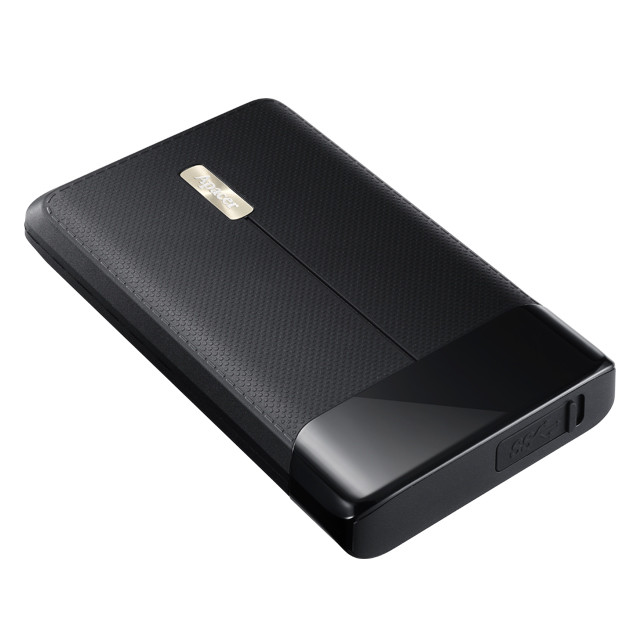
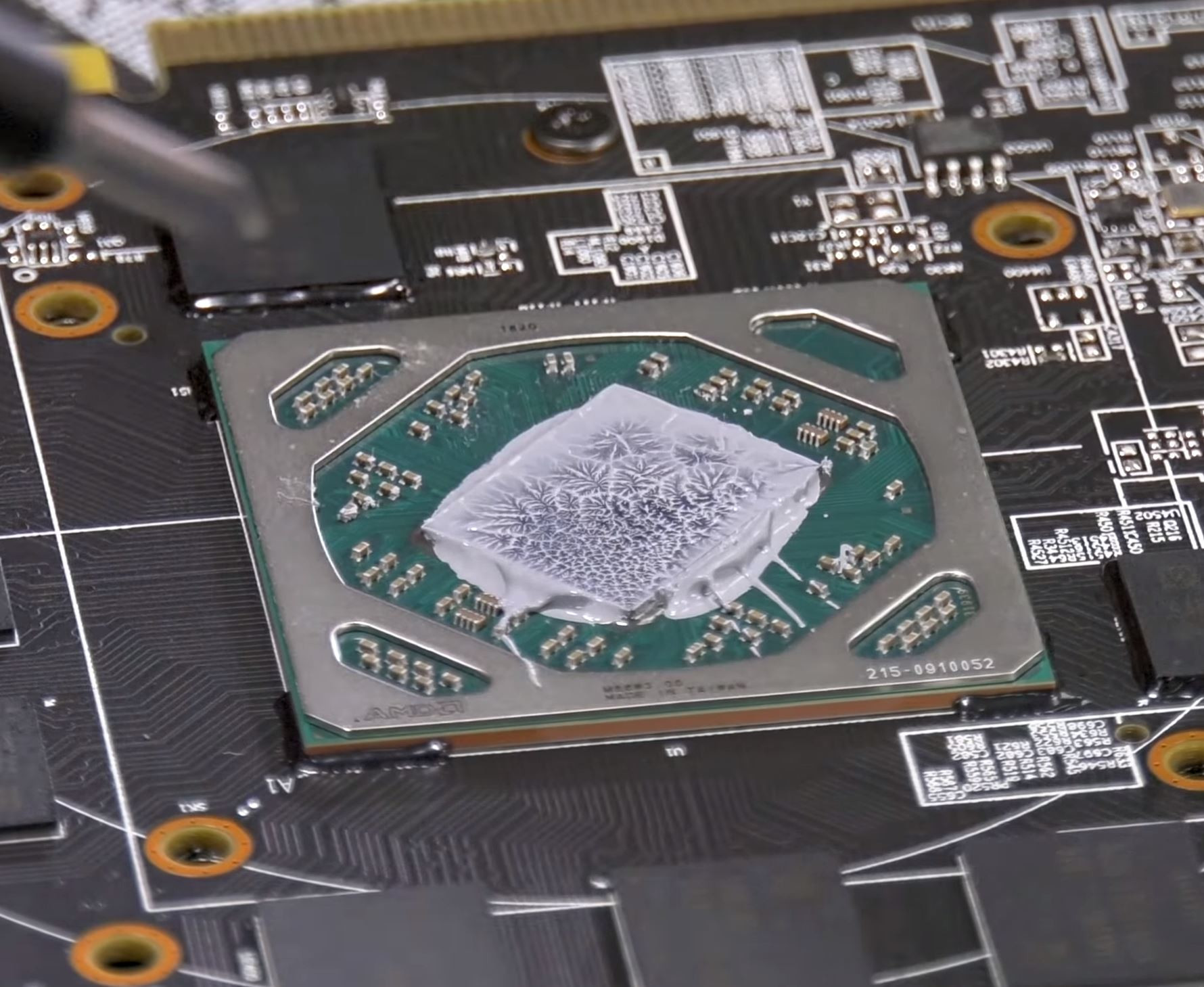
Dell's Insprion 15 3000 is an entry-level notebook that remains not only highly affordable after a quick upgrade to an SSD, but feels quick and responsive. Take that into account, along with the surprisingly good battery life, and you have a decent system for on-the-go that won't break the bank.
It was about 6 months ago that we posted a news story about how a Lenovo representative mentioned that the successor to NVIDIA's GeForce 10-series of GPUs would be named the 11-series. Fast forward in time, we know how that turned out with the recently announced RTX 20-series instead. The rumor mill has not taken a break over the holidays, however, with consistent postings and speculation online about how NVIDIA will announce not only the RTX 2060 at CES 2019, but also a whole new GTX 11-series accompanying it that is aimed to meet gaming needs without real-time ray tracing support and at a lower price point respective to the equivalent RTX SKU.
Perhaps it is fitting that Lenovo provides more fuel to this fire once again, with a listing of a mobile GeForce GTX 1160 (N18E) graphic solution on their upcoming Legion Y530 and Y7000P laptops. VideoCardz.com was quick to capture a screenshot of the specs listing, seen below, that describes it as a "next generation GPU", albeit with an asterisk hinting that the specification may not be final. Indeed, Lenovo has since changed the description on that product page to remove all signs of said 11-series mobile GPUs, and the LaptopMedia specs database for the Legion Y530 also now mentions a "GTX 2060" with 6 GB of VRAM instead. The only thing we know for sure is that we are not sure of anything, and it may well be that a GeForce 11-series, if it even exists, is a mobile-only platform. Hopefully CES will shed more light on this matter, and stay tuned for our coverage of the event accordingly.
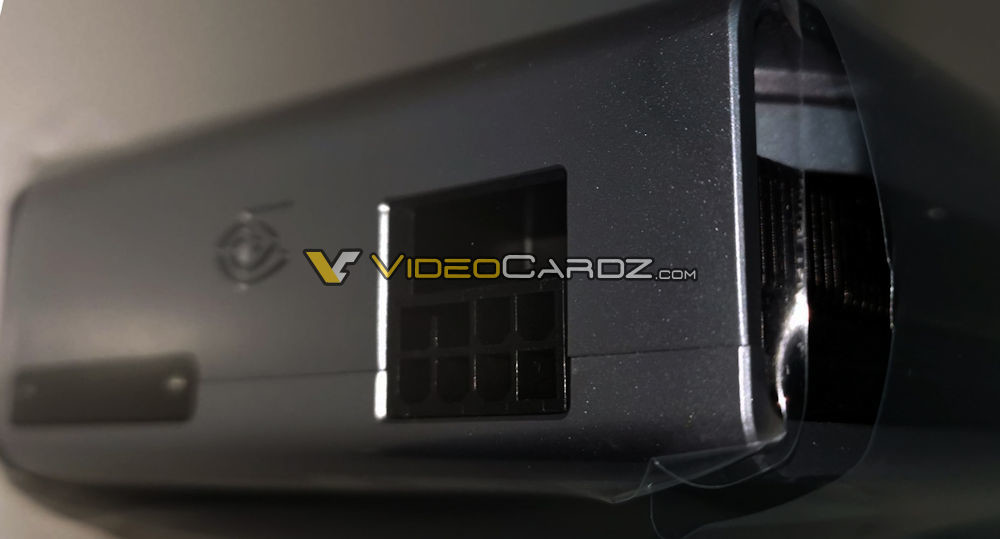
Here are some of the first pictures of NVIDIA's upcoming GeForce RTX 2060 Founders Edition graphics card. You'll know from our older report that there could be as many as six variants of the RTX 2060 based on memory size and type. The Founders Edition is based on the top-spec one with 6 GB of GDDR6 memory. The card looks similar in design to the RTX 2070 Founders Edition, which is probably because NVIDIA is reusing the reference-design PCB and cooling solution, minus two of the eight memory chips. The card continues to pull power from a single 8-pin PCIe power connector.
According to VideoCardz, NVIDIA could launch the RTX 2060 on the 15th of January, 2019. It could get an earlier unveiling by CEO Jen-Hsun Huang at NVIDIA's CES 2019 event, slated for January 7th. The top-spec RTX 2060 trim is based on the TU106-300 ASIC, configured with 1,920 CUDA cores, 120 TMUs, 48 ROPs, 240 tensor cores, and 30 RT cores. With an estimated FP32 compute performance of 6.5 TFLOP/s, the card is expected to perform on par with the GTX 1070 Ti from the previous generation in workloads that lack DXR. VideoCardz also posted performance numbers obtained from NVIDIA's Reviewer's Guide, that point to the same possibility.
The Core i5-9600K may not have the core-count increases of its higher-priced siblings, but it received a healthy frequency bump over its predecessor, coupled with hardware patches to some vulnerabilities. We already proved that the i7-9700K is the best gaming CPU by Intel. Can the humble Core i5 challenge it in this arena?
Steam has releases its statistics for the state of gaming in 2018, where the company reveals which games provided the most engagement, either in sales or players, throughout the year. Top Sellers, Top New Releases, Top Selling VR Titles, Top Early Access Grads, and Most Played Games are the categories across which Steam divided 2018's games, and some of these found themselves on the top spot of more than one category.
Warframe, DOTA 2, Monster Hunter: World, PUBG and CS: GO all find themselves on the Platinum tier of both the Top Sellers and Top Played categories, with more than 100,000 concurrent players at some point in time. The Witcher 3 finds itself in the Gold category of the Top sellers, again, and in the Silver category for Top played. No man's Sky, Stellaris, and Kingdom Come: Deliverance all find themselves in the Gold tier of the Top played game as well, with more than 50,000 concurrent players - No man's Sky, for one, surprises here. The game with one of the worst receptions ever has actually managed to keep relevant for much, much longer than other, much more critically-acclaimed games. Check out the top tiers in the images below.
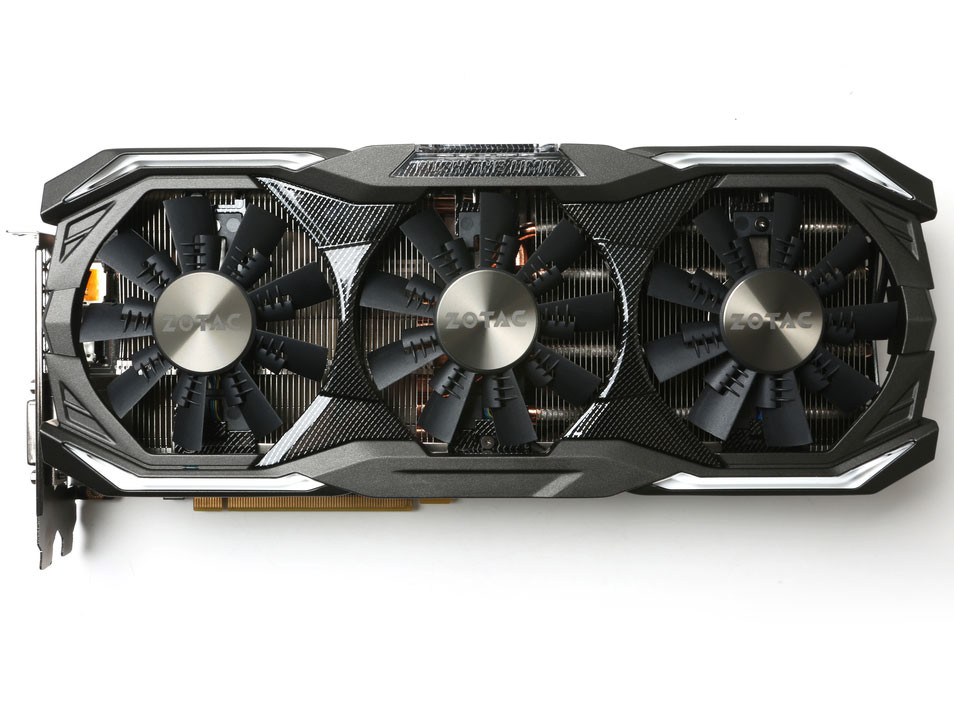
The folks over at HD Tecnología have managed to snag some renders of ZOTAC-s upcoming renditions of the RTX 2060 graphics card, which has been getting more and more significant in the rumor mill as its release date (for now thought to be around January 15th) approaches. For now, two models seem to be planned: the AMP and Twin Fan models.
Both models feature the same cooler design, with angular, jet-like contours and a non-explosive gray and silver color scheme. The power connectors seem to be of the 8-pin type, and the design is being compared with that of the RTX 2070 Mini, also from ZOTAC - which it is. And that should mean similar dimensions and, likely, the same output connectors - 1x dual-link DVI-D connector on card, 3x DisplayPort and 1x HDMI, with an MIA VirtualLink port.
Sapphire debuted its Radeon RX 590 series last month with the RX 590 Nitro+ Special Edition, which at the time was advertised as a limited-edition SKU. The company over Holiday weekend updated its product stack to introduce a new mass-production SKU, the RX 590 Nitro+ OC, minus "Special Edition" branding. There are only cosmetic changes between the two SKUs. Sapphire's favorite shade of blue on the Special Edition SKU makes way for matte-black on the cooler shroud, as do the black accents on the back-plate, instead of blue. The fan impellers are opaque matte black instead of frosty and translucent.
Thankfully, Sapphire hasn't changed the specs that matter - factory-overclock. The card still ships with 1560 MHz engine clocks (boost), and 8.40 GHz (GDDR5-effective) memory, and a "quiet" second BIOS that dials down the clocks to 1545 MHz boost and 8.00 GHz memory. The underlying PCB is unchanged, too, drawing power from a combination of 8-pin and 6-pin PCIe power connectors, and conditioning it with a 6+1 phase VRM. Display outputs include two each of DisplayPort 1.4 and HDMI 2.0, and a dual-link DVI-D. The company didn't reveal pricing, although we expect it to be marginally lower than the Special Edition SKU.
RAIDMAX launched the MX-902F, a set of two heatspreaders for full-length DDR4 thru DDR2 memory modules, which add RGB multi-color LED bling. The heatspreaders are made of an aluminium alloy, with silicone diffusers for five addressable RGB LEDs that can put out 16.7 million colors. Each of the two heatspreaders take in standardized 3-pin addressable-RGB input, and daisy-chain a single aRGB source between the two heatspreaders. The heatspreaders are 51 mm tall (factor in some additional height when installed with a module), 8 mm-thick, and 127 mm long. The company didn't reveal pricing.
Thermaltake today rolled out the Pacific V-RTX 2070 Plus ASUS ROG, a full-coverage water-block designed for ASUS ROG Strix series graphics cards based on the GeForce RTX 2070. These include the ROG Strix RTX 2070 8G Gaming, A8G Gaming, and O8G Gaming. The block combines a nickel-plated copper primary material with an acrylic top embellished with steel. The top is studded with 12 addressable RGB LEDs that plug in directly to the aRGB header of the card, and take control from RGB software. You can also directly plug in the LEDs to a standard 9-pin USB 2.0 header on your motherboard. The block measures 22.6 mm x 149 mm x 286 mm (HxWxL), and takes in standard G 1/4" fittings. Also included with it is a 4 mm-thick full-coverage aluminium back-plate. The company didn't reveal pricing.
beyerdynamic, one of the world's leading manufacturers of headphones, microphones and conferencing products, announces the TEAM TYGR bundle, pairing the TYGR 300 R gaming headphones with FOX Professional USB Studio Microphone. beyerdynamic will showcase TEAM TYGR during CES 2019 from January 8 - 11, 2019.
beyerdynamic's TYGR 300 R is the ultimate gaming headphone with adjustable yokes and a spring steel headband to adapt to any head size. Designed for gaming applications in quiet environments, the TYGR 300 R features an innovative acoustic fleece with soft ear cushions. The single-sided connection cable is terminated with a 3-pole, gold-plated mini jack plug and a screw-on gold plated adapter.
Taiwanese OEM CJSCOPE has outed a tease for their upcoming HX 970 GX laptop, featuring an Intel 9th gen processor and NVIDIA's RX 2080 graphics card in an MXM form-factor. The Mobility version of the RX 2080 will feature the same 2944 CUDA cores, but an up to 1847 MHz core clock - better binning in the mobile versions of these chips, likely.
Other options given by CJSCOPE in configuring the laptop include the Mobility 2070 and 2060. The Mobility RX 2070 follows the desktop version in CUDA cores (2304) and slightly increases the maximum Boost clock to 1710 MHz, while the RX 2060 Mobility reduces the amount of CUDA cores from the prospective 1920 found in the (unreleased) desktop version to 1536 (a 20% reduction in computational resources). The marketing materials also state that the RTX 2060 should be available on January 15th.
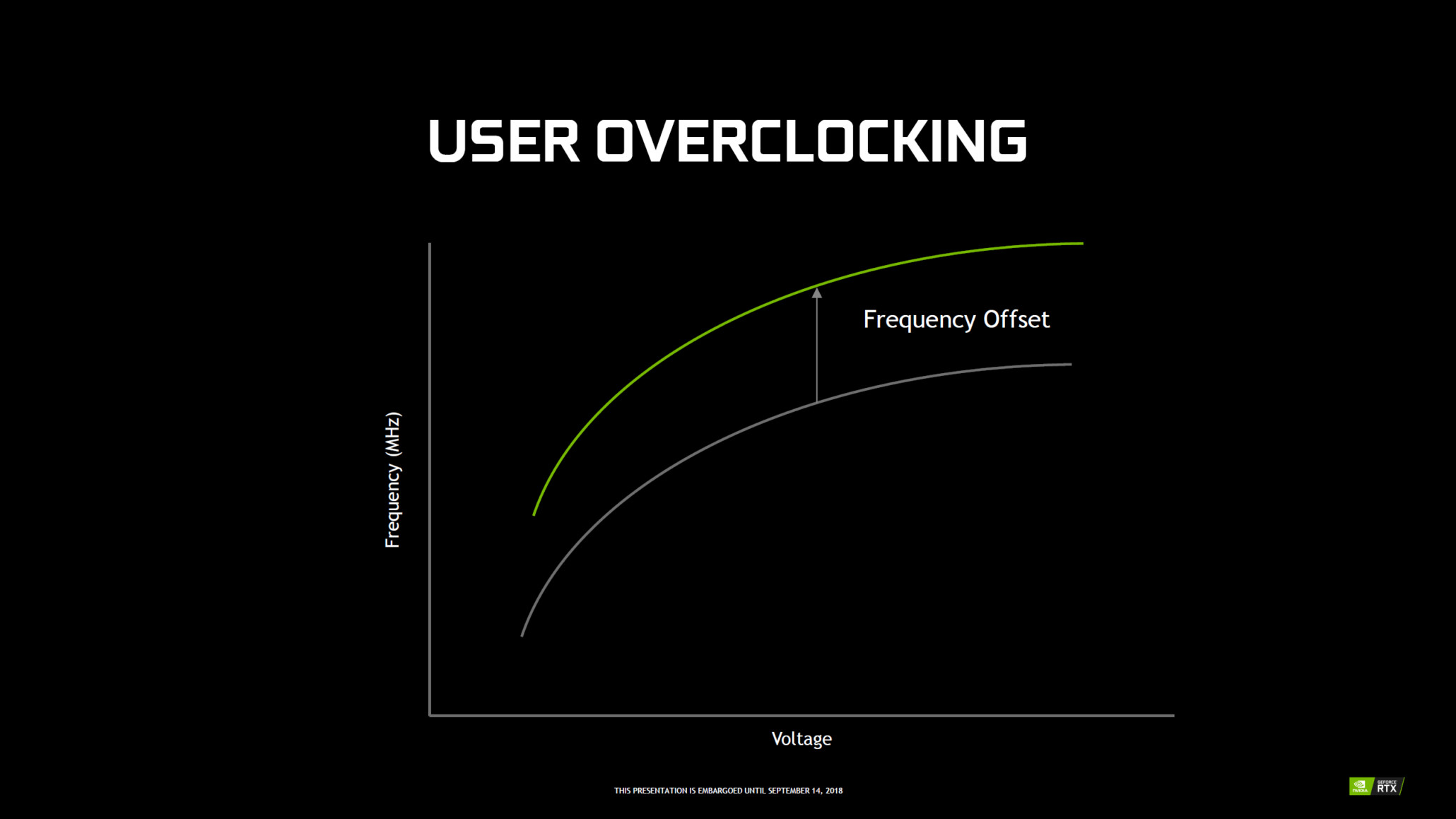
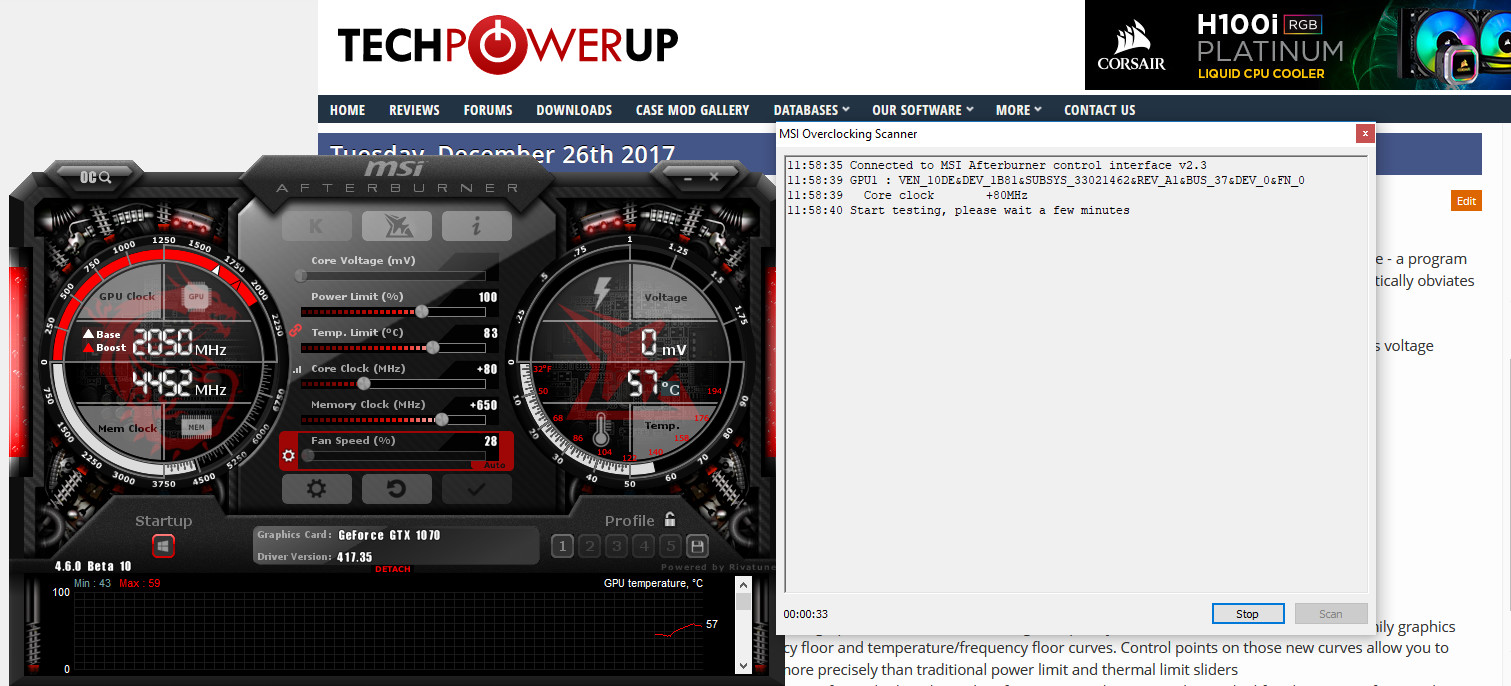
One of the runaway features for NVIDIA's latest RTX-20 series of graphics cards was the introduction of support for the OC Scanner feature - a program that automagically tests a range of frequencies on your NVIDIA graphics card and overclocks it to a deemed "stable" sweet-spot. This practically obviates the need for manual fine-tuning, though of course, the best results should always be found down that road - provided there's enough tinkering.
The latest version of MSI's Afterburner (v4.6.0 beta 10, available in the source link) now brings this functionality to Pascal-based graphics cards (besides some other features, such as voltage control, for Turing; check the entire release notes after the break). Have fun.
To meet the growing demands for powerful portable storage devices, KINGMAX expands its product lineup with the KE31 portable SSD, which is designed to fulfill all you require for a high-performance portable SSD. Featuring a super-tiny size, fast transfer speeds and large capacities up to 960GB, the KE31 is the best companion for heavy users to easily get their works done wherever they go.
NVIDIA drew consumer ire for differentiating its GeForce GTX 1060 into two variants based on memory, the GTX 1060 3 GB and GTX 1060 6 GB, with the two also featuring different GPU core-configurations. The company plans to double-down - or should we say, triple-down - on its sub-branding shenanigans with the upcoming GeForce RTX 2060. According to VideoCardz, citing a GIGABYTE leak about regulatory filings, NVIDIA could be carving out not two, but six variants of the RTX 2060!
There are at least two parameters that differentiate the six (that we know of anyway): memory size and memory type. There are three memory sizes, 3 GB, 4 GB, and 6 GB. Each of the three memory sizes come in two memory types, the latest GDDR6 and the older GDDR5. Based on the six RTX 2060 variants, GIGABYTE could launch up to thirty nine SKUs. When you add up similar SKU counts from NVIDIA's other AIC partners, there could be upward of 300 RTX 2060 graphics card models to choose from. It won't surprise us if in addition to memory size and type, GPU core-configurations also vary between the six RTX 2060 variants compounding consumer confusion. The 12 nm "TU106" silicon already has "A" and "non-A" ASIC classes, so there could be as many as twelve new device IDs in all! The GeForce RTX 2060 is expected to debut in January 2019.
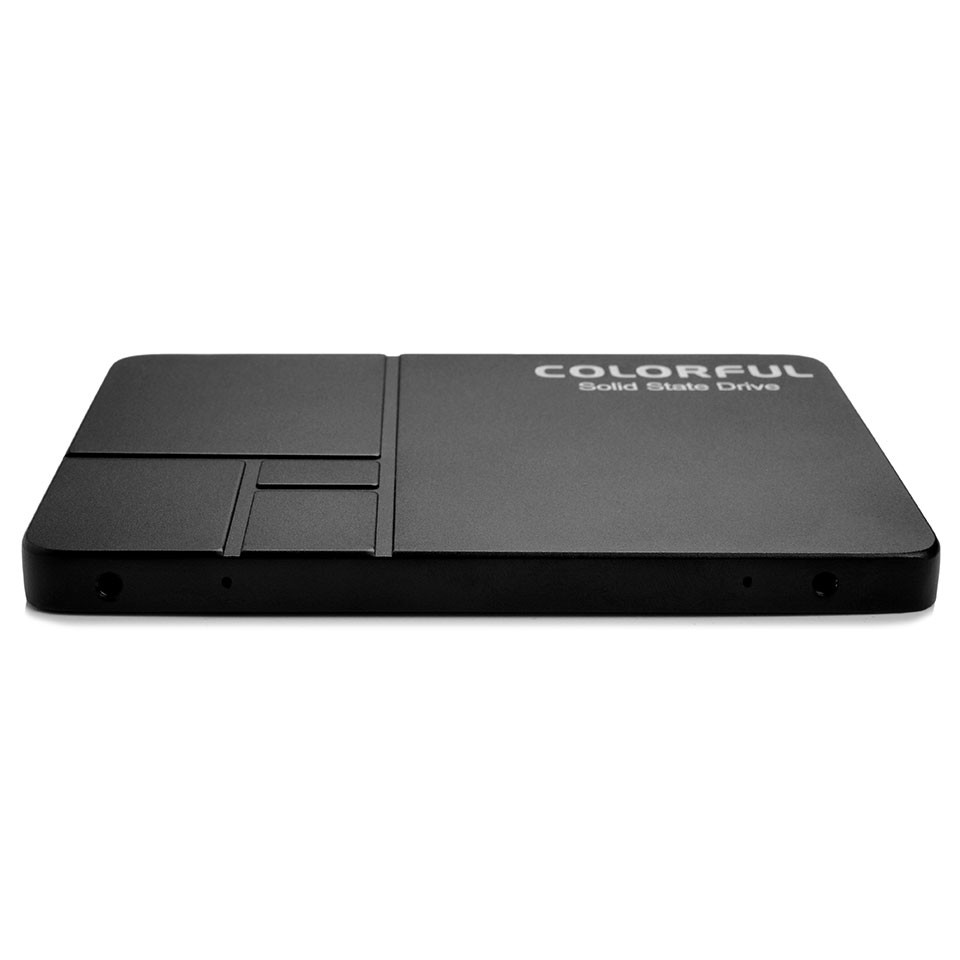
Colorful Technology Company Limited, professional manufacturer of graphics cards, motherboards and high-performance storage solutions is thrilled to announce the latest addition to its rapidly expanding high-performance storage solution portfolio with its latest and highest capacity SSD offering to date. The new COLORFUL SL500 2TB SSD brings massive capacity at a competitive price point giving mainstream consumers a viable option to completely replacing mechanical hard disk storage with high-speed, solid-state drives.
The COLORFUL SL500 2TB SSD removes the need of mixing SSDs with HDDs to balance speed and performance, all the while making it much more accessible to mainstream consumers with its affordable price. Power users, gamers and multimedia professionals can now utilize the speed advantage of SSDs without relying on slower HDDs to compensate for growing file sizes. Now you can store all your games, work on large 4K videos all on a single SSD. The COLORFUL SL500 2TB SSD brings faster load times for apps and games that will benefit both professionals and gamers alike.
TechPowerUp and be quiet! brought you the Upgrade Kit Giveaway through December 2018, presenting you with a unique chance to overhaul the case, PSU, and cooling of your gaming rig from Germany's leading PC cooling components maker. From a pool of thousands of entries, three winners were randomly selected, and without further ado, here are the winners!
Jernej from Slovenia: Wins the full Upgrade Kit, including a be quiet! Silent Base 801 Window case, Straight Power 11 550W power-supply, and Dark Rock 4 CPU cooler
Andre from Brasil and Sebastien from the United Kingdom: Each win a be quiet! Dark Rock 4 CPU Cooler
A huge Congratulations to you three! TechPowerUp and be quiet! will return with more such interesting giveaways.
Every year ends on a high here at TechPowerUp, as we look back to a year's work in bringing the fastest, best, and most incisive technology content to our readers. There can be no better year-ender than the Merry Christmas and a Happy New Year we wish for you, your colleagues, family, and friends!
From all of us here at TechPowerUp, spread across the globe, Thank You for 2018. We once again wish you a Merry Christmas and a Happy New Year!
JOLED, a Japanese Display, Sony and Panasonic group, has announced new OLED solutions for PC monitors that are expected to enter the market in 2019. While OLED has become ubiquitous in both high-end smartphones and TV's, some of the technology's quirks (read: burn-in) mean that it has some more problems that need addressing compared to the other, more traditional display panel technologies. That's likely one of the reasons OLEDs are taking so long to enter the PC monitor market, even though some of their characteristics (such as the fact that the announced JOLED models can features repsosne times of 0.1 ms) are naturally gamer-appealing.
The market entries will start small, with 21.6" diagonals in both 1080p (geared for gamers in partnership with Japanese e-sports team Burning Core) and 4K (which should make its way to the market inside ASUS' Proart PQ22UC. For some reason, there's apparently a 27" panel that's being developed specifically for smart home applications, instead of for the gaming crowds. Go figure.
Fallout 76 has quickly been deemed one of the gaming failures of 2018, with the world of Fallout falling prey to a multitude of factors. You can count Bethesda's game engine and it's infinite amount of bugs, blatant misinformation in marketing campaigns, and monetization, monetization, monetization.
It would seem that in a bid to win back player's graces, Bethesda will be offering PC, PS4 and Xbox players of Fallout 76 that logged in to play the game during 2018 a copy of their Fallout Classic Collection, which includes Fallout, Fallout Tactics: Brotherhood of Steel, and Fallout 2. It's a holiday gift given in a pleading position, so to speak. An announcement that Bethesda would be developing a new game engine would likely be better received by the community as an apology, though.
An Intel Newsroom post penned by the company's Steven Rodgers takes a stab at Qualcomm over their patent litigation cases. Titled "Qualcomm's Patent Litigation Campaign isn't Really about Vindicating Intellectual Property Rights", Rodgers cites the number of times Qualcomm has been fined by various authorities around the world, "nearly a billion dollars in China, $850 million in Korea, $1.2 billion by the European Commission and $773 million in Taiwan (later reduced in a settlement) for anti-competitive practices." Citing consequences such as reduced innovation and raised prices for consumers, Intel calls out Qualcomm in that its goal isn't to "vindicate its intellectual property rights, but rather to drive competition out of the market for premium modem chips, and to defend a business model that ultimately harms consumers."
Now, the collective hardware enthusiast memory isn't one to be trifled with, so I will leave it to you to figure out exactly where the irony is in these accusations. Of course, bad history on a company's part doesn't preclude any responsibility from any other company that is currently employing anti-competitive tactics that do, ultimately, stifle innovation and increase prices for consumers. As some Portuguese humorists would say, "one thing is one thing, another thing is another thing". But I'd say, jibbing my way through this, that it takes one to know one.
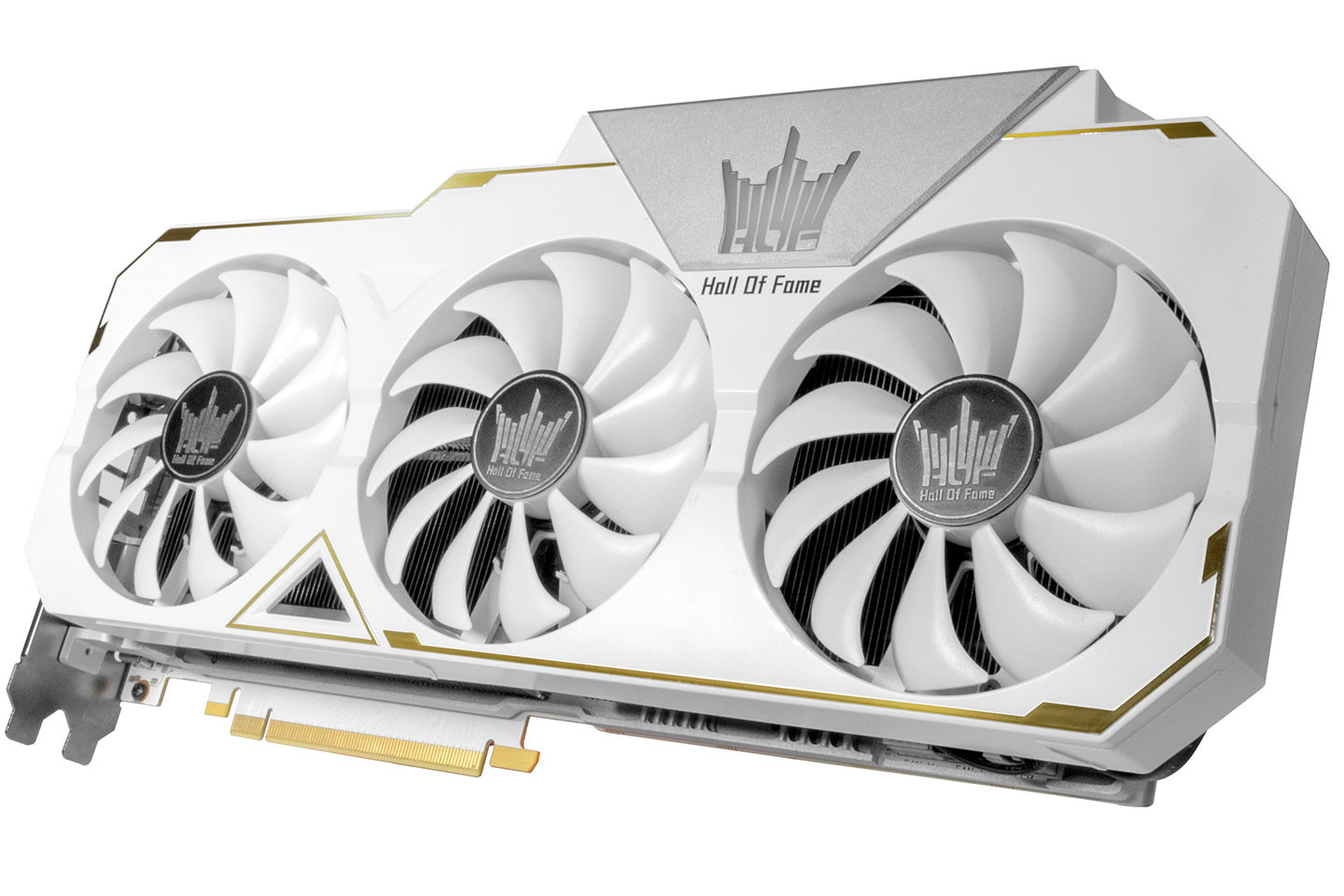
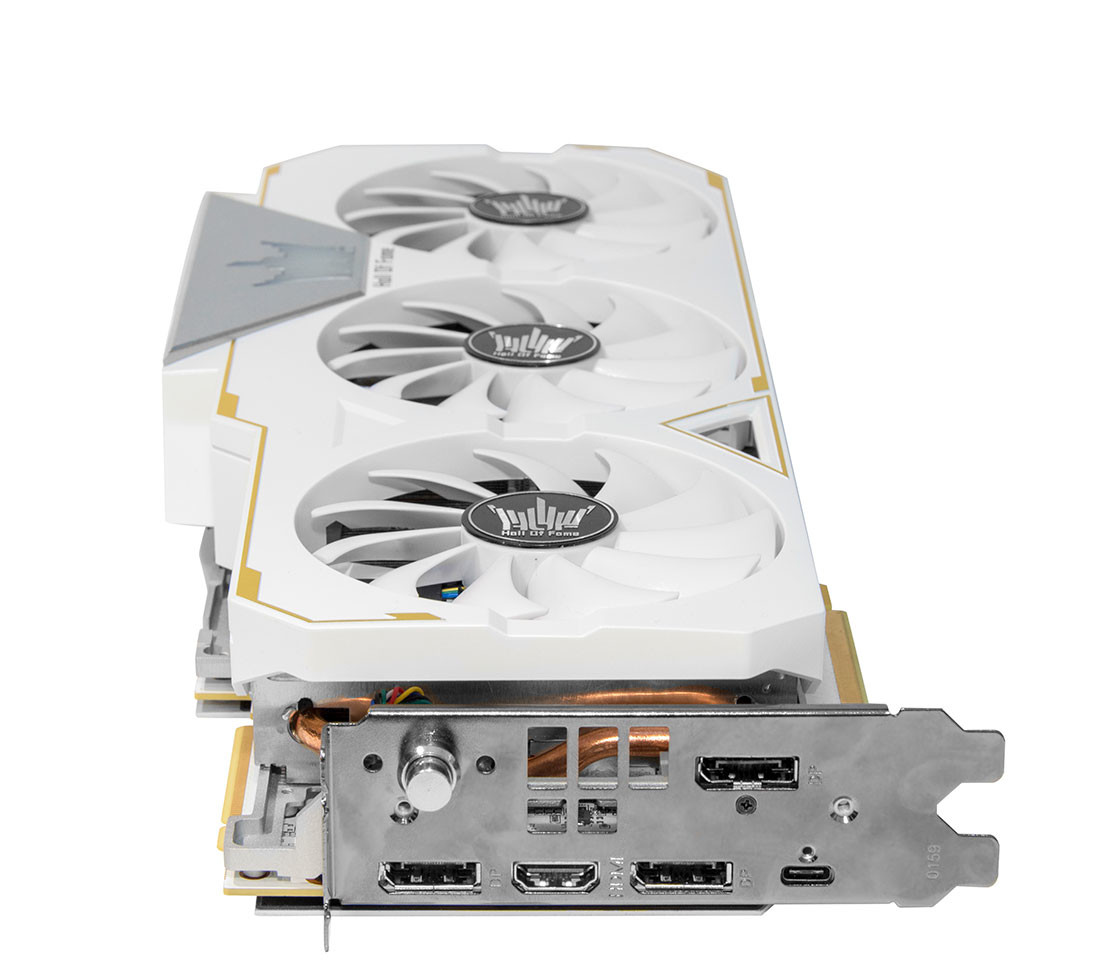
The EU-specific brand of GALAX, KFA2 today rolled out its latest flagship graphics card in the old continent, the GeForce RTX 2080 Ti Hall of Fame (HOF). In true tradition of this brand extension, the card is all-white - including its cooler shroud, fans, back-plate, and the PCB. The custom-design PCB pulls power from a trio of 8-pin PCIe power connectors located at the tail-end of the card rather than on top of it, and conditions it using a 16+3 phase VRM, to support an out-of-the-box speed of 1635 MHz boost, which isn't much higher than the NVIDIA-reference 1545 MHz, but is probably set to leave you a lot of manual OC headroom to play with. The memory is unchanged at 14 Gbps (GDDR6 effective).
The cooling solution uses a large aluminium twin-stack heatsink to which heat drawn from the GPU is fed to the fin-stacks by six nickel-plated copper heat pipes that make direct contact at the base. Additional contact points in the heatsink pull heat from the memory chips and MOSFETs. Three 100 mm fans ventilate the heatsink. The top of the card features an LCD matrix display that can put out live monitoring of temperature, fan-speed, and voltages. When interfaced with an app, it can also put out other details such as clock-speeds and memory utilization. The back-light illumination to this display, along with an ornament on the back-plate, are RGB LED illuminated. The card features two BIOS ROMs switchable via a push-switch. Both BIOSes run the card at the same clock-speeds, however, the second BIOS ramps up power-limit and stiffens the fan-curve. Available now, the KFA2 GeForce RTX 2080 Ti HOF is priced at 1,899€ (including VAT).
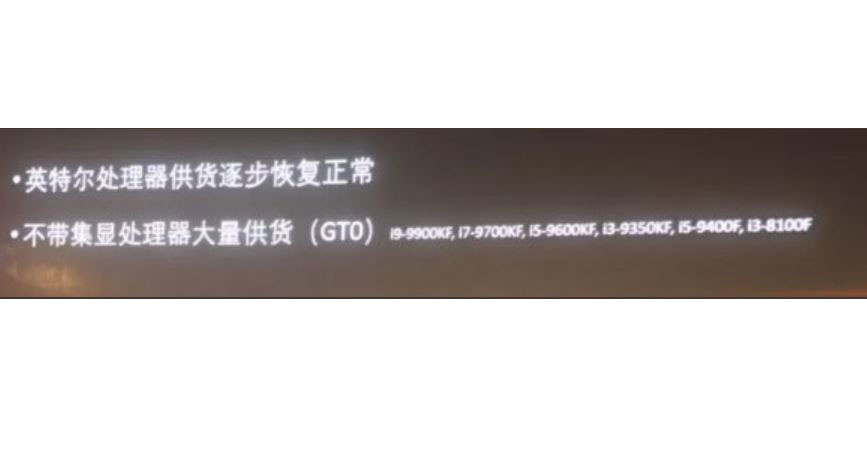
We've tracked the possibility of GPU-disabled 9th generation Core "Coffee Lake Refresh" processors since early December with a Q1-2019 launch target. Some of these chips are already surfacing on retailers, with Norwegian and Finnish online stores listing four chips: the Core i9-9900KF, the i7-9700KF, i5-9600KF, and the i5-9400F. There's no sign of the quad-core i3-9350KF. As mentioned earlier, these are processors with their integrated graphics either disabled or physically absent. The "KF" extension indicates that in addition to lacking an iGPU, these chips feature an unlocked base-clock multipler. The i5-9400F, on the other hand, has a locked multiplier and lacks an iGPU.
The clock-speeds of the i9-9900KF, i7-9700KF, and i5-9600KF appear identical to their iGPU-equipped siblings, with the i9-9900KF featuring 3.60 GHz nominal and 5.00 GHz Turbo Boost, the i7-9700KF featuring 3.60 GHz nominal and 4.90 GHz Turbo Boost, and i5-9600KF featuring 3.70 GHz nominal with 4.70 GHz Turbo Boost. The i5-9400F is an interesting chip, it is speed-bump over the popular i5-8400, with 2.90 GHz nominal and likely 4.20 GHz Turbo Boost. Besides slightly increase clock speeds, you get hardware fixes to certain security vulnerabilities Intel addressed with the 9th generation. The prices of these chips are off the scale, and nothing really worth mentioning.
If you follow the competitive gaming scene, you probably already heard of Fnatic. The eSports organization also sells peripherals under Fnatic Gear, and the Flick 2 is one of their two newest models. It features a PMW3360 top optical sensor, Omron switches rated for 50 million clicks, RGB lighting, and a massive shell that's built for war.
beyerdynamic, one of the world's leading manufacturers of headphones, microphones and conferencing products, announces Soul BYRD, an in-ear headset with an incredible sound spectrum and form-fitting design. beyerdynamic will debut Soul BYRD during CES 2019 in Las Vegas from January 8 - 11, 2019.
beyerdynamic's Soul BYRD is a multi-functional, robust headset with extra flat in-ear design and powerful sound spectrum. The ergonomically shaped housing creates a secure and snug in-ear fit and, combined with the flat shaped housing, the in-ear headset is ideal for relaxing or sleeping without any discomfort. Its closed design prevents music from penetrating to the outside and eliminates ambient noise from the outside. Soul BYRD is manufactured with anodized aluminum faceplates to create an elegant design. The flexible and high-quality cables have a soft surface to prevent them from becoming tangled and limit cable noise to a minimum.
Japanese company IO Data has announced a pair of monitors with a blazing fast 240 Hz refresh rate and a sub-1 ms response time. Part of the reason the response time is so low is the usage of TN (Twisted Nematic) panels on the design, which have historically presented faster response times than other mainstream panel technologies. These are available in a 24" size with varying specs according to the refresh rate: there are 60 Hz, 144 Hz, and 240 Hz panels, each with a maximum brightness of 250, 350, and 400 cd/m². Response times vary in 0.8, 0.7, and 0.6 ms, respectively. It's unclear which technology was used to achieve these response times - either some sort of strobe-based lighting, or an impressive overdrive function.
IO Data only makes its monitors available to their domestic market of Japan, so it's likely these won't be available for the global market. However, since these panels aren't manufactured in-house, but are purchased from a supplier (the amount of companies that have the capability to produce their own LCD panels is thin, to say the least), other companies are bound to introduce products based on these panels. IO Data's GigaCrysta-series displays with a sub-1 ms response time are currently available for $142 (60Hz), $265 (144 Hz) and $380 (240 Hz) on Amazon japan.
Razer, the world's leading lifestyle brand for gamers, today announces its plan for a long-term lease of a new location for its Southeast Asia headquarters based in the technology and media hub of Singapore. The Company anticipates moving into the new facility in 2020. Razer has been on a strong growth trajectory and delivered a stellar year-on-year growth of 39% in revenues and 46% in gross profit in the first half of 2018. Razer's plans for its new headquarters highlight the Company's growth plans in the esports and gaming industries as the total addressable market (TAM) for gamers is expected to grow from 2.35 billion in 2018 to 2.76 billion in 2021, according to Newzoo Global Games Market Report.
The strategic location of the new Razer headquarters in Singapore also rides on the growing traction of the Services business across Southeast Asia. Razer has proven out to be the preferred monetization platform for gaming and content companies seeking to expand their global presence especially in the fast-growing Southeast Asia market, as evidenced by the recent Razer Gold partnerships with PUBG MOBILE, Nexon America and Webzen. Along with Razer Silver loyalty rewards system, Razer Gold empowers gamers to get the most out of their games and gaming lifestyle.
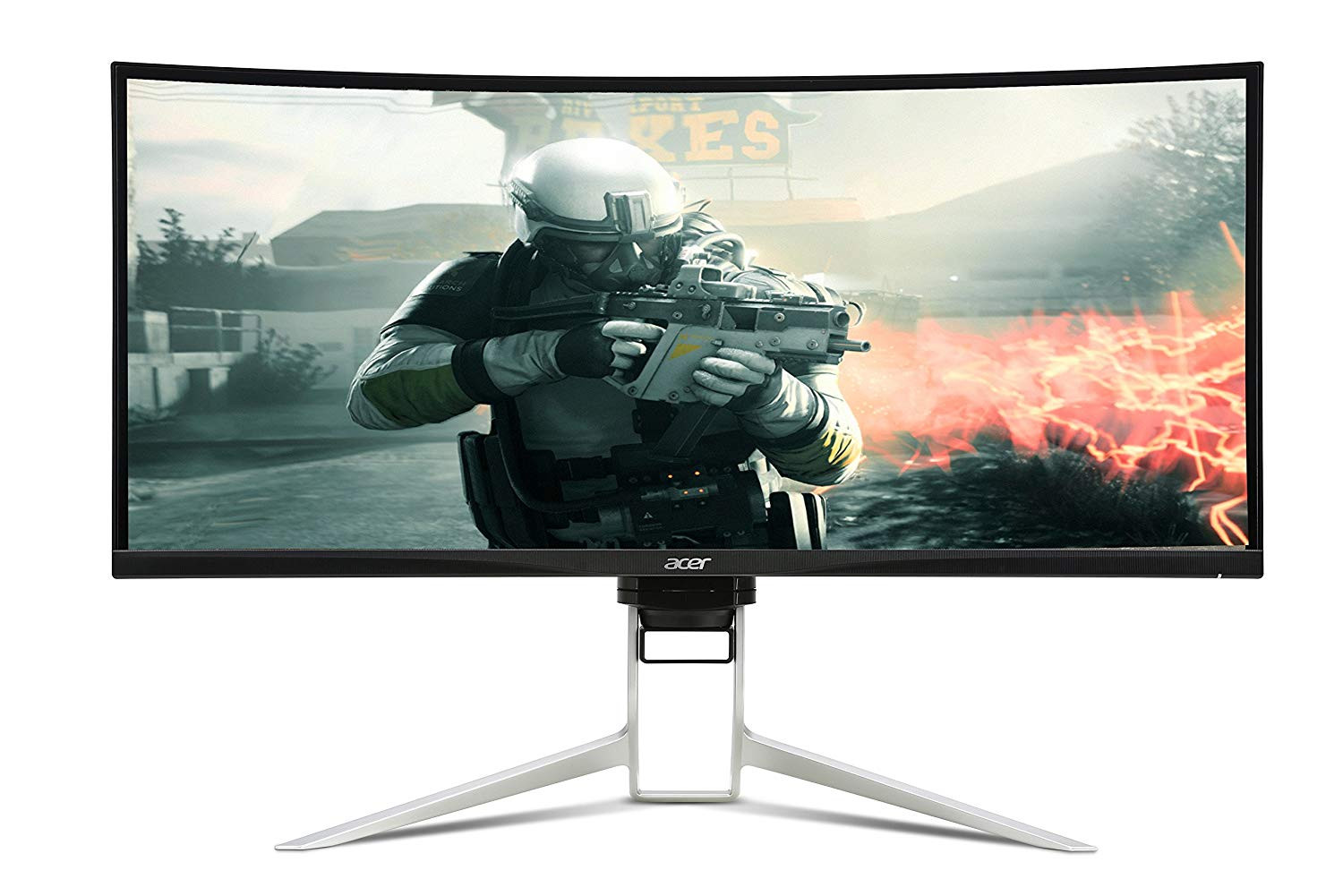
Acer announced the release of another FreeSync monitor to their lineup. The Predator XR343CKP offers a 34", ultrawide, curved IPS panel with a 3440 x 1440 resolution. Being an IPS panel, the 1 ms response time (with MPRT, so, an added blur reduction mode is taken into account for this response time) is a premium specification. It features an up to 100 Hz refresh rate with FreeSync technology enabling variable refreshes without screen tearing.
The panel offers a typical 1,000:1 contrast ratio with a relatively low 350 cd/m² typical brightness, 172/178 viewing angles, 1.07 billion color depth and standard sRGB color gamut. Display Inputs include HDMI, DisplayPort, and 5x USB ports. All of this can be available for the modest amount of $1799... Which isn't at all the number I expected to be quitting based on the specs alone, and looking at other market offerings. But that's what's being shown on Acer's page - though some retailers, such as Amazon Germany, are offering this for some €893 (~$1000), which is much more realistic.
AMD's Athlon branding is probably the company's longest running one when it comes to its commercial CPU solutions. These join AMD's already-released Athlon 200GE, but offering higher clockspeeds for better overall performance, whilst keeping within the same 35W TDP of their slower, lower-tier sibling.
Both the Athlon 220GE and 240GE keep the 2-core, 4-thread design of the Athlon 200GE, but their clockspeeds have been increased to 3.4 GHz and and 3.5 GHz respectively (the 200GE runs at 3.2 GHz. Pricing, of course, increases as the clockspeed does, and while the Athlon 200GE is a steal at just $55 (with its integrated, 3 compute-units graphics accelerator), the 220GE goes for $65, and the 240GE will be available for $75.
Steel Shadows is the second game in a series called Ancient Frontier, an independently developed Sci-Fi strategy game by Fair Weather Studios. The game focuses more on the pirate side of space exploration and leans heavily towards fleet management as opposed to the empire management you'd usually see in games like Endless Space.
AMD will join the coveted Nasdaq-100 index at opening-bell on December 24. With a market-capitalization of $17.72 billion, AMD will join the list of 100 of the largest companies by market-cap listed on Nasdaq that includes non-financial companies. AMD peaked $33.2 billion market-cap in September, but fell 46% due to the cryptocurrency crash that affected sales of GPUs. It still grew 57.23% year-over-year, and hence fared relatively better than NVIDIA, which fell from $289.36 per share as on October 1, to around $135.1 as of now, a 53% decline, but a roughly $150 billion erosion in value over a span of just 3 months.
The world's largest contract semiconductor manufacturing company, TSMC, has been cleared to commence construction of a new 3 nm chip factory at the Southern Taiwan Science Park in Tainan. The new factory is expected to use 20 percent renewable energy and 50 percent recycled water.
The factory's environmental impact assessment was accepted by the Environmental Protection Administration (EPA) on Dec. 19, after concerns were raised about use of water and power sources. TSMC is expected to invest NT$600 million (US$19.45 million) in the project, with construction to begin in 2022. Production is planned to start in late 2022 or early 2023. At the same site, TSMC is also building a 5 nm chip factory, which is expected to be up and running in late 2019 or early 2020.
PhysX SDK 4.0 will be available on December 20, 2018. The engine has been upgraded to provide industrial grade simulation quality at game simulation performance. In addition, PhysX SDK has gone open source, starting today with version 3.4! It is available under the simple 3-Clause BSD license. With access to the source code, developers can debug, customize and extend the PhysX SDK as they see fit.
PhysX has been the market leader in physics simulations for more than a decade. The SDK holds the top spot due to continuous upgrades and optimizations; NVIDIA has ensured that PhysX is always ahead of the curve, enabling developers to deliver state-of-the-art physics simulations.
IBM today announced an agreement with Samsung to manufacture 7-nanometer (nm) microprocessors for IBM Power Systems , IBM Z and LinuxONE , high-performance computing (HPC) systems, and cloud offerings. The agreement combines Samsung's industry-leading semiconductor manufacturing with IBM's high-performance CPU designs. This combination is being designed to drive unmatched systems performance, including acceleration, memory and I/O bandwidth, encryption and compression speed, as well as system scaling. It positions IBM and Samsung as strategic partners leading the new era of high-performance computing specifically designed for AI.
"At IBM, our first priority is our clients," said John Acocella, Vice President of Enterprise Systems and Technology Development for IBM Systems. "IBM selected Samsung to build our next generation of microprocessors because they share our level of commitment to the performance, reliability, security, and innovation that will position our clients for continued success on the next generation of IBM hardware."
It appears that releases from CES are already making their way in the press even before the year ends. We learned of LG's new "Ultra" series monitors recently, and now we get to know about their plans from the laptops business unit. Their Gram lineup was developed to feature lightweight portable laptops with enhanced user experience in mind, and joining the series in 2019 are the 14-inch LG Gram 2-in-1 (model 14T990) and the new LG Gram 17 (model 17Z990), both of which are 2019 CES Innovation Award winners.
The 14" Gram 2-in-1 is a convertible, shifting from tablet to laptop at the whim of the user. It features a 360° hinge coupled with a touch screen to add more use cases in between. This by itself is not necessarily new or unique to the market, but a welcome addition to fans of the LG brand nonetheless. The company wants to also assure the customer that the laptop is built to last, having met the U.S. military MIL-STD-810G standard for durability. Part of this no doubt comes from the incorporation of Corning's Gorilla Glass 5 on the touch screen, and the display underneath uses LG's IPS technology. More information on this, and the Gram 17, following the break.
QNAP Systems, Inc. today launched the compact and versatile TBS-453DX NASbook which is designed for small working spaces and mobile workers. Using four M.2 SATA SSDs for storage, the TBS-453DX can also have 20 cloud storage spaces mapped and local caching enabled, providing the ability to work with online files as quickly as local files. The multi-functional and near-silent TBS-453DX provides HDMI 2.0 4K 60Hz output, hardware transcoding and streaming, and features 10GbE N-BASET connectivity based on Aquantia 's Multi-Gig controller, making it perfect for creating a seamless high-speed network environment for improved teamwork and smooth multimedia applications.
The TBS-453DX NASbook packs serious performance and complete business applications into a tiny, portable frame. By seamlessly integrating cloud storage spaces, the TBS-453DX provides the combined advantages of portability and storage flexibility to boost the abilities of modern offices and studios," said Jason Hsu, Product Manager of QNAP, adding "With the ability to locally cache cloud-based files on the TBS-453DX, no matter if users are working remotely or in the office, they can enjoy access speeds as if they were working within a LAN environment."
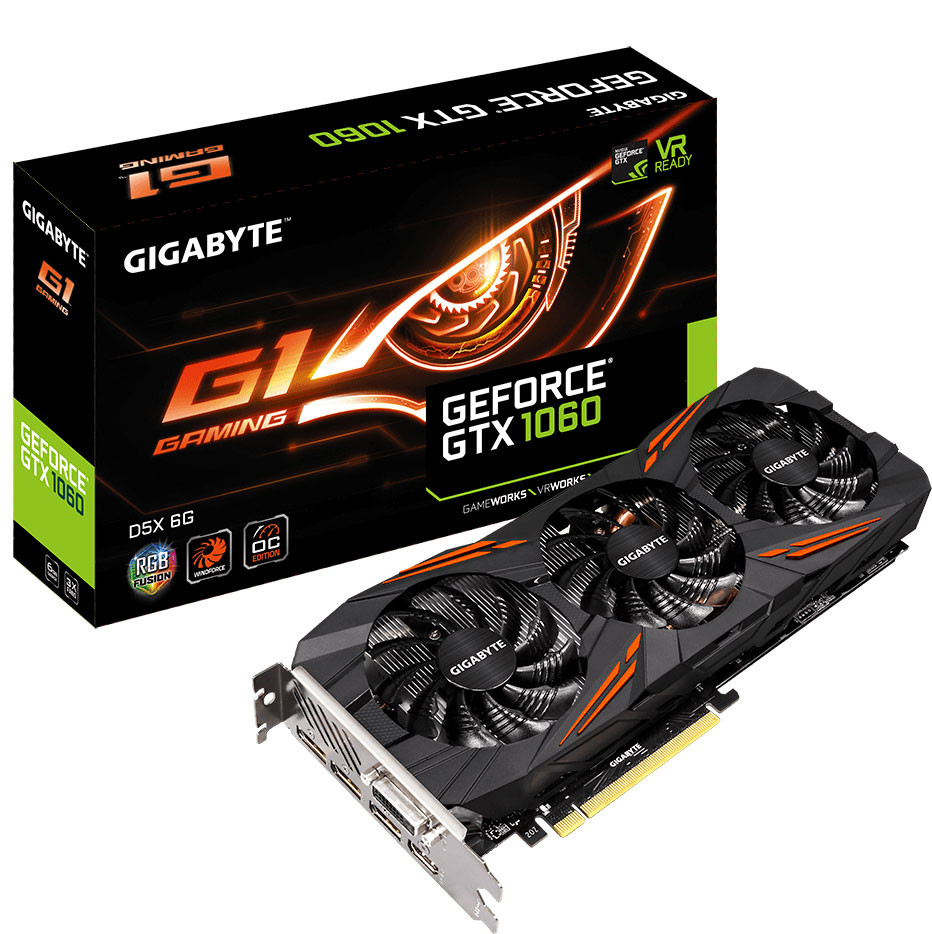
GIGABYTE today rolled out a trio of custom-design graphics cards that implement the new GDDR5X memory equipped variant of NVIDIA GeForce GTX 1060 6 GB. The lineup begins with the GTX 1060 6 GB D5X WindForce 2X OC (model: GV-N1060WF2OC-6GD 2.0), and goes on to the better-endowed GTX 1060 6 GB D5X WindForce 3X OC (GV-N1060WF3OC-6GD 2.0), and the range-topping GTX 1060 6 GB D5X G1.Gaming OC (GV-N1060G1 GAMING-6GD 3.0).
Out of the box, the D5X WindForce 2X OC offers clock speeds of 1556 MHz GPU core, and 1771 MHz GPU Boost, against NVIDIA-reference speeds of 1506/1708 MHz. The D5X WindForce 3X OC has the same exact clock speeds out of the box, but is endowed with a better WindForce 3X triple-fan cooler that helps sustain boost frequencies and manually overclocked speeds better. The D5X G1.Gaming tops the range with 1594 MHz core and 1809 MHz GPU Boost. Sadly all three cards run the GDDR5X memory at 8.00 GHz clock speeds. All three cards make do with a single 8-pin PCIe power input. Prices (MSRP) range from $249.99 for the WindForce 2X OC to $269.99 for the WindForce 3X OC, and $299.99 for the G1.Gaming OC.
TEAMGROUP is proudly announcing the T-FORCE has done to the apex again, work with world's Korean renown overcloker, SAFEDISK, by using the T-FORCE XTREEM DDR4 4500 MHz modules all the way grabbed the world record of SUPER PI 32m calculation, successfully beat all the powerful professional overclockers from HWBOT and all over the world. This excellent performance of T-FORCE XTREEM made the possibility of completion on SUPER PI 32m calculation within 4 minutes and 5 seconds which is unbelievably amazing!
SUPER PI is a significant DRAM module overclocking benching application, also a way to check the overall module specification stability. This time T-FORCE understands need to show the high performance and stability in front of all the users. Thus works with SAFEDISKset up the test environment including T-FORCE XTREEM DDR4 4500 MHz module, Intel Core i9 9900K "Coffee Lake Refresh" CPU and ASUS ROG Maximus IX Apex motherboard. Without a doubt, the world record has been posted at HWBOT and all over the public platform in front of everyone to be the witness of all this awesome performance record from T-FORCE module.
The Mixcder E8 is a pair of wireless, over-ear headphones with active noise cancelling, and a price that's much lower than you'd expect after going over the list of features. Just about everyone is after a pair of wireless headphones nowadays; here's something worth considering if you're on a tight budget.
Razer , the leading lifestyle brand for gamers, today introduced a new way to play on console with the Razer Turret for Xbox One, a wireless keyboard and mouse combo designed for Xbox One. "We're extremely proud to team up with Microsoft to bring you this exclusive collaboration," says Razer Co-Founder and CEO Min-Liang Tan. "With the Razer Turret for Xbox One, it is now possible to bring the full experience of a keyboard and mouse, with lighting and game integration to Xbox One."
Built for reliable gaming on the couch, the Razer Turret for Xbox One offers a fast and stable 2.4 GHz wireless connection via a single dongle for the mouse and keyboard, and battery life of up to 40 hours on a single charge. With Xbox Dynamic Lighting and Razer Chroma technology, console gamers now have access to the largest ecosystem of lighting, with up to 16.8-million color options and lighting effects for their keyboard and mouse. Additionally, Razer has been working with developers to bring Xbox Dynamic Lighting and Razer Chroma support in-game, offering immersive experiences on supported titles such as "X-Morph-Defense", "Vermintide 2" and more.
Tesoro announced today the launch of their latest keyboard, the Gram MX One, in time for Christmas in North America. Indeed, the keyboard is slated to be available December 24 for those wanting a last minute gift, and is part of their popular GRAM series of keyboards. This means that the keyboard uses the same body and case as their Gram Spectrum or SE Spectrum (but not the XS, which uses low profile switches), in the usual black or white color options to choose from. Adding to the options list is a choice of genuine Cherry MX Blue or Brown mechanical switches, both in their non-RGB variant.
The Gram MX One has single color blue backlighting integrated, and uses a minimalist design for those wanting something simple and more affordable than many of the new keyboards released this year. Durability and build quality are emphasized by the company, with specific mentions on the use of doubleshot injected PBT keycaps that adopt the floating style design on a thick steel plate as seen below. Pre-programmed onboard functionality includes lighting effects, key assignment and macro recording. The keyboard measures 445 x 139 x 32 mm and weighs 1.2 Kg (2.65 lb), and there is no word on pricing at this point despite imminent release.
Update Dec 20:- MSRP of the Gram MX One is $79.99 as per Tesoro, and at launch the model available for purchase will be the white color, MX Brown switch variant only. Others will follow thereafter.
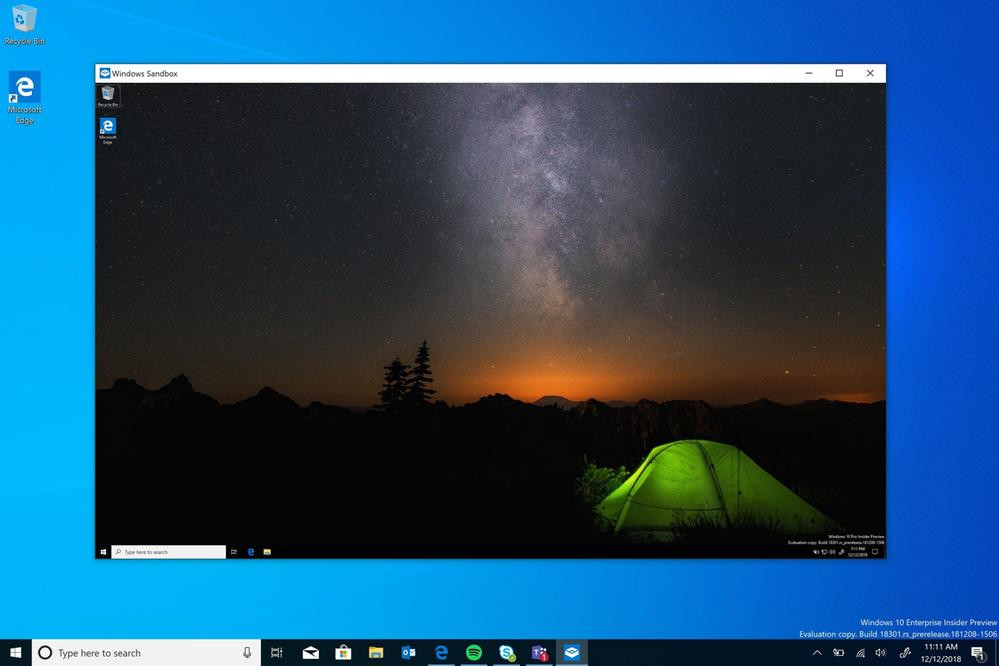
In an always-online world having the ability to test unknown programs or .exe files on PC has required the use of extra software which has always come with issues of its own or the more in-depth use of a virtual machine. In order to eliminate the fear of running unknown programs along with the desire to make testing them easier, Microsoft has announced the development of their Windows Sandbox. This new feature will be coming to Windows 10 Pro and Enterprise next year and as you may have guessed it allows for the creation of a temporary desktop environment. This work environment is made to be secure and disposable meaning you can run an app in the sandbox check for compatibility, possible issues, malware, etc and once done just delete the entire sandbox. Thus keeping your real operating system free and clear of any potentially hidden nasty surprises.
The entire system works by using Microsoft's Hypervisor to create an entirely separate kernel isolated from the host PC. Each time its run it creates a pristine installation of Windows as nothing persists between uses. More importantly, the prerequisites for its use are quite low, with systems currently at the minimum needing Windows 10 Pro or Enterprise Insider build 18305 or later, virtualization capabilities enabled in the BIOS, 4 GB of memory, 1 GB free disk space and 2 CPU cores. Recommended specifications include a CPU with four threads, 8 GB memory, and an SSD, which in this day and age is quite minimal all things considered. While this feature is not likely to be a game changer for the average consumer it should make the lives of IT personnel a bit easier.
With AMD's recent launch of their Adrenalin 2019 Edition drivers, it was only a matter of time until we saw another major release. Enter the Adrenalin 2019 18.12.3 Beta drivers. While no performance improvements have been directly listed for this release, they do contain a large number of fixes. These fixes include but are not limited too; RX Vega graphics cards having their memory locked at 800 MHz, WattMan fan speed gauge will sometimes overfill, Auto tuning controls not displaying a warning message in Radeon Overlay, etc. While these fixes are a welcome sight and were quickly implemented by AMD, they still have a ways to go in regards to getting all the kinks worked out. You can view the full change-log below.
Anno 1602 will likely be a blast from the past for some of us, with the game initially launching all the way back in 1998. Now 20 years later, Ubisoft has decided to give the first game in this illustrious franchise away for free on Uplay until December 23rd. This cult classic brings a mix of city building and economy management with a liberal sprinkle of real-time strategy creating a unique title that defined a genre and still scratches that odd nostalgic itch today.
Of course, since the game is being made available on a digital platform, means improved support for modern operating systems including Windows XP, Vista, 7, 8, and 10. That said, you will need a Uplay account if you don't have one already and will need to redeem the game on Ubisoft's site. Considering the February release of Anno 1800 is fast approaching, now might be a good time to enjoy a classic while you wait. After all what do you have to lose? It is free.
QNAP Systems, Inc. (QNAP), a leading storage, network and computing solution provider, today launched the Intel Xeon E based TS-x83XU enterprise NAS series with ECC DDR4 memory that delivers server-class performance and dependable reliability. All models in the series feature two 10GbE SFP+ ports using Mellanox ConnectX -4 Lx SmartNIC controllers and support installing a PCIe graphics card for empowering video surveillance, virtual machines and AI applications. Coupled with QNAP's exclusive software-defined SSD extra over-provisioning and comprehensive virtualization capabilities, the TS-x83XU series provides a high-performance and dependable - yet cost-efficient - NAS solution for uncompromising enterprise IT requirements.
The TS-x83XU was specifically designed for enterprises that require server-class standards of performance and reliability for business-critical data and applications," said David Tsao, Product Manager of QNAP, adding "businesses and organizations can unlock greater application potential and increase their everyday working efficiency by leveraging game-changing features such as PCIe expandability, SSD-optimization technologies, and tiered storage."
According to a report from DRAMeXchange, a division of market analytics firm TrendForce, contractor pricing of NAND flash products could drop some further 10% entering 2019 and throughout just the first quarter of the next year. Citing higher than expected but output from NAND manufacturers, who managed to ramp up their 64-bit 3D NAND ad higher-than-expected ratios, and with stagnating smartphone demand, channel quantities' increase will lead to dripping (if not cascading) pricing.
As for the trend in the SSD market, DRAMeXchange expects Client SSD contract prices to fall by nearly 10% in 1Q19, a great boon for customers. With global notebook shipments for 1Q19 estimated to decrease by over 15% QoQ, slowing demand for SSDs will lead to decreasing prices matching demand, despite the increasing SSD adoption rate in the PC market and the memory content upgrades. Long story short, enthusiasts: don't do any Christmas shopping for SSDs, barring some amazing deals that do pop up.
LG at CES 2019 is set to announce two new monitors on its "Ultra" lineup, which includes the UltraWide and UltraGear product lines. The UltraWide is pretty self-explanatory, and will be populated by the 49WL95 monitor, a 49" IPS, dual QHD (5120 x 1440) resolution panel with a 32:9 aspect ratio (there's support for up to three PbP modes simultaneously, thus making this a triple monitor setup, should you so choose). 99% coverage of the sRGB color space ensures faithful color reproduction. There's also support for HDR10 content, though the typical brightness of the monitor stands at 350 nits (peak brightness not disclosed). Connectors stand at 1x USB-C, 2x HDMI 1x DP, and 4x USB 3.0.
The second monitor is on LGs UltraGear lineup. The 38GL950G features LG's Nano IPS technology and support for NVIDIA G-Sync and 144 Hz refresh rate. It has a 38" diagonal across a curved panel, a WQHD+ (3840 x 1600) resolution, and a more standard (or is that less wide?) 21:9 aspect ratio. A typical 450 nits brightness means this monitor also supports HDR content, and connectors include 1x HDMI, 1x DP, and 3x USB 3.0 (1 up / 2 down). If any of these monitor ticks your "I want it now" boxes, you might want to wait until CES for the actual announcement and availability info.
Philips, via its MMD brand license partner, today announced the launch of the basic, cost-effective 241B8QJEB monitor. The 241B8QJEB is a no-frills, basic monitor for your office use, and would be ideal as a second or third monitor in a non-gaming environment - though of course it would also work for gaming on a budget, though there are many better options for that particular use case. The pricing of £159 goes hand in hand with the 1080p panel, which fogoes the cheaper TN type for the more image-quality-friendly IPS.
The Phlipos 241B8QJEB is an environment-friendly monitor, with 85% of the materials used in its construction being recycled, thus reducing its footprint in the environment. LowBlue Mode, Flicker-free, and the SmartErgoBase provide ease-of-use specs that can be taken advantage of by users. Connectors include VGA, DVI-D, DisplayPort 1.2, HDMI 1.4, and USB 3.0 Super Speed technology.
"Red Dead Redemption 2" (RDR2) is arguably 2018's biggest game release, and is dominating sales on both the Xbox One and PlayStation 4 platforms it debuted on. Developer Rockstar Games is now eyeing the PC platform, and is ready with an early console port to Windows. A video surfaced on YouTube by "Mrdc kll" recording menus for the PC build of RDR2 with a mouse. The number of graphics settings on offer, particularly setting such as FXAA could only point to the possibility of a PC build, rather than someone who got keyboard/mouse to work on an Xbox One. We can also vaguely make out the build number 1118.8. When this release comes to being is anyone's guess. Rockstar has, in the past, taken anywhere between a 12 to 18 months to port its flagship games to PC, and the original "Red Dead Redemption" never got a PC release.
The Synology MR2200ac looks to be ideal for expanding the coverage of your wireless network. Unlike most other WiFi range extenders, it uses mesh technology, which lets you keep the same network name. However, is its higher price compared to a plain WiFi extender justified?
Raijintek today introduced the Enyo, its biggest and greatest open-frame full-tower chassis. Measuring 707 mm x 398 mm x 659 mm, this monstrosity is a capital-I shaped metal frame with floating tempered glass panels on four sides, and steel panels on two. The left side holds a vast EE-ATX capable motherboard tray and a bottom compartment for stacks of 480 mm x 120 mm radiators; while the right side holds two PSU bays, additional radiator mounts, and drive mounts.
Drives and radiators can be mounted on either sides of the case. Up to twenty three 120 mm or 140 mm fans can be mounted on this case, and you can collectively install up to three completely independent high-end DIY liquid cooling loops. The case is made of 2 mm-thick SECC steel and 3 mm-thick tempered glass. The dual-layer middle partition has passageways for cables and coolant tubes. The company didn't reveal pricing.
You know RGB LED lighting as a"feature" has hit critical mass when it starts getting integrated into monitors. Enter ViewSonics XG240R with it's ELITE RGB accent lighting, which is part of the ELITE RGB Alliance that includes; Thermaltake, Razer, and Cooler Master. Supposedly the accent lighting on this monitor can be synced with other peripherals. However, no details have been given on how that will work just yet. Still, love it or hate it RGB LED illumination is helping sell products, and now ViewSonic is ready to join the party, as for the panel itself it is the same 144 Hz, 1080p, WLED backlight, TN offering used in the XG2402 monitor released previously. No high refresh rate monitor is complete without some form of adaptive sync, with this model, in particular, using FreeSync with a range of 48 Hz to 144 Hz and has a 1 ms response time with Overdrive enabled and a 5 ms response time without.
Viewing comfort with the XG240R and the XG2402 was a priority for ViewSonic with both monitors having height, tilt, pivot, and swivel adjustment options. Connectivity is also quite robust featuring 2x USB Type A 3.0 ports, 1x USB Type B 3.0 port, 2x HDMI 1.4 ports, 1x DisplayPort, and a 3.5 mm headphone jack. Overall the XG240R has a good set of features, excellent connectivity and a high refresh rate all at a suggested MSRP of $272.99. Meaning the inclusion of the RGB accent lighting will only cost you $10 more over the XG2402.
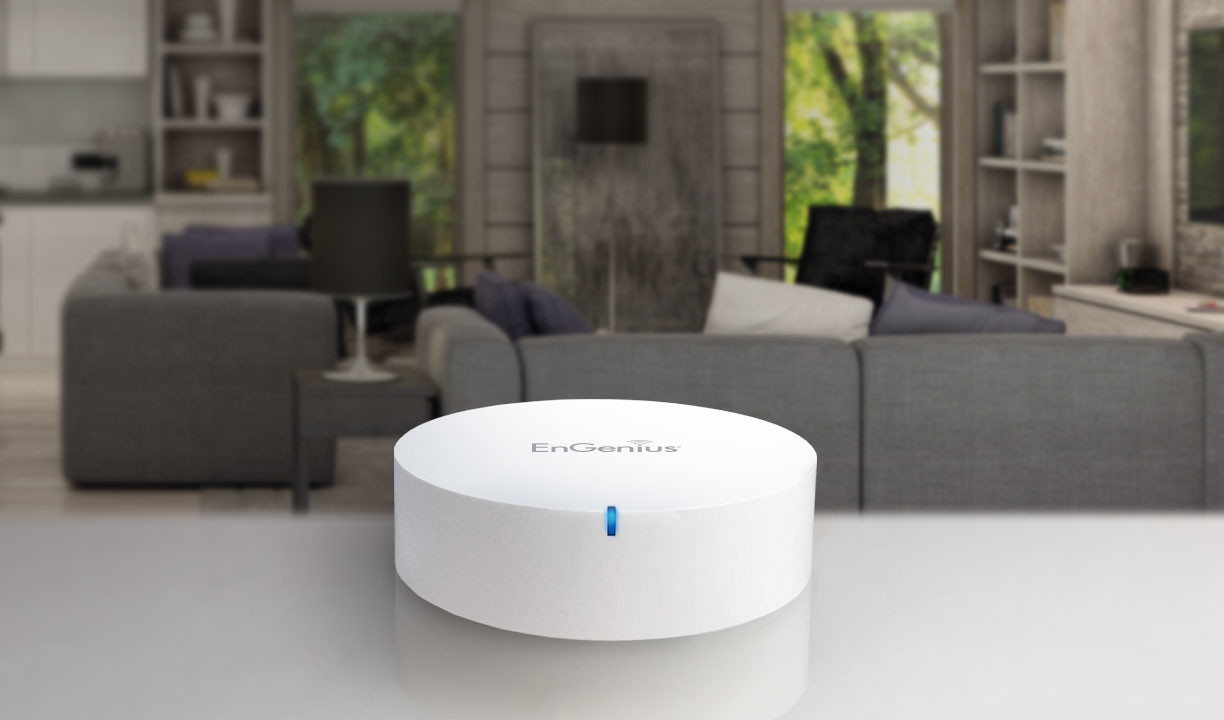
EnGenius Technologies Inc., a multinational networking company known for offering a vast range of quality networking solutions for both consumers and businesses, is pleased to announce the long-awaited Wi-Fi mesh network system called MESHdot Kit. The bundle comes with an elegant wireless mesh router called EMR3500, and MESHdot (EMD11), one of the smallest AC1300 mesh nodes in the world. Both products included in the MESHdot Kit bundle are powered by some of Qualcomm's latest consumer technology. The new Wi-Fi mesh network system is easy to set up and is a direct solution for budget-conscious families wanting to enjoy spotless single-network Wi-Fi signal across the entire house and backyard without breaking the bank.
Available to both Android and Apple devices, the new intuitive specially build EnMesh app makes the process of setting up a sophisticated and reliable Wi-Fi mesh network as easy as apple pie. It only takes a few minutes to create a robust Wi-Fi network and never experience home Wi-Fi connectivity issues ever again. The slick EnGenius AC1300 mesh router EMR3500 comes with built-in 360° high-performance antenna, and the plug-and-play compact MESHdot gives consumers flexibility to cover spotty Wi-Fi areas making sure the home network covers every corner of the entire house. Designed to please the eye and combined with a power plug, EnGenius MESHdot provides high-speed performance perfect for smooth streaming of up to 4K Ultra HD videos, online gaming with support for latest generation consoles, and stable connection powered by EnMesh wireless link technology. The elegant EMR3500 router supports up to eight nodes in the same network making it possible for consumers to build a mesh network robust enough to bring lag-free internet to thousands square feet of living space within a single network.
Thermaltake, a leading premium gaming tower manufacturer, launches the new Level 20 MT ARGB Mid-Tower Chassis and the Level 20 GT ARGB Full Tower Chassis. Both chassis come with addressable 5V ARGB LED fans which can deliver 16.8 million-color RGB illumination. Furthermore, the Level 20 MT and GT ARGB are ready to sync with RGB capable motherboards from ASUS Aura Sync, GIGABYTE RGB Fusion, MSI Mystic Light Sync and ASRock Polychrome. The Level 20 MT ARGB and Level 20 GT ARGB take our latest case innovations and wrap them in an ultra-modern style that is utterly unique in the case market today.
Constructed with an enlarged side panel window to show off the internal components, the Level 20 MT ARGB ATX mid-tower chassis delivers a sleek look to complement its excellent cooling. The Level 20 MT ARGB is preinstalled with three 120mm 5V ARGB LED front fans and one 120mm rear fan to illuminate and dissipate heat more efficiently. The Level 20 GT ARGB edition is a premium full tower that features four tempered glass panels with locking hinged doors, E-ATX motherboard support, patented PCI-E slot design and a removable power cover. The Level 20 GT ARGB comes preinstalled with two 200 mm 5V ARGB LED front fans and one 140mm rear fan. The new Level 20 MT ARGB Mid-Tower Chassis and the Level 20 GT ARGB Full Tower Chassis offer premium design, newest technology, and ultimate compatibility.
Razer has started teasing an upcoming keyboard + mouse combo specifically designed for Xbox couch gamers. Now that Microsoft has added actual keyboard and mouse support to the Xbox console, allowing gamers to use the controllers they feel more comfortable with (or they feel will give them the competitive edge, of course), Razer is looking to cash in on that market. Razer says these have a couch-specific design - which means a keyboard and a mouse thrown together in a board for additional stability on your lap.
It's just a tease, for now, but if you're a Razer fan, you might want to wait for this particular rendition of already-released products (the Corsair Lapdog and Roccat Sova come to mind).
LG has announced another bang-for-buck entry in their monitor line-up, which is usually one of the best in the specs-pricing department. For the modest amount of $349, the 32QK500-W is a 31,5" affair with a QHD (2560*1440) resolution, which supports AMD's FreeSync technology for synchronized refresh rates and greater fluidity in gaming. There's an 8-bit + FRC IPS panel, with a minimum 250 cd/m² brightness (300 typical), which isn't much, but should be enough to be used in a not-too-bright room.
Of course, some of the panel's specifications do point towards the cost-cutting that needed to be done in order to get it to this price-point; the brightness isn't anything to go by (not even close), the FreeSync support tops out at a maximum of 75 Hz, and the 8 ms response time is enough for casual gaming, but not for cutthroat competitive gaming. Some LG technologies such as Black Stabilizer, Crosshairs, and Reading Mode are available. Output connectors stand at 2x HDMI, 1x DisplayPort, and 1x MiniDP, with an additional headphone jack. The monitor is VESA wall-mountable.
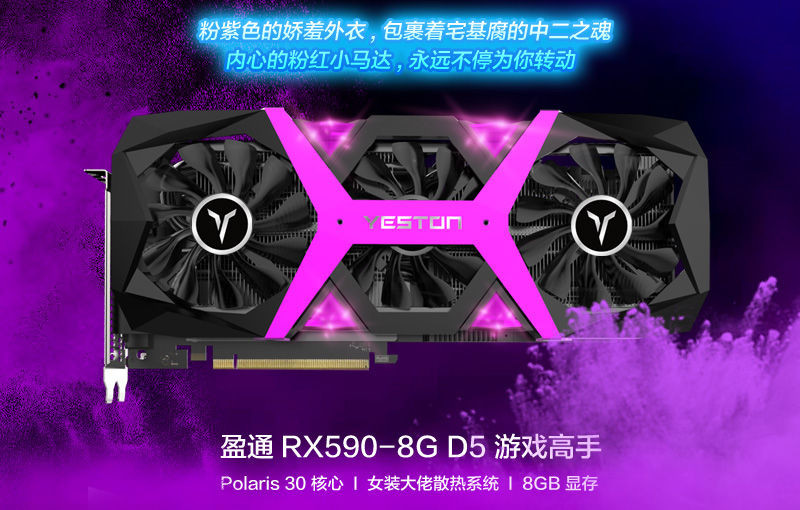
YESTON may not be one of the most covered AIB partners here on TechPowerUp, even though the company does work with both AMD and NVIDIA. The trouble with their offerings is that they're mostly geared towards the Asian market (and the Chinese one in particular), which means availability on the western world is tricky. However, for anyone that wants their hardware to have a rather unusual color scheme without resorting to RGB shennanigans, YESTON have just announced their RX 590 GAME ACE graphics card with a black and purple color scheme. Of course, that doesn't mean there aren't LEDs in this graphics card - they're around the purple X, and are lighting up the same as the graphics card.
The RX 590 Game Ace from YESTON features a triple-fan, 2.5-slot design in the cooling department, features a backplate (with red AMD accents) for additional sturdiness and heat dissipation, and receives power via an 8+6 pin configuration, which is then handled by a 6+2 phase VRM. Clocks are set at a standard 1545 MHz boost, so no overclocking was done.
QNAP Systems, a leading storage, network and computing solution provider, today announced the 8th Gen Intel Core based TVS-x72XU rackmount NAS series, including 8, 12, 16, and 24-bay models and a 9-bay hybrid storage model that supports four 3.5-inch HDDs and five 2.5-inch SSDs. The entire lineup comes with two 10GbE SFP+ SmartNIC ports, flexibility for PCIe expansion, and HDMI 2.0 (4K@60Hz) output. Paired with QNAP's exclusive software-defined SSD extra over-provisioning and comprehensive virtualization, the TVS-x72XU series fulfills requirements for high-speed storage, collaboration, backup, disaster recovery, and iSCSI applications above and beyond basic everyday business needs.
Seasonic is finally getting around to launch its Prime AirTouch power-supply series sometime mid-January 2019. Just to give you an idea of how far along this product has been delayed, Seasonic developed it way back in 2016, and first exhibited it in CES 2017. The series will debut with an 850W model (SSR-850GD-AT), priced at $160. This SKU has already been showing up on American retailers such as Newegg and Amazon since late-October, but has been out of stock. A variation of the Prime Gold series, the AirTouch offers a small degree of fan-control to users. Its 135 mm fluid-dynamic bearing fan comes with five fan-curves, which you can select from by pushing a round button near the AC receptacle.
The fan-control button is embedded with an RGB LED that indicates the active curve. The first curve, called "Silent" (white), kills the fan when the load is below 40%, runs the fan whisper-quiet between 40-80% load, and spools up above 80%. The second curve, called "Low" (blue), runs the fan whisper-quiet up to 60% load, and spools it up from there. The "Medium" (green) curve runs the fan at moderate speeds and caps its speed to 65% beyond 80% load. The "High" (amber) curve maintains moderate speeds up to 80% load, beyond which the maximum fan-speed is capped at 80%. The "Turbo" (red) mode ignores all parameters and simply runs the fan at 100% speed. Seasonic is backing this PSU with its legendary 12-year warranty.
We bring you the world's first GeForce GTX 1060 GDDR5X review. NVIDIA has recently released a new GTX 1060 variant that uses faster GDDR5X chips instead of GDDR5. While out of the box speeds are identical, we found it to house the potential for a massive 44% memory overclock, which lifts the card to new performance levels.
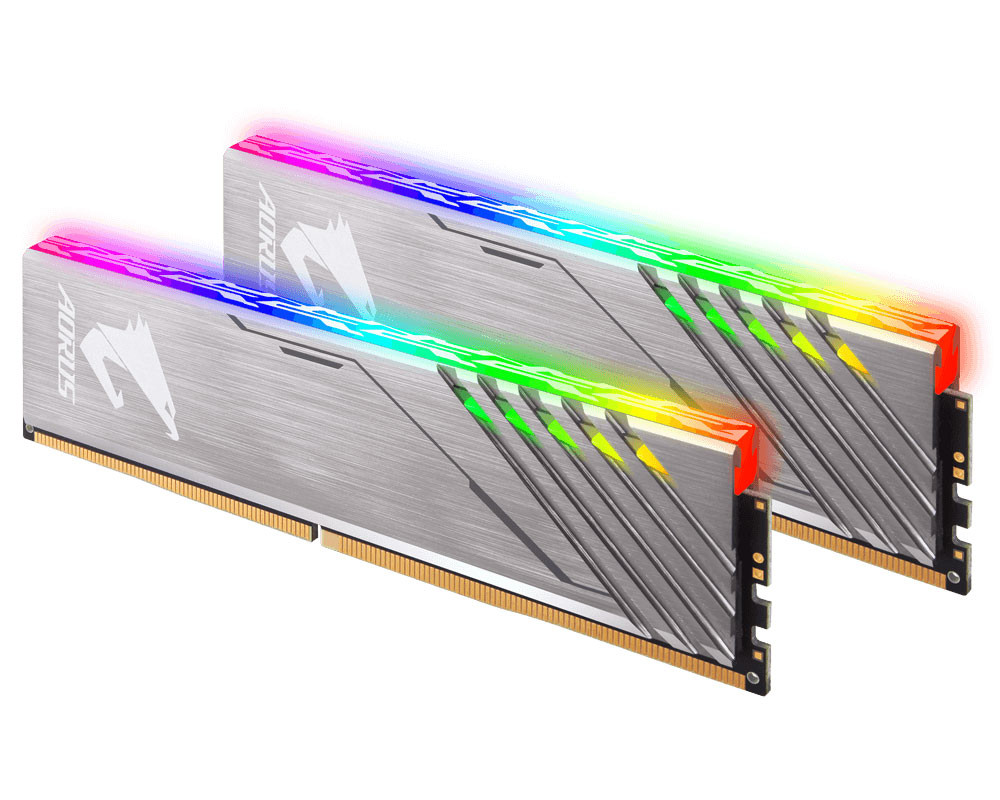
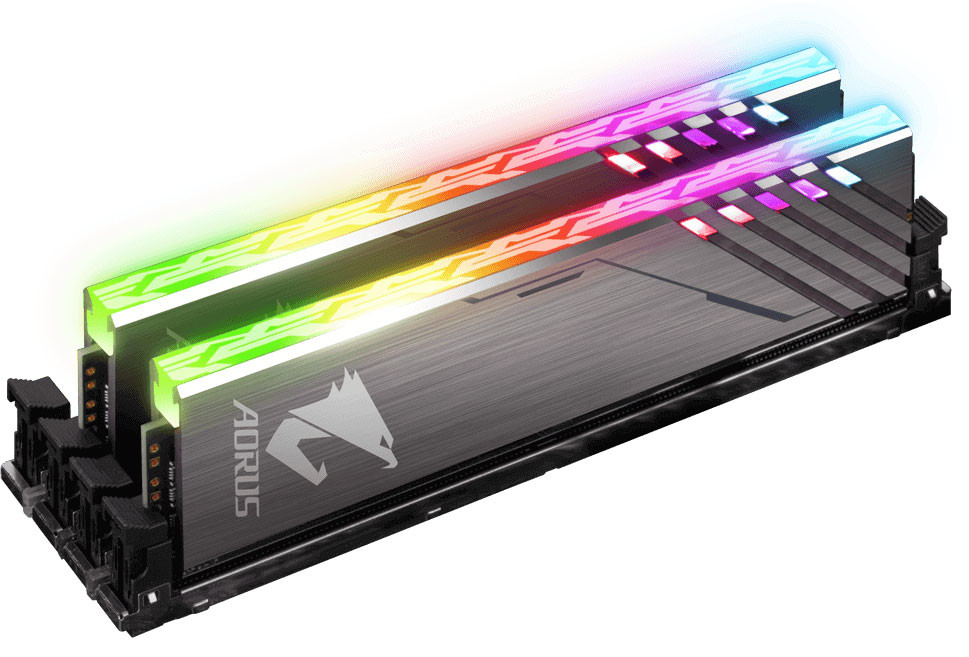
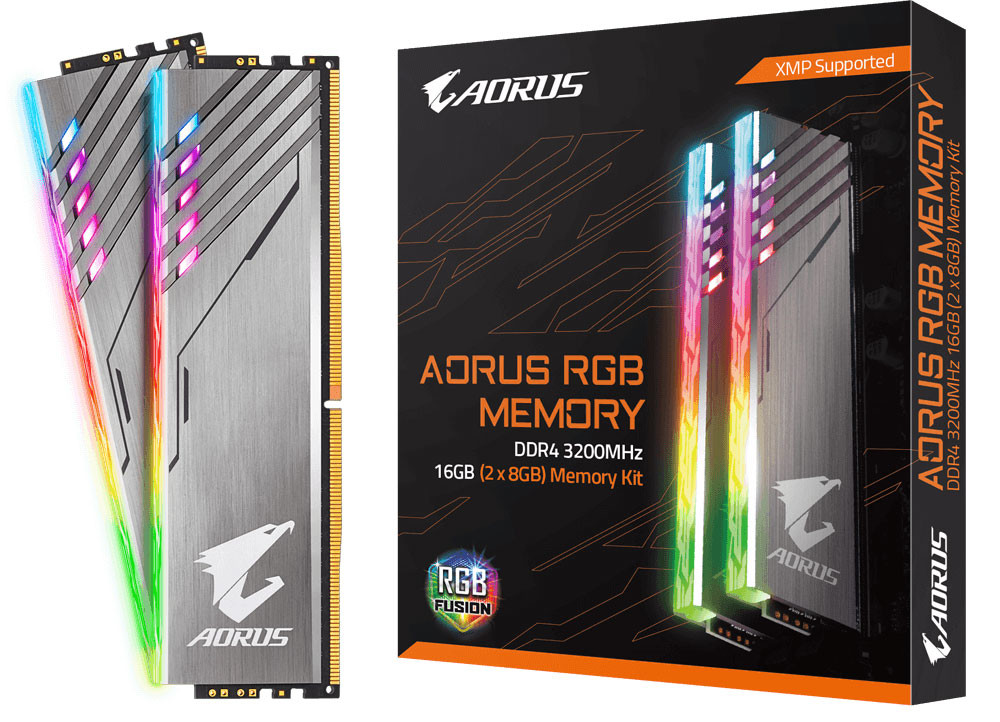
When GIGABYTE originally launched the Aorus RGB Memory DDR4-3200 16GB dual-channel memory kit, it included a pair of dummy modules that resemble the real thing, and let you fill up the blank memory slots of your motherboard. Dummy modules add to the cost, and some users simply don't prefer them, and so the company introduced a new kit bearing the SKU "GP-AR32C16S8K2HU416R," which lacks these dummies.
You get two 8 GB memory modules making up the 16 GB dual-channel kit, each with a chunky 2 mm-thick aluminium heatspreader capped by an acrylic diffuser that puts out light from five addressable RGB LEDs. These modules pack an XMP 2.0 profile that runs them at DDR4-3200 with 16-18-18-38 timings, at 1.35 V. Although the company doesn't specify which brand of DRAM chips it's using, it mentions support for both Intel and AMD platforms.
It seems many companies just never learn, you would think with Bethesda's various controversies surrounding Fallout 76 that they would have taken a step back and reevaluated their position. You would also think that their first decision would not have been to add more horrendously overpriced downloadable content to their Atom shop. However, instead of making an educated decision Bethesda continues to march straight for the cliff like a group of lemmings.
What did they do this time you ask? Well, they decided to offer more absurdly priced bits of cosmetic gear. First up was their Holiday Emote bundle for 1200 Atoms which is 50% off the regular 2400 Atoms. Next is the Mr. and Mrs. Claus outfits listed for 2000 Atoms, down from 3000. Finally theres the Red Rocket Mega Sign for 1400 Atoms. All told buying those three featured items from the Atom Shop would run you about 4600 Atoms or $40 which is coincidently the highest price the game sells for currently. It would appear Bethesda really wants to earn back their development costs on this one.
The launch of the new Epic Games store for the PC has created many an aftershock in the gaming industry, including Steam updating their revenue share model, but the games press and media alike were quick to discuss implications more so for the equally new Discord store that understandably is more in line as far as breaking into the market goes, and impact from competition accordingly. In a series of moves that no doubt pleases game developers and publishers alike, Discord announced that they are going to offer a 90/10 revenue distribution with 90% in favor of developers- an increase over the industry leading "up to 88%" from Epic Games until then.
There is a small catch in that Discord is allowing developers to self-publish the games if they so desire, which in turn is how they will get that 90% revenue share, so it remains to be seen how user friendly that process is. Discord in their blog post made a big point about how it does not cost 30% to distribute games in 2018, a move that will no doubt be examined throughout not only the gaming industry but every single online app distribution platform where a 70/30 split is the current industry standard. As long as this move enables the store to break even and churn out a profit, we would like to see more of this happening to where game developers get more money and do not feel compelled to work ridiculously long hours.
To appease the cautious PC audience thus far, Epic Games has decided to begin with some free games for account holders. As of the time of this post, the excellent aquatic survival game Subnautica is up for grabs. The game was somewhat of a sleeper hit this year, and well worth the free price of admission for anyone interested. The game is available through December 27, after which Epic Games will offer Super Meat Boy for free the following two weeks.
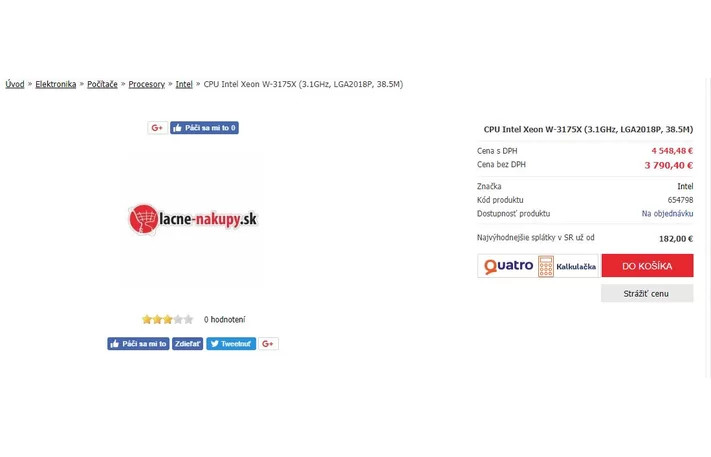
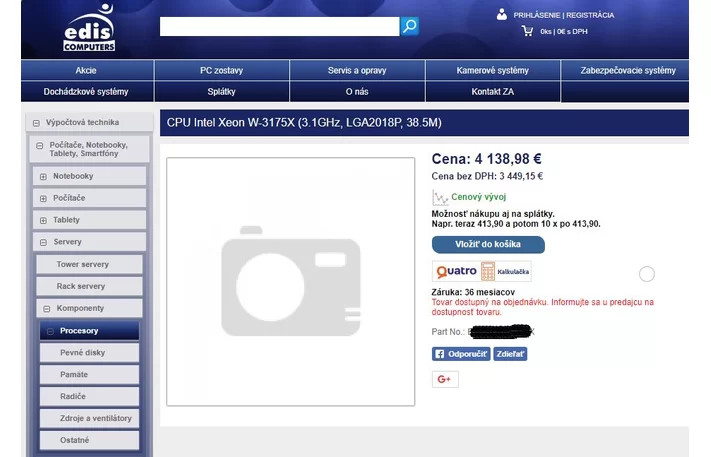
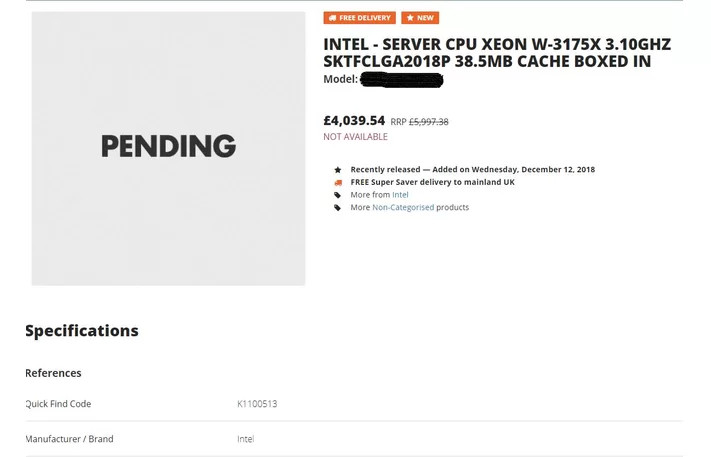
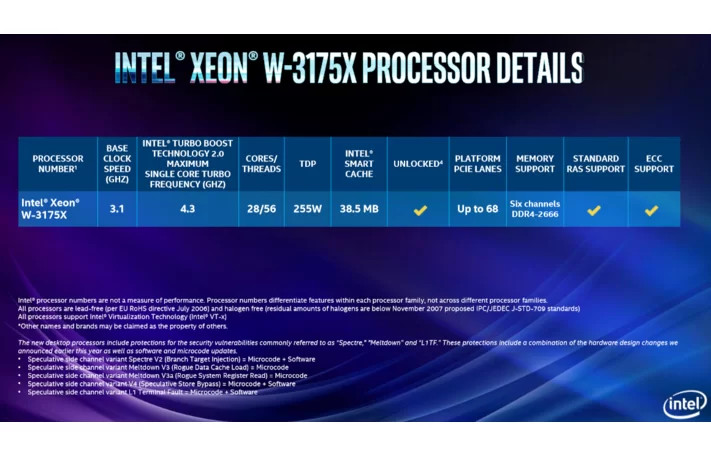
So... Do you want Intel's own HCC CPU in an overclocker-friendly package? But you want in a Xeon branding and envelope, surely, because that's the only place where you can get one of these right now. Well, Intel has you covered - for $4000. Retailers in Europe, hunted by Tom's Hardware, have begun to take stock of these CPUs, and in doing so, current pricing overs around that magic $4,000 mark - at the least. Prices still haven't stabilized due to the low number of outlets offering the CPU right now, and it's likely that when it does, it will stabilize to this lowest common denominator.
The Xeon W-3175X is built on Intel's 14 nm ++ manufacturing lines, features 28 physical cores with HyperThreading, features base/boost clocks of 3.1 / 4.3 GHz respectively, support hexa-channel DDR4 memory, and offers 44 PCIe lanes. It also has a 255 W TDP. Compare these specs to AMD's Threadripper 2990WX with its 32 physical, 64 logical cores, quad-channel DDR4 support, 64 PCIe lanes, 250 W TDP (non-comparable) and $1,799 (very comparable) pricing... Well. Add in the platform cost for one of these Intel babies, with a 3,647-pin LGA3647 motherboard (some feature the most ridiculous power delivery systems you could ever think of, btw, at 32 phases).. with the requirement for 4x eight-pin EPS power connectors and 2x 24-pin connectors. Have fun.
We covered Project Stream in a more detailed news post recently, so this is a short update. The test period is active as of the time of testing, and will remain so through January 15, 2019. Selected entrants now get a bonus incentive of retaining a copy of Assassin's Creed Odyssey, with all progress from the test retained, even after the stream test is done. Indeed, users (who are limited to the USA as of the test period) with a minimum of an hour of game play will see the game added to their Uplay account on file and this should prompt more of the testers (which you can still apply to be, from everything we have seen) to try out Google's take on game streaming over the internet. Yours truly happens to be one who applied, was selected, and played all of five minutes thus far, but be on the lookout for another post early next year with impressions galore on how it goes.
Crossplay has become an interesting point of contention for the industry, with some very popular games and companies advocating for a unified, non-fractured player audience enjoying their games across different media consumption screens, and even gaming platforms. Microsoft has been pushing this kind of capability for some time now, launching their Xbox Play Anywhere initiative which aims to bring PC, Xbox (or both) gamers to parity - acquiring a game on one platform equals having it on both, with all game data being synced.
A new update in the Steam beta update code explicitly refers to Xbox, with an "Xbox_pairwise_id" being present, which could point towards exploration of a future feature. Microsoft adding keyboard and mouse support to their Xbox consoles, news of a new streaming-based console for Microsoft's xCloud efforts, and Steam already offering controller support are some of the little details that could make this a winning bet for both companies.
JEDEC Solid State Technology Association, the global leader in the development of standards for the microelectronics industry, today announced the publication of an update to JESD235 High Bandwidth Memory (HBM) DRAM standard. HBM DRAM is used in Graphics, High Performance Computing, Server, Networking and Client applications where peak bandwidth, bandwidth per watt, and capacity per area are valued metrics to a solution's success in the market. The standard was developed and updated with support from leading GPU and CPU developers to extend the system bandwidth growth curve beyond levels supported by traditional discrete packaged memory. JESD235B is available for download from the JEDEC website.
JEDEC standard JESD235B for HBM leverages Wide I/O and TSV technologies to support densities up to 24 GB per device at speeds up to 307 GB/s. This bandwidth is delivered across a 1024-bit wide device interface that is divided into 8 independent channels on each DRAM stack. The standard can support 2-high, 4-high, 8-high, and 12-high TSV stacks of DRAM at full bandwidth to allow systems flexibility on capacity requirements from 1 GB - 24 GB per stack.
NVIDIA could launch its "RTX for the masses" SKU, the GeForce RTX 2060, sometime mid-January, according to Andreas Schilling. It is also confirmed that the RTX 2060 will feature 6 GB of GDDR6 memory. Schilling confirmed no other specifications of the GPU, but posted official branding for the RTX 2060 SKU. Earlier leaks pin the RTX 2060 as being carved out from the 12 nm "TU106" silicon, with 1,920 CUDA cores, 120 TMUs, 48 ROPs, and a 192-bit wide GDDR6 memory interface, which at 14 Gbps produces a memory bandwidth of 336 GB/s. NVIDIA could target the crowd that wants DXR-enabled gaming at 1080p thru 1440p resolutions.
Samsung Electronics today announced the new Notebook 9 Pen, a premium 2-in-1 PC with a built-in S Pen that allows users to reach their true creative potential. With its combined style, power, and portability, Notebook 9 Pen is perfect for users who want a device that adapts to the way they work, and need the flexibility to get more high quality work done.
"Choice and creativity go hand in hand, and those who create deserve the flexibility to work the way they want, wherever inspiration strikes," said YoungGyoo Choi, Senior Vice President and Head of the PC Business Team, Mobile Communications Business at Samsung Electronics. "With improved design and performance, along with our Notebook's most advanced S Pen yet, the new Notebook 9 Pen is perfect for contemporary professionals who put especially high demands on their technology."
A job listing posted by Microsoft is being hailed as sign of subscription-based times to come to the company's Office 365 and Windows products. Honestly, I believe this to be a matter of time - Subscription services have been increasing at an alarming rate, Microsoft has already tasted the advantages of such a model on their bottom line with their Xbox Live and Games Pass systems, and of course, there're always the ever-giant Spotifys and Netflixes of this world.
Windows and Office as a service is nothing out of the ordinary, really. The job listing for a "Product Manager, M365 Consumer Subscription - Modern Life & Devices (MLD)", which has a job description along the lines of "market a great new Microsoft 365 Consumer Subscription" doesn't come as a surprise. Going from this Office 365 consumer subscription to a Windows one is a bit of a stretch on the basis of the job posting alone, but it is in the foreseeable future for Microsoft's strategy to safeguard Windows and its updates behind a monthly payment, ensuring that one-off purchases are no longer a thing - and guaranteeing a predictable revenue stream.
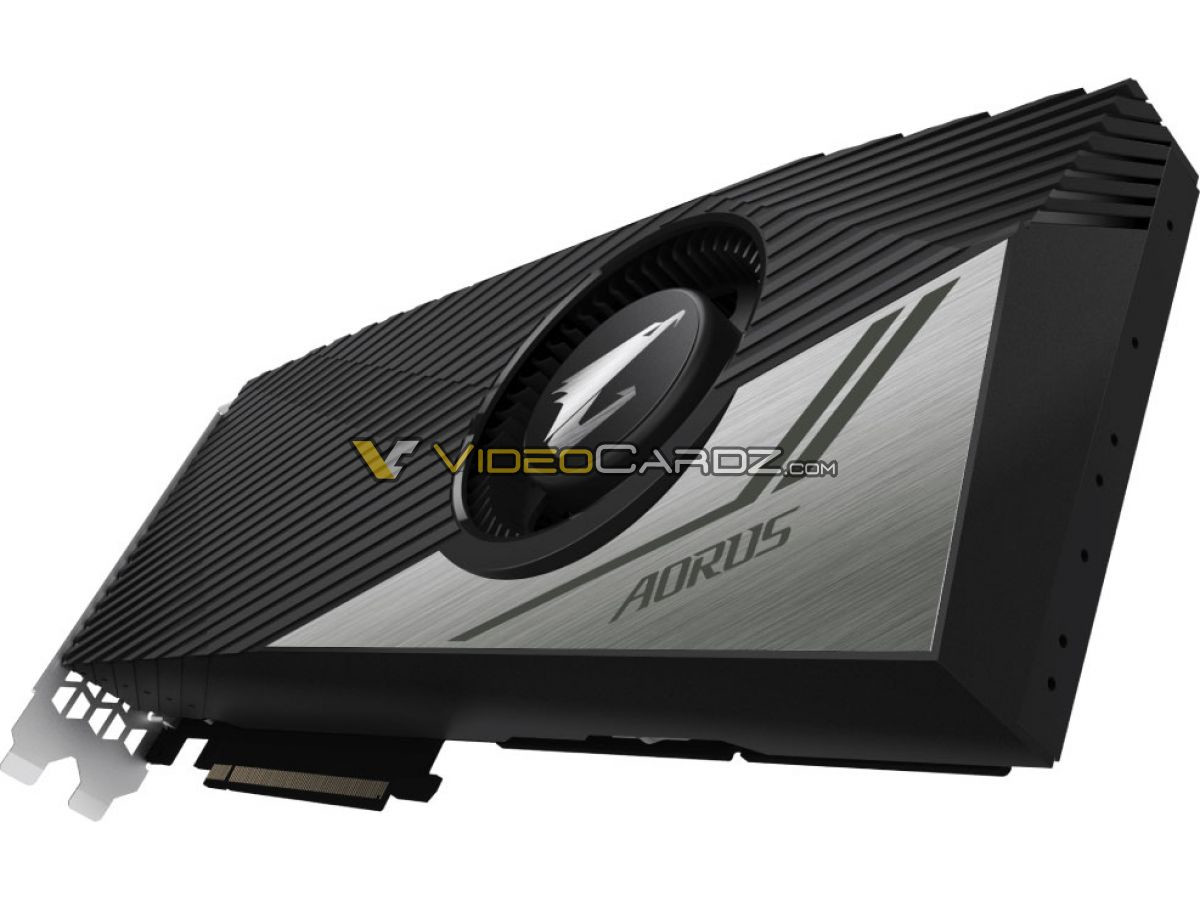
After some leaks indicated that GIGABYTE was preparing a blower-style RTX 2080 Ti, the company has now officially unveiled it. The GIGABYTE AORUS Turbo RTX 2080 Ti feature a blower-style cooler with vapor-chamber, direct-touch technology trying to keep that monstrous, 754 mm² TU102 chip cool and quiet. Luckily, the chip is relatively power efficient, so the acoustic and thermal performance should be sufficient.
The GIGABYTE AORUS Turbo RTX 2080 Ti features a 1650 MHz core clock, and the other specs line up with what we've become used to with RTX 2080 Ti graphics cards (11 GB of GDDR6 memory at 14000 MHz). There's the typical 3x DisplayPort, 1x HDMI, and 1x USB Type-C for VirtuaLink. Expect this version of the RTX 2080 Ti to be near the bottom rung in terms of pricing, when it's available.
ECS today rolled out the LIVA Z2L, a palm-size compact desktop with something in it for electronics hobbyists - a GPIO header. Driven by Intel Pentium/Celeron "Gemini Lake" SoCs, these desktops measure 132 mm x 118 mm x 56.4 mm (WxDxH), and feature VESA mounts, so you could tuck them away behind your display. The unit is completely fanless, and draws power from an external power adapter. Connectivity includes four USB 3.0 ports, including a type-C, two USB 2.0 ports, D-Sub and HDMI display outputs, gigabit Ethernet, and 802.11ac WLAN. Under the hood, the "Gemini Lake" SoC is wired to 4 GB of LPDDR4 memory over two SODIMM slots (single channel), and storage is care of a 64 GB eMMC device that can juggle hot data from a 2.5-inch HDD. The company didn't reveal pricing.
SilentiumPC today rolled out the Gladius GD8 TG ARGB Pure Black case. This ATX mid-tower is characterized by an asymmetric band that runs from the center of the front, through the top, with its gaps with the rest of the panels being embellished with RGB LED diffusers. The left side panel features a clear tempered glass panel. While the RGB LED units are addressable, meaning you can control them via your motherboard's RGB software, SilentiumPC also included an RGB controller module wired to a button on the front-panel, which cycles through 50 lighting presets.
Inside, the Gladius GD8 features a conventional layout, with horizontal partitions. The motherboard tray serves up room for graphics cards up to 37 cm in length, and CPU coolers up to 17.8 cm in height, and the bottom compartment can hold PSUs up to 21 cm in length. Storage features include two 3.5-inch trays that can each hold 2.5-inch drives, and two additional 2.5-inch mounts. SilentiumPC is including three Sigma Pro 120 fans with the case, two fitted as front intakes, and a rear exhaust. There are two 120 mm front intakes, two 120 mm top exhausts, and a 120 mm rear exhaust. Measuring 219 mm x 455 mm x 496 mm (WxDxH), the case dry-weighs around 7 kg. The company didn't reveal pricing.
During the next year and a half, the Finnish IT Center for Science (CSC) will be purchasing a new supercomputer in two phases. The first phase consists of Atos' air-cooled BullSequana X400 cluster which makes use of Intel's Cascade Lake Xeon processors along with Mellanox HDR InfiniBand for a theoretical performance of 2 petaflops. Meanwhile, system memory per node will range from 96 GB up to 1.5 TB with the entire system receiving a 4.9 PB Lustre parallel file system as well from DDN. Furthermore, a separate partition of phase one will be used for AI research and will feature 320 NVIDIA V100 NVLinked GPUs configured in 4-GPU nodes. It is expected that peak performance will reach 2.5 petaflops. Phase one will be brought online at some point in the summer of 2019.
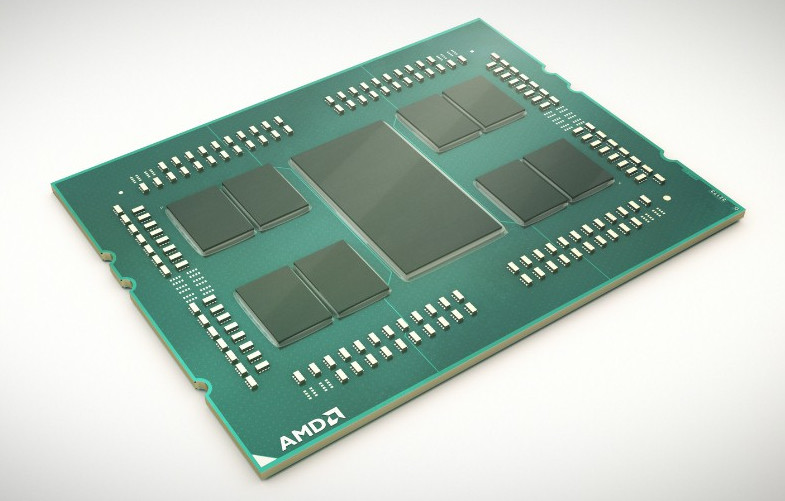
Where things get interesting is in phase two, which is set for completion during the spring of 2020. Atos' will be building CSC a liquid-cooled HDR-connected BullSequana XH2000 supercomputer that will be configured with 200,000 AMD EPYC "Rome" CPU cores which for the mathematicians out there works out to 3,125 64 core AMD EPYC processors. Of course, all that x86 muscle will require a great deal of system memory, as such, each node will be equipped with 256 GB for good measure. Storage will consist of an 8 PB Lustre parallel file system that is to be provided by DDN. Overall phase two will increase computing capacity by 6.4 petaflops (peak). With deals like this already being signed it would appear AMD's next-generation EPYC processors are shaping up nicely considering Intel had this market cornered for nearly a decade.
AMD's Radeon Technology Group (RTG) continues to be in a state of flux, with another executive leaving the company. This time, RTG General Manager and Senior Vice President, Mike Rayfield (pictured on the left below) will be resigning by year's end, marking the second time in a calendar year the group has been devoid of a formal leader. Rayfield previously worked for NVIDIA as the General Manager of their Tegra business unit, and was Vice President and General Manager of Micron's mobile storage business unit prior to that. Having served in all these roles for quite some time, it is somewhat of a surprise to see him leaving AMD so quickly, having only just joined the company back in February 2018. With that said, AMD has said the reason for this departure is so that he can "spend more time with his family and pursue his personal passions".
David Wang (picture on the right below), the current Senior Vice President of Engineering at RTG, will be his interim successor. He already has a storied history at AMD, having worked on ATI/AMD graphics cards as a GPU engineer from the R300 to GCN 1.0 in a time period ranging from the years 2000 to 2012. Under AMD's dual leadership model which was implemented after Raja Koduri's resignation, both Wang and Rayfield have worked together leading the RTG group. Thanks to this, the transition of duties should be relatively smooth even though Wang's role is only temporary, and it will be interesting to see whom AMD picks as Rayfield's long-term successor.
The stock markets are the financial equivalent of a fickle mistress. Just ask NVIDIA. The company has, in recent months, introduced their Turing architecture and derived products - a move NVIDIA deemed such a significant leap over its previous generations that it prompted a change from the GTX of old to a new RTX moniker. The company's latest financial results also reported a 21% increase in revenue YoY, and a 2% increase relative to the last quarter. Despite this and increased cash dividends being delivered to the hands of investors, festive must not be NVIDIA's mind right now.
AMD is putting final touches on its Ryzen 3000U series APUs for ultra-portable notebooks and 2-in-1 devices. Thai PC enthusiast Tum Apisak shared links to Geekbench scores of at least three SKUs, the Ryzen 3 3200U, the Ryzen 3300U, and the Ryzen 5 3500U. The Ryzen 3 3200U combines a 2-core/4-thread CPU component, while the Ryzen 3 3300U packs a 4-core/4-thread CPU, and the Ryzen 5 3500U a better equipped 4-core/8-thread CPU. While the 3200U's CPU is clocked high at 2.60 GHz, the 3300U and 3500U are both clocked at 2.10 GHz. The iGPU specs are still under the wraps as Geekbench only tested the single- and multi-threaded CPU performance. The 3200U scores 3428 points single-threaded owing to its higher nominal clocks, and around 6500 points multi-threaded. The 3300U scores 9686 points in multi-threaded owing to its additional cores (sans SMT). The 3500U increases the multi-threaded score to over 11280 points multi-threaded, on account of being quad-core with SMT.
There's no clarity on the underlying micro-architecture. While the source mentions the codename of these chips as Picasso, the silicon still appears to be 14 nm "Raven Ridge." Over generation, AMD only appears to have pushed its current parts lower down the product stack. For example, the Ryzen 3 3300U appears to share the same CPU configuration (albeit with 5% higher clock-speeds) as the Ryzen 5 2500U from the current-generation. The Ryzen 5 3500U, on the other hand, appears to have essentially the same (again, marginally speed-bumped) CPU as the Ryzen 7 2700U. HP is ready with notebook and 2-in-1 products based on all three chips, although they're unlikely to launch before year-end. Perhaps CES could be a nice launchpad.
(Update 1: It seems that Logitech has launched an updated version of their Options software with a fix for the vulnerabiity - but this only happened after the vulnerabiiity became public. You can go on over Logitech's own webpage to download the updated version, which includes the fix in its changelogs, from here. Safe browsing.)
Adding to the critical vulnerability galore that's been coming out of Google's Project Zero, a researcher has demonstrated how an inherent bug in the "Logitech Options" software renders users vulnerable when visiting web pages. Tavis Ormandy, with Google Project Zero, found that Logitech Options opens a local Websocket port that doesn't require authentication for external commands. Attackers could exploit this issue by sending simulated keystrokes from any website - and thus execute pretty much anything on affected systems.
Another month, another free game from Humble Bundle, the company that shows that Christmas is whenever one feels like it. This month's free game is one of those that will put the hurt on your feet should you step on it... LEGO: The Hobbit will be free of charge for users that redeem it from Humble Bundle's page.
This promotion is available from Thursday, December 13 at 10 a.m. Pacific time to Saturday, December 15 at 10 a.m. Pacific time. Don't leave Gandalf waiting, now.
Silicon Power today announced that they're entering the gaming market with a special set of DDR4 memory modules that cater to everything enthusiasts want. This strategy will go on well into 2019 with a smattering of products across SP's line of products, while allowing the company to enter new markets where they previously didn't compete.
The first step on this road is the announcement and release of the new XPOWER Turbine DDR4 kit with RGB lighting (supporting ASUS Aura Sync, GIGABYTE RGB Fusion, MSI Mystic Light Sync, and ASROCK-Polychrome Sync), maxing out at speeds of 4133 MHz with 1.4 V. Backed by a lifetime warranty and with all modules being 100% tested, according to the company.
ASUS Republic of Gamers (ROG) today announced the ROG Strix GeForce RTX 2080 Ti OC Call of Duty : Black Ops 4 Edition graphics card, an exclusive limited-edition version that's restricted to a production run of just 500 units and available only in selected territories. Decorated with the Call of Duty: Black Ops 4 Edition insignia, the card pairs the NVIDIA A-list GPU with gargantuan power delivery and cooling, and boasts out-of-the-box Boost clocks up to 1665 MHz to ensure performance stays silky smooth during frantic action.
ROG Strix GeForce RTX 2080 Ti OC Call of Duty : Black Ops 4 Edition keeps Turing cool by adopting a 2.7-slot design and devoting most of that real estate to a large heatsink that has 20% more surface area than previous-generation cards. The massive fin assembly allows completely passive operation during light gaming, and when active cooling is needed, it's provided by three IP5X-certified Axial-Tech fans developed specifically for the task. Featuring a smaller hub and longer blades surrounded by a barrier ring to increase structural integrity and static pressure, the new fans shift more air and generate less noise.
Square Enix has added DLSS support to Final Fantasy XV. We take a closer look at NVIDIA's new machine-learning-powered image enhancement technique and provide comparison pictures for you to check out yourself.
Book of Demons is a delightful little papercraft dungeon crawler by developers Thing Trunk. It has plenty of full fat features in typical diabolical dungeon crawler style, but uses cards as items and skills, which are used in live instead of turn-based combat. It's also everything I hoped and dreamed for in such a format.
3DFX is a well-known name for most in our community, I'd wager (I don't have the data to back me up on that, but bare with me). The company is one of the highest-profile defunct companies that vied for a place in the desktop, high-performance GPU space back in the day, and brought its guns bearing on NVIDIA and then ATI. The Rampage was the last GPU ever developed by the company, and looked to compete with NVIDIA's GeForce3. That never saw the light of day, though, with the company shutting its doors before development became viable for market release.
DSOGaming has some images of some of the Rampage GPUs that survived 3DFX's closure, though, and the graphics card is shown running Max Payne, Unreal Tournament & 3DMark 2001. For those of you that ever had a 3DFX graphics card, these should bring you right down memory lane. Enjoy.
4A Games has announced that they're happy with the development on Metro: Exodus as it stands today, and have announced that the game has gone gold (meaning, that it is in a state where it can be produced en-masse and shipped to the achingly awaiting public). Metro: Exodus, the third game accompanying Artyom's struggle to survive in post-apocalyptic Russia, is the first game from the developer to feature an open-world design, and confidence should be going through the roof as it relates to this particular title's quality.
The game has a launch date for February 15th, and will be featuring support for NVIDIA's RTX technology (expectedly, upon launch day). We'll be here to see how that works out in this particular title, of course. In the meantime, 4A Games and publisher Deep Silver have released the full title sequence for the game, which should whet your appetites for the survival game that's coming soon.
GOG, the sales arm of CD Projekt RED, have just announced a winter sale for the gems on their store. And the best way to start a game sale is by offering a game, as GOG has gotten us used to (other game stores, look here), with GOG offering a copy of Full Throttle Remastered for free in the first 48H of the sale (until December 15, 2:00 PM UTC).
The sale has some 1900+ offerings on the digital table for gamers everywhere that like to ask for their games without any kind of DRM and with extra goodies, and daily flash sales will be occurring, with never-before-seen prices for some titles being available for a period of 24H only. If you were looking at CD Projekt RED's own Thronebreaker: The Witcher Tales, for example, you can snag it for 20% off already. Cuphead sees the same discount percentage, while Divinity II: Original Sin Definitive Edition is available at 35% off. So go on, in you go to that particular GOG candyland.
Remember the lawsuit ZeniMax threw Oculus' way? Well, that seems to be settled now, after a back and forward that always saw Oculus (even after the Facebook acquisition) having to pay damages to ZeniMax - at first, $500 million, which was then reduced to $250 million.
Now, the litigation seems to have come to an end, as CNBC reports that ZeniMax's CEO has acknowledged that a settlement was reached. The terms of the settlement were undisclosed (and so was the sum that Facebook definitely had to pay ZeniMax), but CNBC got a statement from the ZeniMax CEO Robert Altman that read: "We are pleased that a settlement has been reached and are fully satisfied by the outcome. While we dislike litigation, we will always vigorously defend against any infringement or misappropriation of our intellectual property by third parties." While ZeniMax says they are fully satisfied with the outcome, it's certainly a far cry from the original up to $4 billion and Oculus sales being blocked that the company was after in the initial terms of the lawsuit.
AMD today released their yearly driver update called Radeon Software Adrenalin 2019 Edition v18.2.2. For the past three years, the company has been releasing year-end feature-packed updates to Radeon Software. The 2017 version saw the introduction of Radeon Software "Adrenalin", before which we had Crimson/ReLive and Omega. The company also sped up its driver release cycle to match AAA game releases, and over the years, increased its reliability score and customer satisfaction. With Radeon Software Adrenalin, AMD is targeting three key consumer segments: Gamers, Enthusiasts, and Creators.
Sharkoon Technologies is an international supplier of PC components and peripherals which boasts performance at a reasonable price. Sharkoon now introduces the successor to its popular gaming mouse, the Drakonia. The new Drakonia II is again presented with a distinctive dragon-scale design and pleasant ergonomic form. The mouse also features a high performance optical sensor from PixArt as well as numerous programmable buttons.
The successful XPC cubes model series gets a boost: With the new SH310R4, the 8th and 9th generation of the Intel Core processors is now also available in Shuttle's entry-level range making it a good-value, but yet powerful model based on "Coffee Lake".
Based on the Intel chipset H310, the XPC cube Barebone SH310R4 supports the latest Intel Core processors of the "Coffee Lake" series with socket LGA1151v2 and up to 95 Watt TDP. Therefore, even the particularly fast ones such as the i9-9900K with up to 8 cores and 16 threads can be used. Two slots on the mainboard allow a total of 32 GB of DDR4 memory to be installed.
ADATA Technology, a leading manufacturer of high-performance DRAM modules, NAND Flash products, and mobile accessories today announces two new gaming products, the XPG GAMMIX S11 Pro PCIe Gen3 x4 M.2 2280 SSD and SX6000 Lite PCIe Gen3 x4 M.2 2280 SSD, continuing its commitment towards offering hardware that help people achieve extreme gaming experiences.
The ASUS GeForce RTX 2070 STRIX OC is a custom-design variant using a large triple-slot cooler that delivers excellent temperatures or very low noise levels because of the inclusion of a dual-BIOS feature, which offers a "quiet" mode. ASUS has also upgraded the power delivery capability of their card to 8-phase with 6+8-pin power input.
In a move that made us go "WTF" internally, Razer has decided to test their fanbase's loyalty more so than ever before. Today, the company introduced Razer Softminer, a mining software program that is intended to be installed on computers and run to mine cryptocurrency. But instead of the users getting whatever new cryptocurrency is in fashion, Razer instead wants to retain all mined crypto and in turn "award" users with the so-called Razer Silver- loyalty reward credits, in their own words. The miner appears to be running off a version of the Gamma desktop application, as per speculation from TweakTown.
Razer Softminer utilizes heavy GPU performance loads, and there is no mention as to what the actual mining is for. It is clear, however, that the users are not mining Razer Silver (which Razer is quick to admit is not cryptocurrency) and these loyalty credits are handed out in an equivalent manner based on the mining power of the system. In their estimate, a sytem with at least a NVIDIA GTX 1050 or AMD RX 460 running the mining program for a whole day will net ~500 Razer Silver, and these can be used to "redeem Razer peripherals, digital rewards such as games, vouchers and more" from a dedicated rewards page.
NieR:Automata on the PC platform is a love-hate affair, the former due to excellent gameplay and replayability via multiple "routes" and the latter no thanks to the game in need of performance enhancements and bug fixes that were promised nearly two years ago but yet to come to fruition. Overall, the game holds an overwhelmingly positive review feedback on Steam, and won many game awards from various video game publications last year. For those who were hoping, or just waiting, for a complete GOTY edition to come out, perhaps this news is for you.
Today, Square Enix officially announced the NieR:Automata Game of the YoRHa Edition that includes the full base game as well as the 3C3C1D119440927 Expansion DLC, four pod designs (Grimoire Weiss pod, Retro Grey pod skin, Retro Red pod skin, Cardboard pod skin), the Machine Mask accessory and two digital wallpapers. This releases February 26, 2019 for $39.99 for PC and the PS4, with the XBOX One having received a "Become As Gods" earlier this year that had brought with it performance improvements. It remains to be seen if the new edition gets a similar patch, which interested users must keep track of before committing to a purchase as many players today have had to resort to a third-party patch to get things smoothly running.
Intel today introduced the B365 Express desktop motherboard chipset as an in-between to its B360 Express and H370 Express chipsets. This model is part of Intel's optical enlargement of its motherboard chipsets to the 22 nm HKMG+ silicon fabrication node, to free up 14 nm++ for processors. Despite this, the TDP of the chipset remains unchanged at 6 Watts. The B365 has a couple of feature additions and subtractions over B360. To begin with it has a wider PCI-Express downstream root-complex, with 20 gen 3.0 lanes, on par with H370 Express. The B360, if you'll recall, only has 12 downstream PCIe lanes. This means B365 motherboards will have additional M.2 and U.2 connectivity.
According to the ARK specifications page for the B365 Express, this chip completely lacks integrated 10 Gbps USB 3.1 gen 2 connectivity. Perhaps the expanded downstream PCIe is really meant for motherboard vendors to use third-party USB 3.1 gen 2 controller chips. You still get eight 5 Gbps USB 3.0 ports (notice we didn't say USB 3.1 gen 1, because don't expect fast-charging features). The chipset also loses the latest generation Wireless AC integrated MAC. All of these point to the possibility of the B365 Express being a re-branded Z170 with locked CPU overclocking. Adding credence to this theory is the fact that while the B360 uses ME version 12, the B365 uses the older ME version 11. Much like the H310C, the B365 could include platform support for Windows 7.
1MORE, whose products have been featured on TechPowerUp multiple times before, today added to their portfolio of audio peripherals with what they call their first truly wireless headphones. This is not necessarily their first wireless headphones, or even their first wireless in-ear headphones, but 1MORE's usage of the phrase here refers to these having no wires connecting both pieces of the headphones either- as opposed to the necklace style wireless headphones they had before.
Called simply the Stylish True Wireless In-Ear Headphones, which no doubt will make it harder to look them up in the long run, these new headphones come in black or gold color offerings and resemble many of the newer Bluetooth earphones in design. However, 1MORE says that they have used the uncommon non-conductive vacuum metallization (NVCM) process to get the final color and finish on these, as opposed to the more popular physical vapor deposition or even electroplating of metal surfaces. They claim is "an eco-friendly vacuum plated coating process that provides both a sleek metallic finish and stable signal transmission".
We took a detailed look at the EK-Velocity CPU waterblock recently, which was released in over 14 different combinations of top material (acetal, acrylic, nickel-plated brass), base plate (copper, nickel-plated copper), and even specific RGB and non-RGB versions. Part of their new "Quantum" design philosophy, today saw the addition of more versions to choose from. In particular, for those who felt having 24 RGB LEDs displaying the same color was not enough, EKWB has introduced two (each for Intel and AMD sockets) digital addressable RGB LED versions to allow for every single LED to shine a different hue.
As with the other RGB versions, these are compatible with ASUS Aura, MSI Mystic Light, Gigabyte/AORUS RGB Fusion, ASRock Polychrome Sync and other digital RGB controllers, thus allowing for a cohesive lighting ecosystem in your PC build. Everything else is similar, including the new cooling engine that offers lower restriction to coolant flow while not necessarily improving on thermal performance relative to the older EK-Supremacy EVO. The EK-Velocity D-RGB CPU block comes in a nickel/plexi or nickel/acetal version for Intel and AMD sockets and are priced at 99.90€ and 99.90€ respectively (inc. VAT in EU).
Be quiet!, the market leader in PC power supplies in Germany for twelve consecutive years, introduces its new mainstream power supply series, Pure Power 11, to the US market. The series consists of three models with fixed cables ranging from 500 to 700 watts and three models with modular cables also ranging from 500 to 700 watts. Previously, Pure Power 10 introduced DC-to-DC transformation to be quiet!'s best selling power supply series, improving crossload performance and voltage regulation on its minor rails. Pure Power 11 expands on this proven technology by upgrading both passive and active components, enabling higher efficiency of up to 92% with 80 PLUS Gold certification, and leading to less heat generation and quieter operation. Manufacturer warranty has also been increased from three to five years.
Intel at its architecture day revealed one of the more exquisite in-house designs for the company in recent years: a hybrid x86 chip that seems to imbibe from ARM's own big.Little design mantra. The new Hybrid x86 CPU that was announced takes this design choice in pairing a single, high-performance Sunny Cove core with four smaller Atom cores. This chip is built using Intel's Foveros manufacturing technology, which means a 22FFL IO chip serves as an active interposer, connected via TSVs to a 10nm die that contains both types of cores. The tiny chips measures just 12 x 12 x 1 mm (144 mm²), and looks to reduce footprint even further by including a POP (package on package) memory design.
The new Intel design is aimed at low-power environments, with the chip having been designed to work on a 2 mW standby power ratio, with less than a 7 W of power - for a big.Little five-core design and a 64 EU design with Gen11 graphics core. Intel's Jim Keller said that the company is testing the intricacies and advantages of this design internally, so more products based on this manufacturing and packaging mantra could pop up sometime in the future.
Intel's discrete graphics card for PC enthusiasts is real. Intel won't just address the pro-graphics and accelerated-compute markets, but also consumer graphics, challenging the duopoly of NVIDIA GeForce and AMD Radeon. Scheduled for 2020, the new Intel Xᵉ is a family of discrete GPUs targeting client-segment (consumer graphics) as well as enterprise (pro-graphics and compute).
As for performance, we speculate that the first Xᵉ products could span a vast lineup of ASICs starting single-digit TFLOP/s range for the client-segment GPU, looking purely at a nondescript performance-time graph presented by Intel. This graph depicts performance double linearly over time up to Gen9, and increase to Intel's own state 1 TFLOP/s for the Gen11 iGPU core in 2019 (a full four years following Gen9). There are a spectrum of GPUs going from the entry-level client-segment all the way up to mid-range and enthusiast segment (Intel finally used the E-word).
Intel's upcoming "Ice Lake" die could be the company's biggest processor innovation in a decade, combining new clean-slate design "Sunny Cove" CPU cores, and a new integrated graphics solution based on the company's Gen11 architecture. "Sunny Cove" introduces significant IPC (single-thread performance) gains over "Coffee Lake," introduces new ISA instruction sets, including AVX-512; and a brand new uncore component; while the Gen11 graphics core is Intel's first iGPU to reach the 1 TFLOP/s mark. Intel demonstrated the ultra-low power "Ice Lake-U" SoC platform in its 2018 Architecture Day briefing.
This "Ice Lake-U" chip, with its TDP in the ballpark of 15 W, was shown ripping through 7-zip and "Tekken 7." With 7-zip, Intel was trying to demonstrate vector-AES and SHA-NI improving archive encryption performance by 75 percent over "Skylake." The Gen11 iGPU was shown providing a smoother gameplay than Skylake with Gen9, although the company neither mentioned resolution, nor frame-rates. Anandtech wagers it's above 30 fps.
NVIDIA today released GeForce 417.35 WHQL software. These drivers provide optimization to the latest update of Final Fantasy XV: Windows Edition, which introduces DLSS (deep learning super-sampling), NVIDIA's major image-quality enhancement feature released alongside "Turing." The 417.35 WHQL update also addresses a number of issues. "Rocket League" now no longer sometimes launch with a white screen and crash-to-desktop. The "Manage GPU Utilization" tab in the Workstation settings of NVCPL on machines running TITAN V no longer appears when it shouldn't. The drivers also fix SLI disabling after driver update on TITAN Xp SLI setups. Ansel support for "Battlefield V" is improved. Texture flickering in "Hitman 2: Silent Assassin" has been fixed. The drivers also include an updated GeForce Experience (version 3.16.0.140).
Intel today unveiled its first clean-slate CPU core micro-architecture since "Nehalem," codenamed "Sunny Cove." Over the past decade, the 9-odd generations of Core processors were based on incrementally refined descendants of "Nehalem," running all the way down to "Coffee Lake." Intel now wants a clean-slate core design, much like AMD "Zen" is a clean-slate compared to "Stars" or to a large extent even "Bulldozer." This allows Intel to introduce significant gains in IPC (single-thread performance) over the current generation. Intel's IPC growth curve over the past three micro-architectures has remained flat, and only grew single-digit percentages over the generations prior.
It's important to note here, that "Sunny Cove" is the codename for the core design. Intel's earlier codenaming was all-encompassing, covering not just cores, but also uncore, and entire dies. It's up to Intel's future chip-designers to design dies with many of these cores, a future-generation iGPU such as Gen11, and a next-generation uncore that probably integrates PCIe gen 4.0 and DDR5 memory. Intel details "Sunny Cove" as far as mentioning IPC gains, a new ISA (new instruction sets and hardware capabilities, including AVX-512), and improved scalability (ability to increase core-counts without running into latency problems).
Today, Intel is revealing major details about its upcoming CPU and graphics architectures to select audience. A big scoop VideoCardz landed is the company's next-generation Gen11 integrated graphics core, the first major upgrade to the company's 4-year old Gen9 architecture. According to them, a Gen11 (default GT2 trim we assume) graphics core should offer a compute throughput of 1 TFLOP/s, which is in the league of the Radeon Vega 8, with its 1.12 TFLOP/s throughput. The Vega 8 is part of AMD's Ryzen 3 2200G processor.
Raw compute power only paints half the picture, the iGPU reportedly also supports tile-based rendering. This is a highly publicized method of rendering that made its consumer debut with NVIDIA "Pascal." Also mentioned are redesigned FPU interfaces, support for half-precision FP16, 2x pixel/clock pipelines, display stream compression that lets it support 5K and 8K displays, and adaptive sync. Intel will debut its Gen11 iGPU with its upcoming Core "Ice Lake" processors that debut on the company's 10 nm silicon fabrication process.
Phanteks today announced the new PH-TC12LS RGB CPU Cooler. The already popular CPU cooler now gets a new illumination upgrade from the award-winning Halos RGB fan frame.
Phanteks' PH-TC12LS RGB is a low profile CPU cooler designed for cases that are limited in space and clearance. The PH-TC12LS RGB uses six C-type heat-pipes (6mm diameter) to deliver thermal conductivity more efficiently. Equipped with Phanteks' PH-F120MP fan, the PH-TC12LS RGB provides exceptional static pressure and airflow through the heatsink for better cooling performance. The PH-TC12LS RGB includes the Halos RGB fan frame to add ambient illumination to complement your system.
INNO3D, a leading manufacturer of awesome high-end graphics hardware components and various innovations, introduces its new iCHILL cooling solution, the iCHILL X3 JEKYLL. Designed around NVIDIA's GeForce RTX series factoring in the sheer power and performance of the RTX 20 series, with the first beneficiary's being the INNO3D GeForce RTX 2070 and RTX 2080. The iCHILL X3 JEKYLL is fully equipped to allow heat dissipation and airflow optimization so that you can push your high-end graphics card to the limit.
URCDKeys is a sensational new deep-discount online software license store. The store is selling two of its most popular products among TechPowerUp readers, at an unbeatable discount of up to 92% off the regular online price. Windows 10 Pro is a recommended flavor of Windows 10 for PC enthusiasts as it gives you greater control thanks to Group Policy Editor, and other administrative tools. URCDKey is selling the OEM license key to Windows 10 Pro for USD $14.86, which further goes down to $11.81 when you apply a TechPowerUp-exclusive coupon at checkout.
Your Windows 10 PC is incomplete without Microsoft Office, and URCDKey is stocked with Office 2016 Professional lifetime global license keys for just $38.02, with a further 20% off for TechPowerUp readers, making the effective price you pay just $30.42. That's a fraction of the price you'd pay for an annual subscription of Office 365. This deal is particularly useful for students, so they don't have to shell out $100 every two semesters.
Exclusive Discount for TechPowerUp readers: Don't forget to use coupon-code TP20 at checkout for an additional 20% off on the already discounted prices!
TechPowerUp and German PC cooling experts Be Quiet! partner to bring you a unique opportunity to overhaul the casing, power, and cooling of your rig, with the Upgrade Kit Giveaway. One randomly-selected lucky winner stands to win a kit consisting of a Be Quiet! Silent Base 801 case, Straight Power 11 550W 80 Plus Gold power-supply, and a Dark Rock 4 CPU cooler (all three). Additionally, two runners up receive a Dark Rock 4, each. Open from today, the Giveaway ends on December 22. It is open to all our readers worldwide (wherever legal). To participate simply fill up a short form that helps us get back to you if you've won. Be Lucky with Be Quiet!
When we first caught the In Win 307 at this year's Computex, we were mesmerized by its front panel, which features 144 RGB LEDs in a rectangular matrix that can be programmed to work like a display. You use In Win's GLOW application to either paint what you want on it, or use it for a number of interactive functions; or simply a really groovy showpiece. The company finally got around to launch the case.
This mid-tower packs room for graphics cards up to 35 cm in length, CPU coolers up to 16 cm in height, and a horizontally partitioned layout in which the smaller partition that holds the PSU is located along the top and inverted sideways. The sidewall can now hold a 360 mm x 120 mm radiator. If you're willing to sacrifice the bottom two expansion slots of your ATX motherboards, an additional 360 mm radiator can be mounted along the bottom. A 120 mm rear exhaust completes the ventilation features. Drive bays include two each of 3.5-inch and 2.5-inch. Measuring 501 mm x 238 mm x 537 mm (HxWxD), the case is made mostly of SECC steel, silicone, and tempered glass (left panel). The company didn't reveal pricing.
Microsoft has apparently taken its IntelliMouse through an upgrade process. One of the more recognizable products harking back to Microsoft's past, the revamped IntelliMouse keeps its form, but sees the inclusion of an improved PixArt PAW 3389 Pro-MS sensor. The PixArt PAW 3389 features 50 levels of DPI sensitivity, running from a base 200 up to 16,000.
The 136 g IntelliMouse is being rated for accelerations up to 50G, and a maximum polling rate of 1,000 Hz; it's of the wired variety, and features a small RGB detail on the palm rest, near the back of the mouse. For now, it's only available in the Chinese Microsoft store (where it's available for 400 Yuan, roughly €50, but it should eventually find its way to other markets.
Nixeus is back in the mouse game with their second model called the REVEL Fit. Is the shape familiar? No wonder as its design is based on the iconic Logitech MX500 series. The specification are great: PixArt PMW3360 sensor, separated main buttons with switches rated for 20 million clicks, rubberized matte black finish, and, of course, RGB lighting.
The Antec Torque is the company's take on open air cases. It doubles down on a compact but elaborate look with the usual material mix focusing on aluminium and tempered glass.
EVGA today released four new all-in-one (AIO) liquid VGA coolers for its GeForce RTX 20-series graphics cards, under its Hybrid Kit branding. The Hybrid Kit "400-HC-1184-B1" is meant for RTX 2080 and RTX 2070 XC, XC2, and Founders Edition variants. The "400-HC-1384-B1" is designed for RTX 2080 Ti Founders Editon and EVGA's XC and XC2 renditions of the RTX 2080 Ti. Both these models are priced at USD $169.99. The "400-HC-1284-B1" is designed for FTW3 series cards based on the RTX 2070 and RTX 2080; while the "400-HC-1484-B1" is meant for the RTX 2080 Ti FTW3. Both these FTW3 variants are priced at $179.99.
These coolers earn their "Hybrid" name in being a combination of liquid and air cooling. An AIO pump-block pulls heat from the GPU, while a heatsink ventilated by a 100 mm fan suspended along a shroud cools the VRM areas of the graphics cards. A base-plate covers the memory areas, and transfers heat to the AIO block. A 120 mm radiator along with a 120 mm PWM fluid-bearing fan dissipate heat drawn from the GPU and memory. The shroud covering it all is studded with addressable RGB LEDs that plug into the aRGB header of the PCB.
After what seemed to be a series of never ending bad news concerning Bethesda's latest game, Fallout 76 received a major patch today that aims to improve the gaming experience in more ways than one. For PC users, a welcome addition comes in the form of the much-needed FOV (field of view) slider that has already helped tackle some complaints as seen online after launch. This comes along with a depth of field slider to allow further customization of the in-game view, which should also have a graphics performance effect depending on your hardware and DOF setting.
More importantly, Bethesda Game Studios has finally conceded that their current C.A.M.P system was far too broken. In particular, users were noticing their camp was lost entirely in between online sessions if someone else occupied the same space/location. This meant that a lot of resources were suddenly lost, and brought the online, multiplayer-only aspect of the game to be more similar to, say, State of Decay wherein players had to treat individual game sessions as possibly not having a point of resumption anymore. It added unnecessary frustration on top of what is frankly a bad video game by all records, and this is before we even get to the various bugs and monetary mishaps the game has seen since. Today's patch is a positive step, however, and hopefully this is one of many, many more that are needed before the game gets any real traction on the PC or console platforms alike. A full list of changes can be seen in the source linked in the full post.
Intel is inching closer to its December 12 "2018 Architecture Day" event targeted at assuring investors and channel partners that its short-term and intermediate-term CPU architecture roadmap looks competitive, by even demonstrating early prototypes of future architectures. One such exhibit revealed a processor demo platform codenamed "Sunnycove." It's not clear if this is a derivative of an upcoming CPU architecture (such as "Ice Lake,") or if it's the first fundamentally new CPU core design since "Nehalem."
The numbers put out by Intel scream "up to 75% more 7-zip performance," without elaborating whether they mean compression, decompression, or encryption. Speaking of the latter, this chip has some serious encryption chops, including support for new encryption instruction-sets that include SHA-NI (secure hash algorithm new instructions), and vector-AES. Much of the chip is designed to accelerate encryption, and its applications could be focused on the enterprise.
GIGABYTE Z390 Aorus Xtreme Waterforce features the most over the top illuminated design among motherboards today. A vast DIY liquid monoblock spans almost an entire diagonal of the motherboard, with a nickel-plated copper base, acrylic top, and more RGB LEDs than Times Square. This block cools everything from the CPU VRM to the CPU itself, and the Z390 Express chipset. The coolant channel even passes over the PCH. Underneath all this, the motherboard is identical in layout, connectivity, and features, as the original Z390 Aorus Xtreme. This board could be sold at a $100-150 premium over the $550 original.
Thermaltake today introduced the View 23 Tempered Glass ARGB, an ATX mid-tower case characterized by a trio of addressable-RGB illuminated 120 mm intake fans dominating the front panel, and a 4 mm-thick tempered glass panel making up the left side. The front, while see-through, is made of acrylic since it features a non-flat surface. The three front fans' LEDs are plugged into a simple controller that cycles between lighting presets at the push of a button on the front panel; although you can plug them to an ARGB header for software control.
Inside, you get a conventional horizontally partitioned layout. The motherboard tray serves up room for graphics cards up to 36.6 cm in length (up to 26 cm if a radiator is mounted along the front intakes), and CPU coolers up to 17 cm in height. Among the other fan vents are a pair of 120 mm exhausts along the motherboard tray pointing outward from the right side panel, two 140 mm top exhausts, and a 120 mm rear exhaust. Drive bays include two 3.5-inch trays that can each hold 2.5-inch drives, and two 2.5-inch mounts behind the motherboard tray. The company didn't reveal pricing.
Creative have been relatively dark in the soundcard front, a business for which they were mainly recognized not that many years ago. The company is looking to cater to the highest-end of music listeners with the impending introduction of their Sound BlasterX AE-9 sound card, though. At $300 a pop, these will pack serious hardware for audiophiles. While the audio processing chip remains the same 3D Sound Core as used in Creative's gaming-focussed AE-5 and AE-5 Pure, for the AE-9, Creative opted for an external DAC - thus removing any digital noises or interference from your system's electronics.
The replaceable operational amplifiers are a given, then, since we're talking about a crowd of users that wants to be able to experiment and tinker with sound processing on their audio sources. The operational amplifiers can be tinkered with as well, aiding in reaching that desired tuning. As for outputs, Optical in and out, standard 3.5mm jacks for rear, center, and sub, as well as RCA stereo out make out the card's rear connectors. And lo and behold - there's a dedicated 6-pin power connector for the card so as to power all of that sound wizardry.
ADATA Technology, a leading manufacturer of high-performance DRAM modules, NAND Flash products, and mobile accessories today launched the UE700 Pro USB flash drive. Featuring read/write speeds of up to 360/180MB/s[1]and up to 256GB of storage capacity, the drive offers users fast data transmissions and plenty of space for high-resolution movies, videos, and other data. What's more, it sports an ultra-thin 7mm form factor and a brushed aluminum surface that's highly portable and stylish.
Employing USB 3.1 the UE700 Pro sports fast read/write speeds of up to 360/180MB per second. That means users can transfer a 4GB high-resolution movie file in a speedy 22 seconds[1]. Also, in an era of 4K videos, there can never be too much storage capacity. Therefore the UE700 comes with up to 256GB of storage capacity so users can capture hi-res photos and videos without fear of running out of space.
ASUS Republic of Gamers (ROG) today announced that the ROG Rapture GT-AX11000 Wi-Fi gaming router is now available. Featuring support for the latest 802.11ax (Wi-Fi 6) standard, which includes a variety of new technologies that improve Wi-Fi speed and increase network capacity and coverage, ROG Rapture GT-AX11000 satisfies gamers' demands for ultrafast, networking performance and reliability. As a gaming router, it also offers numerous additional features designed to provide the best online gaming experiences, including triple-level gaming acceleration to reduce ping times and provide low latency gameplay, Game Radar to let gamers find the best game server before connecting, Open NAT for simple, three-step port forwarding and dynamic frequency selection (DFS) to avoid interference from other wireless devices.
A trio of RGB LED illuminated front fans is emerging as the latest trend in PC case design, and Raidmax Neon RGB is one among many with this element. This ATX mid-tower is characterized by dark tinted tempered glass panels along the front and left side panels, and SECC steel along the right, top, and of course rear. Out of the box, you'll get three 120 mm included with the case, which are factory-fitted along the three 120 mm front intakes. Each of these has a silicone RGB LED diffuser ring along the bore of the frame. Interestingly, the case's sole exhaust is a paltry 80 mm rear vent, and is kept vacant.
You get an all-black interiors with a conventional horizontally-partitioned layout, with the bottom partition completely enclosed from the top, and accessible from the right side. The motherboard tray can house graphics cards up to 35.5 cm in length, and CPU coolers up to 17 cm in height. Storage areas include two 3.5-inch trays which can each hold 2.5-inch drives, and three additional 2.5-inch mounts behind the motherboard tray. The front-panel is basic, with two USB ports, and HDA jacks, and a button to cycle through the RGB LED lighting presets. The case measures 436 mm x 191 mm x 426 mm (LxWxH). The company didn't reveal pricing, although we expect it to be among the cheaper cases in the market.
Greenliant has introduced a new class of ultra-high endurance solid state drives (SSDs) that can reach up to 250,000 program/erase (P/E) cycles. These 1-bit-per-cell (SLC) SSDs are part of Greenliant's new EnduroSLC product line, which offers various endurance specifications-50K, 100K and 250K P/E cycles-for demanding industrial applications.
NANDrive SSDs, enabled by Greenliant's EnduroSLC Technology, now provide embedded systems designers with more options when choosing data storage products for long life applications. Using advanced NAND flash management algorithms and hardware error correction code (ECC) capabilities, Greenliant can significantly increase the life of its high reliability NANDrive SSDs for customers requiring superior endurance and data retention for extended periods of time.
Oh hey remember this news post from July last year? Damien Triolet's work history off-late has been one of many such recent stories. These tend to begin with AMD, and RTG in particular, getting a cash infusion and growing in 2016 and 2017 to where they hired some of the best engineers and marketing personnel from the industry- media or otherwise. This follows a more stagnant GPU division in 2017-2018, Intel deciding to dip their toes back into the discrete GPU market, and in turn.. persuading many to cross over to the blue side.
According to Damien's LinkedIn and FaceBook profiles, he has started working for Intel from November 26, 2018 in a technical marketing position in their Gaming and Graphics division, a role analogous to his from his days at AMD. Presumably, he joins Raja Koduri and the many others who have followed this exact path of late, and everyone remains curious as to what the finished retail product will be. In the meantime, we here at TechPowerUp wish him the best again for his new venture. We had the pleasure of interacting with Damien on multiple occasions in the past, some as colleagues in the media giving hardware manufacturers a hard time, and others when he was hosting us as an AMD employee. His tenure at Hardware.fr has been inspiring to us, with excellent reviews that no doubt were what caught the eyes of AMD in the first place, and Intel will definitely gain from his presence.
Last week was quite busy with news, and one thing that slipped through the cracks then was the announcement of ZOTAC's new NVLink bridging solutions. Marketed under the ZOTAC Gaming brand, these follow in line with other major NVIDIA add-in card (AIC) partners in providing an alternative to the first-party OEM offering, just in case you preferred a different aesthetic. These are available in either a 3-slot (74.5 x 75.5 x 25 mm) or a 4-slot (74.5 x 96 x 25 mm) spacing option, with backlighting support for the ZOTAC Gaming logo in the center that can be configured by their SPECTRA software lighting suite.
These NVLink bridges have not yet been made available for purchase in most regions, with expected retail availability ranging from December 14-20, but those in East Asia can already find them available for comparable prices as with other such options from MSI, ASUS, and GIGABYTE. ZOTAC also put out an unboxing video which gives a better look at the product relative to the renders below, for those interested.
Obsidian Entertainment, which have recently announced their latest videogame in the form of "The Outer Worlds", have now come out of woodwork to assuage some fears gamers might have. In an increasingly microtransaction-ridden digital world, and perhaps not helped by the Microsoft acquisition that Obsidian Entertainment has undergone, fears of microtransactions being added to the game that's expected to be a Fallout spiritual successor naturally grew. Timothy Cain, original creator of Fallout, in an interview with Gamestar, put those thoughts to rest. He said, in no uncertain terms that "There are no microtransactions in the game. You buy it once and then enjoy it forever."
New screenshots and details for the game have also been made known, including an interesting "Flaw" system, which pairs with the now well-known "Perk" to give players debuffs for some of their "weak traits" during gameplay in exchange for perk points. Companions with their own motivations and storylines, choice-driven gameplay with some emergent dynamics, are all part of the recipe. Check out the screenshots and Obsidian's own explanations of some of the games' features after the break.
Skybound Games, who have acquired rights to develop and finish Telltale Games' The Walking Dead game series, have announced the release date for their first in-house episode in the game series. Titled "Broken Toys", the third episode in the season of four will showcase Skybound's ability to execute on the tale started and guided by Telltale. It won't be the time to finally finish our companionship with Clementine, but the second-to-last step will be available come January 15th.
According to Videocardz, they've worked through their industry sources in confirming the headline we're bringing to you - there really is an RTX 2060 chip incoming from NVIDIA. Pictured is GIGABYTE's take on a factory-overclocked graphics card based on that silicon, with a dual-fan cooling system, an 8-pin power connector (which Videocardz says should stay at a 6-pin count on the reference design). According to the report, the new RTX 2060 will see the core count reduced to 30 CUs - which amounts to some 1920 CUDA cores, down from the 36 CUs and 2304 CUDA cores in the RTX 2070.
NVIDIA's new Turing architecture's launch and performance reviews of RTX-enabled games showed considerable difficulties in enabling the raytracing tech in slower hardware than NVIDIA's RTX 2070 - and the RTX 2060 will likely see the new stars of the show, the RT cores, cut down in number form the RTX 2070. I imagine there could be a scenario where NVIDIA kept the same number of raytracing resources as in the RTX 2070, keeping that as the baseline for this generation's raytracing performance, but that's daydreaming. New patches (such as the one for Battlefield V), however, have increased performance of raytracing on existing graphics cards, so maybe the RTX 2060 will be able to offer good experiences on the lowest RT settings?
PowerColor and TechPowerUp brought you a sensational Giveaway embedded into TechPowerUp GPU-Z v2.15.0, with a crateful of PowerColor and AMD gear up for grabs. The Giveaway has drawn to a close, and from nearly 15,000 entries, nineteen lucky winners were picked out. It's a long list, and so without further ado, the winners:
Umut from Turkey, and Dimitris from Greece, win a PowerColor Radeon RX 590 Red Devil 8GB graphics card, each
Sava from Serbia, and Gary from the United States, win an AMD Ryzen 5 2600X 6-core/12-thread desktop processor, each
The following winners get a $30 Steam Wallet Coupon, each: Tarek from Egypt, Mike from Canada, Tundzhay from Bulgaria, David from Alabama USA, Rafael from Brazil, Wassim from Algeria, Serghei from Italy, Tim from Germany, George from Greece, Luca from New York state USA, Oskari from Finland, Jasmin from Bosnia and Herzegovina, Balazs from Spain, Wesley from North Carolina USA, and Martin from the United Kingdom.
A huge Congratulations to each of you. We hope you've had as much trying out the GPU-Z 2.15.0 Giveaway tab as we had fun making it. TechPowerUp and PowerColor will return with more such interesting giveaways!
TechPowerUp today released the latest version of GPU-Z, the popular video sub-system information and diagnostic utility. Version 2.16.0 adds support for new and upcoming GPUs, new features and comes with various bug fixes. To begin with, GPU-Z adds support for NVIDIA's GeForce RTX 2060 graphics card. Support is added for the EVGA iCX sensor suite on RTX 2080 FTW3 and RTX 2080 Ti FTW3 graphics cards.
GPU-Z can now detect UWD and DCH graphics drivers. When such drivers are detected on Windows 10 machines, the driver version will include the "DCH" marker. The "Advanced" tab gives info on the DCH driver status of the installed GPU, too. With version 2.16.0, we also made GPU-Z more high-DPI friendly. The splash screen is aware high-DPI screen resolutions. More importantly, we fixed the sensor list not correctly displaying on high-DPI monitors. Rendering artifacts when resizing the sensor window have been fixed. The main settings panel now has a checkbox that lets you control the updater (this option was previously located inside the update checker itself). A rare crash noticed with AMD "Polaris" GPUs has been fixed.
TP-Link , a leading global provider of consumer and business networking products, today unveiled two new groundbreaking WiFi routers-the Archer AX6000 and the Archer AX11000. Both routers support the new 802.11ax wireless standard, also known as WiFi 6. The revolutionary 802.11ax standard features advanced technologies such as OFDMA, AX MU-MIMO, 160MHz channel and 1024 QAM to vastly improve network capacity and efficiency, aiming to support more devices with faster speed.
The Archer AX6000 is TP-Link's first 802.11ax WiFi router. It is designed to speed up your connection and serve more devices simultaneously-making it the perfect router for your modern home or office whether you're streaming 4k/8k movies, online gaming, experiencing VR, or engaging with your smart devices.
HyperX, the gaming division of Kingston Technology Company, Inc. today announced it is the No.1 PC gaming headset brand in retail for two years running in 2017 and 2018. The achievement is based on total retail revenue in the United States according to the NPD Group - Retail Tracking Service. HyperX became the e-tail sales leader when it entered the gaming headset business with HyperX Cloud. Starting in 2017, HyperX exceeded revenue sales of all other headset brands sold through retail outlets. In 2018, HyperX continued to grow market share bolstered by the growth of Fortnite, PUBG, Call of Duty and Battle Royale multiplayer games.
Best known for its gaming headsets, HyperX provides a variety of PC, console, and wireless headsets including the Cloud II, Cloud Alpha, Cloud Flight and Cloud Revolver. The recently launched Bluetooth-enabled Cloud MIX gaming headset allows gamers to unplug from their gaming device and take their wireless headset anywhere for on-the-go listening. The Cloud MIX design is subtle, street-ready and popular with people who want to use one headset for both gaming and listening to music.
QNAP Systems, Inc. today launched the TS-977XU AMD Ryzen NAS series, QNAP's first 1U hybrid-structure NAS. The series provides four 3.5-inch SATA drive bays for hard drives and five 2.5-inch SATA drive bays for SSDs, allowing users to enable caching and Qtier auto-tiering storage and to benefit from QNAP's revolutionary software-defined SSD extra over-provisioning technology. The TS-977XU also provides well-rounded virtualization applications, providing businesses and organizations with a highly-efficient and cost-effective storage solution.
"By combining AMD Ryzen processors with an advanced hybrid storage structure and 10GbE SFP+ connectivity, the TS-977XU packs tremendous performance into a compact 1U frame. The TS-977XU is further enhanced by PCIe expandability, allowing users to expand core NAS functionality as needed to accommodate changing requirements and business growth," said David Tsao, product manager of QNAP.
AMD late November filed a trademark application with the USPTO for a new logo, for its second generation "Vega" graphics architecture, built around the 7 nm silicon fabrication process. The logo looks similar to the original Vega "V," with two bands marking out the Roman numeral II (2). This logo could appear on the product and marketing on a series of new Radeon Pro and Radeon Instinct (and possibly even gaming-grade Radeon RX?) graphics cards based on AMD's new "Vega 20" multi-chip module. This chip features a doubling in memory bandwidth thanks to its 4096-bit wide HBM2 interface, and the optical shrink of the GPU die to the 7 nm node could enable AMD to dial up engine clocks significantly.
UL Benchmarks released more information on pricing and availability of its upcoming addition to the 3DMark benchmark suite, named "Port Royal." The company revealed that the benchmark will officially launch on January 8, 2019. The Port Royal upgrade will cost existing 3DMark paid (Advanced and Professional) users USD $2.99. 3DMark Advanced purchased from January 8th onward at $29.99 will include Port Royal. 3DMark Port Royal is an extreme-segment 3D graphics benchmark leveraging DirectX 12 and DirectX Raytracing (DXR). UL Benchmarks stated that Port Royal was developed with inputs from industry giants including NVIDIA, AMD, Intel, and Microsoft.
Earlier today we brought you the story of the Corsair Vengeance Pro RGB Lighting Enhancement kit, a $40 pair of dummy modules that fill up your vacant DIMM slots, a solution that polarized our readers to call it both genius and dumb. Thermaltake has a saner solution to fix your memory lighting woes - the Pacific R1 Plus Memory Lighting kit. This accessory latches on to your DIMM 4-slot cluster much like memory air coolers, but instead provides four LED diffusers that gives the appearance of four RGB LED illuminated modules. The best part is you can have any type of standard-height memory underneath, DDR2-thru-DDR4.
The top with four diffusers plugs into a single addressable RGB header. Each diffuser has 9 LEDs underneath, totaling 36. If you don't have an aRGB-capable motherboard, Thermaltake is also including an RGB controller module that lets you plug the kit into a USB 2.0 header and control via the company's own TT RGB Plus app. Measuring 156 mm x 51.1 mm x 43 mm (WxHxD), it weighs about 168 g. The company didn't reveal pricing.
Raijintek today introduced the Pallas 120 RGB, a refresh of the original Pallas from 2014. Raijintek has made four key changes to its design. To begin with, the mirror finish nickel-plated copper base from the original has been replaced with a direct-touch base, where the cooler's six 6 mm-thick copper heat pipes make direct contact with the CPU. The second big change is the black coated aluminium fin-stack and heat-pipes, which offer a matte appearance. Thirdly, the change reflecting the namesake - the fan featuring RGB LED illumination using 10 diodes (4-pin standard RGB header); and lastly, support for newer sockets AM4 and LGA2066, in addition to LGA115x and AM3+.
The C-type heatsink offers a height of just 68 mm, making it perfect for low-profile builds, provided you can find room around the CPU socket for the cooler's vast width and depth. Measuring 130 mm x 146.8 mm x 68 mm (WxDxH), it weighs 550 g, including the fan. The fan specs are mostly unchanged from the original. Drawing power from a 4-pin PWM header, and featuring a hydraulic bearing, it spins between 200 to 1,400 RPM, pushing up to 41.71 CFM of air, with a maximum noise output of 28.43 dBA. The company didn't reveal pricing.
Most gamers probably have only 2 out of 4 DDR4 DIMM slots populated in their rigs, with the vacant memory slots presenting an eyesore for some. Just so you don't have to spend an additional $170+ on a second Vengeance RGB Pro 2-module dual-channel kit to make your memory area look "complete," Corsair has come up with a $40 quick-fix, the Vengeance RGB Pro Light Enhancement Kit (model: CMWLEKIT2W/B). These are dummy modules that look exactly like real Vengeance RGB Pro, and fill up the vacant memory slots on your motherboard.
These "modules" add a grand total of 0 bits to your system memory and are clocked lower than a tuning fork, but draw power from the DIMM slots to drive the RGB LED lighting that can run in sync with your real Vengeance RGB Pro modules. Corsair is using an addressable RGB setup, so motherboard-based software can control or synchronize them with the rest of your lighting. Corsair is offering these 2-pack Light Enhancement Kits in two flavors - black and white. Both variants are priced at $39.99. If you're buying pre-built desktops with Vengeance RGB Pro, insist on finding out if they've used one of these to make a single-channel setup look like dual-channel.
Today Aqua Computer is proud to present the kryographics NEXT 2080 / Ti. These are the most sophisticated coolers Aqua Computer ever produced for graphics cards. All components are CNC machined in Aqua Computers own production facility in Germany and manufactured from the highest quality materials. The complex base plate is milled from 1.8kg raw material, the finished cooler weighs about 1.25kg - with backplate about 1.5kg.
With the NEXT generation of the kryographics series, function and design have been significantly enhanced. The desire for a full-cover cooler was taken into account and the solid copper base almost completely covers the entire card and cools all components described by Nvidia in the technical documentation as a significant heat source. The water flow in the cooler was optimized for high flow rates and direct overflushing of almost all relevant components with some areas flowing through in parallel.
Intel plans to put an 8-core "Coffee Lake" CPU into a chassis with no more than 5 liters volume. Detailed earlier this month, the "Ghost Canyon" is a high-end NUC (next unit of computing) desktop which features the company's premium "Coffee Lake-HR" SoC. This chip features an 8-core/16-thread CPU and Intel UHD 620 graphics, and a PCI-Express 3.0 x16 slot.
Since "Ghost Canyon" is positioned above the "Hades Canyon" NUC in Intel's product stack, Intel isn't bothering to build another MCM with an 8-core CPU and an AMD discrete GPU. It could instead let the NUC feature a faster discrete GPU over an MXM slot. FanlessTech caught the first glimpse of "Ghost Canyon," a matte black box with clear Intel Extreme branding. Apart from its star attraction, "Ghost Canyon" offers up to three HDMI 2.0 ports, two Thunderbolt 3 ports, M.2-2280 NVMe storage, and either PCI-Expresss 3.0 x16 interface for graphics. FanlessTech mentions this product won't be out before early-2020.
For those doing a fresh install of Microsoft's latest Windows 10 operating system (version 1809 October 2018 Update), you may encounter an issue with NVIDIA graphics drivers. Namely, a message may pop up when you install the graphics driver, telling you "The standard NVIDIA graphics driver is not compatible with this version of Windows". The issue is caused by the operating system automatically installing the GeForce 398.36 DCH graphics driver through Windows Update, immediately after first log-on. DCH drivers are also known as "Universal Windows Driver", "UWD", "DCHU", and "Declarative, Componentized, Hardware Support App", and leverage the Windows UWP platform for driver control panels while promising simpler updates and maintainability.
If networking is available during the Windows 10 installation, the operating system will automatically look for a graphics driver on Windows Update, which is a good thing, as it simplifies the setup process for the majority of users. At this point, everything will appear to be fine, however, once you attempt to update from that driver to the newest version from NVIDIA's driver download page, the error will appear. This is highly frustrating for some users, who have been reporting the issue on several online forums, including NVIDIA's own, with little attention paid thus far from their developers. We encountered the problem ourselves today, during the setup of our 2019 SSD review benchmarking install and got motivated to investigate this further.
The ADATA SX8200 Pro comes with a faster controller, which improves the performance of TLC significantly. Especially heavy writes see big improvements with results that almost make this drive look like MLC. Pricing is extremely reasonable, too: only 21 cents per GB. The SX8200 Pro is both faster and cheaper than the Samsung 970 EVO.
Anyone looking for an update to their CPU that didn't quite jump on the Coffee Lake/Zen/Zen+ bandwagon is likely paying close attention to AMD's upcoming Zen 2 CPUs. The upcoming AMD processors will finally leave the company ahead of Intel in terms of manufacturing process for the first time in years, and will bring about AMD's new vision for HCC desktop processors in a chiplet design. With the release of Zen 2 set for 2019 (probably around Computex), and its launch being of such importance to AMD, it isn't that surprising that some promotions/teases are already popping up.
The tease in question was posted by an AMD-contracted Sales agency in South Korea, which launched a campaign inviting users to guess Cinebench scores for upcoming AMD processors: namely, the Ryzen 7 3700X and Ryzen 5 3600X - thus confirming the nomenclature for AMD's upcoming CPUs. The contest finishes on December 14th, and is basically asking users to take a gander on scores for unreleased CPUs - promising prizes of said CPUs when they launch.
Obsidian Entertainment, which was recently acquired by Microsoft in its efforts to bolster its first-party studios, has announced a new video game set for release in 2019. Titled "The Outer Worlds", it's a first-person RPG with a focus on single-player and story - it seems more Fallout than Fallout, really, which should come as a surprise to virtually no-one: this is the game studio that developed Fallout: New Vegas and that still holds the talent of some of that franchises' early creators.
The game seems to be striking a balance between Fallout and Borderlands, both in the art and setting department and overall design. If so, this could be an interesting take on the genre, though we'd hope for either a really strong storyline or some innovative mechanics to set itself apart from other offerings that are crowding this particular strata of the gaming world: Borderlands, Rage, Fallout, and now Far Cry New Dawn are all exploring stretches of this setting. We'll be here to look at what a current-gen Fallout game might be without the Creation Engine - and multiplayer focus like Fallout 76.
Ubisoft has announced the latest installment in the Far Cry series. Titled "New Dawn", the new entry will retain the New Montana setting, with a twist: we are now 17 years into the future (with the baseline being the end of Far Cry 5). An apocalyptic event (a global nuclear catastrophe, naturally) has warped humanity's capabilities and way of living, and we'll get to see an all-new, re-skinned New Montana - it seems tons of pink and purple will make a major splash in this post-apocalyptic setting. Think of how Far Cry 3: Blood Dragon swapped over to a red color scheme, and you get the idea.
Overall, the game makes some changes to the overall Far Cry aesthetic. I'm curious to see how much Hope County has changed with the events that happened in-between games, but I'm slightly suspicious of a game within the same setting and with such a short development time - it's sort of a revisit on the Far Cry Primal formula. The new game drops February 15th, 2019.
Valve has brought about an update to their eons-old competitive shooter CS:GO. The update brings the game to the modern, post-Fortnite era of multiplayer games, with a new Battle Royale mode named "Danger Zone". The "Danger Zone" Battle Royale mode cuts the number of maximum players to 18, though, which is a far cry from other market offerings - but has designed to mode so that each match lasts at most 10 minutes, which should bring about some escalating tension despite the reduced number of players compared to other Battle Royale game modes. The usual "save the hostages" mechanic has been baked into the mode as a way for players to make money, which they can use to purchase weapons, a la classic CS fashion.
The other move that Valve has made in order to boost popularity of CS:GO has been to make the game free to play, waiving the usual $15 entry fee. It just wasn't justifiable, it seems, to keep such a price on a game released back in 2012 - especially not when compared to the money-making prowess of Fortnite.
Epic Games is moving its entire collection of digitally-sold games away from Steam, and on to its own new store+DRM platform rivaling Steam, Origin, and UPlay. The new Epic Games Store plans not only to sell games published by Epic, but also other third-party publishers, to whom Epic is promising an 88% revenue share (keeping a 12% thin margin for handing DRM, unlimited downloads, and update patch distribution). For comparison, Steam rakes in a 30% margin. Epic is offering additional incentives to third-party game studios who use Unreal Engine. Epic Games titles are being pulled out from Steam store. The move does not affect people who already own Epic titles on Steam, as future re-installs and patch updates will continue.
INNO3D, a leading manufacturer of pioneering high-end multimedia components and various innovations is excited to introduce the new iCHILL Frostbite. The brains in R&D have revisited the water cooling solution segment of iCHILL and developed this water block masterpiece. It is designed around NVIDIA's GeForce RTX series 2080 Ti, 2080 and 2070, providing nothing short of excellent cooling for these powerhouse of graphics cards.
INNO3D decided it was the right time to bring back water cooling and add this to the iCHILL arsenal, befitting to the power of the new
RTX series and its need for the best cooling technology. The iCHILL Frostbite is built with top quality components for supreme functionality whilst catering to the aesthetic demands with its magnificent RGB lighting. The iCHILL Frostbite is built with pure copper and is nickel plated which completely seals the heatsink protecting it. Increased cooling performance is enabled with thin thermal pads and close proximity with radiator and component. It also has ultra-thin cooling fins at 0.6 mm thick that stand 0.6 mm between each other resulting in maximum possible cooling performance.
Russian manufacturer Dark Project has arrived to the gaming mouse market with three mice, and the ME3 is first on our test bench. It comes with a PMW3360 top-of-the-line optical sensor, modular shell design, sleek looking RGB lighting—all this inside a quite familiar, right-handed ergonomic shape.
There could be light at the end of the tunnel for Intel's silicon fabrication business after all, as the company reported that its 7 nanometer silicon fabrication node, which incorporates EUV (extreme ultraviolet) lithography, is on track. The company stressed in its Nasdaq Investors' Conference presentation that its 7 nm EUV process is de-linked from its 10 nm DUV (deep ultraviolet) node, and that there are separate teams working on their development. The 10 nm DUV node is qualitatively online, and is manufacturing small batches of low-power mobile "Cannon Lake" Core processors.
Cannon Lake is an optical shrink of the "Skylake" architecture to the 10 nm node. Currently there's only one SKU based on it, the Core i3-8121U. Intel utilized the electrical gains from the optical shrink to redesign the client-segment architecture's FPU to support the AVX-512 instruction-set (although not as feature-rich as the company's enterprise-segment "Skylake" derivatives). The jump from 10 nm DUV to 7 nm EUV will present a leap in transistor densities, with Intel expecting nothing short of a doubling. 10 nm DUV uses a combination of 193 nm wavelength ultraviolet lasers and multi-patterning to achieve its transistor density gains over 14 nm++. The 7 nm EUV node uses an extremely advanced 135 nm indirect laser, reducing the need for multi-patterning. The same laser coupled with multi-patterning could be Intel's ticket to 5 nm.
Introducing the SPARTAN 716 cube tempered glass case. Version two of the SPARTAN series compact PC gamer case is here, the SPARTAN 716 all new S-MICRO ATX structure supporting a standard ATX power supply unit and MICRO ATX or MINI ITX mainboard. Looking to build your own smaller gaming system, this might just be what you are interested in. The SPARTAN 716 makes for the ideal system to carry to your friends or gaming events. With two solid metal handles on the top and bottom you can easy pickup and carry this case with you.
This cube shaped PC enclosure accommodates sufficient space for other components such as HDD/SSD x3, long video cards up to 245mm long x2, large CPU cooler up to 160mm and room for up to x3 cooling fans, one 120/140mm fan space on the front, one 80mm fan space on the bottom and one 120/140mm fan space on the top. A cool looking meshed effect on the rear side of the front tempered glass as well as tempered glass side panels on the left and right to show of LED/RGB lights. The SPARTAN 716 contains x2 USB3.0 & x1 USB2.0 and HD-AC97 audio ports on the top panel so that you can easily connect your peripherals. Backed by the 2 year warranty service from X2-gaming.
So, it goes like this: Microsoft has confirmed they will be killing of their own-developed Edge browser in favor of a Chromium-based alternative. However... The new browser will retain Microsoft's Edge nomenclature, instead of parting ways with the (likely damaged) branding. Microsoft is committing to the open-based Chromium backbone, and will be building upon its database to contribute towards a more open Internet.
The idea is to deliver more frequent updates - and of course, reducing the engineering and coding efforts to keep an in-house browser up to date and secure from all manner of Internet threats. And this will likely be achieved; whether Microsoft's efforts will bring it a higher market share than the current 4%, though, is anyone's guess. It seems to be a usual Microsoft dilemma in that the first search on its browsers is for another web browser... And it might remain especially so without a branding change. Living in Chrome just sounds better than living on Edge.
Denuvo's protection has rapidly deteriorated in the amount of time it actually is able to protect games' first sales period, which is always argued as the most important in the shelf life for any given game launch. While the first Denuvo-protected games lasted weeks and sometimes even months before ever being cracked, the latest releases have seen rapid-fire hits from pirates.
These outcomes must seriously hamper developers' expectations on Denuvo's ability to keep their games protected. Either all developers try and move towards an always-online game system (such as Destiny 2 and some other games), or it seems that both relatively old players (Denuvo) and newcomers (Valeroa) will see their marketing departments having to contort into increasingly impossible shapes to sell their product. Read our own impressions on just Cause 4 here.
EVGA has been launching a number of products in partnership with renowned overclocker KIngpIn (Vince Lucido). These are typically made for extreme overclocking scenarios, and represent the very top of EVGA's offerings in terms of materials, build quality, and scarcity of built cards. For now, there's just a simple tease, posted via Vince Lucido's Instagram account, but this serves to surprise virtually nobody: NVIDIA's Turing will also receive the KIngpIn treatment.
Past examples of KIngpIn-branded graphics cards supported features such as improved power delivery systems (increased number of phases and power connectors), as well as some of the most versatile designs ever, with both triple-slot cooling solutions and single-slot adapters. As always, expect the GPUs inside the KIngpIn RTX 2080 Ti to be cherry-picked versions out of EVGA's crops.
LucidSound, the fastest growing gaming headset brand, announced today the start of a pre-order campaign for the LS41 Wireless Surround Headset, the company's next-generation flagship model delivering advanced surround-sound and premium build quality.
Wireless when used with PlayStation4 and Xbox One, and compatible with mobile devices via the 3.5mm wired connection, the highly-anticipated LS41 is expected to start shipping in January 2019 and is available for pre-order at Amazon and other leading retailers starting today.
INNO3D, a leading manufacturer of pioneering high-end multimedia components and various innovations including the recent addition high performance gaming iCHILL Memory. Its introduction to the market has been very well received due to the various capacities that the iCHILL memory series offers including 4GB to 16GB at speeds of 2400MHz to 4000MHz and with ultra-low latencies up to 15CL.
INNO3D has done wonders with the iCHILL series over the last decade in the graphics department so wanted to apply the same principles, intricacies and devotion to creating a series of performance gaming memory with the ice cool touch. The iCHILL memory modules are equipped with a unique heat spreader design that optimizes system performance for smoother gaming experience with that extra kick to your PC.
QNAP Systems, Inc. today released the new TVS-x72XT NAS series, powered by 8th Gen Intel Core processors with both 10GBASE-T and Thunderbolt 3 high-bandwidth connectivity for tackling heavy workloads and smoothly transferring, displaying and editing 4K videos in real-time. By supporting M.2 PCIe NVMe SSDs and graphics cards, the TVS-x72XT series provides the ability to boost performance and create a scalable working environment for high-speed file sharing and collaboration.
The TVS-x72XT series features quality hardware and excellent performance with multiple 10GBASE-T and Thunderbolt 3 ports to provide workstations with high-capacity and high-throughput storage," said David Tsao, Product Manager of QNAP, adding "the TVS-x72XT series is also an exceptional storage base for iMac Pro users as they can flexibly choose between Thunderbolt 3 and 10GbE connections to suit their application and device needs."
DICE released the Battlefield V Tides of War update today, which includes improvements to the NVIDIA RTX Raytracing technology. We tested this new version on the GeForce RTX 2070, RTX 2080, and RTX 2080 Ti, showing impressive performance gains.
With NVIDIA's GeForce RTX 20-series having already released for desktops, it was only a matter of time until laptops got the RTX treatment as well. Current rumors are suggesting that Nvidia will officially launch their GeForce RTX 20-series mobility GPUs on January 6th at CES with the RTX 2070 and RTX 2070 Max-Q taking center stage. An embargo date of January 26th has also been set, with NVIDIA delaying their final release drivers until then. Meaning final performance results for the new mobile GPUs won't be available until after the embargo date, which should coincide with the general availability of RTX 20-series equipped laptops.
Along with the RTX 2070 and 2070 Max-Q mobility parts, the flagship RTX 2080 Max-Q which isn't expected at the show, is still in the works, with its TU104M 1eab device ID having been leaked earlier. The rest of the GeForce 20-series mobility GPUs are likely to use the GTX moniker if NVIDIA's desktop lineup is anything to go by; however, that is merely speculation at this point.
NVM Express, Inc. today announced the pending availability of the NVMe Management Interface (NVMe-MI ) specification. The NVMe-MI 1.1 release standardizes NVMe enclosure management, provides the ability to access NVMe-MI functionality in-band and delivers new management features for multiple NVMe subsystem solid-state drive (SSD) deployments.
NVM Express Inc., offering an open collection of NVM Express (NVMe ) specifications and resources on the benefits of non-volatile memory, completed technical work on NVMe-MI 1.1 and the specification is in the ratification process with wide availability anticipated in 60 days. The new management features offer NVMe end-users and original equipment manufacturers (OEMs) more control and flexibility.
"The NVMe-MI 1.1 specification defines essential management elements requested by the growing NVMe ecosystem," said Peter Onufryk, NVMe Board Member and NVMe-MI Workgroup Chair. "For example, we didn't have a defined standard to manage NVMe enclosures, and now we have a standard that member companies can map to."
Today Toshiba America Electronic Components Inc. is adding 12 TB and 14 TB models to both its N300 NAS Hard Drive and X300 Performance Hard Drive series. The new 12 TB and 14 TB models use a helium-sealed design, enabling the 3.5-inch mechanical design to deliver increased storage density with a lower hard drive operating power profile. Toshiba laser welding technology and hard drive case is designed to keep the helium securely sealed inside the drive enclosure.
The new 12 TB and 14 TB models operate at 7,200 rpm and come with an ultra-high 256MB data buffer. The N300 NAS and X300 models use Toshiba's advanced Stable Platter Technology to minimize vibrations by stabilizing the motor shaft at both ends for improved tracking accuracy and maximum performance during read and write operations.
ENERMAX, a leading designer and manufacturer of high-performance PC hardware products, announces the launch of a new all-in-one liquid cooler series, LIQTECH II. Responding the market demand of cooling solution for high-end CPUs, LIQTECH II can deliver enthusiast-grade cooling capacity of 500+ watts (TDP) and is compatible with both Intel and AMD sockets (except AMD sTR4).
Furthermore, certified by main motherboard makers (ASRock, ASUS, Gigabyte, and MSI), LIQTECH II can support the latest addressable RGB lighting synchronization with advanced motherboards featuring addressable RGB headers (pin assignment: 5V/D/-/G) to create dynamic visual effects. LIQTECH II is perfect for overclocked systems, image editing workstations, and high-end gaming machines.
Building upon the already popular EVGA GeForce RTX 20-Series cards and customizable Trim Kits, EVGA now offers a limited-edition Carbon Fiber Shroud and Carbon Trim Kit as the next step to make your EVGA graphics card stand out. Made with 100% real Carbon Fiber, EVGA is kicking off its latest RTX Accessories by giving away some Carbon Fiber Shrouds and Carbon Trim Kits to EVGA GeForce RTX 2080 Ti FTW3 and 2080 FTW3 purchasers. For a limited time, you can enter for a chance to win either a Limited Edition Carbon Shroud or Carbon Trim Kit for your EVGA GeForce RTX 2080Ti FTW3 or RTX 2080 FTW3 graphics card.
No the title is not a typo, AMD has today released their Radeon Software Adrenalin 18.12.1.1 beta drivers. This release is essentially the same as the previous 18.12.1 beta drivers, except for the fact they add support for the Epic Games store. Other than that one inclusion nothing else seems to have changed with no performance improvements or fixes mentioned. The known issues AMD have listed remain the same as well, with some systems running multiple displays still potentially experiencing mouse lag when one display is enabled but turned off. Assassin's Creed: Odyssey is still likely to crash at certain locations on Windows 7 systems. Overall, if you plan to check out the Epic Games store you may want to grab these drivers otherwise you can likely just hit snooze and wait for the next release.
Intel's Next Unit of Computing (NUC) systems have always offered a great deal of performance in a tiny form factor. Their current lineup which consists of Hades Canyon features Intel's 8th generation of processors and depending on model can also feature an AMD Radeon RX VEGA M graphics processor, that said, the vast majority of units utilize Intel's integrated graphics. The most potent these configuration is Intel's 100W 4c/8t i7-8809G with Radeon RX Vega M GH graphics. It delivers exceptional performance for the size, allowing users to play AAA games at high settings with stable frame rates.
Thanks to a member of the PC EVA forums we now have access to what appears to be a leaked Intel roadmap showcasing their Ghost Canyon X NUC systems. Set to debut in 2019/2020 Intel will be pushing multiple new CPUs for these systems including a 45W 8c/16t i9-9xxxH, 45W 6c/12t i7-9xxxH, and 45W 4c/8t i5-9xxxH. All three feature UHD graphics by Intel, however, what is most interesting there provisions for a single PCIe X16 slot. Now, in reality, the inclusion of a proper PCIe slot is unlikely, I would speculate due to the size that it is, in fact, an MXM slot which limits options to discrete mobile graphics processors which tend to be far more expensive for consumers. Still, more information is required before making any serious judgments one way or the other at this time.
GIGABYTE looks to expand their NVIDIA GeForce RTX 2080 Ti lineup with the AORUS Turbo. This new offering features a blower-style cooler with a plastic shroud and no backplate. Considering the AORUS brand is typically enthusiast focused along with the fact GIGABYTE themselves already offer an RTX 2080 Ti with a blower-style cooler makes the AORUS Turbo a bit of a head-scratcher. Comparing the two shows the plastic shroud has been altered, however, outward appearance aside it is likely that the AORUS Turbo uses the same cooler as the GIGABYTE RTX 2080 Ti Turbo, which features a large vapor chamber cooler paired with a high-efficiency aluminium heatsink.
Meanwhile, power delivery is handled by two 8-pin PCIe connectors which are the standard for RTX 2080 Ti graphics cards. Display connectivity consists of three Displayport connectors, one HDMI connector, and a USB-C connector with VritualLink support. Other than that, full specifications and pricing are currently unknown. However, it can be speculated that the AORUS Turbo RTX 2080 Ti will feature stock clocks of 1545 MHz on the core and 14000 MHz on the memory with a price that should be close to MSRP at least in theory.
RAPOO, a leader in Wireless peripheral technology, introduces its newest 'VH300 Gaming Headset'. Designed to make even the most casual gamer feel like a pro, VH300 brings the eternal gaming experience, unbeatable! Sporting the clutter free and integrated design with Cool Blue LED backlight, the headset adds a touch of sophistication to gamers personality.
Game Boosting refers to the practice of gamers to pay other, more skilled players to "boost them up" to higher ranks, mainly in competitive multiplayer games. The practice sometimes takes the form of paid partnership with a team of skilled players (where the player that's receiving the boost is of much lower skill, but gets pulled along with the remaining members of the team's efforts) or by actually giving a player access to your account, to play as if he/her was you, and cashing in on his/her better "skillz". This practice, it goes without saying, goes against the competitive nature of certain games, and if you know your South Koreans, you know they take competitive gaming very, very (really, very) seriously.
This is why the country is seemingly looking to put an "illegal" tag on game boosting, as in, illegal enough to warrant prosecution and an actual sentence to jail (a maximum prison sentence of two years and a fine of 20 million won ($18,000). This isn't something that has been cooked up overnight: an amendment to the "Law on Game Business Development" bill was first proposed earlier this summer, and has now passed the National Assembly Legislation Review Committee, bringing it one step closer to becoming law.
The gaming market is one with high gross margins in the vast majority of its product lines - this is easily seen with the number of companies that have just slapped the same aesthetic look and "gaming" branding to otherwise "normal" product lines. One such instance, in particular, is the gaming monitor segment, where increasing perception of more competitiveness with higher refresh-rate monitors has brought about an urge to upgrade in the market - and not the least of which was brought about by games such as PUBG and Fortnite (the former even sparked an upgrade frenzy in China's Internet Cafes as they vied for ever more customers who would get an edge on their store over others that didn't sport these high refresh-rate monitors).
According to TrendForce's report, ASUS is the worldwide sales leader i the gaming monitor segment, followed by Acer, with AOC/Philips coming in a close third. TrendForce reports that the increased demand has seen shipment of gaming-grade (or at least branded) monitors has doubled in 2018 compared to last year, and that a sector that has increased significantly is the one of curved monitors, which has been taken up chiefly by Samsung, bringing it to the fourth spot in the manufacturer race. The curved monitor market has achieved a 50% stake in the whole of the gaming monitor, led chiefly by China's demand.
DigiTimes, citing a Chinese-language Commercial Times report, cites TSMC's 7 nm foundry capacity as likely being underutilized in 2019. After TSMC announced it expected cutting-edge 7 nm designs to correspond to around 20% of the company's revenues in 2019, the company will likely have to review those projections, as lower demand from smartphone chip manufacturers will likely leave TSMC with less actual output than that which it can churn out.
Due to a cutback in orders placed by Apple, HiSilicon and Qualcomm, concerns regarding TSMC's ability to be the sole 7 nm chip fabrication tech for the industry can likely be laid to rest. That the smartphone market is reaching saturation is a well-known quantity - it's becoming harder and harder to cram new technologies that justify the yearly smartphone upgrade that most companies vie for - and one of the reasons for the launch of various brand-specific smartphone subscription services. The difference isn't scandalous - TSMC will still be making use of 80-90% of its total 7nm process capacity during the first half of 2019, the report quoted industry sources as saying.
Same award-winning design - now available with a mesh front! Originally released this time last year, the BitFenix ENSO was dubbed an extremely stylish midi tower offering both tempered glass and fully integrated addressable RGB lighting at a fantastic price point. It's now back, with a fully redesigned MESH front panel and with increased fan capacity. The new MESH panel is perfect for builds featuring overclocked components which demand additional cooling support, but without the need to compromise on the sleek design. Featuring a quick release mechanism and magnetic lock, it's also hassle-free to keep clean.
One of our readers tipped us off with a very plausible looking image that drops a motherlode of information about what AMD's 2nd generation Ryzen (aka Ryzen 3000 series) processor lineup could look like. This includes a vast selection of SKUs, their CPU and iGPU core configurations, clock-speeds, and OEM channel pricing. The list speaks of a reentry for 7th generation A-series "Excavator" as Duron X4 series, followed by Duron 300GE-series based on a highly cut down "Raven Ridge," Athlon 300GE 2-core/4-thread based on an implausible "Zen+ 12 nm" APU die, followed by quad-core Ryzen 3 3000 series processors with and without iGPUs, making up the company's entry-level product lineup.
The core counts seem to jump from 4-core straight to 8-core, with no 6-core in between, for the Ryzen 5 series. This is also where AMD's new IP, the 7 nm "Zen 2" architecture, begins. There appears to be a large APU die (or a 3-chip MCM) with an 8-core CPU and 20-CU iGPU, which makes up certain Ryzen 5 SKUs. These chips are either 8-core/8-thread or 8-core/16-thread. The Ryzen 7 series is made up of 12-core/24-thread processors that are devoid of iGPU. The new Ryzen 9 series extension caps off the lineup with 16-core/32-thread SKUs. And these are just socket AM4.
ECS has released a brand new Mini-ITX motherboard that supports 8th Gen Intel CPUs in the i3/i5/i7, Pentium and Celeron segments in the form of the H310XH5-TI. The motherboard is based on Intel's H310 chipset. Since there's no need for a souped-up VRM solution on this motherboard, there's a 4+1 phase affair present. There are 2x SO-DIMM slots with support for up to 32 GB of DDR4-2667 memory, 1x M.2-2280 slot for PCIe/SATA SSDs, 2x SATA 6 Gbps connectors, and 1x M.2 slot for a Wi-Fi/BT add-in card.
I/O wise, there are 1x GbE port (Realtek 8111H), 1x HDMI 1.4 output, 1x HDMI 1.4 input, 4x USB 3.0 Type-A connectors (two internal and two external), 2x USB 2.0 Type-A ports, and 2x audio jacks. Audio is powered by Realtek's ALC662 codec and a six-channel DAC. There's also a 19VDC input for power delivery straight to the motherboard, and numerous internal headers for expansion, such as a card reader header, a webcam header, a touch board header, a camera header, and an IR sensor header, which suggest a highly-integrated system that can be more than just a small PC.
Just Cause 4 is finally back, letting you blow up things in even more spectacular ways than the predecessor. The game world is set in South America this time, with beautiful rain forests and mountain ranges. We tested the game on 14 graphics cards, including the whole RTX lineup and the Radeon RX 590.
Mutant Year Zero: Road to Eden is a hybrid mix between turn-based strategy and a free-roam RPG. While it takes ideas from the basic concoction of strategy games, it sets itself apart from the group with a nice sprinkling of compelling story and some truly bizarre and unique characters.
It looks like NVIDIA bought itself a mountain of unsold GDDR5X memory chips, and is now refreshing its own mountain of unsold GP104 inventory, to make products more presentable to consumers in the wake of its RTX 20-series and real-time ray-tracing lure. First, it was the GP104-based GTX 1060 6 GB with GDDR5X memory, and now it's the significantly faster GeForce GTX 1070, which is receiving the newer memory, along with otherwise unchanged specifications. ZOTAC is among the first NVIDIA add-in card partners ready with one such cards, the GTX 1070 AMP Extreme Core GDDR5X (model: ZT-P10700Q-10P).
Much like the GTX 1060 6 GB GDDR5X, this otherwise factory-overclocked ZOTAC card sticks to a memory clock speed of 8.00 GHz, despite using GDDR5X memory chips that are rated for 10 Gbps. It features 8 GB of it across the chip's full 256-bit memory bus width. The GPU is factory-overclocked by ZOTAC to tick at 1607 MHz, with 1797 MHz GPU Boost, which are below the clock-speeds of the GDDR5 AMP Extreme SKU, that has not just higher 1805 MHz GPU Boost frequency, but also overclocked memory at 8.20 GHz. Out of the box, this card's performance shouldn't be distinguishable from the GDDR5 AMP Core, but the memory alone should serve up a significant overclocking headroom.
Raijintek today introduced the MYA RBW, a large aluminium fin tower-type CPU cooler with addressable RGB embellishments. The cooler was first shown off at Computex 2018. Its design involves a heavy aluminium fin-stack with ridged fins that have increased surface area over flat fins, capped off by a composite top, with a silicone RGB LED diffuser, and a brushed metal top-plate. Heat drawn by six 6 mm-thick nickel-plated copper heat pipes pass through the fin-stack.
At the base, these heat pipes make direct contact with the CPU. A 13 mm-thick slimline hydraulic bearing 120 mm fan compensates for the fin-stack's thickness, as does the vertical offset in the fin-stack itself, freeing up room near your motherboard's memory slot area. The fan spins between 200 to 1,400 RPM, pushing up to 41.71 CFM of air and a 28.43 dBA minimum noise level. Measuring 130 mm x 86 mm x 163 mm (WxDxH), the cooler weighs about 925 g, including the fan. Among the CPU sockets supported are Intel LGA2066, LGA115x, and AM4. The company didn't reveal pricing.
OWC announced today the availability of its refreshed OWC Drive Dock. Designed to be the ultimate high-performance tool for creative workflows, backup or other tasks requiring constant access to multiple drives, the OWC Drive Dock delivers a compact and easy solution with exceptional performance.
The OWC Drive Dock supports up to two, simultaneous drives and connects to any Mac or PC with the latest USB-C or Thunderbolt 3 port for data rates of up to 981 MB/s; or connects to any Mac or PC with an available standard USB port for data rates of up to 522 MB/s. This new dock can support both 2.5-inch drives, 3.5-inch drives, a combination of both, and can even RAID drives together for data redundancy or performance. The OWC Drive Dock includes an auto-switching internal power supply compatible with a standard dual-prong power cable and no extra power block.
Western Digital Corp. today announced at the RISC-V Summit three new open-source innovations designed to support Western Digital's internal RISC-V development efforts and those of the growing RISC-V ecosystem. In his keynote address, Western Digital's Chief Technology Officer Martin Fink unveiled plans to release a new open source RISC-V core, an open standard initiative for cache coherent memory over a network and an open source RISC-V instruction set simulator.
These innovations are expected to accelerate development of new open, purpose-built compute architectures for Big Data and Fast Data environments. Western Digital has taken an active role in helping to advance the RISC-V ecosystem, including multiple related strategic investments and partnerships, and demonstrated progress toward its stated goal of transitioning one billion of the company's processor cores to the RISC-V architecture.
We already covered In Win's Z-Tower PC Chassis back when it was showcased on the floor of Computex, and made it its crown jewel. In Win has now announced availability of this 8th generation Signature chassis (limited and numbered), with its 5 mm aluminum alloy.
For Electronic Arts when it rains, it pours, as Battlefield V continues to experience a multitude of issues. The various controversies and problems that plagued the game leading up to its release were terrible enough. Now with numerous bugs such as audio issues to squash along with balancing of guns and gadgets, DICE remains unable to catch a break. They have now discovered yet another problem, this time resulting in the delay of their first Tides of War content update "Chapter 1: Overture." This particular update was to deliver the new Panzerstorm map, vehicle visual customization options, The Last Tiger War Story, and the practice range among other things. All this new content will still be released but when that is is currently unknown.
DICE expects the delay to be a short one, but no official date for the launch has been set.
Update (5th Dec, 10:00 UTC): The update is now live and distributing via Origin.
Update (5th Dec, 14:30 UTC): We have just posted a detailed performance review of this patch across all three RTX graphics cards, at three resolutions each. To summarize, the performance gains are big enough that the RTX 2080 Ti can comfortably handle 4K again, and RTX 2080 be capable of 4K with some riders.
InWin Development Inc. (InWin), a leading innovator in PC design, has launched its latest CROWN Series case fans.
High Static Pressure
The CROWN series is a 'turbine inspired' high static pressure fan (1.87 mm H2O). Available in both AC120 (120mm) and AC140 (140 mm) sizes. The surrounding circular casing is tapered outwards at the edge to reduce noise, allows more airflow and provides a more attractive overall lighting effect. The AC120 features nine clear blades, while the AC140 possesses eleven blades. The corner mounting system incorporates four shockproof rubber pads to eliminate any vibration transfer to the chassis.
With more and more companies creating their very own digital storefronts in the PC gaming space, it was only a matter of time until Epic Games threw their hat into the ring. With an announcement posted today, by Tim Sweeney the Epic Games store is now officially a reality. The new digital storefront will be made available for PC and Mac to start with, while other platforms will be added throughout 2019. In regards to games available on the platform, Epic will offer Fortnite alongside a set of hand-curated titles at launch. What those games might be is currently unknown.
Delivering a shot across the bow at Steam and their 30% revenue cut, Epic's game store will instead only take 12%, resulting in developers earning 88% of sales revenue. If they are using Unreal Engine the 5% engine royalty will be waived by Epic and instead is factored into their original 12% take. Putting that into perspective, an Unreal Engine based game released on Steam currently gives developers only 65% of the revenue with Steam earning 30% and Epic 5% due to engine royalties. Going from 65% to 88% is a significant increase in earnings, and it doesn't matter what game engine a developer uses, the revenue split will remain the same. This should leave developers quite happy since they are not limited by game engine choice and Epic benefits from a vastly increased selection of titles they can offer in their digital store.
The upcoming EVGA Z390 DARK is designed from the ground up to be the world's best overclocking motherboard. Need proof? The EVGA Z390 DARK was recently used by Finland Overclocker, Juhani Luumi AKA LUUMI to set a brand new CINEBENCH 8-Core CPU World Record. Armed with an Intel Core i9-9900K, and EVGA Z390 DARK Motherboard and Liquid Nitrogen Cooling, LUUMI was able to clock his CPU to nearly 7GHz and achieve a score of 3142 cb. A new CINEBENCH 8-Core CPU World Record!
Razer, the leading lifestyle brand for gamers, announced today the release of their redesigned 13-inch ultraportable laptop line consisting of three new configurations. The new Razer Blade Stealth is now available with individually calibrated micro edge thin-bezel displays with up to 4K resolution, increased battery life of up to 13 hours, and available NVIDIA GeForce dedicated graphics.
NZXT and PUBG Corporation today announced that two icons of PC gaming, the NZXT Puck and the Pan from PUBG, are together at last. The perfect addition to any gaming battlestation, the NZXT Pan Puck will bash your cable management woes while securely storing any audio headset. With the NZXT Pan Puck your headset is always ready for when you drop into the heat of battle.
"In a heated game of PUBG, I always know that my pan has my back. Whether I am deep in the jungles of Sanhok or the military base in Erangel, the pan has saved me more times than I can count," says Johnny Hou, NZXT's founder, and CEO. "Working again with PUBG Corp. to bring such a trusty and powerful tool to your battle station is very exciting for us. Now with the NZXT Pan Puck you can count on the same level of support when it comes to cable management."
It looks like Microsoft is on a tactical retreat in the web-browser wars, with no amount of marketing integrated with Windows 10 dissuading users from using Google's near-monopolistic Chrome web-browser. Windows Central has come out with a sensational report that suggests that Microsoft could kill off the Edge web-browser that ships with Windows 10. It could try a different strategy against Chrome - designing a new web-browser that's derived from Chromium, the open-source foundation that supplies Chrome with key components. Much like Firefox, Chromium is heavily forked and customized by the OSS community.
Microsoft is internally calling this Chromium-based browser "Anaheim." The browser will be designed for both the x86 and ARM versions of Windows 10, and could be heavily differentiated from Edge and Internet Explorer, which could include a new branding, or perhaps even a significantly different user-interface from Edge. Microsoft could begin non-public community testing of "Anaheim" throughout 2019.
KFA2, the EU-centric co-brand of GALAX launched its GeForce RTX 2070 EX and RTX 2070 EXOC graphics cards in the old continent. Both cards combine a standard-height PCB, mated with a custom-design cooling solution. This cooler features an aluminium fin-stack heatsink that's ventilated by a pair of 100 mm spinners that stay off when the GPU is idling. The fans and a decal on top of the card are RGB LED illuminated. The RTX 2070 EX sticks to NVIDIA-reference clock speeds, with a GPU Boost frequency of 1620 MHz, while the RTX 2070 EXOC dials up the GPU Boost frequency to 1815 MHz. Available from late-December in the EU, the RTX 2070 EX is priced at 519€, and the RTX 2070 EXOC at 569€.
Apacer's latest military-grade shockproof portable hard drive - AC731 USB 3.1 Gen 1 which is with business and elegant design and earned recognition from 2019 Taiwan Excellence Award among over one thousand products. AC731 has passed the U.S. MIL-STD-810G Method 516.6 Procedure IV for 1.2 meters drop test as well as the top-level IP68 rating for waterproof and dustproof protection, plus internal suspension structure featuring anti-vibration function. The elegant design with its sophisticated black casing and exquisite champagne gold panel turns AC731 into the perfect aristocratic portable hard drive for today's trendy professional.
AC731 USB 3.1 Gen 1 military-grade shockproof portable hard drive is Apacer's latest masterpiece. Apart from usual sporty and military-grade shockproof models in the market, AC731 has been designed in an elegant business style, featuring a unique and exciting juxtaposition of matte leather texture and a high-quality polishing case, which shows exclusive simple and graceful. The design concept draws on the fine leather accessories favored by business people. AC731 is covered with a soft and fine leather-texture rubber that makes a comfortable surface, along with neatly created sidelines, while enhancing feeling of grip and handling, and greatly reducing the risk of falling.
SilverStone today released what it calls the world's smallest Kilowatt-class PSUs. The new Strider Platinum series ST1200-PTS and ST1000-PTS are fully-modular PSUs with a physical depth of only 14 cm. You typically find 650~750W PSUs this small. As their model names suggest, these units pack a wallop, with 1200W and 1000W continuous outputs, respectively. Both units are HEDT-friendly, with two 4+4 pin EPS power connectors, in addition to a 24-pin ATX, and eight 6+2 pin PCIe power connectors. You also get up to eight SATA power and six 4-pin Molex.
Under the hood, the units feature a single +12V rail design, with 80 Plus Platinum efficiency, active PFC, ±3% regulation and low ripple, and most common electrical protections, against over/under-voltage, over/under-current, overheat, overload, surge, and short-circuit. The units are cooled by a 120 mm hybrid ceramic bearing fan, which spins below 1000 RPM up to 50% load, with a minimum noise output of 18 dBA, and only then begins to ramp up. SilverStone is including a dust-filter to go with the air-intakes of these PSUs. The 1000W model is priced at USD $209.99, and the 1200W model at $239.99.
Today, "Nature" published a research paper on the next generation of logic devices authored by researchers from Intel, the University of California, Berkeley, and the Lawrence Berkeley National Laboratory. The paper describes a magneto-electric spin-orbit (MESO) logic device, invented by Intel. MESO devices have the potential to lower voltage by 5 times and energy by 10-30 times when combined with ultralow sleep state power, as compared to today's complementary metal-oxide-semiconductors (CMOS). While Intel is pursuing CMOS scaling, the company has been working on computing logic options that will emerge in the next decade for the beyond-CMOS era, driving computing energy-efficiency and allowing performance to grow across diverse computing architectures.
"We are looking for revolutionary, not evolutionary, approaches for computing in the beyond-CMOS era. MESO is built around low-voltage interconnects and low-voltage magneto-electrics. It brings together quantum materials innovation with computing. We are excited about the progress we have made and are looking forward to future demonstrations of reducing the switching voltage even further toward its potential," said Ian Young, Intel Senior Fellow and director of the Exploratory Integrated Circuits group in the Technology and Manufacturing Group.
Toshiba America Electronic Components Inc. today announces a new addition to its popular family of CANVIO external hard drives (HDDs), a 4 TB option in its ADVANCE, BASICS and READY series. The 4 TB option gives up to 33 percent extra storage (compared to 3 TB) for consumers and small and medium-sized businesses (SMBs) that want to store large files and back up their data. Using 1TB platter technology allows the 4 TB CANVIO models to maintain the same low-profile design as 3 TB models. All models support Windows and Mac operating systems and are compatible with both USB 3.0 and USB 2.0.
CANVIO HDDs combine a sleek, slim and stylish design with practical features such as a ramp-load design to prevent internal wear, plug-and-play functionality, backup and security software (available on the ADVANCE models), and a range of more flexible capacity options of 1 TB, 2 TB, and now 4 TB.
It's no news that AMD's Radeon RX 570 graphics card is carved out of the same "Polaris 20" silicon as the RX 580, by disabling 4 out of 36 GCN compute units. AMD kicked a controversy recently, when it launched a China-specific Radeon RX 580-branded SKU with the core-configuration of the cheaper RX 570, confusing Chinese consumers. It turns out that this RX 580 2,048 SP SKU is based on the same exact ASIC variant of the "Polaris 20" silicon as the RX 570, with the only difference being device ID.
We watch a lot of GamersNexus content. Our GPU Database curator noticed something interesting in their recent teardown of a Dataland Radeon RX 580 (2,048 SP) graphics card directly imported from China. The unique ASIC sub-variant code etched on the GPU's aluminium reinforcement brace matches that of the RX 570. AMD internally refers to the RX 570 as "Polaris 20 XL," and its ASIC code etched is supposed to be "215-0910052." For the RX 580, the real one, aka "Polaris 20 XTX," the code etched is "215-0910038." Thanks to GamersNexus' high-resolution filming, our curator was able to spot the ASIC code for "Polaris 20 XL" on the Dataland card's GPU. This confirms that AMD merely took an RX 570 and gave it a different device ID to create the RX 580 2,048 SP, leaving consumers to wade through the confusion.
The Phantom Gaming product line from ASRock takes a bolder, more focused stance than their award winning Taichi line. With an emphasis on gaming performance and featuring the new Phantom Gaming 2.5 Gb/s LAN, the ASRock Z390 Phantom Gaming 9 is designed to be the ultimate gaming flagship.
MSI late November released BIOS updates for its entire range of socket AM4 motherboards, mainly to include AGESA 1.0.0.6, which improves memory compatibility. The updates also pack various motherboard model-specific fixes. Apparently there has been a goof-up with this update (not in a bad way, though). The latest BIOS updates "accidentally" unlock the otherwise locked Athlon 200GE dual-core processor with integrated graphics.
No, you won't get more cores or iGPU stream processors, but the base-clock multiplier letting you easily overclock the processor is now unlocked. This adds value to the $55 processor, given that competing Celeron and Pentium Gold SKUs are overpriced in the market these days. In their overclocking adventures with the 200GE paired with a MSI B450 Gaming Pro Carbon AC motherboard, TechSpot observed that the chip (which is clocked at 3.2 GHz by default) wouldn't POST beyond 3.90 GHz, and that you need vCore at 1.4 V to sustain even 3.90 GHz. They found 3.80 GHz at 1.35 V to be 100% stable (an 18.75% overclock). The memory clocks are still restricted to DDR4-2666, although you can still play with timings.
Seagate has been hyping their new HDD density-improvement technology, HAMR, for some time now. The basis of HAMR (Heat-Assisted Magnetic Recording) in Seagate's ypcoiming HDDs is to increase platter density without having to resort to other solutions so as to increase HDD capacity (increased number of platters, increased footprint, etc). The company says that internal tests of 16 TB HAMR-based HDDs are going well, with expected market release to partners by 2019.
HAMR does keep up with compatibility for enterprise customers, being a drop-in upgrade for other HDD-based storage solutions - they're just higher capacity, higher-performance solutions that don't need any special treatment from deployers. The plan is to release 20 TB solutions by 2020, and a staggering 48 TB in the standard 3.5" form-factor by 2024. Seagate further states that HAMR-based drives far exceed industry-required reliability parameters, so the company is bullish on the attention its technology will garner once available to customers in general. The HAMR tech will be deployed firstly on the company's
AMD seems to be picking up steam over Intel's previous sky-high dominance of the desktop CPU market (Intel still dominates aplenty, really; but AMD has been clawing back market percentage monthly). The latest figures from the German retailer show shoppers taking advantage of AMD's newfound competitiveness in the CPU space, with increasing sales momentum starting on June 2018 up to a staggering 69% total AMD units sold against Intel's 31% during the month of November.
EA-DICE and NVIDIA earned a lot of bad press last month, when performance numbers for "Battlefield V" with DirectX Raytracing (DXR) were finally out. Gamers were disappointed to see that DXR inflicts heavy performance penalties, with 4K UHD gameplay becoming out of bounds even for the $1,200 GeForce RTX 2080 Ti, and acceptable frame-rates only available on 1080p resolution. DICE has since been tirelessly working to rework its real-time raytracing implementation so performance is improved. Tomorrow (4th December), the studio will release a patch to "Battlefield V," a day ahead of its new Tides of War: Overture and new War Story slated for December 5th. This patch could be a game-changer for GeForce RTX users.
NVIDIA has been closely working with EA-DICE on this new patch, which NVIDIA claims improves the game's frame-rates with DXR enabled by "up to 50 percent." The patch enables RTX 2080 Ti users to smoothly play "Battlefield V" with DXR at 1440p resolution, with frame-rates over 60 fps, and DXR Reflections set to "Ultra." RTX 2080 (non-Ti) users should be able to play the game at 1440p with over 60 fps, if the DXR Reflections toggle is set at "Medium." RTX 2070 users can play the game at 1080p, with over 60 fps, and the toggle set to "Medium." NVIDIA states that it is continuing to work with DICE to improve DXR performance even further, which will take the shape of future game patches and driver updates.
EIZO Corporation (TSE: 6737) today announced the release of the FlexScan EV2457, a 24.1-inch LCD monitor featuring a frameless and fully-flat stylish cabinet design with DisplayPort daisy chain compatibility for improved work efficiency and style in the office.
The EV2457, a 24.1-inch 1920 x 1200 resolution LCD monitor, has a frameless and fully-flat design for improved multi-monitor use. With the super thin bezels, several monitors can be arranged side-by-side with minimal space between screens, improving work efficiency and saving space on the desk. Furthermore the monitor comes in either white or black with matching cable colors, for a fully coordinated and stylish office.
NVIDIA today released the latest version of GeForce software suite. Version 417.22 refines optimization for "Battlefield V," with specific game-ready tuning for Battlefield V Tides of War Chapter 1: Overture Update. The drivers also introduce fixes to a number of bugs, including display corruption noticed on some high refresh-rate monitors connected via DisplayPort, and a blank screen noticed on BenQ ZOWIE XL2730 monitors when the refresh-rate is set to 144 Hz. A game crash noticed on "Hellblade" with RTX 2080 Ti is also addressed. Also fixed are incorrect memory clock speed reporting, and incorrect application of RGB color formats in NVIDIA Control Panel.
We recently coveredValeroa, a tentative new entry into the anti-tamper-tech industry. Valeroa tries to skirt the line of being called a full DRM solution with some non-intrusive choices in its design(which still remains much of a mystery). According to the company, "only a handful of functions are protected by Valeroa; this technique doesn't even require an internet connection, it doesn't read or write the hard drive continuously and "does not limit the number of daily installations or changes of hardware". The company's motto is that games with their protection "Cannot be cracked within reasonable time".
Well, crackers took that as a "Challenge Accepted" type of claim, and took to City Patrol: Police to test Valeroa's claims. The result was that the game was cracked just two days after release. Whether or not this means protection was assured for a reasonable time is something to be discussed between Valeroa, City Patrol: Police's publisher Toplitz, the developer (Caipirinha Games) and other companies that might be in the discussion table to use Valeroa's solution. This wasn't such a high-profile release, either; imagine this was a juicy target, such as any new AAA game, and it's likely the cracking procedure would have lasted even less time.
HyperX, the gaming division of Kingston Technology Company, Inc., today announced HyperX ChargePlay Quad Joy-Con Charging Station for Nintendo Switch and HyperX ChargePlay Duo Controller Charging Station for PS4 . ChargePlay Quad charges up to four Joy-Con controllers simultaneously and conveniently connects directly to the Nintendo Switch dock with a two-meter USB charging cable. LED light indicators enable gamers to easily monitor charge status for each individual Joy-Con controller.
HyperX's first charging station for console, ChargePlay Duo charges up to two DUALSHOCK 4 wireless controllers in two hours or less and includes a three-level indicator to monitor charging status. The ChargePlay Duo quickly clicks into the dock without the hassle of trying to find ports, plug in cables, or additional dongles to connect.
ELSA, who've been taking longer and longer to release their own-branded interpretations of NVIDIA's graphics cards, have now decided to partner with INNO3D to deliver their own branded graphics cards under the Turing microarchitecture. Under the "powered by INNO3D" branding, ELSA is announcing RTX 2070 and RTX 2080 graphics cards.
NVIDIA PhysX, the most popular physics simulation engine on the planet, is going open source. We're doing this because physics simulation - long key to immersive games and entertainment - turns out to be more important than we ever thought. Physics simulation dovetails with AI, robotics and computer vision, self-driving vehicles, and high-performance computing.
It's foundational for so many different things we've decided to provide it to the world in an open source fashion. Meanwhile, we're building on more than a decade of continuous investment in this area to simulate the world with ever greater fidelity, with on-going research and development to meet the needs of those working in robotics and with autonomous vehicles.
NVIDIA today introduced NVIDIA TITAN RTX , the world's most powerful desktop GPU, providing massive performance for AI research, data science and creative applications. Driven by the new NVIDIA Turing architecture, TITAN RTX - dubbed T-Rex - delivers 130 teraflops of deep learning performance and 11 GigaRays of ray-tracing performance.
"Turing is NVIDIA's biggest advance in a decade - fusing shaders, ray tracing, and deep learning to reinvent the GPU," said Jensen Huang, founder and CEO of NVIDIA. "The introduction of T-Rex puts Turing within reach of millions of the most demanding PC users - developers, scientists and content creators."
AMD is preparing Radeon Software Adrenalin 2019 Edition, keeping up with the tradition of big year-end software launched that are high on new features. VideoCardz got a whiff of three if its key features. One of them is Voice Control. You will soon be able to talk to your graphics card through voice-commands picked up from your microphone. Rolling out initially in English and Chinese, you will soon be able to control a lot of things while still in game and not having to take your hands off your keyboard/mouse. These include taking screenshots, telling the driver to record or stream your gameplay using ReLive, adjust display settings such as brightness, contrast, and gamma; etc. It should also take commands to change resolution, rotate displays, move workspaces between multiple displays, etc.
Enthusiasts can rejoice as WattMan could get an expanded feature-set, including one-click overclocking, similar to NVIDIA's "Turing" OC Scanner. This one-click OC feature cranks up not just your GPU's clock speeds, but also video memory. The drivers also support fully automated undervolting, which should make several current-generation Radeon graphics cards more energy-efficient. Lastly, AMD seems to be compensating for NVIDIA's VirtualLink implementation by introducing a more advanced interface - direct streaming to VR headsets. Think Steam Link for VR headsets.
Intel's 9th generation re-branding of its "Skylake-X Refresh" HEDT processors could have a rather short lifespan in the company's product-stack of just three quarters. Intel is planning to launch its next HEDT platform, codenamed "Glacier Falls," which succeeds the current "Basin Falls Refresh." "Glacier Falls" could launch around late-Q2/early-Q3, with unveils slated for Computex 2019 (June). These details are part of a slide leak from an internal presentation from motherboard manufacturer GIGABYTE.
The slide revealing "Glacier Falls" also mentions two new mainstream-desktop platform chipsets, the B365 Express and the H310C Express. There is no information on what sets these apart from the current B360 and H310, respectively. We predict their entry is necessitated by stronger CPU VRM requirements to support 9th generation Core 6-core and 8-core processor SKUs that are known to pull up to 140 Watts of power (unrelated to TDP, which is calculated on the basis of nominal clock speed and not Turbo Boost). There's also a faint possibility of Intel giving the B365 CPU overclocking support to compete with the value proposition of AMD's B450.
Intel is readying a curious-looking "KF" brand extension for key SKUs of its 9th generation Core "Coffee Lake Refresh" family. These SKUs include the Core i9-9900KF, the Core i7-9700KF, Core i5-9600KF, and the Core i3-9350KF. The source revealing slides from a GIGABYTE internal presentation mentioning these doesn't explain what "KF" means, but we've heard rumors on what "KF" could mean. The "K" in KF denotes that the processor features an unlocked base-clock multiplier. No points for guessing that one. The "F," however, could indicate a disabled or physically absent iGPU.
This won't be the first time that Intel has launched variants of its mainstream desktop premium SKUs with disabled iGPUs. Intel's reasons for doing so with "Coffee Lake Refresh" could be many, including harvesting dies with defective iGPU components. Physically absent iGPUs could only make sense from the perspective of increasing yields per wafer, as the dies could be around 15% smaller for the 8-core silicon, and 25% smaller for the 6-core silicon. It doesn't make sense from a purely TDP-optimization perspective, because Intel processors are capable of power-gating (and not just clock-gating) user-disabled iGPUs.
In a development that could explain why Intel is frantically stitching together 10 cores with the "Comet Lake" silicon, a slide leaked from a private event hosted by motherboard major GIGABYTE reveals that AMD's third generation Ryzen desktop platform could launch as early as Computex 2019 (June). The platform will include AMD's first client-segment processor based on its "Zen 2" microarchitecture, codenamed "Matisse," and its companion chipset, the AMD X570.
3rd generation Ryzen with X570 is expected to be the world's first mainstream desktop platform to feature PCI-Express gen 4.0. AMD could maintain the processor's backwards compatibility with older 300-series and 400-series chipset motherboards by shaping its PCI-Express implementation to use external re-drivers based on the motherboard. This could make 500-series motherboards slightly pricier than current AM4 motherboards. Backwards compatibility could mean that unless you really need PCIe gen 4.0, you should be able to save money by opting for older motherboards.
NVIDIA is ready with its new flagship halo consumer graphics card, the TITAN RTX. Several video bloggers such as LinusTechTips have apparently already been sampled with this card, and are probably under NDA not to reveal specifications. Given that "Turing" is the only NVIDIA architecture capable of RTX, NVIDIA could be building the TITAN RTX on the largest "TU102" silicon. The GeForce RTX 2080 Ti does not max out this silicon, leaving NVIDIA room to do so with the TITAN RTX.
A maxed out "TU102" should feature 4,608 CUDA cores, 288 TMUs, 96 ROPs, in addition to 576 tensor cores and 72 RT cores. NVIDIA could also max out the 384-bit wide GDDR6 memory bus, and equip the TITAN RTX with 12 GB of video memory. Using 14 Gbps GDDR6 memory chips, NVIDIA can achieve 672 GB/s of memory bandwidth. The TITAN RTX card itself looks similar to the RTX 2080 Ti Founders Edition graphics card, but with an illuminated "TITAN" logo on top. The card still draws power from a pair of 8-pin PCIe power connectors, and it's likely that NVIDIA is using the same PCB, perhaps with additional capacitors. Pricing and availability is anyone's guess. Given that the RTX 2080 Ti Founders Edition was launched at $1,200, we agree with some of our community members' speculation that $1,800-2,000 doesn't seem implausible.