News Archive

Friday, May 31st 2019
Seagate IronWolf 110 NAS SSD 480 GB Review

Seagate IronWolf 110 NAS SSD 480 GB Review

The Seagate IronWolf 110 SSD is the first solid-state drive optimized for use in a NAS. It comes with the best and most consistent write speeds we've seen in a long time. On top of the five-year warranty, Seagate includes a data recovery service that will recover your files in case of failure.

X499 or X299G? Intel's Fall 2019 HEDT Update Heralds a New Chipset?

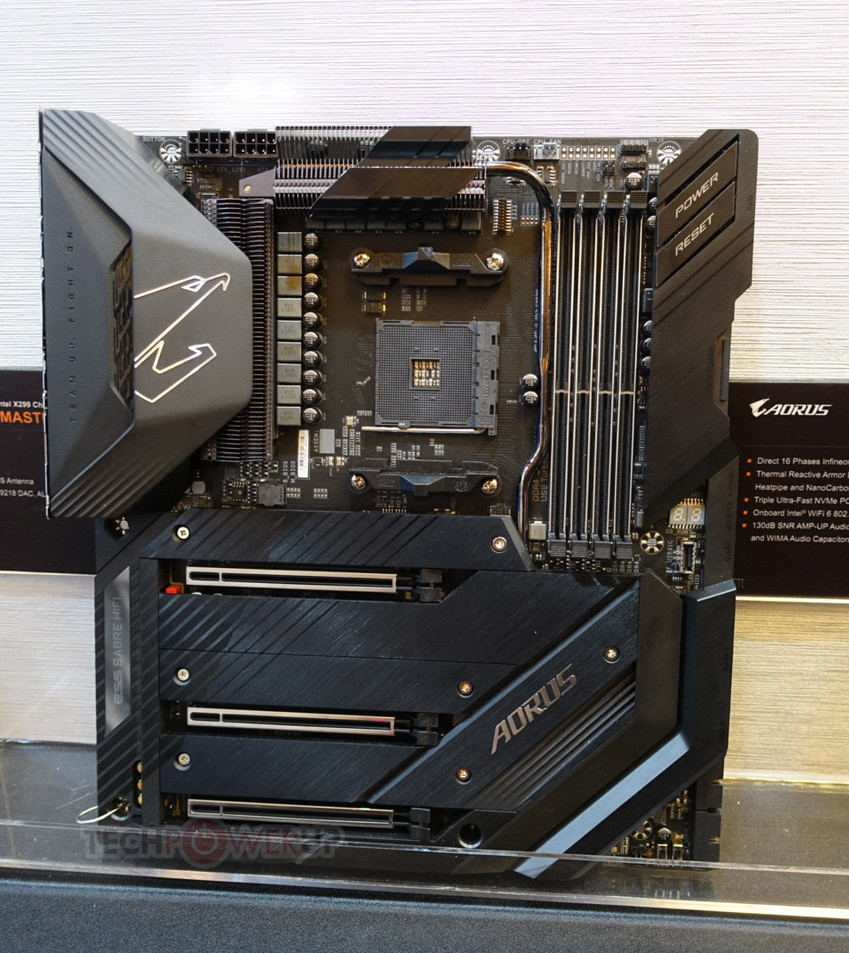
Our readers spotted an interesting visual detail that missed us during our coverage of GIGABYTE's three new socket LGA2066 motherboards unveiled at Computex 2019. One of the three boards, the X299S Designare 10G, has the hard-marking "X499" on its CPU VRM heatsink. Another detail that strikes us is that none of the three new boards we pictured has "X299" printed on the PCB anywhere. The Designare 10G has a sticker below the printed GIGABYTE logo that reads "X299G Designare 10G." The purported X299G Aorus Master has another interesting detail: right above the "Aorus Master" print, there's a tiny sticker marked "X299G," positioned as if it's covering up a printed marking on the PCB itself.

All these details lead us to wonder if GIGABYTE tried to cover up that these boards are in fact based on the unannounced X499 Express chipset, and made to appear like they are X299. We only have paper stickers and the booth placards that indicate "X299," while a metal embossing on the Designare 10G's VRM heatsink reads X499. Intel in its Computex 2019 keynote announced that it will introduce new Core X HEDT processors. It's been over 2 years since the first Core X "Skylake-X" processors launched in Q2-2017. Intel refreshed the lineup in 2018 with 9th generation branding and soldered TIM, with a few specification improvements across the product-stack, but a largely unchanged silicon. It's likely that the Fall 2019 release could see new chips with increased core counts, perhaps even the fabled 22-core die, and some hardware mitigation against recent security vulnerabilities.

AMD Confirms Ryzen 3000 "Matisse" Features Soldered IHS

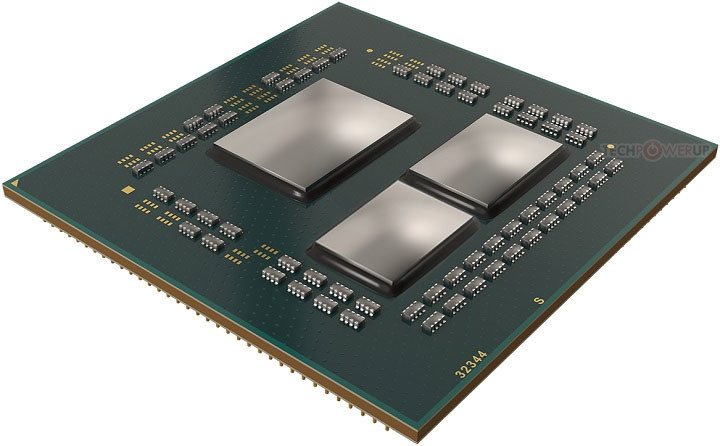
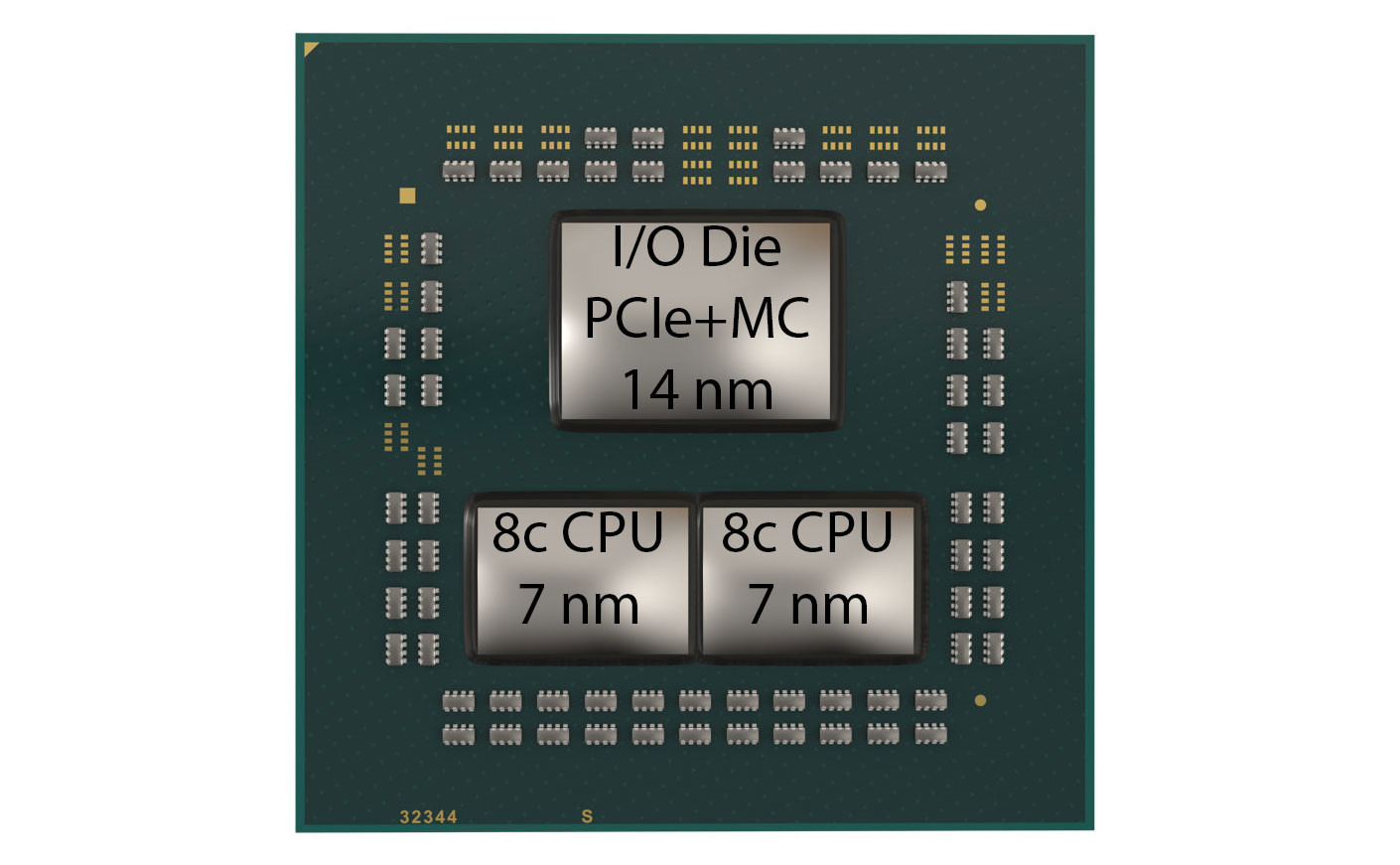
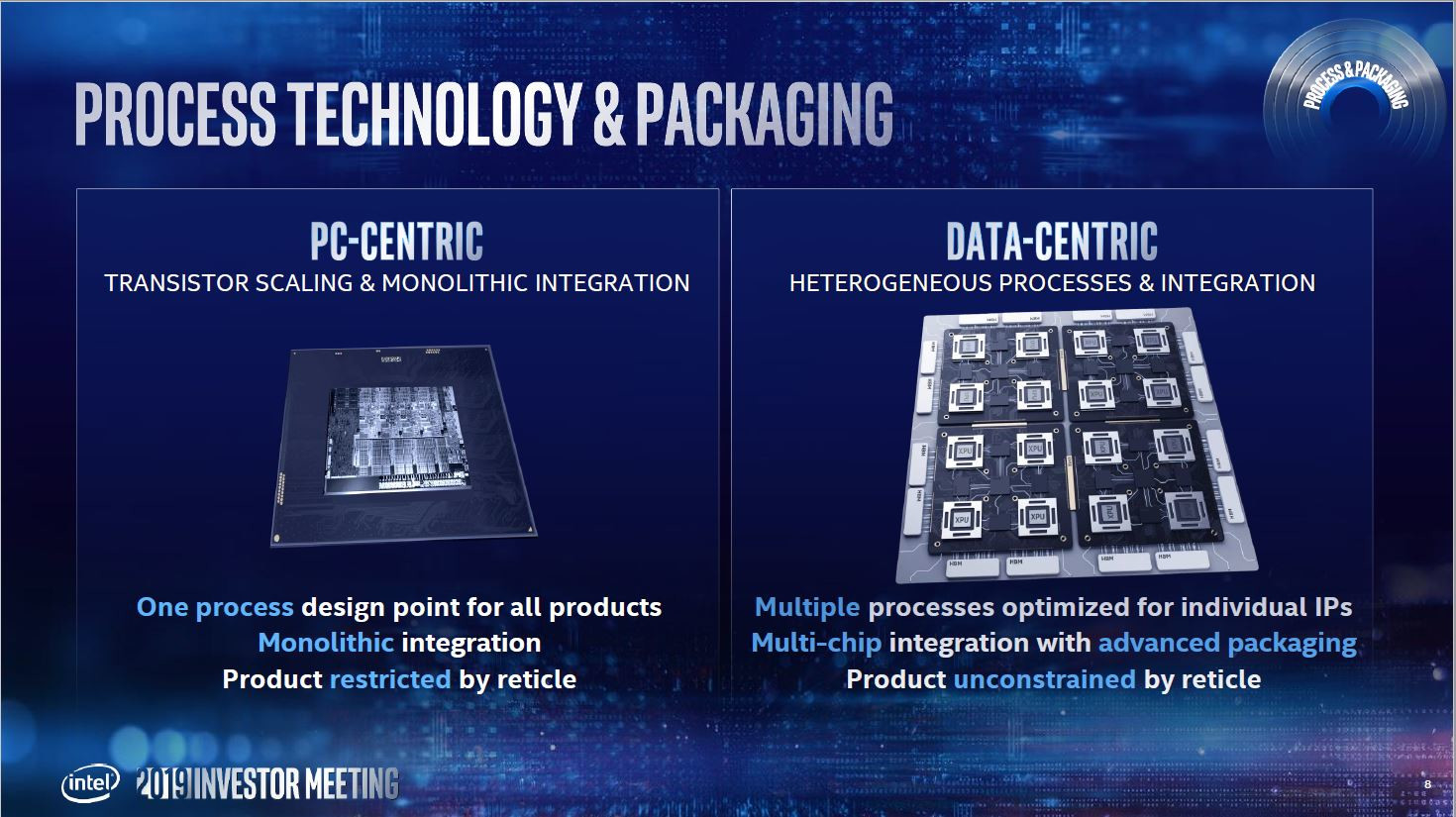
AMD senior technical marketing manager Robert Hallock, responding to a specific question on Twitter, confirmed that the 3rd generation Ryzen processors do feature soldered integrated heatspreaders (IHS). Soldering as an interface material is preferred as it offers better heat transfer between the processor die and the IHS, as opposed to using a fluid TIM such as pastes. "Matisse" will be one of the rare few examples of a multi-chip module with a soldered IHS. The package has two kinds of dies, one or two 7 nm "Zen 2" 8-core CPU chiplets, and one 14 nm I/O Controller die.

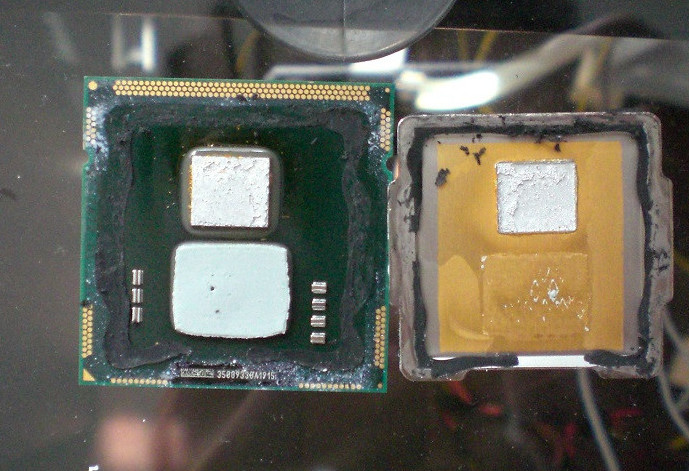
The most similar example of such a processor would be Intel's "Clarkdale" (pictured below), which has its CPU cores sitting on a 32 nm die, while the I/O, including memory controller and iGPU, are on a separate 45 nm die. On-package QPI connects the two. Interestingly, Intel used two different sub-IHS interface materials for "Clarkdale." While the CPU die was soldered, a fluid TIM was used for the I/O controller die. It would hence be very interesting to see if AMD solders both kinds of dies under the "Matisse" IHS, or just the CPU chiplets. Going by Hallock's strong affirmative "Like a boss," we lean toward the possibility of all dies being soldered.
Image Credit: TheLAWNOOB (OCN Forums)

NVIDIA Rushes Out GeForce Hotfix 430.97 Driver

NVIDIA Friday released the GeForce Hotfix 430.97 driver. Hotfix drivers are released when NVIDIA needs to address a limited number of glaring issues with a recently released driver, in this case, the 430.86 WHQL and 430.64 WHQL. Released only for Windows 10, the drivers fix a game crash noticed in "Forza Horizon 4" when driving through tunnels. It also addresses a "Code 43" error noticed on machines powered by Intel "Sandy Bridge" processors when trying to install the WDDM 2.6-ready 430.64 WHQL drivers on Windows 10 May 2019 Update (1903). Grab the drivers from the link below.
NVIDIA GeForce 430.97 Hotfix

The change-log follows.

Tecware VXR, Nexus C, Vega, M2 Micro Among Other Cases on Display at Computex 2019

While visiting the Tecware exhibit, we took the time to check out the numerous cases they had on hand. We started with the VXR dual chamber chassis which was eye-grabbing, to say the least. Featuring a dual chamber layout, it had a sandblasted aluminum exterior with front and side tempered glass panels for getting the best possible view of your hardware. While some cases with such a layout can be starved for air, Tecware took that into account with increased airflow and cooling configurations being available. That, of course, brings up the potential for dust; however, they made sure to include dust filters to help mitigate the issue. On top of all that, the VXR also has removable HDD/SSD trays for easier installation along with extra space for improved cable management.

Taking a closer look at the cooling options the VXR has clearance for CPU coolers of up to 140mm in height which is a bit limiting, but when you consider its radiator support more than makes up for it. The chassis has enough space for up to a 240mm radiator in the top, 240mm radiator in the bottom, and a 360mm radiator on the side. Actual space for fans is a bit different with the case allowing for 3x 120mm in the front, 3x 120mm on the side and 3x 120mm in the bottom. Overall the case is a solid option for custom water cooling or for those planning to use an all-in-one liquid cooled GPU and CPU. As for graphics cards, total clearance was listed as 385mm. Finally, storage and expansion space consist of 2x 3.5" HDD, 4x 2.5" SSD (2 modular SSD trays) and 8x expansion slots. The VXR has an MSRP of $89.99.

Tecware at Computex 2019: Spectre Pro Mechanical Keyboard and Professional Gaming Mice

While visiting with Tecware at Computex 2019, we caught a glimpse of their peripheral lineup, which included a new keyboard dubbed the Spectre PRO and three professional gaming mice dubbed the Impulse PRO, Vector PRO, and Torque PRO.

Starting with the keyboard, the Spectre PRO is a standard 104-key layout design that unlike its competitors comes with modular switch sockets for easy switch replacement with Tecware going so far as to include the tools for the job in the box. When it comes to the switches themselves, they are Outemu Red, Blue, and Brown switches. Other features include 11 multimedia keys and a volume adjustment knob. Macro recording and custom profiling are also built in as well. In terms of build quality, the Spectre PRO impressed when it comes to the keycaps as they were double-shot ABS and had a nice solid feel. Meanwhile the RGB lighting was quite well done too with support for per key customization along with 18 pre-set lighting modes and 11 under glow lighting modes. As with any gaming keyboard, N-key rollover is supported as well.

GIGABYTE Gives AMD X570 the Full Aorus Treatment: ITX to Xtreme

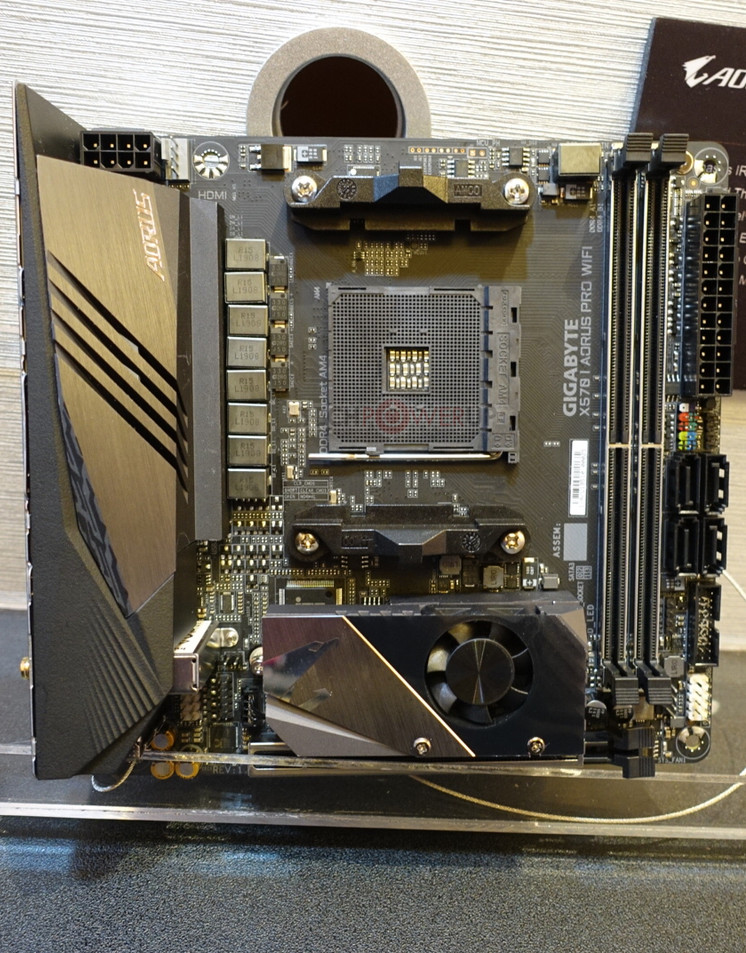
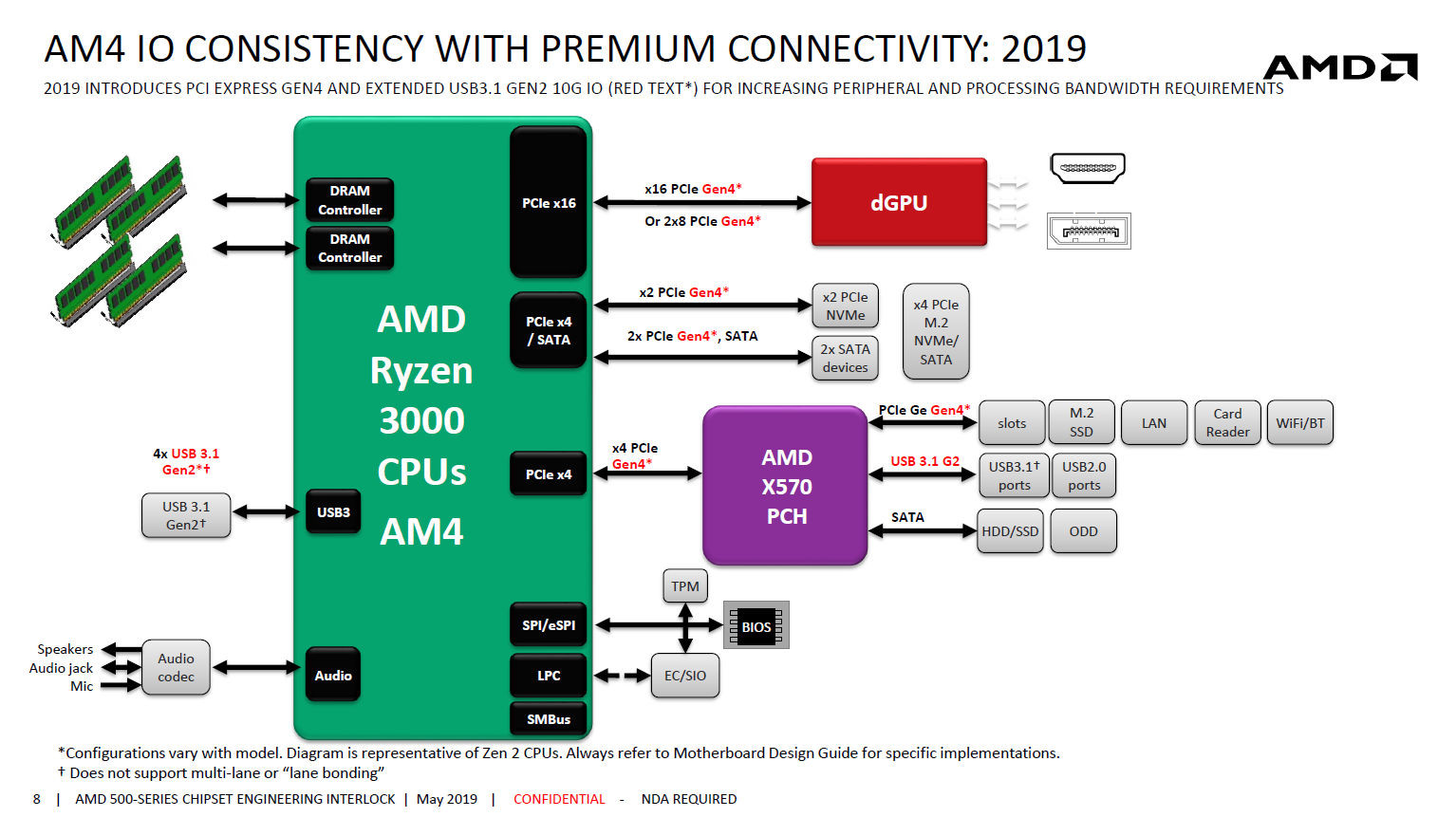
Motherboard vendors are betting big on the success of AMD's "Valhalla" desktop platform that combines a Ryzen 3000-series Zen 2 processor with an AMD X570 chipset motherboard, and have responded with some mighty premium board designs. GIGABYTE deployed its full spectrum of Aorus branding, including Ultra, Elite, ITX Pro, Master, and Xtreme. The X570 I Aorus Pro WiFi mini-ITX motherboard is an impressive feat of engineering despite its designers having to wrestle with the feisty new PCIe gen 4 chipset. It draws power from a combination of 24-pin and 8-pin connectors, and conditions power for the SoC with an impressive 8-phase VRM that uses high-grade PowIRstage components. A rather tall fan-heatsink cools the X570 chipset, with a 30 mm fan.

Connectivity options on the X570 I Aorus Pro WiFi are surprisingly aplenty. The sole expansion slot is a PCI-Express 4.0 x16, but the storage connectivity includes not one, but two M.2-2280 slots (reverse side of the PCB), each with PCI-Express 4.0 x4 and SATA 6 Gbps wiring. Four SATA 6 Gbps ports make for the rest of the storage connectivity. Networking options include 2.4 Gbps 802.11ax WLAN, Bluetooth 5.0 (Intel , and 1 GbE, all pulled by Intel-made controllers. USB connectivity includes six 5 Gbps USB 3.2 gen 1, and two 10 Gbps USB 3.2 gen 2 ports (of which one is type-C), and two 5 Gbps ports by headers. The onboard audio solution has 6-channel analog output, but is backed by a premium Realtek ALC1220VB Enhance CODEC (114 dBA SNR).

GIGABYTE Unveils Three New X299 Motherboards at Computex 2019

At Computex 2019, we spotted three new socket LGA2066 motherboards from GIGABYTE, and several other manufacturers. At its Computex 2019 keynote, Intel announced that in Q3 2019, the company is launching new Core X series HEDT processor models "for creators." When combined with the handful new LGA2066 motherboard models we've spotted, it becomes highly likely that the processors Intel is launching this Fall could be LGA2066-compatible. Without further ado, the X299G Aorus Master, the X299G Aorus Xtreme Waterforce, and the X299G Designare 10G.

The X299G Aorus Master is different from the X299 Aorus Master launched last November, and the X299G Designare 10G is different from the X299 Designare EX launched way back in 2017. The X299G Aorus Xtreme Waterforce is the first "Xtreme" sub-branded LGA2066 product. What's common to these three boards is out-of-the-box support for the upcoming HEDT processor models, besides 9th generation "Skylake-X" Refresh processors, and the original "Skylake-X" chips.

Thermaltake at Computex: TOUGHRAM RGB / TOUGHRAM DDR4 Memory

Thermaltake, the leading PC DIY premium brand for Cooling, Gaming Gear and Enthusiast Memory solutions, proactively participates in the memory market by announcing brand new premium memory products - TOUGHRAM RGB and TOUGHRAM. Besides, the innovative WaterRam RGB Liquid Cooling Memory kit, Thermaltake has expanded its lineup with the clock speed of 3600MHz.

The Thermaltake TOUGHRAM RGB and TOUGHRAM DDR4 Memory lineup is aiming at high performance gaming/overclocking. TOUGHRAM RGB series range from 3000MHz, 3200MHz and 3600MHz. The RGB lighting effects designed for the TOUGHRAM RGB with its addressable RGB lighting settings can be synchronized with the TT AI Voice Control, Amazon Alexa, and Razer Chroma. TOUGHRAM memory series range from 2400MHz to 3000MHz. These two memory series are supported by the TT Premium heatspreader design, which are tightly screened memory ICs that ensure outstanding cooling performance.

KLEVV Shows Off New Flash Drives, SSDs and Memory with Copious Amounts of RGB

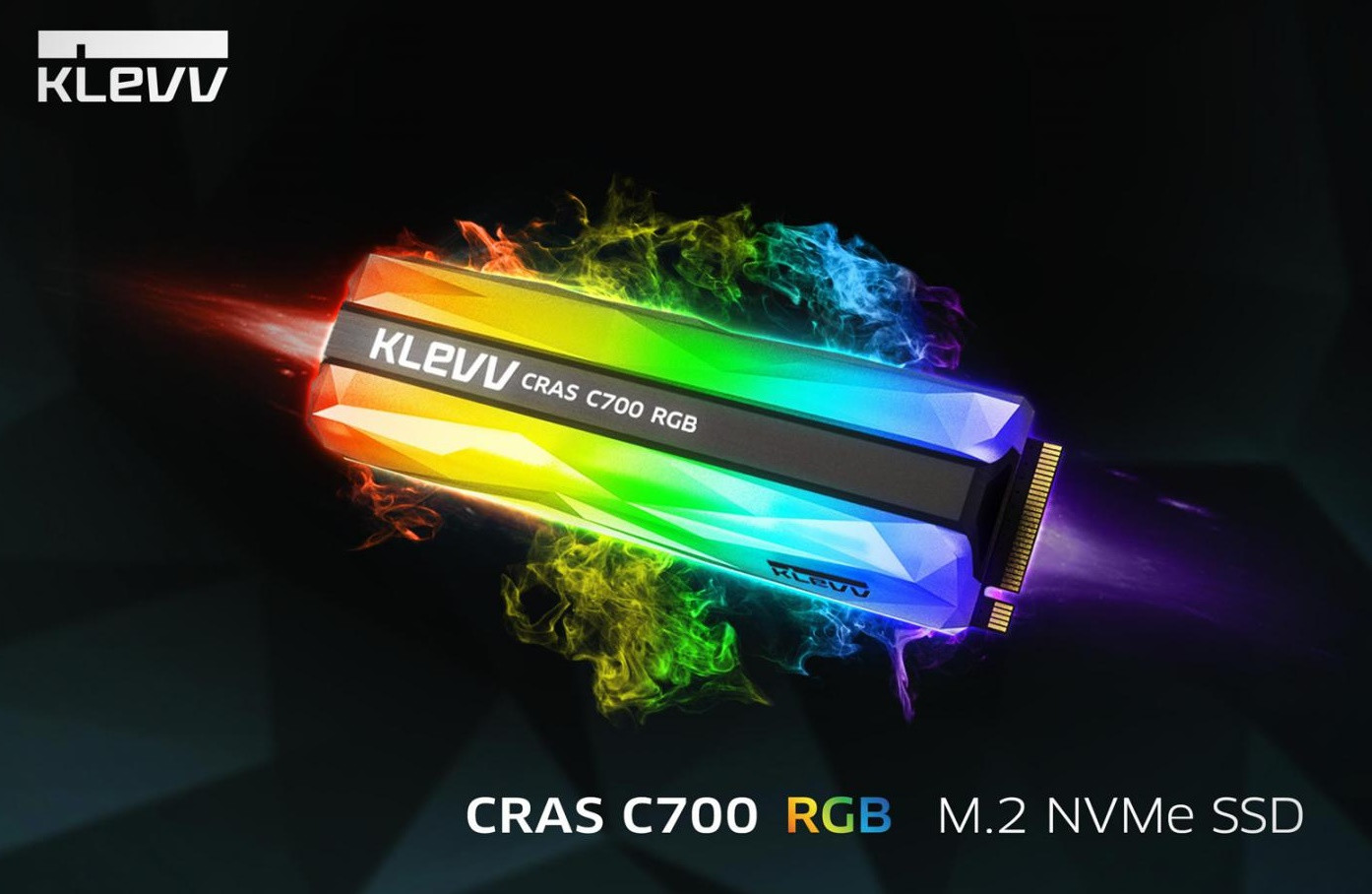
KLEVV at its Computex 2019 booth unveiled a new line of high-performance USB flash drives. It also brought along its latest variants of CRAS series M.2 NVMe SSDs and DDR4 memory, which come with a dazzling/blinding (take your pick) amount of RGB LED embellishment. We begin with the Portable Ghost, branded as a "portable SSD" and not a flash-drive. This is because the USB 3.1 gen 2 type-C connection pulls a PCIe/NVMe internal SSD. When plugged into a PC or a USB charger, the drive can also work as a wireless drive to your other devices over Bluetooth 4.2. The drive comes in two variants based on capacity, which significantly differ in hardware. The 240 GB variant is pulled by a JMicron JM5583 controller, while the 480 GB variant has a Silicon Motion SM2263EN. Both models use 72-layer 3D TLC NAND flash, and have the same on-paper performance figures, with up to 1,250 MB/s reads/writes. The drive isn't without two RGB LED diffusers.

The Blu RC30 is another fascinating, albeit slower drive, that's properly marketed as a flash drive. Built in the conventional 2-piece capped form-factor, the drive features a USB 3.1 gen 1 (5 Gbps) type-A connection. An internal battery which soaks up power when plugged in, lets the drive function wireless over Bluetooth 4.2, and also be used as a wireless presentation tool (a clicker), with capacitive touch surface and a couple of buttons, which imitate a mouse. Built in capacities of 32 GB, 64 GB, and 128 GB, the Blu RC30 offers sequential transfer-rates of up to 250 MB/s reads on all three models, and write-speeds rated at 40 MB/s for the 32 GB model, 50 MB/s for 64 GB, and 90 MB/s for the 128 GB model. Transfer rates are severely throttled in wireless mode. We then moved on to its SSD and memory products.

ZADAK at Computex: Boutique Memory, Coolers, Gaming Desktops, and Case-Mods

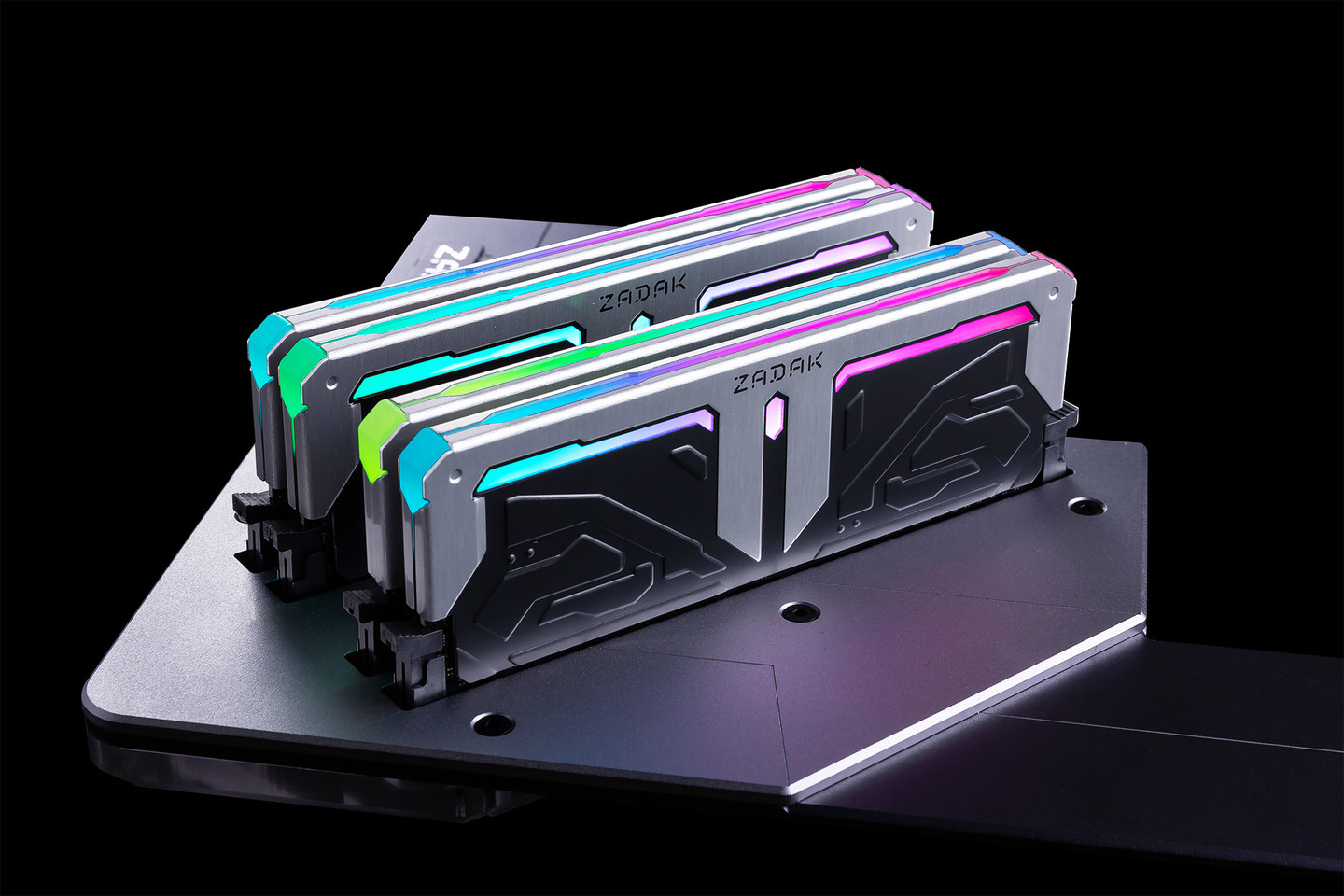
ZADAK may have dropped the "511" from its name, but remains a sought-after boutique hardware brand for case-modders. At its Computex 2019 booth, the company showed off its latest memory modules, cooling products, and a few case-mods that put the two together. The centerpiece at the booth was the Spark line of premium DDR4 memory modules. Silver accents of brushed aluminium top a darker shade, crowned by a silicone addressable-RGB LED diffuser. Each module has five lighting zones - top, top sides, and corners, which the maker calls "Dynamic multi-zone RGB." Each module cycles between 8 lighting presets, although with a 3-pin ARGB connection, you can play with the lighting via software.

ZADAK Spark memory comes in single-module, dual-channel, and quad-channel kits of 8 GB and 16 GB modules, which are further differentiated in four speeds, DDR4-3000, DDR4-3200, DDR4-3600, and DDR4-4133. Up to 3200 MHz, these modules offer timings of 16-18-18-38@1.35V, which loosen to 17-19-19-39@1.35V for DDR4-3600, and 19-21-21-42@1.4V for DDR4-4133. ZADAK claims it tested each memory kit for advertised settings on both Intel Core and AMD Ryzen platforms. Prices start at USD $159.99 for a 2x 8 GB DDR4-3200 memory kit. Next up, is the ZADAK Spark AIO closed-loop liquid CPU cooler.
Thursday, May 30th 2019

Hands On: Raijintek AURAS Workstation, HELOTS SFX 750 PSU, METIS EVO & OPHION M EVO Cases

The most exciting item on display during our visit with Raijintek was something we were unable to get much info on and that was the AURAS Workstation. This monster cooling solution consists of a massive reservoir/distribution block connected to a pump which feeds coolant to four graphics cards and two processors at up to 3000L/H. Heat dissipation was handled by 1x 520mm and 2x 420mm radiators equipped with 10x 140mm RGB fans. Regardless of any specifics in terms of this water cooling loops actual performance, the system on display was certainly a sight to behold, which was made all the more noticeable by a massive show of ARGB lighting.

Raijintek at Computex 2019: EOS, NYX, SAMOS All-in-one Liquid Coolers, RGB Radiators, and Pump

During our visit with Raijintek at Computex 2019, it was apparent the company had gone all in when it comes to ARGB lighting. The first liquid cooler on display was the EOS I 240 RBW. Offering ARGB rainbow lighting, this AIO utilized a 240mm high-density radiator with 12 channels along with a full copper water block with 0.15mm micro channels. Pushing the coolant through the system is a pump that has a max rated pressure head of 1.5M and a max flow rate of 80 L/H. Multiple mounting kits are available for modern sockets.

Meanwhile, the EOS II 240 RBW was also on display. It has all the same features as the EOS I but sports a different block design. Where the CPU and pump block on the EOS I looks a bit like a cyclone in regards to its design and lighting elements. The EOS II has a boxy design with grooves and ARGB LED lighting for that extra bit visual stimulus.

Cougar at COMPUTEX 2019: Conquer 2, Gemini S, Gemini M, and Blazer Essence Chassis

Cougar at COMPUTEX 2019 showcased their newest iteration of the Conquer chassis. Christened the Conquer 2, this is more than simply a revision of their Conquer chassis, featuring modernized, almost "sci-fiyei" looks illuminated by the company's orange toning (selectable and changeable with their Trelux RGB lighting system). The Conquer 2 features a detachable sub-chassis so that users can mount components on the exterior of the chassis' carcass for easier access and installation. The Conquer 2 keeps support for 360 mm radiators despite these design characteristics, and is a case that's sure to draw attention wherever it stands.

COMINO at COMPUTEX 2019: Otto Chassis, CPU + GPU Fullcover Waterblocks

COMINO is a hitherto unrepresented brand at TPU, so we'll try and change that in this post. COMINO is an European manufacturer based off Cyprus, which have specialized in datacenter and retail cooling solutions. They seem particularly geared towards digital currencies, building specialized enclosures for mining hardware to perform at their fullest potential.

At COMPUTEX, the company showcased their OTTO system, built upon their aptly named OTTO chassis, which looks like a full-blown radiator by itself. It's an SFF gaming PC in a ~13 L volume chassis that nonetheless packs in the most powerful components users can buy today: Intel's Core i9-9900K CPU, NVIDIA's RTX 2080 Ti graphics card, and all the other bangs and whistles expected from a top-tier gaming PC. The company has worked on developing everything as needed to make the most of the available space, including the incorporation of Black Ice radiators with Noctua fans, custom water blocks with fins from a different process than usual to allow higher heat exchange, and preparing a dual connection PCIe extension adapter based on the server market needs to allow an x16 connection as opposed to the usual x8. Look out for a more detailed look at the system here in due time!

Bloody at COMPUTEX 2019: Light Strike RGB Mouse, X65 Keyboard, X650 Headphones

Bloody, sprung from A4Tech, took to COMPUTEX 2019 to showcase come of its upcoming products. The company didn't seem to be much ready to play the part, though; its new peripherals, part of their new X series, were still in the works and identified using stickers, with not a lot of detail being available for us press to share with you. However, you can at least look at the designs of those we can identify. The X series attempts to provide cleaner aesthetics relative to the more aggressively designed Bloody brand as a whole.

The Light Strike RGB Gaming Mouse, for one, carries on the company's legacy of having a dedicated fire button, which can likely be programmed for either burst fire or single-shot mode. There's 5000 DPI of resolution available, which is likely more than enough for most casual gamers (32000 DPI seems slightly exaggerated now, doesn't it?). The X65 keyboard features a modular design, with the number pad being removable for users that want to either save space or simply prefer to use their keyboards' top numbers.

Bitspower at COMPUTEX 2019: New CPU, GPU Blocks and Conceptual Products

Bitspower at COMPUTEX 2019 showcased new products and conceptual, advanced looks at products that are still being developed. The company showcased GPU waterblocks for both the NVIDIA RTX 20-series of graphics cards, as well as AMD's current top of the line Radeon VII. On the GPU waterblock side of things, they also showcased an in-development block with a rugged texture and design that carries Bitspower's logo, which would certainly look great on a vertically-mounted GPU.

MIXCDER Launches HD901 Wireless Headphones: Cheapest, Lightest, Most Comfortable Hi-fi Headphones in the Market

Mixcder, the audio experts providing superior sound quality at a low price, announced today the lightest, most comfortable, lowest cost foldable Hi-Fi wireless headphones on the market -- The Mixcder HD901 premium Bluetooth headphones. The Mixcder HD901 Headphones are designed to be everyone's travel-everywhere headphones, featuring a great combination of low price at $19.99, high quality sound with superior bass and 40mm drivers, easy compact travel foldability, light weight at just 5 ounces, and comfort with soft ear cups and adjustable headband sliders. The HD901 is the all-in-one solution for music lovers, audio-book listeners, travelers, sports enthusiasts, and students.

BITFENIX at COMPUTEX 2019: Dawn TG, Nova Mesh 16, Saber PC Chassis Showcased

At COMPUTEX 2019, BITFENIX took the opportunity to showcase their latest case design built for the conscious enthusiast. Their Dawn TG is the company's take on the RGB market, with a stylized, ARGB front fascia that's eerily reminiscent of Oblivion's Tet (the movie, not the game). This case is available in both black and white, and features smoked tempered glass side mirrors for that premium feel.

The Nova Mesh TG Black brings slightly more gaudiness to its RGB design, which is clearly visible behind the tempered glass side mirrors. The panel's front fascia, as the name implies, is covered in mesh so as to maximize airflow for interior components.

AZIO at COMPUTEX 2019: ALUMINUM Keyboard, Mouse and Number Pad, Concrete-built Electronics

AZIO at Computex 2019 showcased a number of new products, which showcase the company's Los Angeles-based design. AZIO's ALUMINUM line of products includes the Iris ALUMINUM K-Pad (which AZIO says is inspired in retro camera designs), the Iris ALUMINUM N-Pad, the RCM ALUMINUM mouse, and the RCPM mouse pad. The Iris K-Pad in particular has a multi-functional knob on the top right corner allowing as much as three actions per side, and is a complex feat of engineering to say the least. We look forward to checking out the new lineup in detail closer to launch.

Various materials, such as leather, are being used in these AZIO products, but the one star of the show has to be the usage of concrete in computer peripherals. I guess we'd have to actually touch these to see if the texture does work well in a daily environment, but it's interesting that this material has been used in a computer peripheral at all - and the effect does look interesting and pleasing to the eye. The RCM aluminium mouse looks like a very sleek unit, with the cold touch of aluminium greeting your first minutes of usage, and it does feature AZIO's design touches that have become the company's hallmark.

Thermaltake Launches Pacific CL360 Max D5 Hard Tube Water Cooling Kit

Thermaltake, the leading PC DIY premium brand for Cooling, Gaming Gear and Enthusiast Memory solutions, announced the premium water cooling kit - Pacific CL360 Max D5 Hard Tube Water Cooling Kit at COMPUTEX 2019 from May 28th to June 1st. The Pacific CL360 Max D5 Hard Tube Water Cooling Kit features a premium-quality combo kit which is ready to be controlled by the TT RGB PLUS software; it also supports the Razer Chroma and Amazon Alexa Voice Service.

The Pacific CL360 Max D5 Hard Tube Water Cooling Kit includes the Riing Duo 12 RGB Radiator Fans, a Pacific W5 RGB CPU Water Block, Pacific PR22-D5 Plus Pump/Reservoir Combo, Pacific CL360 Plus RGB Radiator, a bottle of T1000 Coolant Pure Clear, eight C-Pro G14 PETG 16mm OD Compressions, eight V-Tubler PETG Tubes and other accessories. Every component in the Pacific CL360 Max D5 Water Cooling Kit is particularly selected by Thermaltake PC DIY experts.

MetallicGear at COMPUTEX 2019: Renewed Chassis Portfolio

MetallicGear took to Computex 2019 to renew and revive its product portfolio, announcing the development of no less than four new PC chassis for the discernible enthusiast. One of them is the MetallicGear Neo Silent: a subtle and silent case that integrates sound insulation to the front panel design. The case comes with 1x 120mm Skiron fan non-RGB) and features open PCI slot design for vertical GPU mounting (bracket required).

Second comes the MetallicGear Neo Air, a high airflow case that implemented the MetallicGear's characteristic to the front mesh panel design. The case comes with 2x 20mm Skiron RGB fans and features open PCI slot design for vertical GPU mounting (bracket required). This is followed by the MetallicGear Neo G, a case designed to impress with its tempered glass front panel. Features include 2x 120 Skiron D-RGB fans and open PCI slot design or vertical GPU mounting (bracket required). And finally, the MetallicGear Neo series V2 now refined to improve airflow. The cases are now designed with larger air intake mesh on the front to bring in more air. Pricing information is available after the break.

Phanteks at COMPUTEX 2019: Enthoo 719, Eclipse P360X and P400A, Evolv Shift Air PC Chassis

Update: November 14, 2019: As per Phanteks's request (see this post), we have renamed the Enthoo Luxe 2 to Enthoo 719.

Ever since being revealed at CES 2019, Phanteks has been hard at work on their prototype Enthoo 719. Since then, the 719 has been fine-tuned to bring optimal cooling performance with the best building experience. The new redesigned full tower case incorporates the latest high-end features from the Enthoo Elite and Evolv X. Features such as SSI-EEB motherboard support, extreme water-cooling with dual 480 and dual 360 radiators installed simultaneously, and extensive storage for up to 12x HDD's / 11x SSDs.

Whether you are an extreme gamer or needing a professional workstation, the Enthoo 719 offers you the flexibility to configure the perfect system. With the dual system support, capture all your glorious moments and stream without interfering with your gaming system (Revolt X required). Create a dual PSU (Revolt Pro required) system to run for example powerful deep learning workstations. The Enthoo 719 will be available from early August, at an
MSRP of $189.99 / €189,90.

Phanteks at COMPUTEX 2019: AMP Series PSUs and Glacier Coolers, Evolv Speaker

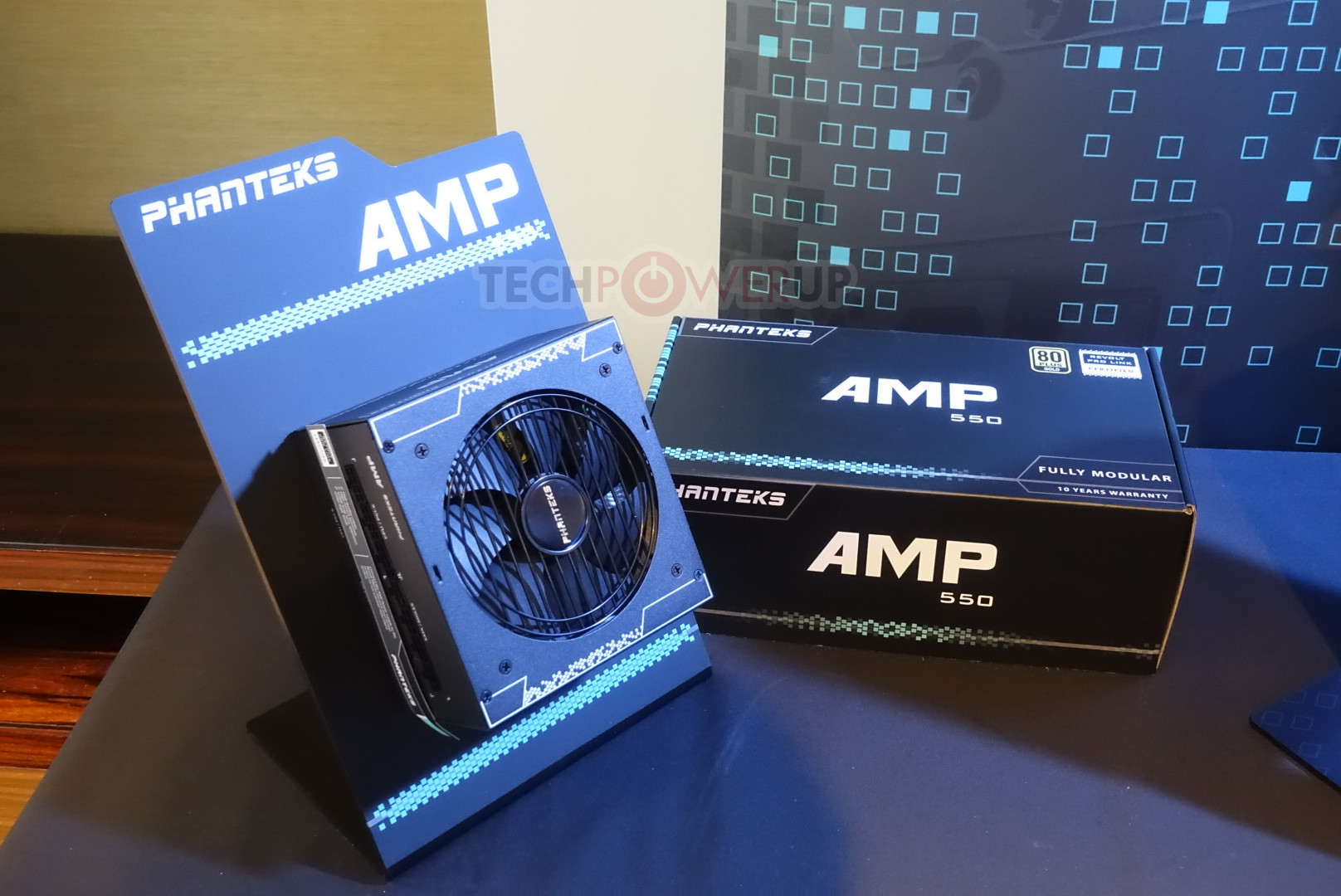
Phanteks at Computex 2019 announced a partnership with Season in delivering their AMP series of PSUs. The AMP Series features a Hybrid Silent Fan Control that achieves optimal cooling with temperature-controlled fan speed and fan-less mode for silent performance. The high powered, compact design of the AMP series provides up to 750 watts in 140mm using modular, 80 Plus Gold efficiency, black, flat power cables. The AMP Series PSU are "Revolt Pro Link certified", validated to ensure 100% compatibility, reliability, and stability by Phanteks to work with the Revolt Pro expandable PSU.

1stPlayer Shows Off Steampunk Line of PSUs and Extension Cables

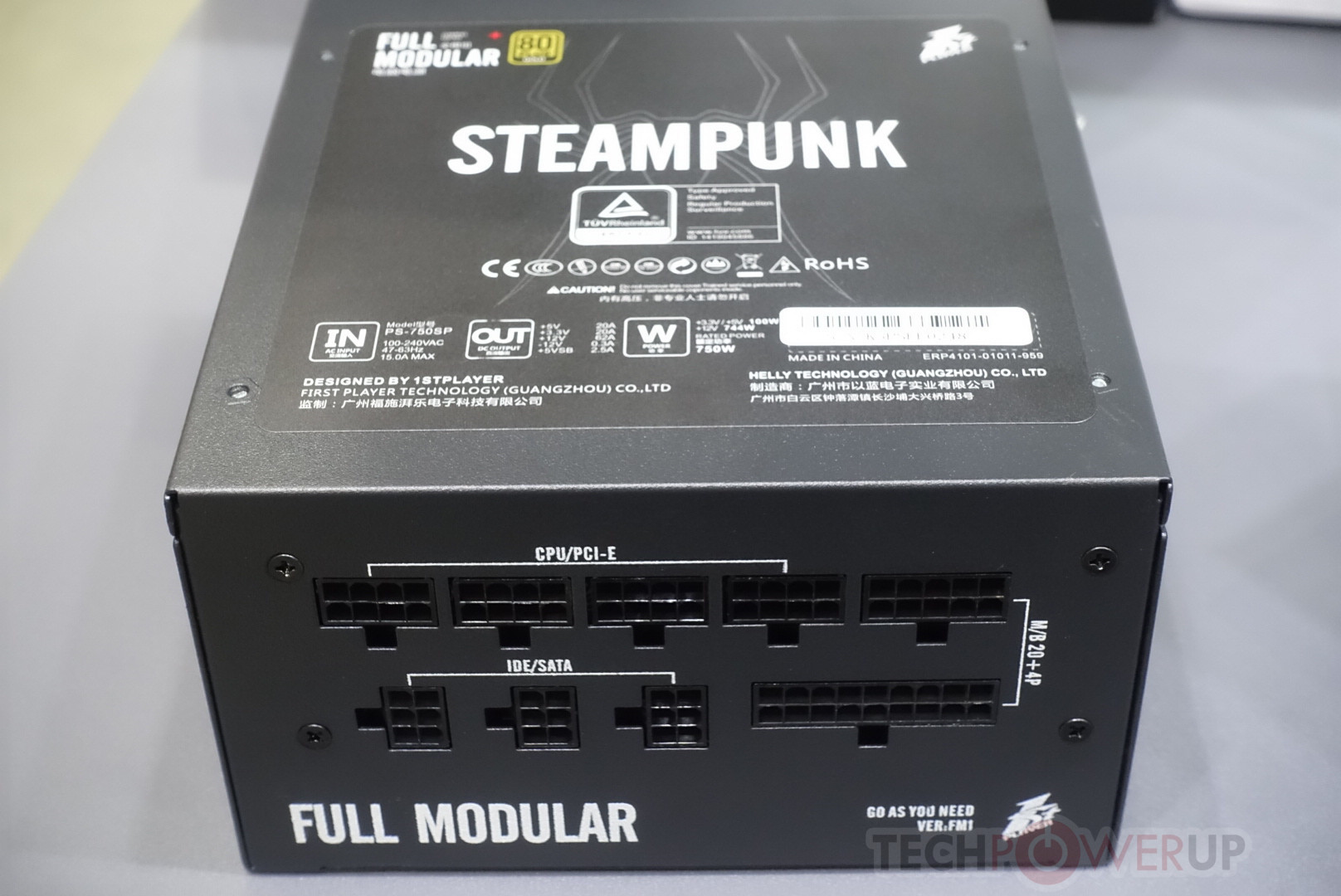
1stPlayer unveiled quite a few new products this Computex, beginning with the Steampunk line of power supplies and power accessories. The Steampunk series consists of fully-modular PSUs in upper-mid range capacities such as 750W. These PSUs come in two physical variants, all-black, and white with RGB-LED illuminated 140 mm fans. Like most other PSUs launched this year, the 750W Steampunk includes two 4+4 pin EPS connectors, besides four 6+2 pin PCIe power, six SATA power, and three Molex. A single +12V rail design and most common electrical protections make for the rest of it.

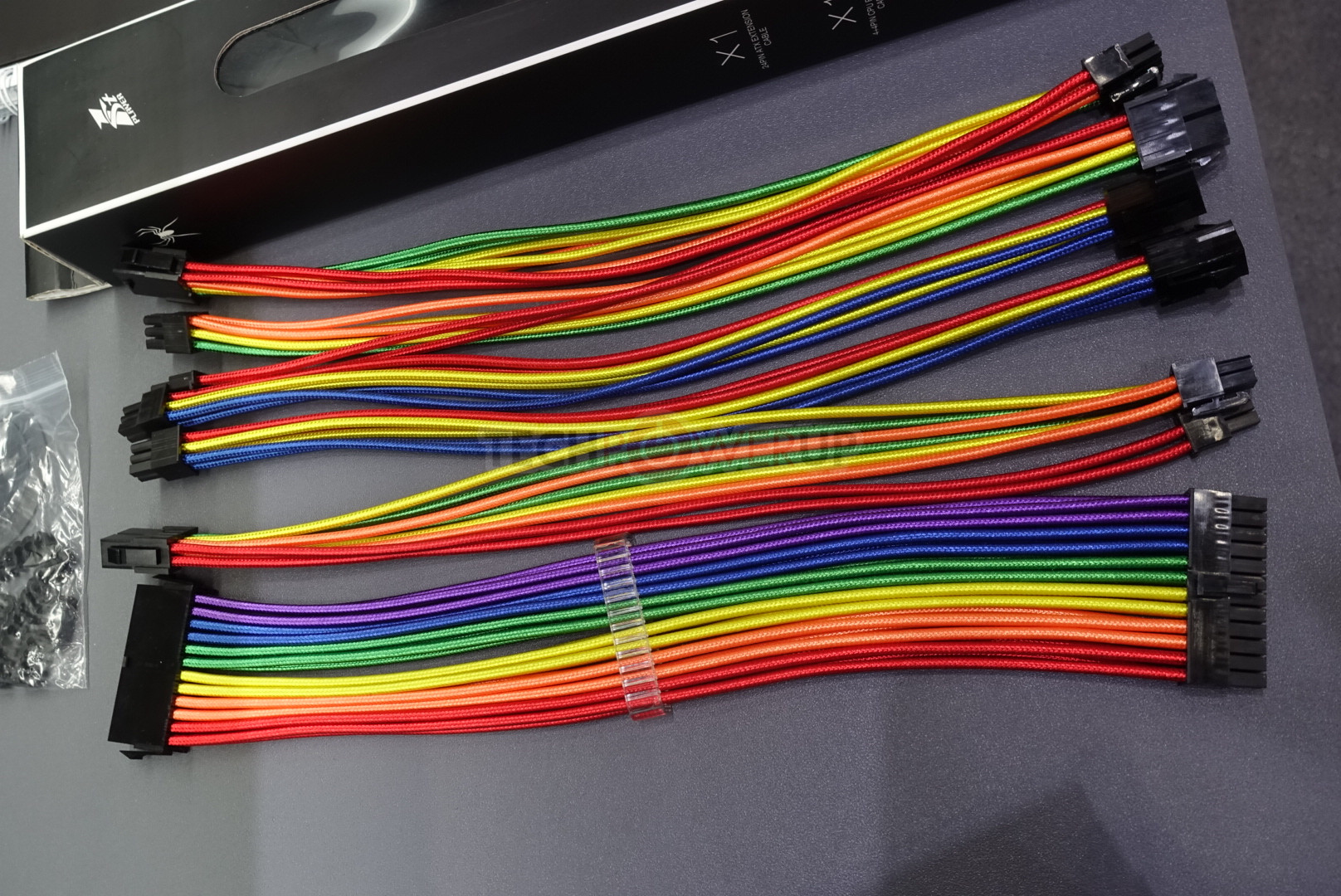
1stPlayer also unveiled a series of Steampunk-branded PSU extension cables purchasable separately from the PSUs. These include colorful fiber braided sleeved individual cables of various shapes and sizes (24-pin, 8-pin EPS, 6+2-pin PCIe, etc.,), or illuminated cables with addressable RGB LED lighting up each cable.

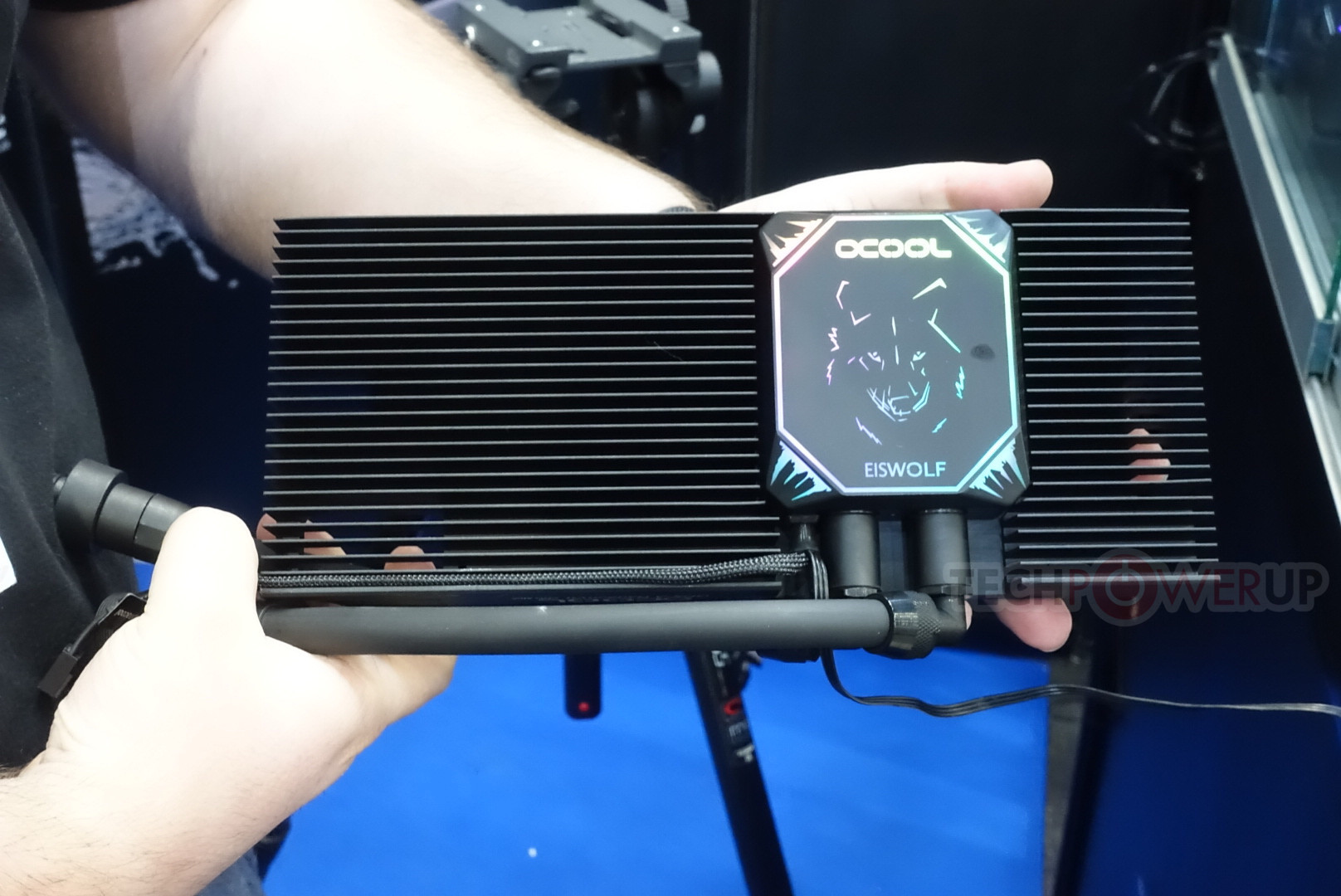
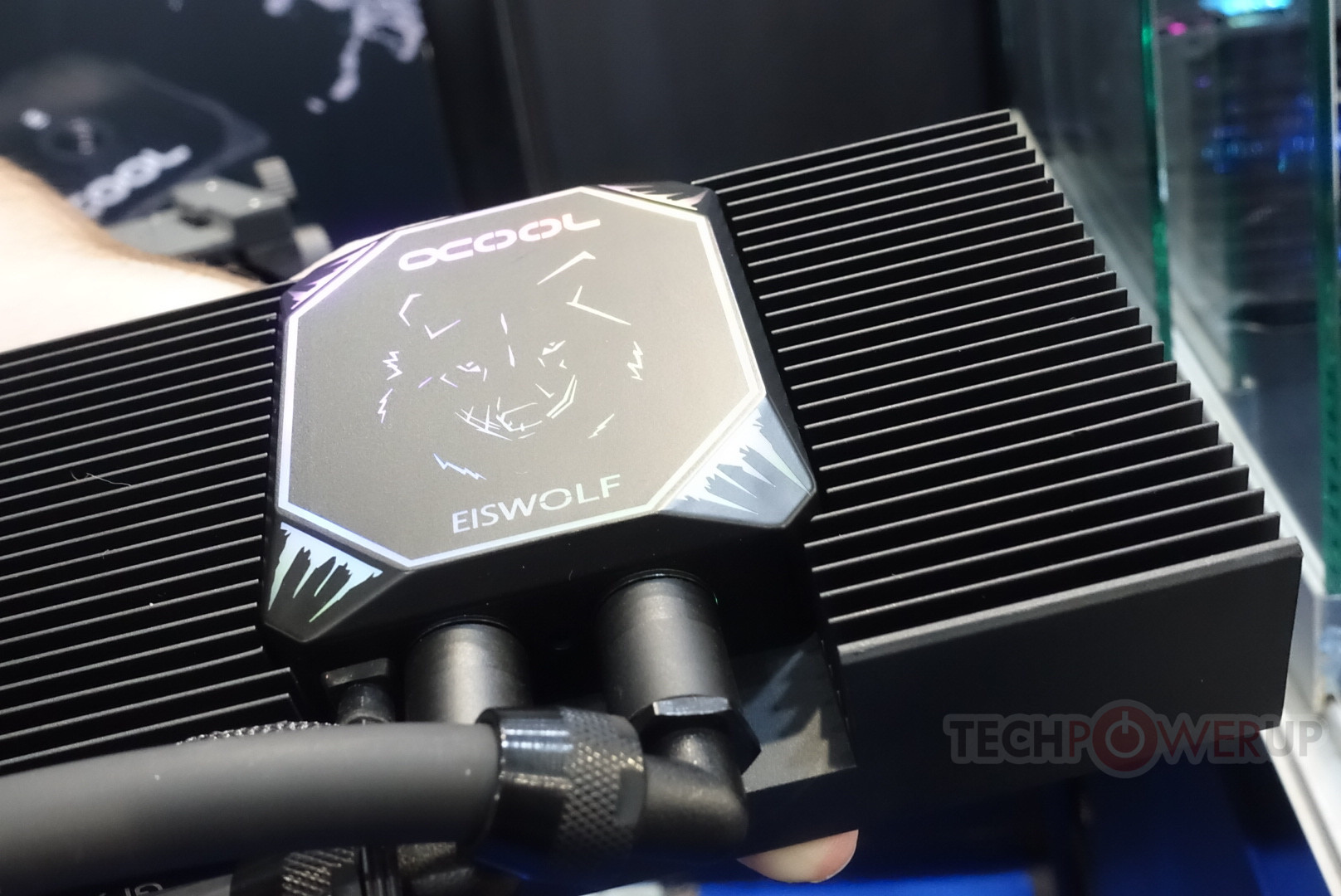
Alphacool Unveils Latest Iterations of Eiswolf and Eisbaer Aurora AIO CPU and VGA Coolers

Alphacool showed off the latest versions of its Eiswolf and Eisbaer all-in-one liquid-coolers, under the Aurora brand extension. While technically closed-loop, the coolant tubes of these coolers are detachable by valved quick-release fasteners, which let you top-up coolant over time, or replace with one of your choice. The Eiswolf, shown here with the wolf logo, supports various NVIDIA and AMD graphics cards that have similar GPU mount-hole spacing, and chip Z-height adjustable using washers. The Eisbaer LT, on the other hand, is designed for CPUs with support for all major sockets.

Although not shown at the booth, the Eisbaer LT Aurora ships with three radiator options: 120 mm x 120 mm, 240 mm x 120 mm, and 360 mm x 120 mm. The top of its pump-block has an RGB LED diffuser with the baer (German for bear) logo. The new Eiswolf Aurora, characterized by the RGB LED Wolf logo on its pump-block, ships with just the one radiator option, 240 mm x 120 mm. The copper pump-block offloads some of the heat of a large anodized aluminium heatsink that pulls heat from your graphics card's VRM and memory chips. The heatsink has a flat, even base, so you have flexibility of positioning the thermal pads to suit your card's PCB. A metal back-plate is included with the cooler.
Wednesday, May 29th 2019
DIYPC Trio-GT-RGB Review

DIYPC Trio-GT-RGB Review

The DIYPC Trio-GT-RGB comes equipped with four LED fans, of which three are in the front (thus the name). On top of that, with three glass panels and extensive I/O, it looks to be a really solid choice with everything you could hope for at such an interesting price point.

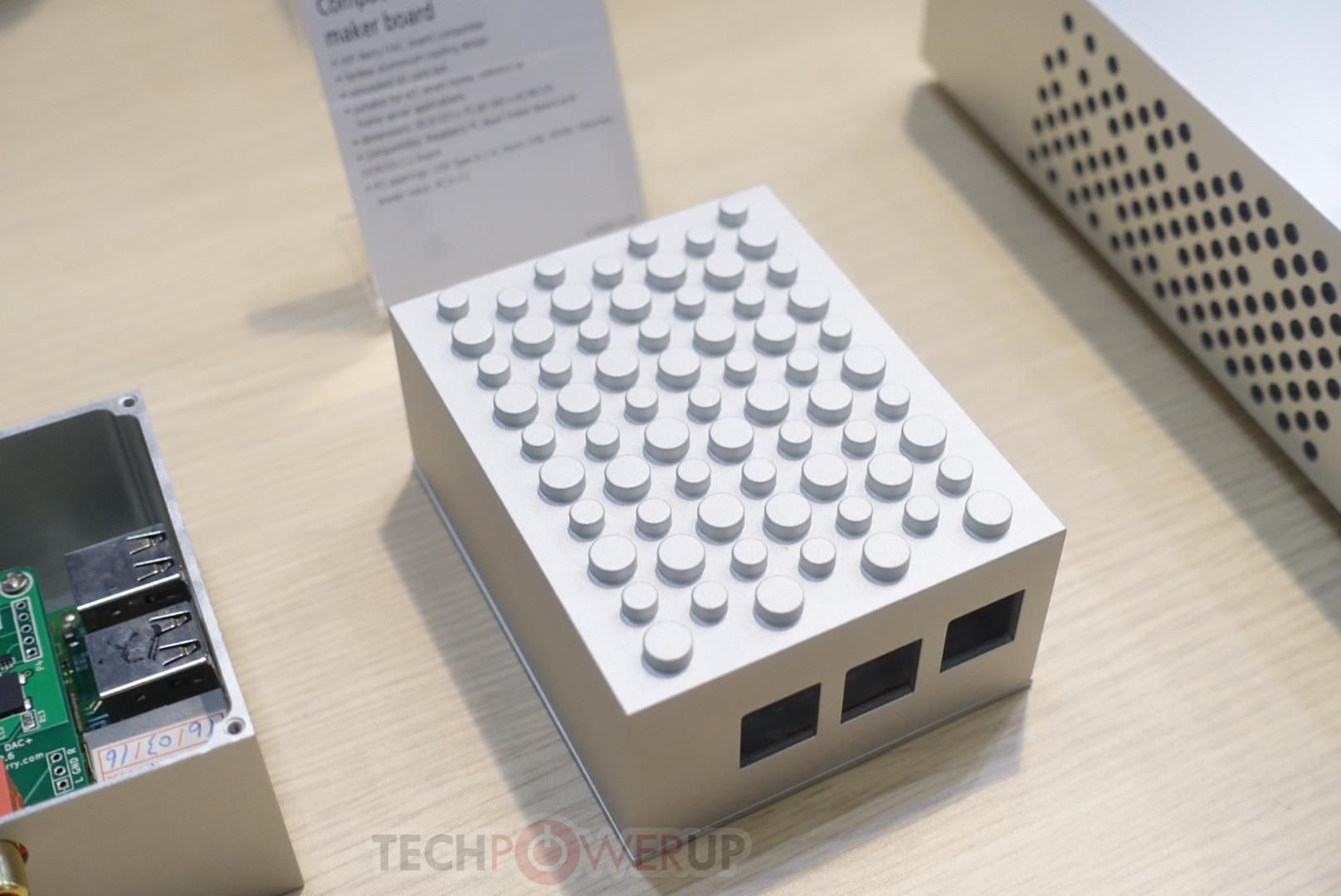
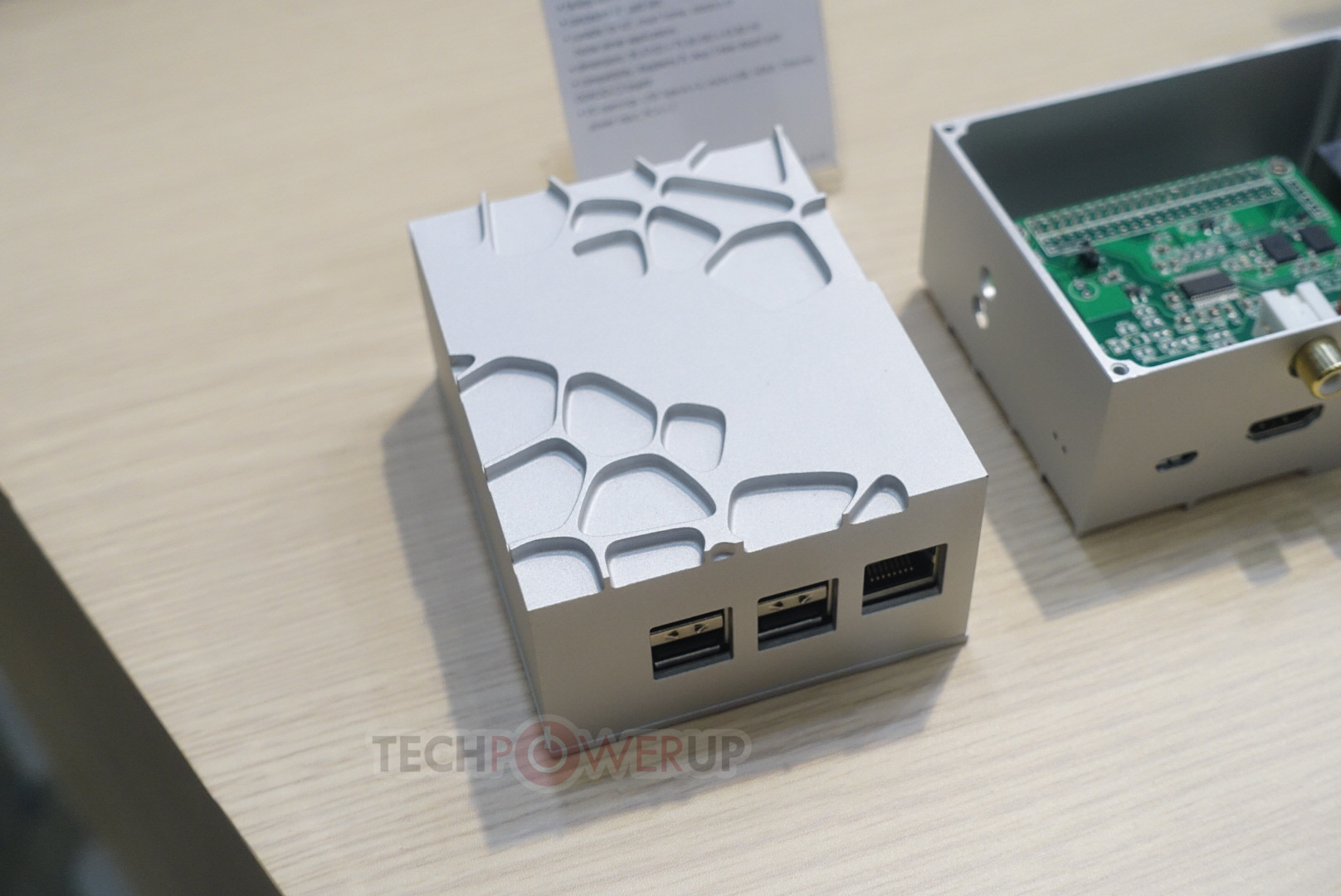
Akasa Presents Several New Aluminium-rich Cases

Akasa this Computex unveiled half a dozen new premium cases for congested desks and living rooms, which make use of copious amounts of aluminium to both look good and stay cool without any moving parts (read: fans). The Dot and Gem made us go "awww" first. The Dot looks like a Lego brick that spent too much time in Pripyat (although not as big as a real brick itself). It can house several models of Raspberry Pi, ASUS Tinker Board, and ODROID-C2, which are ARM-based "makerboards." You also get an included SD card reader, and room for a Hi-Fi Berry DAC board to go with your Pi. The Gem has a nearly identical design, but with an eclectic top plate design.

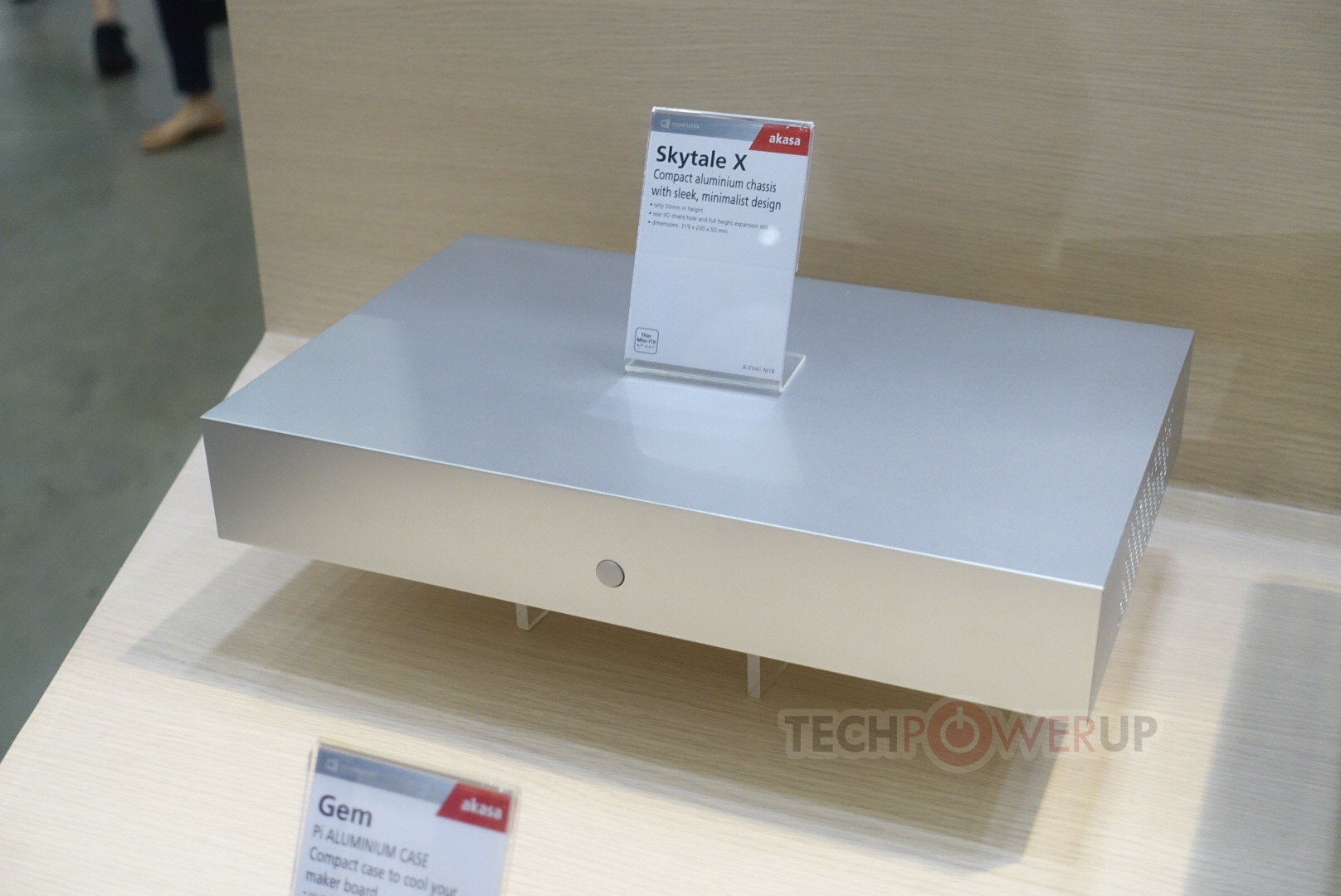
The Skytale and Skytale-X, obviously so-named to catch PC enthusiasts' eyes as they passed by the booth, are sleek, silvery-aluminium HTPC cases with a monolithic design (as opposed to heatsink ridges sticking out of the sides). With a height of just 50 mm, both cases are designed for mini-ITX motherboards that needn't be thin. What sets the two apart is the presence of a full-height add-on card slot on the Skytale-X, which uses a PCIe riser. Lastly, we spotted a new variant of the Turing case Akasa launched in February, which comes in a racy shade of blue.

PCI-SIG Achieves 32 GT/s with New PCI-Express 5.0 Specification

PCI-SIG today announced the release of PCI Express (PCIe ) 5.0 specification, reaching 32 GT/s transfer rates, while maintaining low power and backwards compatibility with previous technology generations. "New data-intensive applications are driving demand for unprecedented levels of performance," said Al Yanes, PCI-SIG Chairman and President. "Completing the PCIe 5.0 specification in 18 months is a major achievement, and it is due to the commitment of our members who worked diligently to evolve PCIe technology to meet the performance needs of the industry. The PCIe architecture will continue to stand as the de facto standard for high performance I/O for the foreseeable future."

"For 27 years, the PCI-SIG has continually delivered new versions of I/O standards that enable designers to accommodate the never-ending increases in bandwidth required for next generation systems, while preserving investments in prior generation interfaces and software," noted Nathan Brookwood, research fellow at Insight 64. "Over that period, peak bandwidth has increased from 133 MB/second (for the first 32-bit parallel version) to 32 GB/second (for the V4.0 by16 serial version), a 240X improvement. Wow! The new PCIe 5.0 standard doubles that again to 64 GB/second. Wow2. We have come to take this increased performance for granted, but in reality, it takes a coordinated effort across many members of the PCI-SIG to execute these transitions so seamlessly."

Noctua Showcases Next Generation of D-type Coolers, Chromax Coolers and More at Computex 2019

During our visit with Noctua, we spotted what every air cooling enthusiast has been hoping for, a brand new top of the line D-type cooler. Noctua's next generation model is of course based on the award-winning NH-D15 and NH-D15S and comes packing 7 heat pipes alongside a 10% increase in surface area for improved performance. It also takes design cues from the NH-D15S by using an asymmetrical design for improved PCIe clearance while also retaining the same fin cutouts for improved RAM clearance of 65 mm.

The company plans to release two versions, one with a single fan and of course a dual fan thus offering both a high compatibility and a maximum performance model. The bundled fan will be Noctua's proven NF-A15 PWM model which when paired with the new redesign results in a cooler capable of dissipating over 400-watts on the TR4 socket. Speaking of sockets, it will support all current offerings including AMD, LGA20xx, LGA115x with a separate model for socket TR4. It has a current ETA of Q1 2020 and will come bundled with Noctua's NT-H2 thermal compound.

Cooler Master Announces New Peripherals at Computex

Cooler Master, a global leader in designing and manufacturing innovative gaming peripherals and computer components, announces its new lineup of wireless peripherals and ultra-lightweight mouse at Computex 2019.

"Showcasing this new wireless lineup at Computex reflects the Cooler Master commitment to bring high-performing and innovative products to gamers and creative pros of all levels." says Bryant Nguyen, Peripheral General Manager.

G.SKILL Showcases Extreme DDR4 at Computex 2019, Up to DDR4-4000 384GB & DDR4-5200 16GB

G.SKILL International Enterprise Co., Ltd., the world's leading manufacturer of extreme performance memory and gaming peripherals, is showcasing several ultra-high speed and low latency DDR4 memory kits on Intel and AMD platforms at Computex 2019. These live demo systems feature motherboards from ASUS, ASRock, EVGA, Gigabyte, and MSI, as well as multiple memory kits made with Samsung B-die ICs.

DDR4-4000 384GB (32GBx12) - Massive Capacity DDR4 Beast of a Kit

Any experienced overclocker knows two factors that make achieving high-speed RAM more difficult - high module capacity and increased module count. This mystical beast of a memory kit runs at DDR4-4000MHz with an enormously massive total capacity of 384GB with 12 modules of 32GB each. While earlier 32GB modules were constructed with 8Gb components, these modules use higher density 16Gb ICs. This extremely high-capacity, high-performance live demo system is built with the Intel Xeon W-3175X processor and ASUS ROG Dominus Extreme motherboard.

Toshiba Launches XG6-P NVMe SSD Series

Toshiba today announced the XG6-P solid state drive (SSD) series, a derivative of its NVMe M.2-based XG6 Series featuring class-leading write performance. Offering up to 2,048 gigabytes (GB) of capacity, XG6-P SSDs are ideal for high-end workstation PCs and gaming systems, as well as cost-optimized data center and composable infrastructures. With over 30 percent higher sequential and random write speeds and over 15 percent higher random read speeds than its predecessor, the XG6-P Series enables enhanced application performance and data access.

8Pack Launches the New Supernova XL ft Intel's Ultra-exclusive i9-9990XE

Ian "8Pack" Parry is proud to announce his latest extreme machine, the Supernova XL. Built inside the CaseLabs STH10, the Supernova XL not only draws its inspiration from the very first 8Pack machine, but also gives one final moment in the sun to add to the already accomplished CaseLabs legacy. Standing at just under a metre the Supernova XL is a colossal machine, consisting of five custom acrylic pass through plates complete with mirrored internals. It's a showpiece to behold. The interior is also fitted with a light box, bathing the water-cooled components in a customisable light display.

Powering the Supernova XL you'll find one Intel's most exclusive processors, the i9-9990XE. Available in extremely limited quantities, through closed auction, this elusive processor is so exclusive it isn't even listed on the official Intel Ark database. The i9-9990XE is a 14 core processor, with a 4.0 GHz base clock pulling 255W TDP, it's capable of hitting a 5.0 GHz boost clock across all cores - straight out of the box. Cooled by a custom water-loop, with two dedicated radiators, the i9-9990XE is overclocked by 8Pack himself for a system that gives only world-class leading performance.

Thermaltake at COMPUTEX 2019: Introducing the Floe DX RGB Series TT Premium Edition AIO

Thermaltake, the leading PC DIY premium brand for Cooling, Gaming Gear and Enthusiast Memory solutions, reveals their top-end liquid CPU cooler Floe DX RGB Series TT Premium Edition at COMPUTEX (TWTC Nangang Exhibition Hall 4th floor, booth number M0120). Available in 240mm, 280mm, and 360mm, Floe DX RGB Series is an all-in-one cooler with a vivid-colored LED waterblock and digital-control Riing Duo RGB high-static pressure fans.

This new cooler series by TT Premium features fantastic cooling performance, exceptional quality, and addressable LEDs design. Both of the waterblock and the fans are equipped with multiple addressable LEDs that can be controlled by the exclusively designed software. Functions within the software allow users to personalize colors for each LED, monitor fan performance and track CPU temperature.

be quiet! at COMPUTEX 2019: Introducing New Straight Power 11 Platinum, System Power 9 CM PSUs

be quiet! at COMPUTEX 2019 introduced two new power supply units that show no compromises in performance and the sound-control the company is known for (and that it proudly bears in its name). The Straight Power 11 series will offer units rated at up to 80 Plus Platinum efficiency, meaning they can be up to 94% efficient while delivering power to your hardware - all with a silent operation thanks to their 135 mm, Silent Wings 3 fans. These are fully modular with Japanese-grade capacitors, and will be offered in 550 W, 650 W, 750 W, 850 W, 1,000 W, and 1200 W capacities.

Gigabyte Shows Off 15 GB/s PCIe 4.0 SSD

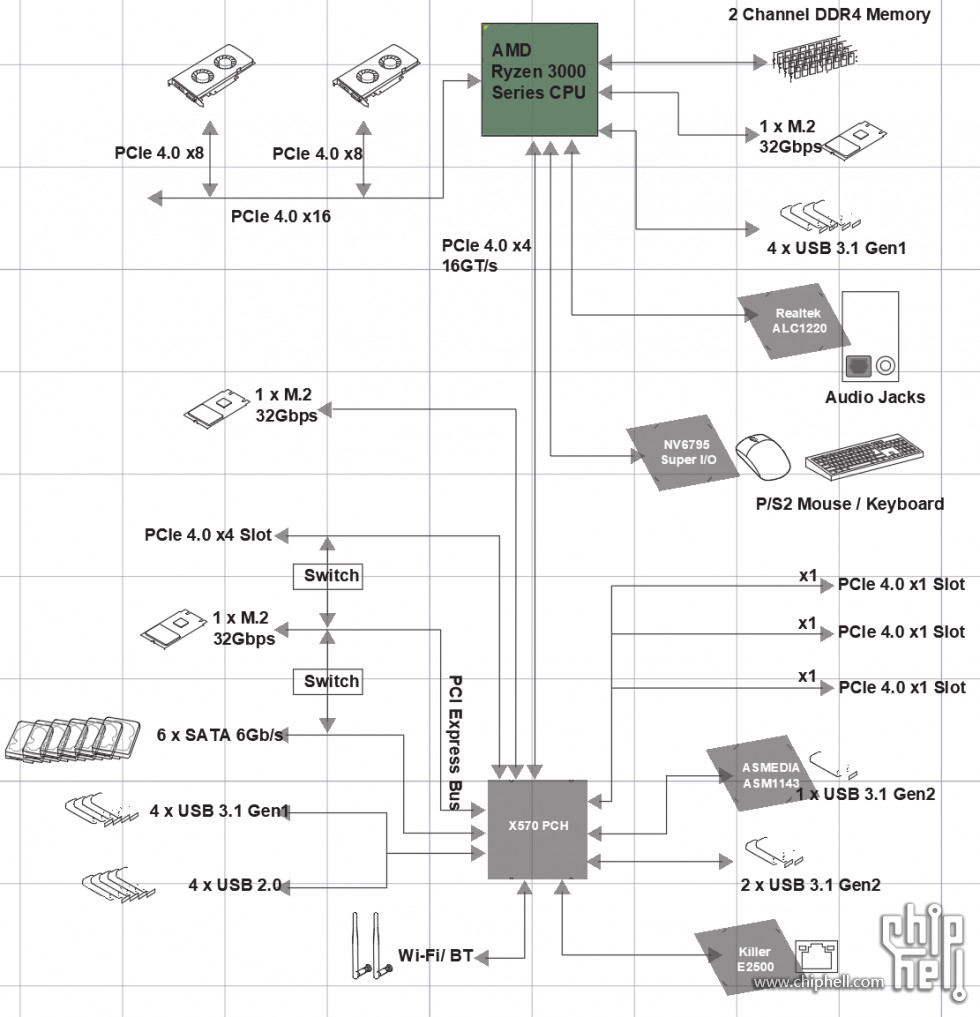
With AMD chipset based motherboards like X570 and next-generation Ryzen 3000 series CPUs delivering the 4.0 version of the PCIe protocol for consumers, products based on the faster protocol are bound to take advantage of its improvements - especially in terms of better bandwidth.

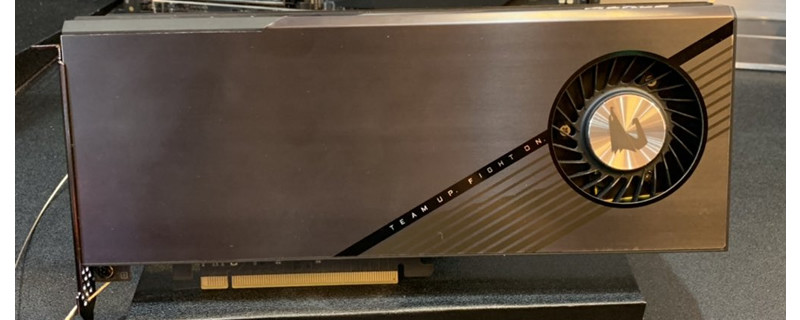
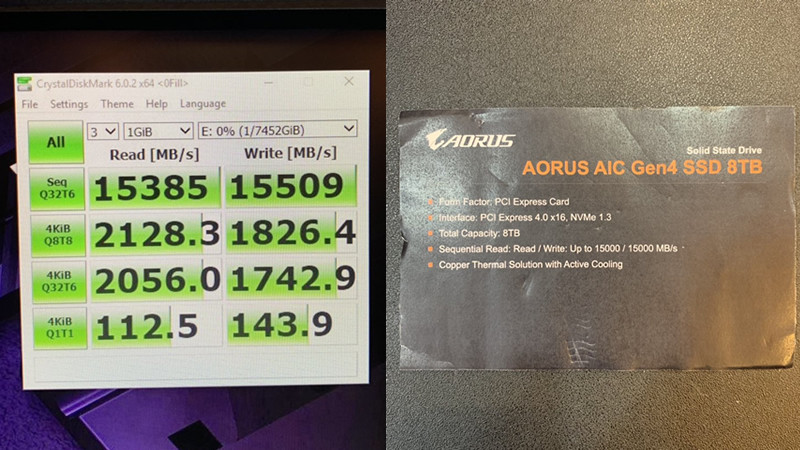
At their Computex booth, Gigabyte showed off some pretty impressive results of their PCIe 4.0 based SSD card. The so-called "Auros AIC Gen4 SSD" is a performance monster. It is able to pack up to four PCIe 4.0 M.2 SSDs that can go up to 2 TB of density each, for a maximum 8 TB total storage. Put them in RAID 0 configuration, though, and you will get some amazing performance numbers. Gigabyte demonstrated speeds exceeding 15 GB/s in sequential reads and writes, providing much more bandwidth than what has ever seen before ina consumer-geared product. The SSD comes with an aluminum shroud with pre-applied thermal pads to facilitate heat dissipation. Additionally, there is a blower fan attached to the card to keep a constant flow of fresh air, which seems like a must if you're packing four M.2 drives inside a tiny aluminum case.

Seasonic Pushes the Fanless Envelope to 700W, Including 80 Plus Titanium

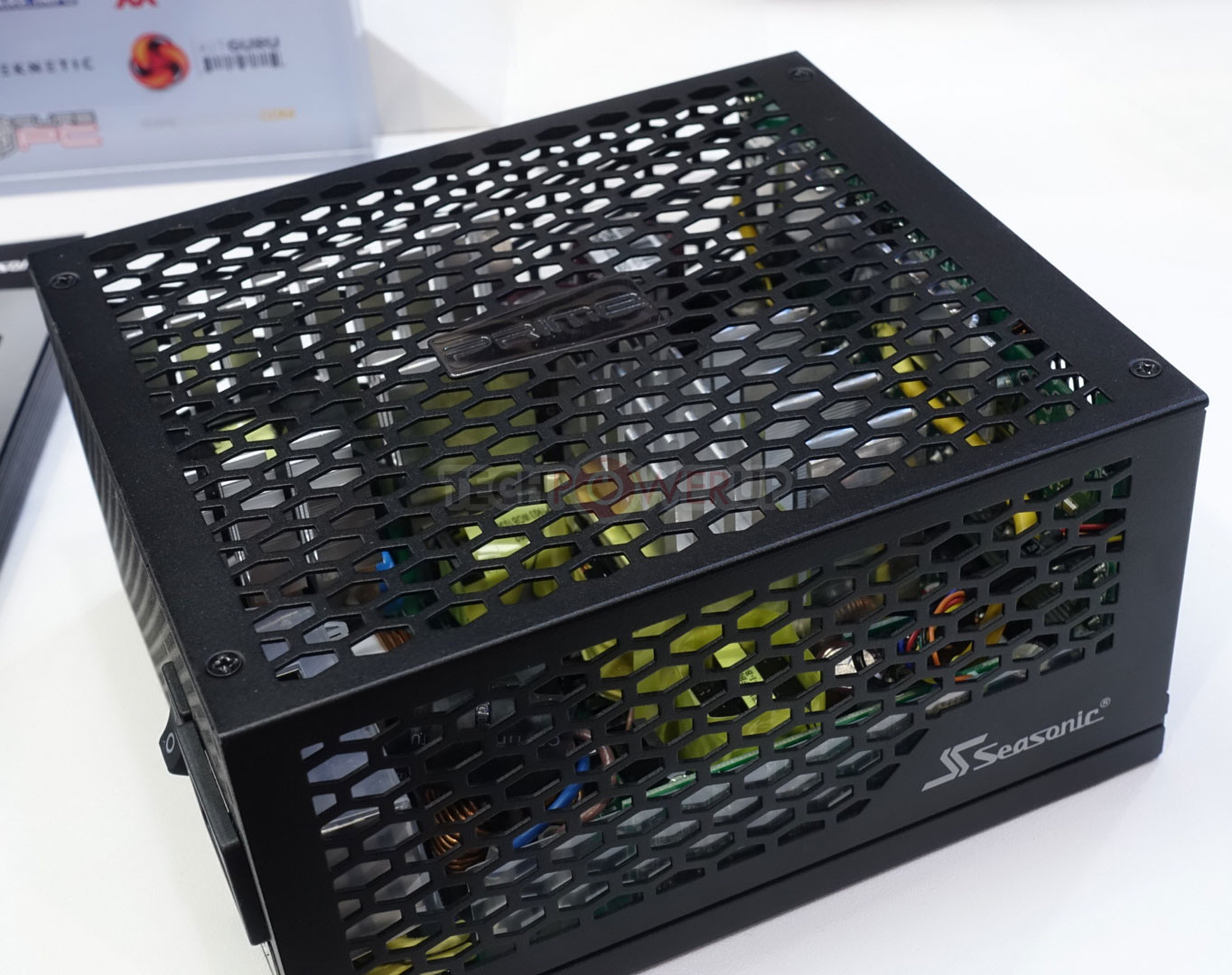
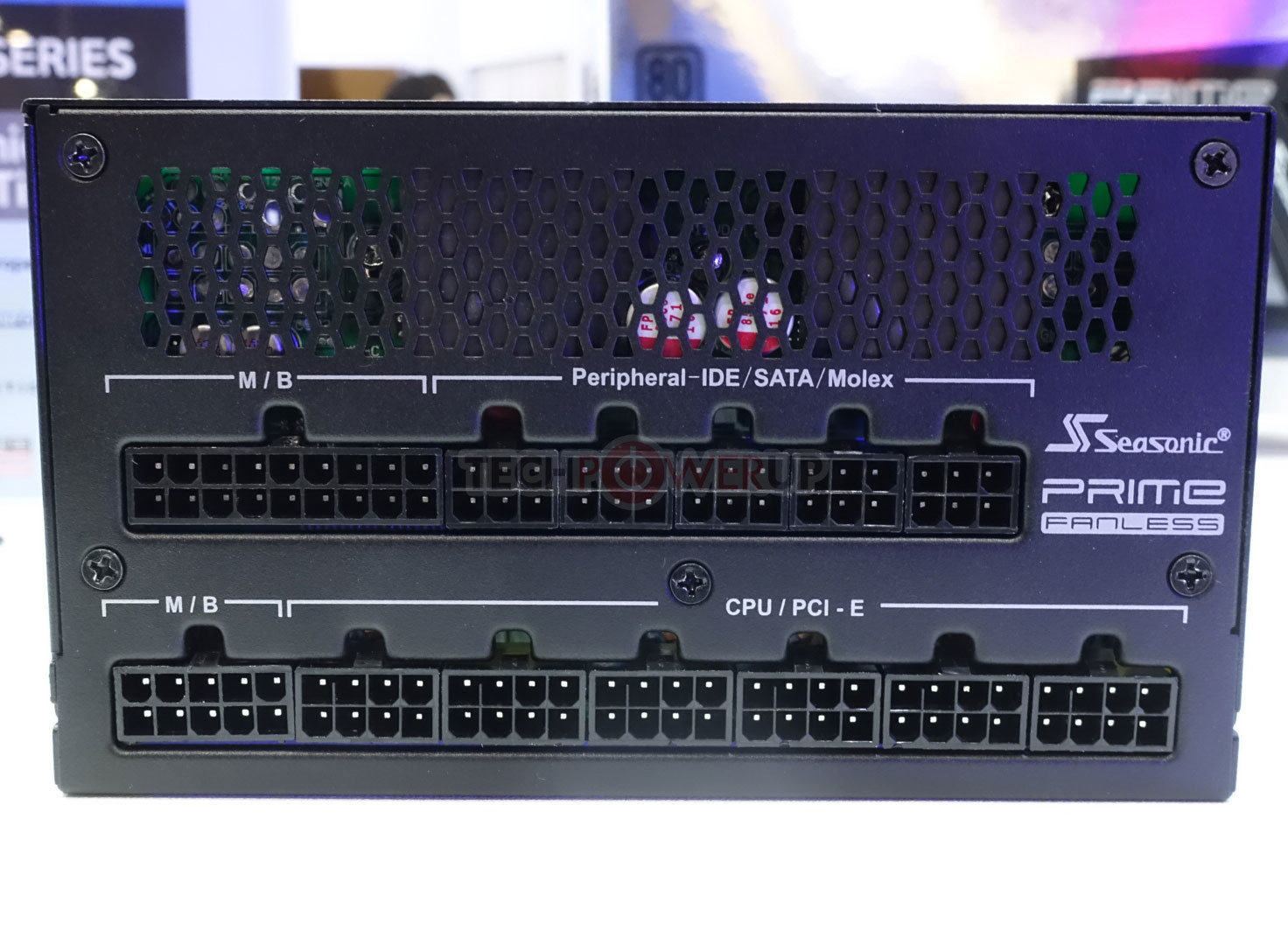
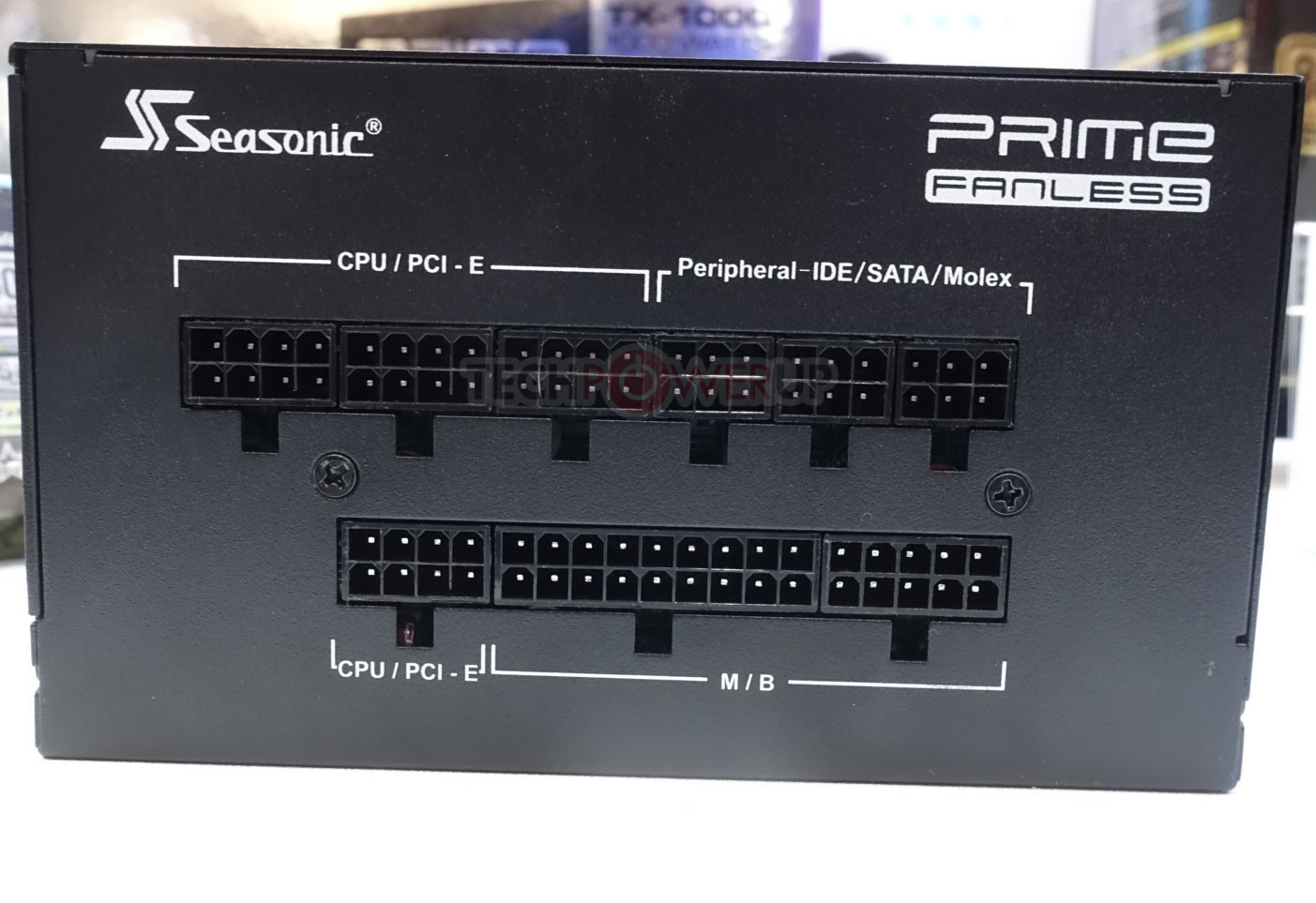
Each year we look forward to the next big fanless PSU. Seasonic did not disappoint this year, with the new Prime Fanless TX-700. This replaces the Prime Titanium Fanless 600W as the company's most powerful PSU of its kind. Its connectivity is updated to include two 4+4 pin EPS connectors, up to six 6+2 pin PCIe power, and up to twelve SATA power connectors. The best part? It holds onto its >94% 80 Plus Titanium efficiency even at 115VAC. Ripple noise suppression has been tightened to 20 mV, and micro-tolerance load regulation to 0.5%. Seasonic picked the choicest aluminium electrolytic capacitors, and worked on improving the thermals even further. The company backs their design effort with a 12-year warranty.

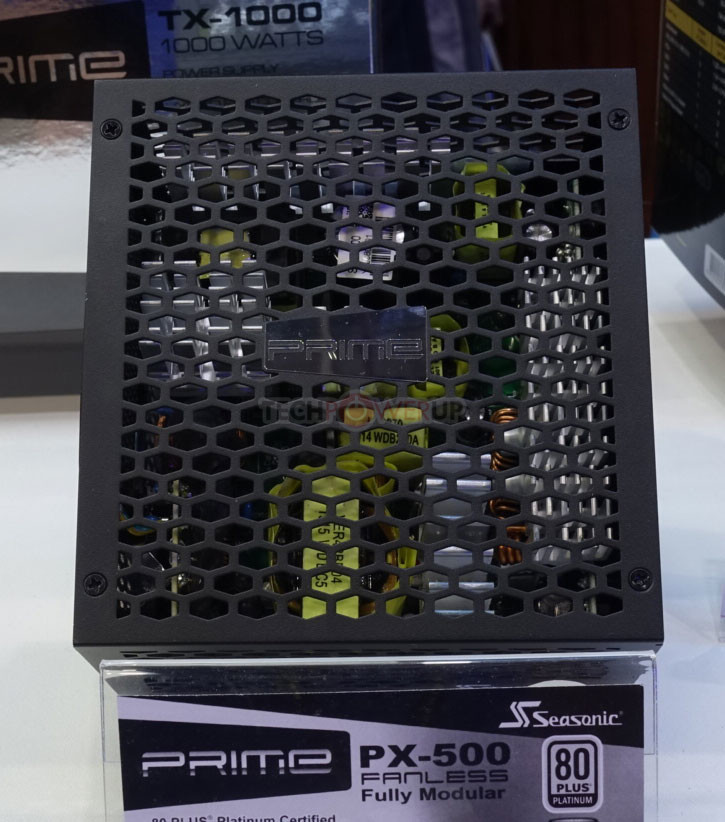
Seasonic also unveiled the compact 12 cm-long Prime Fanless PX-500 if your requirements aren't too steep. This 500W unit boasts of a respectable 80 Plus Platinum efficiency, the same ripple suppression and and MTLR features as its bigger sibling, and the same electrical/thermal protections. And you still get the 12-year warranty so the PSU outlasts everything else in your rig. The PX-500 has enough juice and straws for HEDT, with two 4+4 pin EPS, and four 6+2 pin PCIe.

Seasonic CORE TUF Gaming Alliance PSUs Pictured

Back in 2017, Seasonic introduced its CORE line of mainstream PSUs with 80 Plus Bronze efficiency. In 2019, the company wants to win more mainstream consumers, and hence unveiled a new line of CORE series PSUs boasting of 80 Plus Gold efficiency, partially/fully modular cabling, and ASUS TUF Gaming Alliance co-branding. The new 2019 CORE series come in various mid-range capacities starting from 450W, to 550W, 650W, leading up to 750W. The ones shown at Computex were 450W with partially-modular cabling and 650W with fully-modular cabling.

The new CORE series PSUs are built with compact 14 cm long bodies, and a new 120 mm fan that can stay completely off under a load/temperature threshold. The innards of these PSUs are new, with a few segment-first features such as DC-to-DC switching, and tight (±4%) voltage regulation across all three domains. There is a single +12V rail design, and an active-PFC component. Most common electrical protections are included, such as over/under-voltage, overload, overheat, and short-circuit protection. Seasonic is backing these PSUs with 7-year warranties.

Seasonic Connect a Godsend for Cable Management Novices?

Seasonic showed us a unique new innovation that could change the way you manage your cable clutter, particularly python-wrestling with your 24-pin cable behind the motherboard tray. Called simply the Seasonic Connect, the accessory is a PSU connection hub, or a disintegration of a conventional modular PSU's connector back-plane. A ruler-shaped structure runs behind your case's motherboard tray, with your PSU's various connectors (ATX, EPS, PCIe, SATA), on its either sides. Shorter-than-usual modular cables handle the "last-mile" connection to the various devices. A single ribbon cable runs between the Connect and the PSU, with high-capacity wires for the various voltage domains (+12V, 3.3V, 5V, etc.). Those into PSU cable modding would be breathing very heavily. The upcoming Prime GX750, an upper-mid range model with 80 Plus Gold chops, could be the first to implement this concept.

FSP Goes "Full Tilt" with the CMT710 Premium Case

FSP is doubling down on premium PC cases this Computex. The company unveiled the eye-catching CMT710 open-air chassis. Made from aerospace-grade aluminium and tempered glass, the case features a symmetric, forward-tilting design that's partitioned vertically right along the middle. Each of the two halves has enough width to accommodate 17 cm tall add-on cards or 140 mm-wide radiators. The left side houses the motherboard tray with room for add-on cards close to 40 cm in length. You can also use up the front space to mount a 420 mm x 140 mm radiator, while still leaving room for a pump+reservoir.

The right side is where you'd normally expect the PSU bay, a bunch of drive bays, and room for more liquid cooling gear, until you discover that this half of the case has enough room for a second motherboard, oriented upside down, complete with room for its own liquid-cooling loop. Both halves have vertical add-on card capability letting you show off your high-end VGA. If you decide not to have a second system, you have enough room for dozens of hard drives, elaborate liquid cooling setups, or anything your mind can conjure up in space meant for an entire system!

ASRock X570 Aqua is a $1000 Zen2-ready Liquid-Cooled Monsterboard

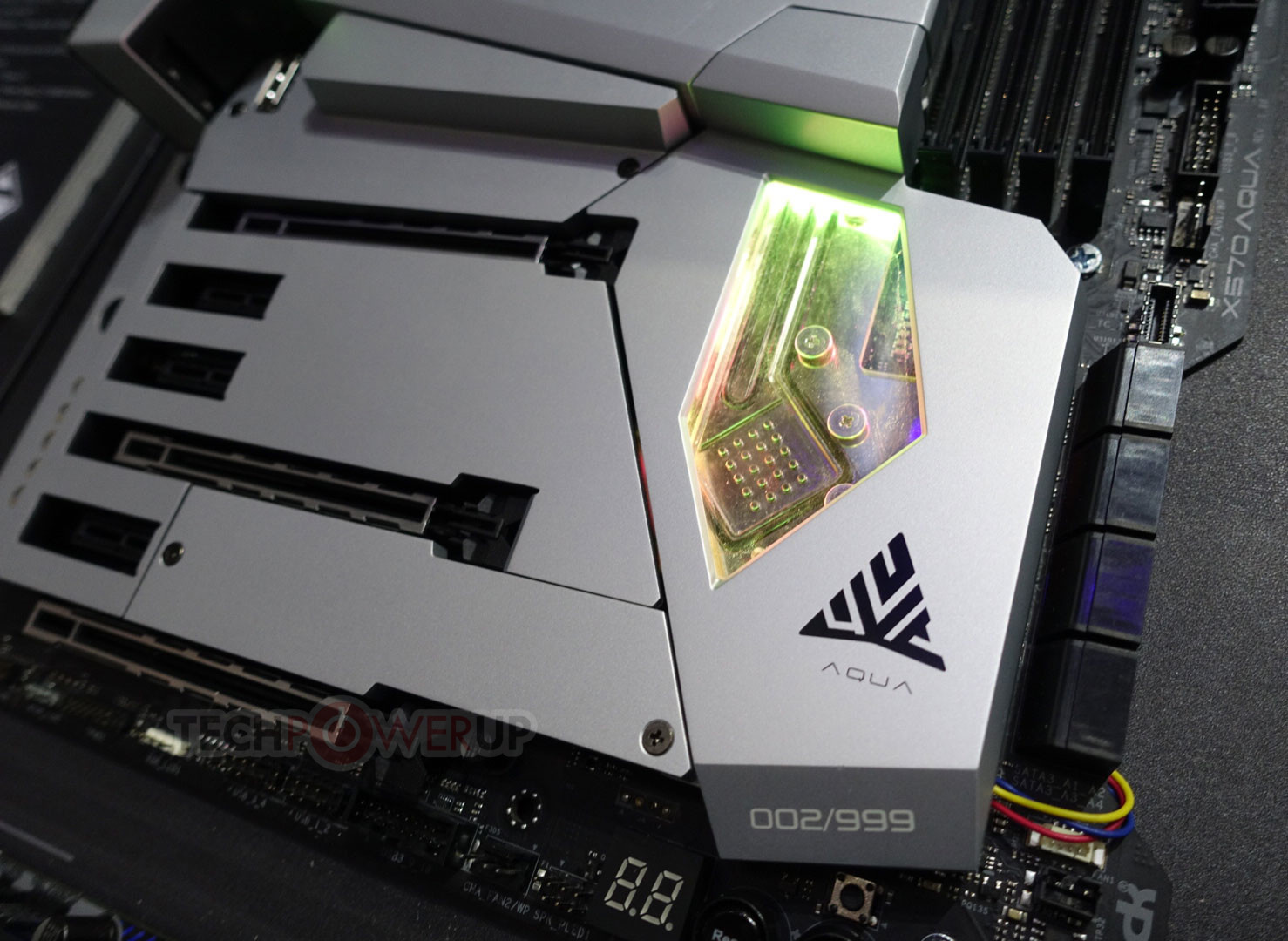
We were pleasantly mistaken when we thought ASRock would stop at the X570 Phantom Gaming X or the X570 Taichi for AMD's new "Valhalla" enthusiast desktop platform. It turns out that they have a roughly-$1,000 monster motherboard in the pipes, called the X570 Aqua. Pictured below, the board is based on a slight variation of the X570 Phantom Gaming X PCB. The biggest change of course is the aluminium shroud that covers most of the board's front side. There's also a metal back-plate.

Beneath the metal shroud is what gives the board its name: a massive liquid-cooling monoblock that cools not just your processor (including heavyweights such as overclocked Ryzen 9 3900X chips), but also the CPU VRM, and the feisty AMD X570 chipset. The coolant channel first goes over the CPU through a large micro-fin lattice, then onto the X570 chipset, and finally over the CPU VRM on its way out. Much like the Phantom Gaming X, this board features daisy-chained dual-channel DDR4 memory slots designed to make the most OC out of 2-module setups.

EVGA SR-3 DARK Will Challenge the ROG Dominus for W-3175X Supremacy

EVGA at its Computex 2019 booth showcased its flagship HEDT motherboard, the SR-3 DARK. This socket LGA3647 motherboard based on Intel C621 chipset, is purpose-built for squeezing the most out of the Xeon W-3175X 28-core HEDT processor Intel rolled out last year to challenge the Threadripper WX. The SR-3 DARK competes with only two other motherboards of its kind, the ASUS ROG Dominus Extreme, and GIGABYTE C621 Aorus Xtreme. EVGA deployed many of the innovations it introduced with the Z390 DARK that make it arguably the best LGA1151 motherboard for record-seeking overclocking.

For starters, the CPU socket is oriented sideways, just like the Z390 DARK, to position the DDR4 memory slots north and south of the socket. There's only one slot per memory channel, so you don't have to worry about multi-slot topology hindering your memory OC in any way. The CPU VRM is located east of the socket, directly next to the board's angled power inputs that include one 24-pin ATX and four 8-pin EPS inputs! There are additional inputs such as two SATA power, and one 6-pin PCIe, to stabilize the other power domains. The VRM area, along with the C621 PCH, are liquid cooled by a monoblock embedded into an aluminium heatsink. This block has a clear-acrylic top, and its coolant channel runs over the CPU VRM first, before guiding the coolant through a fin-lattice over the PCH, and then onto the outlet.
Tuesday, May 28th 2019

Today's Reviews

Accessories
Cases
CPU Coolers
Graphics Cards
Headphones
Keyboards
Memory
Monitors
Mousepads
Notebooks
PSUs
Sound Cards
Speakers
SSD
Cooler Master Masterbox Q500L Review

Cooler Master Masterbox Q500L Review

The Masterbox Q500L is a compact chassis that still allows for a full-size ATX board. However, that is not what makes it unique. That falls to how this case may be used as both a tower or desktop with the freedom to install fans or liquid cooling nearly anywhere and the ability to move the I/O panels around.

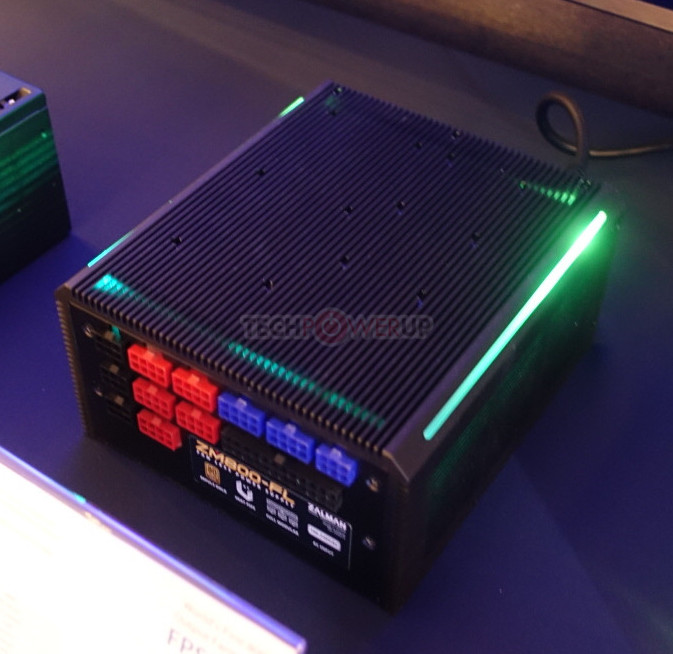
Zalman Debuts All New Fanless and RGB Spectrum Power Supplies

While at Computex 2019 we also had a chance to look at Zalman's power supply lineup which has seen some interesting additions in the FPSU800 and ZM-DFP 700 and 800 which are all new designs. The FPSU800 is billed as the worlds first 800-watt fanless power supply and uses DTH (Direct Touch Heat-pipes) and an all aluminium case to keep temperatures in check while also ensuring long term reliability. It is fully modular with RGB edge lighting keeping things neat and tidy with a touch of flair. In regards to the details, it is an 80 Plus Gold unit with capacitors rated at 105°C. When it comes to protection, the FPSU800 offers OPP, OCP, OTP, OVP, UVP, and SCP and has an Active-PFC design. As the name implies, only an 800-watt unit version is available.

Meanwhile, the ZM-DFP is a bit more gamer focused, available in 700-watt and 800-watt versions it features RGB Spectrum 120 mm and 80 mm fans. Much like the FPSU800, it is fully modular, 80-Plus Gold rated, and has the same protection mechanisms including an Active-PFC design.

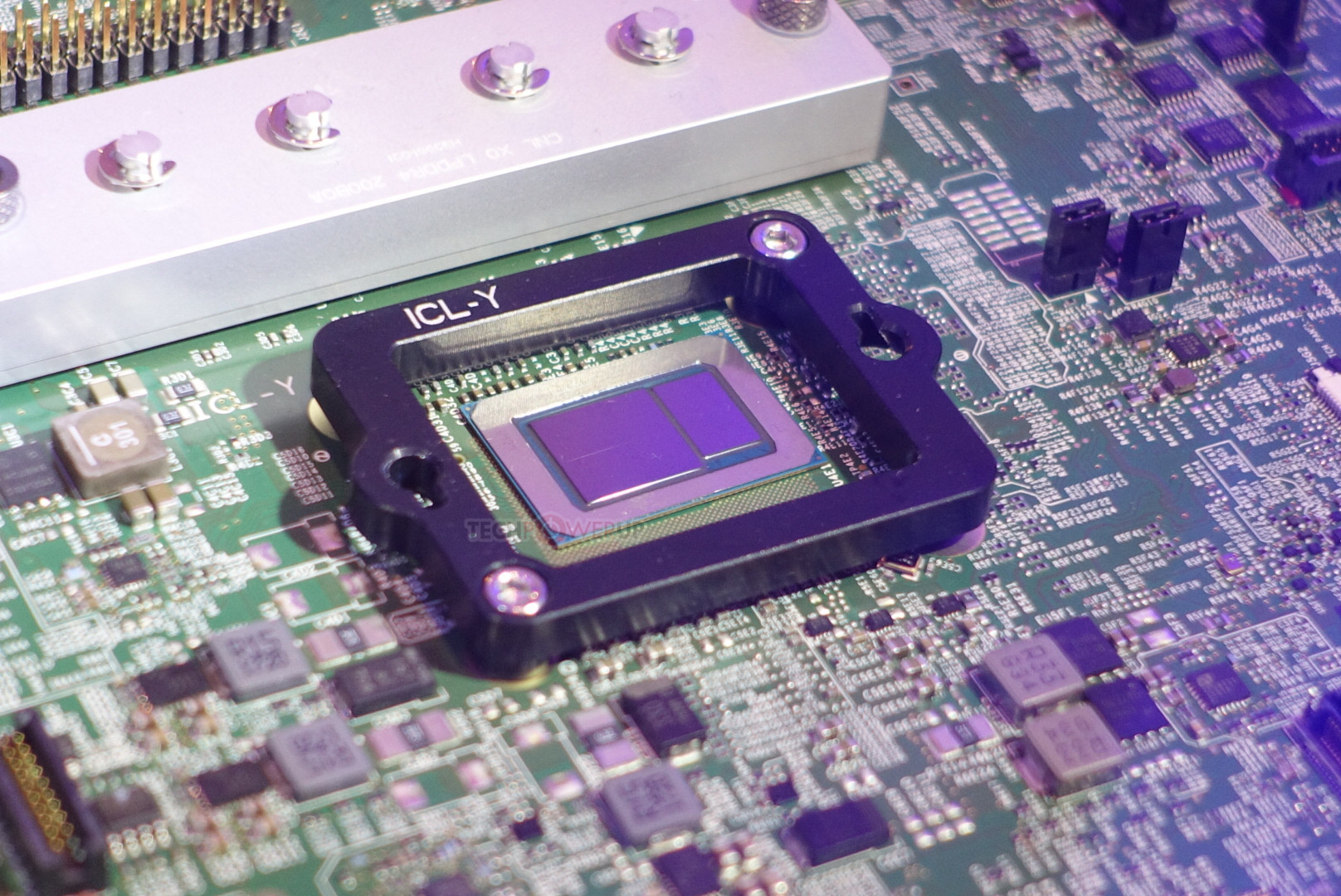
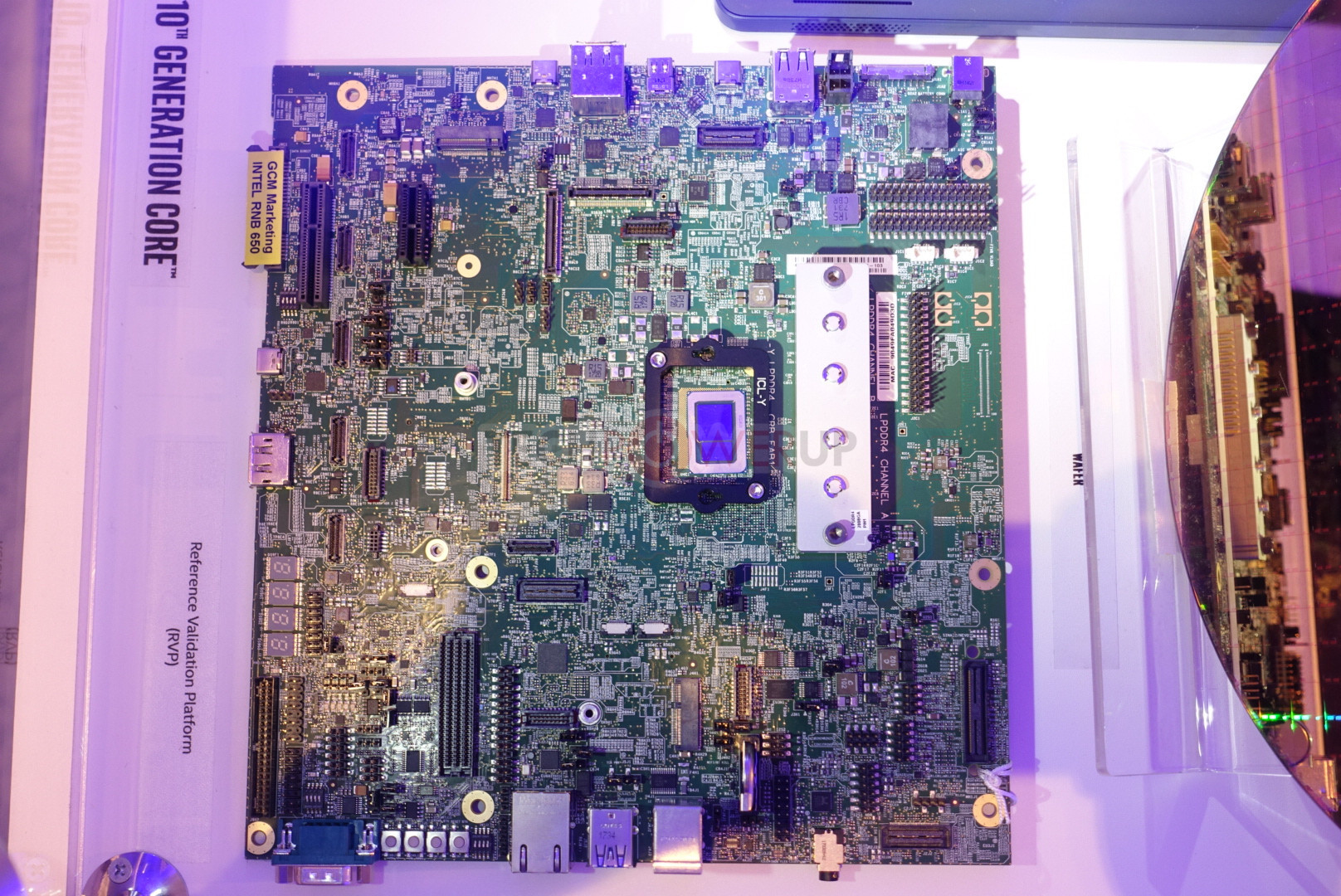
Intel "Ice Lake-Y" MCM Pictured Up Close

Here are some of the first pictures of the 10th generation Core "Ice Lake-Y" multi-chip module, designed for ultra low-power platforms, such as notebooks and 2-in-1 convertibles. These chips have a TDP target as low as 8W to 15W, are built in a BGA (ball-grid array) MCM (multi-chip module) to minimize Z-height and conserve mainboard PCB real-estate, respectively. The larger dies of the two of course is the 10 nm "Ice Lake" SoC with 4 "Sunny Cove" CPU cores, and a Gen11 GT2 iGPU. The smaller die is the PCH (platform controller hub), or chipset. The RVP (reference validation platform) is a motherboard that lets you test every possible connectivity option of the platform, by manually switching around PCIe lanes, SATA links, GPIO, LVDS, and TMDS lanes via jumpers. Intel usually hands these out to OEMs, system integrators, and system software developers. We also spotted the "Ice Lake" 4-core wafer.

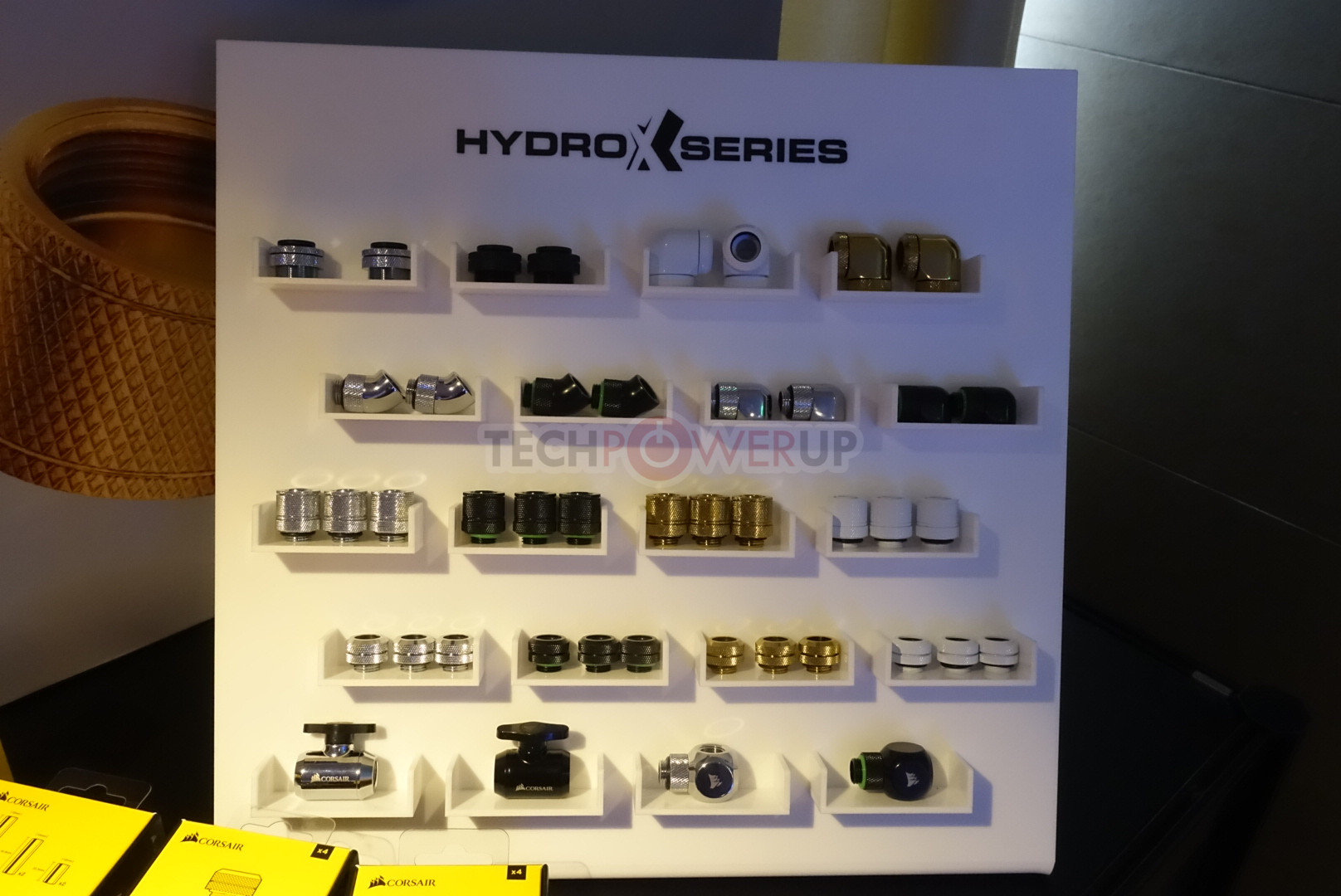
Corsair Hydro X Series DIY Liquid Cooling: Hands-on

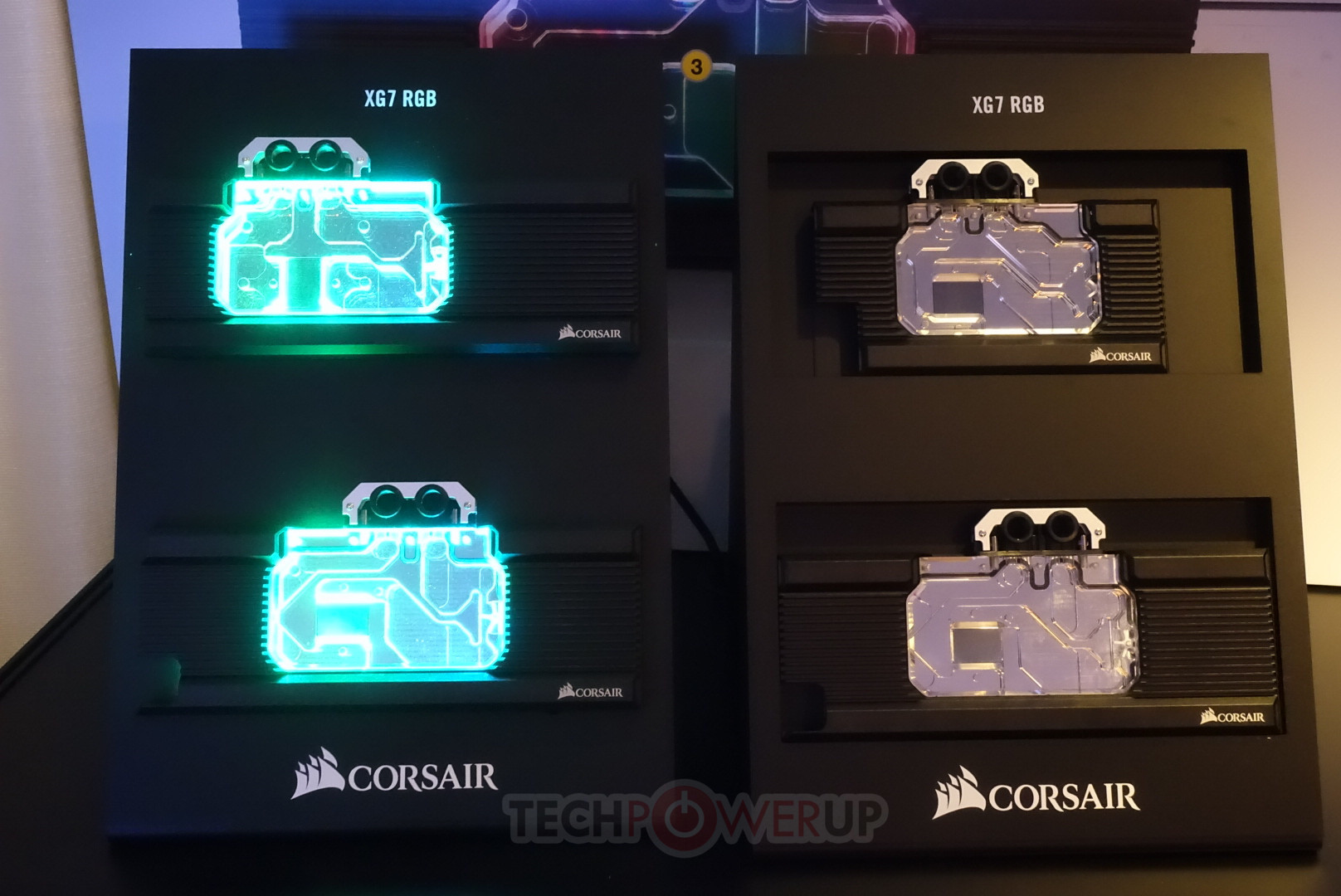
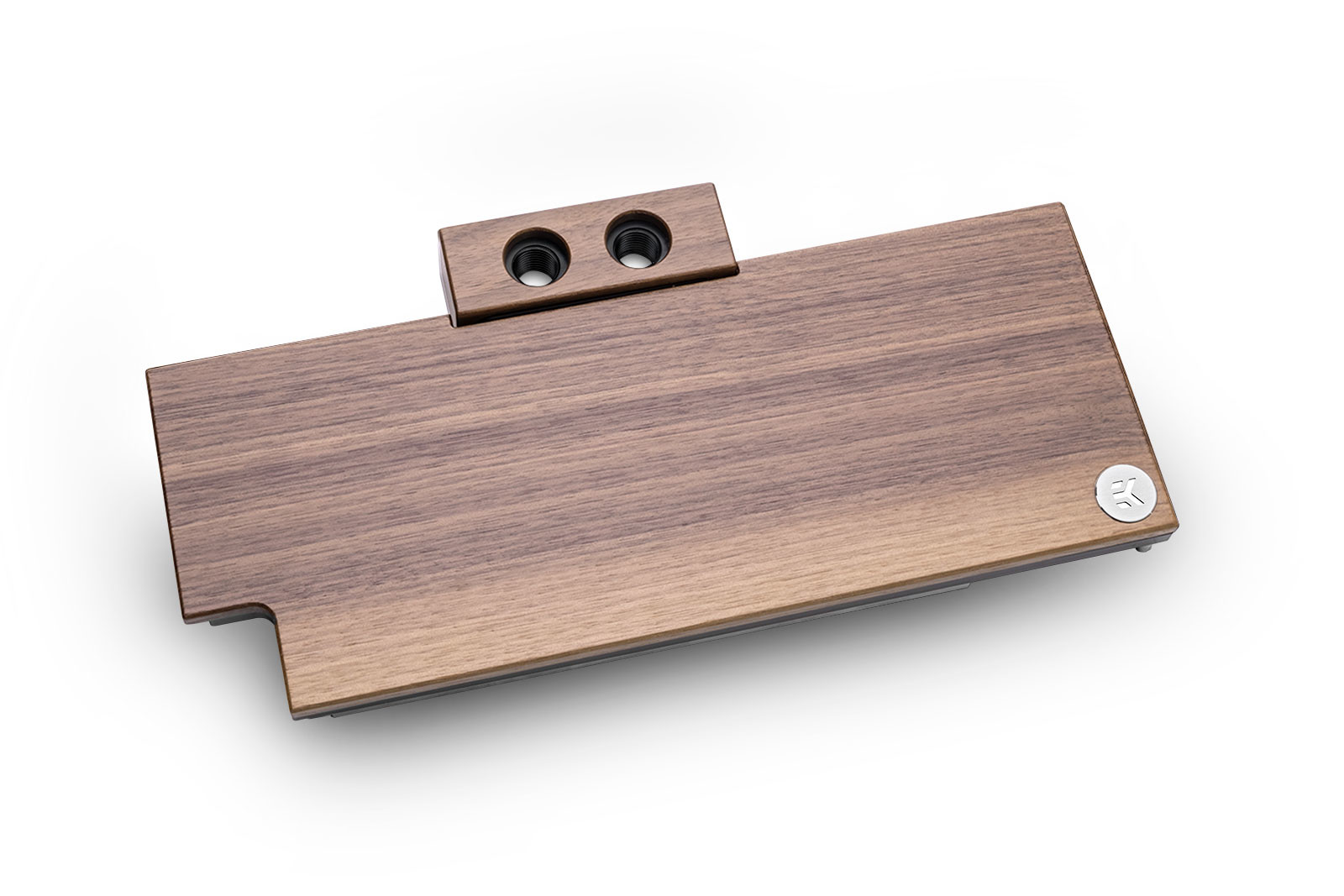
Corsair diversified its cooling business by entering the DIY liquid cooling market, with the new Hydro X series. The company built a whole portfolio of liquid cooling products, which includes CPU water-blocks, full-coverage VGA water-blocks, radiators, pumps, reservoirs, fittings, tubing, coolant, and related accessories such as pressure regulators, inlet ports, VGA back-plates, LED lighting strips, etc.

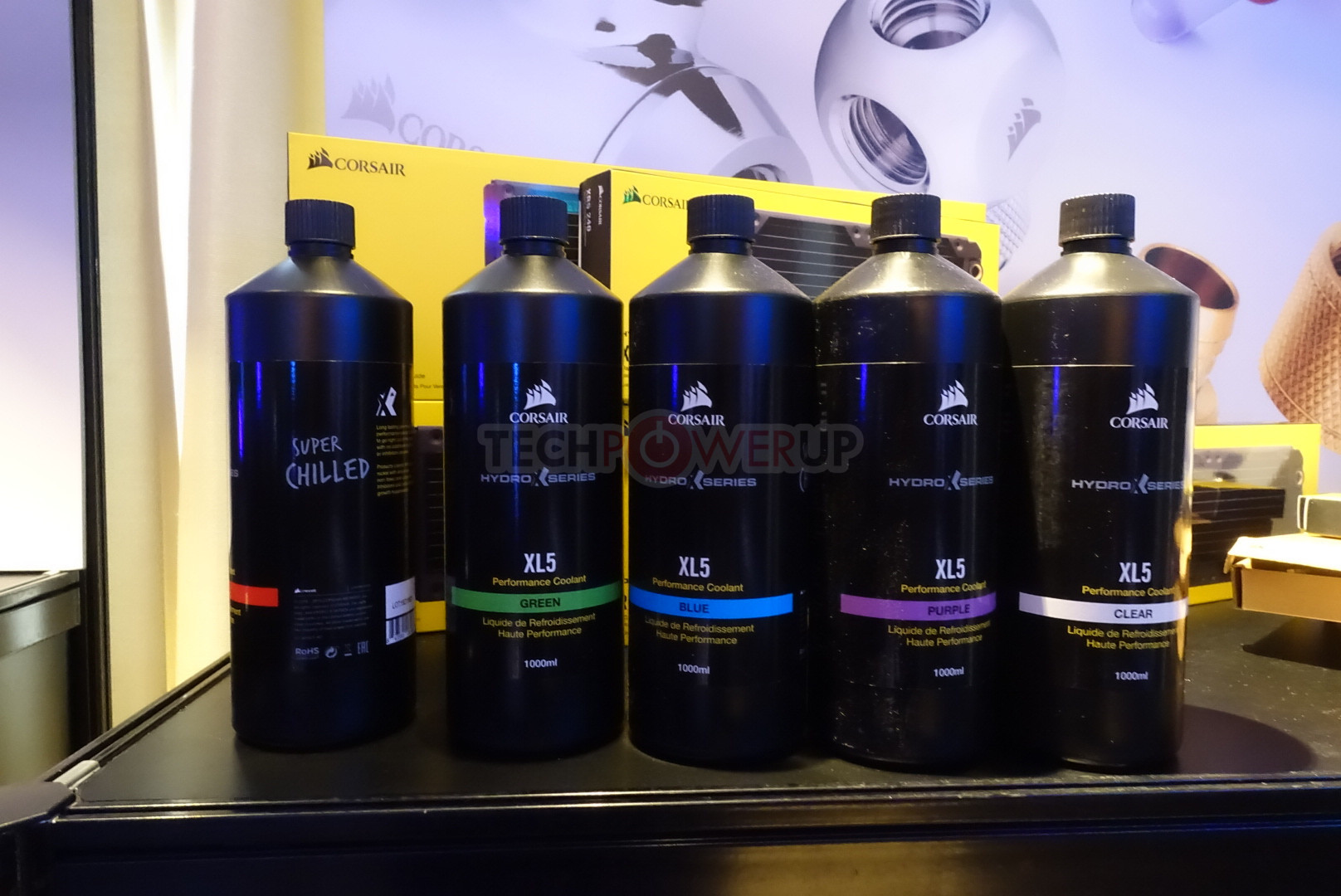
The VGA water-blocks in particular caught our attention. The operative portion of the block cooling the GPU, VRM, and memory, is made of nickel-plated copper with a clear acrylic top, however, an extensive portion is made of ridged metal to passively dissipate some heat. Corsair's radiators come in almost all major shapes and sizes, including the large 3x 140 mm (420 mm x 140 mm) format. The CPU water-blocks come with factory-fitted addressable-RGB LEDs that plug into a 3-pin aRGB header. Corsair also unified the pump and reservoir into a single component. Coolants come in almost all colors.

Zalman Z-Machine 500, TWCS 500 and X101 Cases Among Others Pictured

Zalman didn't forget to bring some cases to Computex, with the company bringing what appears to be there entire lineup spearheaded by the Z-Machine 500. It is an aggressive chassis that uses an open case design for maximum airflow and capable of handling just about any air or liquid cooling setup. It offers support for up to a 360 mm radiator in the front and a 240 mm radiator at the top and comes with five pre-installed 120 mm Spider RGB fans. Due to the internal layout, the motherboard I/O is up top, allowing for easy access. It should also be noted that while classified as an ATX mid-tower, it is only capable of handling 2x SSDs.

Zalman's TWCS 500 on the other hand while very similar to the Z-Machine 500 offers a unique hybrid cooling system, which is a combination of water cooling and immersion cooling. It has support for the same 5x 120 mm fans and comes with a 360 mm radiator pre-installed up front. There is space for a 240 mm radiator up top as well. Like the previous chassis it to is limited to 2x SSDs for storage. These basic features while acceptable can't hold a candle to two features Zalman has listed for this case, with the company listing "Ensure(d) Stability by Applying Insulating Fluoric Refrigerant (10 Degrees Cooler Than Other Cases)" and "Strengthen(ed) Antifouling Function Against Mineral Oil Refrigerant." It definitely makes the hybrid cooling functionality sound a whole lot more interesting. Hopefully, more info on these two features will be forthcoming soon.
Image #1 above is Z-Machine 500, the rest are the TWCS 500.

Zalman CNPS20X Air Cooler & Reserator 5 Liquid Cooler on Display at Computex 2019

Zalman had their Reserator 5 all-in-one liquid coolers on display during our visit at Computex 2019. This latest liquid cooler design is definitely unique in the looks department but also features a few design elements that set it apart from competing products. First and foremost is the pump, which is the world's first patented dual water pump with dual blades for improved cooling performance. It also uses a larger diameter (8 mm) tubing for improved coolant flow. Meanwhile, the fans and pump feature RGB LEDs which can be controlled through Zalman's Z-Sync software. When it comes to sizes, the company will be offering 240 mm, 280 mm, and 360 mm versions.

All Reserator 5 based units will have fans that feature AFDB (advanced fluid dynamic bearings) and utilize a spider-leg styled open frame. The 240 mm and 360 mm versions will max out at 2000 RPM while the 280 mm unit will top out at 1500 RPM. When it comes to the pump, it has a speed of 2800-3000 RPM and has a flow rate of 3 l/min. In regards to materials, all three feature a copper block and aluminium radiator. Zalman has made sure to support every socket imaginable here as well including Intel LGA2066, LGA2011-V3, LGA2011, LGA115x, and LGA1366, along with AMD's AM4, AM3+, AM3, FM2+, FM2.

ASRock Shows Off Taichi and Phantom Gaming VGA Concept Coolers, Likely For Navi Based Graphics Cards

During our visit with ASRock, we caught a glimpse of two VGA concept cards they have been working on. One can only guess but it would seem likely these design may be used in ASRock's upcoming Navi based offerings. That said, for now these concept cards are using Polaris as a base with the first of concept cards being inspired by their Taichi motherboard brand. The center fan along with a side plate is illuminated by RGB LEDs which feature support for ASRock's Polychrome SYNC. As for the cooler itself is a beefy triple slot or more design that makes use of three fans and a stylish metal backplate. Overall the design looks to be a perfect fit for any system running a Taichi motherboard.

ANTEC at Computex 2019: PRIZM Cooling Matrix Dual Fan Setup, P-Series Cases

Even more Antec was available for would-be lookers into their stand, with the company showing off a number of PC chassis and Antec's suggested cooling solution to be paired with said cases. The Antec PRIZM Cooling Matrix is one such cooling system, which pairs a dual-fan setup with 2x 120 mm fans framed by ARGB lighting. Antec say these are compatible with almost all manufacturers' RGB control systems, and feature hydraulic fan bearings for what Antec feels is the best performance. The PRIZM Cooling Matrix Dual Fan Setup is rated for a 45000 hours operating time.

EK releases EK-Vector FTW3 RTX 2080 Ti RGB Block for EVGA FTW3 Series Graphics Cards

EK-Vector FTW3 RTX 2080 Ti RGB

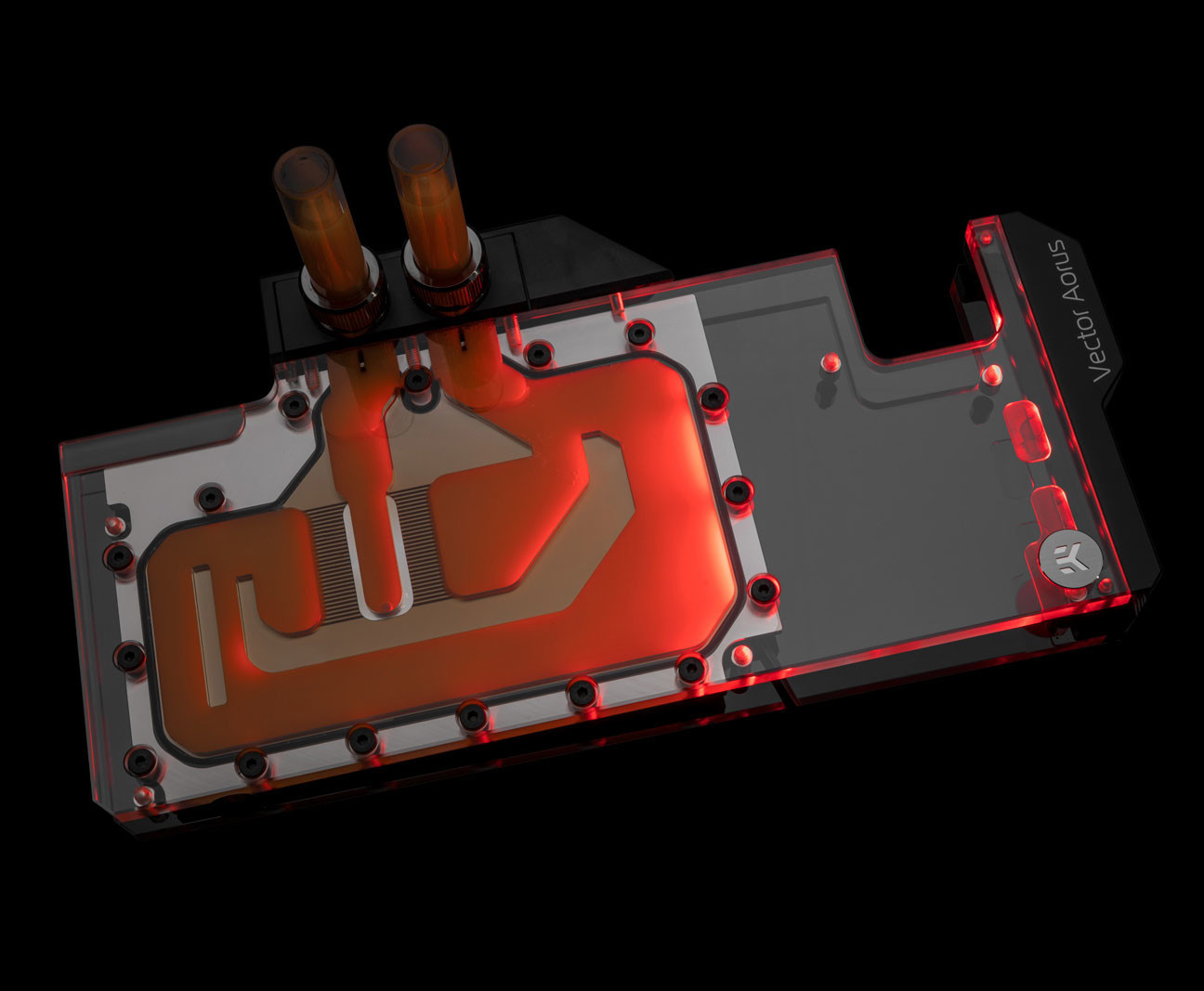
The EK-Vector FTW3 RTX 2080 Ti RGB high-performance water blocks are specially designed for EVGA FTW3 versions of NVIDIA GeForce RTX 2080 Ti graphics cards. The water blocks use the signature EK single slot slim look, and it covers the entire PCB length. This sophisticated cooling solution will transform your powerful EVGA graphics card into a minimalistic, elegant piece of hardware with accented RGB LED lighting. The block also features a unique aesthetic cover over the block Terminal which is designed to showcase the graphics card model via LEDs, visible from the side.

Antec at Computex 2019: Neptune ARGB CPU Liquid Coolers, Signature Series PSUs, Katana ARGB DDR4 Memory Modules

Antec at Computex 2019 showcased a myriad of products, of which we bring you three families in this post: their Neptune ARGB CPU liquid coolers, the Signature Series of PSUs, and their Katana DDR4 memory modules.

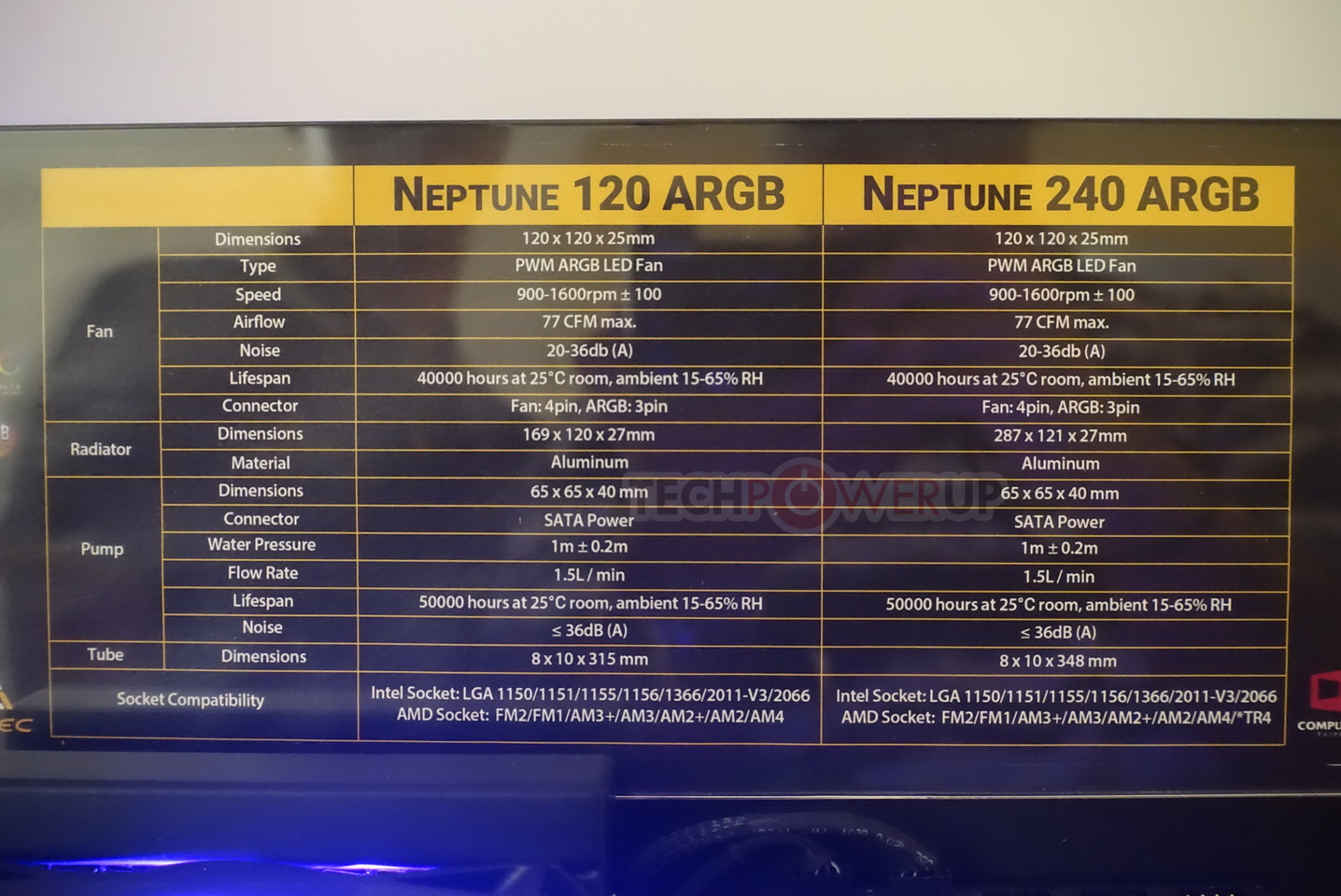
The Neptune ARGB liquid coolers are available in either 120 mm or 240 mm AIO configurations, each packing a single or a dual fan setup (I leave it to you to guess which is which)s. These feature PWM controlled fans, have a flow rate of 1.5 L of cooling liquid per minute, feature RGb lighting (in case you hadn't noticed the ARGB in the name), and are rated for up to 40,000 H MTBF at a 25º room temperature.

ADATA XPG Battlecruiser and Invader Cases Pictured

It's not just PC power-supplies, ADATA is also taking a swing at the premium gaming case market with two new XPG branded ATX mid-tower cases, the XPG Battlecruiser and the XPG Invader. The Battlecruisier is clearly the more airy and 'revealing' of the two, with 4 mm-thick tempered glass making up the front, top, and left-side panels, large intake vents for the front fans, and a horizontal partition that can be collapsed in two parts for extra room to put your DIY liquid cooling components. The case has room for motherboards as long as E-ATX, add-on cards up to 40 cm in length, and CPU coolers up to 17.5 cm in height. There are 7 expansion slots located conventionally, and two vertical slots so you can show off your graphics card better. Six 2.5-inch and three 3.5-inch drive mounts complete its storage area, while you get room for 360 mm (or smaller) radiators along the front and top panels. The front-panel I/O includes a USB type-C, which should be the hallmark of any good case launched after 2017.

The XPG Invader is the more compact case of the two, and has a more restrained styling. It comes in black and white+black color options. You only get tempered glass along the right-side panel, with the front being shrouded in metal, with side-vents for the intake fans. The top panel has a grille with a detachable magnetized dust filter. The motherboard tray has room for ATX (and smaller) motherboards, add-on cards up to 40 cm in length, and CPU coolers up to 17 cm in height. Four 2.5-inch and two 3.5-inch bays make up the storage area. Ventilation includes three 120 mm intakes, two 120 mm top exhausts, and a 120 mm rear exhausts. Accordingly, you can mount 360 mm x 120 mm radiators up front, and 240 mm radiators up top. Front-panel I/O includes USB 3.0 and HDA, but no type-C ports here.

ADATA Enters the PSU Market with XPG Core Reactor Series

A long time ago, a memory manufacturer named Corsair entered the PC power-supply market and would go on to become one of the highest-volume brands in the DIY space. ADATA is making a similar bet with its XPG Core Reactor family of performance-segment fully-modular PSUs. These puppies target the meat of the market, with 550W, 650W, 750W, and 850W capacities, and 80 Plus Gold efficiency rating. All models boast of compact 14 cm length, and are cooled by 120 mm fluid-dynamic bearing fans. The 550W model puts out two 6+2 pin PCIe connectors, the 650W model four, and the rest six. All models 650W and above come with two 4+4 pin EPS outputs.

Under the hood, the XPG Core Reactor features a single +12V rail design, and protections against over/under-voltage, overload, over-current, overheat, no-load operation, and short-circuit. The AC receptacle also has an integrated anti-surge and in-rush current component. Based on the reception of these models, ADATA said it would expand its investment in this market, particularly as demand for PSUs with two EPS connectors rises.

Qualcomm and Lenovo Unveil World's First 5G PC Powered By The Qualcomm Snapdragon Processor

Qualcomm Technologies, Inc., a subsidiary of Qualcomm Incorporated, announced in conjunction with Lenovo the world's first 5G PC2 today at its Computex Press Conference. Project Limitless encompasses a strong technology collaboration between Qualcomm Technologies, Inc. a leader in 5G connectivity, and Lenovo, the leader in PCs, to bring innovation to the always on, always connected PC ecosystem. Project Limitless is powered by the Qualcomm Snapdragon 8cx 5G compute platform and is the world's first 7nm platform purpose-built for PCs that offers 5G connectivity.

The new platform is running on Windows 10 for ARM. It promises multi-day battery life and 7GBps transfer speeds with a Snapdragon x55 5G modem.
Image Source: Tom's Hardware

Colorful Brings it Shiniest New Toys to Computex 2019

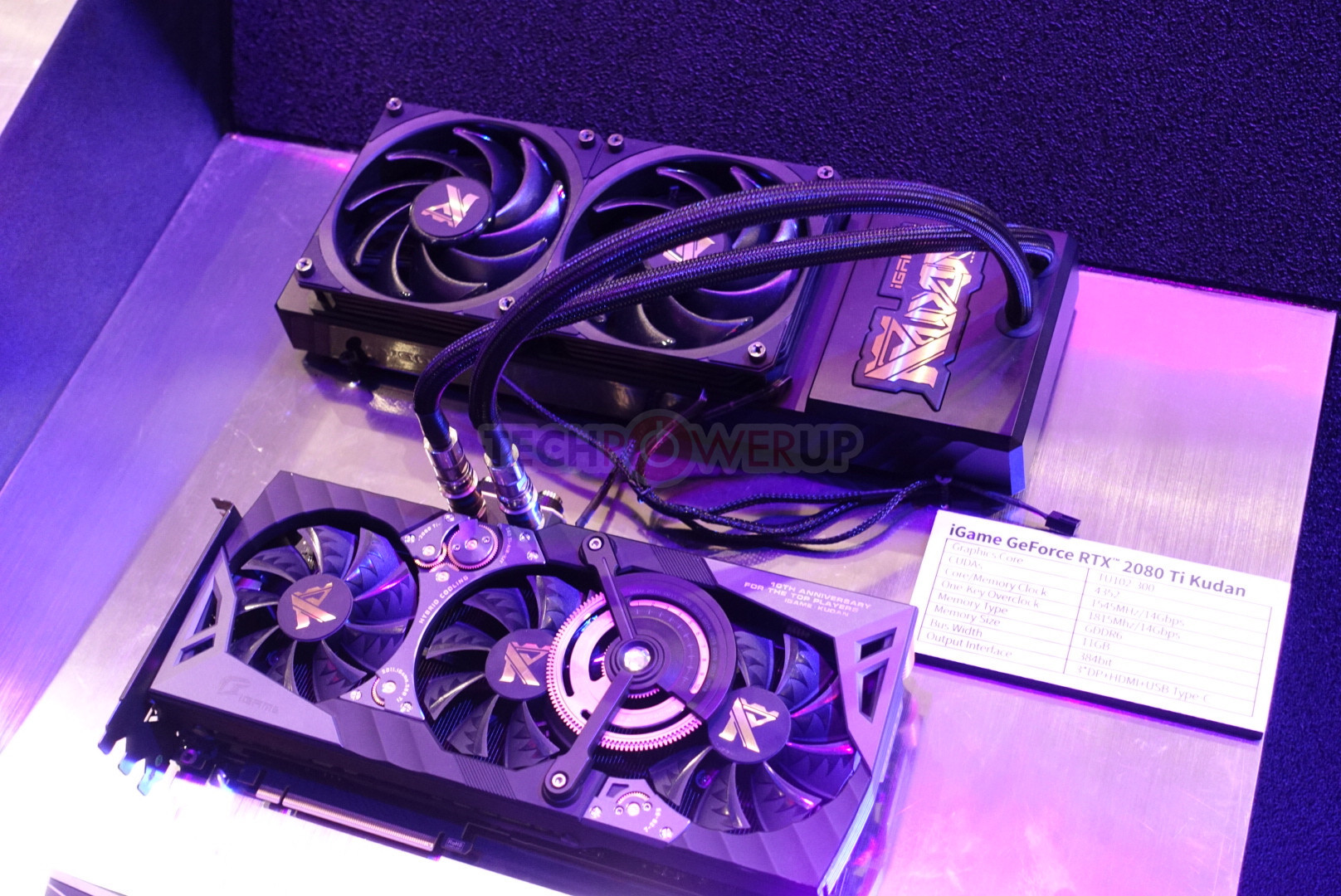
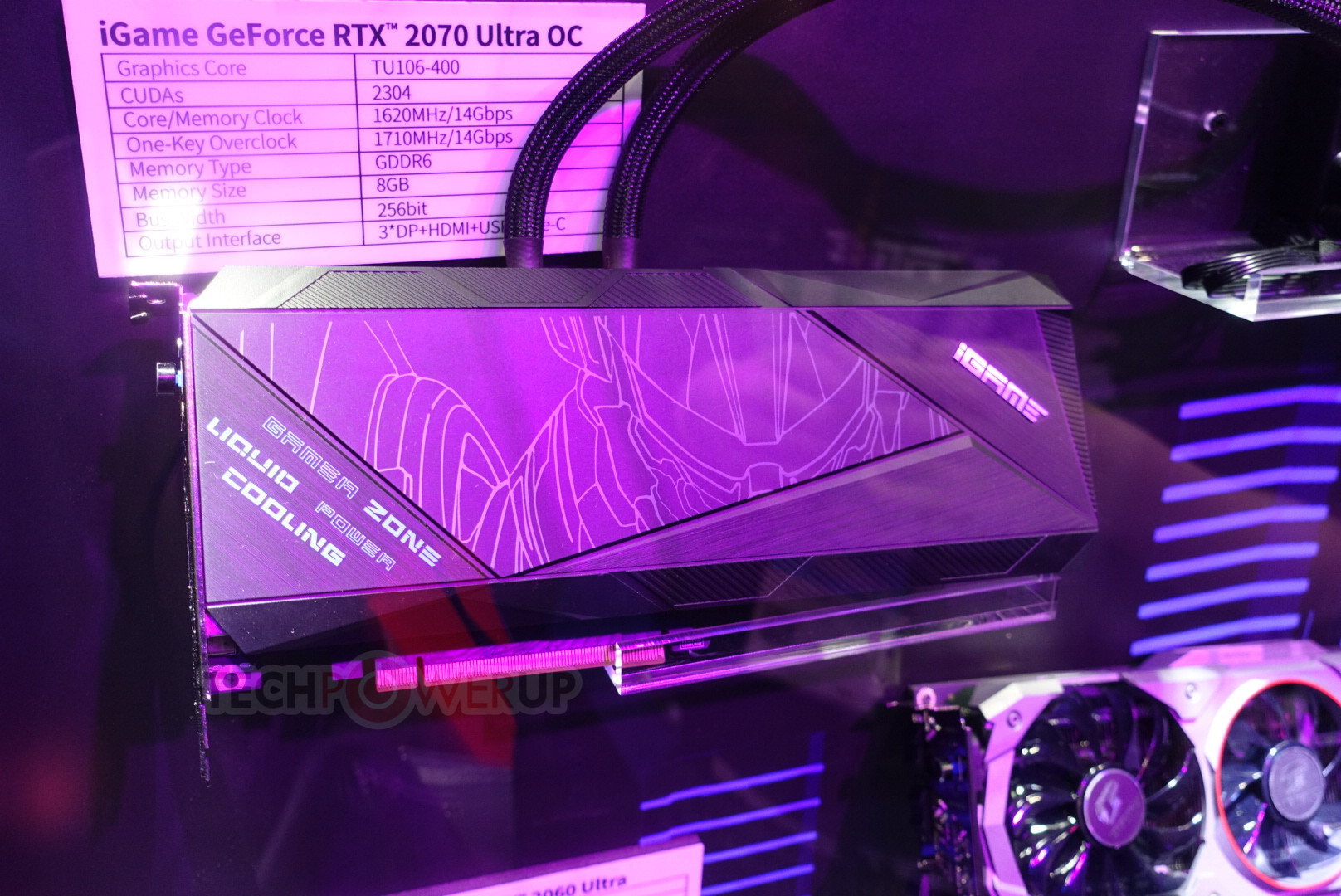
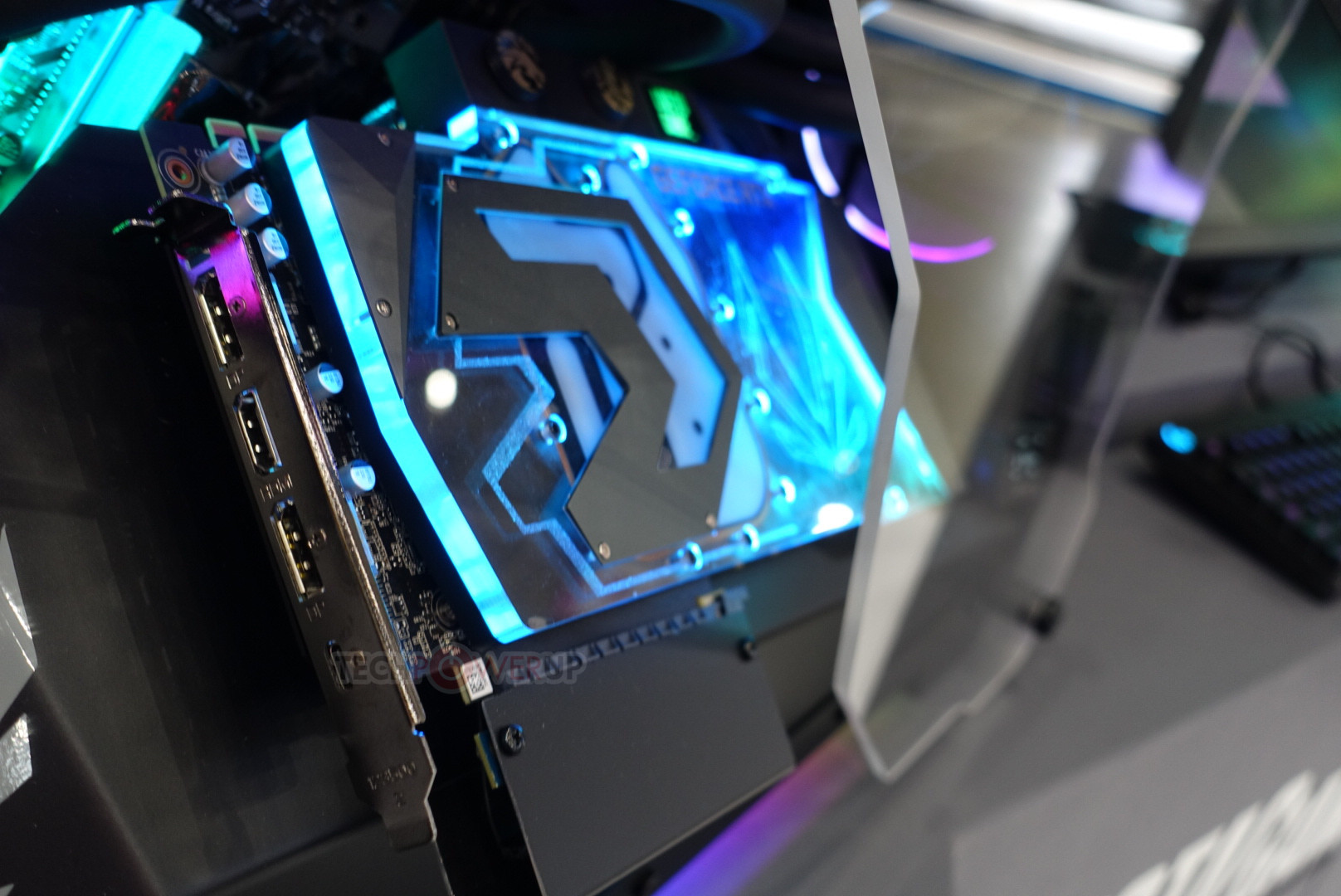
Colorful always believed in shock-and-awe to market their overengineered graphics cards and motherboards; and the company did not disappoint this Computed. We saw their new iGame RTX 2080 Ti Kudan, a 5-fan monstrosity that could very well be the heaviest graphics card ever built. A triple-slot, triple-fan air-cooler copes with some of the heat from the GPU, all of the heat from the VRM and memory; while most of the heat is dissipated by a closed-loop liquid cooling solution that uses a massive radiator that's almost as big as a standard 360 mm x 120 mm, but only has two 120 mm spinners, and 1/3rd of its body made up of a coolant reservoir and integrated pump. The block over the GPU is entirely metal (both base and top), so it could shed some of its heat onto the card's heatsink. How fast is it? Well, out of the box it's a damp 1545 MHz, but has a "one-click OC" to 1815 MHz.

Intel 10th Generation Core Case-badges Revealed

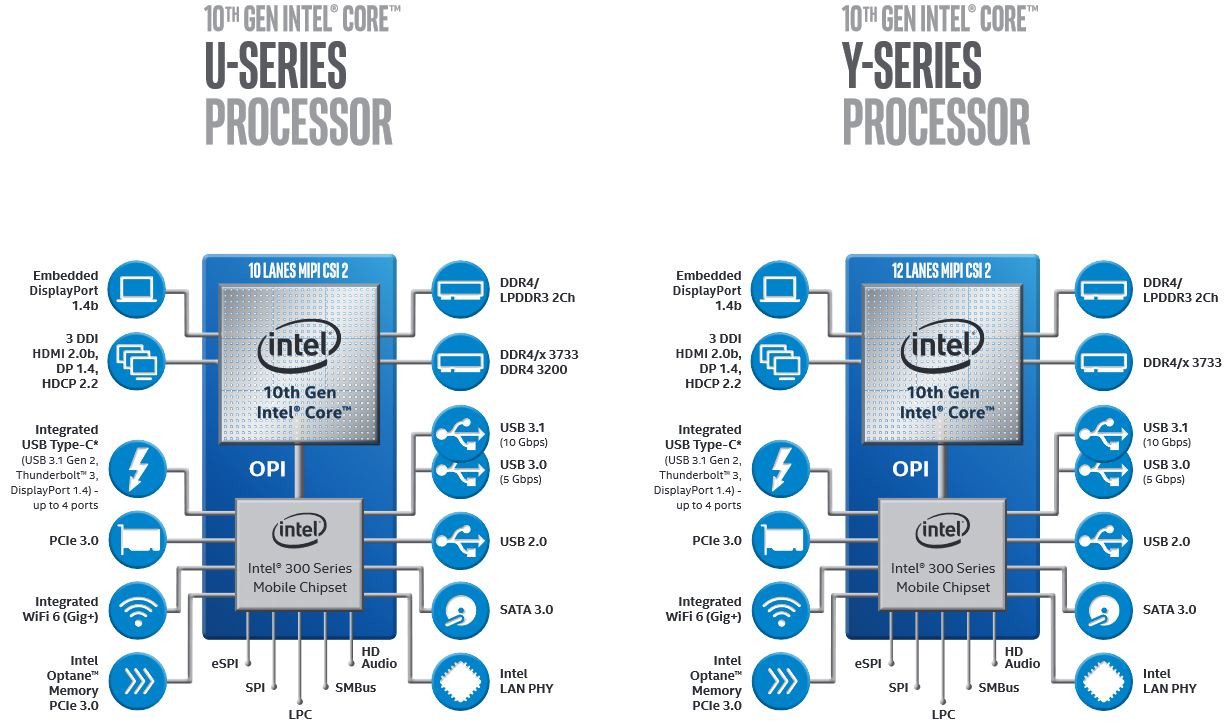
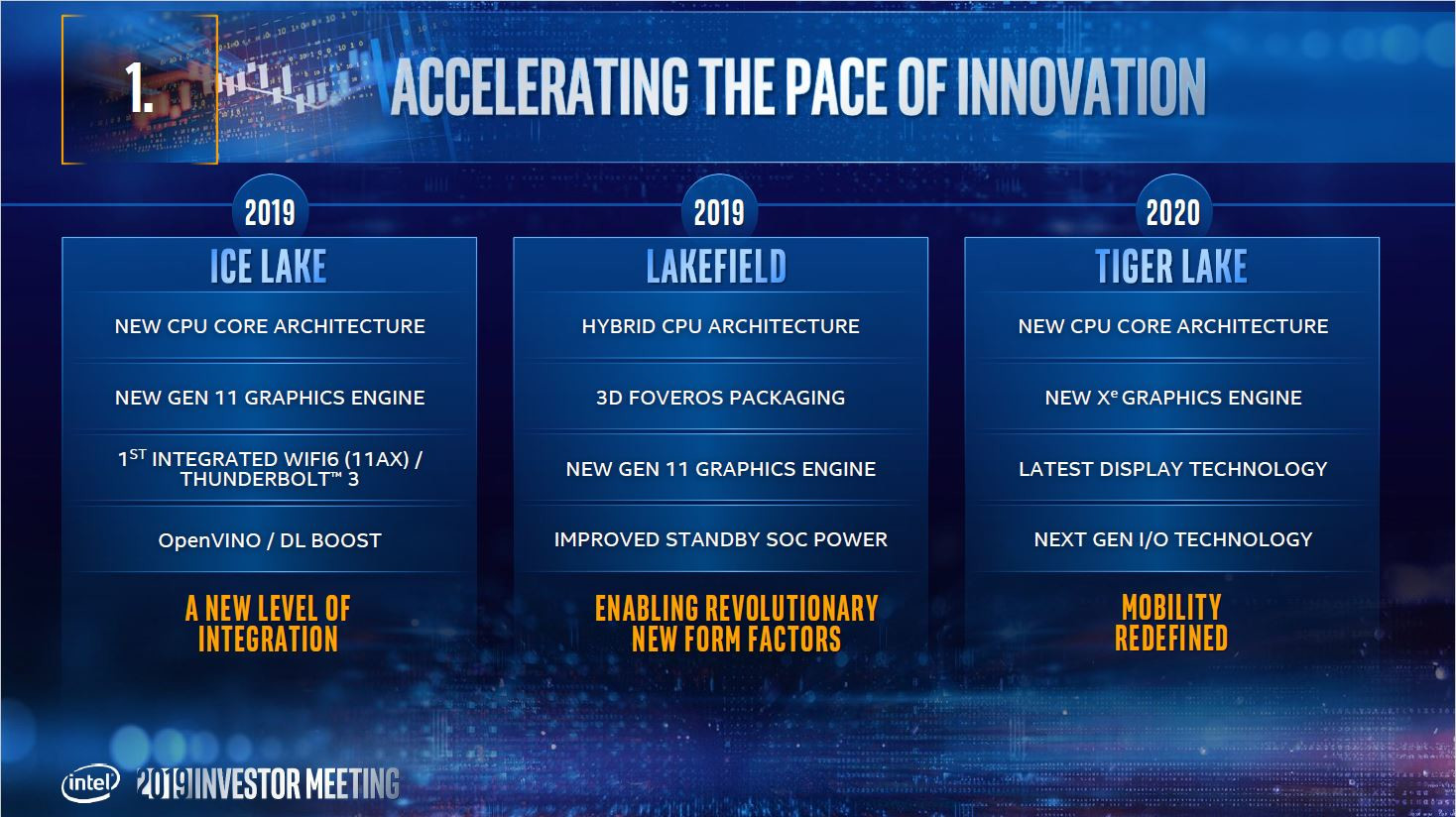
Intel laid rest to speculation that post 9th generation, it could replace its Core brand with something else. The 10th generation Core processors, built around the 10 nm "Ice Lake" microachitecture, will feature the first noteworthy IPC increments since "Skylake" thanks to their new "Sunny Cove" CPU cores. These will also feature DLBoost, a fixed-function matrix-multiplication hardware that speeds up deep-neural net building and training by 5x, as well as certain AVX-512 instructions. The cores will be optimized to cope with 2.4 Gbps 802.11ax Wi-Fi and faster Ethernet standards. The first of these chips will target mobile computing platforms, and will be quad-core parts like the dies pictured below. To save notebook PCB real-estate, Intel will put the processor and PCH dies into a multi-chip module. It will be quite a wait for the desktop implementation, but at least you know what their case-badges look like.

ADATA Unveils its M.2 PCIe Gen4 SSD: Ready for AMD X570

It looks like SSDs will beat graphics cards to utilizing (and benefiting) from the bandwidth of PCI-Express gen 4.0 bus. AMD X570 platform motherboards offer 2-3 M.2 slots with PCIe gen 4.0 x4 wiring (64 Gbps). Corsair formally launched the MP600, and now ADATA joins the party with its unnamed drive. Based on the Silicon Motion SM2267 controller, the drive comes in an unbelievable capacity of up to 8 TB, probably using 96-layer QLC NAND flash.

The controller features DRAM cache, and dynamic SLC caching (all of the NAND flash is treated as SLC until storage demands force portions of them to be treated as MLC, TLC, and eventually QLC). It takes advantage of NVMe 1.3 protocol. As for performance, ADATA claims sequential speeds of up to 4000 MB/s reads. Such speeds were impossible of PCIe gen 3.0 x4 due to various overheads. Sequential writes are still up to 3000 MB/s. 4K random read/write access is rated at 400k IOPS. The company didn't reveal availability details.

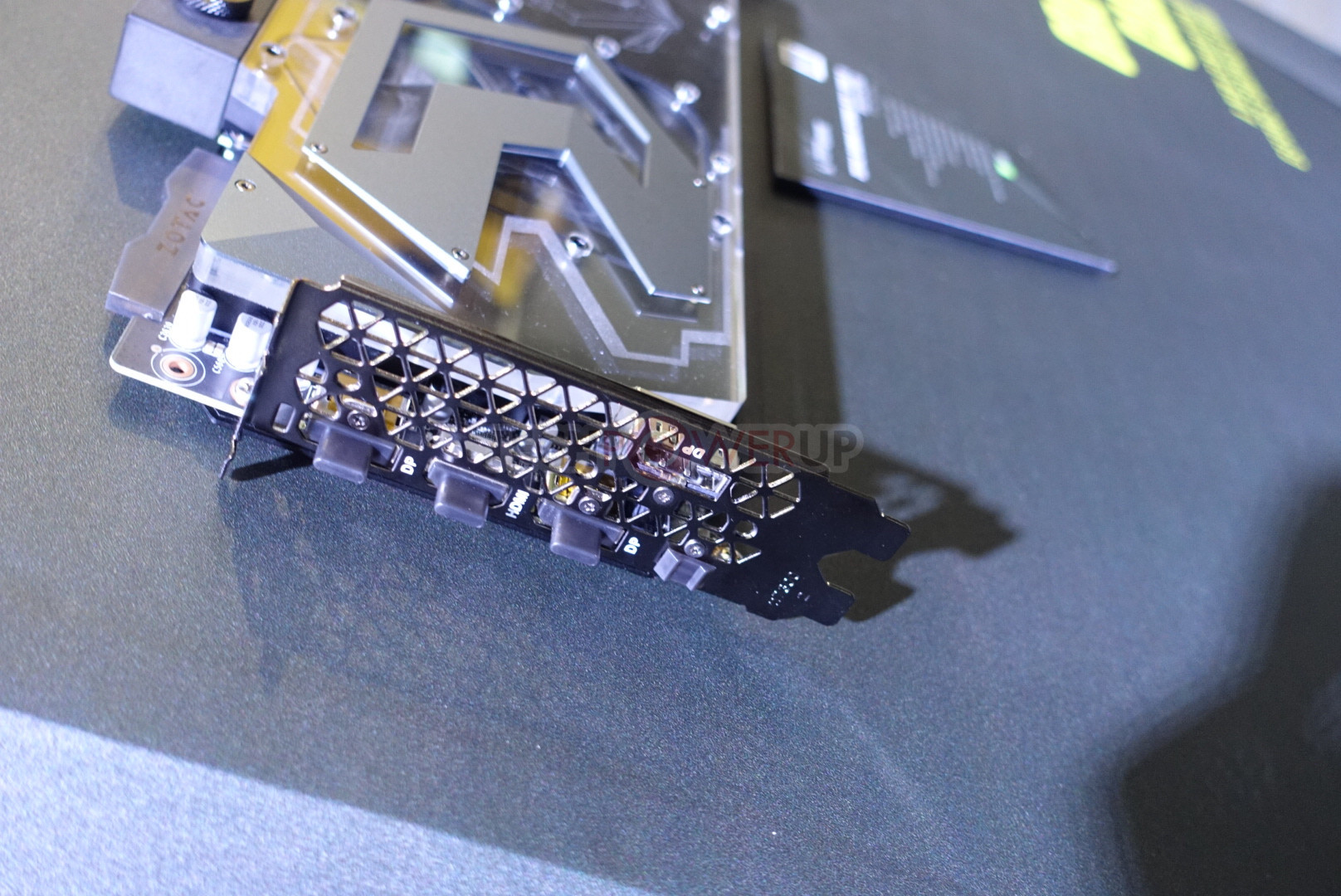
ZOTAC Slims Down its RTX 2080 Ti ArcticStorm to Single-Slot

ZOTAC showed off a new variant of its GeForce RTX 2080 Ti ArcticStorm liquid-cooled graphics card that's slimmed down to single-slot dimensions. This card is practically identical to the original (pictured below), but sacrifices one of its DisplayPorts to have just one row of output connectors, namely two DisplayPorts and one each of HDMI 2.0b and USB-C VirtualLink. The factory-fitted full-coverage water block is unchanged from the original, as are the factory-overclocked speeds of 1575 MHz GPU Boost and untouched 14 Gbps GDDR6 memory.
Monday, May 27th 2019
Alphacool Eisblock XPX CPU Water Block Review

Alphacool Eisblock XPX CPU Water Block Review

Alphacool has added years to the lifespan of their current CPU water block, the Eisblock XPX, by offering new versions and first-party accessories. We take a look at a nylon top version, which uses their patented ramp design aiming to optimize coolant flow and thermal performance, while retaining aesthetics as a high priority as well.

Intel 2019 Computex Keynote: Live Blog

Intel is addressing its Computex keynote address by SVP-GM Client Computing Group Gregory Bryant, and this is its live blog. Bryant began by going back to the history of Intel in Taipei and the building of the computing and consumer electronics ecosystem in the late-1970s.
5:38 AM UTC: Intel announcing new 9th generation desktop and mobile processor SKUs
5:39 AM UTC: Intel announces a 9th generation Core i9 processor with vPro
5:44 AM UTC: 14 new Xeon-E processor SKUs for workstations, 8-core/16-thread 5.00 GHz boost frequency, Optane Memory support

ASRock RX570TM-ITX TBT is a Thunderbolt External GPU with Copious Amounts of Downstream I/O

ASRock showed off the TM-ITX TBT external graphics box platform with a model powered by a Radeon RX 570 GPU. Roughly the size of an SFF mini PC (hence the name thin-mini ITX), the TM-ITX TBT plugs into a 40 Gbps Thunderbolt 3 connector, and in addition to graphics, puts out a constellation of downstream connectivity that includes a 1 GbE wired Ethernet, four USB 3.1 type-A ports, USB 2.0, and a drive bay with SATA 6 Gbps connectivity. Display outputs include two HDMI 2.0, and LVDS (for all-in-one desktops). The RX 570 comes in 4 GB or 8 GB options.

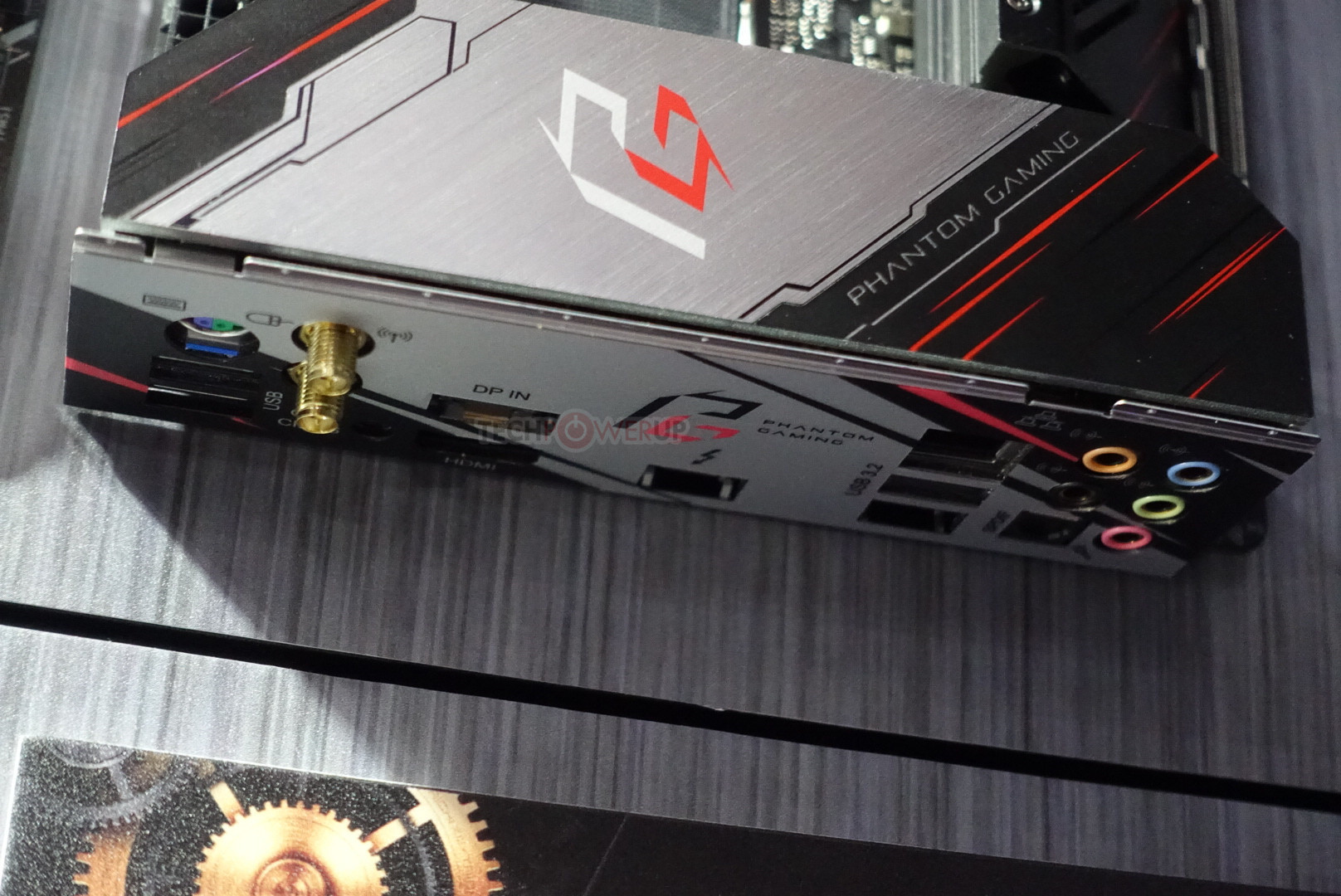
ASRock Unveils X570 Phantom Gaming-ITX TB3 Motherboard

ASRock is ready with its own mini-ITX motherboard based on the AMD X570 chipset, the X570 Phantom Gaming-ITX TB3. This tiny powerhouse one-ups other mini-ITX motherboards in its category by offering 40 Gbps Thunderbolt 3 connectivity over USB type-C, in addition to USB 3.2. This Thunderbolt port also includes a DP pass-through from your discrete graphics card.

Expansion includes one PCI-Express 4.0 x16. Storage connectivity includes one M.2-2280 with PCI-Express 4.0 x4 and SATA 6 Gbps connectivity; and four SATA 6 Gbps ports. Networking options include 2.4 Gbps 802.11ax WLAN, Bluetooth 5.0, and 1 GbE driven by Intel i211-AT. The board pulls power from a combination of 24-pin ATX and 8-pin EPS connectors, conditioning it for the SoC with a 6+2 phase VRM. A chunky fan-heatsink cools the chipset, shedding some of its heat to the enlarged VRM heatsink cloaked under the I/O shroud.

Patriot Trinity is the Swiss Army Knife Among Flash Drives

Patriot Trinity is a unique flash drive that caught our eye at the company's Computex 2019 booth. The drive comes with the ability to plug into USB type-A, micro type-B, and the latest type-C ports. Leveraging USB 3.1 gen 1 (5 Gbps) standard, the drive offers sequential transfer-rates of up to 200 MB/s, but is also backwards compatible with USB 2.0, and supports OTG standard. You can have it in capacities of 32 GB, 64 GB, and 128 GB. It's also engineered for low power draw (well under 50 mA), so it isn't too heavy on your phone's battery. Patriot also showed off the Blaze and Fang, which come in 1-piece retractable and 2-piece lidded form-factors, respectively. The two feature the same innards, with capacities ranging between 128 GB to 1 TB, sequential transfer rates of up to 400 MB/s, and USB 3.1 gen 1 type-A connectors.

Patriot Also Shows Off Burst and P200 SATA SSDs

Patriot Memory's SSD lineup for 2019-20 includes two new SATA SSDs to cater to the mainstream market, the P200 and Burst. Both drives are built in the 2.5-inch form-factor, with SATA 6 Gbps interface. The Burst is available in capacities of up to 960 GB, and is powered by a Phison S11 controller with DRAM cache. The drive offers sequential transfer rates of up to 560 MB/s reads, with up to 540 MB/s writes, and endurance of up to 835 TBW, benefiting from the drive's overprovisioning. The P200 is an interesting drive, in that it comes in two controller options. Capacities 256 GB, 512 GB, and 1 TB ship with Silicon Motion SM2258XT DRAM-less controller, while the 2 TB version is powered by a Maxiotech MAS0902A. On offer are up to 530 MB/s reads, up to 460 MB/s writes, and up to 1 PBW endurance.

Patriot Viper VPR100 and VPN100 SSDs Pictured

Patriot showed off many new M.2 NVMe SSDs at its Computex 2019 booth, led by two Viper series models that caught our eyes, the VPR100 and VPN100. While technically an M.2-2280 drive, the Viper VPR100 features a chunky heatsink that makes the drive wider than 22 mm. This could be a problem if you're trying to install it in an M.2 slot positioned between two PCIe slots. The heatsink is studded with RGB LEDs. The drive is based on the Phison E12 controller and offers sequential transfer rates of up to 3450 MB/s reads, and up to 3000 MB/s writes. The Viper VPN100 is practically the same drive, but with a heatsink that sticks to the 22 mm width limit. You can run both drives without their heatsinks.

Elgato Expands the Stream Deck Range with Stream Deck XL and Stream Deck Mobile

Elgato, the leading provider of hardware and software for content creators, today announced the launch of two new additions to its award-winning portfolio of broadcast controllers: Stream Deck XL and Stream Deck Mobile. From the 32-key Stream Deck XL taking your productivity to new heights, to the convenience of Stream Deck Mobile delivering the full Stream Deck experience to iOS devices, the two new products offer an unprecedented range of options for both professional creators and beginners alike.

The new Stream Deck XL expands the celebrated Stream Deck to 32 brightly-lit LCD keys. Each key is fully programmable and customizable, offering one-touch tactile control with instant visual feedback. Stream Deck's robust software enables you to assign limitless actions to keys: start and stop streaming, adjust audio and lighting levels, switch cameras, trigger onscreen actions, or anything else to simplify and enhance the content creation experience. With a detachable USB-C cable and non-slip magnetic stand included, Stream Deck XL becomes the centerpiece of a modern content creator's setup.

CORSAIR Announces Hydro X Series DIY Liquid Cooling Hardware

CORSAIR , a world leader in PC gaming peripherals and enthusiast components, today announced the launch of the highly-anticipated CORSAIR Hydro X Series, a complete line of custom cooling parts offering PC enthusiasts a new standard of hardware to build the world's most powerful and stunning systems. From CPU and graphics card water blocks to a pump/reservoir, fittings, tubing, radiators, and coolant, the Hydro X Series offers everything you need to build a spectacular custom cooling loop that lowers system temperatures and improves performance, complete with vivid RGB lighting.

Rigorously tested and validated to ensure the utmost reliability and stability, the Hydro X Series has been meticulously designed to work best alongside the massive range of CORSAIR cases and cooling components, fully integrated with CORSAIR iCUE software for automated fan and pump speed control and complete lighting customization.

COLORFUL Announces First AMD X570 Motherboard with New CVN X570 GAMING PRO V14

Colorful Technology Company Limited, professional manufacturer of graphics cards, motherboards and high-performance storage solutions is thrilled to introduce its latest product to gamers, enthusiasts, power users and system builders with the release of the COLORFUL first AMD X570-based motherboard. The new COLORFUL CVN X570 GAMING PRO V14 serves as a foundation for new AMD builds and supports AM4 socket processors including 3rd Gen AMD Ryzen desktop processors.

The CVN X570 GAMING Pro is ready for the future with support for AMD's new 7nm processor based on their Zen2 architecture, while still supporting both 2nd Gen and 1st Gen Ryzen products. This provides and easier and more cost effective upgrade path into the latest hardware. Making its debut is PCIe 4.0 on this motherboard giving it extra bandwidth for high-speed connections with devices. The motherboard also comes rich with USB connectivity including USB3.1 Gen2 and also features wireless LAN.

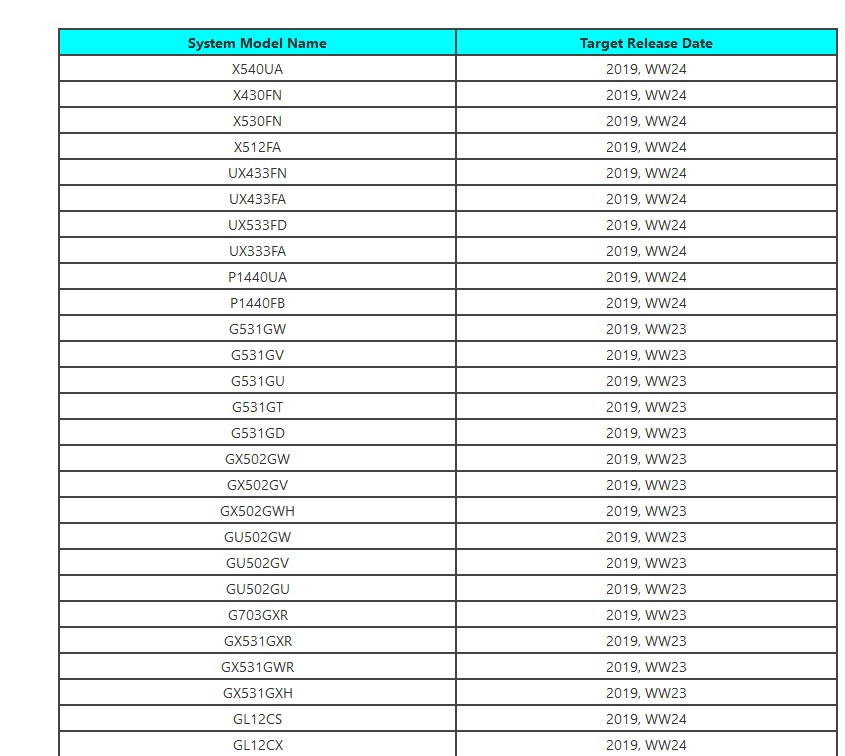
ASUS Debuts Numerous Laptops at Computex 2019, Including AMD Powered Systems

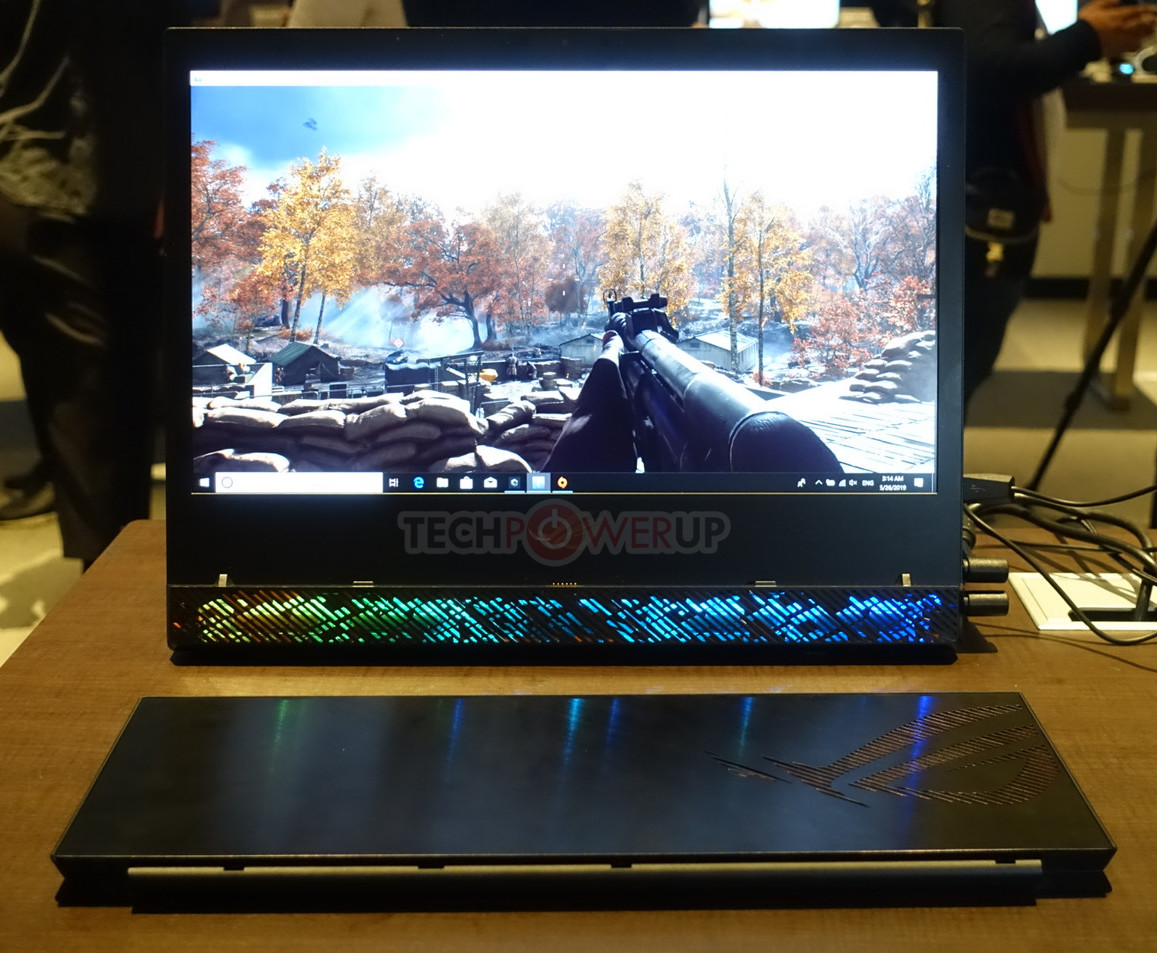
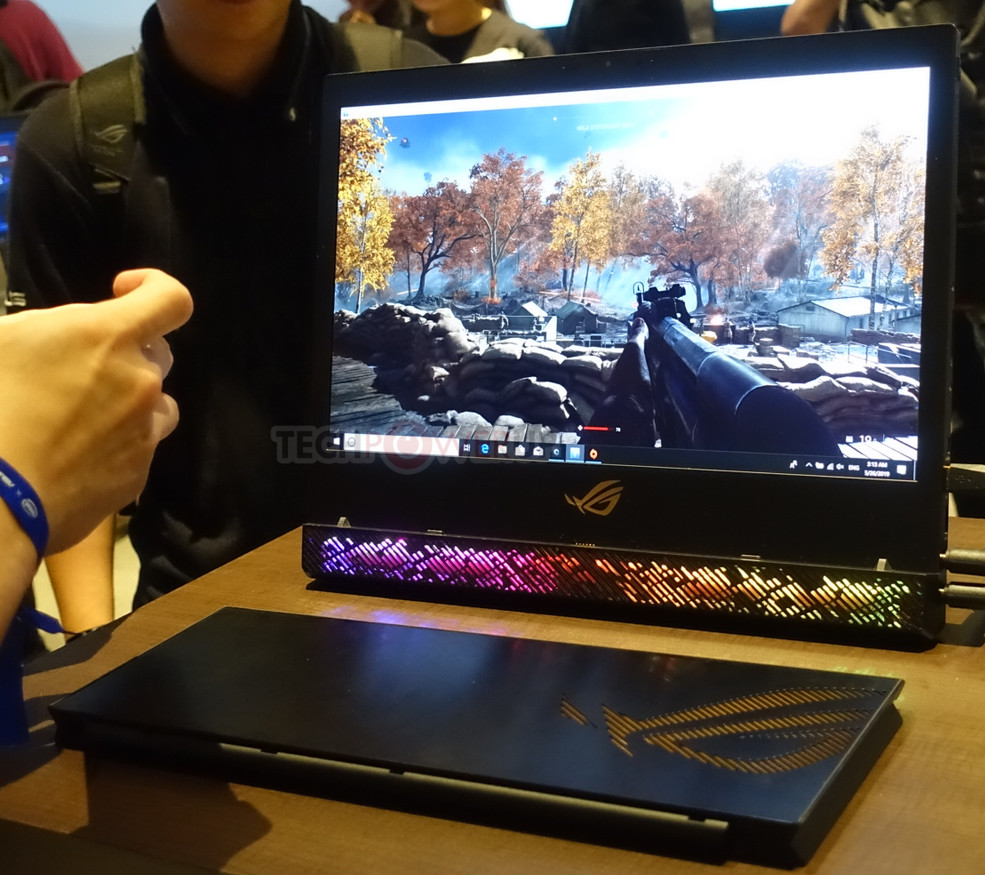
While its honestly staggering see how many products ASUS had on display at Computex this year, I think the number of laptops might take the cake. They had just about everyone imaginable on hand except a kitchen sink. The ROG lineup was represented by the Zephyrus M GU502, Zephyrus S GX502, Zephyrus G GA502, Strix Hero III, Strix SCAR III, and last but not least the Mothership. Meanwhile, the TUF Gaming brand demoed the FX705DU and FX505DU. More surprising is the fact AMD's Ryzen 3750H makes an appearance not only in the TUF Gaming laptops but in the Zephyrus series as well bringing a bit more selection to the once Intel dominated mobile market.

Taking a closer look at the Republic of Gamers lineup and our attention is immediately drawn to the ROG Mothership which due to its design is the most unique laptop on display here. Featuring a detachable keyboard with RGB lighting, eight heat pipes, liquid metal cooling, 4K G-SYNC display, Intel i9-8950H CPU overclocked, NVIDIA GeForce RTX 2080, and NVMe SSDs, it stands out from the crowd. Gone is the traditional clamshell if you so choose without sacrificing performance. It definitely proves to be an eye-catching product.

SilverStone Teases OLED Display Equipped Case at Computex 2019

While by no means a draw dropper at this point it seems SilverStone is looking to try something a bit different, teasing a prototype OLED equipped chassis at Computex 2019. Utilizing the ASUS SDK, it connects to an ASUS motherboard and displays pertinent system information such as CPU temperatures on the display. For now, it is only a prototype with no design set in stone with the company still looking into the best way to implement the feature going so far as to consider going with a 5.25" device as well. However, there is one sticking point, and that is the SDK while open in nature currently only works with ASUS motherboards. While the feature is a bit basic for now, the concept itself is still quite impressive and could prove to be an appealing feature if appropriately implemented. For now, all we know is that SilverStone is looking into it.

ASRock Unveils World's First Thunderbolt 3 Graphics Card

ASRock will be showing the world's first Thin Mini-ITX form factor - RX570TM-ITX/TBT graphics card, which adapts with AMD Radeon RX570 graphics card and supports Intel Thunderbolt 3 technology. The RX570TM-ITX/TBT graphics card is not only the first graphics card with a Thunderbolt 3 Type-C interface which supports 40Gb/s transfer rate and power delivery, but it also features 4 USB 3.1 Gen1 ports, Gigabit Ethernet, and SATA 6Gb/s interface.
The RX570TM-ITX/TBT graphics card is based on the Thin Mini-ITX concept. With this graphics card, All-in-One PC manufacturers can develop their own Thunderbolt monitors with 3D performance and power charging with less effort. Moreover, it would be able to fit in a mini ITX chassis. By connecting a notebook through Thunderbolt 3 Type-C interface, it helps to increase the notebook's 3D computing power and charge the notebook at the same time.

ASUS ROG Strix Line of 80 Plus Gold PSUs Debut

ASUS kicked the door open to barge into the gaming PC PSU market with the ROG Thor high-end PSU last Computex. This year, the company is biting into the meat of the performance gaming market with the new ROG Strix PSU family, making its debut with a 650W model. This PSU offers low idle noise due to excessively large heatsinks, an ASUS-innovation Axial-Tech fan that's designed to direct all of its airflow downwards, with no sideways bleed; full modular cabling, and some cosmetic customization options, including a pair of magnetic stickers. Cabling includes two 4+4 pin EPS connectors, four 6+2 pin PCIe, nine SATA power, and a trio of Molex connectors. ASUS plans to expand this series in both directions.

ASUS Announces Mini-LED Powered ROG Swift PG27UQX G-Sync Ultimate Monitor

ASUS in partnership with NVIDIA announced at COMPUTEX 2019 their first Mini-LED powered PC monitor, which promises to bring the dimming zone game up to an unprecedented level - at least, on IPS technology. The usage of Mini-LED as lighting source for the ROG Swift PG27UQX means that there are many more areas that can be dimmed and brightened according to the displayed content: 576 of them, really, with each being comprised of mini LEDs that are a mere 200-300 micrometers in size.

The ROG Swift PG27UQX features a 27" panel with HDR support (HDR 1000 certification with up to 1,000 nits brightness). It's overclockable to a 144 Hz refresh rate, and color-wise offers DCI-P3 97% and Adobe RGB with quantum-dot technology for 99% coverage. ASUS says that the local dimming capabilities also allow for lower energy consumption (which does make sense). Connector-wise, we're looking at DisplayPort v1.4, HDMI (v2.0), 3x USB 3.0 and 1x 3.5 mm earphone jack. Being a G-Sync Ultimate panel, it features NVIDIA's latest G-Sync processor, which should bringing pricing to even higher levels than you are already expecting.

Lian Li Bets Big on Computex 2019 with New Chassis, Fans, CPU AIO, Motorized Desk

LIAN LI's stars of the show this year are the head turning and showpiece worthy new Odyssey X, a morphable PC chassis with flare, and the revolutionary Concept UNI Fan, an aesthetically pleasing solution to cable clutter. To accompany its latest innovations, LIAN LI also launches a few new products such as the next generation of the TU and LANCOOL series chassis with the TU150 and LANCOOL II, and co-designed products with the O11D-Distro Block G1 and O11 Dynamic XL. In addition, LIAN LI will also be presenting its latest desk solutions with the DK-04 F and DK-05 F, as well as a new contender in the AIO field with the Galahad 240 CPU AIO. Once again, LIAN LI brings a successful lineup of solutions that are sure to make PC enthusiasts drool with envy.

NVIDIA Studio Driver Available Now

NVIDIA Studio Drivers provide artists, creators and developers the best performance and reliability when working with creative applications. To achieve the highest level of reliability, Studio Drivers undergo extensive testing against multi-app creator workflows and multiple revisions of the top creative applications from Adobe to Autodesk and beyond. Available today, the newest NVIDIA Studio Driver provides optimal support for the latest releases of top creative apps, including Autodesk Maya 2019, 3ds Max 2020, Arnold 5.3.1.0, Blackmagic Design DaVinci Resolve 16, and Daz 3D Daz Studio.

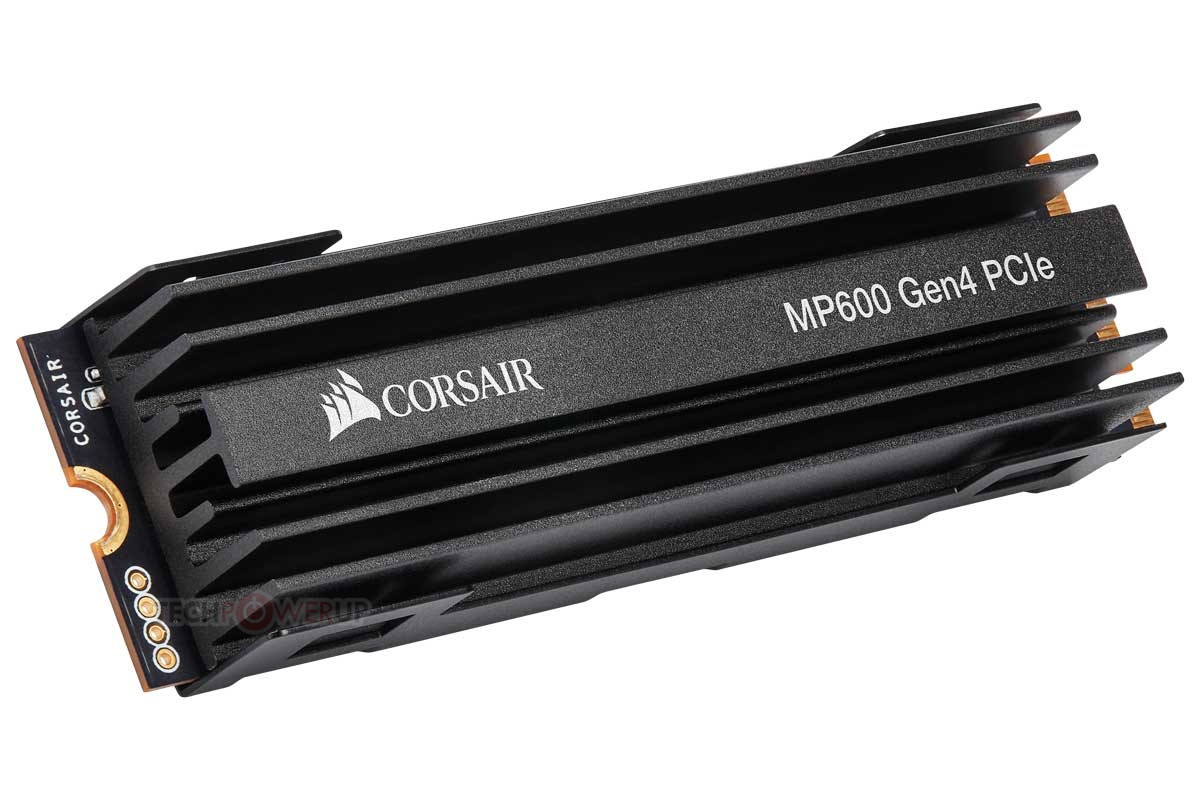
Corsair Announces MP600 M.2 NVMe PCIe Gen 4.0 SSD Compatible with AMD X570

CORSAIR , a world leader in PC gaming peripherals and enthusiast components, today unveiled the new CORSAIR Force Series MP600 NVMe PCIe Gen4 x4 M.2 SSD, one of the world's first PCIe 4.0 M.2 SSDs compatible with the new AMD X570 chipset, also revealed today. Unleashed by the PCIe 4.0 ready AMD X570 chipset, the MP600 reaches new heights of enthusiast single-drive storage performance, delivering up to 4950MB/sec sequential read - ten times the performance of many SATA SSDs, and fifty times faster than some hard disk drives.

The MP600's phenomenal performance stems from the hugely increased bandwidth of PCIe 4.0 (PCI-Express Generation 4), a feature that will be made available to customers for the first time as part of the AMD X570 chipset and 3rd Generation AMD Ryzen Desktop Processors. Easily fitting into a PCIe 4.0 x4 M.2 slot, the MP600's NVMe interface and high-density 3D TLC NAND combine with a Phison PS5016-E16 controller to enable a new level of single-drive SSD performance. Boasting up to 4,950MB/s sequential read and 4,250MB/s sequential write speeds, the MP600 is ready to become the storage center of your new 3rd Gen AMD Ryzen Desktop Processor and AMD X570 chipset-based system.

EK Announces Lignum Nature-inspired Water Blocks

EK , the leading premium liquid cooling gear manufacturer, announces the global launch of the new signature edition product portfolio - EK Lignum . It is inspired by Mr. Edvard König's love for woodwork and modern computer technologies. A perfect symbiosis of the oldest natural building material and contemporary high-end cooling solutions. An unparalleled example of how your PC can reflect your lifestyle. EK Lignum and it's wooden opulence can bring a feeling of comfort and warmth to your home while keeping your PC cool and silent for its maximum possible performance.

The first choice was walnut (Juglans Nigra) because of the fact that it never fails to surprise with its colors and texture. The connection between the water block and the wood enables wood shrinking and expanding which is one of its most natural predispositions in response to the changes in humidity and temperature. EK Lignum products were engineered in a way so that the wood does not come into direct contact with water. Every block has a unique pattern of wood, which makes it one of a kind in the world.

SPC Gear Presents Durable Endorphy Cordura Mousepads

The gaming division of SilentiumPC, branded as SPC Gear, introduces the Endorphy series mousepads, which are made out of unique, military-spec Cordura fabric. The new pads provide unmatched level of precision and responsiveness together with extreme durability and effortless maintenance. Users have the choice between the pad sizes M, L and XL at a competitive price point.

SPC Gear teamed up with Cordura , known for its military and motorcycle protective gear, to create the ultimate mousepad for ambitious Gamers! The result is the Endorphy series, which is designed with supreme accuracy in mind, featuring SPEED-type surface for smooth, friction-less movement and perfect mouse control. SPC Gear Endorphy is the mousepad that is made to enhance the abilities.

NZXT Announces the H510 Elite Compact Premium Mid-Tower

NZXT, a leading developer of software-powered hardware solutions for PC gaming, today announces the H510 Elite, a premium compact mid-tower ATX case. The H510 Elite comes with a tempered glass front panel and included AER RGB 2 fans and a built-in HUE 2 RGB LED strip to highlight the beauty of your build.

All features introduced in the latest iteration of the H Series will be present in the Elite; such as front panel USB-C and the new NZXT Smart Device v2 which brings power to the built-in RGB strips and fans. The H510 Elite retains the features beloved in the initial H Series such as the patented cable management system, single screw tempered glass panel, and all-steel construction.

ASUS at Computex 2019: TUF Gaming VG27AQ Monitor, ROG STRIX 650 W Gold Power Supply

ASUS at Computex 2019 showcased a myriad of products - as is usual, for one of the foremost PC hardware manufacturers. This news piece breaks down two of these products: the TUF Gaming VG27AQ monitor and the ROG STRIX 650 W Gold power supply. Starting with that which allows you to see, the TUF Gaming VG27AQ monitor features both ULMB and Adaptive Sync support (in the form of AMD's FreeSync and NVIDIA's G-Sync). Dubbed ELMB, the new feature allows the monitor to keep its Active Sync features active for super smooth gameplay, whilst enabling motion blur reduction - usually, a choice between the two technologies has to be made.

The 27" screen offers an IPS panel with a 2560 x 1440 pixel resolution, 1 ms response time and maximum 155 Hz refresh rate (Adaptive Sync works between the 40-155 Hz interval) over a DisplayPort connection (144 Hz max over HDMI). A maximum brightness of 350 cd/m² doesn't win any serious accolades, but is more than enough for gaming scenarios. Connectors stand at 2x HDMI 1.4 ports, 1x DisplayPort 1.2, and 2x USB 3.0 ports.

NZXT Refreshes the Award-Winning H Series

NZXT, a leading developer of software-powered hardware solutions for PC gaming, announces today the successors to its award-winning H-Series PC cases. There will be six new models in the refreshed H Series. The H210, H210i, H510, H510i, H710, and H710i further the legacy of the original H-Series by keeping features beloved by builders while adding new ones.

"With the original H Series, we set forth a vision of what we believed to be the future of PC hardware," says Johnny Hou, founder and CEO of NZXT. "It has been very humbling to see the positive response that the H Series has received since it has launched but we are always striving to better our products. We added improvements to the latest line of H-Series to make sure that PC Builders will have the best tools available to them to make simple, modern, and beautiful builds."

BIOSTAR Racing X570GT8 Pictured

We got a closer look at the Racing X570GT8 from BIOSTAR. This board was already leaked to the web earlier this month. Right off the bat we see an understated design with a predictable layout. The board draws power from a combination of 24-pin ATX, 8-pin EPS, and 4-pin ATX power connectors, and uses a 12-phase VRM design. Expansion slots include two PCI-Express 4.0 x16, a third gen 4.0 x16 (electrical gen 4.0 x4), and three other gen 4.0 x1 slots. Storage connectivity includes three M.2 NVMe 64 Gbps slots. Overclocker-friendly features include POST code readout, onboard buttons, and USB BIOS Flashback. The board's sole 1 GbE interface is driven by an Intel i211-AT controller. The onboard audio solution is powered by an ALC1220 CODEC. Expect this board to be priced around $170.

NVIDIA Releases GeForce 430.86 WHQL Drivers

NVIDIA today released GeForce 430.86 WHQL graphics drivers. These drivers come with day-one "Game Ready" optimization for "Quake II RTX" and "Assetto Corsa Competizione." Support is also added for Oculus Rift S and HTC VIVE Pro Eye HMDs, and three new monitors have been added to the G-Sync certification list. The drivers also change a few things around. "World of Warships" is no longer supported by GeForce Experience Freestyle. Several application crashes noticed on Adobe Premier Pro were fixed. Performance issues noticed on "Resolume Arena 6" with GeForce RTX 2080 Notebook have also been fixed.
The change-log follows.

ASRock X570 Motherboards Zoomed Into: Taichi, Phantom Gaming, Steel Legend

ASRock came to Computex 2019 with a fairly big selection of socket AM4 motherboards based on the AMD X570 chipset. The lineup is led by the X570 Taichi, launched as a single SKU and not differentiated into an "Ultimate" variant. ASRock retains the characteristic gearwheel style along the board's styling. Almost the entire bottom half of the board is covered by a metal shroud that spreads heat from the chipset heatsink, and three M.2 SSDs. The chipset heatsink's fan is concealed behind a grille to not look like an eyesore. New generation connectivity options from this board include 2.5 GbE wired + 2.4 Gbps 802.11ax WLAN, and USB 3.2 ports. The Taichi looks a little less understated than its predecessors, with more RGB LED embellishments.

We also spied the X570 Steel Legend, with its polarizing "urban camo" print, and bright metal meatsinks and I/O shrouds. The Steel Legend series motherboards command interesting sub-$200 price-points, and it will be interesting to see where this one lands. You get two M.2 NVMe slots, both with metal heatsinks, an M.2 E-key slot, open-ended x1 slots, and a reasonably powerful ALC1220-based onboard audio solution. We also spotted two Phantom Gaming products, the X570 Phantom Gaming X, and the X570 Phantom Gaming 4, with the Gaming X being the company's flagship X570 offering. This board maxes out the platform's connectivity with three M.2 NVMe slots, 802.11ax WLAN, 2.5 GbE wired networking, an additional 1 GbE interface driven by an Intel controller, USB 3.2, and a strong 16-phase VRM powering the AM4 socket. Like most other ASRock boards, the fan ventilating the chipset heatsink is concealed behind a grille.

GoodOffer24 Unveils Summer Sale: Deep Discount Windows and Office Software

Tis the Summer of PC upgrades and fresh builds, with scores of new hardware to distract you. Some of it pricier than you had expected. Where can you cut costs? How about that part of your PC that doesn't deteriorate in quality at a lower price? This is where GoodOffer24 steps in. With deeply discounted, genuine, globally-valid licenses to software you can't build without, such as Microsoft Windows 10, and Office; this retailer lets you shave anywhere between $100-300 off your budget. Windows 10 Pro is our OS of choice as it has more power-user features than Windows 10 Home. GoodOffer24 is selling licenses for USD $12.14. Office 2019 Professional Plus is the latest version of the productivity suite no home PC build is complete without. You can have it for $56.74.

GoodOffer24 also sells genuine, globally-valid Office 365 Professional Plus annual subscription vouchers for $18.91, which is a significant discount compared to most retailers. If you'd like to buy Windows and Office together, there are even bigger discounts to be had. Windows 10 Pro + Office 2016 Professional Plus are bundled for $35.94. If you'd like the latest version of Office, then Windows 10 Pro + Office 2019 Professional Plus can be had for $61.48. If you're only looking for Office 2016 for most of the features you need, then Office 2016 Professional Plus can be yours for $30.07. All of the prices you see here are available when you apply the TechPowerUp-exclusive discount coupon "LQSM20" at checkout.

Buy Windows 10 Pro at $12.14 from GoodOffer24 | Buy Office 2016 Professional Plus at $30.07 from GoodOffer24 | Buy Office 2019 Professional Plus at $56.74 from GoodOffer24 | Buy Windows 10 Pro + Office 2016 Professional Plus Combo at $35.94 | Buy Windows 10 Pro + Office 2019 Professional Plus Combo at $61.48 | Buy Office 365 Pro Plus 1-year subscription Voucher for $18.91

ASUS Announces 240 Hz Portable ROG Monitor

With an increasing number of "gamers on the go" today, we are getting more gaming products tailored specifically to them. Laptops, portable keyboards, and even portable monitors. Often those monitors aren't very good. They either lack quality or are too small to do anything serious with them. However, ASUS wanted to change that with their launch of a new ROG portable monitor.

At Computex, ASUS has announced a new addition to its portable monitor family, this time under their famous ROG branding. The new ROG Strix XG17, as it is called, appears to be a dream come true for every gamer on the go. It features a 1080p 240 Hz display packed in a 17-inch body made to fit in any bag that is able to carry a 17-inch laptop. It incorporates adaptive sync technology so you will not have to worry about torn frames. The response time is pretty low as well at only 3 ms. You can drive it from any micro HDMI or USB-C DisplayPort cable. It can be powered from the same USB-C DisplayPort cable you use for video, or from the internal battery which is able to handle up to three hours of usage on its own. No information yet on retain availability or pricing, but we look forward to checking it out more sooner than later.

ASUS Unveils the Prime X299 Edition 30 and Prime Utopia Concept Desktop

ASUS is commemorating its 30th year in the motherboard industry with the Prime X299 Edition 30 motherboard and Prime Utopia reference desktop platform. The Prime X299 Edition 30 is a premium LGA2066 motherboard with support for Core i9-9000X series processors out of the box. It is based on a familiar-looking PCB layout, mated to a new mostly-white composite heatsink/shroud over the rear I/O, the M.2 slots, and the chipset heatsink. The VRM heatsink is active and has a concealed 40 mm spinner ventilating the metal. Three each of PCI-Express 3.0 x16 and M.2 NVMe slots, an integrated rear I/O shield, premium connectivity that includes 802.11ac WLAN, and a high-end onboard audio solution, make for the rest of it.

The Prime Utopia is something else. It's a concept high-end desktop built around a motherboard that has slots, headers, ports, and connectors on both sides of the PCB. Its "obverse side," if you can call it that, has a shroud that conceals the memory slots, most controllers, chipset, and a 7-inch USB display that puts out real-time system monitoring data, or pretty much anything you want it to display. The CPU socket is on the other side of the PCB, and the processor and CPU VRM are liquid-cooled. An angled PCI-Express slot holds the graphics card along the plane of the motherboard. It all comes together on a CM Cosmos-like chassis frame that lets you show the innards off.

CUK Makes a Splash This Computex

Computer Upgrade King (CUK) is a new BTO (build-to-order) gaming PC manufacturer based out of Virginia, USA. Unlike other system integrators, CUK extends component choices all the way down to the cases. At Computex, the company showed off its Stratos Mini high-end desktop (HEDT), powered by an AMD Ryzen Threadripper 2990WX processor, AMD Radeon VII graphics, 32 GB of quad-channel DDR4-3000 memory, an ASRock X399M Taichi motherboard, and a SeaSonic Prime 1300W 80 Plus Gold PSU. Also shown off was the Continuum Mini, a compact powerhouse built around a mini-ITX motherboard. Its chops include the Core i9-9900K processor seated on an MSI MPG Z390I Gaming Edge AC motherboard; GeForce RTX 2080 Ti graphics, 16 GB of dual-channel DDR4-3200 Apacer NoX memory; and a 750W power supply.

Four Premium MSI X570 Motherboards Pictured Up Close

With motherboard vendors going big on the AMD "Valhalla" platform (a combination of 3rd generation Ryzen processor and AMD X570 chipset), we got to see MSI pull out every single high-end motherboard label it has, including MEG GODLIKE and MEG Creation. We sneaked into the MSI booth to take some snaps of the other X570 boards, including a close-up of the MEG X570 Ace, and three other MPG series boards. The MEG X570 Ace is largely carved out of the MEG X570 GODLIKE with a little toning down of the style and features. This is still a formidable board built for serious manual overclocking. We also get the sense that MSI is replacing its "Gaming M7" moniker with MEG Ace in its product stack, as we couldn't find an "X570 Gaming M7" anywhere.

With the MEG GODLIKE and MEG Creation expected to be priced north of $300, the MEG X570 Ace could be priced around the $260-mark. Positioned below it around $200-220, is the MPG X570 Gaming Pro Carbon. This board offers everything you need to build a super high-end rig where the focus is on gaming. It has decent CPU overclocking chops, too. The onboard audio and networking features are premium, and we expect MSI to deploy 802.11ax Wi-Fi. The new MPG X570 Gaming Edge is a lighter variant of the Gaming Pro Carbon, and is largely based on the same PCB. If you don't care all that much about board design, the MPG Gaming Edge is the way to go, with its roughly-$180 price. The MPG X570 Gaming Plus is a cost-effective product, and has all of the essentials gamers need for this platform. It is expected to go for around $150.

MSI GeForce RTX 2080 Ti Lighting 10th Anniversary Edition Spied

Here are some of the first pictures of the MSI GeForce RTX 2080 Ti Lightning 10th Anniversary Edition. The company is commemorating 10 years of its flagship Lightning brand of graphics cards that have the highest factory-overclock, the most features, and the best cooling solution you can buy from MSI. There already is an RTX 2080 Ti Lightning, and the 10th Anniversary Edition isn't a special livery. It's a brand new card with the same PCB as the original. The meatier-looking cooling solution now has an OLED display that puts out real-time sensor data, your clan logo, or any GIF. Stay tuned for more.

AMD "Raven Ridge" and "Summit Ridge" CPUs Won't Work on X570 Chipset

If you own an AMD 300-series motherboard and are looking to upgrade to Zen 2-based Ryzen 3000 series processors, you have nothing to worry about, as long as your motherboard vendor puts out a BIOS update that adds compatibility (most vendors already have). If you belong to the demographic which has a 1st generation Ryzen "Summit Ridge" processor or Ryzen 2000 "Raven Ridge" APU laying around and looking to buy an AMD X570 motherboard, we have some bad news for you.

AMD X570 apparently only supports 2nd generation Ryzen "Pinnacle Ridge" processors among the previous generations. The chart below indicates compatibility. It says that while AMD 300-series and 400-series chipsets very much do support the latest Ryzen 3000 series processors launched today, the new X570 chipset only supports "Pinnacle Ridge" processors from the previous generation, besides the latest "Matisse" processors (and the upcoming "Picasso" APUs). 400-series chipsets have the best compatibility. They support every AM4 processor launched so far.

AMD Ryzen 5 3000 Series Lineup Detailed

AMD at its 2019 Computex keynote unveiled its Ryzen 3000 series desktop processors with the more glamorous Ryzen 7 and Ryzen 9 SKUs while glossing over its more high-volume Ryzen 5 3000 series. It turns out that AMD will launch even these chips on the 7th of July. The Ryzen 5 lineup includes the 3600X and 3600. Both these chips are 6-core/12-thread, and AMD is taking the fight to Intel's 9th generation Core i5 series by not touching the core-count and instead focusing on higher IPC and clock-speeds than Intel's offerings.

The Ryzen 5 3600X ticks at 3.80 GHz, with a boost frequency of 4.40 GHz, which is among the highest in the lineup. Its TDP is rated at 95W. The Ryzen 5 3600 is the 'cooler' offering of the two, with 3.60 GHz nominal and 4.20 GHz boost clocks, and 65W TDP. You get the same 512 KB of L2 cache per core, and 32 MB of shared L3 cache, as the 8-core Ryzen 7 series offerings. AMD is expected to price the two along expected lines, with the 3600X going for roughly USD $239, and the 3600 at $199.

ASUS Shows Off its X570 Motherboard Lineup: ITX Included

ASUS at a private pre-Computex event gave us a closer look at a treasure of upcoming products. The star-attractions, however, were its AMD X570 motherboard family that's spread across nearly every brand: ROG Crosshair, ROG Strix, TUF Gaming, Prime, and for the very first time for the AM4 platform, the WS series. The crown jewel of course is the mini-ITX form-factor product, the ROG Strix X570-I Gaming. This board is quite an engineering feat considering the ≥15 Watts TDP of the X570 chipset, which requires active cooling in most cases. An intricate network of heatsinks suspended along heat-pipes leading up to a dense aluminium fin-stack ventilated by a 30 mm fan, cools both the chipset and CPU VRM. ASUS designed this board to handle even the 12-core Ryzen 9 3900X, but we don't expect too much overclocking headroom.

AMD Showcases Several Premium X570 Motherboards for Ryzen 3000 Zen2

AMD at its 2019 Computex private showcase for the media following its CEO's keynote address, unveiled several premium motherboards based on the new AMD X570 chipset. The X570 is an in-house design effort by AMD, and unlike the X470, isn't sourced from ASMedia. The chipset supports PCI-Express gen 4.0 end-to-end, which means not only is the chipset-bus gen 4.0, but also the downstream PCIe lanes it puts out. The chipset connects to the AM4 socket over a PCI-Express 4.0 x4 link (64 Gbps).

It has a downstream PCIe lane budget of 16 lanes, which the motherboard designers can spread out as up up to two M.2 NVMe slots, an x4 (physical x16) slot, a bunch of x1 slots, and newer generation connectivity such as 802.11ax WLAN, 2.5/5.0/10 GbE wired networking, and a larger number of USB 3.2 ports, including newer 20 Gbps portsn over external controllers. This chipset runs hotter than the X470, with a TDP rumored to be around 15W, probably because of the PCIe gen 4.0 implementation. Many of the motherboards we spotted had active fan-heatsinks over the chipset.
Sunday, May 26th 2019

AMD Announces Radeon RX 5700 Based on Navi: RDNA, 7nm, PCIe Gen4, GDDR6

AMD at its 2019 Computex keynote today unveiled the Radeon RX 5000 family of graphics cards that leverage its new Navi graphics architecture and 7 nm silicon fabrication process. Navi isn't just an incremental upgrade over Vega with a handful new technologies, but the biggest overhaul to AMD's GPU SIMD design since Graphics CoreNext, circa 2011. Called RDNA or Radeon DNA, the new compute unit by AMD is a clean-slate SIMD design with a 1.25X IPC uplift over Vega, an overhauled on-chip cache hierarchy, and a more streamlined graphics pipeline.

In addition, the architecture is designed to increase performance-per-Watt by 50 percent over Vega. The first part to leverage Navi is the Radeon RX 5700. AMD ran a side-by-side demo of the RX 5700 versus the GeForce RTX 2070 at Strange Brigade, where NVIDIA's $500 card was beaten. "Strange Brigade" is one game where AMD fares generally well as it is heavily optimized for asynchonous compute. Navi also ticks two big technology check-boxes, PCI-Express gen 4.0, and GDDR6 memory. AMD has planned a July availability for the RX 5700, and did not disclose pricing.

AMD Announces 3rd Generation Ryzen Desktop Processors

AMD CEO Dr. Lisa Su at her 2019 Computex keynote address announced the 3rd generation Ryzen desktop processor family, which leverages the company's Zen 2 microarchitecture, and are built on the 7 nm silicon fabrication process at TSMC. Designed for the AM4 CPU socket, with backwards compatibility for older AMD 300-series and 400-series chipset motherboards, these processors are multi-chip modules of up to two 8-core "Zen 2" CPU chiplets, and a 14 nm I/O controller die that packs the dual-channel DDR4 memory controller and PCI-Express gen 4.0 root complex, along with some SoC connectivity. AMD claims an IPC increase of 15 percent over Zen 1, and higher clock speeds leveraging 7 nm, which add up to significantly higher performance over the current generation. AMD bolstered the core's FPU (floating-point unit), and doubled the cache sizes.

AMD unveiled three high-end SKUs for now, the $329 Ryzen 7 3700X, the $399 Ryzen 7 3800X, and the $499 Ryzen 9 3900X. The 3700X and 3800X are 8-core/16-thread parts with a single CPU chiplet. The 3700X is clocked at 3.60 GHz with 4.40 GHz maximum boost frequency, just 65 Watts TDP and will be beat Intel's Core i7-9700K both at gaming and productivity. The 3800X tops that with 3.90 GHz nominal, 4.50 GHz boost, 105W TDP, and beat the Core i9-9900K at gaming and productivity. AMD went a step further at launched the new Ryzen 9 brand with the 3900X, which is a 12-core/24-thread processor clocked at 3.80 GHz, which 4.60 boost, 72 MB of total cache, 105W TDP, and performance that not only beats the i9-9900K, but also the i9-9920X 12-core/24-thread HEDT processor despite two fewer memory channels. AMD focused on gaming performance with Zen 2, with wider FPU, improved branch prediction, and several micro-architectural improvements contributing to a per-core performance that's higher than Intel's. The processors go on sale on 7/7/2019.

Intel Pushes the Panic Button with Core i9-9900KS

With 7 nm AMD Ryzen 3000 processor family expected to make landfall early-July, and "Ice Lake" nowhere in sight, a panicked Intel announced the development of the Core i9-9900KS 8-core/16-thread LGA1151 processor. Based on the 14 nm "Coffee Lake Refresh" silicon, this processor has a base-frequency of 4.00 GHz, up from 3.60 GHz of the original; and an all-core Turbo Boost frequency of 5.00 GHz, identical to the original i9-9900K, which has its max-turbo set at 5.00 GHZ, too. A revamped Turbo Boost algorithm is expected to yield significant gains in multi-core performance. The company didn't reveal TDP, pricing, or availability.

AMD Computex 2019 Lisa Su CEO Keynote: Live Blog

AMD CEO Dr. Lisa Su is heading the opening Keynote at the 2019 Computex trade-show in Taipei. Her company is on the inflection point of new product-lines, namely the 3rd generation Ryzen desktop processors, 2nd generation EPYC, and Radeon Navi graphics cards. This post serves as our Live Blog of the event.
2:17 AM (UTC): Dr. Su takes centerstage as Computex CEO Walter Yeh welcomes and introduces her.
Friday, May 24th 2019

Today's Reviews

Cases
Cooling
CPU Coolers
Headphones
Keyboards
Memory
Motherboards
Mouse
Notebooks
PSUs
SSD
Storage
Corsair SF Series 750 W Review

Corsair SF Series 750 W Review

With 750 Watts, the Corsair SF750 is the strongest SFX power supply money can buy today. We saw great performance in almost all tests, and it operates quietly. Thanks to the included SFX-to-ATX adapter, you'll be able to pair it with a standard sized system, too.

Cooler Master Unveils V Gold and Platinum PSU Series

Cooler Master today welcomed a new entry to its "V Series" power supplies, adding various Gold and Platinum PSUs. These new models are representing successors to the very well known V series Cooler Master has launched a few years ago. In order to live up to its name, the new models are packing improvements in every aspect possible with less noise and more efficiency.

There are several new models ranging from 650-750 Watts for Gold and 850-1300 Watts for Platinum. What makes them different from previous V series models is a range of many small improvements like better wires to deliver more power to even hungrier GPUs. The Industry standard for wire size is 18 AWG, but Cooler Master went beyond that and put 16 AWG, in order to increase current capacity. The new 100 percent Japanese capacitors allow the new models to operate silently under 40% load.

Gigabyte Teases World's First PCIe 4.0 M.2 SSD With Speeds up to 5000 MB/s, Other Computex Announcements

Who would have thought that Gigabyte - who don't manufacture controllers, nor memory - would be the first company to tease a PCIe 4.0-based M.2 SSD. In a blog post on its website that serves as a warm-up for the upcoming Computex, the company says that they'll be announcing the world's first PCIe 4.0 M.2 SSD - with speeds up to 5000 MB/s at "low temperatures" - I guess that means that thermal throttling will become much more common with these new SSDs.

Any other details are currently unknown; however (and we're just speculating here), we know that Phison was preparing a PCIe 4.0 NVMe controller in the form of the E16. At the time (back in January of 2019), Phison paired their E16 controller with Micron's 96-layer TLC flash, but improvements in controller development as well as changes in the flash memory used could have brought up their - then - performance figures of expected 4.8/4.4 GB/s of read/write throughput on Toshiba's BiCS 4 flash. We'll just have to wait for Computex and see, but oh my - new PCIe 4.0 SSDs, new up-to 16-core CPUs on the 7 nm process, new 7 nm GPUs... Isn't this a great time to be a PC enthusiast? Read after the break for the rest of Gigabyte's Computex tease.

AMD Zen 2 CPUs to Support Official JEDEC 3200 MHz Memory Speeds

An AMD-based system's most important performance pairing lies in the CPU and system RAM, as a million articles written ever since the introduction of AMD's first generation Ryzen CPUs have shown (remember the races for Samsung B-die based memory?). There are even tools that allow you to eke out the most performance out of your AMD system via fine memory overclocking and timings adjustment, which just goes to show the importance the enthusiast community derives from such tiny details that maximize your AMD Zen-based CPU performance. Now, notorious leaker @momomo_us has seemingly confirmed that AMD has worked wonders on its memory controller, achieving a base JEDEC 3200 MHz specification - up from the previously officially supported DDR4-2666 speeds in the first-gen Ryzen (updated to DDR4-2933 speeds on the 12 nm update).

ECS Introduces the Liva SFF 110-A320 Book-sized Mini PC Powered by AMD Ryzen APUs

ECS has introduced a new model into their Liva series of Mini PCs - this time, powered by AMD Ryzen APUs. The ECS LIVA A320 is a 1-liter Mini Pc (book-sized, according to the company, but I guess that depends on the books you prefer to read), and makes use of either an AMD Ryzen 3 or Ryzen 5 APU with up to 35 W TDP.

There's a lot to like about this little Mini PC that could, which ECS is marketing at light gaming workloads and all other content consumption and office-related shenanigans. There is a tooless design for easy upgradeability, 2x DDR4 support in the SO-DIMM form factor, internal support for an M.2 drive (which helps save space in such a small enclosure, even though a 2.5" HDD or SSD is still supported). A VESA mount means this can be installed in the back of a monitor or television for your content consumption needs.

TechPowerUp Releases GPU-Z v2.21.0

TechPowerUp GPU-Z is a handy graphics subsystem information, diagnostic, and monitoring utility no enthusiast can leave home without, and today we bring you its latest version. The new TechPowerUp GPU-Z v2.21.0 adds support for NVIDIA Quadro P500. More importantly, it fixes sensor data readouts being broken for the Radeon VII with Radeon Software 19.5.1 (or later) installed. A broken GPU load sensor for AMD "Raven Ridge" APUs has also been fixed. Lastly, OpenCL support detection has been added for Radeon VII and other graphics cards based on the "Vega 20" MCM. Grab it from the link below.
DOWNLOAD: TechPowerUp GPU-Z

The change-log follows.

ASUS Provides BIOS updates addressing MDS vulnerabilities, ZombieLoad, RIDL, and Fallout

ASUS is aware that a new sub-class of speculative execution side-channel vulnerabilities in Intel CPUs, called Microarchitectural Data Sampling (MDS), also known as ZombieLoad, RIDL, and Fallout, may allow information disclosure. Intel states that selected 8th and 9th Generation Intel Core processors, as well as the 2nd Generation Intel Xeon Scalable processor family, are not vulnerable to MDS. If you are using one of these processors, no further action is necessary.

For other Intel processors, ASUS is working closely with Intel to provide a solution in a forthcoming BIOS update. We recommend owners of affected products update both the BIOS and operating system as soon as these mitigations are available. Please find our first-wave model list below and download the appropriate BIOS update from the ASUS Support website. More details, including affected systems, will be added to this document as they become available.

Cooler Master Announces Collaboration with GTR Simulator

Cooler Master, a global leader in PC component and peripheral manufacturing, today, in collaboration with GTR Simulator, announced the development of a co-branded racing simulator. Designed to be the ultimate gaming rig, the GTA-F Cooler Master Edition enables the user to go from work to play in a matter of seconds.

Made from premium alloy steel, the GTA-F Cooler Master Edition features a fully adjustable frame and first-rate racing seat designed to support racers of every size and sustain the constant strain of full-body maneuvers. With 14 points of adjustability, users can fine-tune their seat, monitor height and distance to the steering wheel/keyboard mount for maximum comfort during long hours of crunching numbers or training for 24 hours of Le Mans.

MSI Announces MPG SEKIRA 500 Series: The Ultimate Craftsmanship of The Gaming Chassis

As the worldwide leading gaming brand, MSI has launched its first gaming chassis - the MPG GUNGNIR 100 Series and received an enthusiast response from customers. At this point, MSI has now wielded years of experiences in gaming to dedicate to developing brand new gaming chassis. Now we are proud to introduce our line up - MPG SEKIRA 500, with innovation, advanced technology and highly customizable remarkable design to bring gamers more than what they imagine.

MSI MPG SEKIRA 500 series gaming chassis is inspired by the legendary axe in the hands of Perun, the God of Thunder in Slavic mythology. Its sharp and neat design combines with an inclined line on the front panel as if an axe is killing the devil spirit, which reflects the supreme power of the axe of Perun.

Final Fantasy XIV Online Surpasses 16 Million Players Worldwide

The global community of FINAL FANTASY XIV Online continues to grow as SQUARE ENIX announced the game has now surpassed 16 million registered users worldwide during a Letter from the Producer LIVE segment streamed from San Francisco. Accumulating almost six years of critical adoration and passionate fandom, the positive momentum of the MMORPG carries into the upcoming release of its third major expansion, FINAL FANTASY XIV: Shadowbringers on July 2, 2019.

Producer and Director Naoki Yoshida also revealed several new details for the upcoming expansion during the livestream, including:
  • Details on battle system changes, including the introduction of the charged action system.
  • Updates to the FATE system, side quests, as well the addition of role quests.
  • Adjustments to job synergy and rebalancing of jobs
  • Various quality of life changes and UI updates

ASUS Teases Collage of Upcoming AMD X570 Motherboards

With AMD expected to launch its 3rd generation Ryzen processor family at the 2019 Computex, the show is expected to have unveilings of several compatible motherboards based on the new AMD X570 chipset. ASUS posted a collage picture that teases its upcoming X570 lineup. This appears to include boards from pretty much all of ASUS's brands, including the high-end ROG Crosshair, the upper mainstream ROG Strix, the mainstream TUF Gaming, and the sober Prime series. From this, the ROG Strix board appears to be the first one we've come across that doesn't use a fan-heatsink to cool the 15W TDP X570 chipset. The Ryzen 3000 "Matisse" processor and X570 chipset make up AMD's "Valhalla" desktop platform.

FinalWire Releases AIDA64 v6.00

FinalWire Ltd. today announced the immediate availability of AIDA64 Extreme 6.00 software, a streamlined diagnostic and benchmarking tool for home users; the immediate availability of AIDA64 Engineer 6.00 software, a professional diagnostic and benchmarking solution for corporate IT technicians and engineers; the immediate availability of AIDA64 Business 6.00 software, an essential network management solution for small and medium scale enterprises; and the immediate availability of AIDA64 Network Audit 6.00 software, a dedicated network audit toolset to collect and manage corporate network inventories.

The latest AIDA64 update introduces SHA3-512 cryptographic hash benchmark and AVX2 optimized benchmarks for the upcoming AMD Zen 2 "Matisse" processors, adds monitoring of sensor values on BeadaPanel LCD displays, and supports the latest AMD and Intel CPU platforms as well as the new graphics and GPGPU computing technologies by both AMD and NVIDIA.
DOWNLOAD: FinalWire AIDA64 v6.00

ADATA Launches XPG SPECTRIX S40G RGB Gaming SSD

ADATA Technology, a leading manufacturer of high-performance DRAM modules, NAND Flash products, and mobile accessories today announces that launch of the XPG SPECTRIX S40G RGB gaming SSD. With sustained read/write speeds of up to 3500/3000MB per second, customizable RGB lighting, and a slew of performance enhancing features, the XPG SPECTRIX S40G is a no brainer for those seeking amazing performance and exceptional reliability.

The S40G supports the NVMe standard and utilizes the high-speed PCIe Gen3 x4 interface to let users enjoy sustained read/write speeds of up to 3500/3000 MB per second. What's more, sporting next-generation 3D Flash memory it offers a leap forward in capacity, efficiency, and durability. Also with the M.2 2280 specification, it supports the latest Intel and AMD platforms. These capabilities make the S40G ideally suited for gamers, PC enthusiasts, overclockers, and graphics professionals. User can customize the SSD's look with programmable RGB lighting effects. They can set up patterns, pulse speed, lighting intensity, and more. Control is a snap with XPG's RGB control software.

BIOSTAR Launches H310MHG Micro-ATX Motherboard

BIOSTAR, a leading manufacturer of motherboards, graphics cards, and storage devices releases the H310MHG micro-ATX motherboard. Equipped with the latest INTEL H310 chipset and 4K HDMI compatible motherboard is sure to satisfy the needs of home entertainment enthusiasts. An array of cutting-edge motherboard technology, elevates immersion like never before, with its dual channel memory interface that supports the most demanding of DDR4 memory modules, an uncompromising PCIe M.2 10Gb/s storage interface and a speedy USB 3.1 Gen 1 brings together the most asked for home theatre enthusiast features onto a single small form factor. Together with its 'granite rock'-like dependability does the BIOSTAR H310MHG bring a fusion of gaming, home theatre, and corporate business needs, within a single solution.

FSP Leads the Way to AIoT and 5G at Computex 2019

FSP, one of the world's leading manufacturers of power supplies, is pleased to announce an extensive range of products for the Computex 2019 show in Taipei, Taiwan, from May 28 to June 1, 2019 - with a special focus on the fast-growing AIoT (Artificial Intelligence of Things) sector and 5G-ready products. FSP will be showing power supplies, chargers and other power-related products designed specifically for these markets. In addition, they will be demonstrating a variety of specialized power supplies and PC cases for gamers.

The AIoT has the potential to drive revolutionary changes in numerous sectors, particularly in B2B, but relies on 24/7/365 uptime backed by a reliable power supply. FSP is ready to meet this demand. The key AIoT segments impact a huge range of applications including smart cities, transportation, logistics, environment, industrials, agriculture, utilities, smart building and consumers. For those key segments, FSP offers 1U, UPS and Redundant PSU which included CRPS for cloud and data center services. For edge computing (so-called 'fog' segment), FSP has Flex ATX, ATX and UPS. Finally, to fully cover the vertical, FSP offers adapters, open frame designs, Flex ATX, chargers and UPS for edge computing and devices at the client end.

URCDKeys Announces Spring-Summer Sale: Deep Discounts on Windows 10 and Office 2019 Software

URCDKeys.com lets you build your dream gaming PC rig by allocating a greater share of your budget on hardware, by saving big on genuine, globally-valid software licenses. As part of its Spring-Summer Sale, the store is selling Windows 10 Pro, Windows 10 Home, and Office 2019 Professional licenses at discounts in excess of 70 percent! Windows 10 Pro can be had for USD $14.50, which is a roughly 90% discount. Office 2019 Professional Plus, the latest version of the productivity suite no home PC is complete without, is selling for USD $61.39, a 72 percent discount over retail price. As a valued TechPowerUp reader, you stand to save even further. By applying a TechPowerUp-exclusive discount coupon code at checkout, you shave a further 20 percent off the already discounted prices! With the coupon applied, Windows 10 Pro can be yours for $11.60, and Office 2019 Professional Plus for $49.11, which is less than half what you'd pay for an annual Office 365 subscription for a lifetime license!

Buy Windows 10 Pro from URCDKey | Buy Office 2019 Professional Plus from URCDKey

Don't forget to use the TechPowerUp-exclusive coupon code TP20 for a further 20% discount for the prices you see above!

DC-ATX Direct Plug from HDPlex Lets You Use External Power-bricks to Power ITX Motheroards Without 2-pin DC-in

The DC-ATX Direct Plug from HDPlex is an interesting new accessory that lets you power mini-ITX motherboards with conventional ATX/EPS inputs inside SFF cases that come with 2-pin external power bricks. The accessory plugs directly into the 24-pin ATX input of your motherboard, and takes input from a 2-pin DC. It also puts out 8-pin EPS for the CPU (over a 4-pin connector), one 6+2 pin PCIe power connector, and two SATA power connectors.

The accessory uses DC-to-DC switching to convert 12V to the various other voltage domains, such as +5V, 3.3V, and 5vsb. The accessory supports a power output only up to 200 Watts, which is still impressive for something its size. Available now, the DC-ATX Direct Plug from HDPlex is priced at USD $62.50. You can also buy a bundle that includes a 200-Watt power brick that's nano-ATX capable.
Thursday, May 23rd 2019

Today's Reviews

CPU Coolers
Graphics Cards
Monitors
Motherboards
Mouse
Mousepads
Notebooks
SSD
Storage
HyperX Fury S Speed Edition Review

HyperX Fury S Speed Edition Review

If you are a sucker for fast, low-resistance mouse pads and love good abstract design on your mat, the HyperX Fury S Speed Edition might be your ideal choice. Available in four different size variants, it can be a viable option for most people. It has stitched edges and is either 3 or 4 mm thick depending on the model.

NVIDIA Teases Something "Super"

NVIDIA late Thursday posted an eyebrow-raising teaser video for something with the word "Super" part of its branding. The video has no voice caption, and is titled "Something Super is Coming." It shows a silvery brushed metal surface with a stylized "Super" logo carved into it. It's anybody's guess what this could be. A new graphics card? An all-in-one gaming desktop? A new mobile gaming platform? A VR headset? Take a guess, because we've run out of them. The only hint dropped by NVIDIA is the YouTube hashtag "#GeForce" that goes with the video, so we know for sure that this is a client-segment gaming product.
The teaser video follows.

AMD Releases Radeon Software Adrenalin 19.5.2 Beta

AMD today posted its latest version of the Radeon Software Adrenalin 2019 Edition. Version 19.5.2, signifying the second release for the month of May 2019, comes with release-date optimization for "Total War : Three Kingdoms." Among the issues fixed are multi-display screen flickering problems noticed on Radeon VII, incorrect maximum temperature values reported by Radeon WattMan for certain GPUs, GPU Utilization showing up for unsupported products on Radeon Performance Metrics Overlay; and HDR video freezing or experiencing corruption on certain Ryzen APUs. Grab the drivers from the link below.

DOWNLOAD: AMD Radeon Software Adrenalin 19.5.2 beta

The change-log follows.

AMD X570 Unofficial Platform Diagram Revealed, Chipset Puts out PCIe Gen 4

AMD X570 is the company's first in-house design socket AM4 motherboard chipset, with the X370 and X470 chipsets being originally designed by ASMedia. With the X570, AMD hopes to leverage new PCI-Express gen 4.0 connectivity of its Ryzen 3000 Zen2 "Matisse" processors. The desktop platform that combines a Ryzen 3000 series processor with X570 chipset is codenamed "Valhalla." A rough platform diagram like what you'd find in motherboard manuals surfaced on ChipHell, confirming several features. To maintain pin-compatibility with older generations of Ryzen processors, Ryzen 3000 has the same exact connectivity from the SoC except two key differences.

On the AM4 "Valhalla" platform, the SoC puts out a total of 28 PCI-Express gen 4.0 lanes. 16 of these are allocated to PEG (PCI-Express graphics), configurable through external switches and redrivers either as single x16, or two x8 slots. Besides 16 PEG lanes, 4 lanes are allocated to one M.2 NVMe slot. The remaining 4 lanes serve as the chipset bus. With X570 being rumored to support gen 4.0 at least upstream, the chipset bus bandwidth is expected to double to 64 Gbps. Since it's an SoC, the socket is also wired to LPCIO (SuperIO controller). The processor's integrated southbridge puts out two SATA 6 Gbps ports, one of which is switchable to the first M.2 slot; and four 5 Gbps USB 3.x ports. It also has an "Azalia" HD audio bus, so the motherboard's audio solution is directly wired to the SoC. Things get very interesting with the connectivity put out by the X570 chipset.
Update May 21st: There is also information on the X570 chipset's TDP.
Update May 23rd: HKEPC posted what looks like an official AMD slide with a nicer-looking platform map. It confirms that AMD is going full-tilt with PCIe gen 4, both as chipset bus, and as downstream PCIe connectivity.

MSI Readies Commemorative RTX 2080 Ti Lighting Z 10th Anniversary Edition

Can you believe it's been 10 years since MSI launched its flagship Lighting brand of graphics cards? Turns out we reviewed our first MSI Lightning card more than a decade ago! An MSI Lightning card has always been the indicator that a flagship GPU by NVIDIA or AMD has succeeded in winning the hearts, minds, and wallets of gamers, lest MSI wouldn't bother with one. MSI already released the GeForce RTX 2080 Ti Lighting Z, and we reviewed it. Sources tell us that the MSI could be working on a second Lightning product based on the RTX 2080 Ti, which isn't a variation of the original, such as the RTX 2080 Ti Lighting Z with a water-block bolted on.

Named something along the lines of RTX 2080 Ti Lightning Z 10th Anniversary Special Edition, the card will look significantly different than the RTX 2080 Ti Lightning Z, and will ship with an on-card OLED display that puts out real-time monitoring data of the card's temperatures, clock-speeds, fan-speeds, voltages, memory utilization, or pretty much whatever you program it to. The card's cooler will also feature a more richly detailed RGB LED embellishment all around, and will be designed like a piece of jewelry. MSI may also touch up the card's electricals, BIOS, and overclocking-headroom to rival EVGA RTX 2080 Ti KINGPIN. MSI will unveil this card at the 2019 Computex exhibition.
Wednesday, May 22nd 2019

Today's Reviews

Cases
CPU Coolers
Gaming PC
Graphics Cards
Keyboards
Memory
Monitors
Motherboards
Mouse
Notebooks
Processors
SSD
ViewSonic ELITE XG240R 144 Hz FreeSync Monitor Review

ViewSonic ELITE XG240R 144 Hz FreeSync Monitor Review

The ViewSonic ELITE XG240R is a 24-inch, 144 Hz gaming monitor supporting FreeSync and adaptive-sync on NVIDIA. It comes with a fully adjustable stand, and an interesting RGB lighting system that can be synced with other components in your computer.

COLORFUL Readies World's Most Unique RTX 2080 Ti

Colorful Technology Company Limited, professional manufacturer of graphics cards, motherboards and high-performance storage solutions is pleased to invite everyone to experience the next-generation of COLORFUL products at COMPUTEX 2019 happening in Taipei, Taiwan this coming May 28 - June 1, 2019. COLORFUL will be holding a showcase of its greatest products on the show floor including its most coveted, limited edition graphics card as well as other special releases including its latest motherboards, memory and storage products, amongst others. COMPUTEX 2019 will be held in Taipei, Taiwan at May 28 - June 1, 2019. Please visit COLORFUL at booth M1112.

Cooler Master Launches the new V Gold Series Power Supply Units

Cooler Master, a global leader in PC component manufacturing, today, announced the availability of the new V Gold power supply unit (PSU), providing a new and improved series of PSUs for the next generation of high-end PC builders.

After five years, the V Gold succeeds Cooler Master's previously launched V Series PSU and will offer users an 80 Plus Gold efficiency rating. Available in the US and Canada in two wattage levels, 650W and 750W, the new V Gold PSU features a semi-fanless mode that enables the 135mm fan at 40% load. Users can manually de-activate the semi-fanless mode via the hybrid switch located at the rear of the PSU.

Windows 10 May 2019 Update 1903 Gaming Performance Tested in 21 Titles, with RTX 2080 Ti and Radeon VII

Microsoft earlier today released to market its latest version of Windows 10, the May 2019 Update (version 1903). There was quite some talk about Microsoft tweaking the kernel to improve CPU performance. Other gamer-relevant changes include updates to WDDM (display driver model), and an updated DirectX 12, which now supports variable-rate shading. A similar technology is available on Vulkan, and has already been implemented in games such as "Wolfenstein: The New Colossus." With much talk about the latest Windows being better for games than the previous Windows 10 Fall 2018 Update (1809), we decided to take it for a spin.

After backing-up our 1809 installation onto a disk image, we updated to 1903 using Windows Update, with the same driver- and game versions as our recently-updated setup (details here). We then put the machine through our entire selection of 21 games, and two high-end graphics cards, the AMD Radeon VII and the NVIDIA GeForce RTX 2080 Ti. We used driver versions 19.5.1 for AMD, and 430.64 for NVIDIA, both of which support Windows 1903. Our tests span 1920x1080 (Full HD), 2560x1440 (1440p), and 3840x2160 pixels (4K) resolutions. We present our data as percentage gain/loss over Windows 1809, with three data-points per game, each representing the three resolutions in the order "Full HD", "1440p", and "4K". The first graph below covers the RTX 2080 Ti, and the second one Radeon VII.

ARM Revokes Huawei's Chip IP Licence

As the trade war between the US and China continues to unfold, we are seeing major US companies ban or stop providing service to China's technology giant Huawei. Now, it looks like the trade war has crossed the ocean and reached the UK. This time, UK based ARM Holdings, the provider of mobile chip IP for nearly all smartphones and tablets, has revoked the license it has given Huawei.

According to the BBC, ARM Holdings employees were instructed to suspend all interactions with Huawei, and to send a note informing Huawei that "due to an unfortunate situation, they were not allowed to provide support, deliver technology (whether software, code, or other updates), engage in technical discussions, or otherwise discuss technical matters with Huawei, HiSilicon or any of the other named entities." The news came from an internal ARM document the BBC has obtained.

Microsoft Advocates for Tighter Governmental Regulation of the Tech Sector With "Strong Enforcement Provisions"

Microsoft's Corporate Vice President and Deputy General Counsel Julie Brill in a blog post this Monday shared her - and Microsoft's - thoughts on regulation and its relationship to the tech sector. Julie Brill commented on the GDPR implementation originating in Europe, and how that could and should serve as a de facto standard of regulation that forces companies to steer away from the self-accountability on which they have remained for so long - and on which, paraphrasing Apple's own Tim Cook, "There are now too many examples where the no rails have resulted in great damage to society."

Microsoft feels that if left to self-regulation, companies won't do as mucha s they could in the pursuit of privacy and their consumers' rights as they would with a strong enforcement regime being planned and implemented at the governmental level. Of course, I think most of us agree with this at a fundamental level. However, there should also exist some defensive measures around the design and implementation of such governmental measures, such as, for one, no interference from corporations in the regulatory process. These should only serve as consultants, to prevent any ideas of bending the regulations in their behalf, and a pervasive strategy that accounts for both small businesses and huge corporation should also be key. We should remember that while the likes of Microsoft Apple, for example, should have relative ease in updating their practices and implementing regulation-required systems, other, smaller players could either live or die in their capability to quickly adapt to the new requirements. Snuffing out competition to the big companies by enforcing heavy penalties might not be the best road. What do you think? More regulation or self-regulation?

ZADAK Announces the SPARK RGB DDR4 Memory

ZADAK announced today the immediate worldwide release of their latest ultra-high-performance RGB gaming memory module, the SPARK RGB DDR4. Firmly aimed at the high-end PC enthusiasts and gamers market, the SPARK RGB DDR4 brings together powerful memory module, overclocking capability and top-notch design elements to form a valuable addition to the ZADAK DDR4 family that is compatible with high-end motherboards.

SPARK RGB DDR4 modules are available in kits ranging from 16GB (2x8GB) up to 64GB (4x16GB) with the top-end models running at 4133 MHz. Overclocking is made simple with XMP 2.0 support allowing users to select their preferred profile for stable and reliable overclocking.

Cryorig to Launch Graphene-Coated C7G CPU Cooler?

As of yet unannounced, it seems that Cryorig may be preparing to launch a graphene-coated version of their popular low-profile C7Cu cooler. Cryorig's own website has a product page up for the part, which makes use of graphene's qualities in both durability, lightness and thermal conductivity to increase performance in the part of the market it arguably matters the most - small form factor. This could signal an improvement in heat dissipation capabilities for this small cooler. The C7 Cu version, in full copper, has a 115W TDP specification, so perhaps the C7G will improve in that front.

The C7G FAQ isn't uploaded as of yet, which speaks to the unannounced nature of the product. The only thing we have to go by, for now, is the image for the product on Cryorig's product page, and the users' manual, which while not giving away much in terms of specifications, but does show that there are a pair of mounting clips included for users to mount their 90 mm fans - whether in 14 mm or 25 mm depth.

Gigabyte's Z390 Aorus Xtreme Waterforce and 5.1 Ghz Core i9-9900K Bundle Now Available

Remember that ludicrous Gigabyte bundle that mixed the company's most outrageously expensive motherboard with a cherry-picked Intel Core i9-9900K overclocked to 5.1 GHz? Well, it's finally available, if that's your particular kind of beach, and the pricing is better than was expected. Solo, the motherboard sets you back $999, while a cherry-picked Intel Core i9-9900K at 5.1 GHz would set you back some $939 in houses such as Silicon Lottery. However, Gigabyte have confirmed that the bundle pricing for these components for the US stands at $1,699 - which really isn't too shabby, if you consider the motherboard to have sufficient bang for your buck.

EA Reveals Next-Generation Hair Rendering for Frostbite

In the gaming industry, everything is evolving around game graphics. GPUs are integrating new technologies such as ray tracing, there are tons of software dedicated to making in-game illustrations look as realistic as possible. Electronic Arts, one of the game publishing companies decided to release a state of the art AAA games, today revealed an update to DICE's Frostbite engine.

DICE's Frostbite engine is powering many of today's AAA titles such as Battlefield V, Anthem and Star Wars Battlefront. Today it got a big update. EA released new capabilities to render the hair of in-game characters with almost real-life realism. This is pretty impressive considering that hair is very difficult to model artificially. Being one of the most interesting topics for game developers, good hair animations are extremely important to achieving the lifelike look newer AAA titles are targeting.

Secretlab Launches 2020 Series Gaming Seats, Includes Game of Thrones Special Editions

For those who came in late, Secretlab is a Singapore-based company that specializes in gaming seats and chairs. Founded in 2014, they were among the very first to establish a foothold in the now-burgeoning gaming chair market, and arguably have led the way from day one. Our own Erasmia was left extremely impressed with their 2018-series Titan chair, to where it was selected among the best of 2017 in the product category as well. We were invited to a sneak peak launch event in New York City earlier this month, where Secretlab shed more light on their 2020 series updates to their popular Omega and Titan lineup.

These updates include over three years of rigorous research and testing, both internal at the company and in collaboration with independent research/testing institutes in Singapore. This level of testing has led to product certifications galore, something virtually unheard of in the gaming chair market. An immediate benefit is an increase in product warranty to 5 years, compared to the industry standard 1-2 years, and this is but one of several updates and improvements we will go over in more detail past the break.

AMD Memory Tweak Tool Lets You OC and Tweak AMD Radeon Memory Timings On-the-fly

Eliovp, who describes himself on GitHub as a Belgian [crypto] mining enthusiast, created what could go down as the best thing that happened to AMD Radeon users all decade. The AMD Memory Tweak Tool is a Windows and Linux based GUI utility that lets you not just overclock AMD Radeon graphics card memory on the fly, but also lets you tweak its memory timings. Most timings apply live, while your machine is running within Windows/Linux GUI, some require memory retraining via a reboot, which means they can't be changed at this time, because rebooting reverts the timings to default. The author is trying to figure out a way to run memory training at runtime, which would let you change those timings, too, in the future. While you're at it, the tool also lets you play with GPU core frequency and fan-control.

The AMD Memory Tweak tool supports both Windows and Linux (GUI), and works with all recent AMD Radeon GPUs with GDDR5 and HBM2 memory types. It requires Radeon Software Adrenalin 19.4.1 or later in case of Windows, or amdgpu-pro ROCM to be actively handling the GPU in case of Linux. The Linux version further has some dependencies, such as pciutils-dev, libpci-dev, build-essential, and git. The source-code for the utility is up on GitHub for you to inspect and test.

DOWNLOAD: AMD Memory Tweak Tool by Eliovp

Intel "Sapphire Rapids" Brings PCIe Gen 5 and DDR5 to the Data-Center

As if the mother of all ironies, prior to its effective death-sentence dealt by the U.S. Department of Commerce, Huawei's server business developed an ambitious product roadmap for its Fusion Server family, aligning with Intel's enterprise processor roadmap. It describes in great detail the key features of these processors, such as core-counts, platform, and I/O. The "Sapphire Rapids" processor will introduce the biggest I/O advancements in close to a decade, when it releases sometime in 2021.

With an unannounced CPU core-count, the "Sapphire Rapids-SP" processor will introduce DDR5 memory support to the data-center, which aims to double bandwidth and memory capacity over the DDR4 generation. The processor features an 8-channel (512-bit wide) DDR5 memory interface. The second major I/O introduction is PCI-Express gen 5.0, which not only doubles bandwidth over gen 4.0 to 32 Gbps per lane, but also comes with a constellation of data-center-relevant features that Intel is pushing out in advance as part of the CXL Interconnect. CXL and PCIe gen 5 are practically identical.

PSA: How to Download the Windows 10 1903 ISO from MS, without the Media Creation Tool

When visiting the Microsoft ISO Disc Image Download Page using a desktop PC, Microsoft will force you to use the Media Creation Tool to get the ISO. A direct download is not available, or you can use the Upgrade Assistant, to upgrade your current running system. This complicates things if you just want to grab the Windows 10 ISO image quickly, without jumping through Microsoft's hoops.

We have learned, that when you make your web-browser render the Windows 10 installation media download page as a mobile device, which obviously doesn't support running the Windows-based Media Creation Tool, Microsoft will give you a direct download link instead. Below we present step-by-step instructions for Firefox and Chrome, the two browsers we use ourselves.

Tuesday, May 21st 2019
GPU Test System Update May 2019

GPU Test System Update May 2019

In anticipation of AMD Navi we've updated our graphics card test system using the latest Intel hardware. The game selection has been revamped, too, seeing the addition of the latest titles, and all major graphics cards are present. In total, we have 18 cards, each tested at three resolutions.
iKBC Table E412 Keyboard Review

iKBC Table E412 Keyboard Review

iKBC adds to their ever-growing keyboard product portfolio with the aptly named "Table" series. The Table E412 is a full-size keyboard that is unabashedly large in footprint, with an integrated wrist rest, dedicated media keys/wheel, white backlight and, for something different than the norm, onboard hardware encryption of the keyboard itself.

Windows 10 May 2019 Update 1903 Goes Live

Microsoft today officially released Windows 10 May 2019 Update (version 1903). Distributed in a regionally phased manner over Windows Update, and on-demand through the Upgrade Assistant tool or downloadable as fresh installation media, Windows 1903 is the year's first major update. It adds several user-interface improvements, such as a more functional Start Menu, a vastly improved search system, a more functional Action Center, handy new features to Explorer, and several under-the-hood improvements. To gamers, it introduces support for standardized variable-rate shading in Direct3D games and applications, which when implemented correctly, can vastly improve performance and details in games.

Mushkin Announces Availability of Helix-L NVMe SSD

Mushkin Enhanced MFG - An industry-leading designer and manufacturer of high-performance and high-reliability computer products, is excited to announce global availability of its much-anticipated Helix-L PCIe m.2 SSD (Solid State Drive) originally announced at CES 2019 and has available capacities of 250 GB, 500 GB, and 1 TB.

Built using the latest Silicon Motion SM2263XT PCIe Gen 3 x 4 NVMe controller to generate super-fast sequential Read and Write speeds. The Helix-L offers extreme storage performance and capacities in a M.2 2280 form factor, fitting directly into a motherboard or notebook. Employing the ultra-high-speed PCIe Gen3 x4 M.2 interface for maximum bandwidth, the Helix-L leaves traditional SATA III and even previous generation M.2 SSDs in the rearview. Loading everything from large video and image files to games, applications or the operating system faster than ever before.

AMD "Navi" Features 8 Streaming Engines, Possible ROP Count Doubling?

AMD's 7 nm "Navi 10" silicon may finally address two architectural shortcomings of its performance-segment GPUs, memory bandwidth, and render-backends (deficiency thereof). The GPU almost certainly features a 256-bit GDDR6 memory interface, bringing about a 50-75 percent increase in memory bandwidth over "Polaris 30." According to a sketch of the GPU's SIMD schematic put out by KOMACHI Ensaka, Navi's main number crunching machinery is spread across eight shader engines, each with five compute units (CUs).

Five CUs spread across eight shader engines, assuming each CU continues to pack 64 stream processors, works out to 2,560 stream processors on the silicon. This arrangement is in stark contrast to the "Hawaii" silicon from 2013, which crammed 10 CUs per shader engine across four shader engines to achieve the same 2,560 SP count on the Radeon R9 290. The "Fiji" silicon that followed "Hawaii" stuck to the 4-shader engine arrangement. Interestingly, both these chips featured four render-backends per shader engine, working out to 64 ROPs. AMD's decision to go with 8 shader engines raises hopes for the company doubling ROP counts over "Polaris," to 64, by packing two render backends per shader engine. AMD unveils Navi in its May 27 Computex keynote, followed by a possible early-July launch.

QNAP Unveils the QNA-UC5G1T USB 3.0 to 5GbE Adapter

QNAP Systems, Inc. (QNAP), a leading storage, network and computing solutions provider, today launched the QNA-UC5G1T USB 3.0 to 5GbE adapter, allowing users to add 5GbE/2.5GbE/1GbE/100MbE connectivity to their computers and NAS via USB 3.0. Users can easily upgrade their network speed with the QNA-UC5G1T using an existing CAT 5e cable to increase file transfer speeds and work efficiency.

"Both home and business users require higher bandwidth to take advantage of high-performance systems and faster internet speeds. The handy QNA-UC5G1T adapter can be easily paired with QNAP's 10GbE switch to create a high-speed network environment at home or in the office to greatly improve network speed and application performance," said Jason Hsu, Product Manager of QNAP, adding "the QNA-UC5G1T is also useful for adding Ethernet connectivity to modern laptops that lack in-built network ports."

Gears of War 5 to be Released in September Along PC Exclusive Gears Tactics

It looks like E3 will be a very good event for Microsoft, which will have its hands full of announcements during the show. According to the latest rumors, Gears 5, the latest release in the Gears of Wars franchise, will be launched in September this year. The supposed launch will be happening during Microsoft's E3 conference. Besides Gears 5, Microsoft will launch PC exclusive game Gears Tactics.

As rumors suggest, we will be getting new Gears of War 5 game in September of this year. The new game is launching as a sequel to the well-known Gears of War 4 game, which showed focus on story and tactics driven gameplay. We expect its sequel to be no different. With many improvements in the game's graphics, we should expect to see high-quality game gameplay given the heritage the previous release, Gears 4, left us with.

Manli Introduces GeForce RTX 2080 and RTX 2080 Ti Gallardo Graphics Cards

Manli Technology Group Limited, one of the major Graphics Cards and other components manufacturers, today announced the superior ultimate edition of Gallardo series graphics solution - Manli GeForce RTXTM 2080 Ti & RTXTM 2080 Gallardo, addition of the latest valued software - Turbo Engine and LED Lighting Control. Two lightning flash across cooling cover, and flashing with stunning LED lights. Meanwhile, it is equipped with 5 composite copper heatpipes, and triple 90 mm fans to ensure working in a silent and cool condition.

U.S. Dept of Commerce Gives Huawei a 90-day Waiver to Wrap Up its Affairs

The United States Department of Commerce granted Huawei a 90-day respite in the form of a waiver, from the Bureau of Industry and Security's list of entities American businesses cannot trade with. Huawei shook the tech world last weekend, when it found itself banned by the Department of Commerce. Called TGL, or Temporary General License, with a defined lifespan of 90 days following 20th May, the TGL "grants operators time to make other arrangements and the Department space to determine the appropriate long term measures for Americans and foreign telecommunications providers that currently rely on Huawei equipment for critical services," said Secretary of Commerce Wilbur Ross.

"In short, this license will allow operations to continue for existing Huawei mobile phone users and rural broadband networks," he added. The 90-day period blunts the abrupt nature of the ban, giving U.S. businesses time to make alternative business plans with other partners. It also gives Huawei time to wrap up its affairs by seeking out dues from U.S. businesses, clearing out its dues to U.S. businesses, and lawfully exiting the U.S. market.

AMD Takes a Bigger Revenue Hit than Microsoft from Huawei Ban: Goldman Sachs

The trade ban imposed on Chinese tech giant Huawei by the U.S. Department of Commerce, and ratified through an Executive Order by President Donald Trump, is cutting both ways. Not only are U.S. entities banned from importing products and services from Huawei, but also engaging in trade with them (i.e. selling to them). U.S. tech firms stare at a $11 billion revenue loss by early estimates. Wall Street firm Goldman Sachs compiled a list of companies impacted by the ban, and the extent of their revenue loss. It turns out that AMD isn't a small player, and in fact, stands to lose more revenue in absolute terms than even Microsoft. It earns RMB 268 million (USD $38.79 million) from Huawei, compared to Microsoft's RMB 198 million ($28.66 million). Intel's revenue loss is a little over double that of AMD at RMB 589 million ($84 million), despite its market-share dominance.

That's not all, AMD's exposure is higher than that of Intel, since sales to Huawei make up a greater percentage of AMD's revenues than it does Intel's. AMD exports not just client-segment products such as Ryzen processors and Radeon graphics, but possibly also EPYC enterprise processors for Huawei's server and SMB product businesses. NVIDIA is affected to a far lesser extent than Intel, AMD, and Microsoft. Qualcomm-Broadcom take the biggest hit in absolute revenue terms at RMB 3.5 billion ($508 million), even if their exposure isn't the highest. The duo export SoCs and cellular modems to Huawei, both as bare-metal and licenses. Storage hardware makers aren't far behind, with the likes of Micron, Seagate, and Western Digital taking big hits. Micron exports DRAM and SSDs, while Seagate and WDC export hard drives.
Monday, May 20th 2019

Today's Reviews

Accessories
Cases
Cooling
CPU Coolers
Headphones
Keyboards
Memory
Monitors
Motherboards
Mouse
Networking
Notebooks
ADATA SX6000 Pro 1 TB NVMe Review

ADATA SX6000 Pro 1 TB NVMe Review

Priced at a stunning $110, the ADATA SX6000 Pro 1 TB is one of the most affordable NVMe drives on the market, and a heatsink is included, too, to help avoid thermal throttling. In our performance testing, we see decent performance that's within a few percentages of other, more expensive M.2 SSDs.

Sapphire Reps Leak Juicy Details on AMD Radeon Navi

A Sapphire product manager and PR director, speaking to the Chinese press spilled the beans on AMD's upcoming Radeon Navi graphics card lineup. It looks like with Navi, AMD is targeting the meat of the serious gamer market, at two specific price points, USD $399 with a "Pro" (cut-down) product, and $499 with an "XT" (fully-fledged) product. AMD has two NVIDIA products in its crosshairs, the GeForce RTX 2070, and the RTX 2060. In the interview, the Sapphire rep mentioned "stronger than 2070", when talking about performance numbers, which we assume is for the Navi XT variant - definitely promising. The $399 Navi "Pro" is probably being designed with a performance target somewhere between the RTX 2060 and RTX 2070, so you typically pay $50 more than you would for an RTX 2060, for noticeably higher performance.

Sapphire also confirmed that AMD's Navi does not have specialized ray-tracing hardware on the silicon, but such technology will debut with "next year's new architecture". They also suggested that AMD is unlikely to scale up Navi for the enthusiast segment, and that the Vega-based Radeon VII will continue to be the company's flagship product. On the topic of Radeon VII custom designs, Sapphire commented that "there is no plans for that". On the other hand, Sapphire is actively working on custom designs for the Navi architecture, and mentioned that "work on a "Toxic" version of Navi is complete, and it is watercooled". Many people have speculated that AMD will unveil Navi at its Computex keynote address on May 27. Sapphire confirmed that date, and also added that the launch will be on 7th of July, 2019.

DIYPC Announces the Cutting-edge Rainbow Flash-V2 Chassis

DIYPC, the leading professional manufacturer of computer cases and accessories DIYPC, is pleased to announce the addition of a new chassis in the DIYPC lineup of RGB products. The new DIYPC Rainbow Flash V2 gaming chassis is a sleek and modern case featuring a futuristic-looking front complete with addressable RGB lighting that runs from top to bottom of the case, giving it a shine that is totally unique and attention-grabbing. The Rainbow Flash-V2 has all the modern features that gaming systems of today require and is aimed at being a versatile case for many gaming builds like excellent cooling, cable management and much more. The DIYPC Rainbow-Flash-V2 will have an MSRP of $99.99.

The DIYPC Rainbow Flash-V2 is a modern chassis supporting ATX, mATX and mITX motherboards. The chassis can hold up to an impressively long 370mm graphics card. A 4mm thick premium tempered glass panel allows you to showcase your build from the side. Magnetic dust filters allows easy cleaning of both top and bottom intake vents.

After a 4 Year Leave, AMD Rejoins the Fortune 500 List

The Fortune 500 lists the top 500 companies in the worold in terms of revenue. These are the most significant movers in the markets, be it of real estate, mining, hedge fund, or semiconductor nature (among others). AMD was "kicked" out of the Fortune 500 back in 2015, when the company was struggling with its Bulldozer-based processors and had an increasingly small marketshare - and thus revenue - that Zen came on to save. Now, thanks to the efforts of everyone involved in the company, they've been listed again on the #460 spot.

The company has been winning minds and wallets when it comes to their CPU solutions in both the mainstream and professional segments, with the company making very important forays into the HPC world mostly thanks to the strength of their CPU lineup - which, in some cases, like with the Frontier Supercomupter (expected to be the world's fastest), can bring wins in the GPU computing department as well. For comparison's sake, Intel stands at a commanding #43, while NVIDIA enjoys a comfortable #268 place.

Intel Again Leader in Silicon Supply Race

Intel was the historic leader in silicon manufacturing and sales from 1993 through 2016, the year it lost its lead to Samsung. The issue wasn't so much to do with Intel, but more to do with market demands at the time - if you'll remember, it was the time of booming DRAM pricing alongside the smartphone demand increase that propagated stiff competition and manufacturers trying to outgun one another in the form of specs. The DRAM demand - and its ridiculous prices, at the time - propelled Samsung towards the top spot in terms of revenue, leaving Intel in the dust.

However, with the decrease in DRAM pricing following the reduce in smartphone demand and increased manufacturing capabilities of semiconductor manufacturers, which flooded the market with product that is being more slowly digested, has led to the drop of the previously-inflated Dram pricing, thus hitting Samsung's revenues enough for Intel to again become "top dog" in the silicon manufacturing world - even as the company struggles with its 10 nm rollout and faced supply issues of their own. As IC Insights puts it, "Intel replaced Samsung as the number one quarterly semiconductor supplier in 4Q18 after losing the lead spot to Samsung in 2Q17. (...) With the collapse of the DRAM and NAND flash markets over the past year, a complete switch has occurred, with Samsung having 23% more total semiconductor sales than Intel in 1Q18 but Intel having 23% more semiconductor sales than Samsung just one year later in 1Q19!".

MSI X570 MPG Motherboards Leaked: Gaming Pro Carbon, Gaming Plus

The folks over at Videocardz have treated us to a leak on MSI's upcoming X570 motherboards. The company's mid-tier MPG motherboards usually include the likes of the Gaming Carbon and Gaming Plus motherboards, and this round of motherboard development is no different. Both motherboards join leaked designs from other brands that showed active cooling being mounted on top of the chipset, a throwback to another era.

The leaked Gaming Plus is the lower-tier of the two leaked solutions of today, cutting on reinforcements on some expansion ports (such as the PCIe 16x slot). The Gaming Pro Carbon features a fancier design (with RGB lighting); the chipset hroud also serves as cooling for M.2 slots you can populate underneath (or so it seems). The Gaming Pro Carbon has more attention to detail on the placement of connectors such as SATA, and seems to have a slight advantage on the overall motherboard power delivery circuits, but these are just being eyeballed. One thing we can see is that while the Gaming Pro Carbon features MSI's Audio Boost feature, the Gaming Plus doesn't. Expect more details to be available closer to launch.

EK Announces Three New Coolant Colors, New Packaging for Coolant Options - Same Price, More Coolant

EK WaterBlocks has just announced that they will be updating the packaging on their coolant options. The company says that no other changes besides packaging have been done - the coolants have been proving to be "very reliable", the company says. I guess that means they don't fail at the one job they have to do. The updated packaging brings about an increase in coolant capacity for the end user, which now sees the bottles being increased in volume from 900 ml to 1000 ml, as well as an added tin foil cap, which serves as a quality assurance regarding the non-violation of your preferred coolant option.

U.S. Tech Industry, Including Google, Microsoft, Intel, and Qualcomm, Ban Huawei

The United States tech industry has overnight dealt a potentially fatal blow to Chinese electronics giant Huawei, by boycotting the company. The companies are establishing compliance with a recent Executive Order passed by President Donald Trump designed to "stop the import, sale, and use of equipment and services by foreign companies based in countries that are potential adversaries to U.S. interests," particularly information technology security. Google has announced that it will no longer allow Huawei to license Android, and will stop updates and Google Play access to Huawei smartphones. Huawei can still equip its phones with open-source Android, but it cannot use Google's proprietary software, including Google Play Store, Chrome, and all the other Google apps. Intel decided to no longer supply processors and other hardware to Huawei, for use in its laptops and server products. Sales of AMD processors will stop, too. Qualcomm-Broadcom have decided to stop supply of mobile SoCs and network PHYs, respectively. Microsoft decided to stop licensing Huawei to use Windows and Office products.

The ban is a consequence of the U.S. Government placing Huawei on a list of banned entities, forcing all U.S. companies to abandon all trade with it, without prior approval from the Department of Commerce. Trade cuts both ways, and not only are U.S. firms banned from buying from Huawei, they're also banned from selling to it. Huawei "buys from" over 30 U.S. companies, (for example, Windows licenses from Microsoft). CNN reports that U.S. firms could lose up to $11 billion in revenues.

LIAN LI Launches New Stylish BORA Digital Fans

LIAN LI Industrial Co. Ltd., a world leading manufacturer of aluminum chassis and peripherals, is proud to unveil the latest addition to its family of well-received RGB fan with the BORA Digital. Following the great success of the BORA and BORA Lite cooling fans, the price competitive BORA Digital is here to dominate in style with 3 frame finishes, built-in 12 addressable LEDs customizable via a RGB controller (or motherboard), and one of the most silent performances in the field, thanks to its adjustable speed and fluid dynamic bearings.

Codemasters Reveal DiRT Rally 2.0 Season Two Content

Codemasters on 17th of May revealed the DiRT Rally 2.0 Season Two DLC will launch on June 4th 2019. New content, comprising of cars, liveries and environments, will be made available every two weeks with a primary focus on rallycross. Traditional rally fans can also enjoy a new location with the return of Wales and the Porsche 911 SC RS.

Debuted in DiRT 4, Group B rallycross cars are celebrated in Season Two with the inclusion of the Peugeot 205 T16 Rallycross, Ford RS200 Evolution, Lancia Delta S4 Rallycross and the MG Metro 6R4 Rallycross. With improved handling and graphical overhaul, the four vehicles will be a welcome addition when they are put through their paces on all rallycross circuits including the two brand new tracks, Bikernieki, Latvia and Estering, Germany. The new tracks are available weeks three and 11 respectively.

Kingston Introduces Next-Gen KC2000 NVMe PCIe SSD

Kingston Digital, Inc., the Flash memory affiliate of Kingston Technology Company, Inc., a world leader in memory products and technology solutions, today announced KC2000, its next generation M.2 NVMe PCIe SSD for enterprise and power users. Kingston's KC2000 NVMe PCIe SSD delivers powerful performance using the latest Gen 3.0 x 4 controller and 96-layer 3D TLC NAND. Offering superior read and write speeds up to 3,200 and 2,200MB/s, respectively, KC2000 delivers outstanding performance and endurance, and improves workflow in desktop, workstations and high-performance computing (HPC) systems.

KC2000 is a self-encrypting drive that supports end-to-end data protection using 256-bit AES Hardware-based encryption and allows the usage of independent software vendors with TCG Opal 2.0 security management solutions such as Symantec , McAfee , WinMagic and others. KC2000 also has built-in Microsoft eDrive support, a security storage specification for use with BitLocker.

XPG Retains Top Spot by Overclocking SPECTRIX D60G to 5738MT/s

ADATA Technology, a leading manufacturer of high-performance DRAM modules, NAND Flash products, and mobile accessories today announces that the XPG Overclocking Lab (XOCL) has overclocked the SPECTRIX D60G RGB DDR4 memory module to a frequency of 5738 MT/s, a new world record. The previous record was 5726 MT/s, which was set only a few days prior. The new record was achieved with an Intel Core i9 chipset and MSI MPG Z390I GAMING EDGE AC motherboard in an LN2-cooled configuration.

Silicon Power Releases Bolt B75 Pro Portable SSD

The uniquely attractive Bolt B75 Pro Portable SSD with USB 3.1 Gen2 interface has joined Silicon Power's (SP) lineup of noteworthy memory storage devices. In an effort to create a well-rounded portable SSD with combined design and performance prowess, SP blended the award-winning design of a previous model with the functionality of an in-demand SSD. The inspiration originated from a German transport plane born nearly a century ago with corrugated metal skin. It inspired the SP design team to add prominent, strengthening ridges to the portable SSD.

Wrapped in a sleek and slim yet lightweight aluminum body that's military-grade shockproof, the Bolt B75 Pro is a perfect example of "form follows function." On the exterior, its 3D ridges provide a barrier from scratches and fingerprints, while the L-shaped LED light gives clear indication of the data transfer status from nearly any angle. On the interior, it has huge storage capacity (256GB/512GB/1TB/2TB) and reads and writes at blistering speeds (up to 520 and 420MB/s respectively).
Sunday, May 19th 2019

COLORFUL Announces iGame G-One All-in-One Gaming PC

Colorful Technology Company Limited, professional manufacturer of graphics cards, motherboards and high-performance storage solutions is thrilled to announce its latest AIO creation for gamers featuring the latest in gaming hardware for the most unrivaled gaming experience in an AIO PC yet. The new COLORFUL iGame G-One All-in-One PC packs powerful hardware in a slim display removing the need for a dedicated tower for your components. The iGame G-One AIO PC features a stylish yet aggressive design which is sure get attention whatever the setting whether it be work or play. The COLORFUL iGame G-One All-in-One PC is expected to to have an MSRP of around $5000.

ZOTAC Announces the ZBOX QX Series Mini PC Powered by Xeon and Quadro

ZOTAC Technology, a global manufacturer of innovation, today introduced the more capable ZBOX Q Series Mini Creator PC featuring the advanced NVIDIA Quadro GPU and powerful workstation focused Intel Xeon processor. The new addition to the ZBOX Q Series leverages the ZBOX Mini PC's sleek and minimal design without compromising the powerful hardware components inside. From stunning industrial design and advanced special effects, to complex scientific visualization and sophisticated data modeling, to creating and editing images and videos, the ZBOX Q Series enables limitless creations.

The new ZBOX Q Series features the industry certified NVIDIA Quadro with up to 16GB GDDR5 memory. It's a tested and certified fully compatible hardware on many major professional design applications. The new Q Series models come equipped with an Intel Xeon processor to deliver fast and responsive performance.
Saturday, May 18th 2019
Glorious Model O Mouse Review

Glorious Model O Mouse Review

Glorious PC Gaming Race just released their first gaming mouse, which is definitely among the best mice you can currently get. Ambidextrous, extremely lightweight, with a high-end sensor, perfect skates and cable—all this at a friendly price tag. This is the first product ever, to get three awards from TPU!

Free Game Alert: Ubisoft's STEEP is free on Uplay, until May 21st

Everyone likes free stuff, so why not enjoy a free copy of Ubisoft's STEEP game? Today Ubisoft announced on their Twitter page that they will be giving away free copies of the STEEP, Ubisoft's game focused on extreme snow sports. It requires you to have a Uplay account to redeem it for free. After getting the game you will be able to keep it forever. But there is a catch. I, for example, can't redeem the giveaway as I am not from the US. The giveaway seems to be targeted at US users exclusively.

Update: Several users on TechPowerUp Forums are reporting that they have redeemed the giveaway without being in the US. It is global. There must have been a problem when I checked it out.

STEEP is game about snow adventures such as snowboarding and sky-diving. Launched way back in the year 2016, it still is a good software everyone should try out. So if you are from the US and want to try some extreme snow adventures and dive deep into the world's mountains without leaving the comfort of your home, you can check the giveaway here. The giveaway will last until May 21st when it will officially end. If you have redeemed the game before that, you will be keeping it forever.
Friday, May 17th 2019

Today's Reviews

Cases
Cooling
Gaming PC
Graphics Cards
Headphones
Memory
Monitors
NAS
PSUs
SSD
Aerocool Tor Review

Aerocool Tor Review

The Aerocool Tor aims to deliver a pretty cool feature set for the gaming enthusiast. With plenty of glass, as well as three RGB fans and a remote to control it all out of the box, we load the Tor up, turn it on, and light it up to figure out if it holds up or if Aerocool had to cut too many corners to offer it at such an attractive price.

AMD to Detail Zen 2, Navi Architectures Come Hot Chips in August

The Hot Chips conference is one of the leading-edge grounds for discussion of new silicon-bound technologies, and AMD will, as usual, take to its grounds in an effort to detail their efforts in their technology fields. The conference's organization has already confirmed a number of participants in its conference schedule, which includes the likes of Intel, Microsoft, Alibaba, NVIDIA, Tesla and of course, AMD.

AMD will be delivering two keynotes: the first, on August 19th, is simply titled "Zen 2", and will therefore deal with the underpinnings of the Zen 2 microarchitecture, which will be pervasive to all of AMD's CPU product lines. A second conference will be held on the same day by AMD's CEO Lisa Su herself, and is titled "Delivering the Future of High-Performance Computing with System, Software and Silicon Co-Optimization". On the next day, August 20th, another AMD keynote is simply titled "7 nm Navi GPU", and we expect it to follow in the footsteps of the Zen 2 conference. So, with AMD diving deep into both architectures come August... it's extremely likely the company will have launched both product lines by then. Fingers crossed. You can find the abstract on AMD's CEO Lisa Su's conference after the break.

EK Releases EK-Momentum ROG Strix Z390-I Monoblock for the Mini-ITX ROG Motherboard

EK Water Blocks, premium computer liquid cooling gear manufacturer from Europe, is releasing an Intel LGA1151 socket based monoblock belonging to the Quantum Line. The EK-Momentum Strix Z390-I is tailor-made for the ROG Strix Z390-I motherboard. The mini-ITX form factor often suffers worse airflow due to less space, and having less space on the motherboard means less VRM components can be built into it.

Having liquid cooling over the VRM area in mini-ITX enclosures is extremely beneficial for the motherboard lifespan and ability to get high overclocks. The addressable, digital RGB LED in the monoblock is compatible with ASUS AURA RGB control, thus offering a full lighting customization experience for every single diode at any given time.

Toshiba and Western Digital to Jointly Invest in Flash Manufacturing Facility in Kitakami, Japan

Toshiba Memory Corporation and Western Digital Corp. have finalized a formal agreement to jointly invest in the "K1" manufacturing facility that Toshiba Memory is currently constructing in Kitakami, Iwate Prefecture, Japan. The K1 facility will produce 3D flash memory to support growing demand for storage in applications such as data centers, smartphones and autonomous cars. Construction of the K1 facility is expected to be completed in the fall of calendar 2019. The companies' joint capital investments in equipment for the K1 facility will enable initial production output of 96-layer 3D flash memory beginning in calendar 2020, with meaningful output expected to begin later in the year.

Toshiba Memory and Western Digital will continue to cultivate and extend their leadership in their respective memory businesses by actively developing initiatives aimed at strengthening technology competitiveness, advancing joint development of 3D flash memory, and making capital investments according to market trends.

XIGMATEK Releases Poseidon RGB Mid-tower Case

XIGMATEK today released the Poseidon RGB (model: EN42272), an ATX mid-tower case that combines two tempered glass panels with a lavish use of RGB LED elements. The front and left-side panels of this case are tinted tempered glass panels. The front panel is accented by a vertical RGB LED strip running along the right side. XIGMATEK is including four 120 mm RGB LED fans with the case, three of these come pre-installed along the front intakes, and one as the case's sole rear exhaust. The fans and embedded LED strip feature 3-pin addressable-RGB inputs. An included 4-channel RGB LED controller drives the four, which features a tiny RF remote control that lets you cycle between presets and toggle individual lighting. The same controller doubles up as a 4-channel PWM fan-controller, which takes inputs from the remote. There is a significantly cheaper variant of this case (model: EN42265), which lacks the fans and combi-controller.

The XIGMATEK Poseidon features a conventional horizontally-partitioned case layout, with the upper compartment holding the motherboard tray that suopports ATX (and smaller) form-factors, while the bottom compartment holds a double of drive bays and the PSU bay. The case can take add-on cards up to 36 cm in length, CPU coolers up to 16.5 cm in height, and PSUs up to 17 cm in length. Storage areas include four 2.5-inch mounts, and two 3.5-inch/2.5-inch trays. Besides the three 120 mm intakes and one 120 mm rear exhaust, the case features two 120 mm top exhausts with a detachable dust filter. The case measures 400 mm x 205 mm x 450 mm (LxWxH). Front panel connectivity includes two each of USB 3.x type-A, and USB 2.0/1.1 ports, and HDA jacks. The company didn't reveal pricing.

ASRock Announces Two New Premium Phantom Gaming Z390 Motherboards

The high-end Intel Z390 chipset is entering the next phase of its life cycle. So, just as everyone begins to feel bored with old motherboard designs from last year, ASRock has decided to give gamers and enthusiasts a welcome surprise by introducing the Z390 Phantom Gaming 7 and Z390 Phantom Gaming X, to join the just launched Z390 Steel Legend. ASRock is bringing new life to the Z390 motherboard market with this complete mainstream to high-end product lineup.

Aesthetics are one of the many big improvements in the new Z390 Phantom Gaming 7 and Z390 Phantom Gaming X. Not only is there the cool RGB lighting already built into the motherboard, plus RGB LED headers, but the beautifully designed pre-installed I/O shield reserves more space for fitting tolerances and allows IO shield positional adjustment while installing, thus fitting the chassis perfectly. Unlike most so-called pre-mounted I/O shields that are only decorated with fancy color schemes, ASRock's design can truly improve the whole PC building experience.

Intel Tried to Bribe Dutch University to Suppress Knowledge of MDS Vulnerability

Cybersecurity researchers at the Vrije Universiteit Amsterdam, also known as VU Amsterdam, allege that Intel tried to bribe them to suppress knowledge of the latest processor security vulnerability RIDL (rogue in-flight data load), which the company made public on May 14. Dutch publication Nieuwe Rotterdamsche Courant reports that Intel offered to pay the researchers a USD $40,000 "reward" to allegedly get them to downplay the severity of the vulnerability, and backed their offer with an additional $80,000. The team politely refused both offers.

Intel's security vulnerability bounty program is shrouded in CYA agreements designed to minimize Intel's losses from the discovery of a new vulnerability. Under its terms, once a discoverer accepts the bounty reward, they enter into a NDA (non-disclosure agreement) with Intel, to not disclose their findings or communicate in the regard with any other person or entity than with certain authorized people at Intel. With public knowledge withheld, Intel can work on mitigation and patches against the vulnerability. Intel argues that information of vulnerabilities becoming public before it's had a chance to address them would give the bad guys time to design and spread malware that exploits the vulnerability. This is an argument the people at VU weren't willing to buy, and thus Intel is forced to disclose RIDL even as microcode updates, software updates, and patched hardware are only beginning to come out.
Update: (17/05): An Intel spokesperson commented on this story.

AMD Ryzen "Picasso" APU Clock Speeds Revealed

AMD is giving finishing touches to its Ryzen 3000 "Picasso" family of APUs, and Thai PC enthusiast TUM_APISAK has details on their CPU clock speeds. The Ryzen 3 3200G comes with 3.60 GHz nominal clock-speed and 4.00 GHz maximum Precision Boost frequency; while the Ryzen 5(?) 3400G ships with 3.70 GHz clock speeds along with 4.20 GHz max Precision Boost. The "Picasso" silicon is an optical shrink of the 14 nm "Raven Ridge" silicon to the 12 nm FinFET process at GlobalFoundries, the same one on which AMD builds "Pinnacle Ridge" and "Polaris 30."

Besides the shrink to 12 nm, "Picasso" features upgraded "Zen+" CPU cores that have improved Precision Boost algorithm and faster on-die caches, which contribute to a roughly 3% increase in IPC on "Pinnacle Ridge," but significantly improved multi-threaded performance compared to 1st generation Ryzen. Clock speeds of both the CPU cores and the integrated "Vega" iGPU are expected to increase. Both the 3200G and 3400G see a 100 MHz increase in nominal clock-speed, and 300 MHz increase in boost clocks, over the chips they succeed, the 2200G and 2400G, respectively. The iGPU is rumored to receive a similar 100-200 MHz increase in engine clock.
Thursday, May 16th 2019

Today's Reviews

Accessories
Cases
CPU Coolers
Graphics Cards
Headphones
Keyboards
Memory
Mouse
SSD

EVGA Releases Free Nahimic 3D Software for NU Audio Sound Card

In January 2019, EVGA launched the NU Audio Card. The NU Audio Card was designed to produce the most immersive audio and lifelike gaming experienced on a PC. This was achieved, in part, by partnering with Audio Note (UK), Ltd. - a world-renowned audio company dedicated to using only the highest quality components and materials in its products, even if it means creating the components in-house. The result is an audio card that features specs often used in higher-end audiophile equipment but at an affordable price for PC enthusiasts. This partnership produced an audio card that has been praised by many reviewers for its Lifelike Audio quality and its dedication to audio fidelity.

Today, EVGA releases a free software update that further enhances and upgrades the capabilities of the EVGA NU Audio Card for owners using Windows 10. The NU Audio Card is now enhanced by Nahimic with 3D Audio for Gamers, along with many other features.

Ballistix DRAM Crushes World DDR4 Overclocking Record at 5726MT/s

Ballistix, Micron's gaming memory brand, is now the official overclocking world record holder. Overclockers used the Ballistix Elite 3600MT/s to set a new overclocking record for the fastest DDR4 memory frequency at a blistering 5726 MT/s. That's 79 percent faster than the max JEDEC DDR4 speed of 3200 MT/s and 115 percent faster than the 2666 MT/s considered mainstream today.

How's that for a speed run? Yes, this record is a big, big, (big, big) deal to us here at Ballistix. But we care just as much about how we earned the top mark. We're proud that we were able to use the same CAS latency - CL24 - used by most of the previous record holders. In addition, we set the record using the same production module of the Ballistix Elite 3600 available to gamers today.

NVIDIA Announces Financial Results for First Quarter Fiscal 2020

NVIDIA today reported revenue for the first quarter ended April 28, 2019, of $2.22 billion compared with $3.21 billion a year earlier and $2.21 billion in the previous quarter. GAAP earnings per diluted share for the quarter were $0.64, compared with $1.98 a year ago and $0.92 in the previous quarter. Non-GAAP earnings per diluted share were $0.88 compared with $2.05 a year earlier and $0.80 in the previous quarter.

"NVIDIA is back on an upward trajectory," said Jensen Huang, founder and CEO of NVIDIA. "We've returned to growth in gaming, with nearly 100 new GeForce Max-Q laptops shipping. And NVIDIA RTX has gained broad industry support, making ray tracing the standard for next-generation gaming.

Microsoft Partners with Sony on Gaming and AI

Sony Corporation (Sony) and Microsoft Corp. (Microsoft) announced on Thursday that the two companies will partner on new innovations to enhance customer experiences in their direct-to-consumer entertainment platforms and AI solutions.

Under the memorandum of understanding signed by the parties, the two companies will explore joint development of future cloud solutions in Microsoft Azure to support their respective game and content-streaming services. In addition, the two companies will explore the use of current Microsoft Azure datacenter-based solutions for Sony's game and content-streaming services. By working together, the companies aim to deliver more enhanced entertainment experiences for their worldwide customers. These efforts will also include building better development platforms for the content creator community.

KLEVV Announces RGB-king CRAS C700 RGB NVMe M.2 SSD

Klevv today announced the launch of the CRAS C700 RGB NVMe M.2 SSD, which dials RGB goodness up to at least 12. The new SSD makes use of the PCIe 3.0 4x interface through the NVMe 1.3 protocol, enabling up to read 1500MB/s read and 1300MB/s write speeds. Klevv have made this SSD available in 120 GB, 240 GB and 480 GB capacities. There's SLC caching on-board, which means performance will certainly be slower in more data-heavy operations, in the event that the SLC cache overflows. The RGB goodness is distributed through 8 individually-addressable LEDs behind a gem-like diffuser, which provides an even glow that's programmable through most motherboard RGB control software.

Klevv also announced that the CRAS C700 RGB NVMe M.2 SSD makes use of 10-layer PCB for "better data integrity", as well as a 27% reduction in operating temperatures for the SD due to KLEVV's heatsink design. An unannounced feature for the RGB power in these SSDs is the ability to illuminate even Game of Thrones' Season 8, Episode 3 from inside your PC case.

Epic Announces the "EPIC Mega Sale", with $10 Off on Every Game Above $14.99

EPIC today announced their first ever EPIC Mega Sale, which brings a pretty linear discount across the games catalogue the online store has available for purchase. The company announced it is slashing at least $10/£10/€10 from every game priced above $14.99/£13.99/€15.99. This includes preorders on their own page, which means you can pre-purchase one of those soon to be released Quantic Dream games on the cheap (Heavy Rain and Beyond: two Souls can be yours for €9.99 right now, for instance), and Close to the Sun for €19.99. So if you are looking for some Epic Games Store exclusives (such as Metro Exodus for €34.99), go on and run.

Apple: Protecting Macs from MDS Vulnerabilities May Reduce Performance by up to 40%

Apple has advised users that they should disable Intel's Hyper-Threading feature on the company's computers due to the recently exposed MDS vulnerabilities. Citing internal testing, Apple said that users can expect an up to 40% performance loss in such a scenario (depending on system and workload, naturally) in various benchmarks and multithreaded workloads. The performance loss is understandable - you're essentially halving the number of threads available for your CPU to process data.

Like Intel said, it becomes an issue of how much users value their performance compared to the security risks involved: a classic risk/benefit scenario, which shouldn't ever be in the equation, after all. If users buy a system with a CPU that has known performance levels, they will obviously expect those to be valid for the longevity of the product, unless otherwise stated and considering operational variances that fall within a margin of error/product obsolescence. Halving your performance because of a design flaw that resulted from an effort to achieve higher and higher IPC increases doesn't strike as a way to inspire confidence in your products.

Former Playstation Exclusives Heavy Rain, Beyond: Two Souls and Detroit: Become Human Release Dates Outed

The former PS4 exclusives Heavy Rain, Beyond: Two Souls and Detroit: Become Human have had announcement dates for their releases on the PC platform. The games, developed by Quantic Dream for the PlayStation platform, are considered some of the best in terms of narrative-focused, visual storytelling experiences in the industry, and have previously been locked behind platform exclusivity that meant Xbox and PC players were being left in the cold regarding these titles.

Heavy Rain will see its release on June 24th for the PC platform, closely followed by Beyond: Two Souls on July 27th - a month difference so gamers can get them across at least two different paychecks. Detroit: become Human will be released in the Fall of 2019, though at an unspecified date (so far). The games will be Epic Games Store exclusives, and free demos will be made available for all titles. A trailer has been released for these demos, which you can catch after the break.

Rage 2 Both Featured and Didn't Feature Denuvo on Release, Bethesda Removes the DRM From Steam Store Version

This is an interesting way to go about implementing DRM in the form of Denuvo - include it in one digital store release, but don't use it on another. This is what Bethesda has apparently done with the game, releasing a non-Denuvo enabled version of the game on their Bethesda Store, whilst offering a Denuvo-inclusive version on the Steam Store - without warning users of this feature on the platform.

After considerable outcry from buyers of the game, who weren't made aware of Denuvo's inclusion, Bethesda has promptly removed the DRM suite from the Steam release, meaning that it is now at parity with the version being distributed on the Bethesda Store. Whether the non-inclusion of Denuvo on the Bethesda store was a matter of making the wrong executable available only the company knows, but it's strange to license the DRM for a single store release - and Bethesda sure didn't include it "accidentally" on the Steam version, which makes the act of not listing it a debatable one. Of course, with one version not sporting the DRM, release groups have already started distributing the game in a cracked state, which obviously invalidates any protection Denuvo might provide.

GeIL Announces EVO SPEAR Phantom Gaming Edition Memory for SFF Systems

GeIL (Golden Emperor International Ltd.), one of the world's leading PC components and peripheral manufacturers, has announced a partnership with ASRock to expand their gaming product line and launch the EVO SPEAR Phantom Gaming Edition Memory. This new memory module delivers the hardcore gaming experience gamers and enthusiasts demand for their SFF (small form factor) systems.

The all-new EVO SPEAR Phantom Gaming Edition Memory is fully compatible with ASRock Phantom Gaming motherboards, including the latest Z390 Phantom Gaming X, Z390 Phantom Gaming 7 and X399 Phantom Gaming 6. It is available as single modules and kits up to 64GB and runs as low as 1.2V and at max 1.35V, thereby resulting in less power consumption and higher reliability. Featuring a stylish and stealthy standard-height heat spreader, EVO SPEAR Phantom Gaming Edition Memory can be used in most case designs especially the SFF (small form factor) systems and full-sized gaming PCs. It's ideal for gamers, enthusiasts, and case modders looking to maximize gaming performance with minimum investment.

Steam Link Application Launched for iOS and Apple TV

Steam's Link application, which allows users to stream their games from PC to the desired device, has finally come to iOS and Apple TV. Originally, the application was expected to release on Android and iOS at the same time, but it has been available on Android devices for more than a year now and iOS support just landed. The reason behind this was rejection from Apple to include such an application in their store.

While the application finally got released for iOS and Apple TV (so you can stream games to your TV as well), it isn't the same as the Android version. Mainly, the difference is simple - no game purchases are allowed in iOS/Apple TV version. That decision came after Valve, the company behind Steam, decided to remove that feature in order to comply with Apple's App Store rules. If game purchasing was allowed then Valve would have to share a cut of the profits with Apple. So far the application has an excellent rating and users have positive opinions about it. You can find it here.

Aqua Computer Unveils Farbwerk Nano, A Tiny USB-powered RGB Controller

The farbwerk nano from Aqua Computer is a tiny USB powered RGB LED controller. It is capable of controlling 90 addressable RGB LEDs and offers unique new functions that also include a light sensor. With the integrated button it can be simply switched on and off, stored profiles can be changed by double-clicking the button and the brightness of connected LED strips can be adjusted by pressing it for a longer time. Much work has been invested in the powerful aquasuite control software. As in a video editing program, up to 20 controllers can be freely assigned, moved, copied and even cloned to areas on the LED strips using drag & drop. A newly developed technology that Aqua Computer describes as ALPHApx allows for the first time to freely combine many different effects through transparency in different layers.

Another highlight is the AMBIENTpx feature. This beautifully programmed intelligent backlight for monitors can now cover almost any panel size with up to 90 LEDs. If more LEDs are required, one can combine several farbwerk nano. The analyzed image areas can be configured and AMBIENTpx also features a filter to ignore the letterbox in videos. When it comes to video and sound, the farbwerk nano is really strong. With special Sound-to-Light effects, level indicators and effects controllable via sound, there are incredible possibilities to set sound on stage.

Scythe Announces the Fuma 2 Dual Tower-type CPU Cooler

Scythe announces the release of new dual-towers cooler, Fuma 2, the successor of the Fuma family. With enlarged fins of heatsink and two Kaze Flex 120 mm fans, Fuma 2 increases 15 percent cooling efficiency compared to the first version. Asymmetrical design and cutout allow unlimited access to RMA module, and HPMS III mounting system guarantees convenient and secure installation as well as perfect contact pressure of most modern sockets and platform. The Scythe Fuma 2 is now available in North America at an MSRP of USD $59.95.
The specifications follow.
Wednesday, May 15th 2019

Today's Reviews

Cases
CPU Coolers
Graphics Cards
Headphones
Keyboards
Memory
Motherboards
Mouse
Notebooks
PSUs
SSD
Tecware Phantom RGB Keyboard Review

Tecware Phantom RGB Keyboard Review

Tecware makes a grand entrance with their Phantom RGB keyboard. Available in TKL or full-size form factors, three switch options, and a modular switch design for increased customization and hot-swapping, extensive onboard controls and per-key RGB lighting, it offers a lot of value for its asking price.
1MORE Stylish True Wireless In-Ear Headphones Review

1MORE Stylish True Wireless In-Ear Headphones Review

1MORE just launched an excellent pair of true wireless in-ear headphones—which not only connect wirelessly to the sound source, but also communicate between the left and right earpiece. For $100, the 1MORE Stylish True Wireless In-Ear Headphones offer great value, both in terms of features and raw performance.

ASRock Outs Z390 Phantom Gaming 4S Motherboard

ASRock today rolled out the Z390 Phantom Gaming 4S motherboard. Clearly built to a cost, the board ships with a narrow ATX PCB, and is positioned below both the Z390 Phantom Gaming 4 and the Z390 Pro4. It draws power from a 24-pin ATX and an 8-pin EPS, conditioning it for the CPU with a 6+2 phase VRM. The LGA1151 socket is wired to four DDR4 DIMM slots, and a single PCI-Express 3.0 x16. The second x16 slot is electrically x4 and wired to the PCH. An M.2 PCIe E-key slot (for WLAN cards) and three open-ended PCIe 3.0 x1 slots make for the rest of the expansion area. Storage connectivity includes just the one M.2-22110 slot (PCI-Express 3.0 x4 and SATA 6 Gbps wiring), and six SATA 6 Gbps ports.

Display outputs include just the one HDMI port. USB connectivity includes eight USB 3.2 gen 1 ports, four on the rear panel, four by headers. The board's sole 1 GbE network interface is driven by an Intel i219-V controller. The onboard audio solution combines a rather premium Realtek ALC1220 CODEC with 6-channel analog output, audio-grade capacitors, and ground-layer isolation. Separate PS/2 ports, one 3-pin addressable-RGB, two 4-pin RGB, and five 4-pin PWM fan headers make for the rest of this board. We expect this to be ASRock's cheapest Z390 offering, priced between USD $110-120.

AMD Confirms Launch of Next-gen Ryzen, EPYC and Navi for Q3

During AMD's annual shareholder meeting today, AMD president and CEO Dr. Lisa Su confirmed the launch of next-generation AMD Ryzen, EPYC CPUs and Navi GPUs for the third quarter of this year. The expected products are going to be manufactured on TSMC's 7 nm process and will be using new and improved architectures.

Ryzen 3000 series CPUs are rumored to have up to as much as 16 cores in Ryzen 9 SKUs, 12 cores in Ryzen 7 SKUs and 8 cores in Ryzen 5 SKUs. EPYC server CPUs will be available in models up to 64 cores. All of the new CPUs will be using AMD "Zen 2" architecture that will offer better IPC performance and, as rumors suggest for consumer models, are OC beasts. Navi GPUs are the new 7 nm GPUs that are expected to be very competitive both price and performance wise to NVIDIA's Turing series, hopefully integrating new technologies such as dedicated Ray Tracing cores for higher frame rates in Ray Tracing enabled games. No next generation ThreadRipper launch date was mentioned, so we don't yet know when and if that will that land.

Samsung Announces Breakthrough in Building Blocks of 3nm Circuits, Updates Roadmap

Samsung Electronics Co., Ltd., a world leader in advanced semiconductor technology, today announced its ongoing commitment to foundry innovation and service at the Samsung Foundry Forum 2019 USA, providing the silicon community with wide-ranging updates on technology advances that support the most demanding applications of today and tomorrow.

The event, held today in Santa Clara, California, features top Samsung executives and industry experts reviewing progress on semiconductor technologies and foundry platform solutions that enable developments in artificial intelligence (AI), machine learning, 5G networking, automotive, the Internet of Things (IoT), advanced data centers and many other domains.

ADATA XPG SPECTRIX D60G Breaks Overclocking Record at DDR4-5634 MHz

ADATA Technology, a leading manufacturer of high-performance DRAM modules, NAND Flash products, and mobile accessories today announces that the XPG Overclocking Lab (XOCL) has overclocked the SPECTRIX D60G RGB DDR4 memory module to a frequency of 5634 MT/s, a new record. The previous record was 5608 MT/s. The milestone was achieved with an Intel Core i9 chipset and MSI MPG Z390I GAMING EDGE AC motherboard in an LN2-cooled configuration. The results have been certified and published on HWBOT.

The D60G is built with high-quality chips and a metal heat sink for excellent signal integrity, reliability, and stability, which effectively extends the lifespan of the memory module. What's more, Intel Extreme Memory (XMP) 2.0 profiles make overclocking a snap and enhance system stability. Instead of adjusting individual parameters in BIOS, users can do it right through their PC's operating system.

Intel Releases CPU Microcode Updates For MDS Vulnerabilities Unearthed on May 14

Intel released CPU microcode updates to address four new security vulnerabilities disclosed by the company on May 14, 2019. These microcode updates can be encapsulated as motherboard UEFI firmware updates, and for some processors even distributed through Windows Update. In its Microcode Revision Guidance document put out on Tuesday, Intel revealed that all Core and Xeon processors going as far as the 2nd generation Core "Sandy Bridge" architecture are eligible for microcode updates.

2nd generation Core is roughly the time when motherboard vendors were forced to adopt UEFI (unrelated to these vulnerabilities). A number of low-power microarchitectures, such as "Gemini Lake," "Cherry View," "Apollo Lake," and "Amber Lake," which are basically all low-power processors released after 2012-13, also receive these updates. Until you wait for your motherboard vendor or PC/notebook OEM to pass on these microcode updates, Intel advises you to disable HyperThreading if your processor is older than 8th gen "Coffee Lake," and seek out the latest software updates.
Additional slides follow.

Patriot VIPER GAMING Launches V550 and V551 Optical Gaming Mouse

Viper Gaming, a trademarked brand of Patriot and a global leader in performance memory, solid state drives, and flash storage solutions, today announced the release of the brand-new V550 and V551 series optical gaming mouse. Both feature the signature VIPER logo, RGB illumination, USB interface with a 1.8-meter braided cable, PixArt 5,000 and 6,200 DPI optical sensors respectively, outstanding gaming performance, and the most accurate sensors to date.

"VIPER GAMING believes that pro gamers come in a variety of age groups and genders, and accuracy is a must-have in a gaming mouse. We are excited to add V550 and V551, dynamic new gaming mice to our lineup of gaming products," said Roger Shinmoto, Vice President of VIPER GAMING. The new V550 and V551 mouse has an onboard PixArt's advanced 3325 and 3327 optical sensors respectively, adjustable DPI of 5,000 for V550 and adjustable DPI of 6,200 for V551, giving gamers the best agility and accuracy under intense gaming situations. When using Viper software, the DPI of V551 can easily be adjusted to 12,000.

Intel Releases ModernFW as Open Source, minimal Firmware Replacement

Today Intel announced ModernFW - an experimental approach to building a minimum viable platform firmware for machines such as cloud server platforms. The reason for this software is that, while traditional PC Firmware has evolved over time and retained its backward compatibility, it has become very big and often inefficient.

So to meet the requirements of new platforms that need to be built quickly and adapted easily, Intel decided to offer a new software package that will help with that. The new firmware package targets x86_64 from ISA standpoint and Linux kernel based OSes.

AMD Confirms its Processors are Unaffected by RIDL and Fallout Vulnerabilities

AMD in a statement confirmed that its processors are unaffected by the RIDL (Rogue In-Flight Data Load) and Fallout vulnerabilities. The company however worded its statement in CYA language, just to be safe. "...we believe our products are not susceptible to 'Fallout' or 'RIDL' because of the hardware protection checks in our architecture. We have not been able to demonstrate these exploits on AMD products and are unaware of others having done so," reads the AMD statement put out late Tuesday (14th May).

AMD came to these conclusions on the basis of its own testing and discussions with the researchers who discovered RIDL. It's important to note here, that the "Fallout" vulnerability AMD is referring to in this statement is the one which is part of four MDS vulnerabilities Intel disclosed yesterday, and not the identically named "Fallout" vulnerability discovered by CTS Labs in 2018, allegedly affecting secure memory management of AMD "Zen" processors.

DIYPC Introduces Modern Style Casing The Rainbow Flash-R1 Chassis

DIYPC, the leading professional manufacturer of computer cases and accessories DIYPC, is thrilled to announce another addition to its exciting line of chassis for gamers and enthusiasts. The DIYPC Rainbow Flash-R1 is a modern style casing that is aimed to accommodate system builders of all levels and give an inspired chassis that looks and feels premium.

A sleek front and tempered glass side panel give a clean, elegant look while showing off the internals of your build. The DIYPC Rainbow Flash-R1 chassis also features modern usability and maintenance features as well as design cues that make it standout from the rest with a touch of RGB in the front via the integrated lighting.

Intel Puts Out Benchmarks Showing Minimal Performance Impact of MDS Mitigation

Intel Tuesday once again shook the IT world by disclosing severe microarchitecture-level security vulnerabilities affecting its processors. The Microarchitectural Data Sampling (MDS) class of vulnerabilities affect Intel CPU architectures older than "Coffee Lake" to a greater extent. Among other forms of mitigation software patches, Intel is recommending that users disable HyperThreading technology (HTT), Intel's simultaneous multithreading (SMT) implementation. This would significantly deplete multi-threaded performance on older processors with lower core-counts, particularly Core i3 2-core/4-thread chips.

On "safer" microarchitectures such as "Coffee Lake," though, Intel is expecting a minimal impact of software patches, and doesn't see any negative impact of disabling HTT. This may have something to do with the 50-100 percent increased core-counts with the 8th and 9th generations. The company put out a selection of benchmarks relevant to client and enterprise (data-center) use-cases. On the client use-case that's we're more interested in, a Core i9-9900K machine with software mitigation and HTT disabled is negligibly slower (within 2 percent) of a machine without mitigation and HTT enabled. Intel's selection of benchmarks include SYSMark 2014 SE, WebXprt 3, SPECInt rate base (1 copy and n copies), and 3DMark "Skydiver" with the chip's integrated UHD 630 graphics. Comparing machines with mitigations applied but toggling HTT presents a slightly different story.

BIOSTAR Releases 3rd Gen Ryzen Support BIOS Updates for AM4 Motherboards

BIOSTAR,a leading manufacturer of motherboards, graphics cards, and storage devices offers piece of mind for its customers, announcing the BIOSTAR AMD AM4 300-series and 400-series motherboardswill be compatible with upcoming 3rd Gen AMD RYZEN CPUs. BIOSTAR's engineering team have been working relentlessly prior to the availability of the upcoming CPUs to ensure BIOSTAR products keep their promise of ensuring customers get the best value without worrying about future upgrades.

Among the motherboard models eligible for BIOS update are: B350ET2, B350GT3, B350GT5, B350GTN, B450GT3, X370GT3, X370GT5, X370GT7, X370GTN, X470GT8, X470GTN, A320MD PRO, A320MH PRO, TA320-BTC, TB350-BTC, A320MY-Q7, A320MH, B45M2, B450MHC, B450MH, and Hi-Fi B350S1. You should be able to find the BIOS updates in the downloads section of the product pages of these motherboards on the BIOSTAR website.

Thermaltake Unveils Level 20 RGB Razer Green Gaming Keyboard

Thermaltake, the leading PC DIY premium brand for Cooling, Gaming Gear and Enthusiast Memory solutions, made its debut with the Level 20 RGB Gaming Keyboard Series earlier this year and is now hitting the market again with the Razer Green Mechanical Switch. The Razer Green Mechanical Switch features a tactile bump and distinctive click sound along with optimized actuation and resets point, designed for those who want to feel and hear every key press. The Level 20 RGB Razer Green Gaming Keyboard is now ready to order on the TT Premium Online Shop.

Constructed with a premium aluminum top plate and floating keycap design, the Level 20 RGB Razer Green Gaming Keyboard delivers 16.8 million of true RGB color illumination across both front-side and 3-side RGB zones, providing a massive 13 dynamic lighting effects (front-side) and 14 dynamic lighting effects (side-face) of color for a truly personalized RGB experience. It is compatible with all Thermaltake TT RGB PLUS power supply, liquid cooling, case fan and LED strip product lines, enabling enthusiasts to sync all RGB colors seamlessly to all Thermaltake compatible product lines for even greater color coordination. In addition, the Level 20 RGB Gaming Keyboard comes with an exclusively designed smartphone/tablet app that features a host of unique functions which include: AI Voice control for access to light functions and essential macros, a patented designed Virtual Game Controller (VGC) mode for a truly unique and astounding mobile gaming experience, and a handy virtual keyboard function for everyday word processing tasks.
Tuesday, May 14th 2019

Today's Reviews

Accessories
Cooling
CPU Coolers
Desktop PC
Graphics Cards
Keyboards
Memory
Motherboards
Mouse
Mousepads
Notebooks
SSD
be quiet! Dark Rock Slim Review

be quiet! Dark Rock Slim Review

be quiet! shakes up the mid-range air cooling market with their Dark Rock Slim. It not only offers solid performance and ultra-low noise levels, but also does so while looking sleek and professional due to the all-black design and lack of RGB LEDs, which will likely please many who are tired of gamer-centric offerings.

HP to Introduce Omen X 25, Omen X 25f 240 Hz, 1080p TN panel Monitors

HP is on the verge of introducing their new gaming grade, Omen-branded gaming monitors. The main design option for these was pure refresh rate speed, with both monitors sacrificing on resolution - a 1080p density is all there is) for blazing fast, 240 Hz refresh rates. The panel type is, of course, the most capable of high refresh rates: TN. The Omen X 25 manages this feat with help of NVIDIA's G-Sync proprietary module, while the X 25f only features support for adaptive sync (this means it's likely G-Sync compatible, at the least, as well as being well paired with AMD's FreeSync).

HP have partnered with Blizzard, meaning these Omen monitors will be the official monitors of the Overwatch League. There's ambient lighting on the base of the panel, which features HP's "micro-edge display" with 1 mm bezels on three sides and a 100 mm, adjustable height stand. The HP Omen X 25 covers ports through 1x DisplayPort 1.2, 1x HDMI 1.4, and 2x USB 3.0 ports, while the X 25f offers 1x DisplayPort 1.2, 2x HDMI 2.0, and 2x USB 3.0 ports. The Omen X25 will be making an appearance in Europe in June for 630€ ($550), and will be released in the US by September of this year. The Omen X 25f will be available in early June in the US and late June in Europe, for $450 (€460).

Yet Another Speculative Malfunction: Intel Reveals New Side-Channel Attack, Advises Disabling Hyper-Threading Below 8th, 9th Gen CPUs

Ouch doesn't even begin to describe how much that headline hurt. As far as speculative execution goes, it's been well covered by now, but here's a refresher. Speculative execution essentially means that your CPU tries to think ahead of time on what data may or may not be needed, and processes it before it knows it's needed. The objective is to take advantage of concurrency in the CPU design, keeping processing units that would otherwise be left idle to process and deliver results on the off-chance that they are indeed required by the system: and when they are called for, the CPU saves time by not having to process them on the fly and already having them available.

The flaws have been announced by Intel in coordination with Austrian university TU Graz, Vrije Universiteit Amsterdam, the University of Michigan, the University of Adelaide, KU Leuven in Belgium, Worcester Polytechnic Institute, Saarland University in Germany and security firms Cyberus, BitDefender, Qihoo360 and Oracle. While some of the parties involved have named the four identified flaws with names such as "ZombieLoad", "Fallout", and RIDL, or "Rogue In-Flight Data Load", Intel is using the PEGI-13 "Microarchitectural Data Sampling (MDS)" name.

HP Launches World's First Dual-Screen Gaming Laptop

Today at the HP Gaming Festival in Beijing, the company unveiled a powerful lineup of OMEN and HP Pavilion Gaming innovations, raising the bar for gaming experiences.

The OMEN X 2S - the world's first dual-screen gaming laptop - provides extraordinary power and multitasking capabilities, the OMEN 15 and OMEN 17 laptops bring exceptional power in their thinnest forms yet, and both HP Pavilion Gaming 15 and HP Pavilion Gaming 17 laptops offer outstanding versatility and mobility for gamers and creatives alike. In addition, with enhancements to OMEN Command Center software and new OMEN and HP Pavilion Gaming displays and accessories, HP has engineered an industry-leading gaming ecosystem that delivers everything gamers need to progress and achieve their goals.

AMD will be hosting their "Next Horizon Gaming" Event at E3 2019

At E3 this year, AMD is hosting a fan event to showcase its next-generation of gaming products. The event will be live-streamed from the E3 conference hall so you can watch it from the comfort of your home. Hosted by The Game Awards creator Geoff Keighley, AMD "Next Horizon Gaming" will be held at The Novo Los Angeles, live on Monday, June 10, 2019, at 3 p.m. Pacific Time. At the show, AMD president Dr. Lisa Su will present details about "upcoming products and technologies that will power gaming from PC to console to cloud for years to come."

Besides Dr. Lisa Su's presentation, there will be a part dedicated to game developers who are supposed to present some of the most anticipated new titles of the year, presumably using AMD technologies.

ASUSTOR Launches 2.5 Gigabit Ethernet Capable Nimbustor 2 and 4 consumer NAS Servers

ASUSTOR Inc. today is thrilled to announce the launch of two enthusiast grade NAS devices, the two bay Nimbustor 2 and the four bay Nimbustor 4. The New Nimbustor series are also known by their original model numbers. The Nimbustor 2 is also known as the AS5202T, while the Nimbustor 4 is known as the AS5304T.

The Nimbustor line represents a departure from generic model numbers to more accurately describe ASUSTOR's products that store data in a personal cloud device. The Nimbustor 2 uses Intel's Gemini Lake dual core Celeron processor clocked at 2.0GHz while the Nimbustor 4 uses a quad-core processor clocked at 1.5GHz. The Nimbustor 2 and 4 come with 2GB and 4GB of DDR4 RAM respectively.

Free Game Alert: GOG Offering The Witcher

The grander the stories, usually, the humbler the beginnings. And so it was for CD Projekt Red with its first adaptation of The Witcher, Wiedźmin, based on Polish author Andrzej Sapkowski's work. The original The Witcher game was built by a CD Projekt Red that had no internal engine, and thus, had to license (then free from EA) developer Bioware's proprietary Aurora engine (used on that company's original neverwinter Nights and expansion packs).

Now, you can have this piece of CD Projekt Red's history for free. Just head on to GOG and you can snag yourself a free, DRM-less copy of the game, including some digital goodies (You'll have to download GWENT, CD Projekt Red's card game, then click on the "Get GWENT card + The Witcher for free" banner. The original game was far, far simpler - and, at the same time, more complex - than its sequels. The version on offer is the definitive one, in the form of the Enhanced Edition: CD Projekt dedicated even more time to polishing the game over the original: it includes over 200 new animations, additional NPC models and recoloring of generic NPC models as well as monsters; vastly expanded and corrected dialogues in translated versions, improved stability, redesigned inventory system and load times reduced by roughly 80%. And if that's not enough, the protagonist has white hair! And if you didn't already know: there's a Netflix series incoming.
Monday, May 13th 2019

Today's Reviews

Cases
Cooling
CPU Coolers
Graphics Cards
Headphones
Mouse
Networking
Processors
PSUs
SSD
RAGE 2 Benchmark Test & Performance Analysis

RAGE 2 Benchmark Test & Performance Analysis

Bethesda's RAGE 2 returns you to the post-apocalyptic world of RAGE with new gameplay mechanics, new enemies, and fast-paced gun play. Unlike its predecessor, RAGE 2 uses the Apex Engine with Vulkan, which helps AMD cards gain performance over their NVIDIA counterparts. We tested using 18 cards at three resolutions, including 4K Ultra HD.
Zhiyun Crane 3 LAB Camera Gimbal Review

Zhiyun Crane 3 LAB Camera Gimbal Review

The Zhiyun Crane 3 LAB is $899, which is the price of a decent camera lens, and can handle payloads up to 4.5 kg, so it supports the popular Panasonic GH5 and Sigma 18-35 mm Art lens combo. It is richly featured and if you buy the full package, you will get everything that a cinematographer needs to start creating.

Intel to Move 3D XPoint Memory Manufacturing to China

With its IMFlash Technology joint-venture with Micron coming to an end, Intel is finding itself with manufacturing challenges for its memory businesses. The company holds IP to both 3D NAND flash and its own invention 3D XPoint memory, which it believes will succeed NAND flash in performance and endurance. The company is now mulling to move manufacturing of 3D XPoint to a foundry in China. Intel currently manufactures this exotic new memory at an IMFlash Technology facility in Utah. Intel's $1.3 billion stake-sale to Micron pushes it out of this facility.

Under the terms of the stake-sale, Micron allows Intel to continue to manufacture 3D XPoint at IMFlash for a year, after which it must manufacture it elsewhere. The transfer of stake is scheduled for October 31st, which means Intel's manufacturing in Utah will continue till October 2020. In the meantime, Intel is planning to move manufacturing to its Fab 68, located in Dalian, China. Intel is now manufacturing 1st and 2nd generation 3D Xpoint, while its 3rd generation is under development, and was earlier slated for initial manufacturing at Intel's Fab 11X in New Mexico, USA. It's not known if Intel has changed these plans. 3rd generation 3D XPoint hits mass-production in 2021.

ASUS Unveils GeForce GTX 1660 Ti EVO Series Graphics Cards

ASUS today unveiled the Dual GeForce GTX 1660 Ti EVO series graphics card, which comes in three variants, a base model, a moderately overclocked A6G model, and the fastest O6G overclocked variant. All three stick to a common board design, which involves a 24.2 cm-long and 13 cm-tall PCB, and a 3-slot thick custom-design cooler. This cooler features a DirectCU II heatsink ventilated by a pair of 80 mm Axial Tech fans. These fans feature barrier rings that run along the periphery of the impeller to prevent lateral airflow, guiding all of it axially (downwards onto the heatsink). The cooler features idle fan-stop.

The cooling solution uses a pair of nickel-plated copper heat pipes that make direct contact with the "TU116" ASIC, conveying heat to the edges of the aluminium fin-stack. The shroud features a tiny RGB LED diffuser. A metal back-plate is included. The card draws power from a single 8-pin PCIe power connector. Display outputs include two HDMI 2.0b, and one each of DisplayPort 1.4 and dual-link DVI-D. The base variant comes with NVIDIA-reference clock speeds of 1500 MHz core and 1770 MHz GPU Boost. The A6G variant has a negligibly increased GPU Boost frequency of 1785 MHz. The O6G variant leads this pack at 1845 MHz. The memory remains untouched at 12 Gbps on all three variants. The company didn't reveal pricing.

AMD Releases Radeon Software Adrenalin 19.5.1 Drivers

Just in time for the release of Bethesda's open-world first-person shooter Rage 2 (find our performance analysis here), AMD has released their latest installment of the Radeon Adrenalin 2019 edition drivers for their graphics cards to make the most of the game. Indeed, AMD claims an improvement in game performance of up to 16% on the Radeon VII relative to last month's 19.4.3 drivers, and this is in addition to added support for the big Windows 10 May 2019 update and instruction tracing for AMD's GPU Profiler version 1.5.X. There is a plethora of fixed issues listed as well, and the usual list of known bugs, all of which can be seen past the break. We have also hosted the drivers installer for your convenience, which can be found at the link below.
DOWNLOAD: AMD Radeon Software Adrenalin 19.5.1

SEGA Confirms Intention to Keep Using Denuvo On Its New Releases

SEGA has confirmed that they are planning to use Denuvo on its future releases (subject to change, of course). The company's affirmation comes hot on the heels of the recent Resident Evil 2's executable release on Steam that didn't pack in the custom-tailored DRM solution, which saw users flying to test the impact of the Denuvo DRM on the games' performance. A difference of 4-12 FPS in the same game and system configurations (in favor of the DRM-less version) have been reported by users that benchmarked both releases, which does amount to a discernible difference in final frame output.

Following the public's reaction to this, SEGA has reaffirmed, in an answer of sorts, that their upcoming Total War: THREE KINGDOMS (May 23rd release) and Team Sonic Racing (May 21st release) will still be using Denuvo so as to protect early sales of the titles. It's interesting that the company has already removed the protection system from Yakuza 0, Yakuza Kiwami and Sonic Mania, and has recently released Yakuza Kiwami 2 without the same tech. It seems that the higher profile the release, the more SEGA tends to opt for the anti-tamper tech - which does make some sense in the grand scheme of things.

ASUS Announces AiMesh AX6100 Wi-Fi System

ASUS today announced the AiMesh AX6100 Wi-Fi System, a complete home mesh Wi-Fi solution consisting of two ASUS RT-AX92U wireless routers.

Featuring the latest Wi-Fi 6 (802.11ax) technology, which includes a variety of new technologies that improve Wi-Fi speed and network capacity, the AiMesh AX6100 Wi-Fi System provides extremely fast, stable and strong Wi-Fi connections anywhere in the home as well as future-proof performance and compatibility with current and legacy Wi-Fi devices.

TP-Link Unveils Affordable Deco W2400 Home Wi-Fi Mesh System

TP-Link , a leading global provider of consumer and business networking products, today announced the Deco W2400 Dual Band Whole Home Mesh WiFi System. This 2-pack system provides fast WiFi coverage for your entire home at a budget-friendly price of $99. The Deco W2400 will be sold exclusively at Walmart and Walmart.com, making affordable internet connectivity and reliable mesh technology available to everyone.

"A mesh system is the perfect solution for consumers struggling with WiFi signal who need fast Wi-Fi coverage for their entire home. But, until now, the cost of mesh WiFi has been prohibitively expensive," said Louis Liu, CEO of TP-Link. "That's why we are proud to partner exclusively with Walmart in introducing the Deco W2400 Whole Home Mesh WiFi System. The Deco W2400 delivers fast and stable WiFi throughout the entire home, offering a robust solution at a price everyone can afford."

AMD Readies Radeon RX 640, an RX 550X Re-brand

One of our readers discovered an interesting entry in the INF file of AMD's Adrenalin 19.4.3 graphics drivers. It includes two instances of "Radeon RX 640," and has the same device ID as the Radeon RX 550X from the current generation. The branding flies in the face of reports suggesting that with its next-generation "Navi" GPUs, AMD could refresh its client-segment nomenclature to follow the "Radeon RX 3000" series, but it's possible that the RX 600 series was carved out to re-brand the existing "Polaris" based low-end chips one step-down (i.e. RX 550X re-branding as RX 640, RX 560 possibly as RX 650, etc.).

The move to create the RX 600 series could also be driven by AMD's need to contain all "Navi" based SKUs in the RX 3000 series, and re-branded "Polaris" based ones in the RX 600, so that, at least initially, consumers aren't led to believe they're buying a re-branded "Polaris" SKU opting for an RX 3000-series graphics card. It's also possible that AMD may not create low-end chips based on "Navi" initially, and focus on the performance-segment with the highest sale volumes among serious gamers, the $200-400 price-range. Based on the 14 nm "Lexa" silicon, the RX 550X is equipped with 640 stream processors, 32 TMUs, 16 ROPs, and 2 GB of GDDR5 memory across a 128-bit wide memory bus. Given the performance gains expected from Intel's Gen11 "Ice Lake" iGPU and AMD's own refreshed "Picasso" APU, the RX 640 could at best be a cheap iGPU replacement for systems that lack it.
Image Credit: Just Some Noise (TechPowerUp Forums)

BIOSTAR Racing X570GT8 Zen 2 Motherboard Pictured and Detailed

MSI, without naming its product, teased its MEG X570 Ace motherboard late last week, obeying the cardinal rules of a teaser, such as not putting out clear pictures or names. BIOSTAR probably wanted to do something similar, but ended up leaking glaring details and pictures of its flagship socket AM4 motherboard based on the AMD X570 chipset, the Racing X570GT8. The X570 is AMD's first in-house design chipset for the AM4 socket after "Promontory" and FM2-based "Bolton," supplied by ASMedia. It was necessitated by the need to get downstream PCIe connectivity from the chipset to be certified for the latest generations (gen 3.0 or later), by AMD, and overcome many of the connectivity limitations of ASMedia "Promontory," from which AMD carved out previous socket AM4 chipsets.

Design compulsions of being a flagship product aside, there are signs of a clear focus on strengthening the CPU VRM on the Racing X570GT8, to cope with the rumored Ryzen 9 series 16-core "Zen 2" processor. The board draws power from a combination of 24-pin ATX and 8+4 pin EPS connectors, conditioning it for the processor with a 12-phase VRM. There are two metal-reinforced PCI-Express x16 slots wired to the AM4 SoC, and we get the first glimpse of the PCI-Express gen 4.0 lane switching and re-driver circuitry. We haven't seen anything to suggest that the downstream PCIe lanes from the X570 chipset are gen 4.0, yet, but we expect them to at least be gen 3.0. The presence of three M.2 slots bodes well for the downstream PCIe lane count. ASMedia "Promontory" puts out a paltry eight gen 2.0 lanes. It's also interesting to see an active fan-heatsink cooling the X570 chipset, indicating a rather high TDP compared to the 3-5 Watt TDP of the 400-series "Promontory" low-power variant chipsets. The component choices by BIOSTAR look premium and are a callback to its T-Power glory days enthusiasts remember.

NVIDIA Sued by Company Behind Big Samsung and Broadcom IP Dispute Wins

NVIDIA has been patent-trolled sued over patent-infringement by Xperi, parent company of Invensas Corporation and Tessera Advanced Technologies. Xperi alleges that NVIDIA violated five of its U.S. patents, bearing numbers 5,666,046; 6,232,231; 6,317,333; 6,849,946; and 7,064,005, which mainly deal with the physical and electrical innovations behind packaging of NVIDIA GPUs (mating of the die with a substrate that has a ball/pin-grid that interfaces with the PCB). NVIDIA designs the GPU die and hands over its packaging requirements to TSMC. The Taiwanese semiconductor fabrication giant oversees both the manufacturing of the GPU die, as well as its packaging. Despite this technicality, Xperi alleges that NVIDIA is responsible for the design of the overall GPU, including its package, and must answer for its wrongdoing.

Xperi is not your average back-alley IP hoarder technology inventor. The San Francisco-based company won IP disputes with several semiconductor giants, including Samsung Electronics and Broadcom. In both cases, Xperia won settlements, making it a giant-killer given its roughly $1.2 billion-market cap. In his Q1 2019 Earnings Call, Xperi CEO Jon Kerchner stated "...Today we filed a lawsuit against NVIDIA for patent infringement. We believe that NVIDIA is using our patent semiconductor technology in certain of its CPUs and processors and we have been speaking with NVIDIA for several years about taking a patent license. We ultimately could not reach an agreement and we felt that we needed to take this action to defend our intellectual property rights. We filed the case in Delaware Federal Court asserting 5 patents."

In Win Launches 928 Super Tower case for $999

In Win, a known luxurious case manufacturer has launched a super tower case titled the 928. The case costs $999 and is made out of premium and high-quality materials such as aluminium and tempered glass. In Win positions this case with the aim to "Present PC's Power" using its spacious interior. For a price of almost 1000 USD, the case is made with looks first and functionality second.

The 928 is made out of three distinct pieces: an aluminium shell and two tempered glass side panels. The aluminium shell is anodized in black and is 4 mm thick. Being over 125 liters in size, the case is perfect for any oversized watercooling build and is compatible with 14' x 14', EEB, E-ATX, ATX, Micro-ATX and Mini-ITX motherboard form factors. Of course, it doesn't lack RGB support - the front In Win logo is RGB illuminated, but that can be turned off if you so prefer. This case is made for extreme workstations that use Intel's Xeon W-3175X CPU, thus using ultra wide EEB motherboards like ASUS ROG Dominus Extreme.
Friday, May 10th 2019

Today's Reviews

Cases
CPU Coolers
Graphics Cards
Headphones
Keyboards
Memory
Mouse
NAS
Notebooks
Sennheiser GSP 550 Review

Sennheiser GSP 550 Review

After releasing two excellent gaming headsets, Sennheiser is at it again with the GSP 550, an open-back model with USB connectivity. That alone makes it quite unique, but does it also make it worth the high asking price of $250/€250? We are here to find out.

Thermaltake Announce Level 20 RGB Battlestation Gaming Desk for an Extraordinary $1,199

Thermaltake have announced the Level 20 RGB Battlestation Gaming Desk, the ultimate gaming desk for gamers (certainly not) on a budget. The Level 20 includes an RGB lighting strip on the edges of the desk, for when you are feeling that particularly kaleidoscopic fondness, and want to cut on turning on your ceiling's lighting. The desk is electrically adjustable (a feature I've always found slightly underwhelming in the premium/usefulness department), with memory for a total of four different height adjustments - particularly useful if you had Tyrion pass by your house in the intervening time.

The RGB is software controllable (Alexa and Razer Chroma are supported), and the entire surface is adequate for (computer) mice to roll through. Its height can be adjusted between 70 - 110 cm, and the top is a 165 cm x 75 cm affair, which should be more than enough space for everything you're cramming on top of your desk right now. And if you want this piece of kit in your life, rest assured that it only costs $1,199. It's a matter of value, on your mind, as a customer. Just beware the shipping doesn't end up more expensive than the Battlestation itself: this thing weighs 75 Kg inside the packaging.

Free Game Alert: Age of Wonders III Being Offered by the Humble Store

The Humble Store, creators of the Humble Bundle where every purchase you make can be personalized, dividing the amount you pay between developers and a non-profit of your choice, has announced that they're giving away free copies of Age of Wonders II. The game, a 4X, turn-based strategy affair, currently stands at a "Mostly Positive" review score on Steam and an 80% aggregate score on Metacritic, was released back in March 31st, 2014.

The game will be available in the Humble Store through May 11, and you now have just 22 hours to redeem it. If you don't have a backlog of games (who doesn't, really), feel free to grab it. If you do have a backlog but don't have Age of Wonders III waiting on it, then you might as well add another sleeper to that heap.

AMD Ryzen 3000 "Zen 2" a Memory OC Beast, DDR4-5000 Possible

AMD's 3rd generation Ryzen (3000-series) processors will overcome a vast number of memory limitations faced by older Ryzen chips. With Zen 2, the company decided to separate the memory controller from the CPU cores into a separate chip, called "IO die". Our resident Ryzen memory guru Yuri "1usmus" Bubliy, author of DRAM Calculator for Ryzen, found technical info that confirms just how much progress AMD has been making.

The third generation Ryzen processors will be able to match their Intel counterparts when it comes to memory overclocking. In the Zen 2 BIOS, the memory frequency options go all the way up to "DDR4-5000", which is a huge increase over the first Ryzens. The DRAM clock is still linked to the Infinity Fabric (IF) clock domain, which means at DDR4-5000, Infinity Fabric would tick at 5000 MHz DDR, too. Since that rate is out of reach for IF, AMD has decided to add a new 1/2 divider mode for their on-chip bus. When enabled, it will run Infinity Fabric at half the DRAM actual clock (eg: 1250 MHz for DDR4-5000).

Ubisoft Announces Tom Clancy's Ghost Recon Breakpoint

Ubisoft has announced Tom Clancy's Ghost Recon Breakpoint. In this new game, you play a "Ghost" - an elite special ops soldier who fights the "Wolves" as its main cause. Its another release in Tom Clancy series, this time following the steps and improving upon its previous release - Wildlands.

Update: The developer has commented on Twitter, that the game will be "always online" - there is no offline mode, which explains why AI-controlled bots on your team have been removed.

Ghost Recon Breakpoint is a military-like shooter set in an open world environment where you are constantly surrounded by threats. You are fighting the "Wolves", an ex-military group that has gone rogue. They are ready to use any means necessary to take you down. Nature is ruthless as well - there are things like slippery slopes where you can easily tumble down and lose health. However, the game action being set in the jungle, you can use many of nature's elements to hide when needed.

MSI Teases MEG X570 Ace Motherboard for Zen 2

With the 2019 Computex almost upon us, motherboard vendors are ready with socket AM4 motherboards based on AMD X570 chipset, which launches alongside the company's first wave of 3rd generation Ryzen "Matisse" processors based on the 7 nm "Zen 2" architecture. MSI put out a teaser animation of its flagship motherboard based on the AMD X570, the MEG X570 Ace. MEG, or MSI Extreme Gaming, is the company's top tier of client-segment motherboards, positioned above MPG (MSI Performance Gaming), and MAG (MSI Arsenal Gaming). Within MEG, MSI has three known sub-brands, GODLIKE, Creation, and Ace. The MEG Ace brand is the cheapest of the three, and designed to offer the most high-end features at its price-point.

Given that the company is teasing a MEG Ace product, it could be testing the waters with "Zen 2," and probably begin working on a GODLIKE product only if these processors establish a superiority over not just the i9-9900K, but also the upcoming 10-core "Comet Lake" chip. AMD's flagship is rumored to be the Ryzen 9 3850X, a mammoth 16-core/32-thread chip clocked up to 5.10 GHz. The "5 6 7" artwork with interposing "3000" indicate three distinct things: The highlighted "6" indicates onboard 802.11ax (Wi-Fi 6) controller. The 5 and 7 could indicate the X570 chipset. The "3000" of course references Ryzen 3000 series.
Thursday, May 9th 2019

Today's Reviews

Accessories
Cases
Cooling
CPU Coolers
Keyboards
Monitors
Mouse
Mousepads
Processors
PSUs
Storage
Razer DeathAdder Essential Review

Razer DeathAdder Essential Review

Razer recently introduced their Essential lineup with cheaper variants of the DeathAdder and Abyssus mice. This review is of the DeathAdder Essential, which features the same iconic shape, but with a mid-level optical sensor, single-color lighting, non-rubberized sides, and a more friendly price tag compared to its bigger brother.
Corsair AX Series 1000 W Review

Corsair AX Series 1000 W Review

At $240, the Corsair AX1000 is certainly not cheap, but it is the best PSU we ever tested. Being built on a Seasonic platform, only top-notch components are used, making this one of the most recommended 1000 W PSUs you can get today, if your system needs much power.

Western Digital Announces Automotive-grade iNAND EM132 eMMC Storage

Western Digital Corp. is addressing the automotive industry's increasing need for storage by equipping vehicle manufacturers and system solution providers with the technology and capacity to support both current and future applications including e-cockpits, Artificial Intelligence (AI) databases, ADAS, advanced infotainment systems, and autonomous computers. As the first 256GB e.MMC using 64-Layer 3D NAND TLC flash technology in the automotive market, the new Western Digital iNAND AT EM132 EFD extends the life of e.MMC beyond 2D NAND to meet evolving application needs and growing capacity requirements.

According to Neil Shah, partner and research director, Counterpoint Research, "Storage is one of the fastest growing semiconductor applications in a connected autonomous car. The advanced in-vehicle infotainment (IVI), AI and sensor-driven autonomous driving systems generate large amounts of data that needs to be processed and stored locally at the edge. The average capacity of storage required per vehicle is expected to balloon beyond 2TB by 2022."

Enermax Unveils T.B.RGB AD Fan Sets

ENERMAX, a leading designer and manufacturer of high-performance PC hardware products, introduces T.B.RGB AD., the advanced version of T.B.RGB fan series. Since the launch in December 2017, the T.B. RGB fans have got much recognition and admiration for its unique illumination and silent cooling performance among the RGB enthusiasts. In addition to the incredible lighting effects and quiet operation, this new advanced version supports addressable RGB (aka ARGB) lighting sync with motherboards from major brands, including ASUS, ASRock, Gigabyte, and MSI. T.B.RGB AD. fan will be available in 3-Fan Pack only.

With the unique halo arc-shaped frame structure of the predecessor, T.B.RGB AD. creates the gorgeous 4-ring ARGB lighting effects to glitter the system. Featuring patented ENERMAX LED LIGHTING technology, the ENERMAX's ARGB fan provides consistent and uniform luminance. Moreover, the brilliant ARGB fan supports lighting synchronization with motherboards that have 4-pin addressable RGB header (The header pin assignment is +5V/D/-/G).

NVIDIA Unveils GeForce 430.64 WHQL Drivers

NVIDIA today unveiled the GeForce 430.64 WHQL graphics drivers. These drivers include the crucial bug fix that caused abnormal CPU usage by telemetry, which was fixed by the non-WHQL 430.53 Hotfix. In addition, it comes Game Ready for "RAGE 2," "World War Z," and "Total War: Three Kingdoms." The drivers also add SLI support for "Imperator: Rome," and "Insurgency Sandstorm." In addition to the high CPU-usage bug, version 430.64 WHQL fixes a flickering observed when 3DMark Time Spy is launched, an application crash with BeamNG, "Hitman 2" DirectX 12 mode, and flickering noticed on secondary monitor when a video is played on the primary one, in dual-monitor setups.

DOWNLOAD: NVIDIA GeForce 430.64 WHQL
The change-log follows.

Intel Receiving $1.3B From Micron for IM Flash Stake

The Intel-Micron divorce in the wake of the former's exit from the joint Im Flash venture has taken some strange turns. However, it seems that Micron is looking to take the entire business out of Intel's hands and keep the manufacturing capacity that was jointly developed and invested in all for themselves, offering Intel anywhere from $1.3B to $1.5B for their stake on the venture - including associated debt of the IMF venture to Intel, which amounts to a cool $1B of that amount. This means that Intel's stake in the venture is being valued at $300 to $500 million.

The only remaining factory that is being operated by both parties is located in Lehi, Utah, and exclusively fabricates 3D XPoint memory, which has only been turned to a consumer and professional product by Intel. The acquisition from Micron means they'll have to fulfill Intel's 3D XPoint orders until 2020, and that they'll be investing on the factory's capacity to produce 2nd generation 3D XPoint for their own product portfolio, as well as post-3D XPoint technologies.

AMD Ryzen 9 3000 is a 16-core Socket AM4 Beast

AMD is giving finishing touches to its 3rd generation Ryzen socket AM4 processor family which is slated for a Computex 2019 unveiling, followed by a possible E3 market availability. Based on the "Matisse" multi-chip module that combines up to two 8-core "Zen 2" chiplets with a 14 nm I/O controller die, these processors see a 50-100 percent increase in core-counts over the current generation. The Ryzen 5 series now includes 8-core/16-thread parts, the Ryzen 7 series chips are 12-core/24-thread, while the newly created Ryzen 9 series (designed to rival Intel Core i9 LGA115x), will include 16-core/32-thread chips.

Thai PC enthusiast TUM_APISAK confirmed the existence of the Ryzen 9 series having landed himself with an engineering sample of the 16-core/32-thread chip that ticks at 3.30 GHz with 4.30 GHz Precision Boost frequency. The infamous Adored TV leaks that drew the skeleton of AMD's 3rd generation Ryzen roadmap, referenced two desktop Ryzen 9 parts, the Ryzen 9 3800X and Ryzen 9 3850X. The 3800X is supposed to be clocked at 3.90 GHz with 4.70 GHz boost, with a TDP rating of 125W, while the 3850X tops the charts at 4.30 GHz base and a staggering 5.10 GHz boost. The rated TDP has shot up to 135W. We can now imagine why some motherboard vendors are selective with BIOS updates on some of their lower-end boards. AMD is probably maximizing the clock-speed headroom of these chips out of the box, to preempt Intel's "Comet Lake" 10-core/20-thread processor.

Crytek Updates CryEngine Roadmap: Version 5.7 to Support DirectX 12, Vulkan and Ray Tracing

Crytek have updated their development roadmap for CryEngine, adding in some of the features we discussed yesterday on our piece regarding their Neon Noir ray tracing tech demo performance. The new roadmap now places Spring 2020 as the time where both DirectX 12 and Vulkan, lower level APIs than the currently-supported DX11, will be fully integrated into the engine. Ray Tracing will be added at the same time, no doubt taking advantage of the higher performance that can be extracted from hardware through the lower level APIs.

It will be interesting to see the level of performance on CryEngine's hardware agnostic ray tracing, and whether their Spring 2020 implementation will take advantage of specialized RTX hardware - or focus on a software solution ran at varying degrees of rendering resolution according to the scene. Though with AMD's Navi being expected to incorporate some sort of hardware-based ray tracing acceleration, it's very likely software calculations will only be a fallback of the coding.

Trendforce: SSD Price-per-GB Could Drop as Low as $0.1 by Year's End

A report from technology market analyst Trendforce places SSD's pricing in sharp decline, with price per GB being projected to hit as low as $0.1 by year's end. Citing oversupply in the NADN flash market and an impending price war to allow manufacturers to sell out accumulating inventory, this is one of those clear cases of a win for consumers - which, after the shenanigans in the DRAM market, is about time. Trendforce further states that the price reductions should render 128 GB SSDs obsolete, as they mostly are by now, with 512 GB capacities becoming the mainstream choice for system integrators and DIY.

Pricing evolution in the market also places premium NVMe solutions at an only 6% premium over SATA offerings, showcasing the increased cost savings that manufacturers have achieved with the reduction in price for NVMe controllers, and the lower amount of physical materials needed to put an NVMe SSD together compared to a SATA-based alternative. Furthermore, Trendforce says that value PCIe-based solutions have a 0% price difference compared to SATA-based ones, so the option for the older form factor should only fall upon how many NVMe/PCIe sockets users' motherboards have available to populate.

Intel Drivers Reveal 400, 495 Series Chipsets for Comet Lake, Ice Lake - New Year, New Socket, Same 14 nm Process

Data extracted from Intel's latest Server Chipset Driver (10.1.18010.8141) mentions support for new chipsets, which will bring about compatibility for the company's upcoming Comet Lake chips. Comet Lake, if you remember, is Intel's latest gasp in the 14 nm process for CPUs, and should bring up to 10 cores to the consumer segment. The increase in maximum number of cores will naturally be Intel's justification for the need for new chipsets and sockets, due to "electrical incompatibilities" and increased requirements in the power delivery subsystem.

If you're looking for the latest and greatest changes to Intel's architecture and manufacturing process, you'll have to wait for Ice Lake, for which the 495 series chipset brings compatibility. But for that one, you'll have to wait until 2020. Let's see what AMD's Ryzen 2 brings to the table against Intel's current (and up to 10 nm Comet Lake) offerings. Even excluding platform longevity, AMD's architecture and core density really has been giving Intel a run for its money.

Microsoft Plans to Release PowerToys for Windows 10

Microsoft will release PowerToys - a set of utilities for power users to tune and streamline their Windows experience for greater productivity. PowerToys are a collection of power tools and apps that give users the ability to customize UI and UX. Unlike previous PowerToys from Windows 95 era, this time we are getting them in open source form.

Inspired by the Windows 95 era PowerToys project, this reboot provides power users with ways to squeeze more efficiency out of the Windows 10 shell and customize it for individual workflows. A great overview of the Windows 95 PowerToys can be found here. The first preview of these utilities and corresponding source code will be released Summer 2019.

BIOSTAR Presents Energy-Efficient and Compact A68N-2100E For Home and Business

BIOSTAR, a leading manufacturer of motherboards, graphics cards, and storage devices, introduces the A68N-2100E SoC Motherboard featuring a compact mini-ITX form-factor powered by the energy efficient AMD E1-2150 Processor and AMD Radeon HD8210 graphics. The BIOSTAR A68N-2100E is designed for homes and businesses that need a capable but energy efficient desktop PC for basic tasks such as browsing the internet, running office applications, and other essentials that most students and professionals use in computers today.

The BIOSTAR A68N-2100E is powered by the AMD Kabini architecture-based E1-2150 dual-core processor with an energy efficient thermal design power (TDP) of 9 watts. It supports the low-cost DDR3 memory with maximum support of up to 16GB memory, which is well suited for home and business use. Its flexible mini-ITX form factor makes it compatible to a wide selection desktop cases, HTPCs, and small-form-factor cases.

US Senator Proposes a Ban on "Manipulative" Video Games

Yesterday, a US senator called Josh Hawley announced a bill to legalize banning of so-called "manipulative" video game design in the United States. The decision was proposed yesterday to US Congress.

The "Protecting Children from Abusive Games Act" would prohibit all games geared towards children, that implement a "pay to win" model where a player is progressing through the game by paying for it. The Senator also added that titles with paid-for in-game awards, such as loot boxes, are supposed to get banned. For overseeing and enforcing the ban, the Federal Trade Commission would be in charge. The FTC in-turn would hire state attorneys to prosecute companies violating the ban.

Intel Switches to a "Data Center First" Strategy with 7nm

Intel traditionally released new CPU microarchitectures and new silicon fabrication nodes with the client segment, and upon observing some degree of maturity with both, graduated them to the enterprise segment. With its homebrew 7 nanometer silicon fabrication process that takes flight in 2021, Intel will flip its roadmap execution strategy, by going "Data Center First." Speaking at the 2019 Investors Day summit, Intel SVP and GM of Data Center Group Navin Shenoy revealed that the first product built on Intel's 7 nm process will be a GPGPU accelerator chip derived from the Xe architecture for the Data Center, followed closely by a new server CPU. Both these products come under Shenoy's group. One is a competitor to likes of NVIDIA Tesla and AMD Radeon Instinct, while the other is a Xeon processor competing with AMD EPYC.

Shenoy explained the reason why within his group, the GPGPU product was prioritized over the server CPU. It has to do with redundancy of the GPU silicon, or specifically, the higher potential to harvest partially defective dies than CPU. A GPU has a larger number of indivisible components that can be disabled if found non-functional at the time of quality assurance, and these harvested dies can be used to carve out variants of a main product. An example of this would be NVIDIA carving out the GeForce GTX 1070 (1,920 CUDA cores) from the GP104 silicon that physically has 2,560 CUDA cores. The first manufacturing runs of the GPGPU will give the foundry valuable insights into the way the node is behaving, so it could be refined and matured for the server CPU. With 10 nm, however, Intel is sticking to the client-first model, by rolling out the "Ice Lake" processor towards the end of 2019. Within the Client Computing group, Intel has flipped its roadmap execution such that mobile (notebook) CPUs take precedence over desktop ones.

QNAP Introduces the QDA Series of Drive Adapters for PC and NAS

QNAP Systems, Inc. today introduced the QDA Series, a range of drive adapters that provide users with the ability to install various drives into their PC/workstation (Windows , Linux ) or QNAP NAS to meet various storage needs. When used with a QNAP NAS, drives installed using QDA Series drive adapters can be easily monitored using the QTS Storage Manager app.

The QDA-A2AR drive adapter accommodates two 2.5-inch SATA drives within a 3.5-inch SATA drive bay with up to 6 Gb/s file transfer speeds. No software driver is required, and it can be installed in a PC/workstation (Windows, Linux) or QNAP NAS. Supports hardware RAID, and provides a disk mode switch tool for selecting RAID modes (Individual, JBOD, RAID 0, or RAID 1). Windows users can use the QNAP External RAID Manager utility to view the RAID and disk information.

Apacer NOX RGB DDR4 All New Gaming Memory Hits the Market

Apacer releases an all-new DDR4 desktop PC gaming memory with ultra-wide angle RGB lighting effects, built specifically for desktop gaming, overclocking and MOD enthusiasts. Designed with unique RGB lighting, high-class aluminum alloy heat sink, and based on the world's best industrial memory module and storage technologies, this state-of-the-art memory solution uses ICs that were meticulously selected for high gaming requirements and supports Intel XMP 2.0 for one-button overclocking. NOX RGB DDR4 has a mysterious, minimalist design for top gamers to unleash mysterious forces and enjoy ultimate gaming and overclocking experiences.

Apacer NOX RGB DDR4 uses unique ultra-wide angle RGB lighting effects featuring exquisitely carved lighting bar with natural, flowing RGB colors displayed in full view. NOX RGB DDR4 is certified by the software of major motherboard manufacturers such as ASUS AURA sync, GIGABYTE RGB Fusion, MSI Mystic Light Sync and ASRock Polychrome Sync. The RGB memory light effects can be easily controlled and synchronized with system lights, so that gamers have the freedom to configure light designs according to personal preferences to display unique styles, completely making your rig truly yours in bright fashion, day or night.

Shuttle Supplies Mini-PC in a Cube Format for 9th Gen Intel Processors

The product family of XPC cubes has a new member: With the SH370R8, Shuttle presents a powerful model for the latest Intel Core processors of the 9th generation and graphics cards from the NVIDIA GeForce RTX 20 series. The SH370R8 targets power users, network users and gamers alike. Based on Intel's H370 chipset, the XPC Barebone SH370R8 supports all the latest Intel Core processors of the "Coffee Lake" series for socket LGA1151v2 with up to 95 W TDP, including the top model Core i9-9900K with eight cores and 16 threads. Four slots are also provided for a total of up to 64 GB of DDR4 memory.

Based on Intel's H370 chipset, the XPC Barebone SH370R8 supports all the latest Intel Core processors of the "Coffee Lake" series for socket LGA1151v2 with up to 95 W TDP, including the top model Core i9-9900K with eight cores and 16 threads. Four slots are also provided for a total of up to 64 GB of DDR4 memory. "The R8 format offers maximum performance and features in a compact size," explains Tom Seiffert, Head of Marketing & PR at Shuttle Computer Handels GmbH. "It is ideal for use in ambitious gaming or professional applications. Storage scenarios with up to four 3.5-inch drives are also possible."

Intel "Tiger Lake" Architecture Combines Willow Cove CPU Cores and Xe iGPU

Even as Intel banks on 10 nm "Ice Lake" to pull it out of the 14 nm dark ages, the company is designing a fascinating new monolithic processor SoC die that succeeds it. Codenamed "Tiger Lake," and slated to debut in 2020, this die packs "Willow Cove" CPU cores and an iGPU based on Intel's Xe architecture, not Gen11. "Willow Cove" CPU cores are more advanced than the "Sunny Cove" cores "Ice Lake" packs, featuring a redesigned on-die cache, additional security features, and transistor optimization yielded from the newer 10 nm+ silicon fabrication process.

Intel is already boasting of 1 TFLOP/s compute power of the Gen11 iGPU on "Ice Lake," so it's logical to predict that the Xe based iGPU will be significantly faster. It will also support the latest display standards. The "next-gen I/O" referenced by Intel could be faster NVMe, Thunderbolt, and USB standards that leverage the bandwidth doubling brought about by PCI-Express gen 4.0. Here's the catch: much like "Ice Lake," the new "Tiger Lake" chip will get a mobile debut as Tiger Lake-Y or Tiger Lake-U, and desktop processors could follow later, possibly even 2021, depending on how much pressure it faces from AMD.

ASUS Launches ROG Strix LC Series AIO Liquid CPU Coolers

ASUS today launched its cost-effective Republic of Gamers (ROG) Strix LC series all-in-one closed-loop liquid CPU coolers. This cooler is available in two variants, the ROG Strix LC 120 and ROG Strix LC 240, based on radiator sizes of 120 mm x 120 mm and 240 mm x 120 mm, respectively. The ROG Strix LC is headed by a cylindrical pump-block with an illuminated ROG logo on top, and four spirally-projecting diffusers along the sides. The RGB LEDs illuminating the block take in addressable RGB input. The primary material is copper, the company didn't reveal the pump bearing type.

Interestingly, unlike most cost-effective CLCs, this cooler offers 4-pin PWM control for the pump, letting you adjust coolant pressure. Both variants ship with 36 cm-long fiber sleeved coolant tubes. You get one or two ASUS ROG Radiator fans depending on the variant. Each of these takes in 4-pin PWM input, spins between 800 to 2,500 RPM, pushing up to 80.95 CFM of air, with a noise output of up to 37.6 dBA. Among the CPU socket types supported are AM4, LGA115x, and LGA2066. The company didn't reveal pricing, but it is expected to cost significantly less than the ROG Ryujin/Ryuo.
Wednesday, May 8th 2019

Today's Reviews

Cases
Cooling
CPU Coolers
Keyboards
Monitors
Notebooks
PSUs
Storage
Cooler Master SK621 Keyboard Review

Cooler Master SK621 Keyboard Review

The Cooler Master SK621 heralds in their first truly portable keyboard lineup. Using Cherry's MX Low Profile switches paired with Bluetooth/wired connectivity, a bezel-less and low-profile case, and a 60% form factor design, this sub-0.5 kg keyboard wants to be a part of your typing life wherever you go. Oh, and there is RGB lighting, too!
FSP CMT340 Review

FSP CMT340 Review

The FSP CMT340 is not just a smaller version of the CMT510. While it offers the same essential configuration with four RGB fans, storage options, and build quality, the CMT340 scores with better liquid-cooling capabilities, slightly better cable routing, and excellent balance in regards to cooling, GPU, and power supply capabilities.

SK Hynix Begins Sampling 96-layer 4D QLC NAND Flash Memory

SK Hynix Inc., announced today that it has delivered samples of new 1Tb (Terabit) QLC (Quadruple Level Cell) product to major SSD (Solid State Drive) Controller companies. The Company applied its own QLC technology to its world's first 96-Layer "CTF (Charge Trap Flash) based 4D (Four-Dimensional) NAND Flash (or 4D NAND)." SK Hynix intends to expand its NAND portfolio to 96-layer-based 1Tb QLC products in time for the QLC market opening and strengthen its responsiveness to the next-generation high-density memory market.

QLC stores four bits of data in one NAND cell, allowing higher density compared to TLC (Triple Level Cell) that stores three bits per cell. Using QLC, it is possible to develop high-density products with cost competitiveness. SK Hynix is able to secure the industry's top-level cost competitiveness through this product, which has reduced the area to less than 90% of the existing 3D-based QLC products.

Intel Switches Gears to 7nm Post 10nm, First Node Live in 2021

Intel's semiconductor manufacturing business has had a terrible past 5 years as it struggled to execute its 10 nanometer roadmap forcing the company's processor designers to re-hash the "Skylake" microarchitecture for 5 generations of Core processors, including the upcoming "Comet Lake." Its truly next-generation microarchitecture, codenamed "Ice Lake," which features a new CPU core design called "Sunny Cove," comes out toward the end of 2019, with desktop rollouts expected 2020. It turns out that the 10 nm process it's designed for, will have a rather short reign at Intel's fabs. Speaking at an investor's summit on Wednesday, Intel put out its silicon fabrication roadmap that sees an accelerated roll-out of Intel's own 7 nm process.

When it goes live and fit for mass production some time in 2021, Intel's 7 nm process will be a staggering 3 years behind TSMC, which fired up its 7 nm node in 2018. AMD is already mass-producing CPUs and GPUs on this node. Unlike TSMC, Intel will implement EUV (extreme ultraviolet) lithography straightaway. TSMC began 7 nm with DUV (deep ultraviolet) in 2018, and its EUV node went live in March. Samsung's 7 nm EUV node went up last October. Intel's roadmap doesn't show a leap from its current 10 nm node to 7 nm EUV, though. Intel will refine the 10 nm node to squeeze out energy-efficiency, with a refreshed 10 nm+ node that goes live some time in 2020.

Crypto Exchange Binance Hacked, $40M+ Stolen in Bitcoin

This is a pretty high-profile heist, as heist come, since Binance is actually the rworld's biggest crypto exxchange in terms of traded volume. The act was reported by Binance as a well-conducted orchestra, with hackers using seemingly unconnected accounts at the most opportune time to achieve a single, high-value withdrawal of $41M (roughly 7,000 Bitcoin at current pricing) - only 2% of Binance's total value in their so-called "hot wallet".

The hackers also took away with several information on users' accounts: a large number of user API keys, 2FA codes, and "potentially other info" were taken besides the cool $41M in Bitcoin. Binance CEO Changpeng Zhao warned that the hackers could still be controlling enough relevant accounts that could allow them to influence pricing and make even more money.

Logitech launches the G502 Lightspeed Mouse, Bringing Wireless to the Family

Logitech has announced an upgraded, improved model of their legendary G502 mouse, in a Lightspeed edition. Ignoring the quantum implications of having a mouse that moves at lightspeed on your palm, the new, updated G502 features Logitech's Latest, in-house Hero 16K sensor: up to 16,000 DPI processed by a 32-bit ARM Cortex-M-based SoC. Logitech says their wireless performance in their proprietary Lightspeed technology is comparable to that of a wired solution, offering 1 ms lag through special, purpose-designed features of the mouse.

Magnetic charging technology available in Logitech's mouse mats mean you'll never be out of juice, with the G502's battery supporting 800 charge cycles before degradation starts to set in. 11 programmable buttons, adjustable weight (starting at 114g up to 130g) and quality of life additions to the mouse's structure, such as rubberized compounds and the G502 Lightspeed's RGB lighting bring this particular rodent up to a $149 pricing.

Crytek's Hardware-Agnostic Raytracing Scene Neon Noir Performance Details Revealed

Considering your reaction, you certainly remember Crytek's Neon noir raytracing scene that we shared with you back in march. At the time, the fact that raytracing was running at such mesmerizing levels on AMD hardware was arguably the biggest part of the news piece: AMD's Vega 56 graphics card with no dedicated raytracing hardware, was pushing the raytraced scene in a confident manner. Now, Crytek have shared some details on how exactly Neon noir was rendered.

The AMD Radeon Vega 56 pushed the demo at 1080p/30 FPS, with full-resolution rendering of raytraced effects. Crytek further shared that raytracing can be rendered at half resolution compared to the rest of the scene, and that if they did so on AMD's Vega 56, they could push a 1440p resolution at 40+ FPS. The raytraced path wasn't running on any modern, lower-level API, such as DX12 or Vulkan, but rather, on a custom branch of Crytek's CryEngine, version 5.5.

Lenovo Launches New ThinkPad Laptops Based on New AMD Ryzen PRO processors

Lenovo has released a trio of new Windows 10 laptops based on new, 2nd generation AMD Ryzen PRO processors, in their famous ThinkPad form factor. There are two models that are part of the T series of ThinkPads, while one is part of X series. For reminding, the T series is the flagship line that offers the best balance between ruggedness, features, processing power, and portability in a 14 or 15-inch unit, while the X series focuses on portability.

The new ThinkPads use the second generation of AMD Ryzen PRO processors, which are 12nm improvements of the previous 14nm Ryzen Family. They carry the 3000 name branding but are similar to the 2000 series of desktop CPUs.

Some AMD Processors Have a Hardware RNG Bug, Losing Randomness After Suspend Resume

Red Hat Systemd (system and service manager) lead developer Lennart Poettering discovered that AMD A6-6310 "Beema" SoC that's popular among low-cost notebooks, has a faulty implementation of the RdRand random-number generation instruction. The processor's hardware random number generator (RNG) loses "randomness" after the machine resumes from a suspended state (i.e. waking up the notebook from sleep by opening its lid while it's powered on). Modern computers rely on RNGs for "entropy," critical to generation of unpredictable keys on the fly for SSL. However, the entropy source needn't be hardware, and isn't so by default. Software RNGs exist, and by default the Linux kernel does not use RdRand to generate entropy. Windows is not known to use RdRand for basic ACPI functions such as suspend/resume; however a faulty hardware RNG is not without implications for the platform, and applications that run on it.

Users on GitHub and Bugzilla report that with this bug, you cannot make a machine suspend a second time after waking it up from a suspended state, if your kernel uses RdRand. Commit cc83d51 to Systemd introduced optional randomness generation based on RdRand instruction. So, if RdRand instruction is present, it is used to generate UUIDs for invocation IDs. Michael Larabel of Phoronix comments that the RdRand bug is only found on older generations of AMD processors, "Excavator" and older; and does not affect the latest "Zen" processors. This bug report chronicles what's wrong with RdRand on the affected processors, as does this Linux kernel bugzilla thread. By avoiding RdRand usage on the system as part of generating a UUID, the reported systemd issue no longer happens. Red Hat is working on a solution to this bug.

EA Expands Its Subscription Service to PlayStation 4

Today, Electronic Arts Inc. announced that it is bringing EA Access to the PlayStation 4 (PS4 ) system. Starting this July, players can sign-up for a monthly subscription (MSRP $4.99), or an annual subscription (MSRP $29.99) through PlayStation Store. With the addition of the PlayStation 4 console to the already existing membership services on Xbox One and PC via Origin , EA now offers its subscription services on more platforms than any other publisher.

As we continue to invest in digital and subscription services, bringing great games to even more players across more platforms is an exciting opportunity for everyone," said Matt Bilbey, Executive VP of Strategic Growth. "Our goal is to give players more choice to try and play our games wherever and however they choose, and we're happy to bring EA Access to PlayStation 4."

ASUS Also Outs ROG Strix B365-F Gaming Motherboard

In quick succession to last week's launch of the ROG Strix B365-G Gaming, ASUS rolled out its first ROG-branded ATX motherboard based on Intel B365 Express chipset, the ROG Strix B365-F Gaming. Supporting all 9th and 8th generation Core processors out of the box, this board is targeted at gamers who don't intend to overclock their CPUs or need memory clock speeds above DDR4-2667. The board draws power from a combination of 24-pin ATX and 8-pin EPS connectors, conditioning it for the CPU with a 10-phase VRM. The board supports up to 64 GB of dual-channel DDR4 memory capped at 2667 MHz.

Expansion includes one PCI-Express 3.0 x16 slot with metal reinforcement wired to the CPU, a PCI-Express 3.0 x4 (physical x16) slot wired to the B365 PCH, three PCIe x1, and an M.2 E-key slot for WLAN cards. Storage connectivity includes two M.2 slots each with PCI-Express 3.0 x4 wiring, one of which even has SATA 6 Gbps wiring; and six SATA 6 Gbps ports. USB connectivity includes two 10 Gbps USB 3.1 Gen 2 ports at the rear panel, and six 5 Gbps USB 3.0 ports, four on the rear panel, two by header. The onboard audio solution is premium ROG SupremeFX, combining a Realtek ALC1220A CODEC with dual high-impedance headphones amplifiers, audio-grade capacitors, and ground-layer isolation. The board's sole 1 GbE interface is pulled by the ubiquitous Intel i219-V controller. Expect this board to be priced around $120.
Tuesday, May 7th 2019

Today's Reviews

Cases
Cooling
CPU Coolers
Graphics Cards
Keyboards
Mouse
PSUs
Sound Cards
Speakers
Noctua NH-U12A Review

Noctua NH-U12A Review

Noctua delivers top-tier air cooling performance in a compact design with the release of the NH-U12A. Sporting two of their latest NF-A12x25 PWM fans, what this cooler lacks in regards to RGB LEDs, it makes up for with brown and tan Noctua styling and a premium build quality that is second to none.

ASUS ROG Strix Carry is a Compact Wireless Mouse That Can Game

ASUS unveiled the Republic of Gamers (ROG) Strix Carry compact wireless mouse, with "gaming" conspicuously missing from its main branding. Its specs sheet, however, suggests it can game. The mouse requires two AA batteries, adding around 50 g to the mouse's 72 g dry-weight. Measuring 101 mm x 62 mm x 36 mm (LxWxH), the ROG Strix Carry features an almost ambidextrous design although is designed for the right hand, with two right-side programmable buttons. The two main buttons have socketed switches, letting users replace switches on their own. The included switches are made by Omron.

Under the hood, the ROG Strix Carry packs a 7,200-dpi optical sensor with an on-the-fly sensitivity adjustment. It supports two wireless modes, 2.4 GHz RF (needs the included USB dongle) and Bluetooth (dongle not needed, your notebook/PC needs to have a Bluetooth interface). The RF mode offers more responsiveness (for gaming), while Bluetooth mode offers more battery-life. The mouse offers up to 300 hours of gaming in RF mode, or up to 465 hours of standard usage in Bluetooth mode. The company didn't reveal pricing.

PNY Rolls Out XLR8 CS3030 Series M.2 NVMe SSDs

PNY today rolled out the XLR8 CS3030 line of high-end SSDs in the M.2-2280 form-factor. Featuring M.2 PCI-Express 3.0 x4 interface, the drives take advantage of the NVMe 1.3 protocol. The company didn't mention which controller it is using, but that it's mated to 3D TLC NAND flash. Available in capacities of 250 GB, 500 GB, and 1 TB, the XLR8 CS3030 has among the highest on-paper maximum sequential-read numbers, at up to 3,500 MB/s. The 250 GB variant writes at up to 1,050 MB/s, the 500 GB variant at up to 2,000 MB/s, and the 1 TB variant up to 3,000 MB/s. Endurance of the three variants is rated at 380 TBW, 800 TBW, and 1,650 TBW, respectively. The company did not put out random-access numbers. Available now, the XLR8 CS3030 series SSDs are backed by a 5-year warranty.

Intel Unveils Project Athena Open Labs

Intel today revealed plans for Project Athena Open Labs in Taipei, Shanghai and Folsom, California, to support performance and low-power optimization of vendor components for laptops built to Project Athena design specifications and target experiences in 2020. Located in key ecosystem hubs and operated by teams of Intel engineers with system-on-chip (SOC) and platform power optimization expertise, the three Open Labs sites will begin operating in June 2019 to enable and optimize components.

"Across the industry, we each play an important role in delivering the advanced laptops of today and the future. Project Athena Open Labs are a critical step in enabling more extensive, day-to-day collaboration with the components ecosystem to continuously raise the bar for innovation across the platform," said Josh Newman, Intel vice president and general manager of PC Innovation Segments, Client Computing Group.

Announcing DRAM Calculator for Ryzen v1.5.0 with an Integrated Benchmark

Yuri "1usmus" Bubliy, who practically wrote the book on AMD Ryzen memory overclocking, presents DRAM Calculator for Ryzen v1.5.0, the latest version of the most powerful tool available to help you overclock memory on PCs powered by AMD Ryzen processors. The biggest feature-addition is MEMBench, a new internal memory benchmark that tests performance of your machine's memory sub-system, and can be used to test the stability of your memory overclock. Among the other feature-additions include the "Compare Timings" button, which gives you a side-by-side comparison of your machine's existing settings, with what's possible or the settings you've arrived at using the app.

Motherboards vary by memory slot topology, and DRAM Calculator for Ryzen can now be told what topology your board has, so it can better tune settings such as procODT and RTT. The author also de-cluttered the main screen to improve ease of use. Among the under-the-hood changes are improved SoC voltage prediction for each generation of Ryzen. The main timing calculation and prediction algorithms are improved with the addition of the likes of GDM prediction. Also added is support for 4-DIMM system configurations. A bug in which the imported HTML profiles were automatically assumed to be specific to Samsung b-die mode. A number of minor changes were made, detailed in the change-log below.

DOWNLOAD: DRAM Calculator for Ryzen by 1usmus

AMD Collaborates with US DOE to Deliver the Frontier Supercomputer

The U.S. Department of Energy today announced a contract with Cray Inc. to build the Frontier supercomputer at Oak Ridge National Laboratory, which is anticipated to debut in 2021 as the world's most powerful computer with a performance of greater than 1.5 exaflops.

Scheduled for delivery in 2021, Frontier will accelerate innovation in science and technology and maintain U.S. leadership in high-performance computing and artificial intelligence. The total contract award is valued at more than $600 million for the system and technology development. The system will be based on Cray's new Shasta architecture and Slingshot interconnect and will feature high-performance AMD EPYC CPU and AMD Radeon Instinct GPU technology.

EK Releases EK-Vector Aorus GPU Water Blocks

EK Water Blocks, the Slovenia based water cooling gear manufacturer, is introducing its new generation of high-performance water blocks specially designed for Gigabyte Aorus GeForce RTX series graphics cards, based on Turing graphics processor.

The EK-Vector Aorus RTX high-performance water blocks are specially designed for Gigabyte Aorus version of NVIDIA GeForce RTX 2080 Ti and RTX 2080 graphics cards. The water blocks use the signature EK single slot slim look, and it covers the entire PCB length. This sophisticated cooling solution will transform your powerful Aorus graphics card into a minimalistic, elegant piece of hardware with accented RGB LED lighting. The block also features a unique aesthetic cover over the block Terminal which is designed to showcase the graphics card model via LEDs, visible from the side.

Cooler Master Releases its First Bluetooth Wireless 60% Layout Mechanical Keyboard

Cooler Master, a global leader in designing and manufacturing innovative gaming peripherals and computer components, today launched its first Bluetooth wireless mechanical keyboard, the SK621. "We created the SK621 with design and functionality in mind. Especially for those who are on the go, workers by day and gamers at night." says Bryant Nguyen, Peripheral General Manager.

The SK621 is a 65-key compact design Bluetooth wireless mechanical keyboard with all the essentials. It uses Cherry MX's new low profile switches providing a reduced travel distance and actuation point with the same signature durability and precision as a standard red switch. The wireless hybrid design allows users to choose between a corded or cordless set up based on preference. The keyboard grants approximately 14 hours of usage while backlit or up to four months without lighting. The board is equipped with Type-C USB for convenience, per-key backlighting, surrounding light bars, and macros can be fully customized through Cooler Masters easy to use Portal Software Application. On-the-fly-controls allow real-time adjustments to lighting and macros without the need of software, including Windows Lock On/Off to prevent accidental actuation during game play. Its chiclet keycaps are slim and slightly contoured to provide a comfortable feel. The SK621 will be available on Amazon starting May 7, 2019, respectively, for $119.99. For more information, please visit the product page.

Super Micro Moving Manufacturing Outside China to Allay Spyware Fears

Motherboard manufacturer Super Micro is moving manufacturing completely outside China to allay fears from customers on spyware implanted by China. Bloomberg in October 2018 put out a sensational article alleging that Super Micro, which specializes in server motherboards bought in bulk by data-centers and cloud companies, contain spyware by the Chinese government designed to spy on US enterprises. Super Micro was quick to refute the article as baseless, but by then the damage to its reputation was done. Faced with declining sales by as much as 10 percent despite rapid industrial CAGR growth, the company is now forced to relocate manufacturing outside China not just to allay these fears, but perhaps also to reduce its import tariff burden imposed by the US government on a spectrum of electronics goods manufactured in China.

China had a manufacturing strangehold on server motherboard manufacturing, amounting to 90 percent of server motherboards shipped in 2017. In 2018, however, with the the US-China trade-war underway, that figure dropped like a rock to just 50 percent, a dramatic fall for just one year. Server component manufacturers are relocating to other countries, such as Taiwan, Vietnam, and Malaysia. Super Micro is relocating to Taiwan, with a new factory set up in Taoyuan at a cost of $65 million.
Monday, May 6th 2019

Today's Reviews

Cases
CPU Coolers
Graphics Cards
Harddisks
Memory
Motherboards
Mouse
Multimedia
NAS
Processors
PSUs
SSD
Storage
TerraMaster D5 THUNDERBOLT 3 5-bay DAS Review

TerraMaster D5 THUNDERBOLT 3 5-bay DAS Review

The TerraMaster D5 has high transfer speeds and huge storage capacity of up to 60 TB, thanks to five drive slots. Two Thunderbolt 3 ports are included, which should be a blessing for video editing, and you can chain multiple TerraMaster D5 units together to further increase capacity.

AMD Radeon RX 3080 XT "Navi" to Challenge RTX 2070 at $330

Rumors of AMD's next-generation performance-segment graphics card are gaining traction following a leak of what is possibly its PCB. Tweaktown put out a boatload of information of the so-called Radeon RX 3080 XT graphics card bound for an 2019 E3 launch, shortly after a Computex unveiling. Based on the 7 nm "Navi 10" GPU, the RX 3080 XT will feature 56 compute units based on the faster "Navi" architecture (3,584 stream processors), and 8 GB of GDDR6 memory across a 256-bit wide memory bus.

The source puts out two very sensational claims: one, that the RX 3080 XT performs competitively with NVIDIA's $499 GeForce RTX 2070; and two, that AMD could start a price-war against NVIDIA by aggressively pricing the card around the $330 mark, or about two-thirds the price of the RTX 2070. Even if either if not both hold true, AMD will fire up the performance-segment once again, forcing NVIDIA to revisit the RTX 2070 and RTX 2060.

ASRock Releases Next-gen AMD CPU BIOS Updates for Socket AM4 Motherboards

ASRock has announced BIOS updates for AMD X470/B450/X370/B350 and A320 series motherboards to support the soon to be released new AMD Ryzen processors. The latest BIOS update will be available for download from specific product pages on ASRock website or simply update through ASRock APP Shop. The latest BIOS for each motherboard are listed as below. BIOS are expected to be released in May.

Marvell to Acquire AQuantia for Approximately $452 Million

Marvell Technology Group Ltd., a leader in infrastructure semiconductor solutions, and Aquantia, Corp., a leader in Multi-Gig Ethernet connectivity, today announced a definitive agreement, approved by the boards of directors of both companies, under which Marvell will acquire all outstanding shares of Aquantia common stock in exchange for consideration of $13.25 per share in cash.

The acquisition of Aquantia complements Marvell's portfolio of copper and optical physical layer product offerings and extends its position in the Multi-Gig 2.5G/5G/10G Ethernet segments. In particular, Aquantia's innovative Multi-gig automotive PHYs, coupled with Marvell's industry-leading gigabit PHY and secure switch products, creates the broadest and most advanced range of high-speed in-car networking solutions in the world. This unique combination accelerates Marvell's vision for the future of automotive networking with speeds necessary to enable level 4 and 5 autonomous driving.

U.S. Hikes Tariffs on Electronics Imports from China by 2.5 Times

President Donald Trump Sunday announced a fresh round of import tariffs affecting $200 billion worth electronics goods from China, starting next Friday. President Trump in a Tweet said that his administration would raise import tariffs to a staggering 25 percent from the existing 10 percent, a 2.5 times change, a move that could increase prices of consumer-electronics and computer hardware by at least 14 percent unless retailers are willing to take a hit on their margins. Tech stocks took a beating to this news as Dow Jones Industrial index fell 1.5 percent, and Nikkei shrunk 0.2 percent.

In the short term, as we mentioned, the new tariffs can increase end-user prices by at least 14 percent. In the medium-term, electronics companies could move their manufacturing out of China, transferring the costs of doing so to the consumer. In the long term, prices could remain high as the countries companies are relocating to may not have the labor or logistics cost advantages of China.

Hard Drive Shipments Expected to Drop Nearly 50 Percent YoY in 2019

With solid-state drives (SSDs) entering value and mainstream price segments, and the transition in consumers' data-storage behavior from local storage to the cloud, there is expected to be a dramatic fall in shipments of hard disk drives (HDDs) in 2019. Japanese company Nidec, which manufactures nearly 85% of all DC motors for use in HDDs across the industry, estimates a nearly 50 percent drop in HDD shipments for 2019. Since these motors are specifically designed for use in HDDs, it is directly proportional to new HDD shipments, thus presenting a reliable outlook of the HDD industry itself. The DC motor inside HDDs is a non user-replaceable component as detaching it involves opening the seal of the disk chamber, thereby contaminating it.

In 2010, Nidec shipped nearly 650 million motors, which dropped significantly down to 375 million motors in 2018, indicating the sharp decline in the HDD industry. While Nidec will ship as few as 290 million motors in 2019, it estimates shipments of HDDs to go down by nearly 50 percent year-over-year (YoY). Data centers are swallowing up large volumes of high-capacity (>10 TB) HDDs for warm- and cold-storage even as SSDs and DRAM are sought for hot-storage. The client-segment, however, is now firmly captivated with SSDs, with even mainstream laptops packing SSDs. Prominent HDD manufacturers Seagate, Western Digital, and Toshiba, have each invested heavily in building up SSD product lines, and specializing their HDD portfolio for enterprise and quasi-enterprise (eg: NAS, NVR, high-uptime client) markets.
Sunday, May 5th 2019

Bitspower Launches Sobek Z390 Monoblock for ASUS ROG Maximus XI Series

Bitspower, one of the world's leading suppliers of water-cooling equipment for performance computers, has this week launched a new mono block for the Republic of Gamers Maximus XI APEX motherboard. The new product is part of the company's Sobek Z390 range, which also includes blocks for the following motherboards: MSI's MEG Z390 Godlike, Republic of Gamers's ROG Maximus XI Extreme, and Maximus XI Hero.

The block has been built to offer your motherboard maximum cooling, with a design that simultaneously cools both the CPU and VRMs. Featuring a direct water injection design, the coldest water first runs over the CPU, then the liquid is redirected over the VRMs, keeping everything at a low temperature for optimal performance.

AMD's Zen 2 Threadripper Conspicuously Absent From Company's Latest Roadmaps

We've all taken a look at AMD's March 2019 product roadmap, which showed us the upcoming 2019 tech the company would be bringing to the table in its "non-stop product momentum". However, it seems that this non-stop product momentum might be coming to an unexpected twist of fate that might delay it from entering the last station - the Zen 2-based Threadripper. In the company's latest May earnings call roadmap, the company silently removed the Zen 2 Threadripper from its product roadmap - where it used to sit right after the launch of Zen 2-based Ryzen products for consumers, is now just a big crop of the space it occupied.

This might mean many things, and a mistake on someone's part while cropping the PowerPoint slide could be the only thing going on here. However, the best and most plausible speculation that can be entertained when one considers this is simple - a supply problem. With the 7 nm node being the newest, most dense fabrication process possible, and with AMD having to share TSMC's 7 nm wafer production with a number of high profile companies - such as Qualcomm, for instance - may mean that supply is simply too tight to support Zen 2-based products across so many product stacks - Ryzen and Epyc - at the same time.

Samsung Kills Production of Famed B-die DDR4 Memory in Favor or Higher Densities

As the world becomes more and more centered on data, as well as its processing and storage, increased memory density across products is becoming more of a necessity. It seems that out of this necessity and a need to streamline its memory production towards favoring denser outputs, Samsung is killing of the famous B-die chips, which were - and still are - part of a love affair with any enthusiast's Ryzen desktop.

Memory compatibility issues with the first gen Ryzen took a while to dissipate, and didn't vanish entirely; however, overclockers quickly found that the most stable and overclockable memory ICs all were of the Samsung B-die type. Now, the company has updated its product catalogue to reflect EOL (End of Life) status for B-dies, replacing it with denser M-Die and A-Die products. M-dies were supposed to bring 32 GB densities to a single rank of memory - and have apparently been siphoned off to server applications and left out in the cold for consumer purchase), while the new A dies increase memory density per IC, meaning less of these are necessary to achieve the same final memory footprint. Whether or not these will feature the same Ryzen compatibility and overclockability as their B-die predecessors is unknown at this point, but it would make a lot of enthusiasts slightly unhappy - and increase the value of B-die offerings in any sort of discerning second-hand market - if they did not.

NVIDIA To Stop Differentiation of Better Binned A-dies for AIB Factory Overclocked Cards

A report from Tom's Hardware.de claims that multiple industry sources have confirmed that NVIDIA will stop offering higher-binned, differentiated A-dies of their Turing silicon. If you'll remember, the company introduced specific A-binned chips for AIB partners to ship with factory overclocks to customers, due to their higher overclockability - and likely, better power consumption profile - when compared to non A-binned dies. This practice was reserved to the company's best, though, in the form of the TU104-400A-A1 die (compared to the TU104-400-A1 dies used in non-overclocked versions of AIB graphics cards). The company is now seemingly killing this practice by offering a one-off Turing die with no such limitations.

This move by NVIDIA - on which we reported firsthand here at TPU - was likely a solution to somewhat less than ideal yields for its TU-104 chips, ensuring partners could provide the best experience to users who were willing to pay the most. The fact of the matter is that AIB partners were locked out of overclocking non-A dies should they acquire them (which were going for less than their higher-binned A-cousins), though the end-user would not see such a limitation - besides the one imposed by the expectedly less capable dies present on those non factory-OC'd cards.
Friday, May 3rd 2019

Today's Reviews

Accessories
Cases
CPU Coolers
Graphics Cards
Harddisks
Headphones
Memory
Mouse
Mousepads
Notebooks
Processors
Storage
Logitech G240 Mouse Pad Review

Logitech G240 Mouse Pad Review

It's safe to say that the gaming market is saturated with mouse pads. There are many different types, even RGB-backlit ones, yet Logitech's G240 stands out of the crowd rather well. It's a medium-sized, ultra-thin cloth mouse pad with a rather unique surface type, rubber backing, and non-stitched edges.

EK-Classic - Less Talk, More Cooling!

EK Water Blocks, the leading premium liquid cooling gear manufacturer, announces the expansion and global availability of newly released Classic Product Lineup. The Classic Lineup is directly addressing price-conscious users while reusing some of the key technological solutions that set the EK as the market leader in the PC liquid cooling industry. The packaging, just as the products themselves are streamlined and simplified, making Classic Line Products the pure essence of liquid cooling. And now, it's available for everyone.

The portfolio is now bearing all the relevant parts that a user needs to complete his liquid cooling loop. The existing combo unit, CPU block and GPU block are now joined with Classic Line radiators, fittings and even a GPU block for the ROG Strix GeForce RTX 2080 Ti graphics card. The Classic Lineup is implementing EK's market-proven technologies that ensure high-quality and high-performance liquid cooling products at a more accessible price. Available at about 3/4 of the price of leading EK Quantum series products, our products can now reach more liquid cooling enthusiasts that desire efficient cooling with EK's guaranteed quality and excellent customer support.

BIOSTAR Presents A68N-5600E For Home Entertainment and Everyday Computing

BIOSTAR, a leading manufacturer of motherboards, graphics cards, and storage devices, introduces the new A68N-5600E SoC motherboard featuring a power efficient AMD PRO A4-3350B Processor and AMD Radeon R4 graphics. The BIOSTAR A68N-5600E is perfect for home entertainment and everyday home computing from web browsing to basic office applications. Watch videos on Netflix and YouTube with high-definition and immersive visuals, thanks to the AMD Radeon graphics, and high-resolution display with HDMI support. The A68N-5600E sports an ultra-compact Mini-ITX form factor, perfect for small-form-factor PCs and HTPCs.

Possible Listings of AMD Ryzen 9 3800X, Ryzen 7 3700X, Ryzen 5 3600X Surface in Online Stores

Remember to bring your osmosis process to the table here, as a good deal of salt is detected present in this story's environment. Some online webstores from Vietnam and Turkey have started listing AMD's 3000 series CPUs based on the Zen 2 architecture. The present company stands at a Ryzen 9 3800X, Ryzen 7 3700X, and Ryzen 5 3600X, and the specs on these are... Incredible, to say the least.

The Ryzen 9 3800X is being listed with 32 threads, meaning a base 16-core processor. Clock speeds are being reported as 3.9 GHz base with up to 4.7 GHz Turbo on both a Turkish and Vietnamese etailer's webpages. The Turkish Store then stands alone in listing AMD's Ryzen 7 3700X CPU, which is reported as having 12 cores, 24 threads, and operating at an extremely impressive 4.2 GHz base and 5.0 GHz Boost clocks. Another listing by the same website, in the form of the Ryzen 5 3600X, details the processor as having 8 physical cores and running at 4.0 GHz base and 4.8 Boost clocks.

TSMC Expects Most 7nm Customers to Move to 6nm Density

TSMC in its quarterly earnings call expressed confidence in that most of its 7 nm (N7) process production node customers would be looking to make the transition to their 6 nm (N6) process. In fact, the company expects that node to become the biggest target for volume ordering (and thus production) amongst its customers, since the new N6 fabrication technology will bring about a sort of "backwards compatibility" with design tools and semiconductor designs that manufacturers have already invested in for its N7 node, thus allowing for cost savings for its clients.

This is despite TSMC's N6 process being able to take advantage of extreme ultraviolet lithography (EUVL) to lower manufacturing complexity. This lowering is achieved by the fact that less exposures of the silicon are required for multi-patterning - which is needed today as TSMC's N7 uses solely deep ultraviolet (DUV) lithography. Interestingly, TSMC expects other clients to pick up its N7+ manufacturing node that aren't already using their 7nm node - the need to develop new tools and lesser design compatibility between its N7 and N7+ nodes compared no N7 and N6 being the justification. TSMC's N7+ will be the first node to leverage EUV, using up to four EUVL layers, while N6 expands it up to five layers, and the upcoming N5 cranks EUVL up to fourteen (allowing for 14 layers.)

Semiconductor Chip Sales Suffer Fourth Largest Decline in 35 Years

According to the World Semiconductor Trade Statistics (WSTS) organization, the semiconductor manufacturing world has just seen one of the largest contractions in the last 35 years. The downturn on produced revenue for manufacturers for the month of March consolidated into a decline of 1.8% compared to February of this year, and a decline of 13% when compared to March 2018 - but quarter-reviewed revenues were even worse. In greenback terms, the semiconductor industry saw a decline from $114.7 billion in the previous quarter to "just" $96.8 billion.

The decline was across all semiconductor product categories, as John Neuffer, president and CEO of the Semiconductor Industry Association (SIA) trade group, said: "Sales in March decreased on a year-to-year basis across all major regional markets and semiconductor product categories, consistent with the cyclical trend the global market has experienced recently." Market analysis firm IC Insights says that the decline was more severe than the WSTS reports, and that it totaled a 17.1% reduction in revenue for the first quarter of this year, making it the fourth biggest decline since 1984. As IC Insights said in a statement, "The first quarter is usually the weakest quarter of the year for the IC market, averaging a sequential decline of 2.1% over the past 36 years, but the severity of the 1Q19/4Q18 IC market drop has started this year off at a very low level."

Official PC System Requirements for Rage 2 Outed

As we draw closer to the release of Rage 2, publisher Bethesda has released the official PC system requirements for the game. The original Rage pushed the boundaries of rendering technology with its Mega Texture technology (which featured some slight streaming issues as available textures were rendered visible according to the scene).

The least of the requirements are set at an Intel Core i5-3570 or an AMD Ryzen 3 1300X CPU, paired with 8 GB of RAM and the long-in-the-tooth GTX 780 3 GB or R9 280 3GB. Recommended configurations will have to pack, at least, an Intel Core i7-4770 or AMD Ryzen 5 1600X CPU with 8 GB of RAM and an Nvidia GTX 1070 8GB or AMD Vega 56 8GB graphics card. The 8 GB of RAM in the recommended settings is a welcome surprise, in that most games have now been requiring 16 GB of system RAM. Unfortunately, Bethesda didn't mention what gameplay experience can be expected from the recommended system configuration. RAGE 2 releases on May 14th.

SMART Modular Announces HRS-T5E Rugged 2.5-inch SSD

SMART Modular Technologies, Inc., a subsidiary of SMART Global Holdings, Inc., (NASDAQ: SGH), and a leader in specialty memory, storage and hybrid solutions including memory modules, Flash memory cards and other solid state storage products, today announced a new addition to its SMART RUGGED product offering, the HRS-T5E 2.5" SATA SSD. Powered by a flexible, custom flash controller, the HRS-T5E SSD provides read/write performance ideal for high throughput applications such as flight data recorders and sensor data capture. It is also well suited for high-reliability telemetry, surveillance, and other mission critical storage applications.

Available in capacities up to 4TB, SMART's new 3D TLC NAND Flash storage solution offers more reliability, superior performance, and requires less power and cooling in applications where traditional hard disk drives (HDDs) are typically used. Recent improvements in 3D NAND, endurance-enhancing data placement and error correction technology, make the T5E perfectly suitable as a cost effective replacement for 2D planar based SSDs for read-intensive applications.
Thursday, May 2nd 2019

Today's Reviews

Cooling
CPU Coolers
Graphics Cards
Memory
Mouse
Networking
Notebooks
PSUs
SSD
HyperX Pulsefire FPS Pro Review

HyperX Pulsefire FPS Pro Review

HyperX's first gaming mouse was the Pulsefire FPS, and now, it's back with a face lift, perfectly up-to-date by today's standards. PixArt PMW3389 top-of-the-line optical sensor, Omron D2FC-F-7N switches rated for 20 million clicks, highly customizable RGB lighting, and a robust, palm-gripping-oriented shape—the specifications are stunning, but is it truly that great?

ASUS Unveils ROG Strix B365-G Gaming Motherboard

With inventories of the B360 Express digesting nicely, motherboard vendors are finally implementing its replacement, the B365 Express, in premium gaming-grade products. ASUS rolled out its first Republic of Gamers (ROG) product, with the ROG Strix B365-G Gaming. Built in the micro-ATX form-factor, this board packs many gamer-essentials and is targeted at PC gamers who don't bother with overclocking. With its in-BIOS memory frequency setting capped at DDR4-2667, ASUS is very specific about the target audience. The board draws power from a combination of 24-pin ATX and 8-pin EPS power connectors, conditioning it for the CPU with a 7+2 phase VRM. The board supports all 9th gen and 8th gen Core "Coffee Lake/Refresh" processors out of the box.

The LGA1151 socket is wired to four DDR4 DIMM slots that support up to 64 GB of dual-channel DDR4-2667 memory; and the board's sole PCI-Express 3.0 x16 slot with a metal reinforcement. A PCI-Express 3.0 x1, M.2 E-key slot (for WLAN cards), and PCI-Express 3.0 x4 (physical x16), make for the rest of the expansion area. Storage connectivity includes two M.2-2280 slots, one of which supports both PCI-Express 3.0 x4 and SATA 6 Gbps, while the other is just PCI-Express 3.0 x4; and six SATA 6 Gbps ports. The board's sole 1 GbE interface is driven by an Intel i219-V controller. USB connectivity includes two type-A 10 Gbps USB 3.1 gen 2 ports, besides six USB 3.0 ports (four on the rear panel, two by headers). The onboard audio solution combines a Realtek ALC1220A CODEC with dual OPAMPs, EMI shielding, audio-grade capacitors, and ground-layer isolation. A couple of 3-pin addressable RGB headers make for the rest of this board, which is expected to retail around the $100-mark.

Epic Games Purchases Rocket League Creator Psyonix, May be Sold as Epic Games Store Exclusive Late 2019

Update: A clarification was sent out earlier today where Epic said that they won't stop supporting Rocket League on Steam, as they never could actually do, since legions of players that had already purchased the game on that platform would pick up their pitchforks with a vengeance. However, wording on Epic's clarification leaves much to be desired, and seemingly confirms that the game will not be available on Steam:
"The PC version of Rocket League will come to the Epic Games store in late 2019. In the meantime, it will continue to be available for purchase on Steam; thereafter it will continue to be supported on Steam for all existing purchasers. (...) "Rocket League remains available for new purchasers on Steam, and long-term plans will be announced in the future."
Epic Games has announced the acquisition of Rocket League developer Psyonix, which created one of the most addictive non/Battle Royale game of recent times. The move by Epic will see the games- introduction to the Epic Games Store, with platform exclusivity confirmed for late 2019 / which means that anyone looking to purchase the game on a PC/centric digital storefront will have to go to Epic's, since Steam will be leaving the vendor equation.

NETGEAR Announces Its Armor Cyber Threat Protector in Partnership With Bitdefender

NETGEAR Armor on your Orbi Mesh WiFi Systems is a cybersecurity solution that protects all internet-connected devices in your home from viruses, malware, stolen passwords, identity theft and hacking, whether you're at home or on the go. Many people already have some type of anti-virus software loaded onto their home computers. However, this is often not effective enough for the cyber threats in today's environment. In fact, according to research, 146 billion records of personal information, such as credit card information or national identification / social security numbers, are expected to be stolen by cybercriminals between 2018 to 2023.

Alphacool Announces Eiswolf GPX-Pro AiO Radeon VII M01

Combine the perfection of the powerful Eiswolf GPX-Pro AiO Radeon VII water cooling with the quality of DIY elements. Expand it as you need it and enjoy the best possible cooling performance in your system. Make perfect use of the Eiswolf GPX-Pro AiO Radeon VII. The included backplate covers your graphics card completely. Cool your graphics card optimally and extend its life expectancy. Your pump - Strong, Quiet, Efficient Alphacool has installed the proven Alphacool DC-LT Ceramic Ultra Low Noise Pump in the Eiswolf GPX-Pro AiO Radeon VII. The pump is known for running extremely quietly. The insulated pump housing means you won't hear it and the vibrations are almost completely absorbed.
Wednesday, May 1st 2019

Today's Reviews

Accessories
Cases
Cooling
Graphics Cards
Keyboards
Motherboards
Mouse
SSD
Alphacool Eiszyklon Aurora RGB LT Fan Review

Alphacool Eiszyklon Aurora RGB LT Fan Review

Alphacool adds to their ever-increasing Aurora lineup of RGB products with the Eiszyklon Aurora RGB LT fans. Available in 1100 or 1300 RPM options, these fans feature 16 RGB LEDs to make for a noise-optimized light-show on your new watercooled PC.
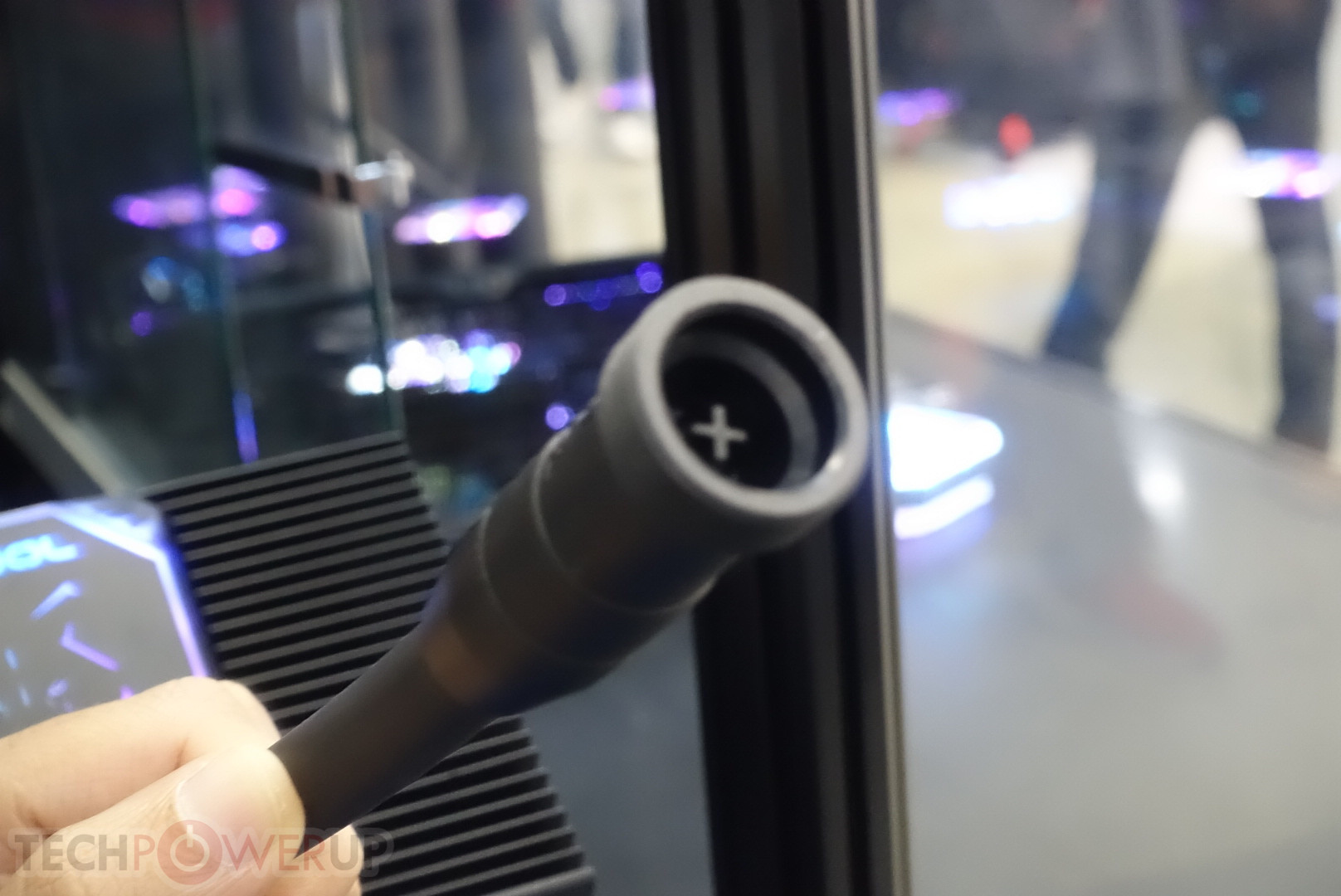
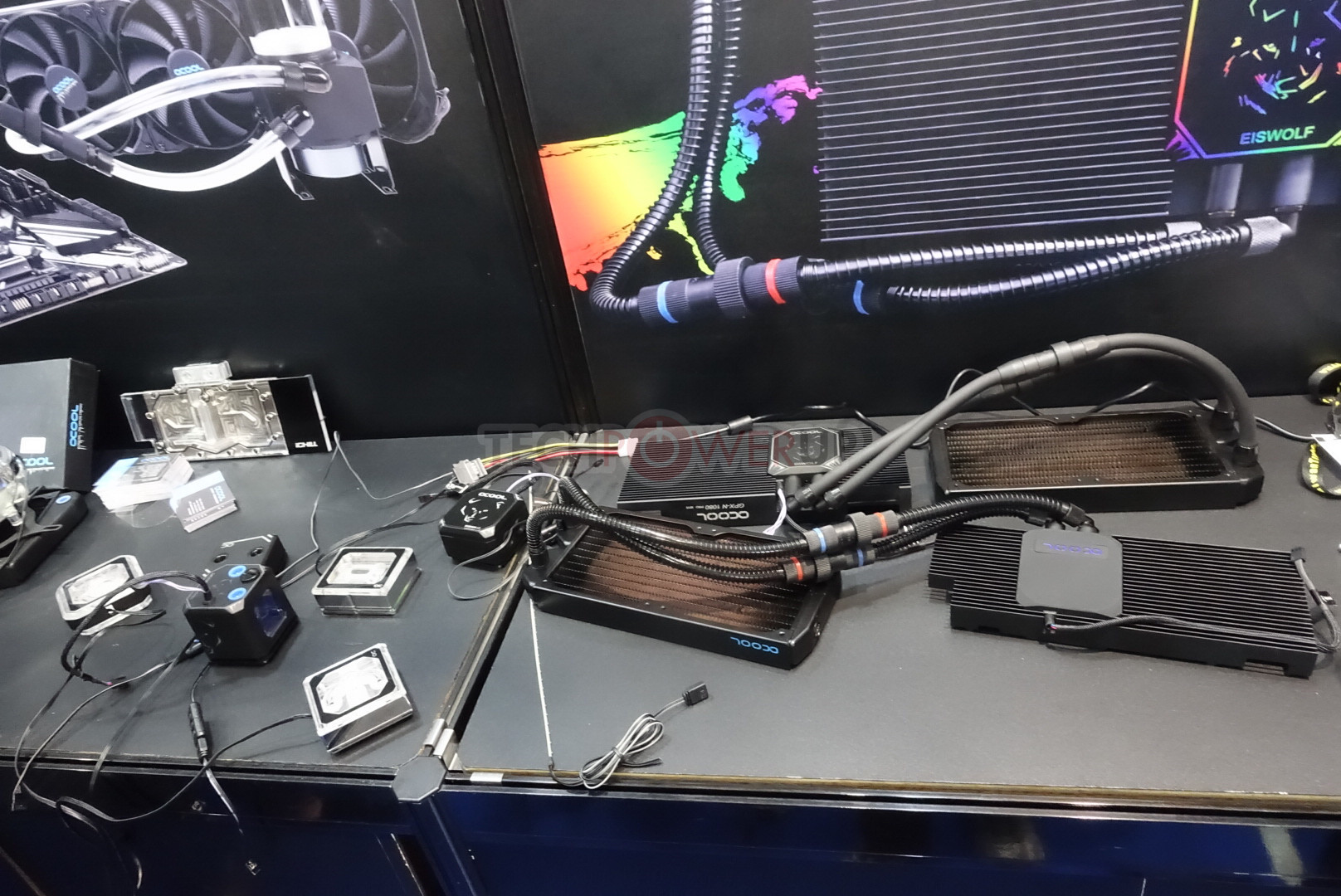
Intel Xe GPUs to Support Raytracing Hardware Acceleration

Intel's upcoming Xe discrete GPUs will feature hardware-acceleration for real-time raytracing, similar to NVIDIA's "Turing" RTX chips, according to a company blog detailing how the company's Rendering Framework will work with the upcoming Xe architecture. The blog only mentions that the company's data-center GPUs support the feature, and not whether its client-segment ones do. The data-center Xe GPUs are targeted at cloud-based gaming service and cloud-computing providers, as well as those building large rendering farms.

"I'm pleased to share today that the Intel Xe architecture roadmap for data center optimized rendering includes ray tracing hardware acceleration support for the Intel Rendering Framework family of API's and libraries," said Jim Jeffers, Sr. Principal Engineer and Sr. Director of Intel's Advanced Rendering and Visualization team. Intel did not go into technical details of the hardware itself. NVIDIA demonstrated that you need two major components on a modern GPU to achieve real-time raytracing: 1. a fixed-function hardware that computes intersection of rays with triangles or surfaces (which in NVIDIA's case are the RT cores), and 2. an "inexpensive" de-noiser. NVIDIA took the AI route to achieve the latter, by deploying tensor cores (matrix-multiplication units), which accelerate AI DNN building and training. Both these tasks are achievable without fixed-function hardware, using programmable unified shaders, but at great performance cost. Intel developed a CPU-based de-noiser that can leverage AVX-512.

Apple to Pay Qualcomm Up To $4.7 Billion in Licensing Fee Arrears

Qualcomm in its quarterly earnings results posted late Wednesday disclosed that it expects Apple to pay it anywhere between USD $4.5 billion to $4.7 billion in licensing fee arrears incurred over the past two years when the two companies were locked in a bitter wireless technology IP licensing dispute. This figure, however, is significantly less than the $7 billion Qualcomm earlier claimed Apple owed. Apple had alleged that Qualcomm unfairly used its market position to inflate costs of cellular modems, and had withheld payments since Q2 2017. Qualcomm's investors are interested in knowing how the two companies arrived at $4.5 billion to $4.7 billion, particularly if Apple scored a discount as part of the settlement.

Corsair Unveils Carbide 175R RGB Mid-tower Case

Corsair updated its entry-level case lineup with the new Carbide 175R RGB (model: CC-9011171-WW). Positioned between its popular 100R and 275R cases and priced at USD $60, the 175R brings many of the features found on a higher priced segment to this one, such as RGB LED embellishments, a faux brushed-metal facade, and a fully enclosed bottom compartment. The front features an RGB LED illuminated company logo with intakes positioned along the top and bottom edges. One of the case's three 120 mm front intakes has a factory-fitted 120 mm fan with RGB LED illumination. Two 140/120 mm top exhausts, and a rear 120 mm exhaust make for the rest of the ventilation.

The left side panel is tempered glass with a dark tint. Inside, the Corsair Carbide 175R RGB features a conventional horizontally partitioned layout with a complete enclosure of the bottom compartment. Storage areas include two 3.5-inch/2.5-inch bays, and two 2.5-inch mounts behind the motherboard tray. Front-panel connectivity includes two USB 3.0 ports (standard header) and a HDA audio combi-jack. Corsair includes dust filters for the top vents and PSU intake. The front panel logo and included fan support 3-pin addressable-RGB input letting you plug them directly to your motherboard for software control.

Patriot Launches New Signature Premium DDR4 Memory

PATRIOT , a global leader in performance memory, SSDs, gaming peripherals, and flash storage solutions, today has announced the release of their latest Signature Premium series line of DDR4 UDIMM memory, which are Non-ECC unbuffered memory designed to deliver outstanding quality, rock solid stability and great performance expected by today's mainstream PC builder.

Signature Premium DDR4 memory provides a wide range of capacities allowing the builder to choose from a variety of speeds and capacities starting with 4GB single modules up to 32GB dual channel kits. The minimalist heat spreader design offers great heat dissipation and is made from high-purity aluminum. Signature Premium DDR4 series modules offer reliability to those who upgrade or build systems for work or business and are cost effective too.

Valve Officially Launches the Valve Index VR HMD, Full Kit Preorder Up for $999

We knew this was coming, given Valve's own teaser confirmation from March, and then a faux pas that resulted in an incomplete Steam store page ending up public for a short time. Valve had promised more details would come in May, and here we are with a lot of information available about the Valve Index headset, the controllers, the base stations, as well as retail pricing + availability.

Name aside, the Valve Index specs that leaked before end up holding true with the retail product. The headset uses dual 1440x1600 RGB LCDs which Valve claims helps provide 50% more subpixels relative to an OLED display. This in turn should result in higher effective sharpness for the same rendering horsepower, and is further accentuated via a 3x better fill factor to mitigate the dreaded screen-door effect. The headset runs at 120 Hz with full backwards compatibility to 90 Hz to work with VR titles built around that specification and, more interestingly, also supports an experimental 144 Hz mode. PC gamers have long known the benefits of higher framerates, and this is especially valid with VR, but time will tell how the rest of the ecosystem works around this. Equally important to VR gaming is the illumination period, which allows on-screen imagery to remain sharp while you are in motion just as well as when at rest. Valve claims up to a 5x reduction here, with a rated illumination period of 0.33 to 0.53 ms depending on the real time framerate. More to see past the break, so be sure to do so if this interests you!

Intel, AMD, and HTC Partner to Resolve Vive Wireless Adapter Compatibility Issue with Ryzen Processors

The headline of this post makes it seem a touch more innocuous than the story may lead to, at least if you believe the rumor mills abound. There has been an ongoing issue with AMD systems using Ryzen CPUs and the HTC Vive wireless adapter (powered by Intel WiGig) to where the systems have frozen or even had a BSOD. HTC acknowledged this as early as Nov, 2018, noting that they have seen this with a subset of Ryzen-based motherboards when the PCIe wireless adapter is installed and running. It took until last week to get a solution of sorts, and unfortunately reports from users indicate this is not a true fix for everyone.

The hotfix update 1.20190410.0 was made available April 25 to attempt to combat this issue, which was garnering a lot of attention in the VR-community on whether there was more Intel could be doing to help AMD customers. This hotfix update is available automatically once an end user with the Vive wireless adapter checks for an update, and HTC acknowledge that they continue to test this, as well as partner with Intel and AMD to help resolve this once and for all. In the meantime, users report mixed success to date, including some we know personally as well, and it remains a thorn in the side of wireless VR to get to the PC successfully.

Apple Reports Second Quarter Results: Services Revenues Reach $11.5 Billion

Apple today announced financial results for its fiscal 2019 second quarter ended March 30, 2019. The Company posted quarterly revenue of $58 billion, a decline of 5 percent from the year-ago quarter, and quarterly earnings per diluted share of $2.46, down 10 percent. International sales accounted for 61 percent of the quarter's revenue.

"Our March quarter results show the continued strength of our installed base of over 1.4 billion active devices, as we set an all-time record for Services, and the strong momentum of our Wearables, Home and Accessories category, which set a new March quarter record," said Tim Cook, Apple's CEO. "We delivered our strongest iPad growth in six years, and we are as excited as ever about our pipeline of innovative hardware, software and services. We're looking forward to sharing more with developers and customers at Apple's 30th annual Worldwide Developers Conference in June."
Nov 28th, 2026 13:43 CST change timezone

New Forum Posts

Popular Reviews

TPU on YouTube

Controversial News Posts